


 |
市場調查報告書
商品編碼
2119635
印度沉澱二氧化矽:市場佔有率分析、產業趨勢與統計、成長預測(2026-2031)India Precipitated Silica - Market Share Analysis, Industry Trends & Statistics, Growth Forecasts (2026 - 2031) |
||||||

※ 本網頁內容可能與最新版本有所差異。詳細情況請與我們聯繫。
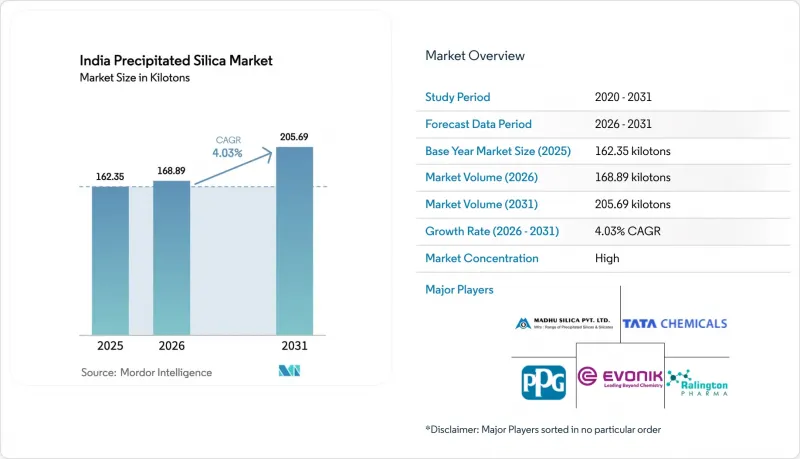
據 Mordor Intelligence 稱,2025 年印度沉澱二氧化矽市場價值為 162.35 千噸,預計到 2031 年將達到 205.69 千噸,而 2026 年為 168.89 千噸,預測期(2026-2031 年)複合年成長率為 4.03%。
本報告按最終用戶行業(農業、口腔護理/化妝品、殺蟲劑、輪胎、電子產品等)、製造程序(濕法工藝、乾法工藝)、產品形式(粉末、珠子、微珠、顆粒)、等級(用於橡膠、食品、牙科/口腔護理、飼料飼料等)和地區(印度北部、印度西部、印度南部、印度東部和印度東北部)進行分類。
印度沉澱二氧化矽市場趨勢及洞察。
國內OEM橡膠產業對輪胎用二氧化矽的需求
為了滿足日益嚴格的燃油效率和排放氣體法規,國內輪胎製造商正在採用更高二氧化矽含量的輪胎,這使得沉澱二氧化矽不再僅僅被視為一種通用原料,而是成為提升輪胎性能的關鍵添加劑。 CEAT公司將其非公路輪胎部門的日產量從105噸提高到160噸,並設定了出口佔銷售額25%的目標,這表明擴大生產規模和實現全球多元化正在增強市場需求的韌性。 2020年的進口限制措施將部分輪胎類別從“自由進口”重新分類為“限制進口”,導致海外進口量減少了80%以上,有效地將二氧化矽需求引導至國內供應鏈。 SUV銷量的成長和子午線輪胎的普及導致輪胎尺寸增大,二氧化矽用量增加,進一步刺激了市場需求。印度沉澱二氧化矽市場正從中直接受益,因為高性能配方提供了定價空間,使製造商即使在原料價格波動的情況下也能維持利潤率。這些相互關聯的汽車行業趨勢導致了多年來一系列穩定的需求,並逐步提高了對特種橡膠等級的需求。
主要快速消費品公司迅速轉向低揮發性有機化合物(VOC)牙膏
日常消費品(FMCG)公司正在改進其口腔護理產品配方,以去除揮發性有機溶劑,並推廣使用沉澱二氧化矽作為研磨劑和流變改性劑。高露潔棕欖印度公司計劃將其高階產品線的銷售額提高兩倍,該細分市場的利潤率為5-8個百分點,並強制要求使用二氧化矽等級的產品以改善美白效果和口腔感受。農村地區的衛生習慣仍然較差,只有20%的都市區消費者每天刷牙兩次,這顯示隨著人們衛生意識的提高,銷售量尚未充分挖掘。沉澱二氧化矽已被印度標準局(BIS)標準IS 6356:2001正式列為認可的研磨劑,這為配方設計人員提供了監管方面的確定性。將優質化與合規性相結合,即使不考慮其對化妝品和個人護理行業的連鎖反應,也正在為印度沉澱二氧化矽市場創造新的價值來源。
對矽酸鈉廢水排放標準更加嚴格。
隨著液體排放的監管力道加大,佔國內產能70%以上的濕式加工設施的資本要求也日益嚴格。中央污染控制委員會(CPCB)的指導方針草案要求在整個二氧化矽價值鏈中實施零液體排放系統、粉塵控制和水循環利用,這增加了合規成本。 2024年5月,Akshalchem公司位於古吉拉突邦的工廠發生火災,凸顯了現代化改造過程中面臨的營運脆弱性。資金有限的小型製造商可能會退出市場或推遲設備升級,導致生產集中在符合法規的大型製造商手中。因此,印度沉澱二氧化矽市場正面臨短期供應緊張的局面,這加劇了競爭壁壘,並在一定程度上抵消了需求的成長。
細分市場分析
到2025年,輪胎產業將佔印度沉澱二氧化矽市場佔有率的36.30%,反映出汽車產業在填料需求方面扮演著舉足輕重的角色。由於整車製造商(OEM)採用二氧化矽增強複合材料來滿足滾動阻力目標和排放氣體標準,市場需求依然強勁。同時,口腔護理和化妝品產業雖然基數較小,但預計到2031年將維持5.12%的複合年成長率,顯示日常消費品正朝著多元化和優質化發展。
輪胎製造商正朝著區域化生產方向發展。 CEAT面向出口的產能擴張計劃以及Apollo新建非公路輪胎工廠的建設計畫,凸顯了本土品牌的全球定位。同時,農業化學品製造商正在採用沉澱二氧化矽以符合可濕性粉劑的相關法規,從而創造了不受汽車市場波動影響的輔助需求。電子產業的應用案例雖然仍處於起步階段,但與印度的半導體和電池相關項目相契合,預示著未來對高純度產品的需求可能增加。這種多元化的應用情境正推動印度沉澱二氧化矽市場朝向專業化產品線發展,進而降低單一終端用途所帶來的風險集中度。
即使到了2025年,濕式製程仍將維持71.80%的市佔率。這是因為運作中製程的設備具有成本遞減的優勢,並且已被廣泛應用於各種配方中。然而,由於環境法規和用水限制,乾法製程的複合年成長率正在加速至4.19%,這表明生產過程正逐步轉向廢水排放量較低的製程。
濕式製程生產商正在維修其廢水處理設施以符合更嚴格的法規,這可能會增加每噸資本支出 (CAPEX),並削弱其成本優勢。採用乾式工藝的公司則透過強調節能和更高的形狀控制精度,在口腔護理和微珠等細分市場中贏得了支持。在整個預測期內,印度沉澱二氧化矽市場預計將繼續保持共存狀態,濕式製程將滿足大批量、價格敏感的橡膠應用需求,而乾式製程將服務於特種和出口導向市場。
其他好處:
- Excel格式的市場預測(ME)表
- 3個月的分析師支持
目錄
第1章:引言
- 研究假設和市場定義
- 調查範圍
第2章:調查方法
第3章執行摘要
第4章 市場狀況
- 市場概覽
- 市場促進因素
- 國內OEM橡膠產業對輪胎用二氧化矽的需求
- 主要日常消費品製造商迅速轉向低VOC牙膏
- 政府扶持太陽能玻璃製造廠(待開發區)
- 遵守BIS濕粉農藥標準的義務
- 新創公司主導的二氧化矽基電池負極材料研發;
- 市場限制因素
- 對矽酸鈉廢水排放標準更加嚴格。
- 堿灰價格波動
- 低價中國製造等級產品的進口滲透率
- 價值鏈分析
- 波特五力模型
第5章 市場規模與成長預測
- 按最終用戶行業分類
- 農業
- 口腔護理和化妝品
- 農業化學品
- 胎
- 電子設備
- 其他終端用戶產業
- 透過生產過程
- 濕式工藝
- 乾法工藝
- 按產品形式
- 粉末
- 珠
- 微珠
- 顆粒
- 按年級
- 橡膠級
- 食品級
- 牙科和口腔清潔用品等級
- 飼料級
- 其他(電池隔膜級、技術級、工業級)
第6章 競爭情勢
- 市場集中度
- 策略趨勢
- 市佔率** / 排名分析
- 公司簡介
- AksharChem(India)Ltd.
- Evonik Industries AG
- Gujarat Multi Gas Base Chemicals
- Huber Engineered Materials
- JAY DINESH CHEMICALS
- Madhu Silica Pvt. Ltd.
- MLA Group of Industries
- PCIPL
- PPG Industries Inc.
- Ralington Pharma
- Regoj Chemical Industries
- Solvay SA
- Supersil Chemicals(I)Pvt. Ltd.
- Tata Chemicals Ltd.
- Tirupati Chemical Corporation
- Wacker Chemie AG
第7章 市場機會與未來展望
According to Mordor Intelligence, the India precipitated silica market size was valued at 162.35 kilotons in 2025 and estimated to grow from 168.89 kilotons in 2026 to reach 205.69 kilotons by 2031, at a CAGR of 4.03% during the forecast period (2026-2031).
This report is Segmented by End-User Industry (Agriculture, Oral Care and Cosmetics, Agrochemicals, Tire, Electronics, and More), Production Process (Wet-Process, Dry-Process), Product Form (Powder, Beads, Micro-Pearls, Granules), Grade (Rubber Grade, Food Grade, Dental/Oral-Care Grade, Feed Grade, Others), and Geography (North India, West India, South India, East and North-East India).
India Precipitated Silica Market Trends and Insights
Tyre-Grade Silica Demand from Domestic OEM-Focused Rubber Industry
Domestic tire manufacturers now integrate higher silica loadings to meet stringent fuel-efficiency and emission norms, positioning precipitated silica as a performance-critical additive rather than a commodity input. CEAT's ramp-up from 105 tons per day to 160 tons per day in its off-highway tire unit, along with its 25% export revenue target, illustrates how scale and global diversification underpin demand resilience. Import restrictions that reclassified several tire categories from "Free" to "Restricted" in 2020 cut foreign inflows by more than 80%, effectively channeling silica demand to domestic supply chains. Growing SUV sales and the radialization wave translate into larger tire dimensions and greater silica dosage, further anchoring consumption. The India precipitated silica market benefits directly as high-performance mixes offer pricing latitude that preserves manufacturer margins amid feedstock volatility. These interlinked automotive trends provide a multi-year volume corridor sustaining a progressive upswing in specialty rubber grades.
Rapid Shift Toward Low-VOC Toothpastes by FMCG Majors
FMCG players are reformulating oral-care lines to eliminate volatile organic solvents, incentivizing the use of precipitated silica as both an abrasive and rheology modifier. Colgate Palmolive India aims to triple premium-segment revenues, where margins are 5-8 percentage points higher, and mandates silica grades that deliver enhanced whitening and mouth-feel properties. Rural hygiene penetration remains low, with only 20% of urban consumers brushing their teeth twice daily, indicating untapped volume upside as awareness increases. BIS standard IS 6356:2001 formally lists precipitated silica among accepted polishing agents, providing regulatory certainty for formulators. Combining premiumization and compliance unlocks a new value pool for the India precipitated silica market, even before considering spillovers into cosmetics and personal-care categories.
Tightening Effluent Norms on Sodium Silicate Effluents
Regulatory scrutiny over liquid discharges is escalating capital requirements for wet-process units, which account for more than 70% of domestic capacity. Draft CPCB guidelines mandate zero-liquid-discharge systems, dust suppression, and water recycling across the silica value chain, inflating compliance costs. The May 2024 fire at Aksharchem's Gujarat plant illustrates operational vulnerabilities faced during modernization. Smaller players lacking financial muscle may exit or delay upgrades, consolidating volume among large, compliant manufacturers. The India precipitated silica market, therefore, navigates a near-term supply tightening that offsets part of the demand gains while reinforcing competitive barriers.
Other drivers and restraints analyzed in the detailed report include:
- Government Push for Solar PV Glass Fabs (Greenfield)
- Mandatory BIS Compliance for Agrochemical Wettable Powders
- Import Penetration of Low-Cost Chinese Grades
For complete list of drivers and restraints, kindly check the Table Of Contents.
Segment Analysis
The tire segment captured 36.30% of the India precipitated silica market share in 2025, reflecting the automotive sector's entrenched role in filler demand. Volume visibility remains high as OEMs integrate silica-reinforced compounds to hit rolling-resistance targets and emission standards. Concurrently, oral care and cosmetics, while having a smaller base, are forecast to post a 5.12% CAGR through 2031, evidencing diversification and premiumization in fast-moving consumer goods.
Tire-makers are regionalizing production; CEAT's export-oriented capacity expansion and Apollo's plans for greenfield off-the-road units highlight the global positioning of domestic brands. Meanwhile, agrochemical formulators adopt precipitated silica for wettable powder compliance, creating ancillary demand insulated from automotive swings. Electronics applications, though nascent, align with national semiconductor and battery programs, hinting at future pull for high-purity grades. This mosaic of use-cases nudges the India precipitated silica market toward specialized product lines, mitigating risk concentration in a single end-use.
Wet-process technology retained 71.80% dominance in 2025 as installed units leverage sunk costs and broad formulation acceptance. Yet environmental mandates and water-usage restrictions accelerate the dry-process CAGR to 4.19%, signaling gradual realignment toward lower-effluent routes.
Wet-process producers are retrofitting effluent-treatment plants to comply with tightened norms, which lifts capex per ton and may erode cost advantages. Dry-process adopters pitch energy savings and tighter morphology control, finding traction in oral-care and micro-pearl niches. Over the forecast horizon, the India precipitated silica market expects coexistence: wet processes serving large-volume, price-sensitive rubber applications, and dry processes capturing specialty and export-oriented segments.
Complete Report Scope:
- By End-user Industry
- Agriculture
- Oral Care and Cosmetics
- Agrochemicals
- Tire
- Electronics
- Other End-User Industries
- By Production Process
- Wet-Process
- Dry-Process
- By Product Form
- Powder
- Beads
- Micro-pearls
- Granules
- By Grade
- Rubber Grade
- Food Grade
- Dental/Oral-Care Grade
- Feed Grade
- Others (Battery-Separator Grade, Technical/Industrial Grade)
List of Companies Covered in this Report:
- AksharChem (India) Ltd.
- Evonik Industries AG
- Gujarat Multi Gas Base Chemicals
- Huber Engineered Materials
- JAY DINESH CHEMICALS
- Madhu Silica Pvt. Ltd.
- MLA Group of Industries
- PCIPL
- PPG Industries Inc.
- Ralington Pharma
- Regoj Chemical Industries
- Solvay SA
- Supersil Chemicals (I) Pvt. Ltd.
- Tata Chemicals Ltd.
- Tirupati Chemical Corporation
- Wacker Chemie AG
Additional Benefits:
- The market estimate (ME) sheet in Excel format
- 3 months of analyst support
TABLE OF CONTENTS
1 Introduction
- 1.1 Study Assumptions and Market Definition
- 1.2 Scope of the Study
2 Research Methodology
3 Executive Summary
4 Market Landscape
- 4.1 Market Overview
- 4.2 Market Drivers
- 4.2.1 Tyre-grade silica demand from domestic OEM-focused rubber industry
- 4.2.2 Rapid shift toward low-VOC toothpastes by FMCG majors
- 4.2.3 Government push for solar PV glass fabs (greenfield)
- 4.2.4 Mandatory BIS compliance for agrochemical wettable powders
- 4.2.5 Start-up led silica-based battery anode R&D
- 4.3 Market Restraints
- 4.3.1 Tightening effluent norms on sodium silicate effluents
- 4.3.2 Volatility in soda-ash prices
- 4.3.3 Import penetration of low-cost Chinese grades
- 4.4 Value Chain Analysis
- 4.5 Porter's Five Forces
- 4.5.1 Bargaining Power of Suppliers
- 4.5.2 Bargaining Power of Buyers
- 4.5.3 Threat of New Entrants
- 4.5.4 Threat of Substitutes
- 4.5.5 Degree of Competition
5 Market Size and Growth Forecasts (Volume)
- 5.1 By End-user Industry
- 5.1.1 Agriculture
- 5.1.2 Oral Care and Cosmetics
- 5.1.3 Agrochemicals
- 5.1.4 Tire
- 5.1.5 Electronics
- 5.1.6 Other End-User Industries
- 5.2 By Production Process
- 5.2.1 Wet-Process
- 5.2.2 Dry-Process
- 5.3 By Product Form
- 5.3.1 Powder
- 5.3.2 Beads
- 5.3.3 Micro-pearls
- 5.3.4 Granules
- 5.4 By Grade
- 5.4.1 Rubber Grade
- 5.4.2 Food Grade
- 5.4.3 Dental/Oral-Care Grade
- 5.4.4 Feed Grade
- 5.4.5 Others (Battery-Separator Grade, Technical/Industrial Grade)
6 Competitive Landscape
- 6.1 Market Concentration
- 6.2 Strategic Moves
- 6.3 Market Share**/Ranking Analysis
- 6.4 Company Profiles (includes Global level Overview, Market level overview, Core Segments, Financials as available, Strategic Information, Market Rank/Share for key companies, Products and Services, and Recent Developments)
- 6.4.1 AksharChem (India) Ltd.
- 6.4.2 Evonik Industries AG
- 6.4.3 Gujarat Multi Gas Base Chemicals
- 6.4.4 Huber Engineered Materials
- 6.4.5 JAY DINESH CHEMICALS
- 6.4.6 Madhu Silica Pvt. Ltd.
- 6.4.7 MLA Group of Industries
- 6.4.8 PCIPL
- 6.4.9 PPG Industries Inc.
- 6.4.10 Ralington Pharma
- 6.4.11 Regoj Chemical Industries
- 6.4.12 Solvay SA
- 6.4.13 Supersil Chemicals (I) Pvt. Ltd.
- 6.4.14 Tata Chemicals Ltd.
- 6.4.15 Tirupati Chemical Corporation
- 6.4.16 Wacker Chemie AG
7 Market Opportunities and Future Outlook
- 7.1 White-space and Unmet-need Assessment

 沉澱二氧化矽:市場佔有率分析、產業趨勢與統計、成長預測(2026-2031)
 沉澱二氧化矽市場-2026-2032年全球市場預測
 沉澱二氧化矽市場規模、佔有率、成長、全球產業分析、區域洞察及2026-2034年預測。
 全球沉澱二氧化矽市場:市場規模、佔有率和趨勢分析(按應用和地區分類),細分市場預測(2026-2033 年)
 2026年全球沉澱二氧化矽市場報告
 沉澱二氧化矽市場規模、佔有率及成長分析(按應用、最終用戶及地區分類)-2026-2033年產業預測
 2032 年沈澱二氧化矽市場預測:按等級、形式、製造流程、來源、應用、最終用戶和地區進行的全球分析
 沉澱二氧化矽市場機會、成長動力、產業趨勢分析及2025-2034年預測
 全球沉澱二氧化矽市場(至 2030 年)按應用(橡膠、食品、塑膠、電池隔膜、其他)、最終用戶產業(汽車、化妝品、電子、農業)、等級(橡膠、食品、工業、化妝品)和地區分類