


 |
市場調查報告書
商品編碼
2119393
碳回收溶劑、吸附劑和薄膜:市場佔有率分析、行業趨勢和統計數據以及成長預測(2026-2031 年)Carbon Capture Solvents, Sorbents, and Membranes - Market Share Analysis, Industry Trends & Statistics, Growth Forecasts (2026 - 2031) |
||||||

※ 本網頁內容可能與最新版本有所差異。詳細情況請與我們聯繫。
據 Mordor Intelligence 稱,碳捕獲溶劑、吸附劑和薄膜的市場規模在 2025 年估計為 48.6 億美元,預計到 2031 年將從 2026 年的 54.1 億美元成長到 100.4 億美元,2026 年至 2031 年的複合年成長率為 13.16%。
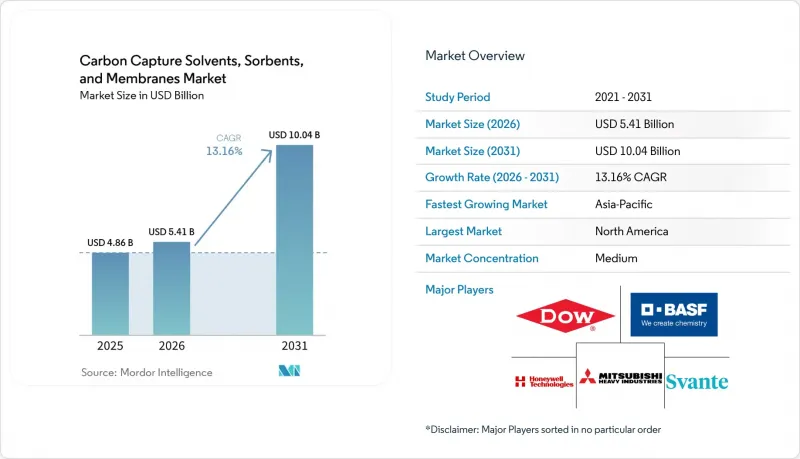
本報告材料類型(溶劑等)、溶劑類型(離子液體等)、吸附劑類型(沸石等)、膜類型(聚合物膜等)、回收方法(直接常壓回收等)、終端用戶產業(水泥等)和地區(亞太地區、北美地區等)進行細分。市場預測以美元計價。
全球碳捕集溶劑、吸附劑及膜市場趨勢及洞察
工業脫碳義務和碳定價
碳定價使得高排放企業在選擇碳捕集材料時直接承擔採購決策。隨著鋼鐵、水泥和鋁業的免費配額計畫於2034年逐步取消,未能減少排放的企業將面臨成本增加。美國的「45Q」框架維持工業點源碳捕集每噸85美元和直接空氣捕集每噸180美元的碳權額度。此外,碳封存和提高採收率管理的統一化,擴大了溶劑供應商可承接的專案範圍。這些變化正在推動碳捕集溶劑、吸附劑和膜市場的需求,而合規成本和投資決策之間的連結也日益緊密。
擴大碳捕獲計畫儲備
至2025年,將有超過42個碳捕集項目運作,使全球二氧化碳捕集與儲存(CCS)年產能提高25%,從而帶動碳捕集溶劑、吸附劑和膜材料的市場發展。已公佈的650多個項目計劃於2026年至2030年間投入運作,形成一個多年期的碳捕集設備和材料採購管道。然而,全球計畫數量仍低於國際能源總署(IEA)淨零排放情境所需的產能,存在著尚未滿足的部署需求。 「北極光」二期計畫於2025年3月做出最終投資決定(FID),旨在2028年將挪威的近海碳儲存能力擴大到每年500萬噸。這類運輸和儲存項目為工業設施處理捕獲的二氧化碳提供了更清晰的途徑。由於專案開發商通常在製程設計的早期階段就選擇材料,並在設施投入運作前簽署供應契約,因此碳捕集溶劑、吸附劑和薄膜材料的市場也從中受益。
溶劑再生過程中的能量損失
在碳捕集溶劑、吸附劑和薄膜的市場中,熱再生溶劑所需的能量仍然是一個需要考慮的項目因素。許多工業設施缺乏足夠的100 度C至140 度C範圍內的低品位熱能,而熱汽提是實現這一目標所必需的。在典型的單一乙醇胺濃度下,這種能量需求會使主發電廠的發電量降低20%至30%。一項2025年的研究報告指出,一種無需薄膜的電化學介導胺再生系統,在每莫耳二氧化碳僅消耗60千焦耳能量的情況下,實現了超過90%的二氧化碳去除率。熱泵整合也是一種部分解決方案。阿邁厄-巴克的一項示範實驗表明,熱泵整合滿足了回收所需熱量的78.3%。在這些方案廣泛商業化之前,對於熱整合方案有限的設施而言,碳捕集溶劑、吸附劑和薄膜的市場推廣速度可能會較為緩慢。
細分市場分析
截至2025年,溶劑在碳捕集溶劑、吸附劑和膜市場中佔42.34%。這一地位反映了該公司在發電和油氣加工領域液態胺吸收法方面豐富的營運經驗。成熟的供應鏈和完善的維護規範降低了開發商的實施風險。預計到2031年,固體吸附劑的複合年成長率將達到15.34%,是所有材料類別中成長最快的。 2025年5月,Svante公司在加拿大不列顛哥倫比亞省開設了一座價值1.5億美元的固體吸附劑過濾器工廠。該廠的產能目標是每年二氧化碳捕集。該工廠的投產表明,結構化吸附劑的生產已經超越了中試階段。產量的增加也提高了開發商在長期運作內更換過濾器時的採購計畫的可預測性。這讓專案發起人確信,他們能夠可靠地為大規模工業設施採購到足夠數量的先進吸附劑。
在低二氧化碳濃度下,溶劑仍然有效,尤其是在天然氣發電廠廢氣中,二氧化碳濃度低於5%。然而,當氣流中二氧化碳濃度在12%至15%之間時,例如在水泥、鋼鐵和乙醇等應用中,吸附劑和薄膜材料更具競爭力。這種差異表明,這些材料類別不能直接互換。對於排放目標具有挑戰性的新規劃項目,應優先選擇適用於高濃度工業氣流和特定場地熱工條件的材料。膜材料和其他材料佔據了碳捕集溶劑、吸附劑和膜材料行業的剩餘佔有率。隨著小規模模組化應用規模擴大到每年數萬噸,它們的使用量也不斷增加。因此,供應商的策略著重於氣流的化學性質和每個場地的運作條件。在蒸氣供應有限的場地,即使習慣使用液體溶劑,吸附劑和膜材料也可能是更優的選擇。反之,對於已經存在胺基基礎設施的地方,溶劑升級可能比徹底的技術變革更實用。
截至2025年,胺類溶劑佔溶劑類型細分市場的70.21%。這一佔有率反映了胺類溶劑的商業性成熟度以及現有吸收器和剝線鉗設備的設計與其運作特性相符。胺類系統還具有許多優勢,例如完善的維護程序和廣泛認可的法規遵循途徑。 CESAR1是一種由3 M 2-氨基-2-甲基-1-丙醇(AMP)和1.5 MPiperazine組成的混合物,其再沸器負荷為每公斤二氧化碳3.0-3.5兆焦耳,而傳統單乙醇胺系統的再沸器負荷為每公斤二氧化碳3.5-4.2兆焦耳。物理溶劑用於高壓燃燒預處理和天然氣流,這些應用場景的熱再生要求相對較低。由於物理溶劑需適應特定的供應條件,因此其應用範圍有限。這種差異至關重要,因為較低的再生負荷優勢並非總能抵消供應商在所有設施中對操作的熟悉程度。開發人員通常會權衡總整合成本、溶劑處理要求以及主機資產的預期壽命。
預計到2031年,離子液體的複合年成長率將達到14.23%。其極低的蒸氣壓、熱穩定性以及對二氧化碳可調控的親和性使其適用於低能耗能源回收設計。一項2025年發表的同行評審研究表明,與單乙醇胺相比,低含水量的離子液體吸收劑可減少20%至50%的可再生能源消耗。然而,高黏度仍然會影響大規模系統中的質傳和泵浦效率。封裝和負載型離子液體膜設計旨在解決此限制。對於傳統胺類可能分解的高溫流體,碳酸鹽-鹼類溶劑和深共熔溶劑也正在被考慮。這些溶劑非常重要,因為它們為操作人員提供了一種替代方案,以應對廢氣污染物或溫度變化導致傳統溶劑壽命縮短的情況。即使實驗室性能良好,選擇過程仍取決於特定現場情況,因為流體輸送、防腐蝕或維護等方面的需求始終存在。
區域分析
到2025年,北美將佔碳捕集溶劑、吸附劑和膜市場36.34%的佔有率。該地區擁有大規模的工業排放源,並具備完善的碳捕集政策架構。美國的「45Q」框架支持工業點源和直接空氣捕集(DAC)計畫。預計美國的碳捕集能力將從2024年的每年2,200萬噸增加到2030年的每年1.76億噸。 Svante公司位於不列顛哥倫比亞省的工廠也在加強其在該地區固體吸附劑的供應鏈。加拿大透過其碳權計劃和亞伯達的碳封存中心支持這一成長。在墨西哥,煉油和石化產業正在湧現新的機會。該地區的業務規模將取決於能否獲得儲存設施、授權的進展以及各個項目能否獲得稅額扣抵合格。這些因素使北美成為主要的需求中心,但預計不同項目的材料選擇仍將有所差異。
預計到2031年,亞太地區的年複合成長率將達到14.94%。日本計劃在2035年將其碳捕獲、利用與儲存(CCUS)能力從每年30萬噸擴大到約1250萬噸,其中許多項目依賴跨國儲存協議。中國是二氧化碳捕集探勘領域的領先國家,正透過胺捕獲和氧燃燒設施向公用事業規模項目邁進。印度、韓國和東南亞國協正在為未來的部署奠定政策基礎。韓國和新加坡已展現出相對較好的政策準備。該地區龐大的工業基礎為適用於當地燃料和原料條件的材料提供了廣泛而長期的機會。跨境儲存計畫可能會增加在運輸和注入前對二氧化碳規格進行標準化的需求。這項要求凸顯了能夠提供可預測純度和高去除率的捕捉系統的重要性。
歐洲的碳定價機制和儲存基礎設施持續支撐著對回收材料的需求。歐盟排放交易體系(EU ETS)2025年的平均價格為每噸二氧化碳73.43歐元,而檢驗排放量較去年同期下降1.3%。歐盟委員會指出,溶劑、壓縮機和塔器是實現其2030年每年5,000萬噸儲存目標的供應鏈挑戰。荷蘭、挪威和英國正在建造大型叢集和儲存項目。南美洲、中東和非洲的市場規模仍然小規模,但蘊藏著獨特的機會。巴西和阿根廷擁有高濃度乙醇和生質燃料資源,而中東的油氣相關回收計畫也正穩步推進。這些地區在需求成長之前需要進一步擴大運輸和儲存基礎設施。由於高濃度資源的回收成本通常更容易控制,因此在這些項目中,高濃度資源可能更受青睞。為早期乙醇、生質燃料、石油和天然氣應用提供支援的材料供應商,或許能夠在大規模基礎設施網路建成之前就確立市場地位。
其他好處:
- Excel格式的市場預測(ME)表
- 3個月的分析師支持
目錄
第1章:引言
- 研究假設和市場定義
- 調查範圍
- 材料、技術和應用範圍
- 收集材料與收集系統之間的價值鏈邊界
第2章:調查方法
第3章執行摘要
第4章 市場狀況
- 市場概覽
- 市場促進因素
- 與工業脫碳相關的法規和碳定價
- 擴大碳捕獲計畫儲備
- 低再生能源消耗材料的需求
- 碳利用和永久移除的經濟學
- 水泥、鋼鐵和煉油廠的維修需求。
- 廢熱與低碳氫化合物的整合
- 市場限制因素
- 溶劑再生過程中能量損失的影響
- 引進首台設備成本高昂
- 碳運輸和儲存基礎設施有限
- 材料劣化、污垢和對污染物的敏感性
- 價值鏈分析
- 波特五力分析
第5章 市場規模與成長預測
- 依材料類型
- 溶劑
- 固體吸附劑
- 電影
- 其他
- 依溶劑類型
- 胺類溶劑
- 物理溶劑
- 離子液體
- 其他(碳酸鹽和鹼性溶劑、深共熔溶劑)
- 吸附劑類型
- 活性碳
- 沸石
- 金屬有機框架(MOFs)
- 其他(胺官能化二氧化矽、金屬氧化物、活性氧化鋁)
- 依膜類型
- 聚合物薄膜
- 混合基質膜
- 陶瓷膜
- 其他(易化轉運膜、中空纖維膜)
- 收集方法
- 燃燒後的回收
- 燃燒前回收
- 直接大氣恢復
- 其他方法(氧燃料燃燒法、工業製程回收法)
- 按最終用戶行業分類
- 發電
- 石油和天然氣
- 水泥
- 其他產業(鋼鐵、化工/石化、氫/氨、垃圾焚化發電)
- 按地區
- 亞太地區
- 中國
- 印度
- 日本
- 韓國
- 東南亞國協
- 其他亞太國家
- 北美洲
- 美國
- 加拿大
- 墨西哥
- 歐洲
- 德國
- 英國
- 法國
- 義大利
- 北歐國家
- 其他歐洲國家
- 南美洲
- 巴西
- 阿根廷
- 其他南美國家
- 中東和非洲
- 沙烏地阿拉伯
- 南非
- 其他中東和非洲國家
- 亞太地區
第6章 競爭情勢
- 市場集中度
- 策略趨勢
- 市佔率和排名分析
- 公司簡介
- Air Liquide
- Air Products and Chemicals, Inc.
- BASF
- Carbon Clean
- Climeworks
- Dow
- Exxon Mobil Corporation
- Fluor Corporation
- Honeywell International Inc
- Linde PLC
- Membrane Technology and Research, Inc.(MTR)
- MITSUBISHI HEAVY INDUSTRIES, LTD.
- Shell plc
- Siemens Energy
- Svante Technologies Inc.
- TORAY INDUSTRIES, INC.
- TOSHIBA CORPORATION
第7章 市場機會與未來展望
According to Mordor Intelligence, the carbon capture solvents, sorbents, and membranes market size is estimated at USD 4.86 billion in 2025 and is estimated to grow from USD 5.41 billion in 2026 to USD 10.04 billion by 2031, at a CAGR of 13.16% during the forecast period (2026-2031).
This report is Segmented by Material Type (Solvents and More), Solvent Type (Ionic Liquids and More), Sorbent Type (Zeolites and More), Membrane Type (Polymeric Membranes and More), Capture Route (Direct Air Capture and More), End-User Industry (Cement and More), and Geography (Asia-Pacific, North America, and More). The Market Forecasts are Provided in Terms of Value (USD).
Global Carbon Capture Solvents, Sorbents, and Membranes Market Trends and Insights
Industrial Decarbonization Mandates and Carbon Pricing
Carbon pricing is making capture materials a direct procurement decision for heavy emitters. The planned withdrawal of free allowances for steel, cement, and aluminum through 2034 will increase cost exposure for facilities that do not reduce emissions. The US 45Q framework preserves a credit of USD 85 per metric ton for industrial point-source capture and USD 180 per metric ton for direct air capture. It also aligns the treatment of carbon dioxide sequestration and enhanced oil recovery, expanding the range of viable projects for solvent suppliers. These changes support demand in the carbon capture solvents, sorbents, and membranes market, where compliance costs and investment decisions are becoming increasingly connected.
Expansion of Carbon Capture Project Pipelines
More than 42 capture projects began operations in 2025, increasing global annual carbon capture and storage capacity by 25% and supporting the carbon capture solvents, sorbents, and membranes market. More than 650 announced projects target operations between 2026 and 2030, creating a multiyear procurement pipeline for capture equipment and materials. The global project count remains below the capacity required under the International Energy Agency's net-zero pathway, leaving unmet deployment needs. Northern Lights Phase 2 reached a final investment decision in March 2025 and aims to expand offshore Norwegian storage capacity to 5 Mt per year by 2028. This type of transport and storage project gives industrial facilities a clearer route for handling captured carbon dioxide. The carbon capture solvents, sorbents, and membranes market benefits because project developers must select materials early in process design and often contract supply before facilities enter service.
Solvent Regeneration Energy Penalty
The energy requirement for thermal solvent regeneration remains a project consideration in the carbon capture solvents, sorbents, and membranes market. Many industrial sites lack sufficient low-grade heat in the 100°C to 140°C range required for thermal stripping. At typical monoethanolamine concentrations, the energy requirement can reduce host power plant output by 20% to 30%. A 2025 study reported a membraneless, electrochemically mediated amine regeneration system that achieved carbon dioxide removal above 90% with energy consumption as low as 60 kJ per mol of CO2. Heat-pump integration offers another partial solution. A demonstration at Amager Bakke reported that heat-pump integration covered 78.3% of the heat demand for capture. Until these options become broadly commercial, adoption in the carbon capture solvents, sorbents, and membranes market may remain slower at sites with limited heat-integration options.
Other drivers and restraints analyzed in the detailed report include:
- Demand for Lower-Regeneration-Energy Materials
- Retrofit Demand from Cement, Steel, and Refining Assets
- High First-of-a-Kind Installation Costs
For complete list of drivers and restraints, kindly check the Table Of Contents.
Segment Analysis
Solvents held 42.34% of the carbon capture solvents, sorbents, and membranes market size in 2025. Their position reflects extensive operating experience with liquid amine absorption across power generation and oil and gas processing. Established supply chains and well-understood maintenance practices reduce execution risk for developers. Solid sorbents are projected to expand at a CAGR of 15.34% through 2031, the highest growth rate among material types. Svante opened a USD 150 million solid-sorbent filter factory in British Columbia in May 2025, with capacity intended to support up to 10 Mt of carbon dioxide capture per year. The facility indicates that structured sorbent production has moved beyond pilot-scale supply. Larger output can also improve purchasing predictability for developers who require filter replacements over long operating periods. It gives project sponsors more certainty that advanced sorbents can be sourced in quantities suitable for large industrial facilities.
Solvents remain effective for low carbon dioxide concentrations, particularly below 5% in natural gas power plant exhaust. Sorbents and membranes compete more strongly where gas streams contain 12% to 15% carbon dioxide, including cement, steel, and ethanol applications. This difference shows that the material categories are not directly interchangeable. New hard-to-abate projects favor materials that match higher-concentration industrial streams and site-specific heat conditions. Membranes and other materials account for the remaining position within the carbon capture solvents, sorbents, and membranes industry. Their use is increasing as smaller, modular applications move toward the 10,000-ton-per-year range. Supplier strategies, therefore, center on the chemical profile of the gas stream and the operating conditions at each site. A site with constrained steam supply may prioritize sorbents or membranes even where liquid solvents are familiar. Conversely, existing amine-based infrastructure can make solvent upgrades more practical than a complete technology change.
Amine-based solvents held 70.21% of the solvent type segment in 2025. This share reflects their commercial maturity and the installed absorber and stripper base designed around their operating characteristics. Amine systems also benefit from well-developed maintenance practices and recognized regulatory pathways. CESAR1, a blend of 3 M 2-amino-2-methyl-1-propanol (AMP) and 1.5 M piperazine, reported reboiler duties of 3.0 to 3.5 MJ per kg of CO2, compared with 3.5 to 4.2 MJ per kg for conventional monoethanolamine systems. Physical solvents serve high-pressure pre-combustion and natural gas streams, where thermal regeneration requirements are lower. Their role is focused because they fit a defined set of feed conditions. This distinction matters because suppliers cannot assume that lower regeneration duty will outweigh operating familiarity at every facility. Developers typically compare total integration costs, solvent handling requirements, and the expected life of the host asset.
Ionic liquids are forecast to grow at a CAGR of 14.23% through 2031. Their negligible vapor pressure, thermal stability, and adjustable affinity for carbon dioxide make them relevant for lower-energy capture designs. A 2025 peer-reviewed study found that water-lean ionic liquid absorbents reduced regeneration energy by 20% to 50% against the monoethanolamine baseline. High viscosity still affects mass transfer and pumping efficiency at larger scales. Encapsulation and supported ionic-liquid membrane designs aim to address this limitation. Carbonate-alkaline and deep eutectic solvents are also being considered for higher-temperature streams where conventional amines can degrade. Their importance lies in giving operators alternatives when flue gas contaminants or temperature profiles shorten conventional solvent life. The selection process remains site-specific because a favorable laboratory property does not eliminate the need for pumping, corrosion control, or maintenance.
Complete Report Scope:
- By Material Type
- Solvents
- Solid Sorbents
- Membranes
- Others
- By Solvent Type
- Amine-Based Solvents
- Physical Solvents
- Ionic Liquids
- Others (Carbonate and Alkaline Solvents, Deep Eutectic Solvents)
- By Sorbent Type
- Activated Carbon
- Zeolites
- Metal-Organic Frameworks (MOFs)
- Others (Amine-Functionalized Silica, Metal Oxides, Activated Alumina)
- By Membrane Type
- Polymeric Membranes
- Mixed-Matrix Membranes
- Ceramic Membranes
- Others (Facilitated-Transport Membranes, Hollow-Fiber Membranes)
- By Capture Route
- Post-Combustion Capture
- Pre-Combustion Capture
- Direct Air Capture
- Others (Oxy-Fuel Combustion, Industrial Process Capture)
- By End-User Industry
- Power Generation
- Oil and Gas
- Cement
- Others (Iron and Steel, Chemicals and Petrochemicals, Hydrogen and Ammonia, Waste-to-Energy)
- By Geography
- Asia-Pacific
- China
- India
- Japan
- South Korea
- ASEAN Countries
- Rest of Asia-Pacific
- North America
- United States
- Canada
- Mexico
- Europe
- Germany
- United Kingdom
- France
- Italy
- NORDIC Countries
- Rest of Europe
- South America
- Brazil
- Argentina
- Rest of South America
- Middle-East and Africa
- Saudi Arabia
- South Africa
- Rest of Middle-East and Africa
- Asia-Pacific
Geography Analysis
North America accounted for 36.34% of the carbon capture solvents, sorbents, and membranes market in 2025. The region combines a large base of industrial emitters with a developed policy framework for carbon capture. The US 45Q framework supports projects for industrial point sources and direct air capture. US capture capacity was projected to increase from 22 million tons per year in 2024 to 176 million tons per year by 2030. Svante's British Columbia factory also strengthens the regional supply of solid sorbents. Canada supports growth through carbon credit structures and Alberta sequestration hubs. Mexico presents an emerging opportunity in refining and petrochemicals. The scale of the regional opportunity depends on access to storage, permitting progress, and individual sites' ability to secure tax-credit eligibility. These factors make North America a major demand center, although project-level differences in material selection are expected to remain.
Asia-Pacific is forecast to grow at a CAGR of 14.94% through 2031. Japan plans to expand carbon capture, utilization, and storage capacity from 0.3 million tons per year to nearly 12.5 million tons per year by 2035, with many projects relying on cross-border storage arrangements. China is a major contributor to carbon capture research and is moving toward procurement-scale projects through amine capture and oxy-combustion facilities. India, South Korea, and ASEAN countries are building policy foundations for future deployment. South Korea and Singapore have shown comparatively stronger policy readiness. The region's large industrial base supports a broad long-term opportunity for materials that align with local fuel and feedstock conditions. Cross-border storage plans may increase the need for consistent carbon dioxide specifications before transport and injection. This requirement increases the importance of capture systems that can deliver predictable purity and high removal rates.
Europe's carbon price signals and storage infrastructure continue to support demand for capture materials. EU Emissions Trading System prices averaged EUR 73.43 per ton CO2 in 2025, while verified emissions declined by 1.3% year over year. The European Commission identified solvents, compressors, and column vessels as supply chain gaps for achieving the 50 million tons per year storage target by 2030. The Netherlands, Norway, and the United Kingdom provide key cluster and storage projects. South America, the Middle-East, and Africa remain smaller markets with distinct opportunities. Brazil and Argentina offer high-concentration ethanol and biofuel sources, while the Middle-East has oil and gas-linked capture projects. These geographies require further expansion of transport and storage infrastructure before demand can scale. Their projects may prioritize high-concentration sources first, as these sources generally offer more manageable capture economics. Material providers that support early ethanol, biofuel, oil, and gas applications may establish a market position before larger infrastructure networks are completed.
- Air Liquide
- Air Products and Chemicals, Inc.
- BASF
- Carbon Clean
- Climeworks
- Dow
- Exxon Mobil Corporation
- Fluor Corporation
- Honeywell International Inc
- Linde PLC
- Membrane Technology and Research, Inc. (MTR)
- MITSUBISHI HEAVY INDUSTRIES, LTD.
- Shell plc
- Siemens Energy
- Svante Technologies Inc.
- TORAY INDUSTRIES, INC.
- TOSHIBA CORPORATION
Additional Benefits:
- The market estimate (ME) sheet in Excel format
- 3 months of analyst support
TABLE OF CONTENTS
1 Introduction
- 1.1 Study Assumptions and Market Definition
- 1.2 Scope of the Study
- 1.3 Material, Technology, and Application Boundaries
- 1.4 Value Chain Boundary Between Capture Materials and Capture Systems
2 Research Methodology
3 Executive Summary
4 Market Landscape
- 4.1 Market Overview
- 4.2 Market Drivers
- 4.2.1 Industrial Decarbonization Mandates and Carbon Pricing
- 4.2.2 Expansion of Carbon Capture Project Pipelines
- 4.2.3 Demand for Lower-Regeneration-Energy Materials
- 4.2.4 Carbon Utilization and Permanent Removal Economics
- 4.2.5 Retrofit Demand From Cement, Steel, and Refining Assets
- 4.2.6 Waste-Heat and Low-Carbon-Hydrogen Integration
- 4.3 Market Restraints
- 4.3.1 Solvent Regeneration Energy Penalty
- 4.3.2 High First-of-a-Kind Installation Costs
- 4.3.3 Limited Carbon Transport and Storage Infrastructure
- 4.3.4 Material Degradation, Fouling, and Contaminant Sensitivity
- 4.4 Value Chain Analysis
- 4.5 Porter's Five Forces Analysis
- 4.5.1 Threat of New Entrants
- 4.5.2 Bargaining Power of Suppliers
- 4.5.3 Bargaining Power of Buyers
- 4.5.4 Threat of Substitutes
- 4.5.5 Competitive Rivalry
5 Market Size and Growth Forecasts (Value)
- 5.1 By Material Type
- 5.1.1 Solvents
- 5.1.2 Solid Sorbents
- 5.1.3 Membranes
- 5.1.4 Others
- 5.2 By Solvent Type
- 5.2.1 Amine-Based Solvents
- 5.2.2 Physical Solvents
- 5.2.3 Ionic Liquids
- 5.2.4 Others (Carbonate and Alkaline Solvents, Deep Eutectic Solvents)
- 5.3 By Sorbent Type
- 5.3.1 Activated Carbon
- 5.3.2 Zeolites
- 5.3.3 Metal-Organic Frameworks (MOFs)
- 5.3.4 Others (Amine-Functionalized Silica, Metal Oxides, Activated Alumina)
- 5.4 By Membrane Type
- 5.4.1 Polymeric Membranes
- 5.4.2 Mixed-Matrix Membranes
- 5.4.3 Ceramic Membranes
- 5.4.4 Others (Facilitated-Transport Membranes, Hollow-Fiber Membranes)
- 5.5 By Capture Route
- 5.5.1 Post-Combustion Capture
- 5.5.2 Pre-Combustion Capture
- 5.5.3 Direct Air Capture
- 5.5.4 Others (Oxy-Fuel Combustion, Industrial Process Capture)
- 5.6 By End-User Industry
- 5.6.1 Power Generation
- 5.6.2 Oil and Gas
- 5.6.3 Cement
- 5.6.4 Others (Iron and Steel, Chemicals and Petrochemicals, Hydrogen and Ammonia, Waste-to-Energy)
- 5.7 By Geography
- 5.7.1 Asia-Pacific
- 5.7.1.1 China
- 5.7.1.2 India
- 5.7.1.3 Japan
- 5.7.1.4 South Korea
- 5.7.1.5 ASEAN Countries
- 5.7.1.6 Rest of Asia-Pacific
- 5.7.2 North America
- 5.7.2.1 United States
- 5.7.2.2 Canada
- 5.7.2.3 Mexico
- 5.7.3 Europe
- 5.7.3.1 Germany
- 5.7.3.2 United Kingdom
- 5.7.3.3 France
- 5.7.3.4 Italy
- 5.7.3.5 NORDIC Countries
- 5.7.3.6 Rest of Europe
- 5.7.4 South America
- 5.7.4.1 Brazil
- 5.7.4.2 Argentina
- 5.7.4.3 Rest of South America
- 5.7.5 Middle-East and Africa
- 5.7.5.1 Saudi Arabia
- 5.7.5.2 South Africa
- 5.7.5.3 Rest of Middle-East and Africa
- 5.7.1 Asia-Pacific
6 Competitive Landscape
- 6.1 Market Concentration
- 6.2 Strategic Moves
- 6.3 Market Share (%)/Ranking Analysis
- 6.4 Company Profiles (includes Global Overview, Market Overview, Core Segments, Financials as available, Strategic Information, Products and Services, and Recent Developments)
- 6.4.1 Air Liquide
- 6.4.2 Air Products and Chemicals, Inc.
- 6.4.3 BASF
- 6.4.4 Carbon Clean
- 6.4.5 Climeworks
- 6.4.6 Dow
- 6.4.7 Exxon Mobil Corporation
- 6.4.8 Fluor Corporation
- 6.4.9 Honeywell International Inc
- 6.4.10 Linde PLC
- 6.4.11 Membrane Technology and Research, Inc. (MTR)
- 6.4.12 MITSUBISHI HEAVY INDUSTRIES, LTD.
- 6.4.13 Shell plc
- 6.4.14 Siemens Energy
- 6.4.15 Svante Technologies Inc.
- 6.4.16 TORAY INDUSTRIES, INC.
- 6.4.17 TOSHIBA CORPORATION
7 Market Opportunities and Future Outlook
- 7.1 White-Space and Unmet-Need Assessment

 全球燃燒後溶劑市場規模、佔有率、趨勢和成長分析報告(2026-2034)
 二氧化碳捕集溶劑和固體吸附劑:市場佔有率分析、行業趨勢和統計數據以及成長預測(2026-2031 年)
 直接空氣回收化學品市場預測至2034年-按化學品類型、回收技術、再生製程、純度等級、最終用戶及地區分類的全球分析碳捕集膜市場預測至2034年-全球分析(依膜材料、膜結構、分離製程、回收技術、應用、最終用戶及地區分類)
 2026 年至 2035 年燃燒後溶劑市場的商業機會、成長要素、產業趨勢與預測。
 碳捕獲市場規模、佔有率和成長分析:按技術、服務、應用、最終用戶產業和地區分類-2026-2033年產業預測2034年點源二氧化碳捕集市場預測-按捕集技術、捕集介質、部署規模、最終用戶和地區分類的全球分析碳捕集發電廠市場預測—全球分析(按捕集技術、發電廠類型、捕集方法、最終用戶和地區分類)—2034年
 碳捕獲化學品市場規模、佔有率和趨勢分析報告:按化學品、應用、地區和細分市場分類(2026-2033 年)
 排放權交易市場:按交易類型、最終用途和地區分類