


 |
市場調查報告書
商品編碼
2119237
二氧化碳捕集溶劑和固體吸附劑:市場佔有率分析、行業趨勢和統計數據以及成長預測(2026-2031 年)CO2 Capture Solvents and Solid Sorbents - Market Share Analysis, Industry Trends & Statistics, Growth Forecasts (2026 - 2031) |
||||||

※ 本網頁內容可能與最新版本有所差異。詳細情況請與我們聯繫。
據 Mordor Intelligence 稱,2025 年 CO2 捕集溶劑和固體吸附劑的市場規模為 30 億美元,預計到 2031 年將達到 52.6 億美元,在預測期(2026-2031 年)內以 11.91% 的複合年成長率成長。
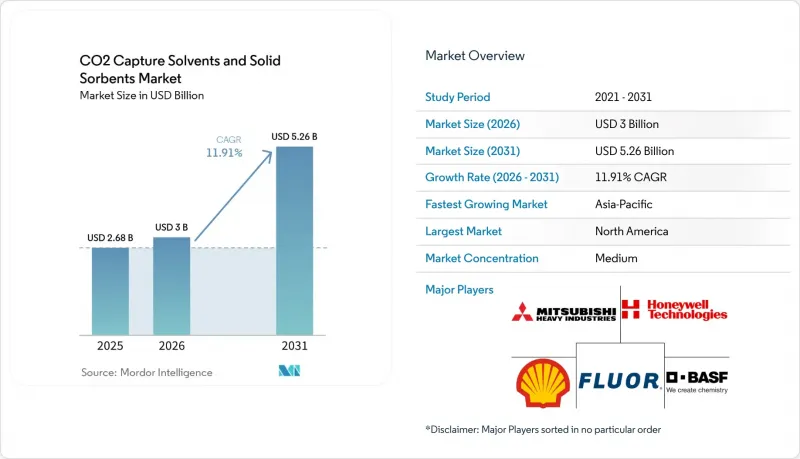
本報告按產品類型(液體溶劑和固體吸附劑)、回收方法(燃燒後回收、燃燒前回收及其他)、製程(吸收、吸附及其他)、排放源產業(發電、水泥、鋼鐵和金屬及其他)以及地區(亞太地區、北美、歐洲及其他)進行細分。市場預測以美元計價。
全球二氧化碳捕集溶劑及固體吸附劑市場趨勢及洞察
碳定價和稅額扣抵有助於提高碳回收的經濟可行性。
二氧化碳捕集溶劑和固體吸附劑市場正從稅額扣抵和碳定價機制中接收更清晰的商業性訊號。 2026年5月,美國國稅局(IRS)最終確定了第45Q條稅額扣抵的通膨調整係數為1.4639。因此,2026年安全地下儲存的二氧化碳稅額扣抵將為每噸29.28美元。根據「一項宏偉法案」(One Big Beautiful Bill Act),直接空氣捕集(DAC)設施將有資格獲得每噸36美元的基本稅額扣抵抵免。這些獎勵將提高捕集設施的預期投資報酬率,並加快前期工程階段溶劑和吸附劑的選擇。此外,歐盟排放交易體系(ETS)的合規要求強制要求符合條件的設施進行能源審計並維持碳中和計劃,從而減少了合規延誤的可能性。
工業部門的淨零排放承諾和減排義務
企業減排目標與融資條款、投資人預期和承購協議的關聯日益密切。因此,二氧化碳捕集溶劑和固體吸附劑市場正在服務那些需要檢驗減排量的項目,而不僅僅是自願聲明的項目。歐盟第四階段法規將免費配額與不符合性能要求的設施的碳中和計畫掛鉤。根據 LeadIT Tracker 預測,到 2025 年,水泥產業預計將有超過 175 個碳捕集、利用與封存 (CCUS) 計畫。 ISO 14064 計算標準和碳邊境調節機制 (CBAM) 進一步增加了對可靠碳含量數據的需求。在這種環境下,水泥、鋼鐵和煉油設施等可以透過捕集技術證明減排效果的產業,對二氧化碳捕集溶劑和固體吸附劑的需求正在成長。
溶劑再生過程中的能量損失
熱再生仍然是二氧化碳捕集溶劑和固體吸附劑市場面臨的一項重大運作限制。商業化的胺基系統通常需要每捕集一噸二氧化碳消耗3.0-3.5吉焦耳的再沸器負荷。中初步試驗和檢驗模型表明,與單乙醇胺相比,含有2-氨基-2-甲基-1-丙醇(AMP)或PiperazineCESAR1的混合溶劑可將再沸器負荷降低20-25%。即使是最佳化後的系統,根據二氧化碳濃度和熱整合條件的不同,仍可能使母廠效率降低5-15%。對於無法獲得低成本廢熱或附近再生能源的設施而言,投資獲利能力將面臨更大的挑戰。這項限制促使人們對吸附和其他低能耗再生方法產生興趣。
細分市場分析
2025年,液態溶劑在二氧化碳捕集溶劑和固體吸附劑市場銷售額中佔63.44%。這一地位反映了其在電廠和工業設施的吸收和再生塔系統中長期穩定的運作經驗。單乙醇胺和混合胺仍然是運作中的燃燒後回收裝置的主要溶劑。物理溶劑,例如Selexol和Rectisol,則用於燃燒前回收和天然氣脫硫應用。離子液體、低水/水溶劑和酵素系統仍處於商業化初期。當能夠以高流量、穩定的二氧化碳流維持常規安裝佈局時,液態體系尤其適用。由於許多規劃項目採用了成熟的吸收配置,該產品領域在二氧化碳捕集溶劑和固體吸附劑產業中仍然佔據核心地位。其持續的重要性也反映了大型專案所需的工藝許可和工程經驗的可用性。
預計2026年至2031年間,固體吸附劑的複合年成長率將達到13.42%。負載型胺、沸石、活性碳和金屬有機框架(MOFs)的運作特性與液體系統不同。 2025年11月,神戶製鋼、Atomis和Nagase & Co.完成了日本首個工業規模的MOF基二氧化碳捕集示範實驗,日處理能力為30公斤。各公司均計劃在2026會計年度進行1噸規模的試驗。 2026年7月,IDEX和Nuada宣佈在法國建成一套工業規模的MOF真空吸附系統,該系統每年可捕捉高達1萬噸的生物來源二氧化碳。這些項目表明,固體材料不僅在實驗室中進行測試,而且在實際工業環境中也得到了應用。最具前景的應用是那些對系統緊湊性和再生能耗要求極高的應用。
2025年,燃燒後回收將佔二氧化碳回收溶劑和固體吸附劑市佔率的57.82%。此技術廣泛應用於燃煤和燃氣發電廠、水泥窯和工業鍋爐。在這些環境中,許多新建和維修工程都普遍採用液態胺系統。同時,燃燒前回收在氫氣生產和整體氣化過程中仍發揮重要作用。 Selexol和Rectisol等吸附劑受益於這些製程的高壓、高濃度進料流。 Catch4Climate公司位於德國的富氧水泥廠於2026年5月生產第一批水泥熟料,並於2026年6月完成了首次富氧燃燒宣傳活動。這種多種回收途徑的組合將使二氧化碳回收溶劑和固體吸附劑市場能夠同時滿足現有煙氣處理流程和新型工業設計的需求。
預計2026年至2031年間,直接空氣捕捉(DAC)的複合年成長率將達到12.05%。 1PointFive公司位於德克薩斯州西部的STRATOS專案採用液態溶劑技術,旨在每年捕捉50萬噸二氧化碳。該項目目前正在試運行,預計將於2026年開始地下注入。作為「Cypress Hub計畫」的一部分,Climeworks公司計劃於2026年在路易斯安那州啟動其第三代固體吸附劑技術的建設。該公司的目標是將每噸二氧化碳的捕整合本控制在250至350美元之間,並使每個模組的能耗比現有系統降低50%。直接空氣捕集(DAC)涵蓋固體吸附劑和液態溶劑系統。因此,市場對二氧化碳捕集溶劑和固體吸附劑的需求正在這兩大產品系列中不斷成長。
區域分析
至2025年,北美將佔二氧化碳捕集溶劑和固體吸附劑市場36.21%的銷售額。美國將第45Q條獎勵與聯邦政府對氨、氫、電力和工業領域計畫的資助結合。能源部已向瓦巴什低碳氨計畫提供了15億美元的「能源主導融資」。加拿大正在推廣針對大型排放企業的碳定價機制和框架,海德堡材料公司計劃於2026年底啟動其埃德蒙頓計畫。墨西哥的市場佔有率仍然較小,其活動主要與天然氣加工和煉油應用有關。北美的商業機會也依賴儲存基礎設施,因為儲存能力是捕集計畫實現資金籌措的必要條件。
預計2026年至2031年,亞太地區的複合年成長率將達到13.16%。日本正大力推動國內碳捕集與封存(CCS)示範計畫與國際低碳氨供應鏈。 2025年7月,三菱重工贏得了北海道電力公司番茄厚真電廠日本最大二氧化碳捕集裝置的基礎設計合約。韓國的「韓國碳捕集、利用與儲存(K-CCUS)藍圖」則著重在鋼鐵、電力和石化設施的實施。中國的計畫則集中在燃煤發電廠和鋼鐵廠。日本和韓國正在推動對二氧化碳捕集溶劑和用於老舊重工業設備維修的胺基系統的固體吸附劑的需求。神戶製鋼、Atomis和Nagase & Co.等公司的計畫也表明,該地區對下一代吸附劑的在地化開發表現出濃厚的興趣。
在歐洲,挪威的「Longship」計畫於2025年6月實現了營運里程碑。此計畫包括布雷維克水泥碳捕集與垃圾焚化發電(WtE)二氧化碳捕集計畫。德國豪瑞集團的「Carbon2Business」計畫旨在每年捕集120萬噸二氧化碳,而其在比利時的「GO4ZERO」計畫預計到2029年每年捕集110萬噸二氧化碳。德國的《碳儲存法》(KSpTG)於2025年11月生效,允許海上二氧化碳出口。南美洲仍處於起步階段,但巴西鹽層下下層的油氣計畫正在發展成為天然氣脫硫基地。中東和非洲正透過向亞洲能源市場出口藍氨的計劃,提升其重要性。
其他好處
- Excel格式的市場預測(ME)表
- 3個月的分析師支持
目錄
第1章:引言
- 研究假設和市場定義
- 調查範圍
第2章:調查方法
第3章執行摘要
第4章 市場狀況
- 市場概覽
- 市場促進因素
- 碳定價和稅額扣抵有助於提高碳回收的經濟可行性。
- 工業部門的淨零排放承諾和減排義務
- 藍氫和低碳氨項目開發
- 工業資產維修需求,尤其是在難以減少排放的情況下。
- 從碳捕獲合約試點階段過渡到基於基礎設施的採購
- 模組化、低能耗的二氧化碳捕集材料已進入商業化階段。
- 市場限制因素
- 溶劑再生過程中的能量損失
- 劣化、腐蝕、排放氣體和廢棄物處理成本。
- 由於二氧化碳運輸和儲存相關的授權和長期責任問題造成的延誤。
- 場地特定的廢氣雜質和維修空間限制
- 價值鍊和供應鏈分析
- 波特五力分析
第5章 市場規模與成長預測
- 依產品類型
- 液體溶劑
- 胺
- 物理溶劑
- 其他(離子液體、低水溶劑、酵素溶劑)
- 固體吸附劑
- 負載型胺
- 沸石
- 活性碳
- 其他(MOF、鹼金屬和金屬氧化物吸附劑)
- 液體溶劑
- 收集方法
- 燃燒後的回收
- 燃燒前回收
- 直接空氣回收(DAC)
- 其他回收方法(BECCS、氧氣燃燒法回收)
- 透過流程
- 吸收
- 吸附
- 溫度變化吸附(TSA)
- 真空變壓吸附 (VSA)
- 其他製程(TVSA、水分變化法、電化學再生法)
- 按排放源產業
- 發電
- 水泥
- 鋼鐵和金屬
- 石油、天然氣和化學品
- 其他排放源產業(氫氣和氨氣、垃圾焚化發電、紙漿和造紙、航運)
- 按地區
- 亞太地區
- 中國
- 印度
- 日本
- 韓國
- 東南亞國協
- 其他亞太國家
- 北美洲
- 美國
- 加拿大
- 墨西哥
- 歐洲
- 德國
- 英國
- 法國
- 義大利
- 北歐國家
- 其他歐洲國家
- 南美洲
- 巴西
- 阿根廷
- 其他南美國家
- 中東和非洲
- 沙烏地阿拉伯
- 南非
- 其他中東和非洲國家
- 亞太地區
第6章 競爭情勢
- 市場集中度
- 策略趨勢
- 市佔率和排名分析
- 公司簡介
- Air Liquide
- Air Products and Chemicals, Inc.
- BASF
- Carbon Clean Solutions Limited
- Climeworks
- Fluor Corporation
- Honeywell International Inc
- JGC HOLDINGS CORPORATION
- KBR, Inc.
- Linde PLC
- MITSUBISHI HEAVY INDUSTRIES, LTD.
- Shell plc
- SLB
- Svante Technologies Inc.
- Technip Energies NV
第7章 市場機會與未來展望
According to Mordor Intelligence, the CO2 capture solvents and solid sorbents market size was valued at USD 3.00 billion in 2025 and is forecast to reach USD 5.26 billion by 2031, at a CAGR of 11.91% during the forecast period (2026-2031).
This report is Segmented by Product Type (Liquid Solvents and Solid Sorbents), Capture Route (Post-Combustion Capture, Pre-Combustion Capture, and More), Process (Absorption, Adsorption, and More), Source Industry (Power Generation, Cement, Steel and Metals, and More), and Geography (Asia-Pacific, North America, Europe, and More). The Market Forecasts are Provided in Terms of Value (USD).
Global CO2 Capture Solvents and Solid Sorbents Market Trends and Insights
Carbon-Price and Tax-Credit Support for Capture Economics
The CO2 capture solvents and solid sorbents market is receiving a clearer commercial signal from tax credits and carbon-pricing systems. The Internal Revenue Service confirmed a 1.4639 inflation adjustment factor for the Section 45Q credit in May 2026. The resulting 2026 credit for secure geological storage was USD 29.28 per metric ton of CO2. Direct air capture facilities qualify for a USD 36 per metric ton base credit under the One Big Beautiful Bill Act. These incentives improve the expected return on capture equipment and bring solvent and sorbent selection forward during front-end engineering work. EU Emissions Trading System (ETS) compliance conditions also require eligible installations to maintain energy audits and carbon-neutrality plans, which reduce the scope for delayed action.
Industrial Net-Zero Commitments and Emissions-Reduction Mandates
Corporate emissions targets are increasingly tied to loan conditions, investor expectations, and offtake agreements. The CO2 capture solvents and solid sorbents market, therefore, serves projects that need verifiable emissions reductions instead of voluntary statements. EU Phase 4 rules link free allocation to carbon-neutrality plans for installations that do not meet performance requirements. The LeadIT tracker identified more than 175 CCUS projects in the cement sector as of 2025. ISO 14064 accounting practices and the Carbon Border Adjustment Mechanism add pressure for credible carbon-content data. This environment supports the CO2 capture solvents and solid sorbents market at cement, steel, and refining facilities, where capture can document emissions reductions.
Solvent Regeneration Energy Penalty
Thermal regeneration remains a material operating constraint for the CO2 capture solvents and solid sorbents market. Commercial amine systems typically require 3.0 to 3.5 GJ of reboiler duty per metric ton of captured CO2. Blended solvents, including including 2-amino-2-methyl-1-propanol (AMP) and piperazine CESAR1, have reduced reboiler duty by 20% to 25% against monoethanolamine in pilot work and validated modeling. Even optimized systems can reduce host-plant efficiency by 5% to 15%, depending on CO2 concentration and heat integration. Facilities without low-cost waste heat or nearby renewable electricity face a more difficult investment case. This limitation increases interest in adsorption and other lower-energy regeneration approaches.
Other drivers and restraints analyzed in the detailed report include:
- Blue Hydrogen and Low-Carbon Ammonia Project Buildout
- Retrofit Demand from Hard-to-Abate Industrial Assets
- Degradation, Corrosion, Emissions, and Waste-Handling Costs
For complete list of drivers and restraints, kindly check the Table Of Contents.
Segment Analysis
Liquid solvents held 63.44% of the CO2 capture solvents and solid sorbents market revenue in 2025. Their position reflects long operating experience with absorber-stripper systems at power plants and industrial facilities. Monoethanolamine and blended amines remain the main solvents used in operating post-combustion plants. Physical solvents such as Selexol and Rectisol serve pre-combustion capture and natural-gas sweetening applications. Ionic liquids, water-lean solvents, and enzymatic systems remain at earlier commercial stages. Liquid systems are particularly relevant where high-volume, steady CO2 streams support conventional equipment layouts. The product segment remains central to the CO2 capture solvents and solid sorbents industry because many planned projects use established absorption configurations. Its continued role also reflects the availability of process licenses and engineering experience for large sites.
Solid sorbents are forecast to expand at a 13.42% CAGR from 2026 to 2031. Supported amines, zeolites, activated carbon, and metal-organic frameworks (MOF) offer different operating characteristics from liquid systems. Kobe Steel, Atomis, and Nagase completed Japan's first industrial-scale MOF-based CO2 capture demonstration at 30 kg per day in November 2025. The partners are examining metric-ton-scale testing during fiscal 2026. IDEX and Nuada announced an industrial-scale MOF vacuum-adsorption unit in France in July 2026 with the capacity to capture up to 10,000 metric tons of biogenic CO2 each year. These projects show that solid materials are being tested in operating industrial settings rather than only in laboratory programs. Their opportunity is strongest in applications where a compact system or lower regeneration energy is important.
Post-combustion capture accounted for 57.82% of the CO2 capture solvents and solid sorbents market share in 2025. It is widely used for coal and gas power plants, cement kilns, and industrial boilers. Liquid amine systems are the usual choice for many new and retrofit applications in these settings. Pre-combustion capture remains important in hydrogen production and integrated gasification. Selexol and Rectisol benefit from high-pressure, high-concentration feed streams in those processes. The Catch4Climate oxy-fuel cement plant in Germany produced its first clinker in May 2026 and completed its first oxygen campaign in June 2026. The route mix allows the CO2 capture solvents and solid sorbents market to address both established flue-gas treatment and newer industrial designs.
Direct air capture is projected to grow at a 12.05% CAGR from 2026 to 2031. 1PointFive's STRATOS project in West Texas is designed to capture 500,000 metric tons of CO2 per year using liquid solvent technology. The facility is progressing through start-up, with underground injection expected in 2026. Climeworks plans to begin construction on its Generation 3 solid-sorbent technology in Louisiana during 2026 as part of the Project Cypress Hub. Climeworks targets capture costs of USD 250 to USD 350 per metric ton and a 50% energy reduction per module relative to current systems. Direct air capture supports both solid sorbent and liquid solvent systems. It therefore broadens the CO2 capture solvents and solid sorbents market demand across the two main product groups.
Complete Report Scope:
- By Product Type
- Liquid Solvents
- Amines
- Physical Solvents
- Others (Ionic Liquids, Water-Lean and Enzymatic Solvents)
- Solid Sorbents
- Supported Amines
- Zeolites
- Activated Carbon
- Others (MOFs, Alkali and Metal-Oxide Sorbents)
- Liquid Solvents
- By Capture Route
- Post-Combustion Capture
- Pre-Combustion Capture
- Direct Air Capture (DAC)
- Other Capture Routes (BECCS, Oxy-Fuel Capture)
- By Process
- Absorption
- Adsorption
- Temperature Swing Adsorption (TSA)
- Vacuum Swing Adsorption (VSA)
- Other Processes (TVSA, Moisture-Swing, Electrochemical Regeneration)
- By Source Industry
- Power Generation
- Cement
- Steel and Metals
- Oil, Gas and Chemicals
- Other Source Industries (Hydrogen and Ammonia, Waste-to-Energy, Pulp and Paper, Maritime)
- By Geography
- Asia-Pacific
- China
- India
- Japan
- South Korea
- ASEAN Countries
- Rest of Asia-Pacific
- North America
- United States
- Canada
- Mexico
- Europe
- Germany
- United Kingdom
- France
- Italy
- NORDIC Countries
- Rest of Europe
- South America
- Brazil
- Argentina
- Rest of South America
- Middle-East and Africa
- Saudi Arabia
- South Africa
- Rest of Middle-East and Africa
- Asia-Pacific
Geography Analysis
North America held 36.21% of the CO2 capture solvents and solid sorbents market revenue in 2025. The United States combines Section 45Q incentives with federal financing for projects in ammonia, hydrogen, power, and industry. The Department of Energy provided USD 1.5 billion in Energy Dominance Financing for the Wabash Low-Carbon Ammonia project. Canada is advancing carbon-pricing and large-emitter frameworks, while Heidelberg Materials is planning its Edmonton project for late 2026. Mexico remains a smaller contributor, with activity linked to natural-gas processing and refinery applications. North American opportunity also depends on storage infrastructure because capture projects need injection capacity to become financeable.
Asia-Pacific is forecast to grow at a 13.16% CAGR from 2026 to 2031. Japan is advancing domestic CCS demonstrations and international low-carbon ammonia supply chains. Mitsubishi Heavy Industries was awarded the basic design contract for Japan's largest CO2 capture plant at Hokkaido Electric Power's Tomato-Atsuma Power Station in July 2025. South Korea's Korea Carbon Capture, Utilization and Storage (K-CCUS) roadmap focuses on deployment at steel, power, and petrochemical facilities. China's projects are concentrated at coal power and steel sites. Japan and South Korea are supporting the CO2 capture solvents and solid sorbents market demand for amine systems used to retrofit aging heavy-industrial assets. The Kobe Steel, Atomis, and Nagase project also shows regional interest in localizing next-generation sorbent development.
In Europe, Norway's Longship program reached operational milestones in June 2025, including the Brevik cement CCS plant and Twence's waste-to-energy carbon-capture project using SLB technology. Holcim's Carbon2Business project in Germany targets 1.2 million metric tons of CO2 capture each year, while its GO4ZERO project in Belgium is designed for 1.1 million metric tons annually by 2029. Germany's Kohlendioxid-Speicherungsgesetz (KSpTG) took effect in November 2025 and enables offshore CO2 export. South America remains at an early stage, although Brazil's pre-salt oil and gas operations provide a natural-gas sweetening base. The Middle-East and Africa are gaining relevance through blue ammonia export plans directed toward Asian energy markets.
- Air Liquide
- Air Products and Chemicals, Inc.
- BASF
- Carbon Clean Solutions Limited
- Climeworks
- Fluor Corporation
- Honeywell International Inc
- JGC HOLDINGS CORPORATION
- KBR, Inc.
- Linde PLC
- MITSUBISHI HEAVY INDUSTRIES, LTD.
- Shell plc
- SLB
- Svante Technologies Inc.
- Technip Energies N.V.
Additional Benefits:
- The market estimate (ME) sheet in Excel format
- 3 months of analyst support
TABLE OF CONTENTS
1 Introduction
- 1.1 Study Assumptions and Market Definition
- 1.2 Scope of the Study
2 Research Methodology
3 Executive Summary
4 Market Landscape
- 4.1 Market Overview
- 4.2 Market Drivers
- 4.2.1 Carbon-Price and Tax-Credit Support for Capture Economics
- 4.2.2 Industrial Net-Zero Commitments and Emissions-Reduction Mandates
- 4.2.3 Blue Hydrogen and Low-Carbon Ammonia Project Buildout
- 4.2.4 Retrofit Demand From Hard-to-Abate Industrial Assets
- 4.2.5 Carbon Capture Contracts Moving From Pilot to Infrastructure-Backed Procurement
- 4.2.6 Modular and Lower-Energy Capture Materials Reaching Commercial Deployment
- 4.3 Market Restraints
- 4.3.1 Solvent Regeneration Energy Penalty
- 4.3.2 Degradation, Corrosion, Emissions, and Waste-Handling Costs
- 4.3.3 CO2 Transport, Storage Permitting, and Long-Term Liability Delays
- 4.3.4 Site-Specific Flue-Gas Impurities and Retrofit Space Constraints
- 4.4 Value and Supply-Chain Analysis
- 4.5 Porter's Five Forces Analysis
- 4.5.1 Bargaining Power of Suppliers
- 4.5.2 Bargaining Power of Buyers
- 4.5.3 Threat of New Entrants
- 4.5.4 Threat of Substitutes
- 4.5.5 Competitive Rivalry
5 Market Size and Growth Forecasts (Value)
- 5.1 By Product Type
- 5.1.1 Liquid Solvents
- 5.1.1.1 Amines
- 5.1.1.2 Physical Solvents
- 5.1.1.3 Others (Ionic Liquids, Water-Lean and Enzymatic Solvents)
- 5.1.2 Solid Sorbents
- 5.1.2.1 Supported Amines
- 5.1.2.2 Zeolites
- 5.1.2.3 Activated Carbon
- 5.1.2.4 Others (MOFs, Alkali and Metal-Oxide Sorbents)
- 5.1.1 Liquid Solvents
- 5.2 By Capture Route
- 5.2.1 Post-Combustion Capture
- 5.2.2 Pre-Combustion Capture
- 5.2.3 Direct Air Capture (DAC)
- 5.2.4 Other Capture Routes (BECCS, Oxy-Fuel Capture)
- 5.3 By Process
- 5.3.1 Absorption
- 5.3.2 Adsorption
- 5.3.3 Temperature Swing Adsorption (TSA)
- 5.3.4 Vacuum Swing Adsorption (VSA)
- 5.3.5 Other Processes (TVSA, Moisture-Swing, Electrochemical Regeneration)
- 5.4 By Source Industry
- 5.4.1 Power Generation
- 5.4.2 Cement
- 5.4.3 Steel and Metals
- 5.4.4 Oil, Gas and Chemicals
- 5.4.5 Other Source Industries (Hydrogen and Ammonia, Waste-to-Energy, Pulp and Paper, Maritime)
- 5.5 By Geography
- 5.5.1 Asia-Pacific
- 5.5.1.1 China
- 5.5.1.2 India
- 5.5.1.3 Japan
- 5.5.1.4 South Korea
- 5.5.1.5 ASEAN Countries
- 5.5.1.6 Rest of Asia-Pacific
- 5.5.2 North America
- 5.5.2.1 United States
- 5.5.2.2 Canada
- 5.5.2.3 Mexico
- 5.5.3 Europe
- 5.5.3.1 Germany
- 5.5.3.2 United Kingdom
- 5.5.3.3 France
- 5.5.3.4 Italy
- 5.5.3.5 NORDIC Countries
- 5.5.3.6 Rest of Europe
- 5.5.4 South America
- 5.5.4.1 Brazil
- 5.5.4.2 Argentina
- 5.5.4.3 Rest of South America
- 5.5.5 Middle-East and Africa
- 5.5.5.1 Saudi Arabia
- 5.5.5.2 South Africa
- 5.5.5.3 Rest of Middle-East and Africa
- 5.5.1 Asia-Pacific
6 Competitive Landscape
- 6.1 Market Concentration
- 6.2 Strategic Moves
- 6.3 Market Share (%)/Ranking Analysis
- 6.4 Company Profiles (includes Global Overview, Market Overview, Core Segments, Financials as available, Strategic Information, Products and Services, and Recent Developments)
- 6.4.1 Air Liquide
- 6.4.2 Air Products and Chemicals, Inc.
- 6.4.3 BASF
- 6.4.4 Carbon Clean Solutions Limited
- 6.4.5 Climeworks
- 6.4.6 Fluor Corporation
- 6.4.7 Honeywell International Inc
- 6.4.8 JGC HOLDINGS CORPORATION
- 6.4.9 KBR, Inc.
- 6.4.10 Linde PLC
- 6.4.11 MITSUBISHI HEAVY INDUSTRIES, LTD.
- 6.4.12 Shell plc
- 6.4.13 SLB
- 6.4.14 Svante Technologies Inc.
- 6.4.15 Technip Energies N.V.
7 Market Opportunities and Future Outlook
- 7.1 White-Space and Unmet-Need Assessment

 全球燃燒後溶劑市場規模、佔有率、趨勢和成長分析報告(2026-2034)
 碳回收溶劑、吸附劑和薄膜:市場佔有率分析、行業趨勢和統計數據以及成長預測(2026-2031 年)
 直接空氣回收化學品市場預測至2034年-按化學品類型、回收技術、再生製程、純度等級、最終用戶及地區分類的全球分析碳捕集膜市場預測至2034年-全球分析(依膜材料、膜結構、分離製程、回收技術、應用、最終用戶及地區分類)
 2026 年至 2035 年燃燒後溶劑市場的商業機會、成長要素、產業趨勢與預測。
 碳捕獲市場規模、佔有率和成長分析:按技術、服務、應用、最終用戶產業和地區分類-2026-2033年產業預測2034年點源二氧化碳捕集市場預測-按捕集技術、捕集介質、部署規模、最終用戶和地區分類的全球分析碳捕集發電廠市場預測—全球分析(按捕集技術、發電廠類型、捕集方法、最終用戶和地區分類)—2034年
 碳捕獲化學品市場規模、佔有率和趨勢分析報告:按化學品、應用、地區和細分市場分類(2026-2033 年)
 排放權交易市場:按交易類型、最終用途和地區分類