


 |
市場調查報告書
商品編碼
2119339
混合式通訊雲端協作:市場佔有率分析、產業趨勢與統計資料、成長預測(2026-2031 年)Hybrid Telco Cloud Orchestration - Market Share Analysis, Industry Trends & Statistics, Growth Forecasts (2026 - 2031) |
||||||

※ 本網頁內容可能與最新版本有所差異。詳細情況請與我們聯繫。
根據 Mordor Intelligence 預測,混合通訊雲端協作市場預計將從 2025 年的 52.1 億美元成長到 2026 年的 65.4 億美元,到 2031 年達到 171.2 億美元,2026 年至 2031 年的複合年預計成長率為 21.22%。
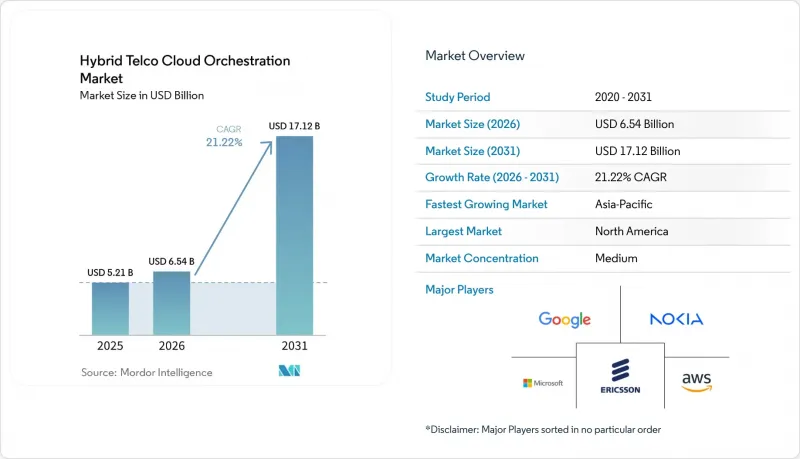
本報告按元件(例如平台)、部署方式(例如公共雲端)、雲端服務模式(例如基礎設施即服務,IaaS)、應用程式(例如網路功能生命週期管理)、最終用戶(例如行動網路營運商)、技術(例如網路功能虛擬化,NFV)、組織規模(例如大型企業、中小企業)和地區進行細分。市場預測以美元計價。
全球混合式通訊雲端協作市場趨勢與洞察
5G獨立組網與雲端原生核心擴展
5G獨立組網核心網的部署是混合通訊雲端協作市場的主要需求來源。這是因為該架構摒棄了4G錨定核心網,並需要跨越私有和公有基礎設施的雲端原生網路能力。諾基亞報告稱,截至2025年第一季,各業者已完成52個5G獨立網路核心網路的商用部署,顯示商用部署正在營運商中普及。利用公共雲端容量來運作本地NFV的營運商需要一個控制平面來管理跨越這兩個領域的虛擬NF和CNF。 2026年3月,NTT Docomo和NEC在AWS上推出了日本首個商用5G核心網,該核心網利用了基於代理的AI和GitOps流水線。這使得部署時間縮短了80%,複雜事件的回應時間縮短了50%。這些成果提高了電信業者對自動化生命週期管理和閉合迴路運維的期望。如果這些營運優勢能夠同時應用於傳統功能和容器化功能,混合電信雲端協作市場將從中受益。如果供應商越來越專注於雲端原生工具,那麼延遲採用獨立方案可能會使後續的現代化改造更加困難。
混合雲和多重雲端中的工作負載可移植性
電信業者正在將流量管理、控制平面和分析工作負載分佈在多個雲端環境中,同時在本地保留對延遲敏感的用戶平面功能。這種設計在混合電信雲端協作市場中催生了對協調的核心需求。 2026年3月,O2 Telefonica 將其生產規模的 5G 核心網路功能遷移到其自有資料中心內的 AWS Outposts,將諾基亞的雲端原生核心與 AWS 的功能相結合,同時保持了本地控制。本地雲端擴展使營運商能夠在不放棄對敏感網路功能的實體控制的情況下利用雲端工具。這些擴展正在成為持久的架構層,而不僅僅是實現全面公共雲端遷移的臨時措施。這種配置增加了對私有叢集、本地雲端擴展以及跨公共區域的通用策略的需求,因此,混合電信雲端協作市場依賴可操作的工作負載可移植性,而不是單一雲端營運模式。
傳統OSS/BSS和網路整合的複雜性
傳統OSS和BSS系統正在減緩混合通訊雲端協作市場的普及。這是因為記錄和替換已運行多年的自訂整合非常困難。儘管人們普遍意識到需要對BSS平台進行現代化改造以支援5G服務,但由於難以擺脫對舊有系統的依賴,實施過程往往會被延誤。運作中中服務的風險通常會導致老舊系統效能逐漸下降,而不是按照計劃逐步退役。 TM Forum的「開放數位架構」為營運商提供了一個分階段退役的標準框架。 Axiata Digital Labs在其“Axonect混合雲編排器”中採用了“開放數位架構”和“開放API”,幫助其在11個國家/地區為3.5億用戶提供服務,並實現了跨運營的兼容性。 2026年2月,Amdocs推出了“aOS”,這是一種基於代理的作業系統,可在任何BSS或OSS堆疊上運行,從而減少了在部署自動化編配之前完全替換系統的需求。
細分市場分析
到2025年,解決方案市佔率將達到58.81%,這反映出市場對整合管理、分析和封閉回路型自動化等功能的一體化技術堆疊的需求。電信業者傾向於選擇單一框架而非多個獨立產品,因為後者可能導致額外的整合工作。解決方案市場佔有率的提升也反映了NFV編配工具的高度成熟以及在4G向5G過渡期間建立的供應商關係。隨著電信營運商擴大將平台營運和支援外包給專業供應商,預計到2031年,服務業將以22.09%的複合年成長率成長。這種轉變有助於解決企業內部雲端原生技能人才持續短缺的問題。
平台產品作為由多家供應商提供的網路功能的共用基礎設施層,其重要性日益凸顯。 Red Hat OpenShift、Rakuten Symphony 的雲端原生平台以及 VMware Telco Cloud Platform 都體現了這種橫向架構方法。 2026 年 2 月,德國電信將「橫向電信雲端」描述為共用基礎設施的模型。該公司的雲端自動化模型透過 Kubernetes 自訂資源定義 (CRD) 管理 CNF 的生命週期。這種架構使電信業者能夠將網路功能與基礎設施解耦,並以最小的返工引入新的服務模型。此外,一些能夠減輕供應商之間整合負擔的平台也為混合通訊雲端協作市場提供了支援。
截至2025年,私有雲端將佔據混合通訊雲端協作市場38.21%的佔有率,預計到2031年將以21.58%的複合年成長率成長。監管規則和延遲要求限制了許多營運商在公有雲區域全面部署用戶平面功能。私有雲端擴大整合營運商自有硬體以及來自公共雲端供應商的本地擴展。這種設計創造了一個混合環境,需要超越傳統本地部署的軟體和服務。公共雲端支援控制平面和管理工作負載,且延遲要求較低。
混合雲端模式可協助電信業者管理網路,同時保留部分傳統基礎架構上的功能。歐盟委員會已將私有雲端、公共雲端和邊緣節點結合,並置於多重雲端編排器之下,作為歐洲電信基礎設施的目標架構。 O2 Telefonica 的 AWS Outposts 部署表明,電信業者可以在其自有資料中心部署生產級 5G 核心功能。此模式允許在利用公共雲端工具的同時,保持本地運作控制。由於策略一致性和工作負載可攜性是核心平台要求,因此混合電信雲端協作市場中存在著能夠促進該模式運作的供應商。
到2025年,SaaS將佔據41.08%的市場佔有率,因為電信業者將採用按需計量收費的採購模式來取得編配和分析功能。這種模式避免了高額的前期許可費用,並減少了部署所需的工程工作量。諾基亞基於AWS的5G核心SaaS為Citymesh在比利時的商用行動服務提供了支援。當客戶需要預先定義的服務而非完整的本地部署平台時,SaaS尤其有效。
隨著電信業者採購用於容器化網路功能的基礎設施容量,預計到2031年,IaaS將以23.04%的複合年成長率成長。這種方式保持了柔軟性,因為基礎設施供應商和工作負載管理供應商不必是同一家公司。 PaaS對於在Kubernetes上建立自動化管線和DevOps工具的電信業者非常有用。 2026年1月,樂天移動在「樂天雲」的容器化5G核心網路環境中檢驗了配備E核心的英特爾至強6處理器。此次檢驗支持了商用5G核心網路的計畫使用以及未來的MEC評估。此類部署有助於商用網路功能雲端基礎設施的標準化,隨著更多電信業者檢驗商用雲端託管,混合電信雲端協作市場預計也將從中受益。
區域分析
到2025年,北美將以32.78%的市佔率引領混合通訊雲端協作市場。 5G獨立組網(SA)營運、私有網路以及附近的超大規模資料中心業者將支撐此市場需求。由於營運商在轉型過程中未能同步擴充其內部雲端團隊,託管服務和IT供應商正在承擔更多部署和維運任務,而混合通訊雲端協作市場的發展也依賴這些提供者的能力。 TELUS已建置了一個雲端原生堆疊,以確保跨多廠商環境的一致性。墨西哥的市場發展仍與5G獨立組網(SA)許可、頻段分配以及營運商的資本投資承諾密切相關。
預計到2031年,亞太地區將以22.43%的複合年成長率成長。日本正在將先進的5G核心網路部署與人工智慧驅動的混合營運相結合,而印度則透過商用5G網路和國內設備部署計畫來擴大需求。 NTT Docomo在AWS上部署的商用5G核心網路已將部署時間縮短了80%,並將複雜事件的回應時間縮短了50%。韓國和澳洲正在推動符合Open RAN互通性標準的雲端原生平台。中國市場規模龐大,但其優先發展國內供應鏈的傾向限制了國際供應商的進入。
在歐洲,NIS2 要求應用並可審計符合主權要求的策略。德國電信的「藍色星球」部署擴展了無線存取、傳輸和核心網路域的編配。波灣合作理事會(GCC) 成員國的電信業者正在為滿足資料居住要求的供應商提供待開發區的業務機會。在南美洲,巴西和哥倫比亞取得了進展,而非洲的部署仍然受到雲端基礎設施密度和營運商級技能缺乏的限制。
其他好處:
- Excel格式的市場預測(ME)表
- 3個月的分析師支持
目錄
第1章:引言
- 研究假設和市場定義
- 調查範圍
第2章:調查方法
第3章執行摘要
第4章 市場狀況
- 市場概覽
- 市場促進因素
- 5G獨立組網與雲端原生核心網擴展
- 混合雲和多重雲端中的工作負載可移植性
- 利用NFV、CNF和開放式RAN實現現代化
- 面向低延遲服務的邊緣雲聯盟
- 基於意圖的自動化和自主網路運行
- 電信營運商平台聯盟及網路API貨幣化
- 市場限制因素
- 將傳統OSS/BSS與網路整合的複雜性
- 網路安全、資料主權和合規風險
- 具備職業級雲端原生技能的人才短缺
- 雲端遷移成本與不完全互通性
- 宏觀經濟因素對市場的影響
- 產業價值鏈分析
- 監理情勢
- 技術展望
- 波特五力分析
第5章 市場規模與成長預測
- 按組件
- 平台
- 解決方案
- 服務
- 不同的發展
- 公共雲端
- 私有雲端
- 混合雲端
- 按類型分類的雲端服務模型
- Infrastructure as a Service(IaaS)
- Platform as a Service(PaaS)
- Software as a Service(SaaS)
- 透過使用
- 網路功能生命週期管理
- 服務設計、履約和激活
- 網路切片和按需品質 (QoD)
- 交通管理和政策控制
- 雲端遷移與現代化
- 邊緣運算和多接入邊緣運算
- 收費、發票、預提
- 網路保障和封閉回路型自動化
- 最終用戶
- 行動電信商
- 固定線路運營商和融合線路運營商
- 企業及專用網路營運商
- 託管服務供應商
- 雲端服務供應商
- 政府和國防通訊機構
- 透過技術
- 網路功能虛擬化(NFV)
- 雲端原生網路能力(CNF)
- 軟體定義網路 (SDN)
- 開放式無線接取網路及雲端無線接取網
- Kubernetes 和容器編排管理
- 人工智慧和機器學習
- 服務網格和基於 API 的編配
- 按組織規模
- 大公司
- 小型企業
- 按地區
- 北美洲
- 美國
- 加拿大
- 墨西哥
- 南美洲
- 巴西
- 阿根廷
- 哥倫比亞
- 其他南美國家
- 歐洲
- 德國
- 英國
- 法國
- 義大利
- 西班牙
- 俄羅斯
- 其他歐洲國家
- 亞太地區
- 中國
- 日本
- 韓國
- 印度
- 澳洲
- 其他亞太國家
- 中東
- 沙烏地阿拉伯
- 阿拉伯聯合大公國
- 土耳其
- 其他中東國家
- 非洲
- 南非
- 奈及利亞
- 埃及
- 其他非洲國家
- 北美洲
第6章 競爭情勢
- 市場集中度
- 策略趨勢
- 市佔率分析
- 公司簡介
- Amazon Web Services, Inc.
- Microsoft Corporation
- Google LLC
- International Business Machines Corporation
- Broadcom Inc.
- Nokia Corporation
- Telefonaktiebolaget LM Ericsson
- Oracle Corporation
- Cisco Systems, Inc.
- Huawei Investment & Holding Co., Ltd.
- ZTE Corporation
- Telefonica Tech
- Amdocs Limited
- Rakuten Symphony, Inc.
- Mavenir Systems, Inc.
- Juniper Networks, Inc.
- Red Hat, Inc.
- Wind River Systems, Inc.
- NEC Corporation
- Samsung Electronics Co., Ltd.
- Hewlett Packard Enterprise Company
- Tata Consultancy Services Limited
- Netcracker Technology Corporation
- Ciena Corporation
第7章 市場機會與未來展望
According to Mordor Intelligence, the hybrid telco cloud orchestration market size is expected to increase from USD 5.21 billion in 2025 to USD 6.54 billion in 2026 and reach USD 17.12 billion by 2031, growing at a CAGR of 21.22% over 2026-2031.
This report is Segmented by Component (Platforms, and More), Deployment (Public Cloud, and More), Cloud Service Model (IaaS, and More), Application (Network Function Lifecycle Management, and More), End User (Mobile Network Operators, and More), Technology (NFV, and More), Organization Size (Large Enterprises, and SMEs), and Geography. The Market Forecasts are Provided in Terms of Value (USD).
Global Hybrid Telco Cloud Orchestration Market Trends and Insights
5G Standalone and Cloud-Native Core Expansion
5G standalone core deployment is a major source of demand for the Hybrid telco cloud orchestration market because the architecture removes the 4G anchor core and requires cloud-native network functions across private and public infrastructure. Nokia reported 52 live 5G standalone core operator deployments at the end of the first quarter of 2025, showing that commercial adoption had reached a broad operator base. Operators running on-premises NFV with public cloud capacity need a control plane that manages both VNFs and CNFs across the two domains. NTT DOCOMO and NEC launched Japan's first commercial 5G Core on AWS in March 2026, using agentic AI and GitOps pipelines that reduced deployment time by 80% and response time for complex incidents by 50%. These results raise operator expectations for automated lifecycle management and closed-loop operations, and the Hybrid telco cloud orchestration market benefits when these operating gains can be applied across both legacy and containerized functions. Delayed standalone decisions can make later modernization harder as cloud-native tools receive greater vendor attention.
Hybrid and Multi-Cloud Workload Portability
Operators are distributing traffic management, control-plane, and analytics workloads across more than one cloud environment while keeping latency-sensitive user-plane functions on-premises. This design creates a coordination need that is central to the Hybrid telco cloud orchestration market. O2 Telefonica moved production-scale 5G Core network functions to AWS Outposts in its own data center during March 2026, combining Nokia's cloud-native core with AWS capabilities while retaining on-premises control. On-premises cloud extensions can give operators cloud tooling without giving up physical control of sensitive network functions. They are becoming a lasting architectural layer rather than a temporary step before complete public-cloud migration. This arrangement increases the requirement for common policies across private clusters, local cloud extensions, and public regions, and the Hybrid telco cloud orchestration market therefore depends on practical workload portability rather than a single-cloud operating model.
Legacy OSS/BSS and Network Integration Complexity
Legacy OSS and BSS systems slow Hybrid telco cloud orchestration market adoption because long-running custom integrations are difficult to document and replace. The need to modernize BSS platforms for 5G services is widespread, but execution often falls behind plan because legacy dependencies are difficult to unwind. Live-service risks mean that older systems often degrade gradually instead of being retired on a planned timeline. TM Forum's Open Digital Architecture gives operators a standard framework for incremental decoupling. Axiata Digital Labs used Open Digital Architecture and Open APIs in its Axonect Hybrid Cloud Orchestrator to support adaptation across 11 country operations serving 350 million subscribers. Amdocs introduced its aOS agentic operating system in February 2026 to operate over any BSS or OSS stack, reducing the need for full replacement before automated orchestration is introduced.
Other drivers and restraints analyzed in the detailed report include:
- NFV, CNF, and Open RAN Modernization
- Edge-Cloud Federation for Low-Latency Services
- Cybersecurity, Data Sovereignty, and Compliance Exposure
For complete list of drivers and restraints, kindly check the Table Of Contents.
Segment Analysis
Solutions held 58.81% in 2025, reflecting demand for integrated stacks that combine management, analytics, and closed-loop automation. Operators often prefer a single framework over several point products because the latter can create new integration work. The solutions position also reflects the established maturity of NFV orchestration tools and vendor relationships formed during the move from 4G to 5G. Services are projected to expand at a 22.09% CAGR through 2031 as operators use specialist providers for platform operations and support. This shift responds to continuing gaps in internal cloud-native skills.
Platform products are gaining importance as shared infrastructure layers for network functions from several suppliers. Red Hat OpenShift, Rakuten Symphony's Cloud-Native Platform, and VMware Telco Cloud Platform illustrate this horizontal approach. Deutsche Telekom described its Horizontal TelCo Cloud in February 2026 as a shared infrastructure model for fixed and mobile core functions using GitOps-based automation. Its cloud automation model manages CNF lifecycles through Kubernetes Custom Resource Definitions. This structure can let operators separate network functions from infrastructure and adopt new service models with less rework, and the Hybrid telco cloud orchestration market is supported by platforms that reduce the integration burden across suppliers.
Private cloud held 38.21% of the Hybrid telco cloud orchestration market share in 2025 and is projected to expand at a 21.58% CAGR through 2031. Regulatory rules and latency needs prevent many operators from placing user-plane functions fully in public cloud regions. Private cloud increasingly includes on-premises extensions from public cloud providers instead of only operator-owned hardware. This design creates a hybrid environment with software and services needs beyond those of traditional local deployments. Public cloud supports control-plane and management workloads where latency requirements are less demanding.
Hybrid cloud models help operators manage networks where some functions remain on legacy infrastructure. The European Commission identifies private cloud, public cloud, and edge nodes under a multi-cloud orchestrator as the target architecture for European telecommunications infrastructure. O2 Telefonica's AWS Outposts deployment showed how an operator can place production 5G Core functions in its own data center. This model preserves local operating control while using public-cloud tools. It also makes policy consistency and workload portability core platform requirements, and the Hybrid telco cloud orchestration market has room for suppliers that can make this model easier to operate.
SaaS held 41.08% in 2025 as operators used consumption-based procurement for orchestration and analytics functions. The model avoids large upfront license commitments and can reduce the engineering effort needed for deployment. Nokia's 5G Core SaaS with AWS supported Citymesh's commercial mobile service in Belgium. SaaS can be especially relevant where customers need defined services rather than a complete in-house platform.
IaaS is projected to expand at a 23.04% CAGR through 2031 as operators source infrastructure capacity for containerized network functions. This approach can preserve flexibility because the infrastructure supplier and workload-management supplier need not be the same company. PaaS is relevant for operators building automation pipelines and DevOps tools on Kubernetes. Rakuten Mobile verified Intel Xeon 6 processors with E-cores in a containerized 5G Core environment on Rakuten Cloud during January 2026. The verification supported planned commercial 5G Core use and future MEC evaluation. These deployments help normalize cloud infrastructure for commercial network functions, and the Hybrid telco cloud orchestration market can benefit as more operators validate commercial cloud hosting.
Complete Report Scope:
- By Component
- Platforms
- Solutions
- Services
- By Deployment
- Public Cloud
- Private Cloud
- Hybrid Cloud
- By Cloud Service Model
- Infrastructure as a Service (IaaS)
- Platform as a Service (PaaS)
- Software as a Service (SaaS)
- By Application
- Network Function Lifecycle Management
- Service Design, Fulfillment, and Activation
- Network Slicing and Quality-on-Demand
- Traffic Management and Policy Control
- Cloud Migration and Modernization
- Edge Computing and Multi-access Edge Computing
- Billing, Charging, and Provisioning
- Network Assurance and Closed-Loop Automation
- By End User
- Mobile Network Operators
- Fixed and Converged Operators
- Enterprise and Private Network Operators
- Managed Service Providers
- Cloud Service Providers
- Government and Defense Communications Agencies
- By Technology
- Network Functions Virtualization (NFV)
- Cloud-Native Network Functions (CNFs)
- Software-Defined Networking (SDN)
- Open RAN and Cloud RAN
- Kubernetes and Container Orchestration
- Artificial Intelligence and Machine Learning
- Service Mesh and API-Based Orchestration
- By Organization Size
- Large Enterprises
- Small and Medium Enterprises
- By Geography
- North America
- United States
- Canada
- Mexico
- South America
- Brazil
- Argentina
- Colombia
- Rest of South America
- Europe
- Germany
- United Kingdom
- France
- Italy
- Spain
- Russia
- Rest of Europe
- Asia-Pacific
- China
- Japan
- South Korea
- India
- Australia
- Rest of Asia-Pacific
- Middle East
- Saudi Arabia
- United Arab Emirates
- Turkey
- Rest of Middle East
- Africa
- South Africa
- Nigeria
- Egypt
- Rest of Africa
- North America
Geography Analysis
North America led the Hybrid telco cloud orchestration market with a 32.78% share in 2025. Active 5G standalone operations, private networks, and nearby hyperscaler infrastructure supported demand. Managed service and IT providers are taking more deployment and operations work as operators migrate without expanding internal cloud teams at the same pace, and the Hybrid telco cloud orchestration market depends on their delivery capacity. TELUS built a cloud-native stack for consistency across a multi-vendor environment. Mexico's development remains linked to 5G standalone licensing, spectrum assignments, and operator capital commitments.
Asia-Pacific is projected to expand at a 22.43% CAGR through 2031. Japan combines advanced 5G core deployment with AI-assisted hybrid operations, while India adds demand through commercial 5G networks and domestic equipment programs. NTT DOCOMO's commercial 5G Core on AWS reduced deployment time by 80% and complex incident response time by 50%. South Korea and Australia are advancing cloud-native platforms aligned with Open RAN interoperability standards. China is substantial in scale, but domestic supply-chain preferences limit international vendor access.
Europe requires sovereign-compatible policy enforcement and auditability under NIS2. Telefonica Germany's Blue Planet deployment extended orchestration across radio access, transport, and core domains. Gulf Cooperation Council operators offer greenfield opportunities for providers that meet data-residency requirements. South America is advancing in Brazil and Colombia, while African adoption remains constrained by cloud infrastructure density and available carrier-grade skills.
- Amazon Web Services, Inc.
- Microsoft Corporation
- Google LLC
- International Business Machines Corporation
- Broadcom Inc.
- Nokia Corporation
- Telefonaktiebolaget LM Ericsson
- Oracle Corporation
- Cisco Systems, Inc.
- Huawei Investment & Holding Co., Ltd.
- ZTE Corporation
- Telefonica Tech
- Amdocs Limited
- Rakuten Symphony, Inc.
- Mavenir Systems, Inc.
- Juniper Networks, Inc.
- Red Hat, Inc.
- Wind River Systems, Inc.
- NEC Corporation
- Samsung Electronics Co., Ltd.
- Hewlett Packard Enterprise Company
- Tata Consultancy Services Limited
- Netcracker Technology Corporation
- Ciena Corporation
Additional Benefits:
- The market estimate (ME) sheet in Excel format
- 3 months of analyst support
TABLE OF CONTENTS
1 INTRODUCTION
- 1.1 Study Assumptions and Market Definition
- 1.2 Scope of the Study
2 RESEARCH METHODOLOGY
3 EXECUTIVE SUMMARY
4 MARKET LANDSCAPE
- 4.1 Market Overview
- 4.2 Market Drivers
- 4.2.1 5G Standalone and Cloud-Native Core Expansion
- 4.2.2 Hybrid and Multi-Cloud Workload Portability
- 4.2.3 NFV, CNF, and Open RAN Modernization
- 4.2.4 Edge-Cloud Federation for Low-Latency Services
- 4.2.5 Intent-Based Automation and Autonomous Network Operations
- 4.2.6 Operator Platform Federation and Network API Monetization
- 4.3 Market Restraints
- 4.3.1 Legacy OSS/BSS and Network Integration Complexity
- 4.3.2 Cybersecurity, Data Sovereignty, and Compliance Exposure
- 4.3.3 Shortage of Carrier-Grade Cloud-Native Skills
- 4.3.4 Cross-Cloud Exit Costs and Incomplete Interoperability
- 4.4 Impact of Macroeconomic Factors on the Market
- 4.5 Industry Value Chain Analysis
- 4.6 Regulatory Landscape
- 4.7 Technological Outlook
- 4.8 Porter's Five Forces Analysis
- 4.8.1 Bargaining Power of Suppliers
- 4.8.2 Bargaining Power of Buyers
- 4.8.3 Threat of New Entrants
- 4.8.4 Threat of Substitutes
- 4.8.5 Rivalry Among Existing Competitors
5 MARKET SIZE AND GROWTH FORECASTS (VALUE)
- 5.1 By Component
- 5.1.1 Platforms
- 5.1.2 Solutions
- 5.1.3 Services
- 5.2 By Deployment
- 5.2.1 Public Cloud
- 5.2.2 Private Cloud
- 5.2.3 Hybrid Cloud
- 5.3 By Cloud Service Model
- 5.3.1 Infrastructure as a Service (IaaS)
- 5.3.2 Platform as a Service (PaaS)
- 5.3.3 Software as a Service (SaaS)
- 5.4 By Application
- 5.4.1 Network Function Lifecycle Management
- 5.4.2 Service Design, Fulfillment, and Activation
- 5.4.3 Network Slicing and Quality-on-Demand
- 5.4.4 Traffic Management and Policy Control
- 5.4.5 Cloud Migration and Modernization
- 5.4.6 Edge Computing and Multi-access Edge Computing
- 5.4.7 Billing, Charging, and Provisioning
- 5.4.8 Network Assurance and Closed-Loop Automation
- 5.5 By End User
- 5.5.1 Mobile Network Operators
- 5.5.2 Fixed and Converged Operators
- 5.5.3 Enterprise and Private Network Operators
- 5.5.4 Managed Service Providers
- 5.5.5 Cloud Service Providers
- 5.5.6 Government and Defense Communications Agencies
- 5.6 By Technology
- 5.6.1 Network Functions Virtualization (NFV)
- 5.6.2 Cloud-Native Network Functions (CNFs)
- 5.6.3 Software-Defined Networking (SDN)
- 5.6.4 Open RAN and Cloud RAN
- 5.6.5 Kubernetes and Container Orchestration
- 5.6.6 Artificial Intelligence and Machine Learning
- 5.6.7 Service Mesh and API-Based Orchestration
- 5.7 By Organization Size
- 5.7.1 Large Enterprises
- 5.7.2 Small and Medium Enterprises
- 5.8 By Geography
- 5.8.1 North America
- 5.8.1.1 United States
- 5.8.1.2 Canada
- 5.8.1.3 Mexico
- 5.8.2 South America
- 5.8.2.1 Brazil
- 5.8.2.2 Argentina
- 5.8.2.3 Colombia
- 5.8.2.4 Rest of South America
- 5.8.3 Europe
- 5.8.3.1 Germany
- 5.8.3.2 United Kingdom
- 5.8.3.3 France
- 5.8.3.4 Italy
- 5.8.3.5 Spain
- 5.8.3.6 Russia
- 5.8.3.7 Rest of Europe
- 5.8.4 Asia-Pacific
- 5.8.4.1 China
- 5.8.4.2 Japan
- 5.8.4.3 South Korea
- 5.8.4.4 India
- 5.8.4.5 Australia
- 5.8.4.6 Rest of Asia-Pacific
- 5.8.5 Middle East
- 5.8.5.1 Saudi Arabia
- 5.8.5.2 United Arab Emirates
- 5.8.5.3 Turkey
- 5.8.5.4 Rest of Middle East
- 5.8.6 Africa
- 5.8.6.1 South Africa
- 5.8.6.2 Nigeria
- 5.8.6.3 Egypt
- 5.8.6.4 Rest of Africa
- 5.8.1 North America
6 COMPETITIVE LANDSCAPE
- 6.1 Market Concentration
- 6.2 Strategic Moves
- 6.3 Market Share Analysis
- 6.4 Company Profiles (includes Global Level Overview, Market Level Overview, Core Segments, Financials as available, Strategic Information, Market Rank/Share, Products and Services, Recent Developments)
- 6.4.1 Amazon Web Services, Inc.
- 6.4.2 Microsoft Corporation
- 6.4.3 Google LLC
- 6.4.4 International Business Machines Corporation
- 6.4.5 Broadcom Inc.
- 6.4.6 Nokia Corporation
- 6.4.7 Telefonaktiebolaget LM Ericsson
- 6.4.8 Oracle Corporation
- 6.4.9 Cisco Systems, Inc.
- 6.4.10 Huawei Investment & Holding Co., Ltd.
- 6.4.11 ZTE Corporation
- 6.4.12 Telefonica Tech
- 6.4.13 Amdocs Limited
- 6.4.14 Rakuten Symphony, Inc.
- 6.4.15 Mavenir Systems, Inc.
- 6.4.16 Juniper Networks, Inc.
- 6.4.17 Red Hat, Inc.
- 6.4.18 Wind River Systems, Inc.
- 6.4.19 NEC Corporation
- 6.4.20 Samsung Electronics Co., Ltd.
- 6.4.21 Hewlett Packard Enterprise Company
- 6.4.22 Tata Consultancy Services Limited
- 6.4.23 Netcracker Technology Corporation
- 6.4.24 Ciena Corporation
7 MARKET OPPORTUNITIES AND FUTURE OUTLOOK
- 7.1 White-Space and Unmet-Need Assessment

 面向電信業者的 Kubernetes 維運:市場佔有率分析、產業趨勢與統計數據以及成長預測(2026-2031 年)
 雲端編配市場:2026-2032年全球市場預測(依服務模式、技術、組織規模、產業及部署模式分類)
 MEC(多重存取邊緣)市場預測至2034年-按組件、部署模式、應用、最終用戶和地區分類的全球分析
 雲端編配市場報告:按解決方案、部署模型、使用者類型、產業和地區分類(2026-2034 年)
 雲端編配市場:按解決方案、部署類型和區域分類
 2026年全球生命週期服務編配市場報告2026年全球門到門任務編配市場報告電信即平台 (TAaP):市場佔有率分析、產業趨勢與統計資料、成長預測(2026-2031 年)2026年全球混合雲端編配市場報告2026年全球人工智慧(AI)編配市場報告