


 |
市場調查報告書
商品編碼
2119327
面向電信業者的 Kubernetes 維運:市場佔有率分析、產業趨勢與統計數據以及成長預測(2026-2031 年)Telco Kubernetes Operations - Market Share Analysis, Industry Trends & Statistics, Growth Forecasts (2026 - 2031) |
||||||

※ 本網頁內容可能與最新版本有所差異。詳細情況請與我們聯繫。
據 Mordor Intelligence 稱,2025 年電信營運商的 Kubernetes 營運市場價值為 18.5 億美元,預計到 2031 年將從 2026 年的 23.6 億美元成長到 61.8 億美元,預測期(2026-2031 年)的複合成長率為 21.23%。
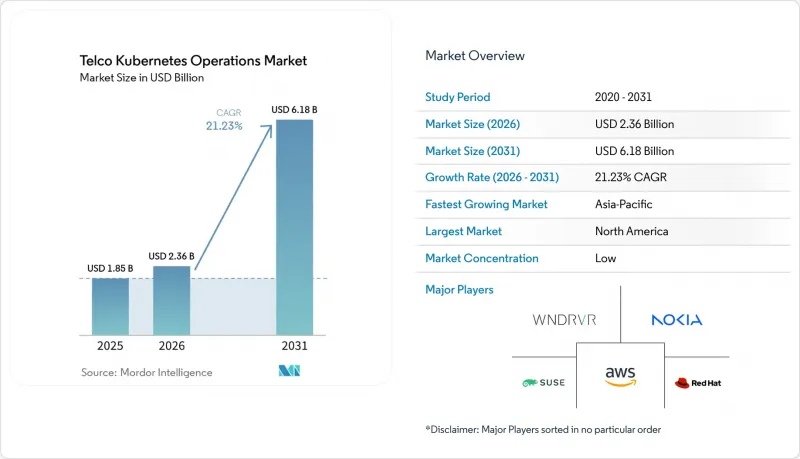
本報告按元件(解決方案和服務)、部署模式(雲端和本地部署)、組織規模(大型企業和中小企業)、應用程式(雲端原生 5G 核心網路、網路功能虛擬化等)、最終用戶(行動網路營運商、固網營運商等)和地區進行細分。市場預測以價值(美元)表示。
全球 Kubernetes 維運市場趨勢及電信業者洞察
5G獨立組網和雲端原生核心網的部署
獨立 5G 核心網路的部署直接帶動了電信業者對 Kubernetes 運維市場的需求。這些核心網路功能採用雲端原生設計,需要在生產規模下容器編排管理。當營運商在其 5G 核心網路中採用 Kubernetes 時,便會獎勵他們將 IMS、策略和收費功能遷移到同一環境。 2026 年 3 月,NTT DOCOMO 與 NEC 合作,開始在 AWS 上提供者使用混合 5G 核心網路服務。此部署利用 Amazon Bedrock AgentCore 和 GitOps 實現了核心網路設計和部署的自動化。 2025 年 7 月,O-RAN 軟體社群發布了 L 版本,將 AI 和機器學習工具、服務管理以及非即時 RAN 控制器元件整合到一個統一的 Kubernetes 環境中。
邊緣站點和分散式工作負載的增加
隨著分散式邊緣部署的普及,電信業者的 Kubernetes 運維市場正從集中式資料中心向外擴展。每個新站點都需要一致的配置、軟體更新、可觀測性和策略控制。 Orange 使用 SUSE RKE2 管理遍布 12 家以上分支機構的數百個運作中的Kubernetes叢集。他們的電信雲端計畫到 2027 年從 3 家分公司的 8 個網路功能擴展到 25 家分公司的 200 個功能。 SUSE 電信雲端 3.6 於 2026 年 5 月新增了對下游邊緣和 RAN叢集的IEEE 1588 高精度定時支援。此支援滿足了分散式站點時分雙工 (TDD) 無線電同步的運作需求。
與運營商級可靠性檢驗相關的負擔
營運商級檢驗正在減緩 Kubernetes 在營運商營運市場的普及,因為它對網路功能提出了嚴格的可用性要求。緊急通訊可能與正常流量運作在同一軟體平台上。諾基亞指出,營運商級網路軟體絕對不能容忍任何停機時間,包括升級期間。營運商必須根據 ITU-T 和 ETSI 的要求檢驗硬體和軟體組合。這導致需要逐一站點、逐一版本地檢驗工作。小規模的業者通常沒有專門的檢驗團隊,嚴重依賴供應商的支援。 2026 年 3 月,博通宣布了 VMware Telco Cloud Platform 9 的升級功能,其中包括對 Kubernetes 每個小版本 24 個月的支援。
細分市場分析
到 2025 年,該解決方案將佔據電信營運商 Kubernetes 運維市場 57.54% 的佔有率。營運商已投資於營運商級發行版、集群管理、策略管治和編配工具。 Red Hat OpenShift、Wind River Cloud Platform 和 SUSE Telco Cloud 解決了營運商內部難以管理的檢驗要求。它們提供經過測試的發布路徑、支援、安全性更新和生命週期管理工具。這使得軟體層成為初始部署的核心。電信業者的 Kubernetes 維運產業也從中受益,因為每個新增叢集都需要相應的平台軟體支援。
預計到2031年,該服務將以23.46%的複合年成長率成長,成為成長最快的組成部分。缺乏Kubernetes專業知識的電信業者通常會將生命週期管理、修補程式和可觀測性任務外包。 2025年6月,愛立信推出了基於GoogleKubernetes引擎的託管式5G核心網路服務「Ericsson On-Demand」。該服務允許電信服務供應商無需運營底層基礎設施即可提供核心網路服務。私有5G、中立主機和衛星連接的邊緣站點都需要各自適當的營運模式。鑑於這些差異,託管解決方案往往比獨立平台授權更受歡迎。
截至2025年,通訊業Kubernetes維運市場規模中,本地部署佔比高達52.44%。電信業者維護本地基礎設施,用於運行敏感的核心功能和對延遲要求極高的工作負載。預計到2031年,雲端部署將以22.08%的複合年成長率成長。許多部署方案採用混合設計,而非將所有工作負載遷移到雲端。控制平面工作負載在雲端運行,而資料平面服務則保留在網路邊緣附近。這種方法使電信業者能夠在不放棄本地處理的情況下,實現通用的營運模式。
現有的 4G 和非獨立組網 (NSA) 5G 系統仍佔據目前網路流量的大部分。這些系統仍然連接到現有的本地基礎設施。另一方面,新的獨立組網 (SA) 5G 功能很可能從一開始就採用雲端原生架構。這將導致技術分階段過渡,而不是即時進行替換。平台供應商需要在整個預測期內支援這兩種配置。部署模式仍然具有競爭力,具體取決於法規、延遲和內部工程能力。
區域分析
到2025年,北美將佔據73.44%的區域市場。主要營運商的基礎設施項目和廣泛的雲端夥伴關係關係鞏固了該地區的地位。一級運營商利用其在4G虛擬化方面的經驗,啟動了獨立的5G部署。他們還擁有成熟的工程團隊和運營商級的採購流程。這些條件使得Kubernetes成為新型5G核心功能的常用編配方案。營運商的Kubernetes維運市場將繼續受益於此成熟的維運基礎。
預計到2031年,亞太地區的複合年成長率將達到22.76%。中國、日本、韓國和印度都在不同程度上推動雲端原生網路計畫。 NTT Docomo於2026年3月在AWS上推出了商用混合5G核心網路服務。該部署利用了自動化設計和部署工具,覆蓋超過9,100萬用戶。 NEC於2025年3月將其5G虛擬化基地台軟體商用化,並計劃在2026財政年度部署超過5萬個vRAN基地台。
在歐洲,Kubernetes 的普及正透過通用的技術參考標準來推進。 「Project Sylva」計畫由 Linux 基金會歐洲分會發起,匯集了德國電信、Orange、沃達豐、西班牙電信和義大利電信等公司。此計畫旨在提升電信業者在不同雲端環境間的可移植性。 Canonical 將於 2025 年加入 Sylva 1.5 版本。此舉將為電信業者的 Kubernetes 運維市場提供更統一的歐洲維運參考標準。在南美、中東和非洲,Kubernetes 的普及進展因地區而異。在內部 Kubernetes 和電信工程技術能力仍然有限的地區,託管服務尤其重要。
其他好處:
- Excel格式的市場預測(ME)表
- 3個月的分析師支持
目錄
第1章:引言
- 研究假設和市場定義
- 調查範圍
第2章:調查方法
第3章執行摘要
第4章 市場狀況
- 市場概覽
- 宏觀經濟因素對市場的影響
- 市場促進因素
- 5G獨立組網和雲端原生核心網的部署
- 邊緣站點和分散式工作負載的激增
- 網路功能虛擬化 (NFV) 和容器化的經濟性
- 多廠商網路自動化和零接觸操作
- 基於 Kubernetes 的人工智慧和封閉回路型保證
- 面向電信營運商的雲端互通性計劃和開放參考架構
- 市場限制因素
- 與運營商級可靠性檢驗相關的負擔
- 傳統 VNF 和 CNF 共存所帶來的複雜性。
- 缺乏 Kubernetes 和通訊方面的工程技能。
- 邊緣站點的能源、硬體加速和成本限制
- 產業價值鏈分析
- 監理情勢
- 技術展望
- 波特五力分析
第5章 市場規模與成長預測
- 按組件
- 解決方案
- 電信商級 Kubernetes 發行版
- 集群管理與政策管治
- 網路自動化與編配
- 服務
- 專業服務
- 託管 Kubernetes 維
- 解決方案
- 按部署模式
- 雲
- 現場
- 按組織規模
- 大公司
- 小型企業
- 透過使用
- 雲端原生 5G 核心網
- 雲端無線存取網和開放式無線存取網
- 邊緣運算和多接入邊緣運算
- 網路功能虛擬化(NFV)
- 其他用途
- 最終用戶
- 行動電信商
- 固定線路電信業者
- 行動虛擬網路營運商和行動虛擬網路啟用者
- 雲端服務供應商和託管服務供應商
- 其他最終用戶
- 按地區
- 北美洲
- 美國
- 加拿大
- 墨西哥
- 南美洲
- 巴西
- 阿根廷
- 其他南美國家
- 歐洲
- 德國
- 英國
- 法國
- 俄羅斯
- 其他歐洲國家
- 亞太地區
- 中國
- 日本
- 韓國
- 印度
- 澳洲
- 其他亞太國家
- 中東
- 沙烏地阿拉伯
- 阿拉伯聯合大公國
- 土耳其
- 其他中東國家
- 非洲
- 南非
- 奈及利亞
- 其他非洲國家
- 北美洲
第6章 競爭情勢
- 市場集中度
- 策略趨勢
- 市佔率分析
- 公司簡介
- Red Hat, Inc.
- Wind River Systems, Inc.
- Rakuten Symphony, Inc.
- Broadcom Inc.
- Nokia Corporation
- Telefonaktiebolaget LM Ericsson
- Huawei Technologies Co., Ltd.
- Cisco Systems, Inc.
- Hewlett Packard Enterprise Company
- Amazon Web Services, Inc.
- Microsoft Corporation
- Google LLC
- SUSE SA
- Canonical Group Limited
- Juniper Networks, Inc.
- Dell Technologies Inc.
- Samsung Electronics Co., Ltd.
- NEC Corporation
- Mavenir Systems, Inc.
- Ciena Corporation
- IBM Corporation
第7章 市場機會與未來展望
According to Mordor Intelligence, the telco Kubernetes operations market size was valued at USD 1.85 billion in 2025 and estimated to grow from USD 2.36 billion in 2026 to reach USD 6.18 billion by 2031, at a CAGR of 21.23% during the forecast period (2026-2031).
This report is Segmented by Component (Solutions, and Services), Deployment Model (Cloud, and On Premise), Organization Size (Large Enterprises, and Small and Medium Enterprises), Application (Cloud-Native 5G Core, Network Function Virtualization, and More), End User (Mobile Network Operators, Fixed-Line Operators, and More), and Geography. The Market Forecasts are Provided in Terms of Value (USD).
Global Telco Kubernetes Operations Market Trends and Insights
5G Standalone and Cloud-Native Core Rollouts
Standalone 5G core rollouts are a direct source of demand for the telco Kubernetes operations market. These core functions use cloud-native designs that need container orchestration at production scale. Once operators use Kubernetes for the 5G core, they have incentives to migrate IMS, policy, and charging functions onto the same environment. NTT DOCOMO launched commercial hybrid 5G Core services on AWS with NEC in March 2026. The deployment used Amazon Bedrock AgentCore and GitOps to automate core design and deployment. The O-RAN Software Community released its L version in July 2025, combining AI and machine learning tools, service management, and non-real-time RAN controller components in a unified Kubernetes environment.
Edge Site Proliferation and Distributed Workloads
Distributed edge deployments are broadening the telco Kubernetes operations market beyond centralized data centers. Each new site needs consistent configuration, software updates, observability, and policy controls. Orange managed several hundred live Kubernetes clusters across more than 12 affiliates using SUSE RKE2. Its Telco Cloud was planned to grow from 8 network functions across 3 affiliates to 200 functions across 25 affiliates by 2027. SUSE Telco Cloud 3.6 added IEEE 1588 precision timing support for downstream edge and RAN clusters in May 2026. This support addresses a production requirement for time-division duplex radio synchronization at distributed sites.
Carrier-Grade Reliability Validation Burden
Carrier-grade validation slows adoption in the telco Kubernetes operations market because network functions have strict availability requirements. Emergency communications can pass through the same software platform as routine traffic. Nokia noted that carrier-grade network software must tolerate zero downtime, including during upgrades. Operators must validate hardware and software combinations against ITU-T and ETSI requirements. This creates a site-by-site and version-by-version backlog. Smaller carriers often lack dedicated validation teams and rely more heavily on supplier support. Broadcom announced upgrade features for VMware Telco Cloud Platform 9 in March 2026, including 24 months of support per minor Kubernetes release.
Other drivers and restraints analyzed in the detailed report include:
- Network Function Virtualization and Containerization Economics
- Multi-Vendor Network Automation and Zero-Touch Operations
- Legacy VNF and CNF Coexistence Complexity
For complete list of drivers and restraints, kindly check the Table Of Contents.
Segment Analysis
Solutions commanded 57.54% of the telco Kubernetes operations market share in 2025. Operators invested in carrier-grade distributions, cluster management, policy governance, and orchestration tools. Red Hat OpenShift, Wind River Cloud Platform, and SUSE Telco Cloud address the validation requirements that are difficult for operators to manage internally. They provide tested release paths, support, security updates, and lifecycle tools. This makes the software layer central to initial deployments. The telco Kubernetes operations industry also benefits when each additional cluster needs supported platform software.
Services are projected to expand at a 23.46% CAGR through 2031, making them the fastest-growing component. Operators with limited Kubernetes expertise are outsourcing lifecycle management, patching, and observability work. Ericsson launched Ericsson On-Demand in June 2025 as a managed 5G core service built on Google Kubernetes Engine. The offer allows communications service providers to provision core services without operating the underlying infrastructure. Private 5G, neutral-host, and satellite-connected edge sites also need tailored operating models. These differences favor managed outcomes over standalone platform licenses.
On-premise deployments held 52.44% of the telco Kubernetes operations market size in 2025. Operators retain local infrastructure for sensitive core functions and workloads that need low latency. Cloud deployments are projected to expand at a 22.08% CAGR through 2031. Many deployments use a hybrid design rather than moving every workload off premises. Control-plane workloads can run in the cloud while data-plane services remain near the network edge. This approach gives operators a common operating model without abandoning local processing.
Existing 4G and non-standalone 5G systems still carry much of current network traffic. Those systems remain connected to established on-premise infrastructure. New standalone 5G functions are more likely to be cloud-native from the start. This creates a layered technology transition instead of an immediate replacement cycle. Platform suppliers need to support both configurations through the forecast period. The deployment model remains a competitive choice based on regulation, latency, and internal engineering capacity.
Complete Report Scope:
- By Component
- Solutions
- Carrier-Grade Kubernetes Distributions
- Cluster Management and Policy Governance
- Network Automation and Orchestration
- Services
- Professional Services
- Managed Kubernetes Operations
- Solutions
- By Deployment Model
- Cloud
- On Premise
- By Organization Size
- Large Enterprises
- Small and Medium Enterprises
- By Application
- Cloud-Native 5G Core
- Cloud RAN and Open RAN
- Edge Computing and Multi-Access Edge Computing
- Network Functions Virtualization
- Other Applications
- By End User
- Mobile Network Operators
- Fixed-Line Operators
- Mobile Virtual Network Operators and Mobile Virtual Network Enablers
- Cloud Service Providers and Managed Service Providers
- Other End Users
- By Geography
- North America
- United States
- Canada
- Mexico
- South America
- Brazil
- Argentina
- Rest of South America
- Europe
- Germany
- United Kingdom
- France
- Russia
- Rest of Europe
- Asia-Pacific
- China
- Japan
- South Korea
- India
- Australia
- Rest of Asia-Pacific
- Middle East
- Saudi Arabia
- United Arab Emirates
- Turkey
- Rest of Middle East
- Africa
- South Africa
- Nigeria
- Rest of Africa
- North America
Geography Analysis
North America held a regional share of 73.44% in 2025. Large operator infrastructure programs and extensive cloud partnerships supported the region's position. Tier 1 operators entered standalone 5G deployments with experience in 4G virtualization. They also had established engineering teams and carrier-grade procurement processes. These conditions made Kubernetes a common orchestration choice for new 5G core functions. The telco Kubernetes operations market continues to benefit from this established operating base.
Asia-Pacific is projected to expand at a 22.76% CAGR through 2031. China, Japan, South Korea, and India are advancing cloud-native network programs at different scales. NTT DOCOMO launched commercial hybrid 5G Core services on AWS in March 2026. The deployment used automated design and deployment tools across a network serving more than 91 million subscribers. NEC commercialized 5G-compatible virtualized base station software in March 2025 and targeted more than 50,000 vRAN base stations by fiscal 2026.
Europe is advancing Kubernetes adoption through shared technical references. Project Sylva brings together Deutsche Telekom, Orange, Vodafone, Telefonica, and Telecom Italia under Linux Foundation Europe. It aims to improve portability across telco cloud environments. Canonical became part of Sylva 1.5 in 2025. This work can provide the telco Kubernetes operations market with more consistent European operating references. South America, the Middle East, and Africa are at varied stages of adoption. Managed services are especially relevant where in-house Kubernetes and telecom engineering skills remain limited.
- Red Hat, Inc.
- Wind River Systems, Inc.
- Rakuten Symphony, Inc.
- Broadcom Inc.
- Nokia Corporation
- Telefonaktiebolaget LM Ericsson
- Huawei Technologies Co., Ltd.
- Cisco Systems, Inc.
- Hewlett Packard Enterprise Company
- Amazon Web Services, Inc.
- Microsoft Corporation
- Google LLC
- SUSE S.A.
- Canonical Group Limited
- Juniper Networks, Inc.
- Dell Technologies Inc.
- Samsung Electronics Co., Ltd.
- NEC Corporation
- Mavenir Systems, Inc.
- Ciena Corporation
- IBM Corporation
Additional Benefits:
- The market estimate (ME) sheet in Excel format
- 3 months of analyst support
TABLE OF CONTENTS
1 INTRODUCTION
- 1.1 Study Assumptions and Market Definition
- 1.2 Scope of the Study
2 RESEARCH METHODOLOGY
3 EXECUTIVE SUMMARY
4 MARKET LANDSCAPE
- 4.1 Market Overview
- 4.2 Impact of Macroeconomic Factors on the Market
- 4.3 Market Drivers
- 4.3.1 5G Standalone and Cloud-Native Core Rollouts
- 4.3.2 Edge Site Proliferation and Distributed Workloads
- 4.3.3 Network Function Virtualization and Containerization Economics
- 4.3.4 Multi-Vendor Network Automation and Zero-Touch Operations
- 4.3.5 Kubernetes-Based AI and Closed-Loop Assurance
- 4.3.6 Telco Cloud Interoperability Initiatives and Open Reference Architectures
- 4.4 Market Restraints
- 4.4.1 Carrier-Grade Reliability Validation Burden
- 4.4.2 Legacy VNF and CNF Coexistence Complexity
- 4.4.3 Shortage of Kubernetes-Telco Engineering Skills
- 4.4.4 Energy, Hardware Acceleration, and Edge-Site Cost Constraints
- 4.5 Industry Value Chain Analysis
- 4.6 Regulatory Landscape
- 4.7 Technological Outlook
- 4.8 Porter's Five Forces Analysis
- 4.8.1 Bargaining Power of Suppliers
- 4.8.2 Bargaining Power of Buyers
- 4.8.3 Threat of New Entrants
- 4.8.4 Threat of Substitutes
- 4.8.5 Competitive Rivalry
5 MARKET SIZE AND GROWTH FORECASTS
- 5.1 By Component
- 5.1.1 Solutions
- 5.1.1.1 Carrier-Grade Kubernetes Distributions
- 5.1.1.2 Cluster Management and Policy Governance
- 5.1.1.3 Network Automation and Orchestration
- 5.1.2 Services
- 5.1.2.1 Professional Services
- 5.1.2.2 Managed Kubernetes Operations
- 5.1.1 Solutions
- 5.2 By Deployment Model
- 5.2.1 Cloud
- 5.2.2 On Premise
- 5.3 By Organization Size
- 5.3.1 Large Enterprises
- 5.3.2 Small and Medium Enterprises
- 5.4 By Application
- 5.4.1 Cloud-Native 5G Core
- 5.4.2 Cloud RAN and Open RAN
- 5.4.3 Edge Computing and Multi-Access Edge Computing
- 5.4.4 Network Functions Virtualization
- 5.4.5 Other Applications
- 5.5 By End User
- 5.5.1 Mobile Network Operators
- 5.5.2 Fixed-Line Operators
- 5.5.3 Mobile Virtual Network Operators and Mobile Virtual Network Enablers
- 5.5.4 Cloud Service Providers and Managed Service Providers
- 5.5.5 Other End Users
- 5.6 By Geography
- 5.6.1 North America
- 5.6.1.1 United States
- 5.6.1.2 Canada
- 5.6.1.3 Mexico
- 5.6.2 South America
- 5.6.2.1 Brazil
- 5.6.2.2 Argentina
- 5.6.2.3 Rest of South America
- 5.6.3 Europe
- 5.6.3.1 Germany
- 5.6.3.2 United Kingdom
- 5.6.3.3 France
- 5.6.3.4 Russia
- 5.6.3.5 Rest of Europe
- 5.6.4 Asia-Pacific
- 5.6.4.1 China
- 5.6.4.2 Japan
- 5.6.4.3 South Korea
- 5.6.4.4 India
- 5.6.4.5 Australia
- 5.6.4.6 Rest of Asia-Pacific
- 5.6.5 Middle East
- 5.6.5.1 Saudi Arabia
- 5.6.5.2 United Arab Emirates
- 5.6.5.3 Turkey
- 5.6.5.4 Rest of Middle East
- 5.6.6 Africa
- 5.6.6.1 South Africa
- 5.6.6.2 Nigeria
- 5.6.6.3 Rest of Africa
- 5.6.1 North America
6 COMPETITIVE LANDSCAPE
- 6.1 Market Concentration
- 6.2 Strategic Moves
- 6.3 Market Share Analysis
- 6.4 Company Profiles (includes Global Level Overview, Market Level Overview, Core Segments, Financials as available, Strategic Information, Market Rank/Share, Products and Services, Recent Developments)
- 6.4.1 Red Hat, Inc.
- 6.4.2 Wind River Systems, Inc.
- 6.4.3 Rakuten Symphony, Inc.
- 6.4.4 Broadcom Inc.
- 6.4.5 Nokia Corporation
- 6.4.6 Telefonaktiebolaget LM Ericsson
- 6.4.7 Huawei Technologies Co., Ltd.
- 6.4.8 Cisco Systems, Inc.
- 6.4.9 Hewlett Packard Enterprise Company
- 6.4.10 Amazon Web Services, Inc.
- 6.4.11 Microsoft Corporation
- 6.4.12 Google LLC
- 6.4.13 SUSE S.A.
- 6.4.14 Canonical Group Limited
- 6.4.15 Juniper Networks, Inc.
- 6.4.16 Dell Technologies Inc.
- 6.4.17 Samsung Electronics Co., Ltd.
- 6.4.18 NEC Corporation
- 6.4.19 Mavenir Systems, Inc.
- 6.4.20 Ciena Corporation
- 6.4.21 IBM Corporation
7 MARKET OPPORTUNITIES AND FUTURE OUTLOOK
- 7.1 White-Space and Unmet-Need Assessment

 混合式通訊雲端協作:市場佔有率分析、產業趨勢與統計資料、成長預測(2026-2031 年)
 雲端編配市場:2026-2032年全球市場預測(依服務模式、技術、組織規模、產業及部署模式分類)
 MEC(多重存取邊緣)市場預測至2034年-按組件、部署模式、應用、最終用戶和地區分類的全球分析
 雲端編配市場報告:按解決方案、部署模型、使用者類型、產業和地區分類(2026-2034 年)
 雲端編配市場:按解決方案、部署類型和區域分類
 2026年全球生命週期服務編配市場報告2026年全球門到門任務編配市場報告電信即平台 (TAaP):市場佔有率分析、產業趨勢與統計資料、成長預測(2026-2031 年)2026年全球混合雲端編配市場報告2026年全球人工智慧(AI)編配市場報告