


 |
市場調查報告書
商品編碼
2119264
人工智慧驅動的行銷服務:市場佔有率分析、行業趨勢和統計數據、成長預測(2026-2031 年)AI-Powered Marketing Services - Market Share Analysis, Industry Trends & Statistics, Growth Forecasts (2026 - 2031) |
||||||

※ 本網頁內容可能與最新版本有所差異。詳細情況請與我們聯繫。
根據 Mordor Intelligence 預測,人工智慧行銷服務的市場規模預計將從 2025 年的 239 億美元成長到 2026 年的 289 億美元,然後從 2026 年到 2031 年以 21.97% 的複合年成長率成長,到 2031 年達到 780 億美元。
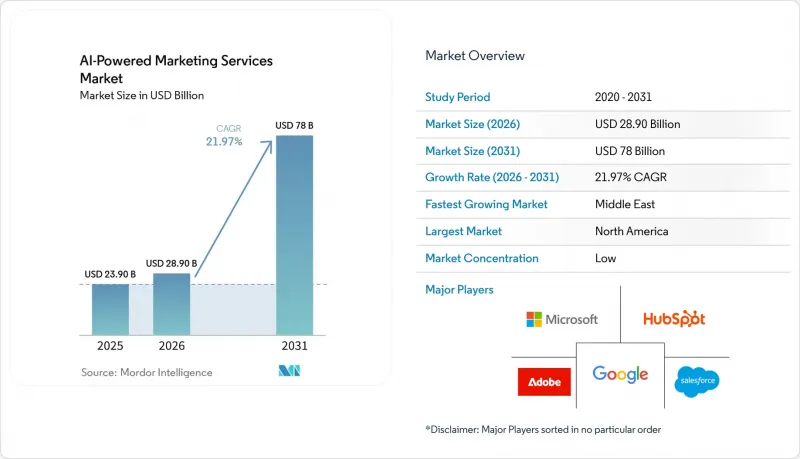
本報告按部署類型(雲端、本地部署、混合部署)、組織規模(大型企業、中小企業)、最終用戶產業(零售與電子商務、IT與電信、醫療保健與生命科學、媒體與娛樂、製造與工業及其他)以及地區進行細分。市場預測以美元計價。
全球人工智慧驅動行銷服務市場的趨勢與洞察
對高度個人化客戶參與日益成長的需求
人工智慧驅動的行銷服務市場正受益於個人化從一種可有可無的策略轉變為客戶參與核心要素的轉變。品牌現在需要跨管道即時回應客戶行為,這推動了對能夠將身分、內容和決策整合到單一工作流程中的平台的需求。 Adobe 在 2025 年報告中指出,63% 的企業已經部署或試用了人工智慧驅動的個人化功能,86% 的企業已經部署了試點或正在開發中的解決方案來分析客戶互動。這顯示企業採用人工智慧驅動的個人化功能已經超越了最初的探索階段。獲取模型不再是主要瓶頸,因為更重要的差異化優勢在於識別整個技術堆疊中的身份並捕捉即時訊號。這一趨勢有利於那些能夠在應用個人化邏輯之前正確整合客戶資料的供應商。同時,對於那些客戶記錄分散的品牌而言,這也增加了客戶維繫的風險。這是因為跨大規模平台提供的一致體驗正在重新定義整個人工智慧驅動的行銷服務市場的用戶期望。
利用生成式人工智慧提高內容創作效率
人工智慧驅動的行銷服務市場也受益於內容創作不再是固定的營運瓶頸。生成式人工智慧工具使得創建更多變體、本地化版本和目標受眾特定的素材成為可能,而無需大幅擴展團隊規模。 2025年6月,Adobe宣布,Lumen Technologies在實施Adobe GenStudio for Performance Marketing後,將宣傳活動推出時間從25天縮短至9天,並將為Meta旗下兩個目標用戶群在各平台上創建廣告變體的時間縮短了65%。 2025年10月,Adobe擴展了GenStudio,新增了大規模內容創作功能、Firefly Design Intelligence、Firefly Creative Production for Enterprise以及更廣泛的廣告投放生態系統。這表明市場對能夠像基礎設施一樣運作的內容運營的需求日益成長。隨著內容產生速度的提升,人工智慧驅動的行銷服務市場對能夠跟上素材產生速度的多層衡量、管治和績效回饋的需求也日益成長。但這並不意味著內容自動化會降低對平台的需求;相反,這意味著在整個人工智慧行銷服務市場中,企業負責人所需的相關系統數量正在增加。
對資料隱私、同意和自動化分析的審查。
隨著隱私法規與自動化用戶畫像和內容生成等實際操作方法的交織日益緊密,由人工智慧驅動的行銷服務市場正面臨越來越嚴格的合規壓力。歐盟人工智慧法案的下一階段實施將於2026年8月啟動,這將加重使用人工智慧進行用戶細分、個人化和自動化決策支援的公司的負擔。 2025年10月,歐洲資料保護監管機構發布了關於生成式人工智慧系統合規使用的最新指南。這些指南在於合法處理、管治和資料保護控制,直接影響企業的採用標準。這迫使人工智慧驅動的行銷服務市場的買家在更廣泛地擴展自動化之前,重新設計其數據管道、用戶許可流程和人工監督機制。這也鞏固了那些已在其產品模式中提供可審計性、文件和策略控制能力的供應商的地位。在人工智慧驅動的行銷服務市場的許多B2B交易中,合規性正從採購的優先事項轉變為可近性的最低要求。
細分市場分析
到2025年,雲端採用率將佔人工智慧行銷服務市場的62.24%。這反映出市場對可擴展、API優先的環境有著強烈的偏好,這類環境能夠支援頻繁的模型更新和高容量處理。雲端平台也非常適合該領域的快速發展,因為供應商無需經歷漫長的升級週期,即可跨客戶部署功能變更、安全性更新和合規性管理。在金融服務、國防和監管嚴格的醫療保健產業,本地部署環境仍然至關重要,因為這些產業的客戶資料處理規則依然嚴格,內部控制優先。儘管如此,人工智慧行銷服務市場的關注點仍然在於雲端平台,因為雲端平台能夠實現更快的部署速度,並在整個客戶參與堆疊中實現更廣泛的整合。
混合部署預計將在人工智慧驅動的行銷服務市場中實現最快成長,2026 年至 2031 年的複合年成長率 (CAGR) 將達到 24.91%。這是因為許多公司現在希望將推理和內容生成遷移到雲端,同時將敏感的身份資料保留在受控環境中。隨著跨國公司在不同地區面臨不同的隱私和資料居住要求,這種架構的重要性日益凸顯。 2026 年 3 月,Adobe 和 NVIDIA 宣佈建立策略合作夥伴關係,以支援下一代 Firefly 模式和雲端原生 3D 數位孿生工作流程。這表明知名品牌正在為部署更複雜的行銷營運所需的協調環境做準備。在人工智慧驅動的行銷服務產業,能夠協調本地資料儲存和雲端執行層之間合規資料傳輸的供應商,將隨著監管要求的日益嚴格而佔據更有利的地位。
區域分析
到2025年,北美將佔據人工智慧行銷服務市場47.78%的佔有率,顯著超越其他地區,成為最大的貢獻者。該地區受益於對企業軟體的大量投資、集中的數位廣告預算以及眾多人工智慧原生行銷技術供應商。美國仍然是諸如答案引擎最佳化、基於代理商的宣傳活動管理和人工智慧原生客戶關係管理等新興領域的領先概念驗證地。加拿大和墨西哥在零售和金融服務領域的廣泛應用進一步豐富了該地區的市場。南美洲尚處於商業化初期,但隨著數位商務和電信行銷日益數據驅動,巴西展現出獨特的區域需求。
歐洲在人工智慧行銷服務市場佔有獨特的地位。這是因為該地區的採用不僅受純粹的需求成長所驅動,也受管治要求的影響。 GDPR的實施、歐盟人工智慧法律的分階段引入以及更嚴格的人工智慧使用者畫像指南,正促使買家轉向更可控的部署模式。雖然這阻礙了激進的個人化,但也推高了對能夠提供合規證明並降低採購風險的供應商的溢價需求。德國和英國仍然是歐洲最大的兩個市場,其中德國與工業領域的自動化需求聯繫更為緊密,而英國與對先進數位廣告的需求聯繫更為緊密。
亞太地區是全球第二大區域市場,但不同國家和平台結構的採用模式差異顯著。在中國,將電商、社交互動和人工智慧建議整合封閉回路型的國內生態系統仍然佔據主導地位,限制了許多全球供應商的直接進入。在印度和東南亞,隨著網路用戶對數位商務和服務的參與度不斷提高,雲端平台正迎來更大的成長機會。在沙烏地阿拉伯和阿拉伯聯合大公國等國家主導的數位經濟項目的推動下,中東預計將成為人工智慧行銷服務市場成長最快的地區,預計2026年至2031年的複合年成長率將達到25.56%。非洲仍然是規模最小的區域,但在南非、奈及利亞和埃及,通訊和金融服務業的需求正在湧現,人工智慧主導的細分和在地化內容可以在這些領域高效擴展應用。
其他好處:
- Excel格式的市場預測(ME)表
- 3個月的分析師支持
目錄
第1章:引言
- 研究假設和市場定義
- 調查範圍
第2章:調查方法
第3章執行摘要
第4章 市場狀況
- 市場概覽
- 宏觀經濟因素對市場的影響
- 市場促進因素
- 對高度個人化客戶參與日益成長的需求
- 利用人工智慧生成技術簡化內容創作流程
- 拓展全通路商務與效果行銷
- 將人工智慧與客戶關係管理和行銷自動化平台整合
- 在生成式引擎最佳化和人工智慧搜尋可見性方面的支出
- 透過人為參與,積極主動地執行宣傳活動,提高生產力。
- 市場限制因素
- 對資料隱私、同意和自動化分析的審查。
- 高昂的實施成本和人工智慧人才短缺。
- 零點擊人工智慧搜尋和歸因壓縮
- 合成媒體的揭露及其對品牌信任的影響
- 產業價值鏈分析
- 監理情勢
- 技術展望
- 波特五力分析
第5章 市場規模及成長預測(價值:10億美元)
- 部署模式
- 雲
- 現場
- 混合
- 按組織規模
- 大公司
- 小型企業
- 按最終用戶行業分類
- 零售與電子商務
- 資訊科技/通訊
- BFSI
- 醫療保健和生命科學
- 媒體與娛樂
- 旅遊與飯店
- 製造業和工業部門
- 其他(汽車、公共部門等)
- 按地區
- 北美洲
- 美國
- 加拿大
- 墨西哥
- 南美洲
- 巴西
- 阿根廷
- 智利
- 其他南美國家
- 歐洲
- 德國
- 英國
- 法國
- 義大利
- 西班牙
- 其他歐洲國家
- 亞太地區
- 中國
- 日本
- 印度
- 韓國
- 澳洲
- 其他亞太國家
- 中東
- 阿拉伯聯合大公國
- 沙烏地阿拉伯
- 卡達
- 其他中東國家
- 非洲
- 南非
- 埃及
- 奈及利亞
- 其他非洲國家
- 北美洲
第6章 競爭情勢
- 市場集中度
- 策略趨勢
- 市佔率分析
- 公司簡介
- Salesforce, Inc.
- Adobe Inc.
- Google LLC
- Microsoft Corporation
- HubSpot, Inc.
- Oracle Corporation
- SAP SE
- International Business Machines Corporation
- Amazon.com, Inc.
- Accenture plc
- Publicis Groupe SA
- WPP plc
- Omnicom Group Inc.
- The Interpublic Group of Companies, Inc.
- The Trade Desk, Inc.
- Klaviyo, Inc.
- Sprinklr, Inc.
- Braze, Inc.
- ActiveCampaign, Inc.
- Bloomreach, Inc.
- Zoho Corporation Pvt. Ltd.
第7章 市場機會與未來展望
According to Mordor Intelligence, the AI-powered marketing services market size is expected to grow from USD 23.9 billion in 2025 to USD 28.9 billion in 2026 and is forecast to reach USD 78 billion by 2031 at 21.97% CAGR over 2026-2031.
This report is Segmented by Deployment Mode (Cloud, On-Premises, and Hybrid), Organization Size (Large Enterprises, and Small and Medium-Sized Enterprises), End-User Industry (Retail and E-Commerce, IT and Telecommunications, Healthcare and Life Sciences, Media and Entertainment, Manufacturing and Industrials, and More), and Geography. The Market Forecasts are Provided in Terms of Value (USD).
Global AI-Powered Marketing Services Market Trends and Insights
Rising Demand for Hyper-Personalized Customer Engagement
The AI-powered marketing services market is benefiting from the shift in personalization from an optional tactic to a core part of customer engagement. Brands are now under pressure to respond to behavior in real time across channels, which raises demand for platforms that can unify identity, content, and decisioning in one workflow. Adobe reported in 2025 that 63% of organizations were already using or piloting AI-powered personalization, and 86% had pilot or working solutions in place to analyze customer interactions, which shows that enterprise adoption has moved past early exploration. The main bottleneck is no longer model access alone, because the stronger differentiator sits in identity resolution and real-time signal ingestion across the stack. That dynamic favors vendors in the AI-powered marketing services market that can connect customer data cleanly before applying personalization logic. It also raises the retention risk for brands that still operate with fragmented customer records, because more consistent experiences on larger platforms are resetting user expectations across the AI-powered marketing services market.
Generative AI-Driven Content Production Efficiency
The AI-powered marketing services market is also gaining from the move away from content creation as a fixed operational bottleneck. Generative tools are making it possible to produce more variations, localizations, and audience-specific assets without expanding teams at the same pace. Adobe said in June 2025 that Lumen Technologies cut campaign launch time from 25 days to 9 days after deploying Adobe GenStudio for Performance Marketing, while ad variation production time for Meta properties across 2 target personas fell by 65%. Adobe also expanded GenStudio in October 2025 with scaled content production capabilities, Firefly Design Intelligence, Firefly Creative Production for Enterprise, and a wider ad delivery ecosystem, which points to growing demand for content operations that behave more like infrastructure. As content velocity rises, the AI-powered marketing services market is seeing stronger demand for measurement, governance, and performance feedback layers that can keep pace with asset output. This means content automation is not reducing platform demand; it is broadening the number of adjacent systems that enterprise buyers need across the AI-powered marketing services market.
Data Privacy, Consent, And Automated Profiling Scrutiny
The AI-powered marketing services market is facing heavier compliance pressure as privacy rules move closer to how automated profiling and content generation work in practice. The next implementation phase of the EU AI Act begins in August 2026, and that raises the burden on enterprises that use AI for segmentation, personalization, and automated decision support. The European Data Protection Supervisor published updated orientations in October 2025 on using generative AI systems in a compliant way, with a focus on lawful processing, governance, and data protection controls that directly affect enterprise deployment standards. This pushes buyers in the AI-powered marketing services market to redesign data pipelines, consent flows, and human oversight mechanisms before scaling automation more broadly. It also strengthens the position of vendors that already offer auditability, documentation, and policy controls as part of their delivery model. For many enterprise deals in the AI-powered marketing services market, compliance features are moving from procurement preference to a minimum entry requirement.
Other drivers and restraints analyzed in the detailed report include:
- Expansion Of Omnichannel Commerce And Performance Marketing
- Integration Of AI With CRM And Marketing Automation Platforms
- High Implementation Costs And AI Talent Gaps
For complete list of drivers and restraints, kindly check the Table Of Contents.
Segment Analysis
Cloud deployment held 62.24% of the AI-powered marketing services market share in 2025, reflecting the strong preference for scalable, API-first environments that can support frequent model updates and high-volume processing. Cloud also suits the pace of this category, because vendors can push feature changes, security updates, and compliance controls across customers without long upgrade cycles. On-premises setups still matter in financial services, defense, and regulated healthcare, where customer data handling rules remain strict and internal control is prioritized. Even so, the center of gravity in the AI-powered marketing services market remains with cloud platforms, which offer faster deployment and broader integration across customer engagement stacks.
Hybrid deployment is expected to post the fastest growth in the AI-powered marketing services market size at a 24.91% CAGR from 2026 to 2031, because many enterprises now want sensitive identity data to remain in controlled environments while inference and content generation move to the cloud. This architecture is becoming more relevant as multinational organizations face different privacy and residency requirements across regions. Adobe and NVIDIA announced a strategic partnership in March 2026 to support next-generation Firefly models and cloud-native 3D digital twin workflows, pointing to the type of connected environment large brands are preparing to use for more complex marketing operations. In the AI-powered marketing services industry, vendors that can orchestrate compliant movement between on-premises data stores and cloud-based execution layers are likely to hold a stronger position as regulatory expectations tighten.
Complete Report Scope:
- By deployment mode
- Cloud
- On-premises
- Hybrid
- By organization size
- Large Enterprises
- Small and Medium-sized Enterprises
- By End-User Industry
- Retail and E-commerce
- IT and Telecommunications
- BFSI
- Healthcare and Life Sciences
- Media and Entertainment
- Travel and Hospitality
- Manufacturing and Industrials
- Others (Automotive, Public Sector, Others)
- By Geography
- North America
- United States
- Canada
- Mexico
- South America
- Brazil
- Argentina
- Chile
- Rest of South America
- Europe
- Germany
- United Kingdom
- France
- Italy
- Spain
- Rest of Europe
- Asia-Pacific
- China
- Japan
- India
- South Korea
- Australia
- Rest of Asia-Pacific
- Middle East
- United Arab Emirates
- Saudi Arabia
- Qatar
- Rest of Middle East
- Africa
- South Africa
- Egypt
- Nigeria
- Rest of Africa
- North America
Geography Analysis
North America accounted for 47.78% of the AI-powered marketing services market share in 2025, making it the largest regional contributor by a wide margin. The region benefits from deep enterprise software spending, a large concentration of digital advertising budgets, and a dense base of AI-native marketing technology vendors. The United States remains the main proving ground for newer categories such as answer engine optimization, agentic campaign management, and AI-native CRM. Canada and Mexico add to regional depth, with visible adoption in retail and financial services use cases. South America is at an earlier stage of commercialization, but Brazil is creating localized demand as digital commerce and telecom marketing become more data-driven.
Europe holds a distinct place in the AI-powered marketing services market because adoption there is being shaped as much by governance requirements as by pure demand growth. GDPR enforcement, the phased rollout of the EU AI Act, and stricter guidance on AI-driven profiling have pushed buyers toward more controlled deployment models. That creates friction for aggressive personalization, but it also supports premium demand for vendors that can document compliance and reduce procurement risk. Germany and the United Kingdom remain the two largest European markets, with Germany tied more closely to industrial-sector automation needs and the United Kingdom to advanced digital advertising demand.
Asia-Pacific is the second-largest regional market, although adoption patterns vary widely by country and platform structure. China remains dominated by domestic ecosystems that combine commerce, social engagement, and AI recommendations in closed loops, which limits direct access for many global vendors. India and Southeast Asia offer greater growth opportunities for cloud-based platforms as internet users move deeper into digital commerce and services. The Middle East is projected to record the fastest expansion in the AI-powered marketing services market, with a 25.56% CAGR from 2026 to 2031, supported by state-backed digital economy programs in Saudi Arabia and the United Arab Emirates. Africa remains the smallest region, but South Africa, Nigeria, and Egypt are creating demand in telecommunications and financial services where AI-led segmentation and localized content can scale efficiently.
- Salesforce, Inc.
- Adobe Inc.
- Google LLC
- Microsoft Corporation
- HubSpot, Inc.
- Oracle Corporation
- SAP SE
- International Business Machines Corporation
- Amazon.com, Inc.
- Accenture plc
- Publicis Groupe S.A.
- WPP plc
- Omnicom Group Inc.
- The Interpublic Group of Companies, Inc.
- The Trade Desk, Inc.
- Klaviyo, Inc.
- Sprinklr, Inc.
- Braze, Inc.
- ActiveCampaign, Inc.
- Bloomreach, Inc.
- Zoho Corporation Pvt. Ltd.
Additional Benefits:
- The market estimate (ME) sheet in Excel format
- 3 months of analyst support
TABLE OF CONTENTS
1 INTRODUCTION
- 1.1 Study Assumptions and Market Definition
- 1.2 Scope of the Study
2 RESEARCH METHODOLOGY
3 EXECUTIVE SUMMARY
4 MARKET LANDSCAPE
- 4.1 Market Overview
- 4.2 Impact of Macroeconomic Factors on the Market
- 4.3 Market Drivers
- 4.3.1 Rising Demand for Hyper-Personalized Customer Engagement
- 4.3.2 Generative AI-Driven Content Production Efficiency
- 4.3.3 Expansion of Omnichannel Commerce and Performance Marketing
- 4.3.4 Integration of AI With CRM and Marketing Automation Platforms
- 4.3.5 Generative Engine Optimization and AI Search Visibility Spend
- 4.3.6 Agentic Campaign Execution and Human-in-the-Loop Productivity Gains
- 4.4 Market Restraints
- 4.4.1 Data Privacy, Consent, and Automated Profiling Scrutiny
- 4.4.2 High Implementation Costs and AI Talent Gaps
- 4.4.3 Zero-Click AI Search and Attribution Compression
- 4.4.4 Synthetic Media Disclosure and Brand Trust Burden
- 4.5 Industry Value Chain Analysis
- 4.6 Regulatory Landscape
- 4.7 Technological Outlook
- 4.8 Porter's Five Forces Analysis
- 4.8.1 Threat of New Entrants
- 4.8.2 Bargaining Power of Buyers
- 4.8.3 Bargaining Power of Suppliers
- 4.8.4 Threat of Substitutes
- 4.8.5 Competitive Rivalry
5 MARKET SIZE AND GROWTH FORECASTS, VALUE (USD BILLION)
- 5.1 By deployment mode
- 5.1.1 Cloud
- 5.1.2 On-premises
- 5.1.3 Hybrid
- 5.2 By organization size
- 5.2.1 Large Enterprises
- 5.2.2 Small and Medium-sized Enterprises
- 5.3 By End-User Industry
- 5.3.1 Retail and E-commerce
- 5.3.2 IT and Telecommunications
- 5.3.3 BFSI
- 5.3.4 Healthcare and Life Sciences
- 5.3.5 Media and Entertainment
- 5.3.6 Travel and Hospitality
- 5.3.7 Manufacturing and Industrials
- 5.3.8 Others (Automotive, Public Sector, Others)
- 5.4 By Geography
- 5.4.1 North America
- 5.4.1.1 United States
- 5.4.1.2 Canada
- 5.4.1.3 Mexico
- 5.4.2 South America
- 5.4.2.1 Brazil
- 5.4.2.2 Argentina
- 5.4.2.3 Chile
- 5.4.2.4 Rest of South America
- 5.4.3 Europe
- 5.4.3.1 Germany
- 5.4.3.2 United Kingdom
- 5.4.3.3 France
- 5.4.3.4 Italy
- 5.4.3.5 Spain
- 5.4.3.6 Rest of Europe
- 5.4.4 Asia-Pacific
- 5.4.4.1 China
- 5.4.4.2 Japan
- 5.4.4.3 India
- 5.4.4.4 South Korea
- 5.4.4.5 Australia
- 5.4.4.6 Rest of Asia-Pacific
- 5.4.5 Middle East
- 5.4.5.1 United Arab Emirates
- 5.4.5.2 Saudi Arabia
- 5.4.5.3 Qatar
- 5.4.5.4 Rest of Middle East
- 5.4.6 Africa
- 5.4.6.1 South Africa
- 5.4.6.2 Egypt
- 5.4.6.3 Nigeria
- 5.4.6.4 Rest of Africa
- 5.4.1 North America
6 COMPETITIVE LANDSCAPE
- 6.1 Market Concentration
- 6.2 Strategic Moves
- 6.3 Market Share Analysis
- 6.4 Company Profiles (includes Global Level Overview, Market Level Overview, Core Segments, Financials as available, Strategic Information, Market Rank/Share, Products and Services, Recent Developments)
- 6.4.1 Salesforce, Inc.
- 6.4.2 Adobe Inc.
- 6.4.3 Google LLC
- 6.4.4 Microsoft Corporation
- 6.4.5 HubSpot, Inc.
- 6.4.6 Oracle Corporation
- 6.4.7 SAP SE
- 6.4.8 International Business Machines Corporation
- 6.4.9 Amazon.com, Inc.
- 6.4.10 Accenture plc
- 6.4.11 Publicis Groupe S.A.
- 6.4.12 WPP plc
- 6.4.13 Omnicom Group Inc.
- 6.4.14 The Interpublic Group of Companies, Inc.
- 6.4.15 The Trade Desk, Inc.
- 6.4.16 Klaviyo, Inc.
- 6.4.17 Sprinklr, Inc.
- 6.4.18 Braze, Inc.
- 6.4.19 ActiveCampaign, Inc.
- 6.4.20 Bloomreach, Inc.
- 6.4.21 Zoho Corporation Pvt. Ltd.
7 MARKET OPPORTUNITIES AND FUTURE OUTLOOK
- 7.1 White-space and unmet-need assessment

 全球行銷人工智慧市場:2026-2030 年
 行銷組合建模軟體:市場佔有率分析、產業趨勢與統計資料、成長預測(2026-2031)
 人工智慧行銷市場:依技術、應用、產業、部署模式和企業規模分類-2026-2032年全球市場預測人工智慧行銷平台:市場佔有率分析、產業趨勢與統計及成長預測(2026-2031 年)行銷科技服務市場:市場佔有率分析、產業趨勢與統計、成長預測(2026-2031)
 全球行銷技術市場規模、佔有率、趨勢和成長分析報告(2026-2034年)
 2026年人工智慧受眾成長預測全球市場報告
 行銷技術市場規模、佔有率、趨勢和預測:按類型、產品類型、應用和地區分類,2026-2034 年
 行銷科技市場:按產品類型、應用和地區分類2026年全球頻譜熱圖分析市場報告