


 |
市場調查報告書
商品編碼
2099501
人工智慧行銷平台:市場佔有率分析、產業趨勢與統計及成長預測(2026-2031 年)AI-Powered Marketing Platform Market - Market Share Analysis, Industry Trends & Statistics, Growth Forecasts (2026 - 2031) |
||||||

※ 本網頁內容可能與最新版本有所差異。詳細情況請與我們聯繫。
根據 Mordor Intelligence 預測,人工智慧行銷平台的市場規模預計將從 2025 年的 103.8 億美元成長到 2026 年的 119.7 億美元,然後從 2026 年到 2031 年以 18.84% 的複合成長率成長,到 203.7 億美元。
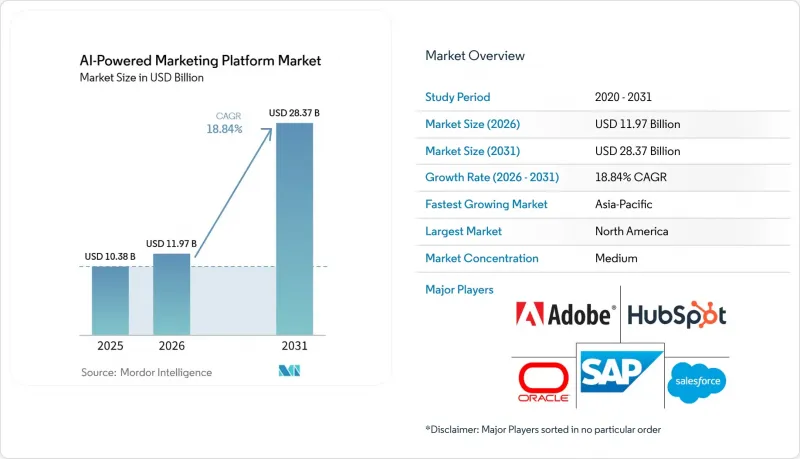
本報告按元件(軟體和服務)、部署類型(雲端、本地部署、混合部署)、應用程式(人工智慧驅動的內容產生、預測性行銷分析等)、企業規模(大型企業、中小企業)、最終用戶產業(銀行、金融服務和保險等)以及地區進行細分。市場預測以美元計價。
全球人工智慧行銷平台市場趨勢及洞察
在整個客戶旅程中實現高度個人化
人工智慧驅動的行銷平台市場正受益於買家期望的廣泛重新定義。這是因為行銷人員在設計宣傳活動時,不再將受眾細分本身視為最終目標。企業越來越需要能夠即時讀取意圖訊號、行為事件和互動情境的系統,並自動更新下一則訊息,無需等待人工宣傳活動週期。這項需求正推動人工智慧驅動的行銷平台市場朝向將客戶資料、內容產生和活化整合到單一營運層中的架構發展。 Adobe 已將「CX Enterprise Coworker」定位為 Experience Cloud、即時客戶資料平台 (Real-Time CDP) 和 GenStudio 之間的編配層。這表明領先的供應商正在將個人化從一項獨立功能轉變為連貫的營運流程。隨著這種模式的日益普及,在工作流程整合和即時資料處理方面擁有優勢的供應商更有可能贏得大規模平台部署。此外,個人化互動現在需要同時兼顧內容品質、存取權管理和資料一致性,因此管治的重要性也日益凸顯。
從基於規則的宣傳活動過渡到基於代理的人工智慧工作流程
人工智慧驅動的行銷平台市場正從助手主導的功能轉向能夠以最小的人工干預完成規劃、生成、測試和最佳化的自主工作流程。這項轉變意義重大,因為它改變了平台的角色,使其從支援宣傳活動團隊的工具轉變為直接執行部分營運工作負載的系統。 Adobe 的 2026 年產品策略專注於在客戶經驗編配中實現代理驅動的協調,這反映出人工智慧驅動的行銷平台市場正在圍繞代理而非孤立的自動化規則進行重新設計。微軟和陽獅集團也於 2026 年擴大了合作,旨在建立全端人工智慧行銷解決方案。這表明大型企業負責人正在為端到端的營運模式而非有限的試驗計畫做準備。因此,計劃與執行之間的差距將縮短,從而促進更頻繁的測試、更快的宣傳活動調整,並增強企業內部持續投資的合理性。此外,那些仍依賴傳統規則集的供應商也面臨越來越大的壓力,因為與代理主導的替代方案相比,此類系統顯得不夠柔軟性。
資料隱私、同意和跨境管治限制
由於授權管理、資料使用法規和跨境營運要求的日益複雜化,人工智慧行銷平台市場面臨許多阻礙因素。大型企業通常會在多個市場進行宣傳活動,但不同地區的客戶資料處理策略、核准流程和儲存要求並不總是一致的。因此,平台選擇不僅取決於功能豐富度,還取決於法律合規性和營運設計,這減緩了人工智慧行銷平台市場的成長。雖然管理良好的供應商可以利用這一點,但許多買家在協調身分識別系統、核准流程和區域資料處理法規方面仍然面臨諸多挑戰。在嚴格監管的行業,這個問題尤其突出,因為除非風險管理、合規和資料團隊批准一致的工作流程,否則行銷團隊無法快速行動。此外,買家通常希望對資料儲存位置和啟動方式進行更精細的控制,因此更傾向於混合部署和可組合部署方案。
細分市場分析
預計到2025年,軟體將佔據人工智慧行銷平台市場68.41%的佔有率,證實了基於授權的平台仍然是該類別的主要收入來源。人工智慧行銷平台市場仍然依賴軟體作為其核心執行系統,因為資料擷取、受眾邏輯、宣傳活動設定和報告都基於平台層。同時,人工智慧行銷平台服務市場預計到2031年將以21.82%的複合年成長率成長,顯示買家對授權後支援的需求日益成長。這種轉變反映了這樣一個現實:在許多實施過程中,團隊必須先進行資料清洗、工作流程重新設計、存取控制設定和變更管理,才能持續利用人工智慧功能。隨著企業嘗試將其行銷工具與CRM、CDP、分析和電商環境整合,服務需求也在增加,因為這些整合通常需要專業的實施技術。
服務機會不僅限於實施階段,買家也越來越需要長期營運支持,即便平台已經運作。在人工智慧行銷平台產業,這凸顯了諮詢和管理服務的重要性,這些服務能夠幫助客戶最佳化提示、設定審核邏輯並長期監控內容品質。此外,它還為供應商和合作夥伴創造了新的收入來源,使他們能夠在初始實施期結束後繼續深入參與客戶帳戶的維護工作。對於買家而言,這種模式縮短了從試點營運過渡到日常營運所需的時間,尤其是在其內部團隊缺乏人工智慧營運經驗的情況下。對供應商而言,隨著平台與客戶營運流程的更緊密整合,服務關係有助於實現更永續的客戶維繫。因此,即使軟體收入仍佔大部分,各組成部分的比例在預測期內也可能趨於平衡。
預計到2025年,基於雲端的架構將佔總收入的72.19%,凸顯了買家在降低初始基礎設施成本的同時,也傾向於擴充性的部署方案。人工智慧驅動的行銷平台市場持續向雲端模式傾斜,因為雲端模式能夠快速交付功能、輕鬆更新,並與外部人工智慧服務無縫整合。然而,混合配置預計到2031年將以20.43%的複合年成長率成長,這表明買家的優先事項有所不同,他們需要更嚴格的控制。在人工智慧驅動的行銷平台市場中,當客戶資料無法在不同系統或司法管轄區之間自由流動時,混合模式的重要性就凸顯出來。這在銀行、醫療保健和政府等行業尤其關鍵,因為這些行業的團隊既需要現代化的啟動工具,也需要對敏感記錄進行嚴格控制。
這一趨勢迫使供應商提供比單純的公共雲端選項更靈活的架構。 2026 年,Databricks 發布了 CustomerLake,這是一個基於代理的客戶資料平台,原生建構於其自有的 Lakehouse 環境之上。這反映出市場對管治的資料利用方式有著廣泛的需求,同時又不希望強制企業從現有資料資產進行完全遷移。儘管雲端部署在整個 AI 驅動的行銷平台市場中仍然佔據主導地位,但混合架構正日益受到關注,因為它們允許將關鍵記錄保存在更靠近公司的位置,同時利用先進的編配和自動化層。這也有助於減少風險管理團隊的阻力,進而降低平台廣泛採用的可能性。未來,混合架構可能會佔據部分先前完全局限於本地環境的需求。因此,部署柔軟性正成為比傳統的「雲端 vs. 本地部署」之爭更為重要的購買決策因素。
區域分析
預計到2025年,北美將佔據人工智慧行銷平台市場34.62%的佔有率,成為最大的區域貢獻者。該地區受益於強大的數位廣告基礎、龐大的企業軟體部署基礎設施以及與多家領先平台供應商和雲端服務供應商的地理接近性。在人工智慧行銷平台市場,這些因素的結合促進了產品的快速部署、強大的合作夥伴網路的建構以及企業對行銷技術(Martech)採購模式日益深入的理解。美國仍然是該地區的主要驅動力,其最大的企業正迅速從人工智慧功能的試點階段過渡到圍繞人工智慧重新設計工作流程。加拿大和墨西哥也逐漸推動需求成長,尤其是在零售、金融服務和客戶參與等數位應用領域。然而,隨著其他地區以其獨特的需求模式擴大部署規模,北美的主導地位已不再是過去式。
預計到2031年,亞太地區將以22.93%的複合年成長率成長,並在預測期內成為人工智慧行銷平台市場規模成長最快的地區。這一成長主要得益於中小企業數位化進程的加速、線上商務活動的擴張以及企業越來越傾向於採用對傳統基礎設施依賴性較低的新型營運工具。中國在人工智慧行銷平台市場中獨樹一幟,其國內生態系統和本土平台結構對供應商准入的影響方式與開放的全球市場截然不同。印度正逐漸成為一個開放的准入機會,這得益於其數位商業基礎設施的擴展以及中小企業技術應用的進步。日本和韓國仍然是重要的市場,因為它們對數位化抱有很高的期望,並且擁有成熟的消費者互動環境。東南亞和澳洲也透過加大對客戶資料基礎設施的投資以及區域內企業行銷宣傳活動現代化改造,為市場成長做出了貢獻。
歐洲在全球人工智慧行銷平台市場仍佔據重要佔有率,但該地區的購買行為往往受到更嚴格的管治和更謹慎的實施流程的限制。德國和英國是該地區的核心市場,擁有大規模的企業基礎,並且對客戶參與和數位體驗工具有顯著的需求。因此,歐洲人工智慧行銷平台市場極具吸引力,但供應商通常需要建立更完善的合規體系和更謹慎的實施計畫才能實現穩定成長。南美市場雖然規模較小,但隨著數位商務的成長和對可衡量行銷措施日益成長的興趣,其重要性也不斷提升。中東和非洲地區仍在發展中,但隨著品牌和代理商客戶參與模式進行現代化改造,投資正在增加。在所有這三個全部區域,人工智慧行銷平台市場的發展並不均衡,這表明供應商需要製定針對特定區域的商業策略,而不是單一的全球策略。
其他好處:
- Excel格式的市場預測(ME)表
- 3個月的分析師支持
目錄
第1章:引言
- 研究假設和市場定義
- 調查範圍
第2章:調查方法
第3章執行摘要
第4章 市場狀況
- 市場概覽
- 市場促進因素
- 整個客戶旅程中對高度個人化的需求。
- 從基於規則的宣傳活動快速轉向基於代理的人工智慧工作流程
- 第三方 Cookie 的減少以及由此導致的第一方資料使用方式的轉變
- 企業級生成式內容創作
- 由財務長主導的行銷投資報酬率審查給閉合迴路歸因帶來壓力
- 將人工智慧整合到行銷雲端套件中,可以減少採購過程中的摩擦。
- 市場限制因素
- 資料隱私、同意和跨境管治限制
- 基於模型的自動內容產生中的錯誤識別和品牌安全風險。
- CRM、CDP 和 MarTech 技術棧之間整合的複雜性。
- 中型企業採購負責人缺乏人工智慧操作技能
- 宏觀經濟因素對市場的影響
- 產業價值鏈分析
- 科技趨勢
- 監理情勢
- 波特五力分析
第5章 市場規模與成長預測
- 按組件
- 軟體
- 服務
- 部署模式
- 基於雲端的
- 現場
- 混合
- 透過使用
- 人工智慧驅動的內容生成
- 預測性市場分析
- 客戶洞察與個性化
- 宣傳活動管理與最佳化
- 行銷自動化
- 對話式行銷
- 按公司規模
- 大公司
- 小型企業
- 按最終用戶行業分類
- 零售與電子商務
- BFSI
- 醫療保健和生命科學
- 資訊科技/通訊
- 媒體與娛樂
- 工業製造
- 政府和公共行政
- 其他終端用戶產業
- 按地區
- 北美洲
- 美國
- 加拿大
- 墨西哥
- 南美洲
- 巴西
- 阿根廷
- 其他南美國家
- 歐洲
- 德國
- 英國
- 法國
- 義大利
- 西班牙
- 俄羅斯
- 其他歐洲國家
- 亞太地區
- 中國
- 印度
- 日本
- 韓國
- 澳洲
- 其他亞太國家
- 中東和非洲
- 中東
- 沙烏地阿拉伯
- 阿拉伯聯合大公國
- 其他中東國家
- 非洲
- 南非
- 奈及利亞
- 其他非洲國家
- 中東
- 北美洲
第6章 競爭情勢
- 市場集中度
- 策略趨勢
- 市佔率分析
- 公司簡介
- Adobe Inc.
- Salesforce, Inc.
- HubSpot, Inc.
- Braze, Inc.
- Oracle Corporation
- SAP SE
- SAS Institute Inc.
- ActiveCampaign, LLC
- Acoustic, LP
- Insider FZ-LLC
- Emarsys eMarketing Systems AG
- Klaviyo, Inc.
- Zendesk, Inc.
- Mailchimp, a division of Intuit Inc.
- Pega Systems Inc.
- HCL Technologies Limited
- Microsoft Corporation
- Google LLC
- Amazon Web Services, Inc.
- Sprinklr, Inc.
第7章 市場機會與未來展望
According to Mordor Intelligence, the AI-powered marketing platform market size is expected to grow from USD 10.38 billion in 2025 to USD 11.97 billion in 2026 and is forecast to reach USD 28.37 billion by 2031 at 18.84% CAGR over 2026-2031.
This report is Segmented by Component (Software, and Services), Deployment Mode (Cloud-Based, On-Premise, and Hybrid), Application (AI Content Generation, Predictive Marketing Analytics, and More), Enterprise Size (Large Enterprises, and Small and Medium Enterprises), End-User Industry (BFSI, and More), and Geography. The Market Forecasts are Provided in Terms of Value (USD).
Global AI-Powered Marketing Platform Market Trends and Insights
Hyper-Personalization Across Customer Journeys
The AI-powered marketing platform market is benefiting from a broad reset in buyer expectations, as marketers no longer treat audience segments as ends in themselves in campaign design. Enterprises increasingly want systems that read intent signals, behavioral events, and engagement context as they happen, then update the next message without waiting for a manual campaign cycle. That requirement is pushing the AI-powered marketing platform market toward architectures that combine customer data, content generation, and activation within a single operating layer. Adobe positioned CX Enterprise Coworker as an orchestration layer across Experience Cloud, Real-Time CDP, and GenStudio, which shows how leading vendors are turning personalization into a connected operating process rather than a standalone feature. As this model becomes more common, vendors with deeper workflow coordination and real-time data handling are likely to win larger platform decisions. It also raises the value of governance, because personalized interactions now depend on content quality, permission controls, and data consistency simultaneously.
Shift From Rule-Based Campaigns to Agentic AI Workflows
The AI-powered marketing platform market is also moving from assistant-led features toward autonomous workflows that can plan, generate, test, and optimize with less manual intervention. This shift matters because it changes the platform's role from a tool that supports campaign teams to a system that directly carries out parts of the operating workload. Adobe's 2026 product direction centered on agent-enabled orchestration across customer experience workflows, reflecting how the AI-powered marketing platform market is being redesigned around agents rather than isolated automation rules. Microsoft and Publicis also expanded their partnership in 2026 to build a full-stack AI marketing solution, showing that large enterprise buyers are preparing for end-to-end operating models rather than narrow pilot programs. The result is a shorter distance between planning and execution, which supports more frequent testing, faster campaign adjustments, and stronger internal justification for follow-on investment. It also increases pressure on vendors that still rely on older rule sets, as those systems can appear rigid compared with agent-led alternatives.
Data Privacy, Consent, and Cross-Border Governance Constraints
The AI-powered marketing platform market faces a significant restraint due to the growing complexity of consent management, data use rules, and cross-border operating requirements. Large organizations often run campaigns across several markets, yet their customer data practices, approval processes, and storage requirements do not always align across those regions. That slows the AI-powered marketing platform market because platform selection now depends on legal readiness and operating design, not only on feature depth. Vendors with stronger controls can turn this into an advantage, but many buyers still face delays as they reconcile identity systems, approval structures, and regional data-handling rules. This issue is especially visible in highly regulated sectors, where marketing teams cannot move quickly unless risk, compliance, and data teams approve the same workflow. It also favors hybrid and composable deployments because buyers often want more control over where data sits and how activation occurs.
Other drivers and restraints analyzed in the detailed report include:
- First-Party Data Activation as Third-Party Cookies Recede
- Generative Content Production at Enterprise Scale
- Model Hallucination and Brand-Safety Risk in Automated Content Generation
For complete list of drivers and restraints, kindly check the Table Of Contents.
Segment Analysis
Software held 68.41% of the AI-powered marketing platform market share in 2025, which confirms that licensed platforms remained the main revenue base across the category. The AI-powered marketing platform market still relies on software as its core execution system, since data ingestion, audience logic, campaign setup, and reporting are all anchored in the platform layer. At the same time, the AI-powered marketing platform market size for services is projected to expand at a 21.82% CAGR through 2031, indicating that buyers increasingly need support after the license is purchased. This shift reflects the reality that many deployments require data cleanup, workflow redesign, access control setup, and change management before teams can use AI functions consistently. Service demand also rises when enterprises try to connect marketing tools with CRM, CDP, analytics, and commerce environments, because these integrations often require dedicated implementation expertise.
The service opportunity is not limited to installation work, because buyers increasingly want long-term operating support after the platform goes live. In the AI-powered marketing platform industry, this raises the importance of advisory and managed services that help customers refine prompts, set review logic, and monitor content quality over time. It also creates a revenue path for vendors and partners that can stay embedded in the customer account well beyond the initial deployment window. For buyers, this model can reduce the time needed to move from pilot use to daily use, especially when internal teams lack deep AI operating experience. For vendors, it makes retention more durable because service relationships tie the platform more tightly to the customer's operating process. Over the forecast period, the component mix is therefore likely to become more balanced even if software remains the larger revenue base.
Cloud-based architectures accounted for 72.19% of 2025 revenue, underscoring buyers' preference for scalable deployments with lower upfront infrastructure costs. The AI-powered marketing platform market continues to lean toward cloud models because they support faster feature delivery, easier updates, and tighter links with external AI services. Even so, hybrid configurations are projected to grow at a 20.43% CAGR through 2031, suggesting a different priority among buyers with stricter control needs. In the AI-powered marketing platform market, hybrid models are becoming more relevant where customer data cannot move freely across systems or jurisdictions. That is especially important in banking, healthcare, government, and other settings where teams need both modern activation tools and closer control over sensitive records.
This trend is pushing vendors to offer more flexible architecture rather than a simple public-cloud choice. Databricks launched CustomerLake in 2026 as an agentic customer data platform built natively on its lakehouse environment, which reflects wider demand for governed data activation without forcing a full shift away from existing enterprise data estates. Although the broader AI-powered marketing platform market still favors cloud deployment, hybrid designs are gaining traction because they let buyers keep critical records closer to home while still using advanced orchestration and automation layers. This also reduces resistance from risk teams that might otherwise block broader platform adoption. Over time, a hybrid may absorb part of the demand that would once have remained fully on-premise. That makes deployment flexibility a more important buying factor than the older cloud-versus-on-premises debate alone.
Complete Report Scope:
- By Component
- Software
- Services
- By Deployment Mode
- Cloud-Based
- On-Premise
- Hybrid
- By Application
- AI Content Generation
- Predictive Marketing Analytics
- Customer Intelligence and Personalization
- Campaign Management and Optimization
- Marketing Automation
- Conversational Marketing
- By Enterprise Size
- Large Enterprises
- Small And Medium Enterprises
- By End-User Industry
- Retail and E-Commerce
- BFSI
- Healthcare and Life Sciences
- IT and Telecom
- Media and Entertainment
- Industrial Manufacturing
- Government and Public Administration
- Other End-User Industries
- By Geography
- North America
- United States
- Canada
- Mexico
- South America
- Brazil
- Argentina
- Rest of South America
- Europe
- Germany
- United Kingdom
- France
- Italy
- Spain
- Russia
- Rest of Europe
- Asia-Pacific
- China
- India
- Japan
- South Korea
- Australia
- Rest of Asia-Pacific
- Middle East and Africa
- Middle East
- Saudi Arabia
- United Arab Emirates
- Rest of Middle East
- Africa
- South Africa
- Nigeria
- Rest of Africa
- Middle East
- North America
Geography Analysis
North America held 34.62% of the AI-powered marketing platform market share in 2025, which made it the largest regional contributor. The region benefits from dense digital advertising activity, a large installed base of enterprise software, and proximity to several major platform vendors and cloud providers. In the AI-powered marketing platform market, that combination supports faster product rollout, stronger partner networks, and broader enterprise familiarity with martech buying models. The United States remains the main regional driver because large organizations there are moving quickly from testing AI features to redesigning workflows around them. Canada and Mexico add incremental demand, particularly where retail, financial services, and customer engagement use cases continue to digitize. Even so, North America is no longer the only center of momentum, as other regions are expanding their adoption base through distinct demand patterns.
Asia-Pacific is projected to expand at 22.93% CAGR through 2031, giving it the strongest growth rate in the AI-powered marketing platform market size during the forecast period. Growth is being supported by faster SME digitization, expanding online commerce activity, and a broader willingness to adopt newer operating tools that rely on lighter legacy infrastructure. China stands out as a distinct environment within the AI-powered marketing platform market because domestic ecosystems and local platform structures shape vendor access differently from open global markets. India is emerging as a major open-access opportunity, helped by a broadening digital business base and more technology adoption among smaller firms. Japan and South Korea remain important because they combine high digital expectations with mature consumer engagement environments. Southeast Asia and Australia also contribute through rising investment in customer data foundations and campaign modernization across regional businesses.
Europe remains a major part of the global AI-powered marketing platform market, although buying behavior there is often shaped by stricter governance expectations and more deliberate rollout processes. Germany and the United Kingdom are central regional markets because they combine large enterprise bases with meaningful demand for customer engagement and digital experience tools. The AI-powered marketing platform market in Europe is therefore attractive, but vendors often need stronger compliance positioning and more careful deployment planning to grow consistently. South America is smaller, yet it continues to build relevance through digital commerce growth and rising interest in measurable marketing activation. The Middle East and Africa are still emerging, though investment is improving as brands and agencies modernize customer engagement models. Across all three regions, the AI-powered marketing platform market is advancing unevenly, indicating that vendors need localized commercial strategies rather than a single global playbook.
- Adobe Inc.
- Salesforce, Inc.
- HubSpot, Inc.
- Braze, Inc.
- Oracle Corporation
- SAP SE
- SAS Institute Inc.
- ActiveCampaign, LLC
- Acoustic, L.P.
- Insider FZ-LLC
- Emarsys eMarketing Systems AG
- Klaviyo, Inc.
- Zendesk, Inc.
- Mailchimp, a division of Intuit Inc.
- Pega Systems Inc.
- HCL Technologies Limited
- Microsoft Corporation
- Google LLC
- Amazon Web Services, Inc.
- Sprinklr, Inc.
Additional Benefits:
- The market estimate (ME) sheet in Excel format
- 3 months of analyst support
TABLE OF CONTENTS
1 INTRODUCTION
- 1.1 Study Assumptions and Market Definition
- 1.2 Scope of the Study
2 RESEARCH METHODOLOGY
3 EXECUTIVE SUMMARY
4 MARKET LANDSCAPE
- 4.1 Market Overview
- 4.2 Market Drivers
- 4.2.1 Hyper-Personalization Demand Across Customer Journeys
- 4.2.2 Rapid Shift From Rule-Based Campaigns to Agentic AI Workflows
- 4.2.3 First-Party Data Activation as Third-Party Cookies Recede
- 4.2.4 Generative Content Production at Enterprise Scale
- 4.2.5 Closed-Loop Attribution Pressure from CFO-Led Marketing ROI Scrutiny
- 4.2.6 Embedded AI in Marketing Cloud Suites Reducing Procurement Friction
- 4.3 Market Restraints
- 4.3.1 Data Privacy, Consent, and Cross-Border Governance Constraints
- 4.3.2 Model Hallucination and Brand-Safety Risk in Automated Content Generation
- 4.3.3 Integration Complexity Across CRM, CDP, and MarTech Stacks
- 4.3.4 Limited In-House AI Operating Skills Among Mid-Market Buyers
- 4.4 Impact of Macroeconomic Factors on the Market
- 4.5 Industry Value Chain Analysis
- 4.6 Technology Outlook
- 4.7 Regulatory Landscape
- 4.8 Porter's Five Forces Analysis
- 4.8.1 Threat of New Entrants
- 4.8.2 Bargaining Power of Suppliers
- 4.8.3 Bargaining Power of Buyers
- 4.8.4 Threat of Substitutes
- 4.8.5 Intensity of Competitive Rivalry
5 MARKET SIZE AND GROWTH FORECASTS (VALUE)
- 5.1 By Component
- 5.1.1 Software
- 5.1.2 Services
- 5.2 By Deployment Mode
- 5.2.1 Cloud-Based
- 5.2.2 On-Premise
- 5.2.3 Hybrid
- 5.3 By Application
- 5.3.1 AI Content Generation
- 5.3.2 Predictive Marketing Analytics
- 5.3.3 Customer Intelligence and Personalization
- 5.3.4 Campaign Management and Optimization
- 5.3.5 Marketing Automation
- 5.3.6 Conversational Marketing
- 5.4 By Enterprise Size
- 5.4.1 Large Enterprises
- 5.4.2 Small And Medium Enterprises
- 5.5 By End-User Industry
- 5.5.1 Retail and E-Commerce
- 5.5.2 BFSI
- 5.5.3 Healthcare and Life Sciences
- 5.5.4 IT and Telecom
- 5.5.5 Media and Entertainment
- 5.5.6 Industrial Manufacturing
- 5.5.7 Government and Public Administration
- 5.5.8 Other End-User Industries
- 5.6 By Geography
- 5.6.1 North America
- 5.6.1.1 United States
- 5.6.1.2 Canada
- 5.6.1.3 Mexico
- 5.6.2 South America
- 5.6.2.1 Brazil
- 5.6.2.2 Argentina
- 5.6.2.3 Rest of South America
- 5.6.3 Europe
- 5.6.3.1 Germany
- 5.6.3.2 United Kingdom
- 5.6.3.3 France
- 5.6.3.4 Italy
- 5.6.3.5 Spain
- 5.6.3.6 Russia
- 5.6.3.7 Rest of Europe
- 5.6.4 Asia-Pacific
- 5.6.4.1 China
- 5.6.4.2 India
- 5.6.4.3 Japan
- 5.6.4.4 South Korea
- 5.6.4.5 Australia
- 5.6.4.6 Rest of Asia-Pacific
- 5.6.5 Middle East and Africa
- 5.6.5.1 Middle East
- 5.6.5.1.1 Saudi Arabia
- 5.6.5.1.2 United Arab Emirates
- 5.6.5.1.3 Rest of Middle East
- 5.6.5.2 Africa
- 5.6.5.2.1 South Africa
- 5.6.5.2.2 Nigeria
- 5.6.5.2.3 Rest of Africa
- 5.6.5.1 Middle East
- 5.6.1 North America
6 COMPETITIVE LANDSCAPE
- 6.1 Market Concentration
- 6.2 Strategic Moves
- 6.3 Market Share Analysis
- 6.4 Company Profiles (includes Global Level Overview, Market Level Overview, Core Segments, Financials as available, Strategic Information, Market Rank/Share, Products and Services, Recent Developments)
- 6.4.1 Adobe Inc.
- 6.4.2 Salesforce, Inc.
- 6.4.3 HubSpot, Inc.
- 6.4.4 Braze, Inc.
- 6.4.5 Oracle Corporation
- 6.4.6 SAP SE
- 6.4.7 SAS Institute Inc.
- 6.4.8 ActiveCampaign, LLC
- 6.4.9 Acoustic, L.P.
- 6.4.10 Insider FZ-LLC
- 6.4.11 Emarsys eMarketing Systems AG
- 6.4.12 Klaviyo, Inc.
- 6.4.13 Zendesk, Inc.
- 6.4.14 Mailchimp, a division of Intuit Inc.
- 6.4.15 Pega Systems Inc.
- 6.4.16 HCL Technologies Limited
- 6.4.17 Microsoft Corporation
- 6.4.18 Google LLC
- 6.4.19 Amazon Web Services, Inc.
- 6.4.20 Sprinklr, Inc.
7 MARKET OPPORTUNITIES AND FUTURE OUTLOOK
- 7.1 White-Space and Unmet-Need Assessment

 人工智慧驅動的行銷服務:市場佔有率分析、行業趨勢和統計數據、成長預測(2026-2031 年)
 全球行銷人工智慧市場:2026-2030 年行銷組合建模軟體:市場佔有率分析、產業趨勢與統計資料、成長預測(2026-2031)
 人工智慧行銷市場:依技術、應用、產業、部署模式和企業規模分類-2026-2032年全球市場預測行銷科技服務市場:市場佔有率分析、產業趨勢與統計、成長預測(2026-2031)
 全球行銷技術市場規模、佔有率、趨勢和成長分析報告(2026-2034年)
 2026年人工智慧受眾成長預測全球市場報告
 行銷技術市場規模、佔有率、趨勢和預測:按類型、產品類型、應用和地區分類,2026-2034 年
 行銷科技市場:按產品類型、應用和地區分類2026年全球頻譜熱圖分析市場報告