


 |
市場調查報告書
商品編碼
2119202
地工合成水泥基複合墊:市場佔有率分析、行業趨勢和統計數據以及成長預測(2026-2031 年)Geosynthetic Cementitious Composite Mats - Market Share Analysis, Industry Trends & Statistics, Growth Forecasts (2026 - 2031) |
||||||

※ 本網頁內容可能與最新版本有所差異。詳細情況請與我們聯繫。
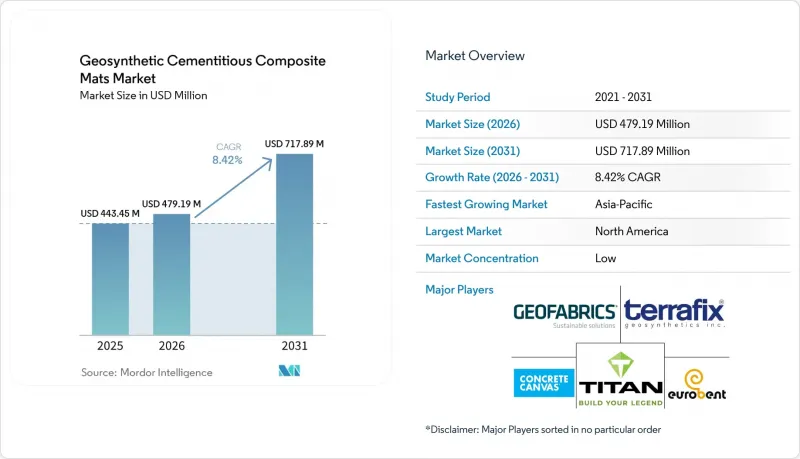
據 Mordor Intelligence 稱,2025 年地工合成水泥基複合墊的市場規模為 4.4345 億美元,2026 年為 4.7919 億美元,預計到 2031 年將達到 7.1789 億美元,在預測期(2026-2031 年)複合年成長率為 8.42%。
本報告按材料類型(聚丙烯 (PP)、聚酯及其他)、形態(寬卷材、模壓墊、批量卷材、板材)、應用領域(侵蝕控制、邊坡穩定及其他)、最終用途(土木工程、交通運輸及其他)和地區(亞太地區、北美地區、歐洲及其他)進行細分。市場預測以美元 (USD) 為單位。
全球地工合成水泥基複合墊市場趨勢及洞察
用於基礎設施維修和提升韌性的支出
基礎設施維修支出正在推動地工合成材料水泥複合材料墊(GCCM)市場的發展,因為許多公共設施需要在不造成長時間服務中斷的情況下進行維修。交通、排水、供水和能源走廊極易受到天氣相關災害的影響,從而擾亂當地社區和經濟活動。根據災害韌性基礎設施聯盟(Coalition for Disaster Resilient Infrastructure)的報告,交通和能源設施佔面臨災害風險的基礎設施的78%,凸顯了對韌性防護系統日益成長的需求。 GCCM適用於線性設施,在這些設施中,傳統澆築混凝土的使用受到諸多限制,例如通行限制、車道封閉和排水時間表等。由於受保護的水道、邊坡或堤防仍然是更廣泛的交通和供水系統的重要組成部分,專案業主通常需要能夠在有限的維護期限內完成的方案。因此,工期調整不僅是施工細節,更是材料選擇的關鍵因素。 ASTM D8364/D8364M-21 (2026) 為GCCM材料提供了一個經批准的規範框架,有助於採購過程中的技術審查。因此,如果專案業主優先考慮將快速安裝與明確的產品性能相結合的修復方法,地工合成材料水泥複合墊市場將會受益。
加快專案建設速度並降低人事費用
對於地工合成材料水泥複合墊(GCCM)市場而言,加快施工速度是一項實際優勢,尤其是在工期較短的工程中。 GCCM在工廠交付組裝後交付,無需現場混凝土攪拌和傳統模板。其搬運方式減少了在複雜地形、偏遠運河、鐵路排水溝和路堤等區域所需的設備數量。當承包商面臨通行限制或車道封閉或運河排水時間有限時,這一點尤其重要。 ASTM標準允許承包商和客戶根據明確的性能特徵來比較不同等級的材料,而無需僅依賴既定的方法。減少工人數量和縮短工期,從而最大限度地減少對關鍵基礎設施的影響,這一優勢體現得最為明顯。
與噴射混凝土、地工織物、拋石護坡和植被系統競爭。
根據專案類型和地區,地工合成材料水泥複合材料市場面臨多種競爭材料。噴射混凝土可能仍適用於需要高抗壓強度的結構性邊坡施工。在陸路可通達的大型河堤防護工程中,拋石護坡仍可能保持其成本優勢。當專案的主要目標是過濾和排水而非剛性防護時,僅使用地工織物的系統仍然有效。當生物多樣性和景觀保護優先於水力防護需求時,也可以選擇植被系統。地工合成材料水泥複合材料供應商需要證明,經認證的水泥複合材料在水力荷載、表面耐久性和縮短工期方面更具優勢。
細分市場分析
2025年,聚丙烯在地工合成材料水泥基複合墊的市佔率達41.84%。這一地位反映了其優異的抗紫外線性能、與乾式矽酸鹽水泥配方的相容性以及在主要產區的廣泛供應。在成熟的應用中,聚丙烯在性能和原料成本之間實現了良好的平衡。它適用於需要穩定地工織物背襯和可靠操作性能的水泥基層應用。這種材料適用於各種侵蝕控制、航道襯砌和土木工程項目。
在地工合成材料水泥基複合墊市場,複合材料預計到2031年將以8.91%的複合年成長率成長。這些材料將纖維、地工格網、排水、拉伸荷載傳遞和耐化學腐蝕等功能整合於單一安裝層中。它們不僅適用於表面保護,還適用於需要更多功能的項目,例如地基加固以及涉及化學和結構暴露的應用。聚酯基材繼續用於對拉伸強度要求極高的應用中,因為纖維的剛度可以降低在持續靜水壓力下的蠕變。當需要分層提供排水、加固和保護覆蓋層時,此特性尤其重要。整合產品可以簡化施工系統,並減少需要現場調整的接縫數量。在第八屆歐洲地工會議(EuroGeo 8)上發表的研究表明,來自受控回收流程的再生聚丙烯在技術上適用於高性能地工合成材料應用。此外,弗勞恩霍夫CCPE報告稱,加工再生聚丙烯和聚酯可以生產出符合工業要求的地工織物,這將進一步激發人們對含有再生材料的配方的興趣。
至2025年,寬幅捲材將佔據地工合成材料水泥複合墊43.56%的市場。這種形式適用於大型邊坡、堤防和水道,其長而連續的覆蓋範圍減少了接縫,簡化了安裝。寬幅卷材可使用標準工程機械在戶外基礎設施施工現場鋪設。在大規模排水和侵蝕控制項目中,材料的連續性和快速鋪設是影響採購決策的重要因素,因此寬幅卷材的應用尤其重要。此外,這種形式也適用於長距離水道和路邊工程。
在地工合成材料水泥複合墊市場,面板預計到2031年將以8.78%的複合年成長率成長。這一成長反映了空間受限的城市排水、水處理和維修項目中對模組化解決方案的需求。面板即使在狹小空間內也能實現更精確的尺寸控制,並簡化材料搬運。模壓墊可適應不規則的涵洞截面形狀、橋台和非標準水道形狀。在這些情況下,現場切割可能會產生廢棄物並帶來品質風險。捲材適用於市政雨水排水和交通基礎設施項目,這些項目需要在寬幅卷材全覆蓋鋪設和客製化單元之間找到折衷方案。面板和模壓墊的形狀設計便於臨時材料存儲,即使工人無法進入施工現場。這使得企劃團隊能夠選擇適合特定場地形狀和搬運限制的形狀。這些形狀選擇不僅適用於開放場地,也適用於空間受限的基礎設施維護工作。
區域分析
到2025年,北美將佔據地工合成材料水泥複合墊(GCCM)市場36.40%的佔有率。該地區市場成長的驅動力主要來自GCCM在交通運輸、雨水管理、排水和水利基礎設施領域的成熟應用。公路、堤防和排水系統需要定期維修,因此對施工干擾最小的材料需求旺盛。 ASTM D8364/D8364M-21 (2026) 為美國和加拿大的技術採購提供了廣泛認可的材料規範。西部水資源管理區也提供了相關的市場機遇,該地區對耐用的管道襯砌和灌溉系統的滲漏控制解決方案有著迫切的需求。該地區擁有成熟的專案實施環境,文件記錄、承包商專業知識和性能測試等因素都會影響材料的選擇。這促使該地區對擁有技術支援和本地快速供貨能力的供應商提出了更高的要求。
預計到2031年,亞太地區將以8.98%的複合年成長率成長,成為地工合成材料水泥複合墊市場成長最快的地區。灌溉管道維修、鐵路路堤建設、防洪和礦業基礎設施建設是該地區需求的主要驅動力。印尼偏遠地區的農業灌溉渠計畫表明,在傳統材料難以運輸的情況下,運輸便利性如何影響材料的選擇。印度和東南亞正透過水資源管理管理和基礎建設項目創造商機。中國憑藉其大規模的土木工程基礎設施以及對邊坡和排水防護的需求,仍然是一個重要的市場。日本、韓國和東南亞國協在水利應用和地震活躍地區對高規格產品的需求不斷成長。該地區的項目涵蓋大規模公共工程和偏遠地區項目,因此需要各種類型和性能等級的材料。因此,本地技術支援對於將廣泛的基礎設施需求轉化為專案層面的具體規格至關重要。
歐洲仍然是地工合成材料水泥複合材料墊的重要市場,這主要得益於鐵路營運商、公路管理機構和水路管理部門對維護和維修材料的需求。在該地區,性能文件和材料用量的減少在產品選擇中變得越來越重要。在南美洲,乾旱農業地區的水道、道路維修和灌溉網路投資推動了需求。在中東和非洲,運河襯砌、供水基礎設施和礦區保護支撐了需求。根據國際金融公司(IFC)統計,天災每年造成中低收入國家3,900億美元的損失,凸顯了韌性基礎建設投資的價值。隨著採購架構內對ASTM地工合成材料水泥複合材料規範的理解不斷加深,這些地區可能會進一步採用該產品。這個前景取決於工程師、承包商和採購團隊能否盡快熟悉地工合成材料水泥複合材料的規範和施工方法。水資源短缺、侵蝕風險和基礎設施有限等因素,使得人們有充分的理由考慮採用能夠快速安裝的襯砌解決方案。
其他好處
- Excel格式的市場預測(ME)表
- 3個月的分析師支持
目錄
第1章:引言
- 研究假設和市場定義
- 調查範圍
第2章:調查方法
第3章執行摘要
第4章 市場狀況
- 市場概覽
- 市場促進因素
- 用於基礎設施維修和提升韌性的支出
- 加快專案建設速度並降低人事費用
- 對侵蝕控制和邊坡防護的需求日益成長
- 投資水資源管理與運河維修
- 遠端部署和減少設備需求
- 減少材料用量及壓花碳纖維的優勢
- 市場限制因素
- 採用噴射混凝土、地工織物、拋石護坡和植被系統等方法進行競爭。
- 施工工藝差,承包商技術能力不足
- 關於GCCM規範、認證和採購方面的知識差距。
- 滿足水泥基混合料和聚合物背襯材料的循環利用要求。
- 價值鏈分析
- 波特五力分析
第5章 市場規模與成長預測
- 依材料類型
- 聚丙烯(PP)
- 聚酯纖維
- 複合材料
- 地工格網加筋型
- 其他材料類型
- 按形式
- 寬卷
- 模壓墊
- 大量捲
- 控制板
- 透過使用
- 侵蝕防治
- 邊坡穩定
- 地基加固
- 運河襯砌
- 收容系統
- 礦山通風牆和地面防護。
- 其他用途
- 按最終用途
- 土木工程
- 環境領域
- 運輸
- 水處理和水基礎設施
- 礦業
- 其他最終用途
- 按地區
- 亞太地區
- 中國
- 印度
- 日本
- 韓國
- 東南亞國協
- 其他亞太國家
- 北美洲
- 美國
- 加拿大
- 墨西哥
- 歐洲
- 德國
- 英國
- 法國
- 義大利
- 北歐國家
- 其他歐洲國家
- 南美洲
- 巴西
- 阿根廷
- 其他南美國家
- 中東和非洲
- 沙烏地阿拉伯
- 南非
- 其他中東和非洲國家
- 亞太地區
第6章 競爭情勢
- 市場集中度
- 策略趨勢
- 市佔率和排名分析
- 公司簡介
- Amplified Concrete Solutions Global, LLC
- Bermuller & Co GmbH
- Changzhou Pioneer Textile Technology Co.,Ltd.
- Concrete Canvas Ltd.
- Eurobent Sp. z oo
- Geofabrics Australasia Pty Ltd.
- Kenviro
- Officine Maccaferri Spa
- PGATech Group of Companies
- Shandong Longxiang New Materials Co., Ltd.
- SOPREMA
- TECHFABINDIA
- terrafix Geosynthetics
- Titan Environmental
第7章 市場機會與未來展望
According to Mordor Intelligence, the geosynthetic cementitious composite mats market size was valued at USD 443.45 million in 2025 and estimated to grow from USD 479.19 million in 2026 to reach USD 717.89 million by 2031, at a CAGR of 8.42% during the forecast period (2026-2031).
This report is Segmented by Material Type (Polypropylene (PP), Polyester, and More), Form (Wide Rolls, Preformed Mats, Batched Rolls, and Panels), Application (Erosion Control, Slope Stabilization, and More), End-Use (Civil Engineering, Transportation, and More), and Geography (Asia-Pacific, North America, Europe, and More). The Market Forecasts are Provided in Terms of Value (USD).
Global Geosynthetic Cementitious Composite Mats Market Trends and Insights
Infrastructure Rehabilitation and Resilience Spending
Infrastructure rehabilitation spending supports the geosynthetic cementitious composite mats market because many public assets need repair without lengthy service interruptions. Transport, drainage, water, and energy corridors are exposed to weather-related damage that can disrupt communities and economic activity. The Coalition for Disaster Resilient Infrastructure reported that transport and energy assets accounted for 78% of hazard-exposed infrastructure assets, increasing attention on resilient protection systems. GCCMs are suited to linear assets where access, lane closures, and dewatering schedules limit the use of conventional poured concrete. A protected channel, slope, or embankment can remain an essential part of a wider transport or water system, so project owners often need an approach that fits within a restricted maintenance period. This makes delivery timing an important part of material selection, not simply a construction detail. ASTM D8364/D8364M-21(2026) provides a recognized specification framework for GCCM materials, which supports technical review during procurement. The geosynthetic cementitious composite mats market can therefore benefit when project owners prioritize repair methods that combine rapid installation with defined product performance.
Faster Installation and Lower Project Labor Requirements
Faster installation is a practical advantage for the geosynthetic cementitious composite mats market, especially on sites with short work windows. GCCMs arrive as factory-assembled materials and avoid on-site concrete mixing and conventional formwork. Their handling approach can reduce equipment needs on difficult terrain, remote canals, railway drainage routes, and road embankments. This matters where contractors face constrained access or limited time for lane closures and canal dewatering. ASTM requirements help contractors and owners compare material classes against defined performance properties rather than rely solely on established methods. The benefit is strongest where a smaller work crew and a shorter installation sequence can reduce disruption to essential infrastructure.
Competition from Shotcrete, Geotextiles, Riprap and Vegetative Systems
The geosynthetic cementitious composite mats market faces different competing materials across project types and geographies. Shotcrete may remain suitable for structural slope work that requires high compressive strength. Riprap can retain a cost advantage on broad riverbank protection projects where land access is available. Geotextile-only systems remain relevant when filtration and drainage are the main project objectives rather than hard armor. Vegetative systems may be selected where biodiversity and visual landscape goals carry greater weight than hydraulic protection needs. GCCM suppliers need to demonstrate where certified cementitious composites offer a stronger fit for hydraulic loads, surface durability, and short installation windows.
Other drivers and restraints analyzed in the detailed report include:
- Rising Demand for Erosion and Slope Protection
- Water-Management and Canal-Rehabilitation Investments
- Installation Quality and Contractor Skill Gaps
For complete list of drivers and restraints, kindly check the Table Of Contents.
Segment Analysis
Polypropylene held 41.84% of the geosynthetic cementitious composite mats market share in 2025. Its position reflects UV stability, compatibility with dry Portland cement formulations, and broad availability across major producing regions. Polypropylene provides a practical balance between performance and raw material cost for established applications. It is used where the cementitious layer requires a stable geotextile backing and reliable handling properties. The material is relevant to a wide range of erosion-control, channel-lining, and civil engineering projects.
Composite is projected to grow at a CAGR of 8.91% through 2031 in the geosynthetic cementitious composite mats market. It combines fiber, geogrid, drainage, tensile-load-transfer, or chemical-resistance functions within one installed layer. It is suited to projects that need more than surface protection, such as ground reinforcement and applications with chemical or structural exposure. Polyester backings continue to serve tensile-critical requirements where fiber stiffness can reduce creep under sustained hydraulic load. This capability is relevant when project teams would otherwise need separate layers to provide drainage, reinforcement, and protective cover. Integrated products can simplify the installed system and reduce interfaces that require field coordination. Research presented at EuroGeo 8 found that recycled polypropylene from managed recycling streams can be technically suitable for high-performance geosynthetic uses. Fraunhofer CCPE also reported that recycled polypropylene and polyester can be processed into geotextiles meeting industrial requirements, supporting future interest in recycled-content formulations.
Wide rolls accounted for 43.56% of the geosynthetic cementitious composite mats market share in 2025. This format is suited to extensive slopes, embankments, and channels where long, continuous coverage reduces seams and installation effort. Wide rolls can be deployed with standard plant equipment on open infrastructure sites. Their use is particularly relevant to large drainage and erosion-control contracts where material continuity and rapid coverage influence procurement decisions. The format also remains practical for long-distance canal and roadside applications.
Panels are projected to expand at a CAGR of 8.78% through 2031 in the geosynthetic cementitious composite mats market. Their growth reflects demand for modular solutions in constrained urban drainage, water treatment, and rehabilitation projects. Panels can offer more precise dimensional control and easier material handling in confined spaces. Preformed mats address irregular culvert profiles, bridge abutments, and nonstandard canal geometries where site cutting could create waste or quality risks. Batched rolls serve municipal stormwater and transportation projects that need a middle ground between wide-roll coverage and customized units. Panel and preformed formats can also make material staging easier where crews have restricted access to the work area. They allow project teams to select a form that fits the geometry and handling limitations of a given site. These form options extend use beyond open sites and support maintenance work in space-constrained infrastructure.
Complete Report Scope:
- By Material Type
- Polypropylene (PP)
- Polyester
- Composite
- Geogrid-Reinforced
- Other Material Types
- By Form
- Wide Rolls
- Preformed Mats
- Batched Rolls
- Panels
- By Application
- Erosion Control
- Slope Stabilization
- Ground Reinforcement
- Canal Lining
- Containment Systems
- Mining Vent Walls and Surface Protection
- Other Applications
- By End-Use
- Civil Engineering
- Environmental Applications
- Transportation
- Water Treatment and Water Infrastructure
- Mining
- Other End-Uses
- By Geography
- Asia-Pacific
- China
- India
- Japan
- South Korea
- ASEAN Countries
- Rest of Asia-Pacific
- North America
- United States
- Canada
- Mexico
- Europe
- Germany
- United Kingdom
- France
- Italy
- NORDIC Countries
- Rest of Europe
- South America
- Brazil
- Argentina
- Rest of South America
- Middle-East and Africa
- Saudi Arabia
- South Africa
- Rest of Middle-East and Africa
- Asia-Pacific
Geography Analysis
North America held 36.40% of the geosynthetic cementitious composite mats market share in 2025. The region benefits from established use of GCCMs in transportation, stormwater management, drainage, and water infrastructure. Recurring rehabilitation needs in highways, embankments, and drainage systems support demand for materials that can be installed with limited service disruption. ASTM D8364/D8364M-21(2026) provides a recognized material specification that supports technical procurement in the United States and Canada. Western water districts also provide a relevant opportunity because irrigation systems need durable canal lining and seepage-control solutions. The region has a mature project-delivery environment in which documentation, contractor familiarity, and performance testing can affect material selection. This supports demand for suppliers that can provide technical evidence and responsive local availability.
Asia-Pacific is projected to expand at a CAGR of 8.98% through 2031, making it the fastest-growing geography in the geosynthetic cementitious composite mats market. Irrigation canal rehabilitation, rail embankment construction, flood protection, and mining infrastructure support regional demand. Remote agricultural canal projects in Indonesia have demonstrated how portability can influence material selection, where conventional inputs are difficult to transport. India and Southeast Asia offer opportunities through water management and infrastructure programs. China remains significant because of its large civil engineering base and need for slope and drainage protection. Japan, South Korea, and ASEAN countries add demand for higher-specification products in hydraulic and seismically active applications. The regional mix includes both large public works and remote local projects, which creates demand for several material forms and performance classes. Local technical support is therefore important for converting broad infrastructure needs into project-level specifications.
Europe remains important to the geosynthetic cementitious composite mats market because rail operators, motorway agencies, and waterway authorities require materials for maintenance and rehabilitation. Product selection in the region increasingly considers performance documentation and lower material use. South America provides demand through waterway investment, road rehabilitation, and irrigation networks in dry agricultural areas. The Middle-East and Africa are supported by canal lining, water-conveyance infrastructure, and mining site protection. The International Finance Corporation (IFC) reported that natural hazards cause USD 390 billion in annual losses in low- and middle-income countries, reinforcing the value of resilient infrastructure investment. These regions may see further adoption as procurement frameworks become more familiar with ASTM-based GCCM specifications. Their outlook depends on how quickly engineers, contractors, and procurement teams become comfortable specifying and installing GCCM materials. Water scarcity, erosion exposure, and infrastructure access limitations provide practical reasons for considering rapid-install lining solutions.
- Amplified Concrete Solutions Global, LLC
- Bermuller & Co GmbH
- Changzhou Pioneer Textile Technology Co.,Ltd.
- Concrete Canvas Ltd.
- Eurobent Sp. z o.o.
- Geofabrics Australasia Pty Ltd.
- Kenviro
- Officine Maccaferri Spa
- PGATech Group of Companies
- Shandong Longxiang New Materials Co., Ltd.
- SOPREMA
- TECHFABINDIA
- terrafix Geosynthetics
- Titan Environmental
Additional Benefits:
- The market estimate (ME) sheet in Excel format
- 3 months of analyst support
TABLE OF CONTENTS
1 Introduction
- 1.1 Study Assumptions and Market Definition
- 1.2 Scope of the Study
2 Research Methodology
3 Executive Summary
4 Market Landscape
- 4.1 Market Overview
- 4.2 Market Drivers
- 4.2.1 Infrastructure Rehabilitation and Resilience Spending
- 4.2.2 Faster Installation and Lower Project Labor Requirements
- 4.2.3 Rising Demand for Erosion and Slope Protection
- 4.2.4 Water-Management and Canal-Rehabilitation Investments
- 4.2.5 Remote-Site Deployment and Reduced Equipment Requirements
- 4.2.6 Lower Material Use and Embodied-Carbon Advantages
- 4.3 Market Restraints
- 4.3.1 Competition from Shotcrete, Geotextiles, Riprap and Vegetative Systems
- 4.3.2 Installation Quality and Contractor Skill Gaps
- 4.3.3 GCCM Specification, Certification and Procurement Familiarity Gaps
- 4.3.4 Cementitious Formulation and Polymer-Backing Exposure to Circularity Requirements
- 4.4 Value Chain Analysis
- 4.5 Porter's Five Forces Analysis
- 4.5.1 Threat of New Entrants
- 4.5.2 Bargaining Power of Suppliers
- 4.5.3 Bargaining Power of Buyers
- 4.5.4 Threat of Substitutes
- 4.5.5 Competitive Rivalry
5 Market Size and Growth Forecasts (Value)
- 5.1 By Material Type
- 5.1.1 Polypropylene (PP)
- 5.1.2 Polyester
- 5.1.3 Composite
- 5.1.4 Geogrid-Reinforced
- 5.1.5 Other Material Types
- 5.2 By Form
- 5.2.1 Wide Rolls
- 5.2.2 Preformed Mats
- 5.2.3 Batched Rolls
- 5.2.4 Panels
- 5.3 By Application
- 5.3.1 Erosion Control
- 5.3.2 Slope Stabilization
- 5.3.3 Ground Reinforcement
- 5.3.4 Canal Lining
- 5.3.5 Containment Systems
- 5.3.6 Mining Vent Walls and Surface Protection
- 5.3.7 Other Applications
- 5.4 By End-Use
- 5.4.1 Civil Engineering
- 5.4.2 Environmental Applications
- 5.4.3 Transportation
- 5.4.4 Water Treatment and Water Infrastructure
- 5.4.5 Mining
- 5.4.6 Other End-Uses
- 5.5 By Geography
- 5.5.1 Asia-Pacific
- 5.5.1.1 China
- 5.5.1.2 India
- 5.5.1.3 Japan
- 5.5.1.4 South Korea
- 5.5.1.5 ASEAN Countries
- 5.5.1.6 Rest of Asia-Pacific
- 5.5.2 North America
- 5.5.2.1 United States
- 5.5.2.2 Canada
- 5.5.2.3 Mexico
- 5.5.3 Europe
- 5.5.3.1 Germany
- 5.5.3.2 United Kingdom
- 5.5.3.3 France
- 5.5.3.4 Italy
- 5.5.3.5 NORDIC Countries
- 5.5.3.6 Rest of Europe
- 5.5.4 South America
- 5.5.4.1 Brazil
- 5.5.4.2 Argentina
- 5.5.4.3 Rest of South America
- 5.5.5 Middle-East and Africa
- 5.5.5.1 Saudi Arabia
- 5.5.5.2 South Africa
- 5.5.5.3 Rest of Middle-East and Africa
- 5.5.1 Asia-Pacific
6 Competitive Landscape
- 6.1 Market Concentration
- 6.2 Strategic Moves
- 6.3 Market Share (%)/Ranking Analysis
- 6.4 Company Profiles (includes Global Overview, Market Overview, Core Segments, Financials as available, Strategic Information, Products and Services, and Recent Developments)
- 6.4.1 Amplified Concrete Solutions Global, LLC
- 6.4.2 Bermuller & Co GmbH
- 6.4.3 Changzhou Pioneer Textile Technology Co.,Ltd.
- 6.4.4 Concrete Canvas Ltd.
- 6.4.5 Eurobent Sp. z o.o.
- 6.4.6 Geofabrics Australasia Pty Ltd.
- 6.4.7 Kenviro
- 6.4.8 Officine Maccaferri Spa
- 6.4.9 PGATech Group of Companies
- 6.4.10 Shandong Longxiang New Materials Co., Ltd.
- 6.4.11 SOPREMA
- 6.4.12 TECHFABINDIA
- 6.4.13 terrafix Geosynthetics
- 6.4.14 Titan Environmental
7 Market Opportunities and Future Outlook
- 7.1 White-Space and Unmet-Need Assessment

 地工合成廢水處理產品:市場佔有率分析、產業趨勢與統計、成長預測(2026-2031 年)地工合成黏土襯墊:市場佔有率分析、產業趨勢與統計、成長預測(2026-2031)
 地工合成材料市場-2026-2032年全球市場預測
 全球地工合成材料市場:依產品類型、最終用途及地區分類-預測至2031年
 地工合成材料市場報告:依產品、類型、材料、應用和地區分類,2026-2034年
 2026年全球地工合成材料市場報告2026年全球地工合成材料網格市場報告地工合成黏土襯墊市場:依產品類型、應用、最終用途及通路分類-2026-2032年全球市場預測
 全球地工合成材料市場規模、佔有率、趨勢和成長分析報告(2026-2034年)
 地工地工合成材料市場-全球產業規模、佔有率、趨勢、機會及預測(依材料、類型、功能、應用、區域及競爭格局分類,2021-2031年)