


 |
市場調查報告書
商品編碼
2119105
地工合成黏土襯墊:市場佔有率分析、產業趨勢與統計、成長預測(2026-2031)Geosynthetic Clay Liners - Market Share Analysis, Industry Trends & Statistics, Growth Forecasts (2026 - 2031) |
||||||

※ 本網頁內容可能與最新版本有所差異。詳細情況請與我們聯繫。
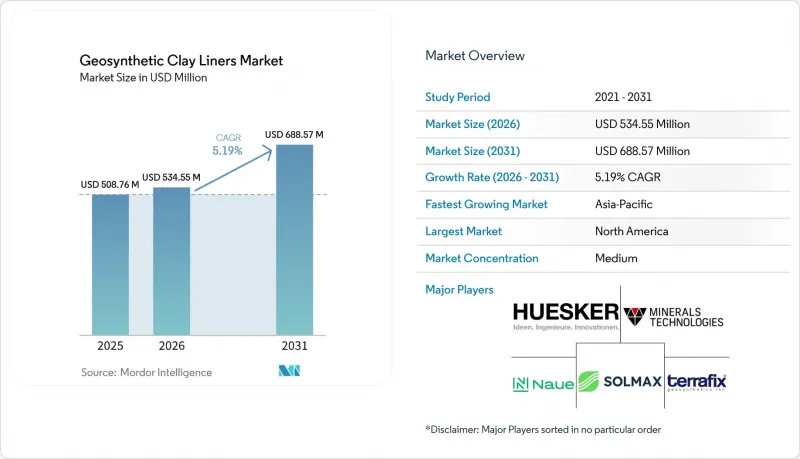
根據 Mordor Intelligence 預測,地工合成黏土襯墊市場規模預計將在 2025 年達到 5.0876 億美元,並從 2026 年的 5.3455 億美元成長到 2031 年的 6.8857 億美元,在預測期(2026-2031 年)內複合年成長率為 5.19%。
本報告按產品類型(增強型地工合成黏土襯墊、非增強型地工合成黏土襯墊、多成分地工合成黏土襯墊和塗層地工合成黏土襯墊)、應用領域(掩埋、圍堰和污水處理、道路和土木工程、採礦及其他應用)以及地區(亞太地區、北美地區、歐洲地區、南美地區以及中東和非洲地區進行細分。市場預測以美元計價。
全球地工合成黏土襯墊市場趨勢及洞察
對掩埋和地下水保護提出更嚴格的要求。
地工合成黏土襯墊市場與定義垃圾掩埋掩埋圍護要求的環境法規密切相關。美國環保署 (EPA) D 子標題的要求和歐盟掩埋指令是掩埋計畫的關鍵合規標準。德國於 2026 年 3 月 2 日發布了修訂後的 BQS 5-5 標準(此前於 2025 年 4 月進行了修訂)。此標準強制要求對用於掩埋表面密封的地工合成黏土襯墊 (GCL) 進行陽離子交換耐久性測試和獨立的生產監測。這些要求優先考慮性能已驗證的材料,這可能會限制在不適合進行大規模土方工程的地區使用壓實黏土。在土耳其,都市固態廢棄物掩埋的數量從 2003 年的 15 個增加到 2022 年的 93 個,這表明法規和技術能力如何能夠擴大設計良好的圍護系統的應用範圍。此外,即使在較舊的掩埋單元中,GCL 也可以適應垂直和水平空間有限的場地,為掩埋場的封閉提供了絕佳的機會。
擴建礦山滲濾液堆場和尾礦庫
由於尾礦儲存標準日益嚴格,地工合成黏土襯墊 (GCL) 市場正在成長。國際礦業與金屬理事會 (ICMM) 於 2025 年 2 月修訂了其尾礦管理指南。博利登塔拉礦業公司 (Boliden Tara Mines) 根據其自我評估,於 2025 年 8 月報告完全符合全球尾礦管理行業標準。其第六階段設施採用複合 GCL 和高密度聚苯乙烯(HDPE) 襯墊系統作為主要屏障。 Tech Resources 公司也於 2025 年 8 月 5 日報告稱其運作的尾礦儲存設施符合該標準。由於滲濾液具有腐蝕性和揮發性,堆浸墊和蒸發池的合規性需要考慮。 GCL 的應用範圍也擴展到礦山回收領域,毛細管屏障系統可以減少酸的產生和滲濾液的流出。
腐蝕性液體的化學不相容性和陽離子交換
在涉及腐蝕性液體流動的專案中,化學相容性問題會限制地工合成黏土襯墊市場的成長。 2025 年的一篇論文研究了傾斜地工止水膜GCL 系統的滲漏情況,結果顯示滲漏率隨滲濾液水頭呈現非線性變化。因此,即使膨潤土發生輕微劣化,在運作條件下也會產生更大的影響。 Knight Piesold 的案例研究記錄了對照試驗中膨脹指數為 29,而實際現場滲濾液中的膨脹指數則降至 8。由於提案產品的性能不適用於現場化學環境,因此被否決。在複雜的採礦專案中,相容性測試可能需要 8 到 12 週的時間。這段時間可能會延誤採購,因此,當耐化學性是主要選擇因素時,高密度聚乙烯 (HDPE)地工止水膜往往是更優的選擇。
細分市場分析
2025年,增強型地工合成黏土襯墊(GCL)的銷售額佔比達到57.34%,憑藉其在垃圾掩埋掩埋襯墊、水庫和礦山邊坡等領域的廣泛應用,推動了地工合成黏土襯墊市場的發展。針刺增強型GCL能夠提供在回填荷載較大且邊坡條件複雜的情況下所需的抗剪強度。這種結構採用互鎖纖維將地工織物基層材料與膨潤土芯材黏合在一起。德國2026年版BQS 5-5標準規定,增強纖維必須在80度C下進行剪切蠕變試驗。這項要求提高了用於掩埋密封的增強型產品的技術標準。能夠提供試驗結果證明並建立受控生產體系的供應商將獲得優先待遇。
在地工合成黏土襯墊(GCL)市場,無筋GCL仍廣泛應用於緩坡土木工程專案。這些產品適用於成本要求不高且內部抗剪強度要求不高的應用,例如路基防水和水庫襯砌。預計從2026年到2031年,多成分和塗層GCL的複合年成長率將達到6.23%。這些產品的設計兼具阻隔功能,能夠有效控制水分、減少氣體排放。奧地利標準ONORM S 2073:2026規定,用於掩埋結構的地工合成密封膜的最低使用壽命為50年。這使得能夠承受長期使用的複合系統變得更加重要。因此,地工合成黏土襯墊行業正從選擇標準材料轉向根據專案需求選擇產品。
區域分析
到2025年,北美將佔全球銷售額的35.48%。該地區的主要需求來自掩埋單元和受美國環保署(EPA)法規約束的危險廢棄物的封存活動。美國的需求正從新建掩埋轉向封場和封頂。這有利於在場地限制導致壓實粘土使用受限的情況下使用高性能產品。由於加拿大採礦業的發展和墨西哥工業的擴張,封存項目數量正在增加。該地區仍然非常重要,因為其完善的法規、檢測能力和成熟的施工規範高級產品提供了支援。
預計2026年至2031年,亞太地區地工合成黏土襯墊市場將以6.45%的複合年成長率成長,成為所有地區中成長最快的市場。該地區的需求成長主要受垃圾掩埋掩埋監管政策變化、基礎設施建設、礦山再生和污水處理項目等因素的共同推動。中國國家標準GB/T 32151.49-2026對廢棄物掩埋業者溫室氣體計算和報告提出了要求,促使人們更加關注掩埋場的工程化防滲措施。印度、澳洲、韓國和東南亞國協透過基礎建設、水處理和礦山再生等項目為市場做出貢獻。此外,該地區的發展前景也反映出,在對性能要求嚴格的項目中,技術先進的地工合成黏土襯墊(GCL)的應用日益廣泛。
在地工合成黏土襯墊市場,歐洲由德國、法國、英國和北歐國家主導。歐盟的掩埋指令和各國的相關要求推動了採購,而德國的BQS 5-5 2026標準則為該地區提供了技術指南。在南美洲,市場主要集中在智利的銅浸出計畫和巴西的廢棄物管理項目。在中東和非洲,水資源短缺是基礎設施建設選擇的重要因素,這表明水庫襯砌和管道防水俱有長期應用潛力。沙烏地阿拉伯和南非就是這些與水資源相關應用的典型例子。這些地區也需要發展相應的施工能力和材料測試體系,以實現地工合成黏土襯墊的永續應用。
其他好處:
- Excel格式的市場預測(ME)表
- 3個月的分析師支持
目錄
第1章:引言
- 研究假設和市場定義
- 調查範圍
第2章:調查方法
第3章執行摘要
第4章 市場狀況
- 市場概覽
- 市場促進因素
- 加強對掩埋和地下水保護的監管
- 與壓縮黏土襯墊相比,節省空間且安裝快速。
- 礦山滲濾液收集池和尾礦儲存設施的擴建
- 增加對水資源管理和污水基礎設施的投資
- 特定場所對高濃度滲濾液的需求,用於聚合物增強型GCL。
- 複合屏障結構中所採用的GCL的性能規格
- 市場限制因素
- 腐蝕性液體中的化學不相容性和陽離子交換
- 安裝過程中造成的損壞、過早吸水、品質保證缺陷。
- 跨應用和跨司法管轄區的標準化局限性
- 長期乾燥、熱循環和氣體暴露條件下的不確定性。
- 價值鏈分析
- 波特五力分析
第5章 市場規模與成長預測
- 依產品類型
- 增強型GCL
- 非增強型GCL
- 多成分和塗層GCL
- 透過使用
- 掩埋土地
- 圍堰和污水處理
- 道路和土木工程
- 礦業
- 其他用途
- 按地區
- 亞太地區
- 中國
- 印度
- 日本
- 韓國
- 東南亞國協
- 其他亞太國家
- 北美洲
- 美國
- 加拿大
- 墨西哥
- 歐洲
- 德國
- 英國
- 法國
- 義大利
- 西班牙
- 北歐國家
- 俄羅斯
- 其他歐洲國家
- 南美洲
- 巴西
- 阿根廷
- 其他南美國家
- 中東和非洲
- 沙烏地阿拉伯
- 南非
- 其他中東和非洲國家
- 亞太地區
第6章 競爭情勢
- 市場集中度
- 策略趨勢
- 市佔率和排名分析
- 公司簡介
- ABG Limited
- AGRU America, Inc.
- Garware Technical Fibres Ltd.
- Geofabrics Australasia Pty Ltd.
- Geo-Synthetics Systems LLC(GSI)
- GGL
- Global Synthetics
- HUESKER International
- Maharshee Geomembrane(India)Pvt. Ltd.
- Minerals Technologies Inc.
- Naue GmbH & Co. KG
- Polyfabrics Australasia Pty Ltd
- Shanghai Yingfan Engineering Material Co., Ltd.
- Solmax
- terrafix Geosynthetics
- Wall Tag Pte Ltd.
第7章 市場機會與未來展望
According to Mordor Intelligence, the geosynthetic clay liners market was valued at USD 508.76 million in 2025 and is estimated to grow from USD 534.55 million in 2026 to reach USD 688.57 million by 2031, at a CAGR of 5.19% during the forecast period (2026-2031).
This report is Segmented by Product Type (Reinforced GCLs, Non-Reinforced GCLs, and Multicomponent and Coated GCLs), Application (Landfills, Containment and Wastewater Treatment, Roadways and Civil Construction, Mining, and Other Applications), and Geography (Asia-Pacific, North America, Europe, South America, and Middle-East and Africa). The Market Forecasts are Provided in Terms of Value (USD).
Global Geosynthetic Clay Liners Market Trends and Insights
Tightening Landfill and Groundwater Protection Requirements
The geosynthetic clay liners market is closely tied to environmental rules that define landfill containment requirements. US EPA Subtitle D requirements and the EU Landfill Directive provide important compliance baselines for landfill projects. Germany published the revised BQS 5-5 on March 2, 2026, following its April 2025 revision. The standard requires cation-exchange durability tests and independent production monitoring for GCLs used in landfill surface seals. These requirements favor materials with documented performance and may limit the use of compacted clay where extensive earthworks are impractical. Turkey increased its municipal solid waste landfill count from 15 in 2003 to 93 in 2022, showing how regulation and engineering capacity can widen the use of engineered containment systems. Older landfill cells also create a closure opportunity because GCLs can fit sites with limited vertical and lateral space.
Expansion of Mining Leach Pads and Tailings Containment
The geosynthetic clay liners market is gaining from more demanding tailings storage practices. The International Council on Mining and Metals updated its tailings management guidance in February 2025. Boliden Tara Mines reported full self-assessed conformance with the Global Industry Standard on Tailings Management in August 2025. Its Stage 6 facility uses a composite GCL and High-Density Polyethylene (HDPE) liner system as the primary barrier. Teck Resources also reported conformance for its inactive tailings storage facilities on August 5, 2025. Heap leach pads and evaporation ponds require compatibility work because their liquids can have aggressive and variable chemistry. GCL use also extends to mine reclamation, where capillary barrier systems can reduce acid generation and leachate flux.
Chemical Incompatibility and Cation Exchange in Aggressive Liquids
Chemical compatibility can restrict the geosynthetic clay liners market in projects with aggressive liquid streams. A 2025 paper examined leakage through inclined geomembrane-GCL systems and found that leakage changes nonlinearly with leachate head. Minor bentonite degradation can therefore have larger consequences under operating conditions. A Knight Piesold case study recorded a control swell index of 29 that fell to 8 in the actual site leachate. The proposed product was disqualified because its properties did not suit the site chemistry. Compatibility testing can take 8 to 12 weeks on complex mining projects. This timing can slow procurement and favor HDPE geomembranes when chemical resistance is the primary selection factor.
Other drivers and restraints analyzed in the detailed report include:
- Rising Water-Containment and Wastewater Infrastructure Investment
- Site-Specific Polymer-Enhanced GCL Demand for Aggressive Leachates
- Installation Damage, Premature Hydration, and Quality Assurance Failures
For complete list of drivers and restraints, kindly check the Table Of Contents.
Segment Analysis
Reinforced GCLs held 57.34% of revenue in 2025 and led the geosynthetic clay liners market through broad use in landfill liners, reservoirs, and mining slopes. Needle-punch reinforcement supports the shear strength required where overburden loads or slopes are demanding. The structure uses interlocking fibers to connect geotextile carriers with the bentonite core. Germany's 2026 BQS 5-5 includes shear-creep testing at 80 °C for reinforcing fibers. This requirement raises the technical standard for reinforced products in landfill sealing. It also favors suppliers that can provide test evidence and controlled production.
Within the geosynthetic clay liners market, non-reinforced GCLs continue to serve low-slope civil construction work. Road subgrade waterproofing and pond lining can use these products where lower cost matters and high internal shear strength is not needed. Multicomponent and coated GCLs are forecast to expand at a 6.23% CAGR from 2026 to 2031. Their design combines barrier functions that can support hydraulic containment and gas attenuation. Austria's ONORM S 2073:2026 sets a minimum 50-year service-life requirement for geosynthetic sealing membranes used in landfill structures. These places added importance to composite systems built for long service periods. The geosynthetic clay liners industry is therefore shifting toward product selection based on project conditions rather than a standard material choice.
Complete Report Scope:
- By Product Type
- Reinforced GCLs
- Non-Reinforced GCLs
- Multicomponent and Coated GCLs
- By Application
- Landfills
- Containment and Wastewater Treatment
- Roadways and civil construction
- Mining
- Other Applications
- By Geography
- Asia-Pacific
- China
- India
- Japan
- South Korea
- ASEAN Countries
- Rest of Asia-Pacific
- North America
- United States
- Canada
- Mexico
- Europe
- Germany
- United Kingdom
- France
- Italy
- Spain
- NORDIC Countries
- Russia
- Rest of Europe
- South America
- Brazil
- Argentina
- Rest of South America
- Middle-East and Africa
- Saudi Arabia
- South Africa
- Rest of Middle-East and Africa
- Asia-Pacific
Geography Analysis
North America held 35.48% of global revenue in 2025. EPA-regulated landfill cells and hazardous-waste containment activity provide the region's core demand base. The United States' demand is shifting from new landfill construction toward closure and cap installation. This favors high-performance grades where land availability limits the use of compacted clay. Canada's mining sector and Mexico's industrial expansion add containment projects. The region remains important because regulation, testing capacity, and established installation practices support premium products.
Asia-Pacific is forecast to grow at a 6.45% CAGR from 2026 to 2031, the fastest regional rate in the geosynthetic clay liners market. The region combines landfill rule changes, infrastructure construction, mining rehabilitation, and wastewater projects. China's national standard GB/T 32151.49-2026 establishes greenhouse gas accounting and reporting requirements for waste landfill operators. This adds attention to engineered containment at landfill facilities. India, Australia, South Korea, and ASEAN countries contribute through infrastructure, water treatment, and mine rehabilitation. The regional outlook also reflects wider use of technically advanced GCLs in projects with demanding performance requirements.
For the geosynthetic clay liners market, Europe is centered on Germany, France, the United Kingdom, and the Nordic countries. The EU Landfill Directive and national requirements guide procurement, while Germany's 2026 BQS 5-5 has become a technical reference for the region. South America is concentrated in Chile's copper leach activity and Brazil's waste management projects. The Middle-East and Africa have long-term potential in reservoir lining and canal waterproofing as water scarcity shapes infrastructure choices. Saudi Arabia and South Africa represent examples of these water-related uses. These regions also need appropriate installation capacity and material testing for sustained adoption.
- ABG Limited
- AGRU America, Inc.
- Garware Technical Fibres Ltd.
- Geofabrics Australasia Pty Ltd.
- Geo-Synthetics Systems LLC (GSI)
- GGL
- Global Synthetics
- HUESKER International
- Maharshee Geomembrane (India) Pvt. Ltd.
- Minerals Technologies Inc.
- Naue GmbH & Co. KG
- Polyfabrics Australasia Pty Ltd
- Shanghai Yingfan Engineering Material Co., Ltd.
- Solmax
- terrafix Geosynthetics
- Wall Tag Pte Ltd.
Additional Benefits:
- The market estimate (ME) sheet in Excel format
- 3 months of analyst support
TABLE OF CONTENTS
1 Introduction
- 1.1 Study Assumptions and Market Definition
- 1.2 Scope of the Study
2 Research Methodology
3 Executive Summary
4 Market Landscape
- 4.1 Market Overview
- 4.2 Market Drivers
- 4.2.1 Tightening Landfill and Groundwater Protection Requirements
- 4.2.2 Space-Saving and Faster Installation Versus Compacted Clay Liners
- 4.2.3 Expansion of Mining Leach Pads and Tailings Containment
- 4.2.4 Rising Water-Containment and Wastewater Infrastructure Investment
- 4.2.5 Site-Specific Polymer-Enhanced GCL Demand for Aggressive Leachates
- 4.2.6 GCL Performance Specifications Embedded in Composite Barrier Designs
- 4.3 Market Restraints
- 4.3.1 Chemical Incompatibility and Cation Exchange in Aggressive Liquids
- 4.3.2 Installation Damage, Premature Hydration, and Quality Assurance Failures
- 4.3.3 Limited Standardization Across Applications and Jurisdictions
- 4.3.4 Long-Term Uncertainty Under Desiccation, Thermal Cycling, and Gas Exposure
- 4.4 Value Chain Analysis
- 4.5 Porter's Five Forces Analysis
- 4.5.1 Threat of New Entrants
- 4.5.2 Bargaining Power of Suppliers
- 4.5.3 Bargaining Power of Buyers
- 4.5.4 Threat of Substitutes
- 4.5.5 Competitive Rivalry
5 Market Size and Growth Forecasts (Value)
- 5.1 By Product Type
- 5.1.1 Reinforced GCLs
- 5.1.2 Non-Reinforced GCLs
- 5.1.3 Multicomponent and Coated GCLs
- 5.2 By Application
- 5.2.1 Landfills
- 5.2.2 Containment and Wastewater Treatment
- 5.2.3 Roadways and civil construction
- 5.2.4 Mining
- 5.2.5 Other Applications
- 5.3 By Geography
- 5.3.1 Asia-Pacific
- 5.3.1.1 China
- 5.3.1.2 India
- 5.3.1.3 Japan
- 5.3.1.4 South Korea
- 5.3.1.5 ASEAN Countries
- 5.3.1.6 Rest of Asia-Pacific
- 5.3.2 North America
- 5.3.2.1 United States
- 5.3.2.2 Canada
- 5.3.2.3 Mexico
- 5.3.3 Europe
- 5.3.3.1 Germany
- 5.3.3.2 United Kingdom
- 5.3.3.3 France
- 5.3.3.4 Italy
- 5.3.3.5 Spain
- 5.3.3.6 NORDIC Countries
- 5.3.3.7 Russia
- 5.3.3.8 Rest of Europe
- 5.3.4 South America
- 5.3.4.1 Brazil
- 5.3.4.2 Argentina
- 5.3.4.3 Rest of South America
- 5.3.5 Middle-East and Africa
- 5.3.5.1 Saudi Arabia
- 5.3.5.2 South Africa
- 5.3.5.3 Rest of Middle-East and Africa
- 5.3.1 Asia-Pacific
6 Competitive Landscape
- 6.1 Market Concentration
- 6.2 Strategic Moves
- 6.3 Market Share (%)/Ranking Analysis
- 6.4 Company Profiles (includes Global Overview, Market Overview, Core Segments, Financials as available, Strategic Information, Products and Services, and Recent Developments)
- 6.4.1 ABG Limited
- 6.4.2 AGRU America, Inc.
- 6.4.3 Garware Technical Fibres Ltd.
- 6.4.4 Geofabrics Australasia Pty Ltd.
- 6.4.5 Geo-Synthetics Systems LLC (GSI)
- 6.4.6 GGL
- 6.4.7 Global Synthetics
- 6.4.8 HUESKER International
- 6.4.9 Maharshee Geomembrane (India) Pvt. Ltd.
- 6.4.10 Minerals Technologies Inc.
- 6.4.11 Naue GmbH & Co. KG
- 6.4.12 Polyfabrics Australasia Pty Ltd
- 6.4.13 Shanghai Yingfan Engineering Material Co., Ltd.
- 6.4.14 Solmax
- 6.4.15 terrafix Geosynthetics
- 6.4.16 Wall Tag Pte Ltd.
7 Market Opportunities and Future Outlook
- 7.1 White-Space and Unmet-Need Assessment

 地工合成水泥基複合墊:市場佔有率分析、行業趨勢和統計數據以及成長預測(2026-2031 年)地工合成廢水處理產品:市場佔有率分析、產業趨勢與統計、成長預測(2026-2031 年)
 地工合成材料市場-2026-2032年全球市場預測
 全球地工合成材料市場:依產品類型、最終用途及地區分類-預測至2031年
 地工合成材料市場報告:依產品、類型、材料、應用和地區分類,2026-2034年
 2026年全球地工合成材料市場報告2026年全球地工合成材料網格市場報告地工合成黏土襯墊市場:依產品類型、應用、最終用途及通路分類-2026-2032年全球市場預測
 全球地工合成材料市場規模、佔有率、趨勢和成長分析報告(2026-2034年)
 地工地工合成材料市場-全球產業規模、佔有率、趨勢、機會及預測(依材料、類型、功能、應用、區域及競爭格局分類,2021-2031年)