


 |
市場調查報告書
商品編碼
2119104
地工合成廢水處理產品:市場佔有率分析、產業趨勢與統計、成長預測(2026-2031 年)Geosynthetic Drainage Products - Market Share Analysis, Industry Trends & Statistics, Growth Forecasts (2026 - 2031) |
||||||

※ 本網頁內容可能與最新版本有所差異。詳細情況請與我們聯繫。
根據 Mordor Intelligence 預測,地工合成廢水處理產品的市場規模預計在 2025 年達到 63.6 億美元,從 2026 年的 68.7 億美元成長到 2031 年的 102.1 億美元,在預測期(2026-2031 年內預計複合年成長率為 8.23%。
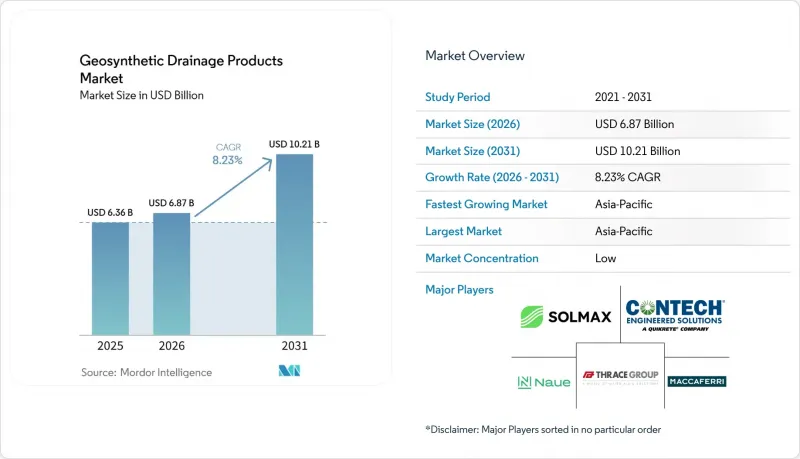
本報告按產品類型(地工複合物排水產品、地工織網等)、材料(聚丙烯、聚乙烯等)、應用領域(道路和高速公路建設、掩埋和廢棄物管理等)以及地區(亞太地區、北美地區、歐洲地區、南美地區、中東和非洲地區)進行細分。市場預測以美元計價。
全球地工合成廢水處理產品市場趨勢及洞察
基礎建設主導建設投資
政府基礎設施支出為地工合成材料排水產品市場提供了穩定的專案需求來源。美國兩黨基礎設施法案撥款3500億美元用於公路項目,目標是在2026年9月前完成,並支持道路下部結構和橋樑引道的排水規範。各州交通部門正在採用地工複合物層來應對凍融循環和靜水壓力,這些因素會縮短路面的使用壽命。中國的「十五」規劃支持交通網路和水資源管理系統建設,為排水材料創造了多年的採購基礎。在印度,預製垂直排水管(PVD)和排水板正被用於農村道路和高速公路走廊專案的軟土地基改良工程。納入長期公共工程項目的規範能夠維持需求,即使在最初的資金籌措宣布之後也能如此,這使得認證供應商在整個地工合成排水產品市場中擁有更高的知名度,並最大限度地減少了因個別項目延誤、競標變更或施工進度區域差異而造成的干擾。
強制性掩埋和污水處理
關於掩埋滲濾液收集和都市污水管網的法規正在推動對經認證的排水地工地工複合物的需求。美國掩埋掩埋場法規強制要求在新建的都市固態廢棄物處理區使用符合水力傳導率要求的排水層,而地工複合物系統只需比礫石更薄的安裝厚度即可滿足此要求。隨著各國環境法規日益嚴格,新興市場現有的單層襯裡掩埋單元可能需要升級為雙層襯裡結構。此類維修需要在襯裡系統之間設置排水層,這可能會擴大地工合成排水產品的潛在市場。此外,沙烏地阿拉伯「2030願景」計畫下污水處理設施的擴建也推動了以管網控制為重點的排水系統的需求。與隨意進行的建設活動相比,符合監管要求的採購條件更具可預測性,因為即使整體建設活動放緩或項目優先級發生變化,掩埋、污水處理設施和管網設施的運營商也必須維持性能要求。
波動性聚丙烯和樹脂價格
在整個地工合成廢水處理產品市場中,聚丙烯在地工複合物製造的原料成本中佔比很高,因此樹脂價格波動構成重大的商業性風險。受中東丙烯供應鏈中斷的影響,北美聚丙烯現貨價格在2026年上半年上漲。歐洲合約價格也出現上漲,但在2026年6月進入回檔階段。如果樹脂成本在交付內上漲,簽訂12至18個月固定價格公共合約的供應商可能會面臨利潤率壓力。多年期樹脂供應合約和垂直整合的擠出能力可以降低這種風險。地工合成廢水處理產品市場中小規模的加工商可能缺乏應對價格波動或投資認證和產品開發的能力,這可能會擴大低成本本地供應商與技術先進、獲得公共資格認證的供應商之間的差距。
細分市場分析
2025年,地工複合物將佔據地工合成排水產品市場35.67%的佔有率,這主要得益於其在路基、掩埋底部排水、擋土牆後排水和屋頂綠化排水系統中的應用。在場地受限的情況下,當設計人員需要控制水流、減少材料搬運並簡化施工物流時,地工複合物複合材料可以取代傳統的顆粒層。根據所提供的技術證據,地工複合物在美國材料與試驗協會(ASTM)D4716測試中的滲透係數為10⁻³至10⁻⁴ m²/s。 GeoFrontiers 2025研究也表明,基於等效性的替代方法可以減少採石量、運輸量和施工時間。由於地工網具有連續的平面流道,能夠限制圍堰蓋層下的水頭壓力,因此地工織網仍被廣泛應用於掩埋滲濾液收集。排水板、預製芯材、管式排水管和毛細阻隔地工複合物被用於地下室牆、平台甲板、隧道牆以及特殊的建築和農業應用中,在這些應用中,整合過濾器可以減少現場工作量。
預計到2031年,預製垂直排水管的複合年成長率將達到8.63%,成為地工合成排水產品市場中成長最快的產品類型。在亞太地區,高鐵、機場、港口和海岸掩埋項目的不斷增加,使得開發商在建造大型結構和路面之前,對軟土地基進行壓實的需求日益成長。一項針對拉蒙岸北環路計畫的研究發現,與自然排水相比,將預製垂直排水管間距設定為1.5-2公尺可以提高壓實速度。此方法適用於整個交通走廊,該走廊的軟黏土地基情況類似。預製垂直排水管可以降低沉降的不確定性,並在施工開始前製定更可預測的施工進度。一項發表於2025年的研究表明,將導電聚合物網路與地工合成相結合,可以監測土壤變形,從而使預製垂直排水管從被動排水組件轉變為可監測的基礎設施系統。
區域分析
截至2025年,亞太地區將佔地工合成排水產品市場41.23%的佔有率,預計到2031年將以9.03%的複合年成長率成長。中國於2026年7月1日生效的JTG/T 3332-2026標準更新了新建國道工程中地工合成材料的規範,並提高了排水材料的性能標準要求。在印度,預製垂直排水管(PVD)的需求受到農村道路連通性舉措、智慧城市專案以及易澇大都會圈走廊地基改良工程的推動。在越南、印尼和菲律賓,軟土地基交通網路的擴張正在推進,PVD正被用作一項關鍵的工程工具。在韓國,隨著城市改造計畫的推進,薄型排水地工複合物在地下室和裙樓建設的應用正在推廣。同時,在日本,由於基礎設施老化和抗震加固工程,需要能夠在地面變形的情況下保持水力性能的系統。 2026年7月,麥卡菲里宣布位於印度坎達萊的工廠將成為集團在全球的第二大生產基地。這反映了該地區在地工合成廢水處理產品市場的重要性。
北美地區的需求主要受《基礎設施投資與就業法案》(IIJA)資助的交通基礎設施項目以及美國環保署(EPA)關於掩埋水資源管理和雨水徑流的要求所驅動。聯邦政府批准撥款後,各州政府可以透過多年專案計畫購買指定的排水系統,因為大型公路工程可能需要三到五年才能完成。 2026年6月,Maccaferri在南卡羅來納州福特勞恩開設了一家工廠,將本地生產和工程支援整合到美國主要專案集群附近。在歐洲,鐵路走廊維修、氣候適應沿海和河岸建設以及歐盟機制資助的基礎設施項目支撐了需求。德語區(德國、奧地利和瑞士)以及比荷盧經濟聯盟國家是高規格需求的核心,它們的承包商網路和國家核准體系往往傾向於選擇擁有良好業績記錄和合規記錄的供應商。
在南美洲,巴西的私人道路特許經營項目為道路排水領域帶來了商機;智利和秘魯正在修訂尾礦處理標準,這有望改善沉澱池滲濾液和採礦設施的排水層。阿根廷在道路維修潛力巨大,但基礎設施的限制和外匯風險限制了其短期購買力。中東和非洲市場分為海灣合作理事會(GCC)市場和撒哈拉以南非洲市場。在海灣合作理事會市場,沙烏地阿拉伯的水利基礎設施擴建為高規格的儲存項目提供了支援;而在撒哈拉以南非洲市場,在銷售量成長之前,需要對培訓和分銷進行投資。 Fibertex Nonwovens 與 Terrain Plant Ltd 於 2025 年建立的合作夥伴關係,清楚地展現了這種在東非地區進行分銷的技能轉移模式。
其他好處:
- Excel格式的市場預測(ME)表
- 3個月的分析師支持
目錄
第1章:引言
- 研究假設和市場定義
- 調查範圍
第2章:調查方法
第3章執行摘要
第4章 市場狀況
- 市場概覽
- 市場促進因素
- 基礎建設主導建設投資
- 強制性掩埋處理和污水處理。
- 尾礦和堆浸採礦的擴建
- 氣候適應型雨水管理與侵蝕控制
- 數位地面壓實和基於物聯網的排水監測
- 薄層高流量複合材料作為骨材的替代品
- 市場限制因素
- 聚丙烯和樹脂價格波動趨勢
- 不同地區在標準和安裝方面的專業知識有差異。
- 與微塑膠和廢舊產品相關的合規風險
- 長期傳輸和堵塞檢驗風險
- 價值鏈分析
- 波特五力分析
第5章 市場規模與成長預測
- 依產品類型
- 地工複合物排水產品
- 地工織網
- 瀝水板
- 預製垂直排水管(PVD)
- 其他產品類型
- 材料
- 聚丙烯
- 聚乙烯
- 聚酯纖維
- 聚氯乙烯(PVC)
- 其他材料
- 透過使用
- 道路和高速公路建設
- 掩埋和廢棄物管理
- 礦業
- 架構和基礎設施
- 農業和園林綠化
- 用水和污水管理
- 隧道和地下排水系統
- 侵蝕防治和邊坡穩定
- 其他用途
- 按地區
- 亞太地區
- 中國
- 印度
- 日本
- 韓國
- 東南亞國協
- 其他亞太國家
- 北美洲
- 美國
- 加拿大
- 墨西哥
- 歐洲
- 德國
- 英國
- 法國
- 義大利
- 北歐國家
- 俄羅斯
- 其他歐洲國家
- 南美洲
- 巴西
- 阿根廷
- 其他南美國家
- 中東和非洲
- 沙烏地阿拉伯
- 南非
- 其他中東和非洲國家
- 亞太地區
第6章 競爭情勢
- 市場集中度
- 策略趨勢
- 市佔率和排名分析
- 公司簡介
- ABG Limited
- AGRU America Inc.
- American Wick Drain
- Cofra BV
- Contech Engineered Solutions LLC
- Fibertex Nonwovens A/S
- GEOfabrics Ltd
- HUESKER International
- Naue GmbH & Co. KG
- Officine Maccaferri Spa
- SKAPS Industries
- Solmax
- TECHFABINDIA
- Tenax Corporation
- Thrace Group
第7章 市場機會與未來展望
According to Mordor Intelligence, the geosynthetic drainage products market size was estimated at USD 6.36 billion in 2025 and is estimated to grow from USD 6.87 billion in 2026 to USD 10.21 billion by 2031, at a CAGR of 8.23% during the forecast period (2026-2031).
This report is Segmented by Product Type (Geocomposite Drainage Products, Geonets, and More), Material (Polypropylene, Polyethylene, and More), Application (Road and Highway Construction, Landfills and Waste Management, and More), and Geography (Asia-Pacific, North America, Europe, South America, and Middle-East and Africa). The Market Forecasts are Provided in Terms of Value (USD).
Global Geosynthetic Drainage Products Market Trends and Insights
Infrastructure-Led Construction Investment
Government infrastructure spending provides a steady source of project demand for the geosynthetic drainage products market. The U.S. Bipartisan Infrastructure Law allocated USD 350 billion to highway programs through September 2026, supporting drainage specifications for road sub-bases and bridge approaches. State transportation agencies use geocomposite layers to manage freeze-thaw cycles and hydrostatic pressure, which can reduce pavement life. China's 15th Five-Year Plan supports transportation networks and water management systems, creating a multiyear procurement base for drainage materials. India's rural road and highway corridor programs also use Prefabricated Vertical Drains (PVDs) and drainage boards in soft-ground improvement work. Specifications embedded in long-running public programs can sustain demand beyond the original funding announcement, giving certified suppliers visibility across the geosynthetic drainage products market and limiting disruption from individual project delays, tender changes, or local variations in construction sequencing.
Mandatory Landfill and Wastewater Containment
Rules for landfill leachate collection and municipal wastewater containment support demand for certified drainage geocomposites. U.S. landfill regulations require new municipal solid-waste units to use drainage layers that meet hydraulic-conductivity requirements, which geocomposite systems can achieve at a lower installed thickness than gravel. Existing single-liner landfill cells in emerging markets may require upgrades to double-liner configurations as national environmental rules become stricter. These upgrades require drainage layers between liner systems and can expand the addressable market for geosynthetic drainage products. Wastewater treatment expansion under Saudi Arabia's Vision 2030 also supports containment-focused drainage demand. Compliance-driven applications offer more predictable purchasing conditions than discretionary construction activity, as landfill, wastewater, and containment operators must meet performance requirements even when broader building activity slows or project priorities change.
Volatile Polypropylene and Resin Pricing
Across the geosynthetic drainage products market, polypropylene represents a significant share of raw material costs in geocomposite manufacturing, making resin pricing a key commercial risk. North American spot polypropylene prices increased during the first half of 2026 amid disruptions to Middle Eastern propylene supply chains. European contract prices also rose before a correction began in June 2026. Suppliers operating under 12- to 18-month fixed-price public contracts may face margin pressure if resin costs rise during active delivery periods. Multi-year resin agreements and vertically integrated extrusion capacity can reduce this exposure. Smaller converters in the geosynthetic drainage products market have less capacity to absorb price fluctuations or fund certification and product development, which can widen the gap between low-cost local suppliers and suppliers qualified for technically demanding public projects.
Other drivers and restraints analyzed in the detailed report include:
- Tailings and Heap-Leach Mining Expansion
- Climate-Resilient Stormwater and Erosion Control
- Microplastic and End-of-Life Compliance Risk
For complete list of drivers and restraints, kindly check the Table Of Contents.
Segment Analysis
Geocomposites accounted for 35.67% of the geosynthetic drainage products market share in 2025, supported by their use in road sub-bases, landfill basal drainage, retaining-wall back drains, and green-roof drainage systems. They replace conventional granular layers when designers require controlled flow, reduced material movement, and simpler installation logistics on constrained sites. Supplied technical evidence places geocomposite hydraulic transmissivity at 10-3 to 10-4 m2/s under American Society for Testing and Materials (ASTM) D4716 testing. GeoFrontiers 2025 research also indicated that equivalency-based substitution can reduce quarrying, transport volumes, and construction time. Geonets remain used in landfill leachate collection because their continuous planar flow paths limit hydraulic head under containment covers. Drainage boards, prefabricated cores, tube drains, and capillary-break geocomposites serve basement walls, podium decks, tunnel walls, and specialized construction and agricultural applications where integrated filters can reduce on-site work.
Prefabricated vertical drains are forecast to expand at a CAGR of 8.63% through 2031, making them the fastest-growing product type in the geosynthetic drainage products market. High-speed rail, airport, port, and coastal reclamation projects are increasing the need for soft-ground consolidation across Asia-Pacific before developers place major structures and pavements. A study of the Lamongan North Ring Road project found that PVD spacing of 1.5 to 2.0 meters improved consolidation speed compared with natural drainage, an approach applicable across similar soft-clay transport corridors. PVDs reduce settlement uncertainty and support more predictable construction schedules before structural work begins. Research published in 2025 showed that conductive polymer networks can be integrated with geosynthetics to monitor soil deformation, potentially shifting PVDs from passive drainage components to monitored infrastructure systems.
Complete Report Scope:
- By Product Type
- Geocomposite Drainage Products
- Geonets
- Drainage Boards
- Prefabricated Vertical Drains (PVDs)
- Other Product Types
- By Material
- Polypropylene
- Polyethylene
- Polyester
- Polyvinyl Chloride (PVC)
- Other Materials
- By Application
- Road and Highway Construction
- Landfills and Waste Management
- Mining
- Building and Infrastructure
- Agriculture and Landscaping
- Water and Wastewater Management
- Tunnel and Underground Drainage
- Erosion Control and Slope Stabilization
- Other Applications
- By Geography
- Asia-Pacific
- China
- India
- Japan
- South Korea
- ASEAN Countries
- Rest of Asia-Pacific
- North America
- United States
- Canada
- Mexico
- Europe
- Germany
- United Kingdom
- France
- Italy
- NORDIC Countries
- Russia
- Rest of Europe
- South America
- Brazil
- Argentina
- Rest of South America
- Middle-East and Africa
- Saudi Arabia
- South Africa
- Rest of Middle-East and Africa
- Asia-Pacific
Geography Analysis
Asia-Pacific accounted for 41.23% of the geosynthetic drainage products market share in 2025 and is forecast to grow at a CAGR of 9.03% through 2031. China's JTG/T 3332-2026 standard, which took effect on July 1, 2026, updates geosynthetic specifications for new national highway projects and raises the baseline performance requirements for drainage materials. India supports the demand for Prefabricated Vertical Drains (PVDs) through rural road connectivity initiatives, Smart Cities projects, and soil improvement works in flood-prone metro corridors. Vietnam, Indonesia, and the Philippines are expanding soft-ground transport networks, where PVDs serve as a primary engineering tool. South Korea's redevelopment pipeline supports the use of thin drainage geocomposites in basement and podium construction, while Japan's aging infrastructure and seismic-resilience programs require systems that can maintain hydraulic performance during ground deformation. Maccaferri announced its Khandale, India, facility in July 2026 as the Group's second-largest global site, reflecting the region's role in the geosynthetic drainage products market.
North American demand is supported by Infrastructure Investment and Jobs Act (IIJA)-funded transportation programs and EPA requirements for landfill leachate management and stormwater runoff. After federal funds are authorized, state agencies can procure specified drainage systems across multiyear project schedules, as major highway projects can take three to five years to complete. Maccaferri opened its Fort Lawn, South Carolina facility in June 2026 to combine local production with engineering support near key US project clusters. Europe is supported by rail-corridor rehabilitation, climate-resilient coastal and riverside works, and infrastructure programs funded through EU mechanisms. The DACH region and Benelux form a high-specification demand core, as their installer networks and national approvals favor suppliers that provide documented performance and conformity records.
South America has a road-drainage opportunity through Brazil's private road concession pipeline, while Chile and Peru are reviewing tailings standards that could upgrade drainage layers at heap-leach and mining facilities. Argentina has significant potential for road rehabilitation, although infrastructure constraints and currency risk limit near-term purchasing power. The Middle-East and Africa remain divided between Gulf Cooperation Council markets, where Saudi water-infrastructure expansion supports high-specification containment projects, and Sub-Saharan Africa, where investment in training and distribution is needed before volumes increase. Fibertex Nonwovens' 2025 collaboration with Terrain Plant Ltd illustrates this skills-transfer model for East African distribution.
- ABG Limited
- AGRU America Inc.
- American Wick Drain
- Cofra B.V.
- Contech Engineered Solutions LLC
- Fibertex Nonwovens A/S
- GEOfabrics Ltd
- HUESKER International
- Naue GmbH & Co. KG
- Officine Maccaferri Spa
- SKAPS Industries
- Solmax
- TECHFABINDIA
- Tenax Corporation
- Thrace Group
Additional Benefits:
- The market estimate (ME) sheet in Excel format
- 3 months of analyst support
TABLE OF CONTENTS
1 Introduction
- 1.1 Study Assumptions and Market Definition
- 1.2 Scope of the Study
2 Research Methodology
3 Executive Summary
4 Market Landscape
- 4.1 Market Overview
- 4.2 Market Drivers
- 4.2.1 Infrastructure-Led Construction Investment
- 4.2.2 Mandatory Landfill and Wastewater Containment
- 4.2.3 Tailings and Heap-Leach Mining Expansion
- 4.2.4 Climate-Resilient Stormwater and Erosion Control
- 4.2.5 Digital Soil-Consolidation and IoT Drain Monitoring
- 4.2.6 Thin High-Flow Composite Substitution for Aggregate Drains
- 4.3 Market Restraints
- 4.3.1 Volatile Polypropylene and Resin Pricing
- 4.3.2 Cross-Regional Standards and Installation Expertise Gaps
- 4.3.3 Microplastic and End-of-Life Compliance Risk
- 4.3.4 Long-Term Transmissivity and Clogging Verification Risk
- 4.4 Value Chain Analysis
- 4.5 Porter's Five Forces Analysis
- 4.5.1 Threat of New Entrants
- 4.5.2 Bargaining Power of Suppliers
- 4.5.3 Bargaining Power of Buyers
- 4.5.4 Threat of Substitutes
- 4.5.5 Competitive Rivalry
5 Market Size and Growth Forecasts (Value)
- 5.1 By Product Type
- 5.1.1 Geocomposite Drainage Products
- 5.1.2 Geonets
- 5.1.3 Drainage Boards
- 5.1.4 Prefabricated Vertical Drains (PVDs)
- 5.1.5 Other Product Types
- 5.2 By Material
- 5.2.1 Polypropylene
- 5.2.2 Polyethylene
- 5.2.3 Polyester
- 5.2.4 Polyvinyl Chloride (PVC)
- 5.2.5 Other Materials
- 5.3 By Application
- 5.3.1 Road and Highway Construction
- 5.3.2 Landfills and Waste Management
- 5.3.3 Mining
- 5.3.4 Building and Infrastructure
- 5.3.5 Agriculture and Landscaping
- 5.3.6 Water and Wastewater Management
- 5.3.7 Tunnel and Underground Drainage
- 5.3.8 Erosion Control and Slope Stabilization
- 5.3.9 Other Applications
- 5.4 By Geography
- 5.4.1 Asia-Pacific
- 5.4.1.1 China
- 5.4.1.2 India
- 5.4.1.3 Japan
- 5.4.1.4 South Korea
- 5.4.1.5 ASEAN Countries
- 5.4.1.6 Rest of Asia-Pacific
- 5.4.2 North America
- 5.4.2.1 United States
- 5.4.2.2 Canada
- 5.4.2.3 Mexico
- 5.4.3 Europe
- 5.4.3.1 Germany
- 5.4.3.2 United Kingdom
- 5.4.3.3 France
- 5.4.3.4 Italy
- 5.4.3.5 NORDIC Countries
- 5.4.3.6 Russia
- 5.4.3.7 Rest of Europe
- 5.4.4 South America
- 5.4.4.1 Brazil
- 5.4.4.2 Argentina
- 5.4.4.3 Rest of South America
- 5.4.5 Middle-East and Africa
- 5.4.5.1 Saudi Arabia
- 5.4.5.2 South Africa
- 5.4.5.3 Rest of Middle-East and Africa
- 5.4.1 Asia-Pacific
6 Competitive Landscape
- 6.1 Market Concentration
- 6.2 Strategic Moves
- 6.3 Market Share (%)/Ranking Analysis
- 6.4 Company Profiles (includes Global Level Overview, Market Level Overview, Core Segments, Financials as available, Strategic Information, Products and Services, Recent Developments)
- 6.4.1 ABG Limited
- 6.4.2 AGRU America Inc.
- 6.4.3 American Wick Drain
- 6.4.4 Cofra B.V.
- 6.4.5 Contech Engineered Solutions LLC
- 6.4.6 Fibertex Nonwovens A/S
- 6.4.7 GEOfabrics Ltd
- 6.4.8 HUESKER International
- 6.4.9 Naue GmbH & Co. KG
- 6.4.10 Officine Maccaferri Spa
- 6.4.11 SKAPS Industries
- 6.4.12 Solmax
- 6.4.13 TECHFABINDIA
- 6.4.14 Tenax Corporation
- 6.4.15 Thrace Group
7 Market Opportunities and Future Outlook
- 7.1 White-Space and Unmet-Need Assessment

 地工合成水泥基複合墊:市場佔有率分析、行業趨勢和統計數據以及成長預測(2026-2031 年)地工合成黏土襯墊:市場佔有率分析、產業趨勢與統計、成長預測(2026-2031)
 地工合成材料市場-2026-2032年全球市場預測
 全球地工合成材料市場:依產品類型、最終用途及地區分類-預測至2031年
 地工合成材料市場報告:依產品、類型、材料、應用和地區分類,2026-2034年
 2026年全球地工合成材料市場報告2026年全球地工合成材料網格市場報告地工合成黏土襯墊市場:依產品類型、應用、最終用途及通路分類-2026-2032年全球市場預測
 全球地工合成材料市場規模、佔有率、趨勢和成長分析報告(2026-2034年)
 地工地工合成材料市場-全球產業規模、佔有率、趨勢、機會及預測(依材料、類型、功能、應用、區域及競爭格局分類,2021-2031年)