


 |
市場調查報告書
商品編碼
2119144
印度城市微型倉庫市場:市場佔有率分析、產業趨勢與統計及成長預測(2026-2031)India Urban Micro-Warehousing - Market Share Analysis, Industry Trends & Statistics, Growth Forecasts (2026 - 2031) |
||||||

※ 本網頁內容可能與最新版本有所差異。詳細情況請與我們聯繫。
據 Mordor Intelligence 稱,2025 年印度城市微型倉庫市場價值 5.9 億美元,預計 2026 年將達到 7.1 億美元,到 2031 年將達到 16.7 億美元,2026 年至 2031 年的複合年成長率為 18.63%。
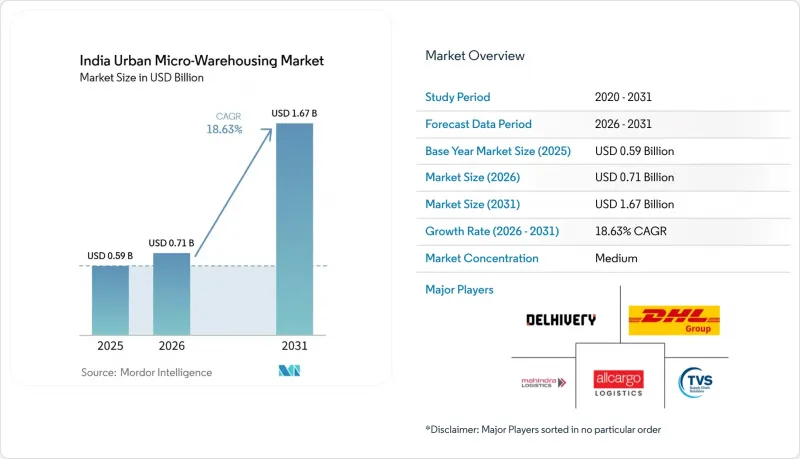
印度城市微型倉庫市場的擴張主要源自於以下事實:主要城市的配送需求不再僅僅依賴大型郊區倉庫,而是需要將庫存放置在靠近消費者的位置。本報告按設施類型(暗庫、微型配送中心等)、溫度控制(溫控、非溫控)、自動化程度(手動、半自動、全自動)、終端用戶行業(電子商務、快餐、食品飲料等)以及地區(北部、中部、西部等)進行細分。市場預測以美元計價。
印度城市微型倉庫市場的趨勢與洞察
提高快速商務中的訂單密度
快速電商已從新興的配送模式轉變為印度都市區履約市場的主要需求驅動力。到2026年5月,Blinkit、Swiggy Instamart和Zepto三大電商平台旗下暗店網路的門市總合將達到5026家,高於去年同期的3,405家,凸顯了城市物流基礎設施的快速擴張。印度城市微型倉庫市場面臨的壓力並非僅源自於門市數量的成長。每個門市每天都需要處理大量訂單,且商品種類日益豐富。隨著訂單密度的增加,能夠維持高存貨周轉和豐富SKU組合的企業更有理由選擇面積更大、位置更優越的都市區門市。而小規模企業則面臨更嚴峻的挑戰,因為當訂單處理量低於損益平衡點時,固定成本會迅速上升。因此,印度城市微型倉庫市場正朝著更精細化的營運模式轉變,在這種模式下,門市密度、處理速度和合規性比單純的網路擴張更為重要。
在1線和2線城市擴展暗店網路
印度的城市微型倉儲市場不再只是集中在最大的幾個大都會圈。網路擴張正深入二線城市。 Flipkart Minutes 於 2026 年 6 月在戈勒克布爾開設了第 1000 個微型倉配中心。此外,該公司營運的 130 個城市中,已有 90 個位於大都會圈區之外,這證實了主要大都會圈以外的需求已經顯現。印度的城市微型倉儲市場正受益於這種更廣泛、更全面的城市覆蓋,因為每個新的服務區域都需要將庫存更靠近當地需求。挑戰在於,小規模的城市往往缺乏符合標準的小型倉庫資產,這些倉庫需要穩定的電力供應、消防安全許可證和便利的交通。因此,即使存在需求,營運商擴張業務的速度也受到限制。因此,印度都市區的微型倉儲市場正在地域上不斷擴張。然而,擴張的速度仍取決於能否以合理的營運成本獲得合適的都市區空間。
都市區主要微型位置的地價和租金很高
高昂的租金是印度城市微型倉庫市場最明顯的營運限制因素之一。 2026年,印度主要大都會圈的倉庫租金為每平方英尺每月18至60印度盧比(約合0.19至0.63美元),而且隨著時間的推移,租金顯著上漲,即使在德里-NCR走廊地區也是如此,這凸顯了都市區物流中心成本的飆升。在印度的城市微型倉庫市場,不斷上漲的租金成本往往迫使業者使用最小可用用地面積,即使更大的倉庫可以改善SKU種類和揀貨效率。這使得固定的位置成本難以分攤到較低的處理量上,使履約獲利能力更容易受到需求波動的影響。資金雄厚的業者可以承受更長時間的壓力,但規模小規模的網路則無法做到。因此,從需求角度來看,印度的城市微型倉庫市場仍然具有吸引力,但從經濟角度來看,它仍然是一個選擇性很強的市場。
細分市場分析
預計到2025年,暗店式履約將佔印度城市微型倉庫市場38.11%的佔有率,凸顯其與當前都市區需求趨勢的契合度。這類倉庫的設計以速度為首要考量,通常服務於配送範圍有限、每日訂單量集中且周轉率高的區域。暗店已成為印度城市微型倉庫市場的主導類型,因為與區域共用倉庫相比,它們能更精準地兌現「30分鐘內送達」的承諾。此外,其單一用途的佈局使營運商能夠更有效率地進行揀貨作業,並更嚴格地管理服務水準。零售門市履約和混合模式仍然十分重要,因為它們允許將現有門市網路用作區域庫存中心。雖然這些模式的專業化程度不如暗店,但它們有助於全通路零售商避免建立完全獨立的履約中心。
預計到2031年,採用多品牌履約中心(MFC)的履約將以25.54%的複合年成長率成長,成為印度城市微型倉庫市場成長最快的設施類型。 MFC的吸引力在於其能夠容納更廣泛的SKU組合,並共用同一城市叢集內的多個品牌和經銷商履約基礎設施。 Flipkart Minutes宣布,到2026年6月,其MFC數量將超過1000個,每月新增75至100個,這表明該模式正在快速擴張。亞馬遜印度也積極推動城市履約中心的部署,顯示印度的城市微型倉庫產業正在超越以生鮮雜貨主導中心的模式。這種轉變意義重大,因為如果管理得當,多客戶物流中心每平方英尺的收益可以高於單品牌暗店。此外,隨著品牌尋求更有效率利用資本的方式快速觸達都市區消費者,第三方物流(3PL) 將在印度的城市微型倉庫市場中發揮越來越重要的作用。
預計到2025年,非溫控設施將佔印度城市微型倉庫市場佔有率的65.68%,這意味著常溫食品和日常消費品(FMCG)仍將佔據主導地位。目前,大部分日常訂單仍屬於無需嚴格冷藏的品類,因此常溫儲存空間仍佔據主導地位。然而,隨著生鮮食品、乳製品、冷凍食品和部分保健品的配送在快速配送訂單中所佔佔有率不斷增加,印度城市微型倉庫市場正在改變。因此,預計到2031年,溫控設施的複合年成長率將達到22.20%。業者不再將冷藏視為僅在特定地點使用的高階功能。越來越多的都市區設施正在將冷藏作為標準配置,以滿足各種快速商業服務的需求。
在印度的城市微型倉儲市場,溫控倉庫的規模雖然仍落後於常溫倉庫,但其營運重要性卻以更快的速度成長。印度冷藏倉庫的供不應求仍然是一個結構性限制因素,推動了對標準化都市區冷庫和末端冷藏配送中心的需求不斷成長。冷鏈營運商正在都市區配送營運中應用先進的技術控制,這表明履約品質不僅體現在運輸環節,也延伸到了倉庫本身。在印度的城市微型倉儲市場,這有利於那些能夠兼顧溫度控制保障和緊湊型城市營運的營運商。此外,基礎常溫設施和能夠支持生鮮食品品類成長的高規格城市設施之間的競爭差距也日益明顯。隨著電商平台不斷擴大其生鮮食品供應,冷鏈能力正逐漸成為結構性差異化因素,而不再只是一個狹窄的細分市場。
其他好處:
- Excel格式的市場預測(ME)表
- 3個月的分析師支持
目錄
第1章:引言
- 研究假設和市場定義
- 調查範圍
第2章:調查方法
第3章執行摘要
第4章 市場狀況
- 市場概況及城市微型倉庫在城市物流中的作用
- 市場促進因素
- 快速商務訂單密度增加
- 都市區門市產品補貨速度的要求
- 一二線城市暗店網路擴張
- 擴大生鮮產品和需要溫度控制的 SKU 的供應。
- 整合最後一公里履約中心
- 適用於小規模都市區地塊的模組化租賃模式
- 市場限制因素
- 都市區主要微位置的土地價格和租金很高
- 合適的小規模倉庫物業供應有限。
- 各地政府和消防部門的合規標準有差異。
- 電力可靠性和冷鏈連續性方面的限制因素
- 法律規範
- 價值鍊和分銷管道的結構分析
- 技術創新前景
- 波特五力分析
- 都市區微型倉庫需求的變化
- 定價和成本結構分析
- 房地產和基礎設施分析
- 分析消費者行為與配送偏好
- 永續交付解決方案和綠色物流舉措
- 地緣政治事件對供應鏈變化的影響
第5章 市場規模及成長預測(價值,2026-2031 年)
- 依設施類型
- 利用暗店進行履約
- 利用微型倉配中心(MFC)進行履約
- 零售店內訂單履約
- 混合設施及其他
- 按溫度類型
- 溫控型
- 無溫度控制
- 按自動化級別
- 手動操作
- 半自動化設施
- 全自動化設施
- 按最終用途行業分類
- 電子商務
- QuickCommerce
- 食品零售
- FMCG
- 食品/飲料
- 藥品和醫療保健
- 家用電子電器和家用電器
- 時尚與生活方式(配件、服裝、鞋履)
- 工業和B2B分銷
- 其他
- 按地區
- 北方
- 中部
- 西
- 東
- 南部
第6章 競爭情勢
- 市場集中度
- 關鍵策略趨勢
- 市佔率分析
- 公司簡介
- DHL Group
- Mahindra Logistics Ltd.
- TVS Supply Chain Solutions Ltd.
- Delhivery Ltd.
- Allcargo Supply Chain Pvt. Ltd.
- DP World Logistics India
- FM Logistic India Pvt. Ltd.
- AWL India Pvt. Ltd.
- Safexpress Pvt. Ltd.
- Prozo Integrated Supply Chain Solutions
- Blue Dart Express Ltd.
- TCI Supply Chain Solutions
- CEVA Logistics(CMA CGM Group)
- DSV Air and Sea Pvt. Ltd.
- KSH Integrated Logistics Pvt. Ltd.
- Holisol Logistics Pvt. Ltd.
- Kuehne+Nagel
- Xpressbees Logistics Pvt. Ltd.
- Edgistify
- Om Logistics Ltd.
- CJ Darcl Logistics Ltd.
- Snowman Logistics Ltd.
第7章 市場機會與未來展望
According to Mordor Intelligence, the India urban micro-warehousing market size was valued at USD 0.59 billion in 2025 and is expected to reach USD 0.71 billion in 2026 and reach USD 1.67 billion by 2031, growing at a CAGR of 18.63% over 2026-2031.
The India urban micro-warehousing market is expanding because delivery expectations in major cities now depend on inventory being placed very close to consumers, rather than in large peripheral warehouses alone. This report is Segmented by Facility Type (Dark Store-Based, MFC-Based, and More), by Temperature (Temperature-Controlled, Non-Temperature Controlled), by Automation Level (Manual, Semi-Automated, and Fully Automated), by End-Use Industry (E-Commerce, Quick Commerce, Food and Beverage, and More), and by Region (North, Central, West, and More). The Market Forecasts are Provided in Terms of Value (USD).
India Urban Micro-Warehousing Market Trends and Insights
Rising Quick Commerce Order Density
Quick commerce has moved from an emerging delivery format to the main demand engine for the India urban micro-warehousing market. The combined dark-store networks of Blinkit, Swiggy Instamart, and Zepto reached 5,026 locations by May 2026, up from 3,405 a year earlier, underscoring how quickly city-based fulfillment infrastructure is being added. The pressure on the India urban micro-warehousing market does not come from store count alone, because each node is expected to process heavy daily order volumes from increasingly broad assortments. As order density rises, operators that can sustain faster inventory turns and fuller SKU depth can justify larger, better-located urban sites. Smaller operators face a more challenging environment because fixed costs rise quickly when order throughput falls below breakeven levels. This is pushing the India urban micro-warehousing market toward a more selective operating model where density, execution speed, and compliance matter more than simple network expansion.
Dark Store Network Expansion in Tier 1 and Tier 2 Cities
The India urban micro-warehousing market is no longer centered only on the largest metros, because network expansion is now moving deeper into Tier-2 cities. Flipkart Minutes opened its 1,000th micro-fulfillment center in Gorakhpur in June 2026, and 90 of its 130 active cities were already non-metro locations, which confirms that demand formation outside major metros is now material. The India urban micro-warehousing market is benefiting from this broader citywide coverage because every new service area requires inventory held close to local demand. The challenge is that smaller cities often have fewer compliant small-format warehousing assets with reliable power, fire approvals, and workable access conditions. That limits how quickly operators can scale, even when demand is present. As a result, the India urban micro-warehousing market is expanding geographically. However, the pace of rollout still depends on whether suitable urban space can be secured at the right operating cost.
High Land and Rental Costs in Prime Urban Micro-Locations
High rent is one of the clearest operating restraints on the India urban micro-warehousing market. Warehouse rentals in Indian metros ranged from INR 18 to INR 60 (USD 0.19 TO USD 0.63) per ft2 per month in 2026, and the Delhi-NCR corridors also saw meaningful rent increases over time, underscoring how expensive urban logistics locations have become. In the India urban micro-warehousing market, rising occupancy costs often force operators to use the smallest workable footprint, even when a larger site would improve SKU depth or picking efficiency. This makes fulfillment economics more sensitive to demand volatility because fixed location costs are harder to spread across lower throughput. Well-funded operators can absorb that pressure for longer, but smaller networks cannot. The result is that the India urban micro-warehousing market remains attractive in demand terms, while still being selective in economic terms.
Other drivers and restraints analyzed in the detailed report include:
- Urban Store Replenishment Speed Requirements
- Fresh and Temperature-Sensitive SKU Expansion
- Fragmented Compliance Across Municipal and Fire Norms
For complete list of drivers and restraints, kindly check the Table Of Contents.
Segment Analysis
Dark-store-based fulfillment accounted for 38.11% of the India urban micro-warehousing market size in 2025, underscoring the format's alignment with the current shape of urban demand. These facilities were built for speed first, and they typically serve narrow delivery radii with dense daily order flow and high item turnover. In the Indian urban micro-warehousing market, dark stores became the leading facility type because they better meet the sub-30-minute promise than shared regional warehouses. Their single-purpose layout also helps operators run tighter picking routines and maintain closer control over service levels. Retail store-based fulfillment and hybrid models remain relevant, as existing store networks can double as local inventory points. Those formats help omnichannel retailers avoid a fully separate fulfillment footprint, although they are less specialized than dark stores.
MFC-based fulfillment is projected to grow at a 25.54% CAGR through 2031, making it the fastest-expanding facility type in the India urban micro-warehousing market. The appeal of MFCs is that they support a broader SKU mix and allow several brands or sellers to share fulfillment infrastructure within the same city cluster. Flipkart Minutes crossed 1,000 MFCs in June 2026 and said it was adding 75 to 100 more each month, which underlines how quickly this model is scaling. Amazon India also moved ahead with the rollout of urban fulfillment centers, showing that the Indian urban micro-warehousing industry is broadening beyond grocery-led formats alone. This shift matters because multi-client hubs can generate higher revenue per ft2 than single-brand dark stores when throughput is well managed. It also gives 3PLs a stronger role in the Indian urban micro-warehousing market as brands seek capital-light ways to reach urban consumers faster.
Non-temperature-controlled facilities accounted for 65.68% of the India urban micro-warehousing market share in 2025, reflecting the still-large role of ambient grocery and FMCG volumes. Most daily orders still sit in categories that do not need strict cold handling, which keeps ambient space dominant in the current mix. Even so, the Indian urban micro-warehousing market is changing, as fresh food, dairy, frozen products, and selected healthcare deliveries are taking a larger share of rapid-delivery baskets. That is why temperature-controlled facilities are forecast to grow at a 22.20% CAGR through 2031. Operators are no longer treating cold rooms as a premium feature used only in a few sites. They are increasingly being planned as a standard requirement in urban facilities that serve a broad range of quick commerce offerings.
The India urban micro-warehousing market size for temperature-controlled capacity is still smaller than ambient capacity, but its operational importance is rising much faster. India's cold storage supply gap remains a structural constraint, which supports stronger demand for compliant urban cold rooms and last-mile cold hubs. Cold chain providers are also adding greater technical controls to urban delivery operations, indicating that fulfillment quality now extends beyond transport into the warehouse itself. In the India urban micro-warehousing market, this favors operators that can combine temperature integrity with small-footprint city operations. It also creates a clearer competitive gap between basic ambient facilities and higher-spec urban sites that can support fresh category growth. As quick commerce platforms expand their fresh offerings, cold chain capabilities are becoming a structural differentiator rather than a narrow niche.
Complete Report Scope:
- By Facility Type
- Dark Store-Based Fulfillment
- Micro-Fulfillment Center (MFC)-Based Fulfillment
- Retail Store-Based Fulfillment
- Hybrid Facility and Others
- By Temperature Type
- Temperature Controlled
- Non-Temperature Controlled
- By Automation Level
- Manual Operations
- Semi-Automated Facilities
- Fully Automated Facilities
- By End-Use Industry
- E-commerce
- Quick Commerce
- Grocery Retail
- FMCG
- Food and Beverage
- Pharmaceuticals and Healthcare
- Consumer Electronics and Household Appliances
- Fashion and Lifestyle (Accessories, Apparel, Footwear)
- Industrial and B2B Distribution
- Others
- By Region
- North
- Central
- West
- East
- South
List of Companies Covered in this Report:
- DHL Group
- Mahindra Logistics Ltd.
- TVS Supply Chain Solutions Ltd.
- Delhivery Ltd.
- Allcargo Supply Chain Pvt. Ltd.
- DP World Logistics India
- FM Logistic India Pvt. Ltd.
- AWL India Pvt. Ltd.
- Safexpress Pvt. Ltd.
- Prozo Integrated Supply Chain Solutions
- Blue Dart Express Ltd.
- TCI Supply Chain Solutions
- CEVA Logistics (CMA CGM Group)
- DSV Air and Sea Pvt. Ltd.
- KSH Integrated Logistics Pvt. Ltd.
- Holisol Logistics Pvt. Ltd.
- Kuehne+Nagel
- Xpressbees Logistics Pvt. Ltd.
- Edgistify
- Om Logistics Ltd.
- CJ Darcl Logistics Ltd.
- Snowman Logistics Ltd.
Additional Benefits:
- The market estimate (ME) sheet in Excel format
- 3 months of analyst support
TABLE OF CONTENTS
1 Introduction
- 1.1 Study Assumptions and Market Definition
- 1.2 Scope of the Study
2 Research Methodology
3 Executive Summary
4 Market Landscape
- 4.1 Market Overview and Role of Urban Micro-Warehousing in Urban Logistics
- 4.2 Market Drivers
- 4.2.1 Rising Quick Commerce Order Density
- 4.2.2 Urban Store Replenishment Speed Requirements
- 4.2.3 Dark Store Network Expansion in Tier 1 and Tier 2 Cities
- 4.2.4 Fresh and Temperature-Sensitive SKU Expansion
- 4.2.5 Densification of Last-Mile Fulfillment Footprints
- 4.2.6 Modular Lease Models for Small Urban Parcels
- 4.3 Market Restraints
- 4.3.1 High Land and Rental Costs in Prime Urban Micro-Locations
- 4.3.2 Limited Availability of Suitable Small-Format Warehousing Assets
- 4.3.3 Fragmented Compliance Across Municipal and Fire Norms
- 4.3.4 Power Reliability and Cold-Chain Continuity Constraints
- 4.4 Regulatory Framework
- 4.5 Value Chain and Distribution Channel Architecture Analysis
- 4.6 Technology Innovations Outlook
- 4.7 Porter's Five Forces Analysis
- 4.7.1 Threat of New Entrants
- 4.7.2 Bargaining Power of Suppliers
- 4.7.3 Bargaining Power of Buyers
- 4.7.4 Threat of Substitutes
- 4.7.5 Rivalry Among Competitors
- 4.8 Evolution of Urban Micro-Warehousing Requirements
- 4.9 Pricing and Cost Structure Analysis
- 4.10 Real Estate and Infrastructure Analysis
- 4.11 Consumer Behavior and Delivery Preferences Analysis
- 4.12 Sustainable Delivery Solutions and Green Logistics Initiatives
- 4.13 Impact of Geo-Political Events on Supply Chain Shifts
5 Market Size and Growth Forecasts (Value, 2026-2031)
- 5.1 By Facility Type
- 5.1.1 Dark Store-Based Fulfillment
- 5.1.2 Micro-Fulfillment Center (MFC)-Based Fulfillment
- 5.1.3 Retail Store-Based Fulfillment
- 5.1.4 Hybrid Facility and Others
- 5.2 By Temperature Type
- 5.2.1 Temperature Controlled
- 5.2.2 Non-Temperature Controlled
- 5.3 By Automation Level
- 5.3.1 Manual Operations
- 5.3.2 Semi-Automated Facilities
- 5.3.3 Fully Automated Facilities
- 5.4 By End-Use Industry
- 5.4.1 E-commerce
- 5.4.2 Quick Commerce
- 5.4.3 Grocery Retail
- 5.4.4 FMCG
- 5.4.5 Food and Beverage
- 5.4.6 Pharmaceuticals and Healthcare
- 5.4.7 Consumer Electronics and Household Appliances
- 5.4.8 Fashion and Lifestyle (Accessories, Apparel, Footwear)
- 5.4.9 Industrial and B2B Distribution
- 5.4.10 Others
- 5.5 By Region
- 5.5.1 North
- 5.5.2 Central
- 5.5.3 West
- 5.5.4 East
- 5.5.5 South
6 Competitive Landscape
- 6.1 Market Concentration
- 6.2 Key Strategic Moves
- 6.3 Market Share Analysis
- 6.4 Company Profiles (includes Global level Overview, Market level overview, Core Segments, Financials as available, Strategic Information, Market Rank/Share for key companies, Products & Services, and Recent Developments)
- 6.4.1 DHL Group
- 6.4.2 Mahindra Logistics Ltd.
- 6.4.3 TVS Supply Chain Solutions Ltd.
- 6.4.4 Delhivery Ltd.
- 6.4.5 Allcargo Supply Chain Pvt. Ltd.
- 6.4.6 DP World Logistics India
- 6.4.7 FM Logistic India Pvt. Ltd.
- 6.4.8 AWL India Pvt. Ltd.
- 6.4.9 Safexpress Pvt. Ltd.
- 6.4.10 Prozo Integrated Supply Chain Solutions
- 6.4.11 Blue Dart Express Ltd.
- 6.4.12 TCI Supply Chain Solutions
- 6.4.13 CEVA Logistics (CMA CGM Group)
- 6.4.14 DSV Air and Sea Pvt. Ltd.
- 6.4.15 KSH Integrated Logistics Pvt. Ltd.
- 6.4.16 Holisol Logistics Pvt. Ltd.
- 6.4.17 Kuehne+Nagel
- 6.4.18 Xpressbees Logistics Pvt. Ltd.
- 6.4.19 Edgistify
- 6.4.20 Om Logistics Ltd.
- 6.4.21 CJ Darcl Logistics Ltd.
- 6.4.22 Snowman Logistics Ltd.
7 Market Opportunities and Future Outlook
- 7.1 White-space and Unmet-Need Assessment

 歐洲城市微型倉庫市場:市場佔有率分析、產業趨勢與統計、成長預測(2026-2031)美國城市微型倉庫:市場佔有率分析、產業趨勢與統計、成長預測(2026-2031 年)
 城市微型倉庫自動化市場預測至2034年-按自動化解決方案、組件、技術、應用、最終用戶和地區分類的全球分析城市微型倉庫租賃市場預測至2034年-全球分析(按設施類型、租賃模式、經營模式、倉庫規模、技術採用、最終用戶和地區分類)城市微型倉儲市場預測至2032年:按設施類型、經營模式、技術、最終用戶和地區分類的全球分析城市微型倉配中心市場預測至2032年:按設施類型、服務內容、組織規模、經營模式、技術、最終用戶和地區分類的全球分析