


 |
市場調查報告書
商品編碼
2119058
美國城市微型倉庫:市場佔有率分析、產業趨勢與統計、成長預測(2026-2031 年)United States Urban Micro-Warehousing - Market Share Analysis, Industry Trends & Statistics, Growth Forecasts (2026 - 2031) |
||||||

※ 本網頁內容可能與最新版本有所差異。詳細情況請與我們聯繫。
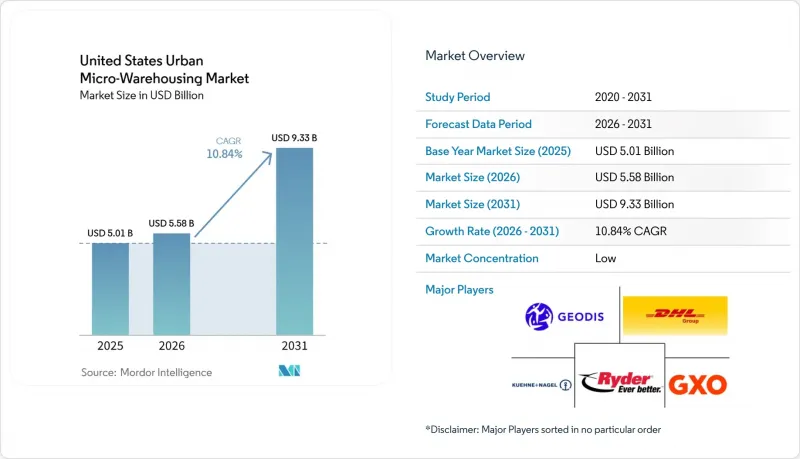
據 Mordor Intelligence 稱,2025 年美國城市微型倉庫市場價值 50.1 億美元,預計到 2031 年將從 2026 年的 55.8 億美元成長到 93.3 億美元,預測期(2026-2031 年)的複合年成長率預計為 10.84%。
隨著當日達和一小時送達服務從加值服務轉變為消費者的日常需求,其需求量不斷成長,迫使零售商和第三方物流公司(3PL)將庫存部署在需求集中的都市區附近。本報告按設施類型(暗庫、微配送中心、零售店、混合型)、溫控類型(溫控、非溫控)、自動化程度(手動、半自動、全自動)、終端用戶行業(電子商務、快餐、食品雜貨、快速消費品、餐飲、其他)和地區(東北部、東南部、中西部、西南部、西部)進行細分。市場預測以美元(USD)為單位。
美國城市微型倉庫市場的趨勢與洞察
當日達、當時送達的成本效益。
在美國城市微型倉庫市場,快速送達消費者已成為最顯而易見的營運重點之一。零售商和第三方物流供應商(3PL)需要在城市範圍內或附近保持庫存,以滿足日益嚴格的配送時限,同時避免承擔不斷上漲的長途運輸和小包裹遞送成本。這種壓力也體現在更廣泛的數位零售需求中,預計到2026年第一季,美國電子商務銷售額將達到3,023億美元,年增9.7%。在如此龐大的規模下,集中式履約模式對於高頻次的都市區而言吸引力下降,因為更大的配送範圍會降低低價訂單的利潤率。美國城市微型倉庫市場受益於緊湊的城市地理位置,這使得營運商能夠縮短配送範圍,提高訂單截止時間的柔軟性,並改善當日達訂單的庫存可用性。隨著這些服務水準逐漸成為標準而非加值服務,分散式庫存管理的經濟效益對更多零售商而言也變得更加合理。
都市區未充分利用的工業用地棕地改造
在美國城市微型倉庫市場,棕地改造正成為企業擴張最實際的途徑之一。 2025年5月,美國環保署(EPA)宣布津貼2.67億美元用於棕地改造,包括場地評估、清理和循環貸款。這直接降低了許多都市區空地長期閒置的清理障礙。 EPA也指出,自棕地計畫啟動以來,已累積投入超過420億美元用於清理和重建,這印證了公共資金能夠吸引大規模私人投資進入物流領域的觀點。在空間有限的都市區,這些地塊是少數無需等待稀缺的待開發區供應即可增加小規模物流容量的途徑之一。因此,在美國城市微型倉庫市場,能夠妥善管理清理進度、地方許可和重建流程,而非僅依賴傳統租賃策略的業者將更具優勢。在老工業區仍靠近人口稠密的住宅和主要交通網路的地區,這一點尤其重要。
都市區房地產領域的高摩擦和分區限制
房地產壁壘仍然是美國城市微型倉庫市場面臨的最大限制之一。最具吸引力的配送區域往往與土地稀缺、開發許可難覓食、且附近住宅可能反對新建物流項目等因素重疊。因此,取得土地本身就成為競爭優勢,因為並非所有業者都能承受漫長的核准流程或承擔長期的前期開發成本。在需求集中、工業用地本就稀缺、且位置的小規模地皮鮮少出現在市場上的沿海大都會圈,這一限制因素尤為突出。儘管美國城市微型倉庫市場在這些情況下仍有成長空間,但其擴張更傾向於棕地改造、現有設施的維修以及與當地關係密切的成熟營運商。因此,准入門檻高,能夠在短時間內建立有效城市網路的營運商選擇有限。
細分市場分析
到2025年,微型倉配中心將佔據美國城市微型倉庫市場38.14%的佔有率,成為市場上最大的設施類型。其優勢在於效用整體、食品雜貨和日常消費品(FMCG)物流,使其成為企業處理多種需求流的可行選擇。暗店式履約是成長最快的設施類型,預計到2031年將以17.75%的複合年成長率成長。這主要是由於快速零售和專門的線上食品雜貨銷售模式需要將庫存放置在更靠近當地社區的地方。暗店式物流在美國城市微型倉庫市場中的成長動能源自於其用地面積小,並且專注於高頻產品線,而非廣泛的、區域性的產品組合。零售店式履約和混合型設施佔據剩餘市場佔有率,隨著實體零售商尋求更有效率地利用其後台空間的方式,它們的重要性日益凸顯。
此細分市場的策略差異體現在柔軟性和資本密集度的不同。多品類履約中心 (MFC) 可容納更廣泛的產品類別,可協助業者根據季節和訂單模式平衡需求波動。另一方面,暗店在訂單密度已驗證的地區最為有效,因為較窄的配送範圍可帶來重複購買和可預測的補貨,從而提高經濟效益。混合型設施則介於兩者之間,為營運商提供了一種無需立即轉型為完全專業化模式即可嘗試自動化或提升本地處理能力的方法。因此,美國城市微型倉庫市場繼續支援多種設施類型,而不是趨向於單一的營運模式。營運商如果根據採購量、服務水準和周邊人口密度選擇設施類型,則更有可能在網路擴張的同時保持獲利能力。
截至2025年,非溫控設施將占美國城市微型倉庫市場規模的63.5%,而常溫倉庫仍將佔據市場主導地位。服裝、家電和日常消費品(FMCG)仍然是都市區電商中最大的品類,而目前的大部分需求傾向於更簡單的設施設計和更低的營運風險。溫控設施的成長速度更快,到2031年複合年成長率將達到14.41%。這是由於都市區地區對專用冷藏設施的需求不斷成長,例如食品雜貨宅配、藥品冷鏈運輸以及食材自煮包履約等。隨著業者從一般零售履約轉向對時間和溫度更為敏感的品類,美國城市微型倉庫市場的這一細分領域正在不斷擴張。 2025年11月,Lineage Inc.在達拉斯都會區開始建造一座全自動冷藏設施,這清楚地徵兆機構投資者仍在增加自動化主導的冷鏈產能。
挑戰在於,與常溫倉庫相比,冷鏈的擴展需要更高的營運規格和更複雜的設計。防火、能源利用和設備可靠性變得更加關鍵,因為一旦發生故障,庫存損失的風險會更快、更直接地顯現。該領域也出現了大規模的資本流動;例如,2026年5月,Americold Realty Trust與EQT推出了一家價值13億美元的合資企業,涵蓋美國各地的12個溫控設施。美國食品藥物管理局(FDA)針對藥品儲存的冷鏈法規以及美國農業部(USDA)針對食品級操作的要求,也進一步影響該領域的設施設計和流程管理。因此,儘管冷鏈仍然是美國城市微型倉庫市場的一個強勁成長領域,但人們也普遍認為,在該領域,擁有更雄厚的財務基礎、合規能力和技術營運規範的營運商更具優勢。
其他好處:
- Excel格式的市場預測(ME)表
- 3個月的分析師支持
目錄
第1章:引言
- 市場分析與定義的前提條件
- 分析範圍
第2章 分析方法
第3章執行摘要
第4章 市場狀況
- 市場概況及城市微型倉庫在城市物流中的作用
- 市場促進因素
- 當日達、當時送達的成本效益
- 都市區未充分利用的工業用地的棕地改造
- 擴大雜貨店和速食店的網路密度
- 大都會圈倉儲市場勞動力短缺
- 最小壓力和市場庫存最佳化
- 自動化設施中的微電網和站點級能源彈性
- 市場限制因素
- 都市區房地產市場摩擦加劇以及分區法規的限制
- 高密度自動化帶來了更高的消防安全法規、安全隱患和保險成本。
- 都市區地區加工能力低下,SKU數量有限的經濟效益
- 本地交通、公路運輸和最後一公里配送出現瓶頸。
- 法律規範
- 價值鍊和分銷管道的結構分析
- 技術創新前景
- 波特五力分析
- 城市微型倉庫的需求趨勢
- 定價和成本結構分析
- 房地產和基礎設施分析
- 分析消費者行為與配送偏好
- 永續交付解決方案和綠色物流舉措
- 地緣政治事件對供應鏈變化的影響
第5章:市場規模與成長率預測(以金額為準,2026-2031 年)
- 依設施類型
- 利用暗店進行履約
- 利用微型倉配中心(MFC)進行履約
- 零售店內訂單履約
- 混合設施及其他
- 按溫度控制類型
- 溫控型
- 無溫度控制
- 按自動化級別
- 手動的
- 半自動
- 全自動
- 按最終用戶行業分類
- 電子商務
- QuickCommerce
- 食品零售
- 快速消費品(日常消費品)
- 食品/飲料
- 藥品和醫療保健
- 家用電子電器/家用電器
- 時尚與生活方式(配件、服裝、鞋履)
- 工業和B2B分銷
- 其他
- 按地區
- 東北
- 東南部
- 中西部
- 西南
- 西
第6章 競爭情勢
- 市場集中度
- 關鍵策略趨勢
- 市佔率分析
- 公司簡介
- DHL Group
- GXO Logistics, Inc.
- Ryder System, Inc.
- GEODIS
- Kuehne+Nagel
- CMA CGM Group(Including CEVA Logistics)
- NFI Industries
- Lineage, Inc.
- Americold
- CJ Logistics
- Kenco Group
- Saddle Creek Logistics Services
- Radial, Inc.
- APL Logistics Ltd.
- Amazon.com, Inc.
- Stord, Inc.
- ODW Logistics
- ShipBob, Inc.
- ShipMonk
- International Distribution Services plc(IDS)
- AP Moller-Maersk(Including Visible SCM)
- Barrett Distribution Centers
第7章 市場機會與未來展望
According to Mordor Intelligence, the United States urban micro-warehousing market size was valued at USD 5.01 billion in 2025 and is estimated to grow from USD 5.58 billion in 2026 to reach USD 9.33 billion by 2031, at a CAGR of 10.84% during the forecast period (2026-2031).
Demand is rising because same-day and same-hour delivery have shifted from premium services to normal consumer expectations, which is forcing retailers and 3PLs to place inventory closer to dense urban demand. This report is Segmented by Facility Type (Dark Store, MFC, Retail Store, Hybrid), by Temperature Type (Controlled, Non-Controlled), by Automation Level (Manual, Semi-Automated, Fully Automated), by End-User Industry (E-Commerce, Quick Commerce, Grocery, FMCG, F&B, and More), and by Geography (Northeast, Southeast, Midwest, Southwest, West). The Market Forecasts in Value (USD).
United States Urban Micro-Warehousing Market Trends and Insights
Same-Day and Same-Hour Delivery Economics
Speed to consumer has become one of the clearest operating priorities in the United States urban micro-warehousing market. Retailers and 3PLs now need inventory within city limits or very close to them if they want to support tighter delivery windows without absorbing higher line-haul and parcel costs. The pressure is visible in broader digital retail demand, with United States e-commerce sales reaching USD 302.3 billion in Q1 2026, up 9.7% year over year. That scale makes a centralized fulfillment model less attractive for high-frequency urban orders because longer shipping zones can weaken margin on lower-ticket baskets. The United States urban micro-warehousing market benefits from compact urban nodes, which let operators shorten delivery radii, increase order cut-off flexibility, and improve inventory availability for same-day orders. As these service levels become standard rather than premium, the economics of distributed stocking become easier to justify across a broader range of retailers.
Brownfield Conversion of Underused Urban Industrial Space
Brownfield conversion is becoming one of the most practical paths to expansion in the United States urban micro-warehousing market. In May 2025, the EPA announced USD 267 million in Brownfields Grants for site assessment, cleanup, and revolving loan funds, which directly lowers part of the remediation barrier that has kept many urban infill sites dormant. The EPA also noted that its Brownfields Program has leveraged more than USD 42 billion in cleanup and redevelopment since its inception, supporting the case that public funding can unlock larger private investment in logistics. In constrained urban corridors, these parcels often represent one of the few remaining routes to add small logistics capacity without waiting for rare greenfield supply. The United States urban micro-warehousing market, therefore, favors operators that can manage cleanup timelines, local approvals, and redevelopment sequencing rather than relying only on conventional leasing strategies. This is especially relevant where older industrial districts still sit close to dense residential demand and major transport links.
High Urban Real Estate Friction and Zoning Constraints
Real estate friction remains one of the clearest constraints on the United States urban micro-warehousing market. The most attractive delivery zones are often the same places where land is scarce, entitlements are difficult to obtain, and nearby residential uses raise opposition to new logistics projects. This makes site access a competitive advantage in itself because not every operator can wait through long approval cycles or absorb extended pre-development costs. The constraint is most acute in large coastal metros where demand is dense, but industrial land is already tightly held and rarely becomes available in small, well-located parcels. The United States urban micro-warehousing market can still grow under these conditions, but expansion tends to favor brownfield redevelopment, retrofit strategies, and incumbents with deeper local relationships. That raises entry costs and narrows the pool of players that can build meaningful urban networks at speed.
Other drivers and restraints analyzed in the detailed report include:
- Grocery and Quick Commerce Network Density Expansion
- Labor Scarcity in Dense Metropolitan Warehousing Markets
- Fire Code, Safety, and Insurance Cost Escalation for High-Density Automation
For complete list of drivers and restraints, kindly check the Table Of Contents.
Segment Analysis
Micro-fulfillment centers accounted for 38.14% of the United States urban micro-warehousing market share in 2025, which made them the largest facility format in the market. Their lead comes from broad usefulness across e-commerce, grocery, and FMCG flows, giving operators a format that can work across multiple demand streams. Dark-store-based fulfillment is the fastest-growing facility type, with a 17.75% CAGR through 2031, as quick commerce and dedicated e-grocery models require inventory to be closer to neighborhoods. This part of the United States urban micro-warehousing market is gaining ground because dark stores can be deployed in compact footprints and built around high-frequency baskets rather than broad regional assortment. Retail store-based fulfillment and hybrid facilities make up the remaining share and are becoming more relevant as physical retailers seek ways to use back-of-house space more productively.
The strategic split within this segment is between flexibility and capital intensity. MFCs support a wider range of categories, which helps operators balance demand variability across seasons and order profiles. Dark stores work best where order density is already proven, because their economics improve when a tight delivery radius produces repeat purchases and predictable replenishment. Hybrid facilities sit in the middle and give operators a way to test automation or add local capacity without moving immediately into a fully specialized format. That is why the United States urban micro-warehousing market continues to support more than one facility format rather than converging on a single operating model. Operators that match facility type to basket size, service promise, and neighborhood density are more likely to protect margins as networks scale.
Non-temperature-controlled facilities accounted for 63.5% of the United States urban micro-warehousing market size in 2025, keeping ambient nodes at the core of the market. Apparel, consumer electronics, and FMCG remain the largest urban e-commerce categories, so a large part of current demand still favors simpler facility designs and lower operating risk. Temperature-controlled sites are growing faster, at a 14.41% CAGR through 2031, because grocery delivery, pharmaceutical cold-chain needs, and meal-kit fulfillment require dedicated refrigerated capacity closer to city demand. This part of the United States' urban micro-warehousing market is expanding as operators move from general retail fulfillment into more time- and temperature-sensitive categories. A visible signal came in November 2025, when Lineage broke ground on a fully automated cold storage facility in the Dallas Metroplex, reinforcing that institutional players are still adding automation-led cold-chain capacity.
The challenge is that cold-chain expansion requires greater operational discipline and higher design complexity than ambient space. Fire protection, energy use, and equipment reliability matter more because failure carries a faster and more direct inventory-loss risk. The segment is also seeing larger capital moves, such as Americold Realty Trust's May 2026 USD 1.3 billion joint venture with EQT covering 12 United States temperature-controlled facilities. FDA cold-chain rules for pharmaceutical storage and USDA requirements for food-grade operations further shape site design and process control in this segment. As a result, the United States urban micro-warehousing market continues to treat cold-chain as a strong growth pocket, but also as one that favors operators with deeper balance sheets, compliance capability, and technical operating discipline.
Complete Report Scope:
- By Facility Type
- Dark Store-Based Fulfillment
- Micro-Fulfillment Center (MFC)-Based Fulfillment
- Retail Store-Based Fulfillment
- Hybrid Facility and Others
- By Temperature Type
- Temperature Controlled
- Non-Temperature Controlled
- By Automation Level
- Manual Operations
- Semi-Automated Facilities
- Fully Automated Facilities
- By End-User Industry
- E-commerce
- Quick Commerce
- Grocery Retail
- FMCG
- Food and Beverage
- Pharmaceuticals and Healthcare
- Consumer Electronics and Household Appliances
- Fashion and Lifestyle (Accessories, Apparel, Footwear)
- Industrial and B2B Distribution
- Others
- By Region
- Northeast
- Southeast
- Midwest
- Southwest
- West
List of Companies Covered in this Report:
- DHL Group
- GXO Logistics, Inc.
- Ryder System, Inc.
- GEODIS
- Kuehne+Nagel
- CMA CGM Group (Including CEVA Logistics)
- NFI Industries
- Lineage, Inc.
- Americold
- CJ Logistics
- Kenco Group
- Saddle Creek Logistics Services
- Radial, Inc.
- APL Logistics Ltd.
- Amazon.com, Inc.
- Stord, Inc.
- ODW Logistics
- ShipBob, Inc.
- ShipMonk
- International Distribution Services plc (IDS)
- A.P. Moller - Maersk (Including Visible SCM)
- Barrett Distribution Centers
Additional Benefits:
- The market estimate (ME) sheet in Excel format
- 3 months of analyst support
TABLE OF CONTENTS
1 Introduction
- 1.1 Study Assumptions and Market Definition
- 1.2 Scope of the Study
2 Research Methodology
3 Executive Summary
4 Market Landscape
- 4.1 Market Overview and Role of Urban Micro-Warehousing in Urban Logistics
- 4.2 Market Drivers
- 4.2.1 Same-Day and Same-Hour Delivery Economics
- 4.2.2 Brownfield Conversion of Underused Urban Industrial Space
- 4.2.3 Grocery and Quick Commerce Network Density Expansion
- 4.2.4 Labor Scarcity in Dense Metropolitan Warehousing Markets
- 4.2.5 De-Minimis Pressure and In-Market Stocking Optimization
- 4.2.6 Micro-Grid and Site-Level Energy Resilience for Automated Facilities
- 4.3 Market Restraints
- 4.3.1 High Urban Real Estate Friction and Zoning Constraints
- 4.3.2 Fire Code, Safety, and Insurance Cost Escalation for High-Density Automation
- 4.3.3 Limited SKU Economics for Low-Throughput Urban Sites
- 4.3.4 Local Traffic, Curbside, and Last-Mile Delivery Bottlenecks
- 4.4 Regulatory Framework
- 4.5 Value Chain and Distribution Channel Architecture Analysis
- 4.6 Technology Innovations Outlook
- 4.7 Porter's Five Forces Analysis
- 4.7.1 Threat of New Entrants
- 4.7.2 Bargaining Power of Suppliers
- 4.7.3 Bargaining Power of Buyers
- 4.7.4 Threat of Substitutes
- 4.7.5 Rivalry Among Competitors
- 4.8 Evolution of Urban Micro-Warehousing Requirements
- 4.9 Pricing and Cost Structure Analysis
- 4.10 Real Estate and Infrastructure Analysis
- 4.11 Consumer Behavior and Delivery Preferences Analysis
- 4.12 Sustainable Delivery Solutions and Green Logistics Initiatives
- 4.13 Impact of Geo-Political Events on Supply Chain Shifts
5 Market Size and Growth Forecasts (Value, 2026-2031)
- 5.1 By Facility Type
- 5.1.1 Dark Store-Based Fulfillment
- 5.1.2 Micro-Fulfillment Center (MFC)-Based Fulfillment
- 5.1.3 Retail Store-Based Fulfillment
- 5.1.4 Hybrid Facility and Others
- 5.2 By Temperature Type
- 5.2.1 Temperature Controlled
- 5.2.2 Non-Temperature Controlled
- 5.3 By Automation Level
- 5.3.1 Manual Operations
- 5.3.2 Semi-Automated Facilities
- 5.3.3 Fully Automated Facilities
- 5.4 By End-User Industry
- 5.4.1 E-commerce
- 5.4.2 Quick Commerce
- 5.4.3 Grocery Retail
- 5.4.4 FMCG
- 5.4.5 Food and Beverage
- 5.4.6 Pharmaceuticals and Healthcare
- 5.4.7 Consumer Electronics and Household Appliances
- 5.4.8 Fashion and Lifestyle (Accessories, Apparel, Footwear)
- 5.4.9 Industrial and B2B Distribution
- 5.4.10 Others
- 5.5 By Region
- 5.5.1 Northeast
- 5.5.2 Southeast
- 5.5.3 Midwest
- 5.5.4 Southwest
- 5.5.5 West
6 Competitive Landscape
- 6.1 Market Concentration
- 6.2 Key Strategic Moves
- 6.3 Market Share Analysis
- 6.4 Company Profiles (includes Global Level Overview, Market Level Overview, Core Segments, Financials as Available, Strategic Information, Market Rank/Share for Key Companies, Products & Services, and Recent Developments)
- 6.4.1 DHL Group
- 6.4.2 GXO Logistics, Inc.
- 6.4.3 Ryder System, Inc.
- 6.4.4 GEODIS
- 6.4.5 Kuehne+Nagel
- 6.4.6 CMA CGM Group (Including CEVA Logistics)
- 6.4.7 NFI Industries
- 6.4.8 Lineage, Inc.
- 6.4.9 Americold
- 6.4.10 CJ Logistics
- 6.4.11 Kenco Group
- 6.4.12 Saddle Creek Logistics Services
- 6.4.13 Radial, Inc.
- 6.4.14 APL Logistics Ltd.
- 6.4.15 Amazon.com, Inc.
- 6.4.16 Stord, Inc.
- 6.4.17 ODW Logistics
- 6.4.18 ShipBob, Inc.
- 6.4.19 ShipMonk
- 6.4.20 International Distribution Services plc (IDS)
- 6.4.21 A.P. Moller - Maersk (Including Visible SCM)
- 6.4.22 Barrett Distribution Centers
7 Market Opportunities and Future Outlook
- 7.1 White-space and Unmet-Need Assessment

 印度城市微型倉庫市場:市場佔有率分析、產業趨勢與統計及成長預測(2026-2031)歐洲城市微型倉庫市場:市場佔有率分析、產業趨勢與統計、成長預測(2026-2031)
 城市微型倉庫自動化市場預測至2034年-按自動化解決方案、組件、技術、應用、最終用戶和地區分類的全球分析城市微型倉庫租賃市場預測至2034年-全球分析(按設施類型、租賃模式、經營模式、倉庫規模、技術採用、最終用戶和地區分類)城市微型倉儲市場預測至2032年:按設施類型、經營模式、技術、最終用戶和地區分類的全球分析城市微型倉配中心市場預測至2032年:按設施類型、服務內容、組織規模、經營模式、技術、最終用戶和地區分類的全球分析