


 |
市場調查報告書
商品編碼
2119089
歐洲城市微型倉庫市場:市場佔有率分析、產業趨勢與統計、成長預測(2026-2031)Europe Urban Micro-Warehousing - Market Share Analysis, Industry Trends & Statistics, Growth Forecasts (2026 - 2031) |
||||||

※ 本網頁內容可能與最新版本有所差異。詳細情況請與我們聯繫。
據 Mordor Intelligence 稱,2025 年歐洲城市微型倉庫市場價值 42.3 億美元,預計到 2031 年將從 2026 年的 47.3 億美元成長到 80.6 億美元,預測期(2026-2031 年)複合年成長率為 11.27%。
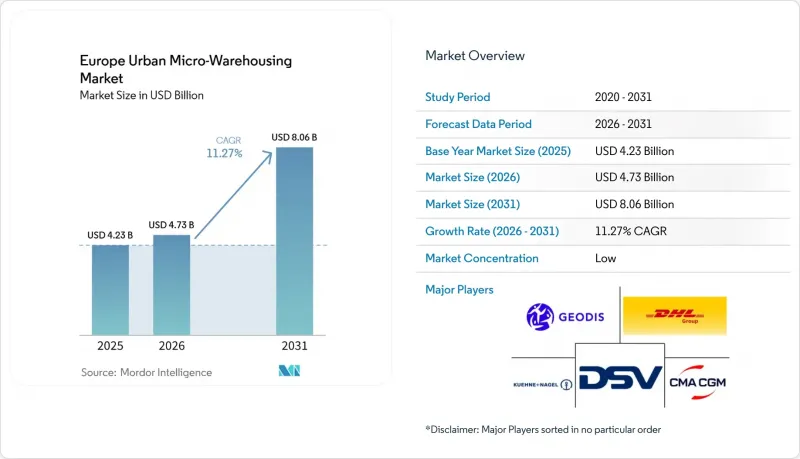
歐洲城市微型倉庫市場正在擴張,因為都市區供應鏈正從位於郊區的大規模物流中心轉向城市更靠近終端用戶的小規模倉庫。本報告按設施類型(暗庫、微型倉儲中心、零售、混合型)、溫度控制類型(溫控、非溫控)、自動化程度(手動、半自動、全自動)、終端用戶行業(電子商務、快餐、食品雜貨、快速消費品、其他)和地區(英國、德國、法國、西班牙、義大利、比利時、荷蘭、北歐國家)進行細分。市場預測以美元計價。
歐洲都市區微型倉庫市場的趨勢與洞察
歐洲主要城市最後一公里配送的密度壓力
歐洲都市區微型倉庫市場的發展受一個簡單的營運現實所驅動:密集的都市區配送路線幾乎沒有空間從遠距離設施調撥庫存。在配送中心密度高、運輸選擇有限的情況下,已位於城市內的庫存價值成長速度遠超在郊區網路路線上增加車輛所帶來的價值成長。一項針對歐洲90個步行區的2026年調查顯示,在歷史中心實現城市配送的脫碳需要多樣化的「最後一公里」運輸方案,這凸顯了將庫存設置在附近而非延長配送距離的重要性。這項發現意義重大,因為城市物流不再僅以速度和成本來衡量,營運商越來越需要遵守當地的交通和排放法規。因此,歐洲城市微型倉庫市場的發展受到與傳統「最後一公里」營運模式信譽度下降相同的城市環境因素的驅動。將庫存設置在人口密集區域附近的營運商可以更快地做出回應,降低配送路線的複雜性,並獲得在城市郊區難以獲得的配送時限。
快速商務的成長以及人們對當日送達的期望
歐洲都市區微型倉庫市場正受益於大都會圈消費者對「當日達」和「近乎即時達」日益成長的期望。如今,消費者將快速配送視為其購買提案中不可或缺的一部分,而這一趨勢涵蓋了更廣泛的產品類別。這意味著企業在設計其網路時,不僅要考慮倉庫規模,還要考慮回應時間。快速電商產業經歷了一段整合期,最終形成了一個財務管理更為穩健的企業群體,這些企業蓄勢待發,準備利用更大、更有效率的倉庫位置。這一點至關重要,因為領導企業不再將所有暗倉集中在住宅,而是轉向能夠實現更高處理能力和更穩定補貨的模式。歐洲都市區微型倉庫市場正受益於此轉變,因為它將需求重新分配給了更易於自動化且更適合都市區工業區規劃的設施。因此,該細分市場的成長不僅與特定品類的需求相關,也與在經歷了最初的擴張階段後變得更加永續的成熟營運模式相關。
都市區房地產成本不斷上漲,土地取得困難。
高昂的都市區房地產成本仍然是歐洲都市區微型倉庫市場面臨的最大障礙之一。倫敦、巴黎和阿姆斯特丹等城市的黃金地段往往被少數業主壟斷,微型倉庫的租金溢價遠遠超出小規模業者的負擔能力。這個問題不僅限於租金;許多投資合格的都市區租賃合約都要求雄厚的財力和嚴格的合約條款,這使得缺乏足夠資金的新進入者望而卻步。因此,歐洲都市區微型倉庫市場越來越依賴那些能夠觀點承擔高昂都市區成本的大型成熟業者。因此,資金獲取而非服務品質或技術差異,正成為營運商能否在主要城市地段運作的決定性因素。這種壓力也加速了產業整合,因為無法獲得合適位置的營運商除了合作、轉租或退出市場之外,幾乎別無選擇。
細分市場分析
到2025年,微型倉配中心將佔歐洲都市區微型倉庫市場41.37%的佔有率,成為歐洲都市區微型倉庫產業的主導設施類型。這一主導地位反映了人口密集城市對服務的強勁需求,以及能夠支援靠近需求點的緊湊型、高吞吐量庫存運營的設施的適用性。這種模式尤其有效,因為2000至5000平方米的面積既足夠緊湊,可以融入都市區物流網路,又能提供足夠的空間進行系統化的揀貨和存儲。預計到2031年,基於暗店的履約將以18.18%的複合年成長率成長,這一速度不僅反映了其擴張,也反映了其對環境的適應。成長主要集中在那些為了響應市政壓力而從住宅遷至更合適的工業區和混合物流區的更永續的企業群體。
零售門市履約和混合型設施構成了設施組合的剩餘部分,兩者都發揮著至關重要的作用,幫助企業更有效率地利用現有的城市資產。混合模式尤其適合希望將面向客戶的營運和本地化的履約功能整合在同一地點的全通路零售商。這種結構提高了資產利用效率,縮短了損益平衡點,因為企業不必依賴單一的用途。 Breckmann 計劃於 2025 年在英國和荷蘭推出其模組化、即插即用的倉庫解決方案“Bscale”,這表明靈活的使用模式如何幫助那些不想從一開始就投資建設功能齊全的專用設施的品牌更容易地進入歐洲城市微型倉庫市場。因此,設施選擇正成為長期的策略決策,因為租賃協議簽訂時選擇的建築類型通常決定了該設施未來能夠實際容納的自動化程度和處理能力。
截至2025年,常溫儲存設施將佔歐洲都市區微型倉庫市場的63.02%,這意味著該市場仍將主要依賴電子商務、日常消費品(FMCG)和時尚物流,這些領域無需專門的環境控制。然而,預計到2031年,溫控倉庫的容量將以14.84%的複合年成長率成長,這表明其將顯著擴展到更複雜、更高價值的產品類型。藥品冷鏈、生鮮食品配送和生物製藥物流等需求正促使業者將受控庫存設置在更靠近大都會圈需求中心的位置。這點至關重要,因為都市區溫控空間開發難度高、營運成本高,但一旦運作,往往就能實現成本績效效益。因此,歐洲都市區微型倉庫市場正從常溫商品轉向那些合規性、品質保證和快速補貨能帶來更高收益的領域。
第二個需求趨勢源自於“快速商業”,其產品範圍不再局限於常溫保存的商品,而是擴展到生鮮食品、乳製品、食材自煮包和冷藏便利商店商品。這種產品組合的轉變催生了暗倉和微型倉配中心的需求,這些設施的內部配置不同於簡單的常溫存儲,需要更卓越的隔熱性能和更嚴格的流程控制。 Arla Foods 和 XPO 物流 的物流中心項目將於 2026 年 1 月在剪切機的 Prologis RFI DIRFT 啟動,該項目展示了圍繞更專業化的物流基礎設施對冷藏食品網路進行的重組,XPO 計劃於 2027 年下半年開始在該設施運營。在歐洲都市區微型倉庫產業,這些趨勢進一步凸顯了對能夠支持受監管藥品分銷和商業主導食品宅配服務擴張的城市冷鏈能力的需求。因此,該領域受益於兩個截然不同的需求促進因素:受監管的醫療產品分銷和高階食品的都市區履約。這兩個因素共同提升了其在歐洲都市區微型倉庫市場的戰略重要性。
其他好處:
- Excel格式的市場預測(ME)表
- 3個月的分析師支持
目錄
第1章:引言
- 研究假設和市場定義
- 調查範圍
第2章:調查方法
第3章執行摘要
第4章 市場狀況
- 市場概況及城市微型倉庫在城市物流中的作用
- 市場促進因素
- 歐洲主要城市最後一公里配送的密度壓力
- 快速商務的成長以及人們對當日送達的期望
- 都市區房地產短缺導致市中心房源接近性。
- 微型倉配的需求日益成長,以降低每筆訂單的運輸成本。
- 重組零售網路,擺脫大規模、邊緣化的物流中心。
- 都市區房地產短缺和對提高勞動效率日益成長的需求
- 市場限制因素
- 都市區房地產成本高昂,供不應求。
- 複雜的區域分類、授權程序和市政土地使用限制。
- 都市區夜班工作的勞動限制
- 自動化和維修專案的資本投資強度
- 法律規範
- 價值鍊和分銷管道的結構分析
- 技術創新前景
- 波特五力分析
- 都市區微型倉庫需求的變化
- 定價和成本結構分析
- 房地產和基礎設施分析
- 分析消費者行為與配送偏好
- 永續交付解決方案和綠色物流舉措
- 地緣政治事件對供應鏈變化的影響
第5章 市場規模及成長預測(價值,2026-2031 年)
- 依設施類型
- 利用暗店進行履約
- 利用微型倉配中心(MFC)進行履約
- 零售店內訂單履約
- 混合設施及其他
- 按溫度類型
- 溫控型
- 無溫度控制
- 按自動化級別
- 手動操作
- 半自動化設施
- 全自動化設施
- 按最終用戶行業分類
- 電子商務
- QuickCommerce
- 食品零售
- FMCG
- 食品/飲料
- 藥品和醫療保健
- 家用電子電器和家用電器
- 時尚與生活方式(配件、服裝、鞋類)
- 工業和B2B分銷
- 其他
- 國家
- 英國
- 德國
- 法國
- 西班牙
- 義大利
- 比利時
- 荷蘭
- 北歐國家(丹麥、芬蘭、冰島、挪威、瑞典)
- 其他歐洲國家
第6章 競爭情勢
- 市場集中度
- 關鍵策略趨勢
- 市佔率分析
- 公司簡介
- DHL Group
- Kuehne+Nagel
- DSV A/S
- CMA CGM Group(Including CEVA Logistics)
- GEODIS
- GXO Logistics, Inc.
- DACHSER
- Rhenus Logistics
- ID Logistics
- FM Logistic
- FIEGE
- Arvato
- Hellmann Worldwide Logistics
- Nippon Express Holdings
- NYK Line(Including Yusen Logistics)
- XPO Inc.
- Noatum Logistics
- Logwin AG
- Bleckmann Logistics
- STEF Group
- PostNord
- Katoen Natie
第7章 市場機會與未來展望
According to Mordor Intelligence, the Europe urban micro-warehousing market size was valued at USD 4.23 billion in 2025 and is estimated to grow from USD 4.73 billion in 2026 to reach USD 8.06 billion by 2031, at a CAGR of 11.27% during the forecast period (2026-2031).
The Europe urban micro-warehousing market is expanding because urban supply chains are moving away from large perimeter distribution centers and toward smaller in-city nodes that sit closer to final demand. This report is Segmented by Facility Type (Dark Store, MFC, Retail, Hybrid), by Temperature Type (Controlled, Non-Controlled), by Automation Level (Manual, Semi-Automated, Fully Automated), by End-User Industry (E-Commerce, Quick Commerce, Grocery, FMCG, and More), and by Geography (United Kingdom, Germany, France, Spain, Italy, Belgium, Netherlands, Nordics). The Market Forecasts are in Value (USD).
Europe Urban Micro-Warehousing Market Trends and Insights
Last-Mile Delivery Density Pressure in Major European Cities
The Europe urban micro-warehousing market is being shaped by a simple operating reality: dense city routes do not leave enough room for slow inventory movement from distant facilities. When delivery stops are tightly packed and travel access is constrained, the value of inventory already inside the city rises faster than the value of adding more vehicles to an outer-network route. A 2026 study covering 90 European pedestrian zones found that different last-mile modes will be needed to decarbonize urban delivery in historic cores, reinforcing the case for closer inventory placement rather than longer dispatch distances. That finding matters because city logistics is no longer judged solely by speed and cost, and operators are increasingly being pushed to comply with local mobility and emissions rules. The Europe urban micro-warehousing market, therefore, gains support from the same urban conditions that are making legacy last-mile operating models less reliable. Operators that place stock closer to dense neighborhoods can respond faster, reduce route complexity, and protect fulfillment windows that are harder to sustain from peri-urban sites.
Growth of Quick Commerce and Same-Day Fulfillment Expectations
The Europe urban micro-warehousing market is also gaining from the steady normalization of same-day and near-immediate fulfillment expectations in large urban centers. Consumers now treat rapid delivery as part of the buying proposition for a wider set of products, which means operators must design networks around response time rather than around warehouse scale alone. Quick commerce has gone through a period of consolidation, leaving a more financially disciplined operator base better positioned to use larger, more efficient sites. This matters because the strongest players are no longer trying to fit every dark store into residential blocks; instead, they are shifting toward formats that support better throughput and more consistent replenishment. The Europe urban micro-warehousing market benefits from that transition because it redirects demand toward facilities that are easier to automate and more compatible with urban industrial zoning. Growth in this part of the market is therefore tied not only to category demand, but also to a maturing operating model that is becoming more durable after the early expansion phase.
High Urban Property Costs and Limited Site Availability
High urban property costs remain 1 of the clearest brakes on the Europe urban micro-warehousing market. Prime sites in cities such as London, Paris, and Amsterdam are controlled by a narrow landlord base, and the rent premium for micro-warehouse space can rise well above levels smaller operators can comfortably absorb. The issue is not limited to rent, because many investment-grade urban leases also require balance-sheet strength and covenant quality that exclude undercapitalized entrants. That leaves the Europe urban micro-warehousing market more dependent on larger incumbents that can underwrite expensive urban locations over a longer time horizon. The result is a market where access to capital often determines who can operate in the best city nodes before service quality or technological differences do. This pressure also accelerates consolidation, since operators that cannot secure viable sites often have little choice but to partner, sublease, or exit.
Other drivers and restraints analyzed in the detailed report include:
- Urban Real-Estate Scarcity Driving In-City Inventory Proximity
- Rising Need for Micro-Fulfillment to Reduce Delivery Cost per Order
- Complex Zoning, Permitting, and Municipal Use Restrictions
For complete list of drivers and restraints, kindly check the Table Of Contents.
Segment Analysis
Micro-fulfillment centers accounted for a 41.37% share of the Europe urban micro-warehousing market size in 2025, making them the leading facility type in the Europe urban micro-warehousing industry. Their lead reflects a good fit between dense-city service expectations and facilities that can support compact, high-throughput inventory operations close to demand. The format works especially well because footprints of 2,000 to 5,000 m2 are large enough for structured picking and storage, yet still small enough to fit urban logistics networks. Dark store-based fulfillment is forecast to grow at 18.18% CAGR through 2031, and that pace reflects adaptation as much as expansion. Growth is becoming concentrated in a more durable operator group that has responded to municipal pressure by moving away from residential settings and into better-suited industrial or mixed logistics zones.
Retail store-based fulfillment and hybrid facilities fill the rest of the facility mix, and both are important because they help operators use existing urban assets more efficiently. Hybrid models are especially relevant for omnichannel retailers that want a single location to support customer-facing activities and local fulfillment capacity. That structure can improve asset utilization and shorten break-even periods because the operator does not rely on a single use case for the site. Bleckmann's 2025 launch of its Bscale modular plug-and-play warehousing solution in the United Kingdom and the Netherlands shows how flexible access models are opening the Europe urban micro-warehousing market to brands that do not want to fund a full dedicated buildout at the start. Facility choice is therefore becoming a long-duration strategic decision, because the building type selected at lease signing often determines what level of automation and throughput the site can realistically support later.
Non-temperature-controlled storage held 63.02% of the Europe urban micro-warehousing market share in 2025, which shows that the market still depends mainly on e-commerce, FMCG, and fashion flows that do not require specialized environmental control. Even so, temperature-controlled capacity is projected to grow at a 14.84% CAGR through 2031, indicating clear expansion into more complex and higher-value product categories. Pharmaceutical cold chain, fresh grocery distribution, and biologic medicine logistics are all pushing operators to place controlled inventory closer to metropolitan demand. This is important because temperature-controlled urban space is harder to develop, more expensive to operate, and often more affordable once in use. As a result, the Europe urban micro-warehousing market is moving beyond ambient goods and into segments where compliance, quality assurance, and faster replenishment carry a larger revenue premium.
A second demand stream is coming from quick commerce, as product assortments expand beyond shelf-stable goods to include fresh produce, dairy, meal kits, and chilled convenience items. Once that category mix changes, dark stores and micro-fulfillment centers need a different internal configuration, better insulation, and stronger process control than simple ambient storage requires. The January 2026 Arla Foods and XPO Logistics distribution center project at Prologis RFI DIRFT in Northamptonshire shows how chilled food networks are being reorganized around more specialized distribution infrastructure, with XPO set to operate the site from late 2027. In the Europe urban micro-warehousing industry, that kind of development reinforces the case for city-serving cold-chain capacity that can support both regulated pharmaceutical flows and commercially driven food delivery expansion. The segment is therefore gaining from 2 separate demand drivers, regulated healthcare distribution and premium urban grocery fulfillment, which together lift its strategic importance within the Europe urban micro-warehousing market.
Complete Report Scope:
- By Facility Type
- Dark Store-Based Fulfillment
- Micro-Fulfillment Center (MFC)-Based Fulfillment
- Retail Store-Based Fulfillment
- Hybrid Facility and Others
- By Temperature Type
- Temperature Controlled
- Non-Temperature Controlled
- By Automation Level
- Manual Operations
- Semi-Automated Facilities
- Fully Automated Facilities
- By End-User Industry
- E-commerce
- Quick Commerce
- Grocery Retail
- FMCG
- Food and Beverage
- Pharmaceuticals and Healthcare
- Consumer Electronics and Household Appliances
- Fashion and Lifestyle (Accessories, Apparel, Footwear)
- Industrial and B2B Distribution
- Others
- By Country
- United Kingdom
- Germany
- France
- Spain
- Italy
- Belgium
- Netherlands
- NORDICS (Denmark, Finland, Iceland, Norway, and Sweden)
- Rest of Europe
List of Companies Covered in this Report:
- DHL Group
- Kuehne+Nagel
- DSV A/S
- CMA CGM Group (Including CEVA Logistics)
- GEODIS
- GXO Logistics, Inc.
- DACHSER
- Rhenus Logistics
- ID Logistics
- FM Logistic
- FIEGE
- Arvato
- Hellmann Worldwide Logistics
- Nippon Express Holdings
- NYK Line (Including Yusen Logistics)
- XPO Inc.
- Noatum Logistics
- Logwin AG
- Bleckmann Logistics
- STEF Group
- PostNord
- Katoen Natie
Additional Benefits:
- The market estimate (ME) sheet in Excel format
- 3 months of analyst support
TABLE OF CONTENTS
1 Introduction
- 1.1 Study Assumptions and Market Definition
- 1.2 Scope of the Study
2 Research Methodology
3 Executive Summary
4 Market Landscape
- 4.1 Market Overview and Role of Urban Micro-Warehousing in Urban Logistics
- 4.2 Market Drivers
- 4.2.1 Last-Mile Delivery Density Pressure in Major European Cities
- 4.2.2 Growth of Quick Commerce and Same-Day Fulfillment Expectations
- 4.2.3 Urban Real-Estate Scarcity Driving In-City Inventory Proximity
- 4.2.4 Rising Need for Micro-Fulfillment to Reduce Delivery Cost per Order
- 4.2.5 Retail Network Reconfiguration Away From Large Perimeter DCs
- 4.2.6 Urban Property Scarcity and Rising Labor-Efficiency Demand
- 4.3 Market Restraints
- 4.3.1 High Urban Property Costs and Limited Site Availability
- 4.3.2 Complex Zoning, Permitting, and Municipal Use Restrictions
- 4.3.3 Labor Constraints for Urban Night-Shift Operations
- 4.3.4 Capex Intensity of Automation and Retrofit Projects
- 4.4 Regulatory Framework
- 4.5 Value Chain and Distribution Channel Architecture Analysis
- 4.6 Technology Innovations Outlook
- 4.7 Porter's Five Forces Analysis
- 4.7.1 Threat of New Entrants
- 4.7.2 Bargaining Power of Suppliers
- 4.7.3 Bargaining Power of Buyers
- 4.7.4 Threat of Substitutes
- 4.7.5 Rivalry Among Competitors
- 4.8 Evolution of Urban Micro-Warehousing Requirements
- 4.9 Pricing and Cost Structure Analysis
- 4.10 Real Estate and Infrastructure Analysis
- 4.11 Consumer Behavior and Delivery Preferences Analysis
- 4.12 Sustainable Delivery Solutions and Green Logistics Initiatives
- 4.13 Impact of Geo-Political Events on Supply Chain Shifts
5 Market Size and Growth Forecasts (Value, 2026-2031)
- 5.1 By Facility Type
- 5.1.1 Dark Store-Based Fulfillment
- 5.1.2 Micro-Fulfillment Center (MFC)-Based Fulfillment
- 5.1.3 Retail Store-Based Fulfillment
- 5.1.4 Hybrid Facility and Others
- 5.2 By Temperature Type
- 5.2.1 Temperature Controlled
- 5.2.2 Non-Temperature Controlled
- 5.3 By Automation Level
- 5.3.1 Manual Operations
- 5.3.2 Semi-Automated Facilities
- 5.3.3 Fully Automated Facilities
- 5.4 By End-User Industry
- 5.4.1 E-commerce
- 5.4.2 Quick Commerce
- 5.4.3 Grocery Retail
- 5.4.4 FMCG
- 5.4.5 Food and Beverage
- 5.4.6 Pharmaceuticals and Healthcare
- 5.4.7 Consumer Electronics and Household Appliances
- 5.4.8 Fashion and Lifestyle (Accessories, Apparel, Footwear)
- 5.4.9 Industrial and B2B Distribution
- 5.4.10 Others
- 5.5 By Country
- 5.5.1 United Kingdom
- 5.5.2 Germany
- 5.5.3 France
- 5.5.4 Spain
- 5.5.5 Italy
- 5.5.6 Belgium
- 5.5.7 Netherlands
- 5.5.8 NORDICS (Denmark, Finland, Iceland, Norway, and Sweden)
- 5.5.9 Rest of Europe
6 Competitive Landscape
- 6.1 Market Concentration
- 6.2 Key Strategic Moves
- 6.3 Market Share Analysis
- 6.4 Company Profiles (includes Global Level Overview, Market Level Overview, Core Segments, Financials as Available, Strategic Information, Market Rank/Share for Key Companies, Products & Services, and Recent Developments)
- 6.4.1 DHL Group
- 6.4.2 Kuehne+Nagel
- 6.4.3 DSV A/S
- 6.4.4 CMA CGM Group (Including CEVA Logistics)
- 6.4.5 GEODIS
- 6.4.6 GXO Logistics, Inc.
- 6.4.7 DACHSER
- 6.4.8 Rhenus Logistics
- 6.4.9 ID Logistics
- 6.4.10 FM Logistic
- 6.4.11 FIEGE
- 6.4.12 Arvato
- 6.4.13 Hellmann Worldwide Logistics
- 6.4.14 Nippon Express Holdings
- 6.4.15 NYK Line (Including Yusen Logistics)
- 6.4.16 XPO Inc.
- 6.4.17 Noatum Logistics
- 6.4.18 Logwin AG
- 6.4.19 Bleckmann Logistics
- 6.4.20 STEF Group
- 6.4.21 PostNord
- 6.4.22 Katoen Natie
7 Market Opportunities and Future Outlook
- 7.1 White-space and Unmet-Need Assessment

 印度城市微型倉庫市場:市場佔有率分析、產業趨勢與統計及成長預測(2026-2031)美國城市微型倉庫:市場佔有率分析、產業趨勢與統計、成長預測(2026-2031 年)
 城市微型倉庫自動化市場預測至2034年-按自動化解決方案、組件、技術、應用、最終用戶和地區分類的全球分析城市微型倉庫租賃市場預測至2034年-全球分析(按設施類型、租賃模式、經營模式、倉庫規模、技術採用、最終用戶和地區分類)城市微型倉儲市場預測至2032年:按設施類型、經營模式、技術、最終用戶和地區分類的全球分析城市微型倉配中心市場預測至2032年:按設施類型、服務內容、組織規模、經營模式、技術、最終用戶和地區分類的全球分析