


 |
市場調查報告書
商品編碼
2119129
長影片行銷服務:市場佔有率分析、產業趨勢與統計、成長預測(2026-2031 年)Long-Form Video Marketing Services - Market Share Analysis, Industry Trends & Statistics, Growth Forecasts (2026 - 2031) |
||||||

※ 本網頁內容可能與最新版本有所差異。詳細情況請與我們聯繫。
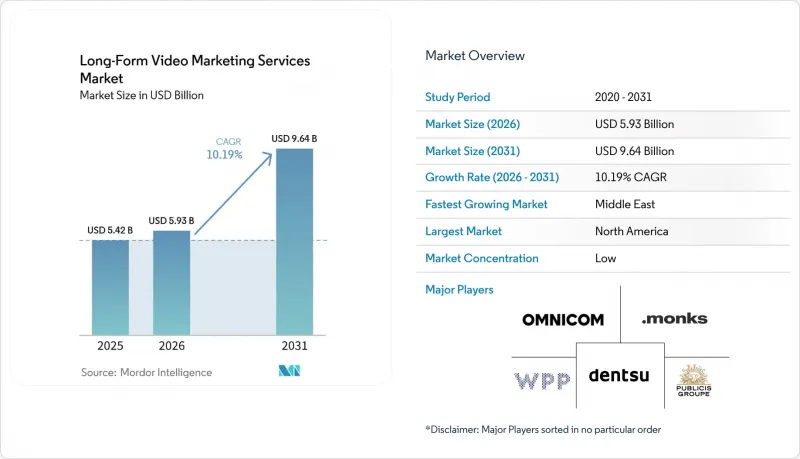
據 Mordor Intelligence 稱,長影片行銷服務的市場規模預計將從 2025 年的 54.2 億美元成長到 2026 年的 59.3 億美元,到 2031 年的複合年成長率為 10.19%。
本報告按服務類型(影片策略與規劃、影片製作、後製、分發與推廣)、終端用戶產業(科技與軟體、金融服務、醫療保健與生命科學、媒體與娛樂、消費品牌與零售、旅遊與飯店等)以及地區進行細分。市場預測以美元計價。
長影片行銷服務市場的全球趨勢與洞察
擴大對影片和思想領袖的B2B投資
B2B企業不再將影片視為可有可無的內容活動,而是視為需求創造的核心投資。 LinkedIn近期一項針對B2B行銷人員的調查顯示,多數行銷長(CMO)表示影片能夠加速銷售週期並提高線索轉換率。這使得影片的商業價值不僅對行銷團隊至關重要,對營收經理也同樣重要。高階主管訪談、紀錄片式案例研究以及多集教育節目都需要專業的規劃和製作。長篇影片行銷服務市場可以從以下方面獲益:服務提供者應將這些節目與銷售管道的最終成果掛鉤,而不是將其視為孤立的創新交付物。這種方法還有助於建立以持續專案而非一次性專案為中心的長期客戶關係。
網路研討會和教育影片的參與度很高
網路研討會和結構化培訓計畫正在強化長篇內容在B2B採購中的作用。 ON24的基準研究證實,平均參加人數保持穩定,與會者逐年提高,註冊與會者轉化為實際參與者的轉換率很高,觀眾參與度也持續成長。報告也顯示,網路研討會的行動號召(CTA)促使演示預約量逐年增加。直播期間的會議預約量也顯著成長,縮短了從內容互動到銷售會議的流程。點播觀看功能使網路研討會的價值超越了實況活動本身。負責製作、推廣和重播管理的供應商可以將單一專案打造為長期有效的資源,協助潛在客戶開發。
儘管對影片內容的需求不斷成長,但內容預算卻保持不變。
即使企業認知到影片的價值,預算壓力仍然是限制因素。 Wistia 的一份報告顯示,到 2025 年,51% 的企業影片預算將保持不變或減少,而所有企業(無論規模大小)的影片觀看量將增加 6-7%。這造成了財力雄厚、能夠增加支出的企業與被迫優先考慮成本效益的中型企業之間的差距。人工智慧驅動的製作可以降低每個項目的成本,但也可能削弱專業工作室的高價定價模式。當謹慎的行銷預算限制了實驗性投入時,這種壓力尤其突出。服務供應商可以透過在內容需求和合規要求表明更永續的支出領域累積專業知識來降低這種風險。
細分市場分析
截至2025年,影片製作服務在長影片行銷服務市場規模中佔34.66%。由於大多數企業團隊無法在內部完成劇本創作、拍攝、導演、動畫製作和動態圖像等工作,原創內容的創作仍然至關重要。這促使需要複雜且品牌專屬內容的公司經常選擇外包。預計到2031年,分發和推廣服務將以10.91%的複合年成長率成長。客戶越來越意識到,如果沒有透過LinkedIn、YouTube和連網電視等平台進行有計劃的傳播,他們的作品價值將受到限制。這種服務擴張反映出一種趨勢,即從個人內容創作轉向管理如何將內容傳遞給特定的專業受眾。
對於開展跨季度專案的公司而言,影片策略和規劃服務的重要性日益凸顯。這些客戶需要在製作開始前,確定影片格式、目標受眾和發行管道順序。後製服務以及其他服務,例如分析、無障礙字幕和內容重用,有助於更系統化的內容管理。長影片行銷服務產業正朝著整合規劃、製作、分發和效果評估的月月模式轉變。控股公司能夠大規模地交付這些項目,而獨立服務商則憑藉更快的交付速度、人工智慧驅動的工作流程效率以及行業特定的剪輯深度,在競爭中脫穎而出。
區域分析
到2025年,北美將佔據長影片行銷服務市場41.53%的佔有率。該地區B2B技術公司的高度集中以及成熟的衡量方法支撐了市場需求。 YouTube上的螢幕觀看量提升了長影片系列和連網電視(CTV)發行的商業性價值。 LinkedIn的專業使用者群體也更傾向於選擇基於可信度和情境相關性的內容。在加拿大和墨西哥,中端市場預計將出現商機,包括在墨西哥本地製作的西班牙語B2B內容。
歐洲的成長主要由英國、德國和法國推動,其中英國擁有成熟的創新製作基地。 B2B影片行銷在德國的中型企業市場正逐漸普及。亞太地區是除中東以外成長速度第二快的市場,其中印度和韓國引領成長。中國、日本、韓國和其他亞太國家正在擴大市場規模,但在地化和平台需求可能會導致供應商之間的差異化。
預計到2031年,中東地區的複合年成長率將達到10.96%,在所有區域市場中成長最高。根據IAB MENA的報告,該地區的數位廣告市場在2025年實現了同比成長。該報告還指出,社群影片和連網電視廣告在2025年也實現了強勁成長。儘管「2030願景」計畫、土耳其龐大的網路使用者群體以及南非和奈及利亞的早期需求都創造了機遇,但基礎設施、效果衡量和預算方面的限制依然存在。
其他好處:
- Excel格式的市場預測(ME)表
- 3個月的分析師支持
目錄
第1章:引言
- 研究假設和市場定義
- 調查範圍
第2章:調查方法
第3章執行摘要
第4章 市場狀況
- 市場概覽
- 市場促進因素
- 加大對B2B領域影片與思想領導的投入。
- 網路研討會和教學影片的參與率很高
- 在LinkedIn和YouTube上拓展專業影片的發現機會
- 透過在生產中應用人工智慧,我們可以降低單位成本並縮短交貨時間。
- 在電視螢幕上觀看 YouTube 可以提高長篇劇集的盈利。
- 「隱形買家的影響力」正在推動對可信賴影片的需求。
- 市場限制因素
- 儘管對影片內容的需求不斷成長,但內容預算卻保持不變。
- 觀看行為與流程之間的相關性較弱。
- 人工智慧驅動的思想領導統一性和真實性的風險
- 平台演算法在超長內容的差異
- 產業價值鏈分析
- 監理情勢
- 宏觀經濟因素對市場的影響
- 技術展望
- 波特五力分析
第5章 市場規模與成長預測
- 按服務類型
- 影片策略與規劃服務
- 影像製作服務(劇本創作、拍攝、導演、動畫、動態圖像等)
- 後製服務
- 分銷和促銷服務
- 其他服務類型
- 按最終用途行業分類
- 科技與軟體
- 金融服務
- 醫療保健和生命科學
- 媒體與娛樂
- 消費品牌和零售商
- 教育
- 旅遊與飯店
- 政府/公共部門
- 其他終端用戶產業
- 按地區
- 北美洲
- 美國
- 加拿大
- 墨西哥
- 南美洲
- 巴西
- 阿根廷
- 智利
- 其他南美國家
- 歐洲
- 英國
- 德國
- 法國
- 俄羅斯
- 義大利
- 西班牙
- 其他歐洲國家
- 亞太地區
- 中國
- 日本
- 印度
- 韓國
- 其他亞太國家
- 中東
- 沙烏地阿拉伯
- 阿拉伯聯合大公國
- 土耳其
- 其他中東國家
- 非洲
- 南非
- 奈及利亞
- 其他非洲國家
- 北美洲
第6章 競爭情勢
- 市場集中度
- 策略趨勢
- 市佔率分析
- 公司簡介
- WPP plc
- Omnicom Group Inc.
- Publicis Groupe SA
- Dentsu Group Inc.
- Media.Monks BV
- Lemonlight Media LLC
- Wyzowl Ltd.
- Vidico
- Epipheo Studios LLC
- Mekanism
- Sandwich Video Inc.
- Signature Video Group, Inc.
- Sparkhouse Inc.
- webdew, Inc.
- Storyhunter
- Shootsta Holdings Pty Ltd
- Thinkmojo
- VeracityColab LLC
- Bold Content Video Ltd.
第7章 市場機會與未來展望
According to Mordor Intelligence, the long-form video marketing services market size is expected to increase from USD 5.42 billion in 2025 to USD 5.93 billion in 2026 and reach USD 9.64 billion by 2031, expanding at a CAGR of 10.19% over 2026-2031.
This report is Segmented by Service Type (Video Strategy and Planning, Video Production, Post-Production, and Distribution and Promotion), End-Use Industry (Technology and Software, Financial Services, Healthcare and Life Sciences, Media and Entertainment, Consumer Brands and Retail, Travel and Hospitality, and More), and Geography. The Market Forecasts are Provided in Terms of Value (USD).
Global Long-Form Video Marketing Services Market Trends and Insights
Rising B2B Investment in Video and Thought Leadership
B2B organizations are making video a core demand-generation investment instead of a discretionary content activity. LinkedIn's recent survey of B2B marketers found that most CMOs said video accelerated sales cycles and lead conversion. This makes the commercial case for video relevant to revenue leaders as well as marketing teams. Executive interviews, documentary case studies, and multi-episode educational programs require professional planning and production. The Long-form video marketing services market can benefit when providers link these programs to pipeline outcomes instead of treating them as isolated creative deliverables. This approach can also support longer client relationships built around a continuing program rather than a single assignment.
Strong Webinar and Educational Video Engagement
Webinars and structured educational programs are reinforcing the role of long-form content in B2B buying. ON24 recorded strong average session attendance in its benchmarks, with improved participation from the prior year, a healthy registration-to-attendee conversion rate, and sustained audience engagement. The report also found that webinar calls to action generated more demo bookings year over year. Meeting bookings during live sessions increased significantly, shortening the path from content engagement to a sales discussion. On-demand viewing extends the working life of a webinar beyond the live event. Providers that handle production, promotion, and replay management can position a single program as an asset that supports lead generation over a longer period.
Flat Content Budgets Despite Higher Video Demand
Budget pressure remains a constraint even when companies recognize the value of video. Wistia reported that 51% of companies had flat or declining video budgets in 2025, while video plays increased by 6%-7% among both small and large companies. This produces a split between well-funded enterprises that can increase spending and mid-market clients that must prioritize cost efficiency. AI-assisted production may reduce the cost of each deliverable, but it can also weaken the premium pricing model of specialist studios. The pressure is particularly relevant where cautious marketing budgets limit experimentation. Service providers can reduce this exposure by building expertise in sectors where content needs and compliance requirements support more durable spending.
Other drivers and restraints analyzed in the detailed report include:
- Expanding Professional Video Discovery on LinkedIn and YouTube
- AI-Assisted Production Lowers Unit Costs and Speeds Delivery
- Weak Attribution Between Watch Behavior and Pipeline
For complete list of drivers and restraints, kindly check the Table Of Contents.
Segment Analysis
Video Production Services accounted for 34.66% of the Long-form video marketing services market size by service type in 2025. Original asset creation remains essential because most enterprise teams cannot internalize scriptwriting, filming, direction, animation, and motion-graphics work. This supports regular outsourcing by companies that need polished, brand-authored programs. Distribution and Promotion Services is projected to expand at a CAGR of 10.91% through 2031. Clients increasingly recognize that a production has limited value without planned amplification through LinkedIn, YouTube, and connected television. The service's expansion reflects a move from making individual assets to managing how content reaches a defined professional audience.
Video Strategy and Planning Services has become more important for companies that run multi-quarter programming. These clients need support to sequence formats, audiences, and distribution channels before production begins. Post-Production Services and other services, such as analytics, accessibility captioning, and content repurposing, support more systematic content operations. The Long-form video marketing services industry is moving toward retainer programs that combine planning, production, distribution, and measurement. Holding companies can provide these programs at scale, while independent providers compete through delivery speed, AI-enabled workflow efficiency, and sector-specific editorial depth.
Complete Report Scope:
- By Service Type
- Video Strategy and Planning Services
- Video Production Services (Scriptwriting, Filming, Direction, Animation, Motion graphics, among others)
- Post-Production Services
- Distribution and Promotion Services
- Other Service Types
- By End-use Industry
- Technology and Software
- Financial Services
- Healthcare and Life Sciences
- Media and Entertainment
- Consumer Brands and Retail
- Education
- Travel and Hospitality
- Government and Public Sector
- Other End-use Industries
- By Geography
- North America
- United States
- Canada
- Mexico
- South America
- Brazil
- Argentina
- Chile
- Rest of South America
- Europe
- United Kingdom
- Germany
- France
- Russia
- Italy
- Spain
- Rest of Europe
- Asia-Pacific
- China
- Japan
- India
- South Korea
- Rest of Asia-Pacific
- Middle East
- Saudi Arabia
- United Arab Emirates
- Turkey
- Rest of Middle East
- Africa
- South Africa
- Nigeria
- Rest of Africa
- North America
Geography Analysis
North America held 41.53% of the Long-form video marketing services market share in 2025. A high concentration of B2B technology companies and mature measurement practices supports regional demand. Television-screen viewing on YouTube improves the commercial case for long-form series and connected television distribution. LinkedIn's professional audience also favors programs built on credibility and contextual relevance. Canada and Mexico offer mid-market opportunities, including locally produced Spanish-language B2B content in Mexico.
Europe's growth is supported by the United Kingdom, Germany, and France, with the United Kingdom maintaining an established creative production base. Germany's industrial mid-market is increasing its adoption of B2B video marketing. Asia-Pacific represents the next fastest-growing opportunity outside the Middle East, led by India and South Korea. China, Japan, South Korea, and other Asia-Pacific countries add volume, although localization and platform requirements can differentiate providers.
The Middle East is projected to expand at a CAGR of 10.96% through 2031, the fastest rate among geographic segments. IAB MENA reported that the regional digital advertising category expanded in 2025 compared to the previous year. The report also recorded strong growth in social video and connected television advertising during 2025. Vision 2030 programs, Turkey's connected population, and early demand in South Africa and Nigeria create opportunities, although infrastructure, measurement, and budget constraints remain.
- WPP plc
- Omnicom Group Inc.
- Publicis Groupe S.A.
- Dentsu Group Inc.
- Media.Monks B.V.
- Lemonlight Media LLC
- Wyzowl Ltd.
- Vidico
- Epipheo Studios LLC
- Mekanism
- Sandwich Video Inc.
- Signature Video Group, Inc.
- Sparkhouse Inc.
- webdew, Inc.
- Storyhunter
- Shootsta Holdings Pty Ltd
- Thinkmojo
- VeracityColab LLC
- Bold Content Video Ltd.
Additional Benefits:
- The market estimate (ME) sheet in Excel format
- 3 months of analyst support
TABLE OF CONTENTS
1 INTRODUCTION
- 1.1 Study Assumptions and Market Definition
- 1.2 Scope of the Study
2 RESEARCH METHODOLOGY
3 EXECUTIVE SUMMARY
4 MARKET LANDSCAPE
- 4.1 Market Overview
- 4.2 Market Drivers
- 4.2.1 Rising B2B Investment In Video and Thought Leadership
- 4.2.2 Strong Webinar and Educational Video Engagement
- 4.2.3 Expanding Professional Video Discovery On LinkedIn and YouTube
- 4.2.4 AI-Assisted Production Lowers Unit Costs and Speeds Delivery
- 4.2.5 TV-Screen YouTube Viewing Improves Long-Form Series Economics
- 4.2.6 Hidden Buyer Influence Raises Demand For Credibility-Led Video
- 4.3 Market Restraints
- 4.3.1 Flat Content Budgets Despite Higher Video Demand
- 4.3.2 Weak Attribution Between Watch Behavior and Pipeline
- 4.3.3 AI-Sameness and Authenticity Risk In Thought Leadership
- 4.3.4 Platform Algorithm Volatility For Ultra-Long-Form Content
- 4.4 Industry Value-Chain Analysis
- 4.5 Regulatory Landscape
- 4.6 Impact of Macroeconomic Factors on the Market
- 4.7 Technological Outlook
- 4.8 Porter's Five Forces Analysis
- 4.8.1 Threat of New Entrants
- 4.8.2 Bargaining Power of Buyers
- 4.8.3 Bargaining Power of Suppliers
- 4.8.4 Threat of Substitutes
- 4.8.5 Competitive Rivalry
5 MARKET SIZE AND GROWTH FORECASTS (VALUE)
- 5.1 By Service Type
- 5.1.1 Video Strategy and Planning Services
- 5.1.2 Video Production Services (Scriptwriting, Filming, Direction, Animation, Motion graphics, among others)
- 5.1.3 Post-Production Services
- 5.1.4 Distribution and Promotion Services
- 5.1.5 Other Service Types
- 5.2 By End-use Industry
- 5.2.1 Technology and Software
- 5.2.2 Financial Services
- 5.2.3 Healthcare and Life Sciences
- 5.2.4 Media and Entertainment
- 5.2.5 Consumer Brands and Retail
- 5.2.6 Education
- 5.2.7 Travel and Hospitality
- 5.2.8 Government and Public Sector
- 5.2.9 Other End-use Industries
- 5.3 By Geography
- 5.3.1 North America
- 5.3.1.1 United States
- 5.3.1.2 Canada
- 5.3.1.3 Mexico
- 5.3.2 South America
- 5.3.2.1 Brazil
- 5.3.2.2 Argentina
- 5.3.2.3 Chile
- 5.3.2.4 Rest of South America
- 5.3.3 Europe
- 5.3.3.1 United Kingdom
- 5.3.3.2 Germany
- 5.3.3.3 France
- 5.3.3.4 Russia
- 5.3.3.5 Italy
- 5.3.3.6 Spain
- 5.3.3.7 Rest of Europe
- 5.3.4 Asia-Pacific
- 5.3.4.1 China
- 5.3.4.2 Japan
- 5.3.4.3 India
- 5.3.4.4 South Korea
- 5.3.4.5 Rest of Asia-Pacific
- 5.3.5 Middle East
- 5.3.5.1 Saudi Arabia
- 5.3.5.2 United Arab Emirates
- 5.3.5.3 Turkey
- 5.3.5.4 Rest of Middle East
- 5.3.6 Africa
- 5.3.6.1 South Africa
- 5.3.6.2 Nigeria
- 5.3.6.3 Rest of Africa
- 5.3.1 North America
6 COMPETITIVE LANDSCAPE
- 6.1 Market Concentration
- 6.2 Strategic Moves
- 6.3 Market Share Analysis
- 6.4 Company Profiles (includes Global Level Overview, Market Level Overview, Core Segments, Financials as available, Strategic Information, Market Rank/Share, Products and Services, Recent Developments)
- 6.4.1 WPP plc
- 6.4.2 Omnicom Group Inc.
- 6.4.3 Publicis Groupe S.A.
- 6.4.4 Dentsu Group Inc.
- 6.4.5 Media.Monks B.V.
- 6.4.6 Lemonlight Media LLC
- 6.4.7 Wyzowl Ltd.
- 6.4.8 Vidico
- 6.4.9 Epipheo Studios LLC
- 6.4.10 Mekanism
- 6.4.11 Sandwich Video Inc.
- 6.4.12 Signature Video Group, Inc.
- 6.4.13 Sparkhouse Inc.
- 6.4.14 webdew, Inc.
- 6.4.15 Storyhunter
- 6.4.16 Shootsta Holdings Pty Ltd
- 6.4.17 Thinkmojo
- 6.4.18 VeracityColab LLC
- 6.4.19 Bold Content Video Ltd.
7 MARKET OPPORTUNITIES AND FUTURE OUTLOOK
- 7.1 White-Space and Unmet-Need Assessment

 人工智慧影片市場:按設備類型、傳輸方式、技術類型、影片生成類型、應用和地區分類
 影片內容管理系統市場-2026-2032年全球市場預測
 影片內容:市場佔有率分析、產業趨勢與統計、成長預測(2026-2031年)影片內容行銷服務市場:市場佔有率分析、產業趨勢與統計、成長預測(2026-2031)數位視訊內容解決方案市場:按組件、部署類型、組織規模、最終用戶產業和應用程式分類-2026-2032年全球市場預測
 2026年全球教育影片授權市場報告
 全球企業影片內容管理市場規模、佔有率、趨勢和成長分析報告(2026-2034年)
 2026-2030年全球數位影片內容市場
 視訊內容管理系統市場分析及預測(至2035年):按類型、產品類型、服務、技術、組件、應用、部署類型、最終用戶、功能和解決方案分類
 數位影片內容市場報告:按經營模式、設備、類型和地區分類(2026-2034 年)