


 |
市場調查報告書
商品編碼
2119102
虛擬網紅行銷服務:市場佔有率分析、產業趨勢與統計、成長預測(2026-2031)Virtual Influencer Marketing Services - Market Share Analysis, Industry Trends & Statistics, Growth Forecasts (2026 - 2031) |
||||||

※ 本網頁內容可能與最新版本有所差異。詳細情況請與我們聯繫。
據 Mordor Intelligence 稱,2025 年虛擬網紅行銷服務市場價值 12.4 億美元,預計到 2031 年將從 2026 年的 14.3 億美元成長至 32.1 億美元,預測期(2026-2031 年)複合年成長率為 17.54%。
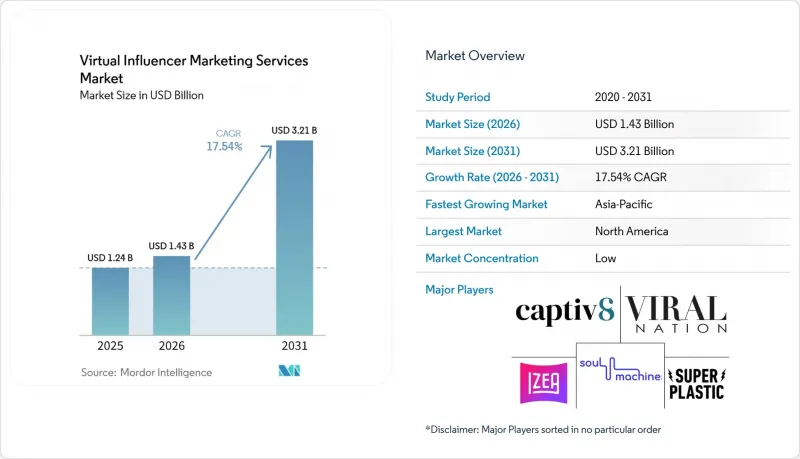
本報告按服務類型(策略與概念開發、虛擬形象創建與設計等)、應用領域(活動行銷、社交電商、社群建立)、終端用戶產業(時尚美妝、零售電商、娛樂媒體、食品飲料、汽車等)以及地區進行細分。市場預測以美元計價。
全球虛擬網紅行銷服務市場趨勢及洞察
對「始終運作」和「品牌安全」的創作者資源的需求日益成長。
品牌安全已成為創作者行銷採購的核心考量。研究表明,到2025年,74%的企業行銷人員將比前一年更加重視品牌安全,而82%重視品牌安全的機構表示,其創作者專案的投資回報率(ROI)有所提高。虛擬人物可以遵守既定的內容規則,並且不會做出可能造成聲譽風險的即興個人判斷。這使得虛擬網紅行銷服務市場在品牌需要透過頻繁發佈內容和宣傳活動來保持持續對外溝通時,具有顯著的實際優勢。研究顯示,89%的企業受訪者優先考慮低風險創作者,凸顯了管理創作者資產的必要性。此外,當品牌所需的內容規模超出自身管道的處理能力時,類似的營運模式可以減輕管治負擔。然而,即使實現了自動化分發,文化判斷、資訊揭露和品管仍然至關重要,因此服務供應商仍然需要主動篩選流程。
社群電商的擴張與「可購買虛擬形象」模式的出現。
隨著社群電商的興起,虛擬形像作為直接推廣產品的工具,其角色日益凸顯。虛擬形象可以支援重複推送可購買內容、進行直播活動以及進行產品說明,而無需像真人創作者那樣受到時間安排的限制。這強化了「虛擬網紅行銷服務市場」在內容需要與電商活動緊密結合的項目中的作用。預計到2031年,活動行銷的複合年成長率將達到18.06%,這表明品牌正在將電商活動與新品發布和線下體驗的時機結合。虛擬化身形式的引入可能會改變品牌、代理商和創作者之間的商業性關係,因為平台營運商可以更嚴格地管理庫存和內容標準。當虛擬化身支援持續的購物活動時,服務提供者必須謹慎管理產品的準確性、內容的適宜性和客戶互動。
消費者對「真實性」的擔憂與信任之間的差距
在依賴信譽和情感聯繫的宣傳活動中,真實性仍然是最大的障礙。一項調查顯示,95%的品牌對人工智慧在創作者行銷中的應用表示擔憂,其中最主要的擔憂是缺乏真實、人性化的聯繫。一項針對73篇同行評審研究的系統性回顧發現,與虛擬網紅互動中的信任度和情感連結通常低於人際互動的標準。該研究還表明,過於明確的資訊揭露可能會降低資訊來源的可信度,並降低購買意願。這為虛擬網紅行銷服務市場帶來了一個難題:透明度固然重要,但也可能影響受眾的反應。服務提供者需要設計具有明確目標和受眾期望的、貼近現實的虛擬形象,並提供不會過度強調人類特徵的內容。與其隱瞞虛擬形像是真人替代品的事實,不如坦誠地將其呈現為數位角色,這樣才能增強信任。
細分市場分析
到2025年,「宣傳活動統籌和媒體運營」將佔據虛擬網紅行銷服務市場30.81%的佔有率。這一主導地位反映了在社交、電商和程序化管道中持續有效地利用虛擬形象所需的工作量。服務提供者必須在同一宣傳活動中協調虛擬形象的創建、平台調整、發布計劃、社群腳本和媒體活動。隨著品牌行銷活動從單通路測試轉向跨平台持續運營,這項要求也變得更加嚴格。策略和概念開發仍然至關重要,因為品牌團隊需要在製作開始前明確角色定位和內容方向。 「虛擬形象創建和設計」為角色提供了視覺和技術基礎,使其能夠反覆出現而不損害品牌一致性。在服務結構方面,能夠持續處理從初始規劃到宣傳活動管理所有環節,而無需依賴多個各自獨立的供應商的服務提供者俱有優勢。這進一步強化了客戶傾向於選擇少數能夠管理整個流程的合作夥伴的趨勢。在虛擬網紅行銷服務市場,這種組合意味著營運協調是服務提供者價值主張的核心。
「測量、分析與最佳化」領域預計到2031年將以17.98%的複合年成長率成長。這一快速成長反映了市場對與商業性目標相關的檢驗結果的需求。 「社群管理和受眾互動」的重要性也日益凸顯,因為虛擬角色不僅需要定期發佈內容,還需要持續互動來維持受眾的參與。虛擬網紅行銷服務產業正日益受到將創新內容傳送與測量和受眾管理相結合的服務的影響。這些功能幫助品牌從單純的內容創作轉向具有清晰績效評估的管理型專案。雖然自動化應用日益廣泛,但人工監督仍然必不可少,因為語氣、受眾信任和品牌契合度仍然需要積極管理。同時具備營運管理和測量能力的供應商對企業買家而言將變得越來越重要。因此,有助於預算編制的報告在虛擬網紅行銷服務市場中將變得越來越重要。
區域分析
預計到2025年,北美將佔據虛擬網紅行銷服務市場35.18%的佔有率。該地區擁有龐大的企業網紅行銷預算和完善的數位媒體基礎設施。此外,該地區的品牌擅長衡量和選擇宣傳活動,這有利於更有系統的服務採購。美國聯邦貿易委員會 (FTC) 的建議以及紐約州的《合成表演者廣告法》(將於2026年6月9日生效)正在改變服務提供者的運作方式,強制要求他們更加重視資訊揭露和合約合規性。雖然這些要求可能會增加行政工作量,但也提升了透明營運實務的價值。加拿大和墨西哥目前市場佔有率相對較小,但其數位商務活動為服務普及提供了更多空間。該地區的虛擬網紅行銷服務市場依賴能夠同時管理創新活動和合規流程的服務提供者。
預計亞太地區在2026年至2031年間將以20.11%的複合年成長率成長。在日本,與虛擬角色互動已形成成熟的文化;而在韓國,一個與K-POP粉絲緊密相連的虛擬偶像生態系統正在發展中。在中國,一個日益壯大的虛擬網紅生態系統正與深度合成技術的管治架構融合。 2026年7月,東京的一個試點計畫展示了在戶外廣告和店內體驗中使用對話式虛擬人。該地區的成長為能夠實現角色在地化、滿足文化期望並符合當地技術要求的供應商創造了機會。然而,不同市場在消費者偏好和資訊揭露法規方面的差異,也提高了外國參與企業進入該地區的門檻。
歐洲是繼北美之後第二成熟的地區,其中英國、德國和法國是主要的需求中心。這些國家的買家非常重視效果衡量、透明的資料處理以及遵守《一般資料保護規則》(GDPR)。在中東,阿拉伯聯合大公國和沙烏地阿拉伯正經歷快速成長,這得益於年輕且精通網路的用戶群以及政府支持的創新經濟計畫。非洲仍處於起步階段,但南非、奈及利亞和埃及的需求正透過行動優先的社群電商和與Z世代的互動而不斷擴大。南美洲以巴西為中心,「Lu do Magalu」案例表明,虛擬角色可以觸及廣泛的消費群體。這些發展中地區為服務提供者提供了長期的機遇,但宣傳活動策略必須反映當地語言、平台使用習慣和消費者信任。
其他好處:
- Excel格式的市場預測(ME)表
- 3個月的分析師支持
目錄
第1章:引言
- 研究假設和市場定義
- 調查範圍
第2章:調查方法
第3章執行摘要
第4章 市場狀況
- 市場概覽
- 市場促進因素
- 對「始終在線、品牌安全的創作者素材」的需求日益成長
- 降低人工智慧、電腦生成圖像和在地化的製作成本。
- Z世代和阿爾法世代對虛擬身分的接受度日益提高。
- 社群商務與「可購買虛擬形象」模式的擴展
- 創作者倦怠正促使該品牌走向「人機結合的人才模式」。
- 公司擁有的虛擬形象智慧財產權正成為可重複使用的第一方媒體資產。
- 市場限制因素
- 消費者對真實性和信任的需求之間存在差距。
- 高成本結構和持續的故事管理成本
- 揭露標籤和來源元資料可能會降低合成內容的效能。
- 數位肖像權相關法規的擴展加劇了合約談判和版權管理方面的摩擦。
- 宏觀經濟因素對市場的影響
- 產業價值鏈分析
- 科技趨勢
- 監理情勢
- 波特五力分析
第5章 市場規模與成長預測
- 按服務類型
- 策略和概念發展
- 虛擬形象的創建與設計
- 宣傳活動編配與媒體管理
- 社群管理和受眾參與
- 測量、分析、最佳化
- 透過使用
- 活動行銷
- 社群電商
- 社區營造
- 按最終用戶行業分類
- 時尚與美妝
- 零售與電子商務
- 娛樂媒體
- 食品/飲料
- 旅遊與飯店
- BFSI
- 車
- 其他終端用戶產業
- 按地區
- 北美洲
- 美國
- 加拿大
- 墨西哥
- 南美洲
- 巴西
- 阿根廷
- 智利
- 其他南美國家
- 歐洲
- 德國
- 英國
- 法國
- 義大利
- 西班牙
- 其他歐洲國家
- 亞太地區
- 中國
- 日本
- 印度
- 韓國
- 澳洲
- 其他亞太國家
- 中東
- 阿拉伯聯合大公國
- 沙烏地阿拉伯
- 卡達
- 其他中東國家
- 非洲
- 南非
- 埃及
- 奈及利亞
- 其他非洲國家
- 北美洲
第6章 競爭情勢
- 市場集中度
- 策略趨勢
- 市佔率分析
- 公司簡介
- HypeAuditor, Inc.
- Captiv8, Inc.
- Viral Nation Inc.
- IZEA Worldwide, Inc.
- NeoReach, Inc.
- The Influencer Marketing Factory LLC
- Socially Powerful Media Ltd
- Aww Inc.
- Soul Machines Limited
- UneeQ
- DeepBrain AI, Inc.
- Synthesia Limited
- Superplastic, Inc.
- Pinscreen, Inc.
- Didimo, Inc.
- Epic Games, Inc.
- Dapper Labs, Inc.
- Sidus Studio X, Inc.
- Imaginuity Interactive, LLC
- The Clueless
- RightSpend Limited
- SpotSource, Inc.
第7章 市場機會與未來展望
According to Mordor Intelligence, the virtual influencer marketing services market size was valued at USD 1.24 billion in 2025 and estimated to grow from USD 1.43 billion in 2026 to reach USD 3.21 billion by 2031, at a CAGR of 17.54% during the forecast period (2026-2031).
This report is Segmented by Service Type (Strategy and Concept Development, Avatar Creation and Design, and More), Application (Event Marketing, Social Commerce, Community Building), End User Industry (Fashion and Beauty, Retail and E-Commerce, Entertainment and Media, Food and Beverage, Automotive, and More), and Geography. The Market Forecasts are Provided in Terms of Value (USD).
Global Virtual Influencer Marketing Services Market Trends and Insights
Rising Demand for Always-On Brand-Safe Creator Assets
Brand safety has become a core consideration in creator marketing procurement. found that 74% of enterprise marketers considered brand safety more important in 2025 than in the prior year, while 82% of organizations that prioritized it reported higher return on investment from creator programs. Virtual personas can follow defined content rules and cannot make unscripted personal decisions that create reputation risk. This gives the Virtual Influencer Marketing Services Market a practical advantage where brands need a consistent public voice across frequent posts and campaigns. reported that 89% of enterprise respondents valued lower-risk creators, which reinforces the need for controlled creator assets. The same operating model can reduce the governance burden when a brand needs content at a scale that owned channels cannot provide. Service providers still need active review processes because automated delivery does not remove the need for cultural judgment, disclosure, and quality control.
Expansion of Social Commerce and Shoppable Avatar Formats
Social commerce is making virtual personas more useful as direct product-discovery tools. A character can support repeated shoppable content, live activity, and product education without the scheduling limits that affect human creators. This strengthens the role of the Virtual Influencer Marketing Services Market in programs where content needs to be closely linked to commerce activity. Event Marketing is projected to grow at an 18.06% CAGR through 2031, indicating that brands are also connecting commerce activity to launch moments and live experiences. Virtual avatar formats may give platform owners greater control over inventory and content standards, potentially changing the commercial relationship among brands, agencies, and creator talent. Providers need to carefully manage product accuracy, content suitability, and customer interactions when avatars support ongoing shopping activity.
Consumer Authenticity Concerns and Trust Gaps
Authenticity remains the most important barrier when a campaign depends on credibility or emotional connection. They reported that 95% of brands had concerns about AI in creator marketing, with a lack of authentic human connection among the main concerns. A systematic review of 73 peer-reviewed studies found that trust and emotional connection in virtual influencer interactions generally remained below human benchmarks. Studies also found that prominent disclosure reduced purchase intention through lower source credibility. This creates tension for the Virtual Influencer Marketing Services Market because transparent labeling is required in many contexts, but it can affect audience response. Providers must design personas with a clear purpose, realistic audience expectations, and content that does not overstate human qualities. Trust can improve where the avatar is presented honestly as a digital character rather than as an undisclosed substitute for a person.
Other drivers and restraints analyzed in the detailed report include:
- Higher Gen Z and Gen Alpha Receptivity to Virtual Personas
- Falling AI, CGI, and Localization Production Costs
- High Build and Ongoing Narrative Management Costs
For complete list of drivers and restraints, kindly check the Table Of Contents.
Segment Analysis
Campaign Orchestration and Media Operations held 30.81% of the Virtual Influencer Marketing Services Market share in 2025. The leading position reflects the work needed to use a virtual persona consistently across social, commerce, and programmatic channels. Providers must coordinate avatar production, platform adjustments, publishing schedules, community scripts, and media activity within the same campaign. This requirement is more demanding as brand programs shift from single-channel tests to recurring activity across several platforms. Strategy and Concept Development remain important because brand teams need a clear character role and content direction before production begins. Avatar Creation and Design provides the visual and technical base for a character that can appear repeatedly without losing brand consistency. The service mix favors providers that can move from early planning to live campaign management without relying on several disconnected vendors. This supports the client's preference for a smaller group of partners that can manage the complete process. Within the Virtual Influencer Marketing Services Market, this combination makes operational coordination a central part of provider value.
Measurement, Analytics, and Optimization is projected to expand at a 17.98% CAGR through 2031. The faster growth reflects demand for auditable results that can be linked to commercial objectives. Community Management and Audience Engagement is also becoming more important because virtual characters need sustained interaction, not only scheduled posts, to maintain audience interest. The Virtual Influencer Marketing Services industry is increasingly shaped by services that combine creative delivery with measurement and audience operations. These functions help brands move from content output to managed programs with defined performance reviews. The growing use of automation does not remove the need for human oversight, because tone, audience trust, and brand suitability still require active management. Providers that demonstrate both operational control and measurement capability are likely to be more relevant to enterprise buyers. The Virtual Influencer Marketing Services Market will therefore place greater importance on reporting that supports budget decisions.
Complete Report Scope:
- By Service Type
- Strategy and Concept Development
- Avatar Creation and Design
- Campaign Orchestration and Media Operations
- Community Management and Audience Engagement
- Measurement, Analytics, and Optimization
- By Application
- Event Marketing
- Social Commerce
- Community Building
- By End User Industry
- Fashion and Beauty
- Retail and E-commerce
- Entertainment and Media
- Food and Beverage
- Travel and Hospitality
- BFSI
- Automotive
- Other End User Industries
- By Geography
- North America
- United States
- Canada
- Mexico
- South America
- Brazil
- Argentina
- Chile
- Rest of South America
- Europe
- Germany
- United Kingdom
- France
- Italy
- Spain
- Rest of Europe
- Asia-Pacific
- China
- Japan
- India
- South Korea
- Australia
- Rest of Asia-Pacific
- Middle East
- United Arab Emirates
- Saudi Arabia
- Qatar
- Rest of Middle East
- Africa
- South Africa
- Egypt
- Nigeria
- Rest of Africa
- North America
Geography Analysis
North America held 35.18% of the Virtual Influencer Marketing Services Market share in 2025. The region has large enterprise influencer marketing budgets and an established digital media infrastructure. Its brands are also familiar with campaign measurement and procurement processes, which support more structured service buying. The U.S. Federal Trade Commission's endorsement rules and New York's Synthetic Performer Advertising Law, effective June 9, 2026, are shaping provider operations by requiring more attention to disclosure and contract compliance. These requirements can increase administrative work, but they also make transparent operating practices more valuable. Canada and Mexico remain smaller contributors, while their digital commerce activity provides additional room for service adoption. The Virtual Influencer Marketing Services Market in the region relies on providers capable of managing both creative activities and compliance processes.
Asia-Pacific is projected to expand at a 20.11% CAGR from 2026 to 2031. Japan has a strong culture of engagement with digital characters, while South Korea has developed a virtual idol ecosystem connected with K-pop audiences. China combines a growing virtual-influencer ecosystem with governance frameworks for deep-synthesis technology. In July 2026, an activation in Tokyo demonstrated the use of a conversational virtual human across outdoor advertising and in-store experiences. The region's growth creates opportunities for providers that can localize characters, manage cultural expectations, and meet local technology requirements. It also raises the standard for international entrants because local consumer preferences and disclosure rules differ across markets.
Europe follows North America in maturity, with the United Kingdom, Germany, and France serving as the main demand centers. Buyers in these countries place strong importance on measurement, transparent data handling, and compliance with the General Data Protection Regulation. The Middle East is developing quickly in the UAE and Saudi Arabia, supported by young, connected audiences and government-backed creative economy programs. Africa remains at an earlier stage, with South Africa, Nigeria, and Egypt building demand through mobile-first social commerce and Gen Z engagement. South America is anchored by Brazil, where Lu do Magalu demonstrates that virtual personas can reach broad consumer audiences. These developing regions give providers a longer-term opportunity, but campaign strategies need to reflect local language, platform use, and consumer trust.
- HypeAuditor, Inc.
- Captiv8, Inc.
- Viral Nation Inc.
- IZEA Worldwide, Inc.
- NeoReach, Inc.
- The Influencer Marketing Factory LLC
- Socially Powerful Media Ltd
- Aww Inc.
- Soul Machines Limited
- UneeQ
- DeepBrain AI, Inc.
- Synthesia Limited
- Superplastic, Inc.
- Pinscreen, Inc.
- Didimo, Inc.
- Epic Games, Inc.
- Dapper Labs, Inc.
- Sidus Studio X, Inc.
- Imaginuity Interactive, LLC
- The Clueless
- RightSpend Limited
- SpotSource, Inc.
Additional Benefits:
- The market estimate (ME) sheet in Excel format
- 3 months of analyst support
TABLE OF CONTENTS
1 INTRODUCTION
- 1.1 Study Assumptions and Market Definition
- 1.2 Scope of the Study
2 RESEARCH METHODOLOGY
3 EXECUTIVE SUMMARY
4 MARKET LANDSCAPE
- 4.1 Market Overview
- 4.2 Market Drivers
- 4.2.1 Rising Demand for Always-On Brand-Safe Creator Assets
- 4.2.2 Falling AI, CGI, and Localization Production Costs
- 4.2.3 Higher Gen Z and Gen Alpha Receptivity to Virtual Personas
- 4.2.4 Expansion of Social Commerce and Shoppable Avatar Formats
- 4.2.5 Creator Burnout is Nudging Brands Toward Hybrid Human-Digital Talent Stacks
- 4.2.6 Owned Avatar IP is Emerging as a Reusable First-Party Media Asset
- 4.3 Market Restraints
- 4.3.1 Consumer Authenticity Concerns and Trust Gaps
- 4.3.2 High Build and Ongoing Narrative Management Costs
- 4.3.3 Disclosure Labels and Provenance Metadata May Depress Synthetic Content Performance
- 4.3.4 Expanding Digital-Likeness Rules Increase Contracting and Clearance Friction
- 4.4 Impact of Macroeconomic Factors on the Market
- 4.5 Industry Value-Chain Analysis
- 4.6 Technology Outlook
- 4.7 Regulatory Landscape
- 4.8 Porter's Five Forces Analysis
- 4.8.1 Threat of New Entrants
- 4.8.2 Bargaining Power of Suppliers
- 4.8.3 Bargaining Power of Buyers
- 4.8.4 Threat of Substitutes
- 4.8.5 Intensity of Competitive Rivalry
5 MARKET SIZE AND GROWTH FORECASTS (VALUE)
- 5.1 By Service Type
- 5.1.1 Strategy and Concept Development
- 5.1.2 Avatar Creation and Design
- 5.1.3 Campaign Orchestration and Media Operations
- 5.1.4 Community Management and Audience Engagement
- 5.1.5 Measurement, Analytics, and Optimization
- 5.2 By Application
- 5.2.1 Event Marketing
- 5.2.2 Social Commerce
- 5.2.3 Community Building
- 5.3 By End User Industry
- 5.3.1 Fashion and Beauty
- 5.3.2 Retail and E-commerce
- 5.3.3 Entertainment and Media
- 5.3.4 Food and Beverage
- 5.3.5 Travel and Hospitality
- 5.3.6 BFSI
- 5.3.7 Automotive
- 5.3.8 Other End User Industries
- 5.4 By Geography
- 5.4.1 North America
- 5.4.1.1 United States
- 5.4.1.2 Canada
- 5.4.1.3 Mexico
- 5.4.2 South America
- 5.4.2.1 Brazil
- 5.4.2.2 Argentina
- 5.4.2.3 Chile
- 5.4.2.4 Rest of South America
- 5.4.3 Europe
- 5.4.3.1 Germany
- 5.4.3.2 United Kingdom
- 5.4.3.3 France
- 5.4.3.4 Italy
- 5.4.3.5 Spain
- 5.4.3.6 Rest of Europe
- 5.4.4 Asia-Pacific
- 5.4.4.1 China
- 5.4.4.2 Japan
- 5.4.4.3 India
- 5.4.4.4 South Korea
- 5.4.4.5 Australia
- 5.4.4.6 Rest of Asia-Pacific
- 5.4.5 Middle East
- 5.4.5.1 United Arab Emirates
- 5.4.5.2 Saudi Arabia
- 5.4.5.3 Qatar
- 5.4.5.4 Rest of Middle East
- 5.4.6 Africa
- 5.4.6.1 South Africa
- 5.4.6.2 Egypt
- 5.4.6.3 Nigeria
- 5.4.6.4 Rest of Africa
- 5.4.1 North America
6 COMPETITIVE LANDSCAPE
- 6.1 Market Concentration
- 6.2 Strategic Moves
- 6.3 Market Share Analysis
- 6.4 Company Profiles (includes Global Level Overview, Market Level Overview, Core Segments, Financials as available, Strategic Information, Market Rank/Share, Products and Services, Recent Developments)
- 6.4.1 HypeAuditor, Inc.
- 6.4.2 Captiv8, Inc.
- 6.4.3 Viral Nation Inc.
- 6.4.4 IZEA Worldwide, Inc.
- 6.4.5 NeoReach, Inc.
- 6.4.6 The Influencer Marketing Factory LLC
- 6.4.7 Socially Powerful Media Ltd
- 6.4.8 Aww Inc.
- 6.4.9 Soul Machines Limited
- 6.4.10 UneeQ
- 6.4.11 DeepBrain AI, Inc.
- 6.4.12 Synthesia Limited
- 6.4.13 Superplastic, Inc.
- 6.4.14 Pinscreen, Inc.
- 6.4.15 Didimo, Inc.
- 6.4.16 Epic Games, Inc.
- 6.4.17 Dapper Labs, Inc.
- 6.4.18 Sidus Studio X, Inc.
- 6.4.19 Imaginuity Interactive, LLC
- 6.4.20 The Clueless
- 6.4.21 RightSpend Limited
- 6.4.22 SpotSource, Inc.
7 MARKET OPPORTUNITIES AND FUTURE OUTLOOK
- 7.1 White-Space and Unmet-Need Assessment

 2026年全球虛擬網紅市場報告
 創作者贊助市場規模、佔有率和成長分析:按贊助類型、創作者類型、平台、產業、公司類型、宣傳活動持續時間和地區分類-2026-2033年產業預測
 創作者變現平台市場規模、佔有率和成長分析:按平台類型、收入模式、內容類型、創作者類型、最終用戶和地區分類-2026-2033年產業預測
 創作者店鋪市場規模、佔有率和成長分析:按平台類型、收入模式、創作者類型、最終用戶、部署方式和地區分類-2026-2033年產業預測
 影響者廣告:市場佔有率分析、產業趨勢與統計、成長預測(2026-2031)
 本地群眾集資平台市場預測至2034年-按平台類型、資金籌措模式、目標區域、平台存取、應用、最終用戶和區域分類的全球分析2026年全球網紅市場報告2026年全球內容創作者經濟市場報告
 2026-2030年全球創作者經濟基礎建設平台市場2026 年全球創作者基準儀錶板市場報告