


 |
市場調查報告書
商品編碼
2099296
影響者廣告:市場佔有率分析、產業趨勢與統計、成長預測(2026-2031)Influencer Advertising - Market Share Analysis, Industry Trends & Statistics, Growth Forecasts (2026 - 2031) |
||||||

※ 本網頁內容可能與最新版本有所差異。詳細情況請與我們聯繫。
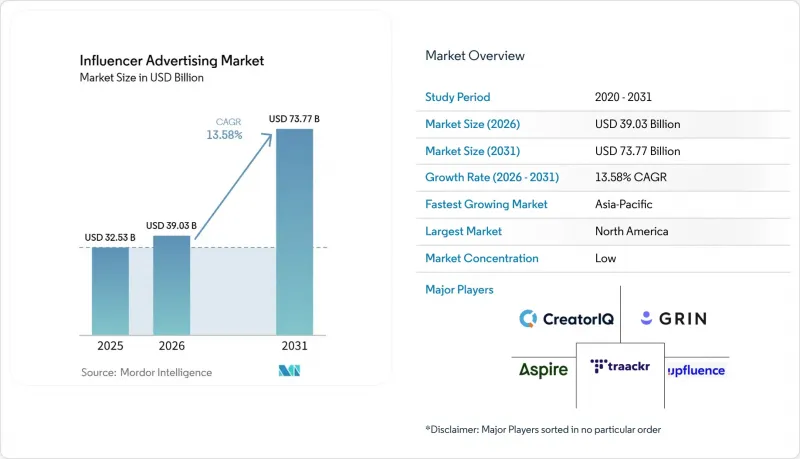
根據 Mordor Intelligence 預測,網紅廣告市場預計將從 2025 年的 325.3 億美元成長到 2026 年的 390.3 億美元,到 2031 年達到 737.7 億美元,2026 年至 2031 年的複合年預計成長率為 13.58%。
本報告按宣傳活動類型(贊助內容、聯盟行銷、產品贈送、品牌大使)、內容形式(影片、圖片、直播、部落格/報導、播客/音訊)、最終用戶(時尚、食品、電子產品、旅遊、健康、汽車、金融服務、娛樂等)和地區進行細分。市場預測以美元計價。
全球網紅廣告市場趨勢及洞察
品牌對「真實」創作者主導內容的需求日益成長
品牌對有效溝通的定義正發生穩定轉變,網紅廣告市場也因此受益匪淺。創作者驅動的內容不再只是輔助元素,而是核心管道。據 CreatorIQ 稱,波士頓顧問公司 (BCG) 在 2025 年進行的一項消費者調查預測,屆時網紅將成為影響購買決策的主要資訊來源,其影響力將超過線上搜尋、自有社交內容、傳統媒體和口碑。這表明,創作者的聲音如今對購買行為的影響力有多麼強大。這種轉變促使人們更傾向於自然、製作成本低且與人們日常使用社交平臺的方式相符的內容,從而幫助創作者建立更牢固的受眾信任。 LTK 預測,到 2025 年,70% 的 Z 世代和千禧世代消費者將更傾向於「行動優先」的社交購物,屆時創作者將更多地扮演值得信賴的嚮導,而非咄咄逼人的廣告商。這進一步印證了創作者主導的推薦在購買過程中日益重要的角色。此外,Aspire 的一份報告顯示,到 2025 年,品牌大使計畫儘管規模小規模,但在宣傳活動宣傳活動中仍將實現最高的投資報酬率。這表明,當品牌需要持續贏得信任並提升轉換率時,與內容創作者建立長期合作關係比一次性廣告投放效果更佳。因此,在網紅廣告市場,大規模的內容創作者。
短影片貨幣化模式的拓展
短影片這種形式讓品牌能夠在一次觀看過程中將故事敘述、產品演示和購買行為整合在一起,從而持續推動網紅廣告市場的發展。根據 Gigapay 的一份報告顯示,TikTok Shop 的商品交易總額 (GMV) 預計將在 2026 年達到 1,122 億美元,幾乎是 2025 年的兩倍。這表明,在創作者的積極參與下,電商整合型影片正在迅速擴張。報導指出,TikTok 和 YouTube 正在建立鼓勵創作者持續創作原創影片的報酬機制,確保廣告主能夠獲得充足且持續的品牌廣告位。這一點至關重要,因為能夠從平台專案和贊助中獲得收入的創作者可以更頻繁地發佈內容,嘗試更多影片形式,並快速回應品牌需求。這種經營模式將促使更多廣告支出流向那些能夠在網紅廣告市場中同時吸引眼球並促成購買行為的影片形式。此外,與僅用於提升品牌知名度的視訊形式相比,影片主導的購買流程具有更高的商業性價值。
「圍牆花園」之間測量結果的碎片化
網紅廣告市場面臨的最大營運挑戰在於,品牌仍難以基於統一的定義來比較不同平台上的廣告成效。 2026年1月,IAB指出,由於各大平台各自管理不同的瀏覽規則、展示邏輯和轉換窗口,因此對於試圖比較大規模廣告支出的廣告主而言,跨平台ROI分析十分困難。分析指出,為確保財務標準下的課責,需要進行八項結構性改進,包括通用的展示標準、更完善的第三方檢驗,以及提高創作者整個技術堆疊供應鏈的透明度。正是由於這一差距,一些大型廣告主即使在宣傳活動系列層面的互動效果看起來不錯的情況下,仍然會將預算限制在創作者身上,因為企業級預算核准需要可比較的證據。促銷代碼、無塵室和第一方像素等局部措施對特定宣傳活動有效,但它們無法取代適用於所有主流平台的全面衡量體系。在網紅廣告市場彌合這一報告差距之前,預算從更標準化的數位管道轉移的速度可能仍將保持低迷。
細分市場分析
2025年,贊助內容宣傳活動佔該細分市場總支出的48.27%,持續維持其在網紅廣告市場中最大宣傳活動結構的地位。這是因為贊助內容行銷活動與提升品牌知名度的目標相契合,尤其是在日常消費品、時尚和金融服務等領域。其規模也反映了既有的慣例;許多品牌團隊早在以轉化為導向的創作者購買模式普及之前,就已經採用了基於贊助的主導模式、定價邏輯和代理工作流程。即使其他宣傳活動形式成長更快,並吸引更多財務團隊的關注,這些既定流程對於抑制市場佔有率的劇烈波動仍然至關重要。預計到2031年,聯盟行銷和效果行銷宣傳活動的複合年成長率將達到17.78%,成為成長最快的宣傳活動類別,因為廣告主要求更清晰的銷售歸因和更嚴格的報酬機制。這種轉變正逐步推動網紅廣告市場從訂閱制的曝光模式轉向基於可衡量結果的報酬體系。
品牌大使計畫依然發揮著至關重要的作用。當品牌需要建立信任和持續性時,與創作者建立長期合作關係比一次性宣傳活動更能創造商業性價值。產品和禮品贈送仍然有效,因為它們可以降低宣傳活動的初始成本,並幫助品牌透過與多位創作者合作來擴大影響力。根據 Modash 的一份報告,65.7% 的網紅行銷人員在品牌推廣活動中優先考慮禮品和產品贈送,這解釋了為什麼儘管效果廣告預算不斷增加,這種模式仍然有效。隨著宣傳活動的經濟效益日益嚴格,網紅廣告產業可能會維持一種混合結構:贊助仍然佔據相當大的佔有率,禮品贈送有助於擴大規模,而聯盟行銷模式在新支出中的佔有率也在不斷成長。這種平衡反映了買家對同一創作者計畫中既能提升品牌知名度又能帶來實際效果的需求。
區域分析
2025年,北美繼續保持在網紅廣告市場最大區域的地位,佔35.44%的市場佔有率。這主要得益於北美地區相比其他大多數地區更成熟的廣告主工具、代理商流程以及資訊揭露預期。美國憑藉高品牌參與度、更強大的歸因基礎以及完善的企業級創作者平台,持續鞏固其市場地位。此外,美國聯邦貿易委員會(FTC)關於代言廣告和網紅資訊揭露的指導意見,為品牌和代理商提供了更清晰的營運框架,降低了在多個宣傳活動中擴展創作者專案時的不確定性。這種清晰度至關重要,因為大型廣告主在宣傳活動開始宣傳活動了解規則,而不是事後才去解讀規則,他們更願意投入預算。這也有助於品牌團隊在規劃決策時,更有系統地利用網紅廣告市場的規模優勢,尤其是在需要加強課責的情況下。
預計到2031年,亞太地區將以16.22%的複合年成長率成長,隨著行動優先行為和社群電器的融合,該地區將成為網紅廣告市場成長最快的地區。 2025年,日本國內網紅行銷市場規模將超過1,021億日圓,以2025年1美元兌152日圓的平均外匯計算,約6.72億美元。此外,隨著TikTok Shop於2025年在日本上線,TikTok上的宣傳活動活動也將增加。印度的網紅廣告市場預計在2025年將達到3000-3500次。以2025年1美元兌84印度盧比的平均外匯計算,市場規模約為3.57億至4.17億美元,預計到2027年將達到4.7億至5.2億美元,複合年成長率為22%。印度的語言組成也是一個關鍵因素。 68.2%的活躍內容創作者使用印地語,23.9%使用當地語言,這使得他們能夠觸達二三線城市受眾,而這些受眾群體在以英語為中心的行銷策略中往往被忽視。在全部區域,以銷售額和轉換率衡量的宣傳活動比例預計將從2023年的28.24%上升到2025年的42.47%,這顯示隨著電商工具的改進,網紅廣告市場在衡量效果方面正變得越來越可靠。
歐洲在網紅廣告市場仍佔據相當大的佔有率,尤其是在英國,買家需求強勁,且網紅的計畫利用率高於全部區域平均。在德國,許多品牌仍自行管理網紅運營,依賴平台工具的公司較少。這為能夠證明工作流程效率和合規支援的供應商提供了發展空間。歐洲議會研究辦公室也指出,歐盟內部平台、消費者保護和國家資訊揭露法規的多層運作,增加了跨境網紅計畫協調的必要性。在中東,市場正透過奢侈品、旅遊和一般宣傳活動蓬勃發展,而非洲仍處於發展初期,南非、奈及利亞和埃及等市場正持續建構以行動端為先的網紅行銷活動。
其他好處:
- Excel格式的市場預測(ME)表
- 3個月的分析師支持
目錄
第1章:引言
- 研究假設和市場定義
- 調查範圍
第2章:調查方法
第3章執行摘要
第4章 市場狀況
- 市場概覽
- 市場促進因素
- 品牌對創作者主導、真實故事的需求日益成長。
- 拓展影片的獲利模式
- 「可購買內容」與社群商務的融合。
- 基於效果的網紅預算分配
- 創作者發現與工作流程平台的發展
- 擴大跨平台宣傳活動衡量方法的應用
- 市場限制因素
- 跨「圍牆花園」型平台的測量資料碎片化
- 持續不斷的詐欺行為、虛假粉絲和互動操縱
- 監管機構對建議的資訊揭露和聲明進行審查。
- 創作者行為無法預測,導致品牌安全風險。
- 產業價值鏈分析
- 價格分析
- 科技趨勢
- 監理情勢
- 波特五力分析
第5章 市場規模與成長預測
- 按宣傳活動類型
- 贊助內容宣傳活動
- 聯盟行銷和效果宣傳活動
- 產品分銷和贈品宣傳活動
- 品牌大使計劃
- 按內容格式
- 影片內容
- 基於圖像的內容
- 直播內容
- 部落格和報導內容
- 播客和音頻節目
- 最終用戶
- 時尚、服飾、美容
- 食品/飲料
- 家用電子產品
- 旅遊與飯店
- 健康與保健
- 車
- 金融服務
- 娛樂與媒體
- 其他最終用戶
- 按地區
- 北美洲
- 美國
- 加拿大
- 墨西哥
- 南美洲
- 巴西
- 阿根廷
- 智利
- 其他南美國家
- 歐洲
- 德國
- 英國
- 法國
- 義大利
- 西班牙
- 其他歐洲國家
- 亞太地區
- 中國
- 日本
- 印度
- 韓國
- 澳洲
- 其他亞太國家
- 中東
- 沙烏地阿拉伯
- 阿拉伯聯合大公國
- 卡達
- 其他中東國家
- 非洲
- 南非
- 埃及
- 奈及利亞
- 其他非洲國家
- 北美洲
第6章 競爭情勢
- 市場集中度
- 策略趨勢
- Vendor Positioning Analysis
- 公司簡介
- CreatorIQ
- AspireIQ, Inc.
- Traackr, Inc.
- GRIN Technologies Inc.
- Upfluence Inc.
- Captiv8 Inc.
- Kolsquare SAS
- Influencity
- Bazaarvoice, Inc.
- Meltwater
- Sprout Social, Inc.
- Stonecast Financial LLC(HypeAuditor)
- Later
- Onalytica Ltd.
- IZEA Worldwide, Inc.
- NeoReach Inc.
- The Social Shepherd Ltd.
- RewardStyle, Inc. d/b/a LTK
- NoxInfluencer
- Linqia, Inc.
第7章 市場機會與未來展望
According to Mordor Intelligence, the influencer advertising market size is expected to increase from USD 32.53 billion in 2025 to USD 39.03 billion in 2026 and reach USD 73.77 billion by 2031, growing at a CAGR of 13.58% over 2026-2031.
This report is Segmented by Campaign Type (Sponsored Content, Affiliate, Product Seeding and Gifting, and Brand Ambassador), Content Format (Video, Image, Live Streaming, Blog and Written, and Podcasts and Audio), End User (Fashion, Food, Electronics, Travel, Health, Automotive, Financial Services, Entertainment, and More), and Geography. The Market Forecasts are Provided in Terms of Value (USD).
Global Influencer Advertising Market Trends and Insights
Rising Brand Demand for Authentic Creator-Led Content
The Influencer advertising market is benefiting from a steady change in how brands define effective communication, with creator content now treated as a core channel rather than a side experiment. CreatorIQ reported that a 2025 BCG consumer survey ranked influencers as the leading source shaping purchase decisions, ahead of online search, owned social content, traditional media, and word of mouth, which shows how strongly creator voices now affect buying behavior. This shift favors content that looks natural, is lightly produced, and feels close to the way people already use social platforms, which helps creators maintain stronger audience trust. LTK stated in 2025 that 70% of Gen Z and millennial consumers preferred mobile-first social shopping, with creators acting more as trusted guides than interruptive advertisers, which supports the growing role of creator-led recommendations in purchase journeys. Aspire also reported that brand ambassador programs delivered the highest ROI among campaign structures in 2025 despite low campaign volume, which shows that longer creator relationships can outperform one-off placements when brands need repeat trust and stronger conversion intent. As a result, the Influencer advertising market is seeing higher value flow toward creators who can hold audience confidence over time rather than only deliver a large top-line reach number.
Expansion Of Short-Form Video Monetization
The Influencer advertising market continues to gain momentum from short-form video because this format combines brand storytelling, product demonstration, and shopping behavior in the same viewing session. Gigapay reported that TikTok Shop gross merchandise value is projected to reach USD 112.2 billion in 2026, nearly double the 2025 level, which shows how quickly commerce-linked video is scaling around creator participation. The same source noted that TikTok and YouTube structured creator payouts in ways that support a steady flow of original video output, which gives advertisers a large and renewable supply of branded inventory. This matters because creators who earn from both platform programs and sponsorships can post more often, test more formats, and respond faster to brand briefs. That operating model helps the Influencer advertising market pull more spend toward formats that can carry both attention and action. It also raises the commercial importance of video-led buying paths compared with formats that stop at awareness.
Measurement Fragmentation across Walled Gardens
The biggest operational problem in the Influencer advertising market is that brands still struggle to compare results across platforms with a consistent set of definitions. IAB stated in January 2026 that major platforms continue to control their own view rules, impression logic, and conversion windows, which makes cross-platform ROI analysis difficult for advertisers trying to compare spend at scale. The same analysis outlined eight structural upgrades needed for finance-grade accountability, including common impression standards, better third-party verification, and clearer supply-path transparency across creator technology stacks. This gap explains why some large advertisers still limit creator budgets even when campaign-level engagement looks strong, because budget approval at enterprise scale depends on comparable evidence. Partial fixes such as promo codes, clean rooms, and first-party pixels help on specific campaigns, but they do not yet replace a broad measurement system that works across major platforms. Until the Influencer advertising market closes this reporting gap, the pace of budget migration from more standardized digital channels will remain restrained.
Other drivers and restraints analyzed in the detailed report include:
- Shoppable Content and Social Commerce Integration
- Performance-Based Influencer Budget Allocation
- Rising Fraud, Fake Followers, and Engagement Manipulation
For complete list of drivers and restraints, kindly check the Table Of Contents.
Segment Analysis
Sponsored content campaigns held 48.27% of segment spend in 2025, which kept them as the largest campaign structure in the Influencer advertising market because they fit awareness goals across fast-moving consumer goods, fashion, and financial services. Their scale also reflects habit, because many brand teams already use sponsorship-based briefing models, pricing logic, and agency workflows that were built before conversion-led creator buying became common. That installed process matters because it slows rapid share shifts even when other campaign types grow faster and attract stronger attention from finance teams. Affiliate and performance campaigns are projected to grow at a 17.78% CAGR through 2031, which makes them the fastest-moving campaign category as advertisers seek clearer sales attribution and tighter payout discipline. This change is gradually moving the Influencer advertising market away from flat-fee exposure and toward structures that reward measurable outcomes.
Brand ambassador programs still play an important role because repeated creator relationships can deliver stronger commercial value than one-off activations when brands need trust and continuity. Product seeding and gifting also remain useful because they lower upfront campaign cost and help brands widen reach across many creators at once. Modash reported that 65.7% of influencer marketers prioritized gifting and seeding for brand awareness initiatives, which helps explain why this model remains active even as performance budgets rise. As campaign economics tighten, the Influencer advertising industry is likely to keep a mixed structure where sponsorship remains large, gifting supports scale, and affiliate models take a growing share of new spending. That balance reflects buyer demand for both upper-funnel visibility and lower-funnel accountability inside the same creator program.
Complete Report Scope:
- By Campaign Type
- Sponsored Content Campaigns
- Affiliate and Performance Campaigns
- Product Seeding and Gifting Campaigns
- Brand Ambassador Programs
- By Content Format
- Video Content
- Image-Based Content
- Live Streaming Content
- Blog and Written Content
- Podcasts and Audio Shows
- By End User
- Fashion, Apparel, and Beauty
- Food and Beverage
- Consumer Electronics
- Travel and Hospitality
- Health and Wellness
- Automotive
- Financial Services
- Entertainment and Media
- Other End User
- By Geography
- North America
- United States
- Canada
- Mexico
- South America
- Brazil
- Argentina
- Chile
- Rest of South America
- Europe
- Germany
- United Kingdom
- France
- Italy
- Spain
- Rest of Europe
- Asia-Pacific
- China
- Japan
- India
- South Korea
- Australia
- Rest of Asia-Pacific
- Middle East
- Saudi Arabia
- United Arab Emirates
- Qatar
- Rest of Middle East
- Africa
- South Africa
- Egypt
- Nigeria
- Rest of Africa
- North America
Geography Analysis
North America held 35.44% share in 2025, which kept it as the largest regional component of the Influencer advertising market because advertiser tools, agency processes, and disclosure expectations are more established than in most other regions. The United States continues to anchor that position through high brand participation, stronger attribution infrastructure, and a deeper base of enterprise-grade creator platforms. FTC guidance on endorsements and influencer disclosures has also given brands and agencies a clearer operating framework, which reduces uncertainty when they scale creator programs across multiple campaigns. That clarity matters because large advertisers are more willing to commit budget when campaign rules are understood before activation rather than interpreted after the fact. It also supports more structured use of the Influencer advertising market size in planning decisions where brand teams need stronger accountability before releasing spend.
Asia-Pacific is projected to grow at a 16.22% CAGR through 2031, making it the fastest-growing region in the Influencer advertising market as mobile-first behavior and social commerce continue to converge. Japan's domestic influencer marketing market exceeded JPY 102.1 billion in 2025, which was equivalent to USD 672 million using the 2025 average exchange rate of JPY 152 per USD, and campaign activity on TikTok increased after TikTok Shop launched in Japan in 2025. India's influencer marketing market reached INR 3,000-3,500 crore in 2025, which was equivalent to USD 357-417 million using the 2025 average exchange rate of INR 84 per USD, and it is projected to reach INR 4,500-5,000 crore (USD 0.47-0.52 billion) by 2027 at a 22% CAGR. India's language mix also matters because 68.2% of active creators work in Hindi and 23.9% in regional languages, which expands access to Tier-2 and Tier-3 audiences that English-led strategies often miss. Across APAC, campaigns measured by sales and conversions rose from 28.24% in 2023 to 42.47% in 2025, which shows that the Influencer advertising market is becoming more accountable as commerce tools improve.
Europe remains a major part of the Influencer advertising market, with the United Kingdom showing especially strong buyer appetite and higher planned creator use than the broader regional average. Germany stands out because a larger share of brands still manage influencer work in-house and fewer rely on platform tools, which leaves room for vendors that can prove workflow savings and compliance support. The European Parliament Research Service also noted that the European Union operates through a layered set of platform, consumer protection, and national disclosure rules, which raises coordination needs for cross-border creator programs. The Middle East is emerging through luxury, tourism, and public-facing campaigns, while Africa remains earlier in development but continues to build mobile-first creator activity in markets such as South Africa, Nigeria, and Egypt.
- CreatorIQ
- AspireIQ, Inc.
- Traackr, Inc.
- GRIN Technologies Inc.
- Upfluence Inc.
- Captiv8 Inc.
- Kolsquare SAS
- Influencity
- Bazaarvoice, Inc.
- Meltwater
- Sprout Social, Inc.
- Stonecast Financial LLC (HypeAuditor)
- Later
- Onalytica Ltd.
- IZEA Worldwide, Inc.
- NeoReach Inc.
- The Social Shepherd Ltd.
- RewardStyle, Inc. d/b/a LTK
- NoxInfluencer
- Linqia, Inc.
Additional Benefits:
- The market estimate (ME) sheet in Excel format
- 3 months of analyst support
TABLE OF CONTENTS
1 INTRODUCTION
- 1.1 Study Assumptions and Market Definition
- 1.2 Scope of the Study
2 RESEARCH METHODOLOGY
3 EXECUTIVE SUMMARY
4 MARKET LANDSCAPE
- 4.1 Market Overview
- 4.2 Market Drivers
- 4.2.1 Rising Brand Demand for Authentic Creator-Led Storytelling
- 4.2.2 Expansion of Short-Form Video Monetization
- 4.2.3 Shoppable Content and Social Commerce Convergence
- 4.2.4 Performance-Based Influencer Budget Allocation
- 4.2.5 Growth of Creator Discovery and Workflow Platforms
- 4.2.6 Higher Adoption of Cross-Platform Campaign Measurement
- 4.3 Market Restraints
- 4.3.1 Measurement Fragmentation Across Walled-Garden Platforms
- 4.3.2 Rising Fraud, Fake Followers, and Engagement Manipulation
- 4.3.3 Regulatory Scrutiny on Endorsement Disclosure and Claims
- 4.3.4 Brand Safety Risks From Unpredictable Creator Behavior
- 4.4 Industry Value Chain Analysis
- 4.5 Pricing Analysis
- 4.6 Technology Outlook
- 4.7 Regulatory Landscape
- 4.8 Porter's Five Forces Analysis
- 4.8.1 Bargaining Power of Buyers
- 4.8.2 Bargaining Power of Suppliers
- 4.8.3 Threat of New Entrants
- 4.8.4 Threat of Substitutes
- 4.8.5 Industry Rivalry
5 MARKET SIZE AND GROWTH FORECASTS (VALUE)
- 5.1 By Campaign Type
- 5.1.1 Sponsored Content Campaigns
- 5.1.2 Affiliate and Performance Campaigns
- 5.1.3 Product Seeding and Gifting Campaigns
- 5.1.4 Brand Ambassador Programs
- 5.2 By Content Format
- 5.2.1 Video Content
- 5.2.2 Image-Based Content
- 5.2.3 Live Streaming Content
- 5.2.4 Blog and Written Content
- 5.2.5 Podcasts and Audio Shows
- 5.3 By End User
- 5.3.1 Fashion, Apparel, and Beauty
- 5.3.2 Food and Beverage
- 5.3.3 Consumer Electronics
- 5.3.4 Travel and Hospitality
- 5.3.5 Health and Wellness
- 5.3.6 Automotive
- 5.3.7 Financial Services
- 5.3.8 Entertainment and Media
- 5.3.9 Other End User
- 5.4 By Geography
- 5.4.1 North America
- 5.4.1.1 United States
- 5.4.1.2 Canada
- 5.4.1.3 Mexico
- 5.4.2 South America
- 5.4.2.1 Brazil
- 5.4.2.2 Argentina
- 5.4.2.3 Chile
- 5.4.2.4 Rest of South America
- 5.4.3 Europe
- 5.4.3.1 Germany
- 5.4.3.2 United Kingdom
- 5.4.3.3 France
- 5.4.3.4 Italy
- 5.4.3.5 Spain
- 5.4.3.6 Rest of Europe
- 5.4.4 Asia-Pacific
- 5.4.4.1 China
- 5.4.4.2 Japan
- 5.4.4.3 India
- 5.4.4.4 South Korea
- 5.4.4.5 Australia
- 5.4.4.6 Rest of Asia-Pacific
- 5.4.5 Middle East
- 5.4.5.1 Saudi Arabia
- 5.4.5.2 United Arab Emirates
- 5.4.5.3 Qatar
- 5.4.5.4 Rest of Middle East
- 5.4.6 Africa
- 5.4.6.1 South Africa
- 5.4.6.2 Egypt
- 5.4.6.3 Nigeria
- 5.4.6.4 Rest of Africa
- 5.4.1 North America
6 COMPETITIVE LANDSCAPE
- 6.1 Market Concentration
- 6.2 Strategic Moves
- 6.3 Vendor Positioning Analysis
- 6.4 Company Profiles (includes Global Level Overview, Market Level Overview, Core Segments, Financials as available, Strategic Information, Products and Services, Recent Developments)
- 6.4.1 CreatorIQ
- 6.4.2 AspireIQ, Inc.
- 6.4.3 Traackr, Inc.
- 6.4.4 GRIN Technologies Inc.
- 6.4.5 Upfluence Inc.
- 6.4.6 Captiv8 Inc.
- 6.4.7 Kolsquare SAS
- 6.4.8 Influencity
- 6.4.9 Bazaarvoice, Inc.
- 6.4.10 Meltwater
- 6.4.11 Sprout Social, Inc.
- 6.4.12 Stonecast Financial LLC (HypeAuditor)
- 6.4.13 Later
- 6.4.14 Onalytica Ltd.
- 6.4.15 IZEA Worldwide, Inc.
- 6.4.16 NeoReach Inc.
- 6.4.17 The Social Shepherd Ltd.
- 6.4.18 RewardStyle, Inc. d/b/a LTK
- 6.4.19 NoxInfluencer
- 6.4.20 Linqia, Inc.
7 MARKET OPPORTUNITIES AND FUTURE OUTLOOK
- 7.1 White-space and Unmet-Need Assessment


