


 |
市場調查報告書
商品編碼
2119092
聯網電視廣告服務:市場佔有率分析、產業趨勢與統計及成長預測(2026-2031 年)Connected TV Advertising Services - Market Share Analysis, Industry Trends & Statistics, Growth Forecasts (2026 - 2031) |
||||||

※ 本網頁內容可能與最新版本有所差異。詳細情況請與我們聯繫。
根據 Mordor Intelligence 預測,聯網電視廣告服務市場預計將從 2025 年的 248.5 億美元成長到 2026 年的 283.8 億美元,到 2031 年達到 561.9 億美元,2026 年至 2031 年的複合年成長率為 14.64%。
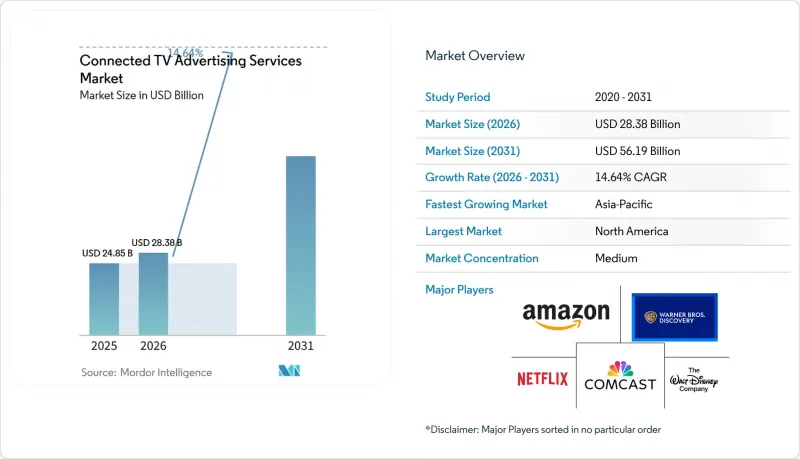
本報告按服務類型(媒體規劃與策略、媒體採購與投放、受眾資訊服務、效果衡量與歸因、創新改編與最佳化)、廣告主產業(零售與電商、媒體與娛樂、汽車、電信、金融服務等)以及地區進行細分。市場預測以美元(USD)計價。
全球聯網電視廣告服務市場趨勢及洞察
預算從傳統電視轉向串流媒體的趨勢正在加速。
預計到2026年,電視廣告預算向串流媒體的轉移將成為結構性趨勢。根據Premion和Advertiser Perceptions的研究,大多數美國聯網電視廣告商計劃在2026年增加支出,平均增幅顯示預算將大幅成長。廣告主並非只是增加支出,而是將原本用於傳統電視、展示廣告、付費搜尋和社群媒體的預算重新分配到聯網電視。研究也顯示,相當一部分聯網電視投資直接來自傳統電視預算的重新分配。大多數聯網電視預算由整合型或混合型代理團隊管理,這表明隨著廣告商在整個電視領域整合受眾覆蓋範圍、廣告購買和報告,其規劃方式正在轉變。這種營運模式的轉變正在影響聯網電視廣告服務市場的宣傳活動策劃、廣告資源選擇、曝光頻率控制和效果衡量合作夥伴的選擇。隨著廣告主對效果證據的要求越來越高,擁有經過驗證的第一方資料和加值內容版權的平台在留住廣告預算方面佔據優勢。
程序化和自助式購買正在擴大廣告主的覆蓋範圍。
程序化基礎設施正在拓展聯網電視廣告服務市場的准入管道,使其不再侷限於傳統的託管服務模式。三星廣告宣布,從2026年第三季開始,智慧型電視主螢幕廣告資源將透過The Trade Desk和Google Display and Video 360平台提供。此次合作採用Magnite的SpringServe作為廣告投放層,為買家提供程式化途徑,直達關鍵的電視介面。自動化存取使小規模的廣告主能夠測試聯網電視,而無需像以往直接交易那樣投入大量預算。同時,現有買家可以將通用的工作流程管理應用於更廣泛的廣告資源。對於廣告代理商而言,這讓他們能夠更柔軟性管理跨發布商、裝置和宣傳活動目標的覆蓋範圍和頻率。自助購買的擴展支持更廣泛的廣告主群體,同時也提升了透明的供應路徑、賣家資訊揭露和可靠的投放報告的重要性。
跨平台指標的碎片化現象仍在持續。
在聯網電視廣告服務市場,衡量指標的分散化仍是買家面臨的一項重大營運挑戰。 2025年12月,IAB發布了《聯網電視標準化衡量指南》,涵蓋了直接購買和競標購買管道的展示次數、可見度、覆蓋範圍、頻率和關注度等指標。 2026年4月,IAB歐洲發布了《聯網電視衡量框架與透明度原則》,並徵求公眾意見。該框架由IAB與亞馬遜廣告、FreeWheel、Google、IAB英國、Magnite、三星廣告和YouTube合作制定。儘管這些努力已建立了通用定義,但跨平台覆蓋範圍去重仍未一致實施,尤其是在宣傳活動使用不同平台、購買管道和報告系統的情況下。因此,買家在比較直接購買和程序化購買與發布商交易的效果時仍然面臨困難,這可能導致預算決策的延遲,並凸顯了在聯網電視廣告服務市場進行獨立檢驗的重要性。
細分市場分析
至2025年,媒體採購和投放將佔聯網電視廣告服務市佔率的33.14%。這一市場地位反映了程序化擔保交易、私人市場以及與發行商的直接合作在宣傳活動執行中發揮的重要作用。隨著設備製造商開始向買家提供智慧電視主螢幕廣告位,這些螢幕正成為程式化廣告庫存的新來源。這為能夠管理跨優質發行商、電視作業系統和串流媒體應用的廣告購買的服務供應商提供了支援。隨著標準化衡量指南推動對檢驗和效果報告的需求,衡量和歸因服務的重要性也不斷提升。 IAB發布的《2025指南》為買方和賣方機構提供了關於直接交易和競標交易中有效訊號的通用指南。
預計到2031年,受眾和資訊服務將以15.12%的複合年成長率成長。買家越來越重視包含豐富商業數據、可識別身分的受眾群體,這些群體可用於優質影片廣告資源。 WPP Media和Criteo已推出聯網電視廣告投放方案,利用超過17,000家電子商務網站(年商品交易總額超過1兆美元)的即時訊號。此方案利用精心篩選的交易ID,在參與的優質廣告資源中觸達高意向消費者。隨著代理商透過共用團隊整合線性電視和串流媒體的廣告策劃,媒體策劃和策略也在不斷發展。創新廣告插入和更個人化的影片製作,尤其對於那些在聯網電視廣告服務市場中缺乏內部製作能力的品牌而言,正推動創意調整和最佳化。
區域分析
2025年,北美將佔據聯網電視廣告服務市場45.71%的佔有率。該地區蓬勃發展的串流媒體業務、強勁的零售媒體活動以及完善的程序化基礎設施,正推動美國聯網電視預售支出在2026年達到177.3億美元,超過黃金時段線性電視預售支出169.8億美元。沃爾瑪提案收購Vizio和Vibe.Co,這將增強其整合商業數據、電視作業系統和自助廣告的能力。 Roku報告稱,其有效用戶超過9000萬,並在2025年實現了按照美國通用會計準則(GAAP)計算的首個全年盈利。該地區的聯網電視廣告服務市場受益於能夠將零售數據與成熟的優質影片覆蓋範圍相結合的廣告商。
預計到2031年,亞太地區將以14.91%的複合年成長率成長,成為聯網電視廣告服務市場成長最快的地區。該地區涵蓋了串流媒體使用、智慧型電視普及和程序化廣告購買等市場,這些市場的發展起點各不相同。澳洲和韓國擁有更成熟的數位影片環境和完善的廣告授權流程。東南亞仍依賴寬頻發展和連網型設備普及率的提高。印度擁有龐大且不斷成長的聯網電視用戶群體,為廣告主提供了超越傳統線性電視的新管道。此外,廣播公司視訊點播(VOD)服務的擴張以及日本程序化廣告的日益普及也推動了該地區的需求成長。
歐洲是全球第二大市場,並且持續保持成長動能。 2025年下半年,歐洲聯網電視廣告觀看量成長了33%,而美國僅成長了11%。在法國,2025年上半年程序化廣告佔聯網電視廣告曝光量的36%。 GDPR和ePrivacy的要求提升了歐洲市場第一方資料的價值,使得「無塵室」夥伴關係變得更加重要。在中東,聯網電視的成長速度超過了整體數位廣告市場的成長速度,其中阿拉伯聯合大公國和沙烏地阿拉伯引領了這一成長。南美洲仍處於起步階段,但葡萄牙和西班牙FAST頻道的成長預計將覆蓋範圍擴大到巴西和阿根廷的智慧型電視家庭用戶。
其他好處:
- Excel格式的市場預測(ME)表
- 3個月的分析師支持
目錄
第1章:引言
- 研究假設和市場定義
- 調查範圍
第2章:調查方法
第3章執行摘要
第4章 市場狀況
- 市場概覽
- 市場促進因素
- 預算從傳統電視轉向串流媒體的趨勢正在加速。
- 程序化和自助式廣告購買正在擴大廣告主的覆蓋範圍。
- 體育賽事直播和高價值賽事的轉播權正在轉移到串流媒體上。
- 可購買的互動式 CTV 格式提高了轉換前階段的效能。
- 電視作業系統正成為媒體平台關注的新焦點。
- 「潔淨室商業」意味著閉合迴路定位的準確性有所提高。
- 市場限制因素
- 跨平台測量標準尚未標準化。
- 隱私和身分資訊的洩漏會削弱家庭解決問題的能力。
- 創新和元資料的碎片化正在減緩大規模執行的速度。
- 供應鏈不透明以及因聯網電視詐騙造成的優質廣告收入浪費。
- 宏觀經濟因素對市場的影響
- 產業價值鏈分析
- 監理情勢
- 技術展望
- 波特五力分析
第5章 市場規模與成長預測
- 按服務類型
- 媒體規劃與策略
- 媒體採購與推廣
- 目標層和資訊服務
- 測量與歸因
- 創造性適應和最佳化
- 透過廣告業
- 零售與電子商務
- 媒體與娛樂
- 車
- 溝通
- 金融服務
- 衛生保健
- 旅遊與飯店
- 其他廣告業
- 按地區
- 北美洲
- 美國
- 加拿大
- 墨西哥
- 南美洲
- 巴西
- 阿根廷
- 智利
- 哥倫比亞
- 其他南美國家
- 歐洲
- 英國
- 德國
- 法國
- 義大利
- 西班牙
- 荷蘭
- 北歐的
- 俄羅斯
- 其他歐洲國家
- 亞太地區
- 中國
- 日本
- 印度
- 韓國
- 澳洲和紐西蘭
- 東南亞
- 其他亞太國家
- 中東
- 沙烏地阿拉伯
- 阿拉伯聯合大公國
- 土耳其
- 其他中東國家
- 非洲
- 南非
- 奈及利亞
- 埃及
- 其他非洲國家
- 北美洲
第6章 競爭情勢
- 市場集中度
- 策略趨勢
- 市佔率分析
- 公司簡介
- The Trade Desk, Inc.
- Google LLC
- Amazon.com, Inc.
- Roku, Inc.
- The Walt Disney Company
- Netflix, Inc.
- Comcast Corporation
- FreeWheel Media, Inc.
- Magnite, Inc.
- PubMatic, Inc.
- Innovid Corp.
- DoubleVerify Holdings, Inc.
- Integral Ad Science Holding Corp.
- Nexxen International Ltd.
- Samsung Electronics Co., Ltd.
- LG Electronics Inc.
- Yahoo Inc.
- Microsoft Corporation
- Viant Technology Inc.
- VideoAmp, Inc.
- iSpot.tv, Inc.
- Paramount Global
- Warner Bros. Discovery, Inc.
- Tatari, Inc.
- Simulmedia, Inc.
- OpenAP LLC.
第7章 市場機會與未來展望
According to Mordor Intelligence, the connected TV advertising services market size is expected to increase from USD 24.85 billion in 2025 to USD 28.38 billion in 2026 and reach USD 56.19 billion by 2031, growing at a CAGR of 14.64% over 2026-2031.
This report is Segmented by Service Type (Media Planning and Strategy, Media Buying and Activation, Audience and Data Services, Measurement and Attribution, and Creative Adaptation and Optimization), Advertiser Industry (Retail and Ecommerce, Media and Entertainment, Automotive, Telecom, Financial Services, and More), and Geography. The Market Forecasts are Provided in Terms of Value (USD).
Global Connected TV Advertising Services Market Trends and Insights
Linear-To-Streaming Budget Reallocation Accelerates
The television budget movement toward streaming is expected to become structural by 2026. A Premion and Advertiser Perceptions survey found that most U.S. connected TV advertisers planned to increase spending in 2026, with average planned increases indicating meaningful budget expansion. Advertisers are reallocating these budgets from linear television, display, paid search, and social media, rather than funding them only through incremental spending. The survey also found that a notable share of connected TV investment came directly from linear television reallocation. Integrated or hybrid agency teams managed a majority of connected TV budgets, indicating that planning practices are changing as advertisers coordinate audience delivery, buying, and reporting across television environments. This operational shift affects campaign planning, inventory selection, frequency control, and the selection of measurement partners within the connected TV advertising services market. Platforms with authenticated first-party data and premium content rights are better positioned to retain budgets as advertisers demand clearer evidence of outcomes.
Programmatic and Self-Serve Buying Broadens Advertiser Access
Programmatic infrastructure is extending access to the connected TV advertising services market beyond the managed-service model. Samsung Ads announced that Smart TV home screen inventory would become available through The Trade Desk and Google Display and Video 360 from Q3 2026. The arrangement uses Magnite's SpringServe as the ad-serving layer and gives buyers a programmatic route to a prominent television interface. Automated access can help smaller advertisers test connected TV without the budgets traditionally required for direct deals, while allowing established buyers to apply common workflow controls across more inventory. It also gives agencies more flexibility to manage reach and frequency across publishers, devices, and campaign objectives. The expansion of self-service buying supports a broader group of advertisers while increasing the importance of transparent supply paths, seller disclosures, and reliable delivery reporting.
Cross-Platform Measurement Standards Remain Fragmented
Measurement fragmentation remains a major operational constraint for buyers in the connected TV advertising services market. IAB published its Standardized Measurement Guide for Connected TV in December 2025, covering impressions, viewability, reach, frequency, and attention across direct and biddable buying paths. IAB Europe released a connected TV measurement framework and transparency principles for public comment in April 2026. The framework was developed with Amazon Ads, FreeWheel, Google, IAB UK, Magnite, Samsung Ads, and YouTube. These initiatives establish common definitions, but they do not yet deliver consistent cross-platform reach deduplication, especially where campaigns use different platforms, buying paths, and reporting systems. Buyers, therefore, continue to face difficulty comparing performance across direct publisher sales and programmatic transactions, which can delay budget decisions and make independent verification more important in the connected TV advertising services market.
Other drivers and restraints analyzed in the detailed report include:
- Live Sports and Premium Event Rights Shift to Streaming
- Shoppable and Interactive CTV Formats Improve Lower-Funnel Performance
- Privacy and Identity Signal Loss Weakens Household Resolution
For complete list of drivers and restraints, kindly check the Table Of Contents.
Segment Analysis
Media Buying and Activation held 33.14% of the connected TV advertising services market share in 2025. Its position reflects the role of programmatic guaranteed deals, private marketplaces, and direct publisher integrations in executing campaigns. Smart TV home screens are becoming another programmatic inventory source as device companies make those placements available to buyers. This supports service providers that can manage buying across premium publishers, TV operating systems, and streaming applications. Measurement and Attribution services are also becoming more important as standardized measurement guidance increases demand for verification and outcome reporting. IAB's 2025 guide gives buy-side and sell-side organizations a common reference for valid signals across direct and biddable transactions.
Audience and Data Services is projected to expand at a 15.12% CAGR through 2031. Buyers are placing greater value on commerce-enriched and identity-resolved audience segments that can be activated against premium video inventory. WPP Media and Criteo launched a connected TV activation using real-time signals from more than 17,000 e-commerce sites that represented over USD 1 trillion in annual gross merchandise value. The approach uses curated deal IDs to reach high-intent shoppers across participating premium inventory. Media Planning and Strategy is also changing as agencies coordinate linear television and streaming planning through shared teams. Creative Adaptation and Optimization benefits from dynamic ad insertion and more personalized video production, especially for brands that lack internal production capacity in the connected TV advertising services market.
Complete Report Scope:
- By Service Type
- Media Planning and Strategy
- Media Buying and Activation
- Audience and Data Services
- Measurement and Attribution
- Creative Adaptation and Optimization
- By Advertiser Industry
- Retail and Ecommerce
- Media and Entertainment
- Automotive
- Telecom
- Financial Services
- Healthcare
- Travel and Hospitality
- Other Advertiser Industries
- By Geography
- North America
- United States
- Canada
- Mexico
- South America
- Brazil
- Argentina
- Chile
- Colombia
- Rest of South America
- Europe
- United Kingdom
- Germany
- France
- Italy
- Spain
- Netherlands
- Nordics
- Russia
- Rest of Europe
- Asia-Pacific
- China
- Japan
- India
- South Korea
- Australia and New Zealand
- Southeast Asia
- Rest of Asia-Pacific
- Middle East
- Saudi Arabia
- United Arab Emirates
- Turkey
- Rest of Middle East
- Africa
- South Africa
- Nigeria
- Egypt
- Rest of Africa
- North America
Geography Analysis
North America held 45.71% of the connected TV advertising services market share in 2025. The region combines mature streaming adoption, retail media activity, and developed programmatic infrastructure. U.S. connected TV upfront spending reached USD 17.73 billion in 2026, surpassing USD 16.98 billion for primetime linear television upfront spending. Walmart's Vizio and proposed Vibe.Co acquisitions strengthen its ability to connect commerce data, TV operating systems, and self-service advertising. Roku reported more than 90 million active households and achieved its first full year of GAAP profitability in 2025. The connected TV advertising services market in the region benefits from buyers who can combine retail data with established premium video reach.
Asia-Pacific is projected to expand at a 14.91% CAGR through 2031, making it the fastest-growing regional area in the connected TV advertising services market. The region includes markets where streaming use, smart TV adoption, and programmatic buying are expanding from different starting points. Australia and South Korea have more mature digital video environments and are developing consent practices. Southeast Asia remains tied to broadband development and the growth of connected-device access. India has a large and growing connected TV audience, creating additional advertiser reach beyond linear television. Japan's broadcaster video-on-demand expansion and wider programmatic adoption also support regional demand.
Europe is the second-largest region and continues to gain momentum. European connected TV ad views grew 33% in the second half of 2025, compared with 11% in the United States. France recorded a 36% programmatic share of connected TV impressions in the first half of 2025. GDPR and ePrivacy requirements raise the value of first-party data and clean-room partnerships across European markets. In the Middle East, connected TV grew faster than the overall digital advertising environment, led by the UAE and Saudi Arabia. South America remains at an earlier stage, while FAST channel growth in Portuguese and Spanish can expand smart TV household reach in Brazil and Argentina.
- The Trade Desk, Inc.
- Google LLC
- Amazon.com, Inc.
- Roku, Inc.
- The Walt Disney Company
- Netflix, Inc.
- Comcast Corporation
- FreeWheel Media, Inc.
- Magnite, Inc.
- PubMatic, Inc.
- Innovid Corp.
- DoubleVerify Holdings, Inc.
- Integral Ad Science Holding Corp.
- Nexxen International Ltd.
- Samsung Electronics Co., Ltd.
- LG Electronics Inc.
- Yahoo Inc.
- Microsoft Corporation
- Viant Technology Inc.
- VideoAmp, Inc.
- iSpot.tv, Inc.
- Paramount Global
- Warner Bros. Discovery, Inc.
- Tatari, Inc.
- Simulmedia, Inc.
- OpenAP LLC.
Additional Benefits:
- The market estimate (ME) sheet in Excel format
- 3 months of analyst support
TABLE OF CONTENTS
1 INTRODUCTION
- 1.1 Study Assumptions and Market Definition
- 1.2 Scope of the Study
2 RESEARCH METHODOLOGY
3 EXECUTIVE SUMMARY
4 MARKET LANDSCAPE
- 4.1 Market Overview
- 4.2 Market Drivers
- 4.2.1 Linear-To-Streaming Budget Reallocation Accelerates
- 4.2.2 Programmatic and Self-Serve Buying Broadens Advertiser Access
- 4.2.3 Live Sports and Premium Event Rights Shift to Streaming
- 4.2.4 Shoppable and Interactive CTV Formats Improve Lower-Funnel Performance
- 4.2.5 TV Operating Systems Become New High-Attention Media Surfaces
- 4.2.6 Clean-Room Commerce Signals Sharpen Closed-Loop Targeting
- 4.3 Market Restraints
- 4.3.1 Cross-Platform Measurement Standards Remain Fragmented
- 4.3.2 Privacy and Identity Signal Loss Weakens Household Resolution
- 4.3.3 Creative and Metadata Fragmentation Slows Scaled Execution
- 4.3.4 Supply-Path Opacity and CTV Fraud Waste Premium Spend
- 4.4 Impact of Macroeconomic Factors on the Market
- 4.5 Industry Value Chain Analysis
- 4.6 Regulatory Landscape
- 4.7 Technological Outlook
- 4.8 Porter's Five Forces Analysis
- 4.8.1 Bargaining Power of Buyers
- 4.8.2 Bargaining Power of Suppliers
- 4.8.3 Threat of New Entrants
- 4.8.4 Threat of Substitutes
- 4.8.5 Intensity of Rivalry
5 MARKET SIZE AND GROWTH FORECASTS (VALUE)
- 5.1 By Service Type
- 5.1.1 Media Planning and Strategy
- 5.1.2 Media Buying and Activation
- 5.1.3 Audience and Data Services
- 5.1.4 Measurement and Attribution
- 5.1.5 Creative Adaptation and Optimization
- 5.2 By Advertiser Industry
- 5.2.1 Retail and Ecommerce
- 5.2.2 Media and Entertainment
- 5.2.3 Automotive
- 5.2.4 Telecom
- 5.2.5 Financial Services
- 5.2.6 Healthcare
- 5.2.7 Travel and Hospitality
- 5.2.8 Other Advertiser Industries
- 5.3 By Geography
- 5.3.1 North America
- 5.3.1.1 United States
- 5.3.1.2 Canada
- 5.3.1.3 Mexico
- 5.3.2 South America
- 5.3.2.1 Brazil
- 5.3.2.2 Argentina
- 5.3.2.3 Chile
- 5.3.2.4 Colombia
- 5.3.2.5 Rest of South America
- 5.3.3 Europe
- 5.3.3.1 United Kingdom
- 5.3.3.2 Germany
- 5.3.3.3 France
- 5.3.3.4 Italy
- 5.3.3.5 Spain
- 5.3.3.6 Netherlands
- 5.3.3.7 Nordics
- 5.3.3.8 Russia
- 5.3.3.9 Rest of Europe
- 5.3.4 Asia-Pacific
- 5.3.4.1 China
- 5.3.4.2 Japan
- 5.3.4.3 India
- 5.3.4.4 South Korea
- 5.3.4.5 Australia and New Zealand
- 5.3.4.6 Southeast Asia
- 5.3.4.7 Rest of Asia-Pacific
- 5.3.5 Middle East
- 5.3.5.1 Saudi Arabia
- 5.3.5.2 United Arab Emirates
- 5.3.5.3 Turkey
- 5.3.5.4 Rest of Middle East
- 5.3.6 Africa
- 5.3.6.1 South Africa
- 5.3.6.2 Nigeria
- 5.3.6.3 Egypt
- 5.3.6.4 Rest of Africa
- 5.3.1 North America
6 COMPETITIVE LANDSCAPE
- 6.1 Market Concentration
- 6.2 Strategic Moves
- 6.3 Market Share Analysis
- 6.4 Company Profiles (includes Global Level Overview, Market Level Overview, Core Segments, Financials as available, Strategic Information, Market Rank/Share, Products and Services, Recent Developments)
- 6.4.1 The Trade Desk, Inc.
- 6.4.2 Google LLC
- 6.4.3 Amazon.com, Inc.
- 6.4.4 Roku, Inc.
- 6.4.5 The Walt Disney Company
- 6.4.6 Netflix, Inc.
- 6.4.7 Comcast Corporation
- 6.4.8 FreeWheel Media, Inc.
- 6.4.9 Magnite, Inc.
- 6.4.10 PubMatic, Inc.
- 6.4.11 Innovid Corp.
- 6.4.12 DoubleVerify Holdings, Inc.
- 6.4.13 Integral Ad Science Holding Corp.
- 6.4.14 Nexxen International Ltd.
- 6.4.15 Samsung Electronics Co., Ltd.
- 6.4.16 LG Electronics Inc.
- 6.4.17 Yahoo Inc.
- 6.4.18 Microsoft Corporation
- 6.4.19 Viant Technology Inc.
- 6.4.20 VideoAmp, Inc.
- 6.4.21 iSpot.tv, Inc.
- 6.4.22 Paramount Global
- 6.4.23 Warner Bros. Discovery, Inc.
- 6.4.24 Tatari, Inc.
- 6.4.25 Simulmedia, Inc.
- 6.4.26 OpenAP LLC.
7 MARKET OPPORTUNITIES AND FUTURE OUTLOOK
- 7.1 White-Space and Unmet-Need Assessment

 聯網電視:市場佔有率分析、行業趨勢和統計數據、成長預測(2026-2031 年)聯網電視廣告:市佔率分析、產業趨勢與統計及成長預測(2026-2031 年)
 2026年全球可尋址電視廣告市場報告
 聯網電視市場規模、佔有率和趨勢分析報告:按螢幕大小、技術、分銷管道、地區和細分市場預測(2026-2033 年)2026年全球可尋址線性電視(TV)市場報告2026年全球免費廣告支援串流電視(FAST)市場報告
 聯網電視市場分析及預測(至2035年):按類型、產品類型、服務、技術、組件、應用、形式、設備、最終用戶和功能分類2026年全球連網電視市場報告
 聯網電視市場規模、佔有率及成長分析(按螢幕大小、技術、螢幕類型、解析度、作業系統、連線功能、智慧功能和地區)-2025-2032 年產業預測
 連網電視市場機會、成長動力、產業趨勢分析及 2025-2034 年預測