


 |
市場調查報告書
商品編碼
2119046
簡訊行銷服務:市場佔有率分析、產業趨勢與統計、成長預測(2026-2031)SMS Marketing Services - Market Share Analysis, Industry Trends & Statistics, Growth Forecasts (2026 - 2031) |
||||||

※ 本網頁內容可能與最新版本有所差異。詳細情況請與我們聯繫。
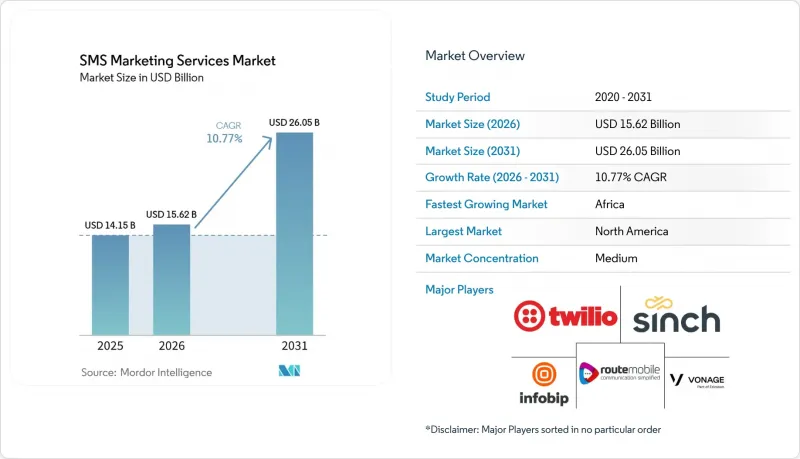
據 Mordor Intelligence 稱,2025 年簡訊行銷服務市值為 141.5 億美元,2026 年為 156.2 億美元,預計到 2031 年將達到 260.5 億美元,2026 年至 2031 年的複合年成長率為 10.77%。
本報告按公司規模(大型企業和中小企業)、終端用戶行業(零售和電子商務、媒體和娛樂、醫療保健和生命科學、旅遊和酒店、消費品以及其他行業(教育、汽車、IT和電信等))和地區進行細分。市場預測以美元計價。
全球簡訊行銷服務市場趨勢與洞察
高開啟率和即時轉換機會
簡訊行銷服務市場充分利用了簡訊管道的優勢,無需消費者打開單獨的應用程式,即可將有時效性的優惠和服務訊息直接髮送到他們的設備上。 Subtext 在其基於 2025 年發送的訊息發布的 2026 年基準報告中指出,短信打開率高達 98%,其中 95% 的訊息在三分鐘內被打開。 Omnisend 的研究表明,自動化宣傳活動的轉換率為 0.77%,而定時群發宣傳活動的轉換率僅為 0.12%,這充分體現了根據客戶行為觸發的訊息的價值。他們的數據包括購物車遺棄、售後跟進以及其他可以在客戶購買意願仍然較高時與其互動的活動。此外,即時送達使得比較宣傳活動活動效果更加便捷,因為企業可以將訊息與特定的客戶行為關聯起來,而無需依賴通用的促銷日曆。這使得宣傳活動團隊能夠更清晰地論證發送時間、目標受眾、訊息內容以及購買轉換路徑的合理性,同時尊重檢驗是否選擇接收訊息的意願。
中小企業自助簡訊平台的引入
自助式產品正在擴大缺乏專門開發團隊或龐大技術預算的公司進入簡訊行銷服務市場的管道。根據 TXTIimpact 預測,到 2025 年,66% 的美國公司將使用簡訊行銷,並且同樣比例的公司將增加在該管道的預算。 Listrak 的數據顯示,到 2025 年,零售商的簡訊發送量將增加 93%,客戶收入將增加 16.7%,而黑色星期五和網路星期一期間的簡訊收入將增加 21%。 2026 年 5 月,HubSpot 推出了付費的 Marketing Hub附加元件,提供原生簡訊功能,讓用戶在其現有的行銷工作流程中建立訊息。這些產品透過範本、引導式工作流程、與電子商務和 CRM 應用的直接連結以及允許團隊從小小規模宣傳活動開始的設置,縮短了設置時間。即使是小規模團隊也能管理訂閱、訊息傳輸頻率和基本結果,而無需在多個分散的系統中分配工作,也無需依賴外部開發項目來進行日常更改。
遷移範圍擴大至 WT 和 RCS
WhatsApp 和 RCS 正在對簡訊行銷服務市場構成競爭壓力,尤其是在消費者已廣泛使用基於應用程式的通訊並期望獲得富媒體功能的地區。據 Infobip 稱,WhatsApp 擁有超過 30 億有效用戶,每天發送 1400 億條訊息,使其成為北美以外領先的企業通訊工具。該公司還報告稱,隨著 RCS 對各種設備的支援不斷擴展,其全球用戶已超過 15 億。然而,簡訊並非適用於所有場景,因為客戶的存取權限和管道可用性會因地區、裝置、營運商和應用程式使用情況而異。即使沒有單獨安裝應用程式、沒有資料通訊連接或相容的 RCS 連接,簡訊仍然可以觸及客戶。營運商並未將通路選擇視為永久替代方案,而是實施路由系統,在可用時選擇 RCS 或 WhatsApp,並在需要普遍分發時使用簡訊。
細分市場分析
到2025年,大型企業將佔據簡訊行銷服務市場60.53%的佔有率。大型企業專案通常需要強大的訊息處理能力、專門的API團隊、客戶細分以及與內部資料系統的整合。金融服務、零售、醫療保健和物流行業的用戶還需要強大的控制措施來管理用戶許可和發送者註冊。大型企業可以透過更大的訊息發送量來分攤這些合規和營運成本。此外,將文字通訊與客戶數據平台記錄結合,以進行有針對性的全國性宣傳活動,也成為日益成長的趨勢。
預計2026年至2031年間,中小企業(SME)的複合年成長率將達到14.51%,成為該細分市場中成長最快的企業。訂閱式收費系統、自助設定以及與HubSpot、Salesforce和Shopify的預置整合,大大降低了以往啟動和運行專案所需的開發工作量。 Klaviyo報告稱,其客戶近三分之二的簡訊流量收入來自新買家,這凸顯了小規模如何利用自動化流程不僅獲取新客戶,還能有效客戶維繫。 HubSpot於2026年5月發布的簡訊附加元件也同樣將宣傳活動工具整合到Marketing Hub工作流程中。透過簡化小規模企業的註冊、授權和創建宣傳活動的流程,該平台將能夠為簡訊行銷服務產業贏得更廣泛、更均衡的基本客群。
區域分析
2025年,北美地區佔據了簡訊行銷服務市場32.31%的佔有率。該地區擁有完善的企業通訊基礎設施、較高的智慧型手機普及率以及廣泛的通訊平台應用。 A2P 10DLC的註冊改善了註冊寄件者的營運環境,並減少了灰色路由流量。 Twilio公佈2026年第一季營收為14.1億美元(年增20%),並將其2026年營收成長預期上調至14%至15%。
歐洲仍然是簡訊行銷服務市場的主要區域中心,GDPR合規性對供應商選擇和客戶流程都產生了影響。德國、英國、法國、義大利和西班牙滿足了零售、金融服務和物流公司的需求。 LINK Mobility為遍佈歐洲的66,000多家客戶提供服務,並表示其2025年全年業績反映了人工智慧和RCS技術的進一步應用。在亞太地區,儘管RCS和人工智慧技術在中國、日本、韓國和澳洲的應用已較為成熟,但市場狀況仍有差異,例如印度正在部署以合規性主導的A2P通訊。印度的《廣告信法案》(DLT)框架要求企業註冊商業通訊模板,因此合規能力成為選擇供應商的關鍵因素。
預計2026年至2031年間,非洲的複合年成長率將達到15.12%,是所有地區中最高的。 2025年,行動技術將為非洲經濟貢獻2,400億美元,佔該地區GDP的7.8%。 GSMA預測,到2030年,這項貢獻將達到2,900億美元。在網路存取不均衡的市場,文字訊息仍然是一種實用的商業管道,無需持續的數據連接。 2025年11月,LINK Mobility完成了對南非SMSPortal的收購,獲得了一家擁有超過5,400家客戶、每年處理160億條訊息的企業。在中東,零售、銀行和旅館業的使用者對先進的企業服務有著迫切的需求;而在南美,電子商務的成長,以及像Zenvia這樣專注於區域客戶體驗基礎設施的供應商的存在,都為行動通訊的發展提供了助力。
其他好處:
- Excel格式的市場預測(ME)表
- 3個月的分析師支持
目錄
第1章:引言
- 研究假設和市場定義
- 調查範圍
第2章:調查方法
第3章執行摘要
第4章 市場狀況
- 市場概覽
- 市場促進因素
- 高開啟率和即時轉換機會
- 在中小企業引進自助簡訊平台
- 整合電商平台和客戶數據平台可以提高宣傳活動的精準度。
- 富文本通訊的日益普及推動了對大規模文字回退方案的需求。
- 註冊寄件者框架可以提高符合規定的品牌的交付率。
- 透過網路 API 進行號碼分析可以提高目標定位和詐欺防範能力。
- 市場限制因素
- 人們越來越傾向使用 WhatsApp 和其他富媒體通訊服務。
- 更嚴格的同意和內容合規要求
- Passkey 的廣泛應用導致了由身分驗證主導的通訊的使用減少。
- 終端費用上漲,灰色路線正常化導致利潤率承壓。
- 宏觀經濟因素對市場的影響
- 產業價值鏈分析
- 科技趨勢
- 監理情勢
- 波特五力分析
第5章 市場規模與成長預測
- 按公司規模
- 大公司
- 小型企業
- 按最終用戶行業分類
- 零售與電子商務
- 媒體與娛樂
- 醫療保健和生命科學
- 旅遊與飯店
- 消費品
- 其他終端用戶產業(銀行、金融服務與保險、教育、汽車、IT/電信等)
- 按地區
- 北美洲
- 美國
- 加拿大
- 墨西哥
- 南美洲
- 巴西
- 阿根廷
- 智利
- 其他南美國家
- 歐洲
- 德國
- 英國
- 法國
- 義大利
- 西班牙
- 其他歐洲國家
- 亞太地區
- 中國
- 日本
- 印度
- 韓國
- 澳洲
- 其他亞太國家
- 中東
- 阿拉伯聯合大公國
- 沙烏地阿拉伯
- 卡達
- 其他中東國家
- 非洲
- 南非
- 埃及
- 奈及利亞
- 其他非洲國家
- 北美洲
第6章 競爭情勢
- 市場集中度
- 策略趨勢
- 市佔率分析
- 公司簡介
- Twilio Inc.
- Sinch AB
- Infobip Ltd.
- Bird BV
- Vonage Holdings Corp.
- Bandwidth Inc.
- CM.com NV
- TeleSign Corporation
- Global Message Services AG
- BICS SA/NV
- Orange SA
- Retarus GmbH
- Mitto AG
- Zenvia Inc.
- Tata Communications Limited
- Plivo Inc.
- Soprano Design Pty Ltd
- Clickatell Corporation
- LINK Mobility Group Holding ASA
- Monty Mobile SAL
第7章 市場機會與未來展望
According to Mordor Intelligence, the SMS marketing services market size was valued at USD 14.15 billion in 2025, USD 15.62 billion in 2026, and is forecast to reach USD 26.05 billion by 2031, registering a CAGR of 10.77% during 2026-2031.
This report is Segmented by Enterprise Size (Large Enterprises, and Small and Medium-Sized Enterprises), End User Industry (Retail and E-Commerce, Media and Entertainment, Healthcare and Life Sciences, Travel and Hospitality, Consumer Goods, and More (Education, Automotive, and IT and Telecom Amongst More)), and Geography. The Market Forecasts are Provided in Terms of Value (USD).
Global SMS Marketing Services Market Trends and Insights
High Open Rates and Immediate Conversion Windows
The SMS Marketing Services Market benefits from a channel that places time-sensitive offers and service messages directly on a consumer device, without requiring a person to open a separate application. Subtext reported a 98% open rate and stated that 95% of messages were opened within 3 minutes in its 2026 benchmark report, based on messages sent during 2025. Omnisend found that automated campaigns converted at 0.77%, compared with 0.12% for scheduled broadcast campaigns, showing the value of messages triggered by customer behavior. Its data covered cart abandonment, post-purchase follow-up, and other actions that can be addressed while purchase intent is still active. Immediate delivery also allows a business to link a message to a specific customer action rather than relying on a general promotional calendar, making campaign results easier to compare. This gives campaign teams a clearer basis for testing timing, audience selection, message content, and the route from a response to a purchase, while respecting the opt-in choices that determine whether the message can be sent.
Small Business Adoption of Self-Serve Text Platforms
Self-serve products are broadening access to the SMS Marketing Services Market for businesses without dedicated development teams or large technology budgets. TXTImpact reported that 66% of U.S. businesses used SMS marketing in 2025, and the same share increased their budgets for the channel. Listrak recorded a 93% increase in retailer SMS volume in 2025, alongside a 16.7% increase in client revenue and a 21% increase in Black Friday and Cyber Monday SMS revenue. HubSpot made native SMS available as a paid Marketing Hub add-on in May 2026, placing message creation within established marketing workflows for its users. These products reduce setup time through templates, guided workflows, direct links to commerce and CRM applications, and settings that allow teams to start with modest campaign volumes. They also allow small teams to manage opt-ins, message cadence, and basic results without shifting work among several disconnected systems or relying on an external development project for routine changes.
Growing Shift to WhatsApp and Rich Communication Services
WhatsApp and RCS create competitive pressure for the SMS Marketing Services Market, particularly where consumers already use app-based messaging extensively and expect rich media functions. Infobip stated that WhatsApp had more than 3 billion active users and carried 140 billion messages each day, making it a major enterprise messaging option outside North America. The company also reported that RCS passed 1.5 billion users globally after broader handset support. This does not mean that SMS will be replaced in every use case, since customer access and channel availability vary by geography, device, carrier, and application use. SMS still reaches customers without a separate application, an active data session, or a compatible RCS connection. Operators are responding with routing systems that select RCS or WhatsApp when available and use SMS when universal delivery is necessary, rather than treating channel choice as a permanent replacement decision.
Other drivers and restraints analyzed in the detailed report include:
- Commerce and Customer Data Platform Integrations Improve Campaign Precision
- Rich Messaging Rollouts Increase Demand for Text Fallback at Scale
- Stricter Consent and Content Compliance Requirements
For complete list of drivers and restraints, kindly check the Table Of Contents.
Segment Analysis
Large enterprises held 60.53% of the SMS Marketing Services Market share in 2025. Their programs typically require high message throughput, dedicated API teams, customer segmentation, and integration with internal data systems. Financial services, retail, healthcare, and logistics users also need robust controls for consent and sender registration. Large organizations can spread these compliance and operating costs across higher message volumes. They are more likely to combine text messaging with customer data platform records to create targeted nationwide campaigns.
Small and medium-sized enterprises are projected to grow at a 14.51% CAGR from 2026 to 2031, the highest rate within this segmentation. Subscription pricing, self-serve setup, and prebuilt links to HubSpot, Salesforce, and Shopify reduce the development effort once needed to start a program. Klaviyo reported that nearly two-thirds of SMS flow revenue among its customers came from new buyers, underscoring how smaller e-commerce businesses can use automated flows for acquisition as well as retention. HubSpot's May 2026 SMS add-on similarly placed campaign tools inside Marketing Hub workflows. The SMS Marketing Services industry can gain a broader, more balanced customer base when platforms make registration, consent, and campaign creation easier for smaller businesses.
Complete Report Scope:
- By Enterprise Size
- Large Enterprises
- Small and Medium-Sized Enterprises
- By End User Industry
- Retail and E-commerce
- Media and Entertainment
- Healthcare and Life Sciences
- Travel and Hospitality
- Consumer Goods
- Other End User Industries (BFSI, Education, Automotive, and IT and Telecom amongst Others)
- By Geography
- North America
- United States
- Canada
- Mexico
- South America
- Brazil
- Argentina
- Chile
- Rest of South America
- Europe
- Germany
- United Kingdom
- France
- Italy
- Spain
- Rest of Europe
- Asia-Pacific
- China
- Japan
- India
- South Korea
- Australia
- Rest of Asia-Pacific
- Middle East
- United Arab Emirates
- Saudi Arabia
- Qatar
- Rest of Middle East
- Africa
- South Africa
- Egypt
- Nigeria
- Rest of Africa
- North America
Geography Analysis
North America held 32.31% of the SMS Marketing Services Market share in 2025. The region has established enterprise messaging infrastructure, high smartphone use, and extensive adoption of communication platforms. A2P 10DLC registration has improved the operating conditions for registered senders and limited grey-route traffic. Twilio reported USD 1.41 billion in first-quarter 2026 revenue, a 20% year-over-year increase, and raised its 2026 reported revenue growth guidance to 14%-15%.
Europe remains a major regional base for the SMS Marketing Services Market, where GDPR compliance affects vendor selection and customer processes. Germany, the United Kingdom, France, Italy, and Spain support demand from retail, financial services, and logistics organizations. LINK Mobility serves more than 66,000 customers across Europe and reported that its 2025 annual results reflected stronger adoption of AI and RCS. Asia-Pacific combines diverse market conditions, from mature RCS and AI use in China, Japan, South Korea, and Australia to compliance-led A2P messaging in India. India's DLT framework requires organizations to register commercial communication templates, making compliance capability an important factor in provider selection.
Africa is projected to grow at a 15.12% CAGR from 2026 to 2031, the highest regional rate. Mobile technologies contributed USD 240 billion to Africa's economy in 2025, equal to 7.8% of regional GDP, and the GSMA expects this contribution to reach USD 290 billion by 2030. In markets with uneven internet access, text messaging remains a practical business channel that does not require continuous data connectivity. LINK Mobility completed its acquisition of South Africa-based SMSPortal in November 2025, gaining a business that served more than 5,400 customers and processed 16 billion messages annually. The Middle East has sophisticated enterprise demand from retail, banking, and hospitality users, while South America benefits from e-commerce growth and providers such as Zenvia that focus on regional customer experience infrastructure.
- Twilio Inc.
- Sinch AB
- Infobip Ltd.
- Bird B.V.
- Vonage Holdings Corp.
- Bandwidth Inc.
- CM.com N.V.
- TeleSign Corporation
- Global Message Services AG
- BICS SA/NV
- Orange S.A.
- Retarus GmbH
- Mitto AG
- Zenvia Inc.
- Tata Communications Limited
- Plivo Inc.
- Soprano Design Pty Ltd
- Clickatell Corporation
- LINK Mobility Group Holding ASA
- Monty Mobile S.A.L.
Additional Benefits:
- The market estimate (ME) sheet in Excel format
- 3 months of analyst support
TABLE OF CONTENTS
1 INTRODUCTION
- 1.1 Study Assumptions and Market Definition
- 1.2 Scope of the Study
2 RESEARCH METHODOLOGY
3 EXECUTIVE SUMMARY
4 MARKET LANDSCAPE
- 4.1 Market Overview
- 4.2 Market Drivers
- 4.2.1 High Open Rates and Immediate Conversion Windows
- 4.2.2 Small Business Adoption of Self-Serve Text Platforms
- 4.2.3 Commerce and Customer Data Platform Integrations Improve Campaign Precision
- 4.2.4 Rich Messaging Rollouts Increase Demand for Text Fallback at Scale
- 4.2.5 Registered Sender Frameworks Improve Deliverability for Compliant Brands
- 4.2.6 Network Api Number Intelligence Improves Targeting and Fraud Control
- 4.3 Market Restraints
- 4.3.1 Growing Shift to WhatsApp and Rich Communication Services
- 4.3.2 Stricter Consent and Content Compliance Requirements
- 4.3.3 Passkey Adoption Weakens Authentication-Led Messaging Volumes
- 4.3.4 Termination Fee Inflation and Grey-Route Normalization Pressure Margins
- 4.4 Impact of Macroeconomic Factors on the Market
- 4.5 Industry Value-Chain Analysis
- 4.6 Technology Outlook
- 4.7 Regulatory Landscape
- 4.8 Porter's Five Forces Analysis
- 4.8.1 Threat of New Entrants
- 4.8.2 Bargaining Power of Suppliers
- 4.8.3 Bargaining Power of Buyers
- 4.8.4 Threat of Substitutes
- 4.8.5 Intensity of Competitive Rivalry
5 MARKET SIZE AND GROWTH FORECASTS (VALUE)
- 5.1 By Enterprise Size
- 5.1.1 Large Enterprises
- 5.1.2 Small and Medium-Sized Enterprises
- 5.2 By End User Industry
- 5.2.1 Retail and E-commerce
- 5.2.2 Media and Entertainment
- 5.2.3 Healthcare and Life Sciences
- 5.2.4 Travel and Hospitality
- 5.2.5 Consumer Goods
- 5.2.6 Other End User Industries (BFSI, Education, Automotive, and IT and Telecom amongst Others)
- 5.3 By Geography
- 5.3.1 North America
- 5.3.1.1 United States
- 5.3.1.2 Canada
- 5.3.1.3 Mexico
- 5.3.2 South America
- 5.3.2.1 Brazil
- 5.3.2.2 Argentina
- 5.3.2.3 Chile
- 5.3.2.4 Rest of South America
- 5.3.3 Europe
- 5.3.3.1 Germany
- 5.3.3.2 United Kingdom
- 5.3.3.3 France
- 5.3.3.4 Italy
- 5.3.3.5 Spain
- 5.3.3.6 Rest of Europe
- 5.3.4 Asia-Pacific
- 5.3.4.1 China
- 5.3.4.2 Japan
- 5.3.4.3 India
- 5.3.4.4 South Korea
- 5.3.4.5 Australia
- 5.3.4.6 Rest of Asia-Pacific
- 5.3.5 Middle East
- 5.3.5.1 United Arab Emirates
- 5.3.5.2 Saudi Arabia
- 5.3.5.3 Qatar
- 5.3.5.4 Rest of Middle East
- 5.3.6 Africa
- 5.3.6.1 South Africa
- 5.3.6.2 Egypt
- 5.3.6.3 Nigeria
- 5.3.6.4 Rest of Africa
- 5.3.1 North America
6 COMPETITIVE LANDSCAPE
- 6.1 Market Concentration
- 6.2 Strategic Moves
- 6.3 Market Share Analysis
- 6.4 Company Profiles (includes Global Level Overview, Market Level Overview, Core Segments, Financials as available, Strategic Information, Market Rank/Share, Products and Services, Recent Developments)
- 6.4.1 Twilio Inc.
- 6.4.2 Sinch AB
- 6.4.3 Infobip Ltd.
- 6.4.4 Bird B.V.
- 6.4.5 Vonage Holdings Corp.
- 6.4.6 Bandwidth Inc.
- 6.4.7 CM.com N.V.
- 6.4.8 TeleSign Corporation
- 6.4.9 Global Message Services AG
- 6.4.10 BICS SA/NV
- 6.4.11 Orange S.A.
- 6.4.12 Retarus GmbH
- 6.4.13 Mitto AG
- 6.4.14 Zenvia Inc.
- 6.4.15 Tata Communications Limited
- 6.4.16 Plivo Inc.
- 6.4.17 Soprano Design Pty Ltd
- 6.4.18 Clickatell Corporation
- 6.4.19 LINK Mobility Group Holding ASA
- 6.4.20 Monty Mobile S.A.L.
7 MARKET OPPORTUNITIES AND FUTURE OUTLOOK
- 7.1 White-Space and Unmet-Need Assessment

 行動傳訊服務市場:全球市場預測,2026-2032年
 2034年企業通訊市場預測-按組件、部署模式、通訊管道、企業規模、應用、最終用戶和地區分類的全球分析
 電子商務行銷服務:市場佔有率分析、產業趨勢與統計、成長預測(2026-2031 年)
 2026年全球行動傳訊市場報告
 群發簡訊行銷服務市場:按組件、部署方式、公司規模、設備類型、簡訊類型、最終用戶和地區分類
 行動傳訊市場分析及預測(至2035年):依類型、產品類型、服務、技術、組件、應用、設備、部署模式及最終用戶分類
 大量簡訊市場規模、佔有率和成長分析(按類型、組件、行業垂直領域、公司規模和地區分類)—2026-2033年行業預測
 美國簡訊行銷市場規模、佔有率、趨勢分析報告:按簡訊類型、組織、最終用途、細分市場預測,2024-2030 年