


 |
市場調查報告書
商品編碼
2072685
電子商務行銷服務:市場佔有率分析、產業趨勢與統計、成長預測(2026-2031 年)Ecommerce Marketing Services Market - Market Share Analysis, Industry Trends & Statistics, Growth Forecasts (2026 - 2031) |
||||||

※ 本網頁內容可能與最新版本有所差異。詳細情況請與我們聯繫。
根據 Mordor Intelligence 預測,電子商務行銷服務市場規模預計將在 2025 年達到 936.8 億美元,2026 年達到 1063.8 億美元,2031 年達到 2008.8 億美元,2026 年至 2031 年的複合年成長率為 13.56%。
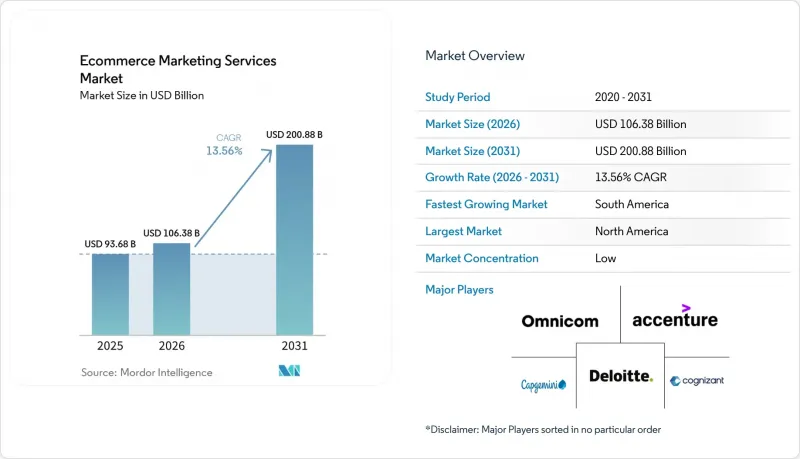
本報告按服務類型(例如,搜尋引擎最佳化 (SEO)、付費搜尋和購物廣告、付費社交和社交電商行銷)、組織規模(中小企業和大型企業)、最終用戶行業(例如,零售和消費品、時尚和服裝、美容和個人護理)以及地區進行細分。市場預測以美元 (USD) 計價。
全球電子商務行銷服務市場趨勢及洞察
人工智慧驅動的個人化和創新自動化提高了電子商務的投資報酬率。
電子商務行銷服務市場正朝著人工智慧主導的執行模式轉型,個人化已成為一項基本需求,而非可選項。根據 Shopify 預測,2026 年第一季,透過人工智慧存取的訪客轉換率比自然搜尋訪客高出約 50%,平均訂單價值也高出 14%。這凸顯了能夠將產品發現、產品數據和轉化工作流程整合到單一程序中的代理商的優勢。這種轉變提高了代理商的門檻,因為僅靠人工創新團隊無法跟上人工智慧團隊目前在測試速度和內容量方面的水平。此外,這種轉變也促使電子商務行銷服務市場的客戶優先考慮擁有專有工作流程工具、強大的資訊流管理和更結構化目錄管理方法的合作夥伴。因此,目錄豐富、創新自動化和人工智慧賦能的內容創作正從輔助項目發展成為核心的、持續的合約服務。
零售媒體和市場廣告預算持續成長。
受零售媒體和電商平台廣告擴張的推動,電子商務行銷服務市場正蓬勃發展。這是因為品牌方正將更多預算投入與購買行為密切相關的管道。隨著廣告主不再像以往那樣追求以提升品牌知名度為導向、但歸因不明的廣告位,而是更加重視閉合迴路衡量和第一方交易數據,零售媒體的吸引力也隨之提升。這種轉變也影響著客戶的預算分配,提供贊助產品媒體、貨架展示和跨平台報告等服務的代理商在以結果為導向的預算中佔據了更大的佔有率。目前,北美和歐洲的主要零售媒體生態系統仍是成長的熱點,但隨著電商平台競爭的加劇,類似的購買邏輯正在向其他地區蔓延。由於不同品類的需求並不均衡,在美妝、個人護理、醫療保健和其他快速消費品領域擁有強大影響力的代理商在電子商務行銷服務市場中佔據了更有利的地位。
不斷上漲的客戶獲取成本(CAC)對宣傳活動效率帶來了壓力。
電子商務行銷服務市場持續面臨獲客成本上漲的壓力,因為許多代理商的工作範圍與付費管道的績效直接掛鉤。根據 Shopify 商家的數據,客戶獲取成本 (CAC) 預計將從去年的 274 美元上漲至 2026 年的 318 美元,這意味著代理商必須更加努力才能證明付費獲客預算的合理性並維持投資回報率 (ROAS)。當成本上漲超過轉換效率的提升時,品牌會將資金轉移到客戶維繫管道,例如電子郵件、簡訊、忠誠度計畫和聯盟計畫。雖然通路構成的這種轉變不會消除對代理商的需求,但它會削弱那些在電子商務行銷服務市場中過度依賴付費客戶獲取管理的公司的發展勢頭。能夠在客戶獲取和生命週期管道之間重新分配客戶預算,同時不影響績效課責的代理機構將更具優勢。
細分市場分析
到2025年,付費搜尋和購物廣告將佔電子商務行銷服務市場規模的27.13%,並持續維持其最大服務領域的地位。這是因為有購買意願的搜尋查詢與最終購買決策最為接近。儘管成本壓力不斷增加,但該管道仍然佔據了相當大的支出佔有率,因為它仍然是品牌在線銷售最直接的創收途徑之一。谷歌和亞馬遜在捕捉產品主導需求方面的優勢進一步鞏固了這一地位,因為消費者在購買前已經比較並考慮了各種選擇。在電子商務行銷服務市場,這意味著擁有資訊流管理、競標策略、落地頁最佳化和平台整合專業知識的代理商將繼續在其客戶關係中扮演核心角色。
付費社群行銷和社群電商行銷預計將在2026年至2031年間以16.53%的複合年成長率成長,成為電商行銷服務市場中成長最快的服務領域。 2025年,全球整體社群媒體廣告收入將達到1,177億美元,年增32.6%。這充分展現了社交主導需求環境的規模和商業性吸引力。內容和網紅行銷專案也朝著更貼近直接銷售的「可購買」形式轉變,這改變了品牌對創新成果和管道的價值評估。同時,不斷上漲的獲客成本也凸顯了利用電子郵件、簡訊和推播通知等管道進行用戶留存行銷的重要性,越來越多的成長計畫正轉向重新運作自身管道。此外,隨著品牌意識到零售平台內的搜尋可見度對轉換率和整合獲客成本的影響日益顯著,電商平台廣告和數位貨架最佳化也不斷擴展。
區域分析
在2025年的電子商務行銷服務市場中,北美仍是最大的區域收入來源,佔32.73%的市佔率。同時,亞太地區預計將在2031年之前實現最快成長。該地區的領先地位源於企業行銷預算的增加、零售媒體的廣泛應用以及已成熟的代理商生態系統,這些都為整合商務的實施提供了支持。在美國,創作者廣告市場預計到2025年將達到370億美元,這表明品牌預算正迅速轉向與電商相關的內容和以創作者主導的客戶獲取方式。加拿大和墨西哥的需求也在不斷成長,尤其是在行動商務蓬勃發展的推動下,對在地化付費社群廣告、市場廣告和成效衡量的需求日益增加。監管法規環境也變得越發重要,因為隱私法規和人工智慧驅動推薦的指導方針正在影響代理商如何定位目標受眾、揭露內容以及處理消費者資料。
亞太地區是電子商務行銷服務成長最快的區域市場,複合年成長率高達15.29%,主要得益於電子商務的持續強勁成長以及品牌迅速轉向人工智慧驅動的新型商務執行模式。中國不僅是該地區最大的國內市場,也是人工智慧主導的產品發現、社群電商和平台主導的客戶獲取等模式的重要試驗場。印度、韓國和澳洲也出現了新的需求,因為國內品牌擴大將付費社群廣告、平台管理和轉化為導向的宣傳活動活動外包。因此,亞太地區的電子商務行銷服務市場呈現出獨特的特徵,速度、平台熟練度和在地化與純粹的媒體購買量同等重要。
歐洲是電子商務行銷服務市場中至關重要但結構性限制的區域,隱私法規和平台監管正在影響代理商收集數據和衡量績效的方式。英國、德國和法國憑藉著成熟的代理商生態系統和強大的零售基礎設施,持續支撐著區域需求。隨著行動商務和電商平台的日益普及,南美洲正在崛起為重要的成長區域。尤其是在巴西,平台之間的競爭日益激烈,使得在地化執行和數位貨架曝光變得愈發重要。中東和非洲也蘊藏長期成長機遇,例如阿拉伯聯合大公國和沙烏地阿拉伯等國持續投資於數位商務基礎設施,而奈及利亞和南非則圍繞行動優先的購物行為塑造著服務需求。
其他好處:
- Excel格式的市場預測(ME)表
- 3個月的分析師支持
目錄
第1章:引言
- 調查範圍
第2章:調查方法
第3章執行摘要
第4章 市場狀況
- 市場概覽
- 市場促進因素
- 電子商務競爭加劇,對企業績效帶來更大壓力
- 人工智慧驅動的個人化和創新自動化提高了電子商務的投資報酬率。
- 零售媒體和市場廣告預算持續成長。
- 全通路購物和社交電商正在推動對整合實施方案的需求。
- 基於代理的商務、人工智慧驅動的產品發現和基於獎勵的結構化目錄最佳化。
- 跨境市場的多元化發展增加了對在地化數位貨架服務的需求。
- 市場限制因素
- 隱私措施的改變和 cookie 的禁用導致訊號遺失,削弱了定向效果。
- 不斷上漲的客戶獲取成本給宣傳活動效率帶來了壓力。
- 產品數據不足阻礙了個人化和人工智慧的規模化應用。
- 黑箱平台的自動化降低了控制和測量的透明度。
- 產業價值鏈分析
- 宏觀經濟因素對市場的影響
- 監理情勢
- 技術展望
- 波特五力分析
第5章 市場規模與成長預測
- 按服務類型
- 搜尋引擎最佳化(SEO)
- 付費搜尋廣告和購物廣告
- 付費社群行銷和社群電商行銷
- 市場廣告和數位貨架最佳化
- 內容影響者行銷
- 透過電子郵件、簡訊和推播通知進行客戶維繫行銷。
- 聯盟行銷和夥伴關係關係行銷
- 其他服務類型
- 按組織規模
- SME
- 大公司
- 按最終用戶行業分類
- 零售和消費品
- 時尚與服裝
- 美容及個人護理
- 家用電子產品
- 食品和飲料
- 家居用品/家具
- 健康與保健
- 其他終端用戶產業
- 按地區
- 北美洲
- 美國
- 加拿大
- 墨西哥
- 南美洲
- 巴西
- 阿根廷
- 其他南美國家
- 歐洲
- 德國
- 英國
- 法國
- 義大利
- 西班牙
- 其他歐洲國家
- 亞太地區
- 中國
- 日本
- 印度
- 韓國
- 澳洲
- 其他亞太國家
- 中東
- 阿拉伯聯合大公國
- 沙烏地阿拉伯
- 卡達
- 其他中東國家
- 非洲
- 南非
- 埃及
- 奈及利亞
- 其他非洲國家
- 北美洲
第6章 競爭情勢
- 市場集中度
- 策略趨勢
- 市佔率分析
- 公司簡介
- Accenture plc
- Omnicom Group Inc.
- Capgemini SE
- Cognizant Technology Solutions Corporation
- Deloitte Touche Tohmatsu Limited
- Infosys Limited
- International Business Machines Corporation
- Tata Consultancy Services Limited
- Wipro Limited
- Genpact Limited
- Adobe Inc.
- Merkle, Inc.
- Publicis Groupe SA
- WPP plc
- Stagwell Inc.
- Pattern, Inc.
- Cart.com, Inc.
- WebFX, Inc.
- SmartSites LLC
- NP Digital, LLC
第7章 市場機會與未來展望
According to Mordor Intelligence, the ecommerce marketing services market size is projected to be USD 93.68 billion in 2025, USD 106.38 billion in 2026, and reach USD 200.88 billion by 2031, growing at a CAGR of 13.56% from 2026 to 2031.
This report is Segmented by Service Type (Search Engine Optimization (SEO), Paid Search and Shopping Advertising, Paid Social and Social Commerce Marketing, and More), Organization Size (SMEs, and Large Enterprises), End-User Industry (Retail and Consumer Goods, Fashion and Apparel, Beauty and Personal Care, and More), and Geography. The Market Forecasts are Provided in Terms of Value (USD).
Global Ecommerce Marketing Services Market Trends and Insights
AI-Driven Personalization and Creative Automation Improve Commerce ROI
The ecommerce marketing services market is moving toward AI-led execution because personalization has become a baseline expectation rather than an optional feature. Shopify reported that AI-referred visitors converted at nearly 50% higher rates than organic search visitors and had 14% higher average order values in Q1 2026, which strengthens the case for agencies that can connect discovery, product data, and conversion workflows in a single program. That shift is raising the operating standard for agencies because human-only creative teams cannot match the testing speed or content volume that AI-supported teams can now deliver. It is also pushing clients to favor partners with proprietary workflow tools, stronger feed management, and better-structured catalog practices in the ecommerce marketing services market. As a result, catalog enrichment, creative automation, and AI-ready content production are moving into core retainers instead of sitting in side projects.
Retail Media and Marketplace Advertising Budgets Keep Expanding
The ecommerce marketing services market is gaining momentum from the expansion of retail media and marketplace advertising, as brands are directing more budget to channels closely tied to purchase behavior. Retail media has become more attractive as advertisers prioritize closed-loop measurement and first-party transaction data over awareness-led placements with weaker attribution. That shift is also changing account economics because agencies that can manage sponsored product media, shelf visibility, and cross-platform reporting are winning a larger share of performance-led budgets. The strongest momentum remains concentrated in major retail media ecosystems in North America and Europe, though the same buying logic is now spreading to other regions as marketplace competition deepens. Category demand is not moving evenly, which means agencies with strong presence in beauty, personal care, health, and other fast-turning consumer verticals are better positioned in the ecommerce marketing services market.
Customer Acquisition Cost Inflation Compresses Campaign Efficiency
The ecommerce marketing services market still faces pressure from rising acquisition costs because many agency scopes are tied directly to paid channel performance. Shopify's merchant data showed CAC rising to USD 318 in 2026 from USD 274 a year earlier, which means agencies must work harder to justify paid acquisition budgets and defend return on spend. When costs rise faster than conversion efficiency, brands shift funds toward retention channels such as email, SMS, loyalty programs, and affiliate programs. That mix shift does not eliminate agency demand, but it does reduce momentum for firms that depend too heavily on paid acquisition management alone in the ecommerce marketing services market. It also favors agencies that can rebalance client budgets across acquisition and lifecycle channels without losing performance accountability.
Other drivers and restraints analyzed in the detailed report include:
- Rising Performance Pressure as Ecommerce Competition Intensifies
- Omnichannel Shopping and Social Commerce Raise Demand For Integrated Execution
- Signal Loss From Privacy Changes and Cookie Deprecation Weakens Targeting
For complete list of drivers and restraints, kindly check the Table Of Contents.
Segment Analysis
Paid search and shopping advertising held 27.13% of ecommerce marketing services market size in 2025, which kept it as the largest service line because commercial-intent queries still sit closest to purchase decisions. The channel continues to command spend even when cost pressure rises, because it remains one of the most directly attributable paths to revenue for brands selling online. That position is reinforced by Google's and Amazon's strength in capturing product-led demand; shoppers are already comparing options. In the ecommerce marketing services market, this means agencies with strong feed management, bid strategy, landing page discipline, and marketplace integration continue to sit in the center of client relationships.
Paid social and social commerce marketing is projected to grow at a 16.53% CAGR from 2026 to 2031, making it the fastest-growing service type in the ecommerce marketing services market. Social media advertising revenues reached USD 117.7 billion globally in 2025, rising 32.6% year over year, which shows the scale and commercial pull of social-led demand environments. Content and influencer programs are also shifting toward shoppable formats tied more closely to direct sales, which is changing how brands assess creative output and channel value. Email, SMS, and push retention marketing are gaining weight at the same time because rising acquisition costs are pushing more growth plans toward owned-channel reactivation. Marketplace advertising and digital shelf optimization are also expanding as brands recognize that search visibility inside retail platforms increasingly shapes both conversion and blended acquisition costs.
Complete Report Scope:
- By Service Type
- Search Engine Optimization (SEO)
- Paid Search and Shopping Advertising
- Paid Social and Social Commerce Marketing
- Marketplace Advertising and Digital Shelf Optimization
- Content and Influencer Marketing
- Email, SMS and Push Retention Marketing
- Affiliate and Partnership Marketing
- Other Service Types
- By Organization Size
- SMEs
- Large Enterprises
- By End-user Industry
- Retail and Consumer Goods
- Fashion and Apparel
- Beauty and Personal Care
- Consumer Electronics
- Grocery and Food and Beverage
- Home and Furniture
- Health and Wellness
- Other End-User Industries
- By Geography
- North America
- United States
- Canada
- Mexico
- South America
- Brazil
- Argentina
- Rest of South America
- Europe
- Germany
- United Kingdom
- France
- Italy
- Spain
- Rest of Europe
- Asia-Pacific
- China
- Japan
- India
- South Korea
- Australia
- Rest of Asia-Pacific
- Middle East
- United Arab Emirates
- Saudi Arabia
- Qatar
- Rest of Middle East
- Africa
- South Africa
- Egypt
- Nigeria
- Rest of Africa
- North America
Geography Analysis
North America remained the leading regional revenue base with 32.73% share in the ecommerce marketing services market in 2025, while Asia-Pacific is expected to post the fastest growth through 2031. The region's lead comes from deeper enterprise marketing budgets, broad adoption of retail media, and a more mature agency ecosystem that already supports integrated commerce execution. In the United States, creator advertising reached USD 37 billion in 2025, showing how quickly brand budgets are moving toward commerce-linked content and creator-led customer acquisition. Canada and Mexico are also adding demand, especially as mobile commerce growth increases the need for localized paid social, marketplace advertising, and performance measurement. The regulatory environment is also becoming increasingly important, as privacy rules and guidance on AI-led endorsements are shaping how agencies handle targeting, content disclosure, and consumer data use.
Asia-Pacific is the fastest-growing regional market, with a 15.29% CAGR in ecommerce marketing services, as ecommerce adoption remains strong and brands move quickly to newer forms of AI-assisted commerce execution. China stands out as the largest national market in the region and as a major testing ground for AI-led product discovery, social commerce, and marketplace-led customer acquisition. India, South Korea, and Australia are also adding new demand as domestic brands become more willing to outsource paid social, marketplace management, and conversion-focused campaign work. This is giving the ecommerce marketing services market in Asia-Pacific a distinct profile in which speed, platform fluency, and localization matter as much as pure media-buying scale.
Europe remains an important but more structurally constrained part of the ecommerce marketing services market because privacy regulation and platform oversight affect how agencies collect data and measure performance. The United Kingdom, Germany, and France continue to anchor regional demand through established agency ecosystems and strong retail infrastructure. South America is emerging as a meaningful growth pocket as mobile commerce and marketplace adoption improve, especially in Brazil, where local execution and digital shelf visibility matter more amid rising platform competition. The Middle East and Africa also offer long-term growth opportunities as countries such as the United Arab Emirates and Saudi Arabia continue to invest in digital commerce infrastructure, while Nigeria and South Africa build service demand around mobile-first shopping behavior.
- Accenture plc
- Omnicom Group Inc.
- Capgemini SE
- Cognizant Technology Solutions Corporation
- Deloitte Touche Tohmatsu Limited
- Infosys Limited
- International Business Machines Corporation
- Tata Consultancy Services Limited
- Wipro Limited
- Genpact Limited
- Adobe Inc.
- Merkle, Inc.
- Publicis Groupe S.A.
- WPP plc
- Stagwell Inc.
- Pattern, Inc.
- Cart.com, Inc.
- WebFX, Inc.
- SmartSites LLC
- NP Digital, LLC
Additional Benefits:
- The market estimate (ME) sheet in Excel format
- 3 months of analyst support
TABLE OF CONTENTS
1 INTRODUCTION
- 1.1 Scope of the Study
2 RESEARCH METHODOLOGY
3 EXECUTIVE SUMMARY
4 MARKET LANDSCAPE
- 4.1 Market Overview
- 4.2 Market Drivers
- 4.2.1 Rising Performance Pressure as Ecommerce Competition Intensifies
- 4.2.2 AI-Driven Personalization and Creative Automation Improve Commerce ROI
- 4.2.3 Retail Media and Marketplace Advertising Budgets Keep Expanding
- 4.2.4 Omnichannel Shopping and Social Commerce Raise Demand for Integrated Execution
- 4.2.5 Agentic Commerce and AI Product Discovery Reward Structured Catalog Optimization
- 4.2.6 Cross-Border Marketplace Diversification Increases Need for Localized Digital Shelf Services
- 4.3 Market Restraints
- 4.3.1 Signal Loss from Privacy Changes and Cookie Deprecation Weakens Targeting
- 4.3.2 Customer Acquisition Cost Inflation Compresses Campaign Efficiency
- 4.3.3 Poor Product Data Readiness Limits Personalization and AI Scale-Up
- 4.3.4 Black-Box Platform Automation Reduces Control and Measurement Transparency
- 4.4 Industry Value Chain Analysis
- 4.5 Impact of Macroeconomic Factors on the Market
- 4.6 Regulatory Landscape
- 4.7 Technological Outlook
- 4.8 Porter's Five Forces Analysis
- 4.8.1 Bargaining Power of Buyers
- 4.8.2 Bargaining Power of Suppliers
- 4.8.3 Threat of New Entrants
- 4.8.4 Threat of Substitutes
- 4.8.5 Intensity of Competitive Rivalry
5 MARKET SIZE AND GROWTH FORECASTS (VALUE)
- 5.1 By Service Type
- 5.1.1 Search Engine Optimization (SEO)
- 5.1.2 Paid Search and Shopping Advertising
- 5.1.3 Paid Social and Social Commerce Marketing
- 5.1.4 Marketplace Advertising and Digital Shelf Optimization
- 5.1.5 Content and Influencer Marketing
- 5.1.6 Email, SMS and Push Retention Marketing
- 5.1.7 Affiliate and Partnership Marketing
- 5.1.8 Other Service Types
- 5.2 By Organization Size
- 5.2.1 SMEs
- 5.2.2 Large Enterprises
- 5.3 By End-user Industry
- 5.3.1 Retail and Consumer Goods
- 5.3.2 Fashion and Apparel
- 5.3.3 Beauty and Personal Care
- 5.3.4 Consumer Electronics
- 5.3.5 Grocery and Food and Beverage
- 5.3.6 Home and Furniture
- 5.3.7 Health and Wellness
- 5.3.8 Other End-User Industries
- 5.4 By Geography
- 5.4.1 North America
- 5.4.1.1 United States
- 5.4.1.2 Canada
- 5.4.1.3 Mexico
- 5.4.2 South America
- 5.4.2.1 Brazil
- 5.4.2.2 Argentina
- 5.4.2.3 Rest of South America
- 5.4.3 Europe
- 5.4.3.1 Germany
- 5.4.3.2 United Kingdom
- 5.4.3.3 France
- 5.4.3.4 Italy
- 5.4.3.5 Spain
- 5.4.3.6 Rest of Europe
- 5.4.4 Asia-Pacific
- 5.4.4.1 China
- 5.4.4.2 Japan
- 5.4.4.3 India
- 5.4.4.4 South Korea
- 5.4.4.5 Australia
- 5.4.4.6 Rest of Asia-Pacific
- 5.4.5 Middle East
- 5.4.5.1 United Arab Emirates
- 5.4.5.2 Saudi Arabia
- 5.4.5.3 Qatar
- 5.4.5.4 Rest of Middle East
- 5.4.6 Africa
- 5.4.6.1 South Africa
- 5.4.6.2 Egypt
- 5.4.6.3 Nigeria
- 5.4.6.4 Rest of Africa
- 5.4.1 North America
6 COMPETITIVE LANDSCAPE
- 6.1 Market Concentration
- 6.2 Strategic Moves
- 6.3 Market Share Analysis
- 6.4 Company Profiles (includes Global Level Overview, Market Level Overview, Core Segments, Financials as available, Strategic Information, Market Rank/Share, Products and Services, Recent Developments)
- 6.4.1 Accenture plc
- 6.4.2 Omnicom Group Inc.
- 6.4.3 Capgemini SE
- 6.4.4 Cognizant Technology Solutions Corporation
- 6.4.5 Deloitte Touche Tohmatsu Limited
- 6.4.6 Infosys Limited
- 6.4.7 International Business Machines Corporation
- 6.4.8 Tata Consultancy Services Limited
- 6.4.9 Wipro Limited
- 6.4.10 Genpact Limited
- 6.4.11 Adobe Inc.
- 6.4.12 Merkle, Inc.
- 6.4.13 Publicis Groupe S.A.
- 6.4.14 WPP plc
- 6.4.15 Stagwell Inc.
- 6.4.16 Pattern, Inc.
- 6.4.17 Cart.com, Inc.
- 6.4.18 WebFX, Inc.
- 6.4.19 SmartSites LLC
- 6.4.20 NP Digital, LLC
7 MARKET OPPORTUNITIES AND FUTURE OUTLOOK
- 7.1 White-Space and Unmet-Need Assessment

 簡訊行銷服務:市場佔有率分析、產業趨勢與統計、成長預測(2026-2031)
 行動傳訊服務市場:全球市場預測,2026-2032年
 2034年企業通訊市場預測-按組件、部署模式、通訊管道、企業規模、應用、最終用戶和地區分類的全球分析
 2026年全球行動傳訊市場報告
 群發簡訊行銷服務市場:按組件、部署方式、公司規模、設備類型、簡訊類型、最終用戶和地區分類
 行動傳訊市場分析及預測(至2035年):依類型、產品類型、服務、技術、組件、應用、設備、部署模式及最終用戶分類
 大量簡訊市場規模、佔有率和成長分析(按類型、組件、行業垂直領域、公司規模和地區分類)—2026-2033年行業預測
 美國簡訊行銷市場規模、佔有率、趨勢分析報告:按簡訊類型、組織、最終用途、細分市場預測,2024-2030 年