


 |
市場調查報告書
商品編碼
2118886
金屬射出成型:市場佔有率分析、產業趨勢與統計、成長預測(2026-2031)Metal Injection Molding - Market Share Analysis, Industry Trends & Statistics, Growth Forecasts (2026 - 2031) |
||||||

※ 本網頁內容可能與最新版本有所差異。詳細情況請與我們聯繫。
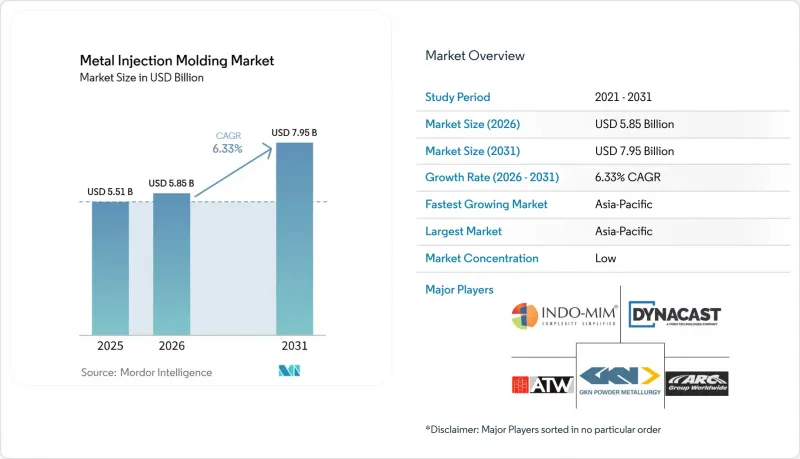
據 Mordor Intelligence 稱,2025 年金屬射出成型市場價值為 55.1 億美元,預計到 2031 年將達到 79.5 億美元,而 2026 年為 58.5 億美元,預測期(2026-2031 年)複合年成長率為 6.33%。
本報告按材料類型(不銹鋼、低合金鋼、碳鋼等)、應用領域(結構件、精密機械零件等)、終端用戶產業(汽車、醫療保健等)和地區(亞太地區、北美地區、歐洲地區、南美地區、中東和非洲地區)進行細分。市場預測以美元計價。
全球金屬射出成型市場趨勢與洞察
對小型化和高精度金屬零件的需求日益成長
微型化技術的進步正在改變可大量生產的金屬零件範圍。金屬射出成型能夠製造重量少於1克、尺寸不足1毫米的零件,同時保持商業項目所需的重複性。小型穿戴式裝置、智慧型手機和高密度電子組件的普及,增加了對小型、複雜形狀內部結構硬體的需求。類似的設計趨勢也影響導管硬體和植入式感測器,這些產品既需要生物相容性,也需要小型化。擁有更高公差控制、表面光潔度和尺寸重複性等級的供應商,能夠在同等產量下滿足其他製造流程無法滿足的要求。
擴大以近淨成形金屬射出成型零件取代傳統機械加工零件的範圍
對於結構較為複雜的零件,近淨成形生產可以減少加工步驟。當產量足以抵銷模具成本,或加工造成的材料損耗較大時,此優勢尤其重要。金屬射出成型適用於外殼、支架、致動器以及其他需要重複形狀的零件。它還為製造商提供了一種將功能整合到單一注塑件中的方法,而無需組裝多個機械加工零件。這種方法在北美、歐洲和亞太地區尤其有效,因為這些地區的汽車、工業、醫療和消費品產業對生產一致性要求很高。然而,由於需要在批量生產開始前檢驗原料、模具、燒結性能和最終尺寸,因此其應用受到一定限制。
金屬粉末原料和材料認證高成本。
金屬粉末原料佔MIM(金屬射出成型)原料總成本的70%至85%。標準不鏽鋼牌號如316L和17-4 PH的價格為每公斤20至40美元,鈦(Ti-6Al-4V)的價格為每公斤50至80美元,而航太級鈦的價格則可能超過每公斤100美元。用於醫療和航太專案的新粉末批次需要8至12週的可追溯性測試和批次驗收檢驗。鎳和鈦的價格波動可能會使供應商與其客戶之間的長期定價協議變得複雜。作為加強供應鏈管理計畫的一部分,Indo-MIM正在卡納塔克邦的Goulividhanur建造一座鐵粉製造廠,目標是在2027會計年度運作。對於沒有粉末生產能力的純轉換器公司而言,保持與一體化供應商相同的成本競爭力可能會變得更加困難。
細分市場分析
2025年,不鏽鋼佔全球銷售額的53.18%。其廣泛應用反映了其耐腐蝕性、生物相容性以及對316L和17-4 PH牌號不銹鋼的親和性。這些牌號廣泛應用於汽車感測器外殼、醫療設備、槍械零件、家用電子電器鉸鍊和工業致動器等領域。 2026年發表的一項研究發現,採用瓊脂黏合劑系統製造的MIM SS316L不銹鋼的機械性質與鍛造產品相當。低合金鋼則用於變速箱和傳動系統,在這些應用中,耐磨性和成本仍然是重要的考慮因素。
預計到2031年,鈦合金市場將以7.92%的複合年成長率成長,成為金屬射出成型市場中成長最快的材料類別。一項2025年的研究報告顯示,含0.5 wt%石墨的MIM BETA鈦合金的抗張強度為900-1100 MPa,接近鍛造零件的性能。與氣體霧化法粉末加工相比,氫化物-脫氫法粉末加工提高了成本競爭力。此外,隨著汽車電氣化程度的提高,軟磁性Fe-Si、Fe-Co和Fe-Ni合金在馬達和執行器領域也備受關注。鈷合金在整形外科耐磨表面、鎢合金在輻射屏蔽以及碳鋼在二次結構應用中繼續發揮重要作用。
區域分析
預計到2025年,亞太地區將佔據全球金屬射出成型(MIM)市場佔有率的46.39%,並在2031年之前以6.93%的複合年成長率成長。在中國,每輛新能源汽車的MIM零件用量比同類內燃機汽車高出20%以上。印度正成為重要的生產中心,Indo-MIM公司位於清奈的工廠將於2025年投入生產。日本和韓國則為醫療設備硬體和半導體製造設備提供高精度生產能力。
在北美,醫療設備、國防和槍械產業對高附加價值產品的需求旺盛。與家用電子電器或通用汽車專案相比,這些應用領域通常能提供更高的單件利潤率。德國的汽車和工業機械基礎支撐著歐洲的需求。匈牙利AFT公司報告稱,到2026年4月,其為北約客戶生產的槍械用金屬注射成型(MIM)組件產量將增加五倍。該公司的業務活動表明,東歐一個以國防領域為中心的產業叢集正在擴大。
南美、中東和非洲在金屬射出成型市場仍處於發展階段,規模較小。巴西和阿根廷的需求主要來自汽車零件製造和工業設備供應鏈。中東地區正隨著沙烏地阿拉伯國防能力的現代化和阿拉伯聯合大公國對精密工程的投資而發展成為基本客群。南非的採礦業和汽車產業正在形成初步的需求基礎。
其他好處:
- Excel格式的市場預測(ME)表
- 3個月的分析師支持
目錄
第1章:引言
- 研究假設和市場定義
- 調查範圍
第2章:調查方法
第3章執行摘要
第4章 市場狀況
- 市場概覽
- 市場促進因素
- 對小型高精度金屬零件的需求日益成長
- 以近淨成形金屬射出成型零件取代傳統機械加工零件的趨勢日益成長。
- 金屬射出成型在複雜醫療設備零件中的應用日益廣泛。
- 國防和槍械應用領域對高精度零件的需求不斷成長。
- 擴大金屬射出成型在電動車(EV)和電動動力傳動系統零件中的應用。
- 市場限制因素
- 金屬粉末原料和材料認證高成本。
- 燒結收縮帶來的尺寸控制挑戰
- 醫療和國防應用領域的長期產品認證和法規核准流程
- 價值鏈分析
- 波特五力分析
第5章 市場規模與成長預測
- 材料類型
- 不銹鋼
- 低合金鋼
- 軟磁合金
- 碳鋼
- 鈦合金
- 鈷合金
- 工具鋼
- 鎢合金
- 其他材料類型
- 透過使用
- 結構構件
- 精密機械零件
- 耐磨部件
- 小零件
- 外科和整形外科組件
- 電子元件
- 裝飾部件
- 其他用途
- 按最終用途行業分類
- 車
- 醫療保健
- 電氣和電子設備
- 工業機械
- 航太/國防
- 槍枝
- 消費品
- 奢侈品和珠寶飾品
- 其他終端用戶產業
- 按地區
- 亞太地區
- 中國
- 印度
- 日本
- 韓國
- 其他亞太國家
- 北美洲
- 美國
- 加拿大
- 墨西哥
- 歐洲
- 德國
- 英國
- 法國
- 義大利
- 俄羅斯
- 其他歐洲國家
- 南美洲
- 巴西
- 阿根廷
- 其他南美國家
- 中東和非洲
- 沙烏地阿拉伯
- 南非
- 其他中東和非洲國家
- 亞太地區
第6章 競爭情勢
- 市場集中度
- 策略趨勢
- 市佔率和排名分析
- 公司簡介
- Advanced Powder Products
- ARC Group Worldwide
- ATW Companies
- Dean Group International
- Dynacast
- Epson Atmix Corporation
- GKN Powder Metallurgy
- Greene Group Industries, Inc.(Britt Manufacturing)
- INDO-MIM
- Kinetics Climax
- Ningbo JX Advanced Metals Co., Ltd.
- Rockleigh Industries
- Schunk Sintermetalltechnik GmbH
- Sintex
- Smith Metal Products
第7章 市場機會與未來展望
According to Mordor Intelligence, the metal injection molding market was valued at USD 5.51 billion in 2025 and is estimated to grow from USD 5.85 billion in 2026 to reach USD 7.95 billion by 2031, at a CAGR of 6.33% during the forecast period (2026-2031).
This report is Segmented by Material Type (Stainless Steel, Low Alloy Steel, Carbon Steel, and More), Application (Structural Components, Precision Mechanical Components, and More), End-Use Industry (Automotive, Medical and Healthcare, and More), and Geography (Asia-Pacific, North America, Europe, South America, and Middle-East and Africa). The Market Forecasts are Provided in Terms of Value (USD).
Global Metal Injection Molding Market Trends and Insights
Growing Demand for Miniaturized and High-Precision Metal Components
Miniaturization is changing the range of metal parts that can be produced in volume. Metal injection molding can make sub-gram and sub-millimeter components while retaining the repeatability needed for commercial programs. Compact wearables, smartphones, and dense electronic assemblies have increased demand for internal structural hardware with small and complex forms. The same design direction affects catheter hardware and implantable sensors, where biocompatibility and small dimensions are both required. Suppliers that improve tolerance control, surface finish, and dimensional repeatability can address requirements that alternative processes may not meet at comparable production volumes.
Increasing Replacement of Conventionally Machined Parts with Net-Shape Metal Injection Molded Components
Net-shape production can reduce the number of machining steps for suitable complex parts. This advantage matters most when production volumes can absorb tooling costs and when material waste from machining is significant. Metal injection molding supports housings, brackets, actuators, and other parts that require repeatable geometry. It also gives manufacturers a route to combine functions into a single molded component instead of assembling several machined pieces. The approach is relevant in North America, Europe, and the Asia-Pacific region, where automotive, industrial, medical, and consumer products require high production consistency. Its adoption is limited by the need to validate feedstock, tooling, sintering behavior, and final dimensions before series production begins.
High Costs Associated with Metal Powder Feedstock and Material Qualification
Metal powder feedstock represents 70-85% of the total MIM feedstock cost. Standard stainless steel grades such as 316L and 17-4 PH cost USD 20-40 per kilogram, while titanium Ti-6Al-4V costs USD 50-80 per kilogram, and aerospace grades can exceed USD 100 per kilogram. New powder lots for medical or aerospace programs require 8-12 weeks of traceability testing and lot-acceptance validation. Nickel and titanium price changes can complicate long-term pricing commitments for suppliers and their customers. Indo-MIM is constructing an iron powder facility in Gowribidanur, Karnataka, for an FY2027 launch, which supports its plan for greater supply-chain control. Pure converters without powder production capabilities may find it harder to match the cost position of integrated suppliers.
Other drivers and restraints analyzed in the detailed report include:
- Rising Adoption of Metal Injection Molding for Complex Medical Device Components
- Increasing Demand for High-Precision Components in Defense and Firearms Applications and Growing Use in Electric Vehicle Components
- Dimensional Control Challenges Due to Sintering Shrinkage
For complete list of drivers and restraints, kindly check the Table Of Contents.
Segment Analysis
Stainless steel accounted for 53.18% of global revenue by value in 2025. Its use reflects corrosion resistance, biocompatibility, and familiarity with 316L and 17-4 PH grades. These grades are used in automotive sensor housings, medical instruments, firearms components, consumer electronics hinges, and industrial actuators. Research published in 2026 found that MIM SS316L made with agar binder systems achieved mechanical properties consistent with wrought equivalents. Low-alloy steels serve transmission and driveline applications where wear resistance and cost remain important.
Titanium alloys are forecast to grow at a 7.92% CAGR through 2031, making them the fastest-growing material group in the metal injection molding market. A 2025 study reported tensile strengths of 900-1,100 MPa for a MIM beta titanium alloy with 0.5 wt% graphite, bringing its performance closer to wrought specifications. Hydride-dehydride powder processing has improved the cost case against gas-atomized powder. Soft magnetic Fe-Si, Fe-Co, and Fe-Ni alloys are also gaining attention in motors and actuators as vehicle electrification expands. Cobalt alloys remain relevant for orthopedic wear surfaces, tungsten alloys for radiation shielding, and carbon steel for secondary structural programs.
Complete Report Scope:
- By Material Type
- Stainless Steel
- Low Alloy Steel
- Soft Magnetic Alloys
- Carbon Steel
- Titanium Alloys
- Cobalt Alloys
- Tool Steel
- Tungsten Alloys
- Other Material Types
- By Application
- Structural Components
- Precision Mechanical Components
- Wear-Resistant Parts
- Miniature Components
- Surgical and Orthopedic Components
- Electronic Components
- Decorative Components
- Other Applications
- By End-Use Industry
- Automotive
- Medical and Healthcare
- Electrical and Electronics
- Industrial Machinery
- Aerospace and Defense
- Firearms
- Consumer Products
- Luxury Goods and Jewelry
- Other End-Use Industries
- By Geography
- Asia-Pacific
- China
- India
- Japan
- South Korea
- Rest of Asia-Pacific
- North America
- United States
- Canada
- Mexico
- Europe
- Germany
- United Kingdom
- France
- Italy
- Russia
- Rest of Europe
- South America
- Brazil
- Argentina
- Rest of South America
- Middle-East and Africa
- Saudi Arabia
- South Africa
- Rest of Middle-East and Africa
- Asia-Pacific
Geography Analysis
Asia-Pacific held 46.39% of the global metal injection molding market share in 2025 and is forecast to grow at a 6.93% CAGR through 2031. MIM content per new energy vehicle in China is more than 20% higher by part count than in comparable internal combustion vehicles. India is becoming an important production location, and Indo-MIM began operations at its Chennai plant in 2025. Japan and South Korea contribute precision-grade capacity for medical device and semiconductor equipment hardware.
North America has high-value demand for medical devices, defense, and firearms. These applications typically have higher per-part margins than consumer electronics or commodity automotive programs. European demand is supported by Germany's automotive and industrial machinery base. AFT-Hungary reported fivefold growth in firearm MIM component volumes for NATO customers in April 2026. The company's activity indicates a growing defense-focused cluster in Eastern Europe.
South America, and Middle-East and Africa remain smaller development areas for the metal injection molding market. Brazil and Argentina have demand through automotive parts manufacturing and industrial equipment supply chains. The Middle-East is developing as a customer base through defense modernization in Saudi Arabia and precision engineering investment in the UAE. South Africa provides an early demand base through mining and automotive activity.
- Advanced Powder Products
- ARC Group Worldwide
- ATW Companies
- Dean Group International
- Dynacast
- Epson Atmix Corporation
- GKN Powder Metallurgy
- Greene Group Industries, Inc. (Britt Manufacturing)
- INDO-MIM
- Kinetics Climax
- Ningbo JX Advanced Metals Co., Ltd.
- Rockleigh Industries
- Schunk Sintermetalltechnik GmbH
- Sintex
- Smith Metal Products
Additional Benefits:
- The market estimate (ME) sheet in Excel format
- 3 months of analyst support
TABLE OF CONTENTS
1 Introduction
- 1.1 Study Assumptions and Market Definition
- 1.2 Scope of the Study
2 Research Methodology
3 Executive Summary
4 Market Landscape
- 4.1 Market Overview
- 4.2 Market Drivers
- 4.2.1 Growing Demand for Miniaturized and High-Precision Metal Components
- 4.2.2 Increasing Replacement of Conventionally Machined Parts with Net-Shape Metal Injection Molded Components
- 4.2.3 Rising Adoption of Metal Injection Molding for Complex Medical Device Components
- 4.2.4 Increasing Demand for High-Precision Components in Defense and Firearms Applications
- 4.2.5 Growing Use of Metal Injection Molding in Electric Vehicle (EV) and Electrified Powertrain Components
- 4.3 Market Restraints
- 4.3.1 High Costs Associated with Metal Powder Feedstock and Material Qualification
- 4.3.2 Dimensional Control Challenges Due to Sintering Shrinkage
- 4.3.3 Lengthy Product Qualification and Regulatory Approval Processes in Medical and Defense Applications
- 4.4 Value Chain Analysis
- 4.5 Porter's Five Forces Analysis
- 4.5.1 Threat of New Entrants
- 4.5.2 Bargaining Power of Suppliers
- 4.5.3 Bargaining Power of Buyers
- 4.5.4 Threat of Substitutes
- 4.5.5 Competitive Rivalry
5 Market Size and Growth Forecasts (Value)
- 5.1 By Material Type
- 5.1.1 Stainless Steel
- 5.1.2 Low Alloy Steel
- 5.1.3 Soft Magnetic Alloys
- 5.1.4 Carbon Steel
- 5.1.5 Titanium Alloys
- 5.1.6 Cobalt Alloys
- 5.1.7 Tool Steel
- 5.1.8 Tungsten Alloys
- 5.1.9 Other Material Types
- 5.2 By Application
- 5.2.1 Structural Components
- 5.2.2 Precision Mechanical Components
- 5.2.3 Wear-Resistant Parts
- 5.2.4 Miniature Components
- 5.2.5 Surgical and Orthopedic Components
- 5.2.6 Electronic Components
- 5.2.7 Decorative Components
- 5.2.8 Other Applications
- 5.3 By End-Use Industry
- 5.3.1 Automotive
- 5.3.2 Medical and Healthcare
- 5.3.3 Electrical and Electronics
- 5.3.4 Industrial Machinery
- 5.3.5 Aerospace and Defense
- 5.3.6 Firearms
- 5.3.7 Consumer Products
- 5.3.8 Luxury Goods and Jewelry
- 5.3.9 Other End-Use Industries
- 5.4 By Geography
- 5.4.1 Asia-Pacific
- 5.4.1.1 China
- 5.4.1.2 India
- 5.4.1.3 Japan
- 5.4.1.4 South Korea
- 5.4.1.5 Rest of Asia-Pacific
- 5.4.2 North America
- 5.4.2.1 United States
- 5.4.2.2 Canada
- 5.4.2.3 Mexico
- 5.4.3 Europe
- 5.4.3.1 Germany
- 5.4.3.2 United Kingdom
- 5.4.3.3 France
- 5.4.3.4 Italy
- 5.4.3.5 Russia
- 5.4.3.6 Rest of Europe
- 5.4.4 South America
- 5.4.4.1 Brazil
- 5.4.4.2 Argentina
- 5.4.4.3 Rest of South America
- 5.4.5 Middle-East and Africa
- 5.4.5.1 Saudi Arabia
- 5.4.5.2 South Africa
- 5.4.5.3 Rest of Middle-East and Africa
- 5.4.1 Asia-Pacific
6 Competitive Landscape
- 6.1 Market Concentration
- 6.2 Strategic Moves
- 6.3 Market Share (%)/Ranking Analysis
- 6.4 Company Profiles (includes Global Overview, Market Overview, Core Segments, Financials as available, Strategic Information, Products and Services, and Recent Developments)
- 6.4.1 Advanced Powder Products
- 6.4.2 ARC Group Worldwide
- 6.4.3 ATW Companies
- 6.4.4 Dean Group International
- 6.4.5 Dynacast
- 6.4.6 Epson Atmix Corporation
- 6.4.7 GKN Powder Metallurgy
- 6.4.8 Greene Group Industries, Inc. (Britt Manufacturing)
- 6.4.9 INDO-MIM
- 6.4.10 Kinetics Climax
- 6.4.11 Ningbo JX Advanced Metals Co., Ltd.
- 6.4.12 Rockleigh Industries
- 6.4.13 Schunk Sintermetalltechnik GmbH
- 6.4.14 Sintex
- 6.4.15 Smith Metal Products
7 Market Opportunities and Future Outlook
- 7.1 White-Space and Unmet-Need Assessment

 MIM精密元件市場:全球市場預測,2026-2032年
 MIM射出成型設備市場規模、佔有率和成長分析:按設備類型、機器類型、自動化程度、應用、最終用戶和地區分類-2026-2033年產業預測
 金屬射出成型市場機會、成長促進因素、產業趨勢分析及2026-2035年預測
 金屬射出成型市場規模、佔有率、趨勢和預測:按材料類型、最終用途行業和地區分類,2026-2034年
 金屬射出成型市場規模、佔有率和趨勢分析報告:按應用、地區和細分市場預測(2026-2033 年)金屬射出成型市場:依材料、產品類型、製程及應用分類-2026-2032年全球市場預測金屬射出成型零件市場機會、成長要素、產業趨勢分析及預測(2026-2035年)
 金屬射出成型市場-全球產業規模、佔有率、趨勢、機會及預測(依材料類型、最終用途產業、地區及競爭格局分類,2021-2031年)家用電子電器用MIM組件市場按產品、材質、應用和最終用戶分類 - 全球預測(2026-2032年)
 金屬射出成型市場規模、佔有率和成長分析(按材料類型、最終用途產業和地區分類)-2026-2033年產業預測