


 |
市場調查報告書
商品編碼
2109216
金屬射出成型市場機會、成長促進因素、產業趨勢分析及2026-2035年預測Metal Injection Molding Market Opportunity, Growth Drivers, Industry Trend Analysis, and Forecast 2026 - 2035 |
||||||

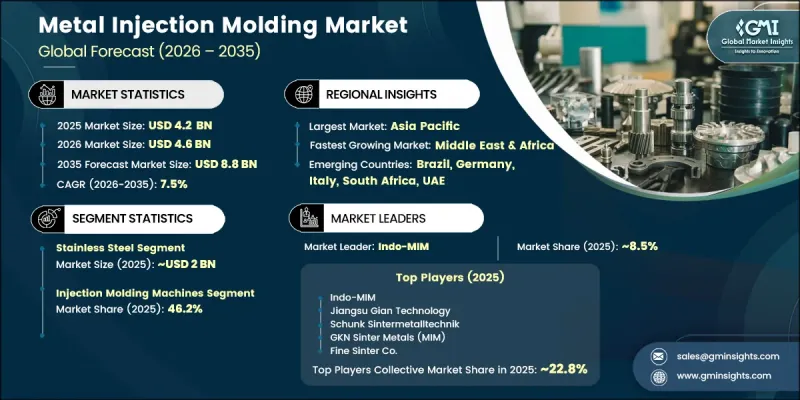
全球金屬射出成型市場預計到 2025 年價值 42 億美元,年複合成長率為 7.5%,到 2035 年將達到 88 億美元。
隨著各行業越來越依賴精密設計的金屬零件來支持大規模生產,同時保持高尺寸精度和材料利用率,全球金屬射出成型市場正穩步成長。汽車、醫療設備、航太和家用電子電器產業不斷成長的生產需求持續推動著對能夠大規模生產複雜部件的金屬射出成型成型技術的強勁需求。向電動車轉型、先進醫療技術的廣泛應用以及製造營運數位化進程的推進,進一步促進了市場成長。對下一代通訊基礎設施和先進運算系統的投資增加,也推動了整個電子供應鏈對精密金屬零件的需求。同時,汽車平台的演進為金屬射出成型創造了新的機遇,因為製造商需要輕量化、耐用且高精度的零件來提升性能和製造效率。持續的技術進步、製造自動化水平的提高以及對成本效益型生產方式的日益重視,預計將進一步增強全球金屬射出成型行業的長期前景。
| 市場範圍 | |
|---|---|
| 開始年份 | 2025 |
| 預測期 | 2026-2035 |
| 初始市場規模 | 42億美元 |
| 預測金額 | 88億美元 |
| 複合年成長率 | 7.5% |
預計到2025年,不銹鋼市場規模將達到20億美元,並在2026年至2035年間以7.5%的複合年成長率成長。不銹鋼憑藉其耐腐蝕性、機械強度、耐久性和長使用壽命等優點,在全球金屬射出成型市場中持續主導,並廣泛應用於各種工業領域。其中,316L和304L不銹鋼牌號在基準年約佔金屬射出成型市場總市值的26.5%,反映了它們在多個運作應用行業的廣泛應用。此外,17-4 PH沉澱硬化型不鏽鋼牌號因其高強度、優異的耐磨性和即使在惡劣工作環境下也能維持的可靠性能,佔總市值的13.5%。
預計到2025年,射出成型機市佔率將達到46.2%。這一主導地位主要得益於市場對先進製造系統的需求不斷成長,這些系統能夠實現穩定的產品品質、更高的營運效率和大規模生產。對自動化生產設施和精密製造技術的投資不斷增加,並持續推動各行各業採用最先進的射出成型設備。
預計到2025年,北美金屬射出成型市佔率將達到17.2%。市場成長主要得益於對高精度金屬零件需求旺盛的產業、國內製造業活動的活性化以及對先進生產能力的持續投資。此外,加強區域供應鏈和擴大本地產能的持續努力也促進了金屬射出成型技術的應用,進一步鞏固了美國在北美市場的主導地位。
目錄
第1章:調查方法和範圍
第2章執行摘要
第3章 行業洞察
- 產業生態系分析
- 供應商情況
- 利潤率
- 每個階段增加的價值
- 影響價值鏈的因素
- 影響產業的因素
- 促進因素
- 汽車和電子產業對複雜、高精度和微型元件的需求日益成長。
- 在醫療和矯正領域(手術器械、植入、托槽)的應用日益廣泛。
- 向電動車動力傳動系統的轉變正在創造對 MIM(機械絕緣)組件(如鎖定機構和變速箱部件)的新需求。
- 在大量生產中,MIM製程相比CNC加工具有成本優勢。
- 產業潛在風險與挑戰
- 高昂的初始模具和安裝成本限制了小規模生產的可行性。
- 其應用範圍受零件尺寸和重量的限制(通常小於 100 克)。
- 由於燒結收縮率存在差異(15-20%),因此需要在模具中進行精確修正。
- 依賴進口高純度金屬粉末和特殊黏合劑
- 機會
- 用於微型醫療和穿戴式電子元件的微型MIM技術
- 鈦金屬微創金屬對金屬(MIM)技術在整形外科、牙科和航太領域的應用拓展
- MIM與積層製造的融合(混合製造平台)
- 國防和槍械現代化項目正在推動對精密零件的需求。
- 促進因素
- 成長潛力分析
- 供應鏈分析
- 金屬粉末供應鏈(霧化、等級、主要供應商)
- 黏合劑體系的供應和配方趨勢
- 供應鏈脆弱性與風險評估
- 近岸外包與供應鏈在地化趨勢
- 未來市場趨勢
- 技術與創新展望
- 最新科技趨勢
- 新興技術
- 監理情勢
- 全球製造與品質標準(ASTM B883、ISO 22068)
- 醫療設備監管要求(FDA、CE 標誌、MDR)
- 航太和國防領域的認證標準(AS9100、NADCAP)
- 環境與職業安全法規(REACH、RoHS、OSHA)
- 貿易數據分析
- 依HS編碼分類的進出口量及進口額趨勢(燒結金屬零件)
- 主要貿易走廊及關稅影響(中美、歐亞、印度-世界)
- 人工智慧和生成式人工智慧對市場的影響
- 利用人工智慧改造現有經營模式(自動缺陷偵測、預測性維護)
- 按細分領域分類的生成式人工智慧應用案例和實施藍圖(設計最佳化、模擬、製程控制)
- 風險、限制和監管考量
- 價格分析
- 過去價格趨勢分析(金屬粉末、原料、MIM成品零件)
- 依球員類型分類的定價策略(高級球員、超值球員、成本加成球員)
- 波特的分析
- PESTLE分析
- 消費行為分析
第4章 競爭情勢
- 介紹
- 企業市佔率分析
- 企業矩陣分析
- 主要市場公司的競爭分析
- 競爭定位矩陣
- 主要進展
- 併購
- 夥伴關係和聯盟
- 新產品發布
- 業務拓展計劃
第5章 市場估計與預測:依材料分類,2022-2035年
- 主要趨勢
- 不銹鋼
- 奧氏體不鏽鋼牌號(316L、304L)
- 沉澱硬化等級(17-4 PH)
- 鐵素體牌號(430L)
- 低合金鋼
- MIM-2200(Fe-Ni)
- MIM-2700(Fe-Ni-Mo)
- MIM-4605(Fe-Ni-Mo-C)
- 軟磁性材料
- 鐵矽合金
- 鐵鎳合金
- 鈦合金
- Ti-6Al-4V(5級)
- 商用級純鈦
- 鈷鉻合金
- 其他
第6章 市場估算與預測:依設備類型分類,2022-2035年
- 主要趨勢
- 射出成型機
- 液壓射出成型機
- 電動射出成型機
- 混合式射出成型機
- 活頁夾移除裝置
- 溶劑型黏合劑去除系統
- 催化黏合劑去除系統
- 熱脫脂系統
- 燒結爐
- 間歇式燒結爐
- 連續式(帶式/推式)燒結爐
第7章 市場估計與預測:依最終用戶產業分類,2022-2035年
- 主要趨勢
- 車
- 動力傳動系統和變速箱部件
- 鎖定閂鎖機構
- 轉向和煞車系統部件
- 電動車專用零件(電瓶系統硬體、馬達零件)
- 醫療和正畸治療
- 手術器械和內視鏡組件
- 整形外科和牙科植體
- 正畸托槽和附件
- 藥物傳輸和診斷設備的組件
- 電氣和電子設備
- 智慧型手機和穿戴式裝置的硬體
- 連接器外殼和電磁干擾屏蔽組件
- 硬碟機 (HDD) 和資料儲存組件
- 半導體和PCB硬體
- 消費品
- 眼鏡產品鉸鍊和鏡框
- 高階商品和服裝的五金。
- 運動用品和精密工具
- 航太/國防
- 結構件和執行裝置
- 航空電子設備和感測器外殼組件
- 槍支和武器部件
- 產業
- 切削刀具和刀片
- 閥門、緊固件和流體控制組件
- 精密齒輪和機械組件
- 其他(能源、電信、新興應用)
第8章 市場估計與預測:依地區分類,2022-2035年
- 主要趨勢
- 北美洲
- 美國
- 加拿大
- 歐洲
- 德國
- 法國
- 英國
- 義大利
- 西班牙
- 亞太地區
- 中國
- 日本
- 印度
- 澳洲
- 韓國
- 拉丁美洲
- 巴西
- 墨西哥
- 阿根廷
- 中東和非洲
- 沙烏地阿拉伯
- UAE
- 南非
第9章:公司簡介
- Global Leaders
- Indo-MIM Pvt. Ltd
- ARC Group Worldwide
- Schunk Sintermetalltechnik GmbH
- BASF SE
- Epson Atmix Corporation
- GKN Sinter Metals
- Jiangsu Gian Technology Co., Ltd
- 當地公司
- Fine Sinter Co., Ltd
- Taisei Kogyo Co., Ltd
- Porite Corporation/Porite Taiwan
- MIMplus Technologies GmbH & Co. KG
- Parmaco Metal Injection Molding AG
- Sintex A/S
- Parmatech Corporation(ATW Companies)
- 新興企業
- Advanced Powder Products(APP)
- Smith Metal Products
- Elnik Systems LLC
- Ryer Inc
- DSH Technologies LLC
- Taiwan Powder Technologies Co., Ltd
- Advanced Materials Technologies
The Global Metal Injection Molding Market was valued at USD 4.2 billion in 2025 and is estimated to grow at a CAGR of 7.5% to reach USD 8.8 billion by 2035.
The global metal injection molding market is witnessing steady expansion as industries increasingly rely on precision-engineered metal components that support large-scale manufacturing while maintaining high dimensional accuracy and material efficiency. Rising production requirements across the automotive, medical device, aerospace, and consumer electronics sectors continue to create strong demand for metal injection molding technologies capable of producing complex parts in high volumes. The ongoing transition toward electric mobility, increasing adoption of advanced medical technologies, and growing digitalization of manufacturing operations are further supporting market growth. Expanding investments in next-generation communication infrastructure and advanced computing systems are also driving the need for precision metal components used throughout the electronics supply chain. At the same time, evolving vehicle platforms are creating new opportunities for metal injection molding as manufacturers require lightweight, durable, and highly accurate components that improve performance and manufacturing efficiency. Continuous technological advancements, greater manufacturing automation, and increasing emphasis on cost-effective production methods are expected to strengthen the long-term outlook for the global metal injection molding industry.
| Market Scope | |
|---|---|
| Start Year | 2025 |
| Forecast Year | 2026-2035 |
| Start Value | $4.2 Billion |
| Forecast Value | $8.8 Billion |
| CAGR | 7.5% |
The stainless steel segment generated USD 2 billion in 2025 and is projected to grow at a CAGR of 7.5% from 2026 to 2035. Stainless steel continues to dominate the global metal injection molding market because it offers an excellent combination of corrosion resistance, mechanical strength, durability, and long service life across a wide range of industrial applications. Within this category, 316L and 304L stainless steel grades represented approximately 26.5% of the total metal injection molding market value during the base year, reflecting their broad adoption across multiple end-use industries. In addition, the 17-4 PH precipitation-hardening grade accounted for 13.5% of the overall market value due to its ability to deliver high strength, excellent wear resistance, and dependable performance in demanding operating environments.
The injection molding machines segment held a 46.2% share in 2025. Its leadership is supported by increasing demand for advanced manufacturing systems capable of delivering consistent production quality, greater operational efficiency, and high-volume output. Growing investments in automated production facilities and precision manufacturing technologies continue to strengthen the adoption of modern injection molding equipment across multiple industrial sectors.
North America Metal Injection Molding Market accounted for a 17.2% share in 2025. Market growth is supported by strong demand from industries requiring high-precision metal components, increasing domestic manufacturing activity, and continued investments in advanced production capabilities. Ongoing efforts to strengthen regional supply chains and expand local manufacturing capacity are also contributing to higher adoption of metal injection molding technologies, reinforcing the country's leadership within the North American market.
Major companies operating in the global metal injection molding market include Indo-MIM Pvt. Ltd., ARC Group Worldwide, Schunk Sintermetalltechnik GmbH, BASF SE, Epson Atmix Corporation, GKN Sinter Metals, Jiangsu Gian Technology Co., Ltd., Fine Sinter Co., Ltd., Taisei Kogyo Co., Ltd., Porite Corporation / Porite Taiwan, MIMplus Technologies GmbH & Co. KG, Parmaco Metal Injection Moulding AG, Sintex A/S, Parmatech Corporation (ATW Companies), Advanced Powder Products (APP), Smith Metal Products, Elnik Systems LLC, Ryer Inc., DSH Technologies LLC, Taiwan Powder Technologies Co., Ltd., and Advanced Materials Technologies. Companies operating in the global metal injection molding market are strengthening their market position by expanding manufacturing capabilities, investing in advanced production technologies, and improving process automation to enhance efficiency and product consistency. Market participants are focusing on research and development to introduce innovative materials, optimize production methods, and improve component performance across diverse industrial applications. Strategic collaborations with original equipment manufacturers, expansion into high-growth regional markets, and broader product portfolios are helping companies increase their competitive advantage. Businesses are also prioritizing quality assurance, precision manufacturing, and customized component development to address evolving customer requirements.
Table of Contents
Chapter 1 Methodology & Scope
- 1.1 Research approach
- 1.2 Quality Commitments
- 1.2.1 GMI AI policy & data integrity commitment
- 1.2.1.1 Source consistency protocol
- 1.2.1 GMI AI policy & data integrity commitment
- 1.3 Research Trail & Confidence Scoring
- 1.3.1 Research Trail Components
- 1.3.2 Scoring Components
- 1.4 Data Collection
- 1.4.1 Partial list of primary sources
- 1.5 Data mining sources
- 1.5.1 Paid sources
- 1.5.1.1 Sources, by region
- 1.5.1 Paid sources
- 1.6 Base estimates and calculations
- 1.6.1 Base year calculation for any one approach
- 1.7 Forecast model
- 1.7.1 Quantified market impact analysis
- 1.7.1.1 Mathematical impact of growth parameters on forecast
- 1.7.1 Quantified market impact analysis
- 1.8 Research transparency addendum
- 1.8.1 Source attribution framework
- 1.8.2 Quality assurance metrics
- 1.8.3 Our commitment to trust
Chapter 2 Executive Summary
- 2.1 Industry 360° synopsis
- 2.2 Key market trends
- 2.2.1 Region
- 2.2.2 Material Type
- 2.2.3 Equipment Type
- 2.2.4 End-user Industry
Chapter 3 Industry Insights
- 3.1 Industry ecosystem analysis
- 3.1.1 Supplier landscape
- 3.1.2 Profit margin
- 3.1.3 Value addition at each stage
- 3.1.4 Factor affecting the value chain
- 3.2 Industry impact forces
- 3.2.1 Growth drivers
- 3.2.1.1 Growing demand for complex, high-precision small components across automotive & electronics
- 3.2.1.2 Rising adoption in medical & orthodontic applications (surgical instruments, implants, brackets)
- 3.2.1.3 EV powertrain transition creating new MIM component demand (lock mechanisms, transmission parts)
- 3.2.1.4 Cost advantage of MIM over CNC machining in high-volume production
- 3.2.2 Industry pitfalls & challenges
- 3.2.2.1 High initial tooling & setup costs limiting viability for low-volume production
- 3.2.2.2 Part size & weight constraints (typically <100g) restricting application scope
- 3.2.2.3 Sintering shrinkage variability (15–20%) requiring precise mold compensation
- 3.2.2.4 Dependence on imported high-purity metal powders & specialty binders
- 3.2.3 Opportunities
- 3.2.3.1 Micro-MIM for miniaturized medical & wearable electronics components
- 3.2.3.2 Titanium MIM expansion in orthopedic, dental & aerospace applications
- 3.2.3.3 MIM integration with additive manufacturing (hybrid manufacturing platforms)
- 3.2.3.4 Defense & firearms modernization programs driving precision component demand
- 3.2.1 Growth drivers
- 3.3 Growth potential analysis
- 3.4 Supply Chain Analysis
- 3.4.1 Metal Powder Supply Chain (Atomization, Grades, Key Suppliers)
- 3.4.2 Binder System Supply & Formulation Trends
- 3.4.3 Supply Chain Vulnerabilities & Risk Assessment
- 3.4.4 Nearshoring & Supply Chain Localization Trends
- 3.5 Future market trends
- 3.6 Technology and innovation landscape
- 3.6.1 Current technological trends
- 3.6.2 Emerging technologies
- 3.7 Regulatory landscape
- 3.7.1 Global Manufacturing & Quality Standards (ASTM B883, ISO 22068)
- 3.7.2 Medical Device Regulatory Requirements (FDA, CE Marking, MDR)
- 3.7.3 Aerospace & Defense Qualification Standards (AS9100, NADCAP)
- 3.7.4 Environmental & Workplace Safety Regulations (REACH, RoHS, OSHA)
- 3.8 Trade data analysis
- 3.8.1 Import/Export Volume & Value Trends by HS Code (Sintered Metal Parts) (Driven by Primary Research)
- 3.8.2 Key Trade Corridors & Tariff Impact (China-US, EU-Asia, India-Global) (Driven by Primary Research)
- 3.9 Impact of AI & generative AI on the market
- 3.9.1 AI-Driven Disruption of Existing Business Models (Automated Defect Detection, Predictive Maintenance)
- 3.9.2 GenAI Use Cases & Adoption Roadmap by Segment (Design Optimization, Simulation, Process Control)
- 3.9.3 Risks, Limitations & Regulatory Considerations
- 3.10 Pricing Analysis
- 3.10.1 Historical Price Trend Analysis (Metal Powder, Feedstock, Finished MIM Parts) (Driven by Primary Research)
- 3.10.2 Pricing Strategy by Player Type (Premium / Value / Cost-plus) (Driven by Primary Research)
- 3.11 Porter’s analysis
- 3.12 PESTEL analysis
- 3.13 Consumer Behavior Analysis
Chapter 4 Competitive Landscape, 2025
- 4.1 Introduction
- 4.2 Company market share analysis
- 4.3 Company matrix analysis
- 4.4 Competitive analysis of major market players
- 4.5 Competitive positioning matrix
- 4.6 Key developments
- 4.6.1 Mergers & acquisitions
- 4.6.2 Partnerships & collaborations
- 4.6.3 New product launches
- 4.6.4 Expansion plans
Chapter 5 Market Estimates & Forecast, By Material Type, 2022 – 2035, (USD Billion) (Thousand Units)
- 5.1 Key Trends
- 5.2 Stainless Steel
- 5.2.1 Austenitic Grades (316L, 304L)
- 5.2.2 Precipitation-Hardening Grades (17-4 PH)
- 5.2.3 Ferritic Grades (430L)
- 5.3 Low Alloy Steel
- 5.3.1 MIM-2200 (Fe-Ni)
- 5.3.2 MIM-2700 (Fe-Ni-Mo)
- 5.3.3 MIM-4605 (Fe-Ni-Mo-C)
- 5.4 Soft Magnetic Materials
- 5.4.1 Iron-Silicon Alloys
- 5.4.2 Iron-Nickel Alloys
- 5.5 Titanium Alloys
- 5.5.1 Ti-6Al-4V (Grade 5)
- 5.5.2 Commercially Pure Titanium
- 5.5.3 Cobalt-Chromium Alloys
- 5.6 Others
Chapter 6 Market Estimates & Forecast, By Equipment Type, 2022 – 2035, (USD Billion) (Thousand Units)
- 6.1 Key Trends
- 6.2 Injection Molding Machines
- 6.2.1 Hydraulic Injection Molding Machines
- 6.2.2 Electric Injection Molding Machines
- 6.2.3 Hybrid Injection Molding Machines
- 6.3 Debinding Equipment
- 6.3.1 Solvent Debinding Systems
- 6.3.2 Catalytic Debinding Systems
- 6.3.3 Thermal Debinding Systems
- 6.4 Sintering Furnaces
- 6.4.1 Batch Sintering Furnaces
- 6.4.2 Continuous (Belt/Pusher) Sintering Furnaces
Chapter 7 Market Estimates & Forecast, By End-user Industry, 2022 – 2035, (USD Billion) (Thousand Units)
- 7.1 Key Trends
- 7.2 Automotive
- 7.2.1 Powertrain & Transmission Components
- 7.2.2 Lock & Latch Mechanisms
- 7.2.3 Steering & Braking System Parts
- 7.2.4 EV-Specific Components (Battery System Hardware, Motor Parts)
- 7.3 Medical & Orthodontics
- 7.3.1 Surgical Instruments & Endoscopic Components
- 7.3.2 Orthopedic & Dental Implants
- 7.3.3 Orthodontic Brackets & Attachments
- 7.3.4 Drug Delivery & Diagnostic Device Components
- 7.4 Electrical & Electronics
- 7.4.1 Smartphone & Wearable Device Hardware
- 7.4.2 Connector Housings & EMI Shielding Components
- 7.4.3 Hard Disk Drive (HDD) & Data Storage Components
- 7.4.4 Semiconductor & PCB Hardware
- 7.5 Consumer Goods
- 7.5.1 Eyewear Hinges & Frames
- 7.5.2 Luxury Goods & Apparel Hardware
- 7.5.3 Sporting Goods & Precision Tools
- 7.6 Aerospace & Defense
- 7.6.1 Structural & Actuator Components
- 7.6.2 Avionics & Sensor Housing Parts
- 7.6.3 Firearms & Ordnance Components
- 7.7 Industrial
- 7.7.1 Cutting Tools & Tooling Inserts
- 7.7.2 Valves, Fasteners & Fluid Control Components
- 7.7.3 Precision Gears & Mechanical Assemblies
- 7.8 Others (Energy, Telecom, Emerging Applications)
Chapter 8 Market Estimates & Forecast, By Region, 2022 – 2035, (USD Billion) (Thousand Units)
- 8.1 Key Trends
- 8.2 North America
- 8.2.1 U.S.
- 8.2.2 Canada
- 8.3 Europe
- 8.3.1 Germany
- 8.3.2 France
- 8.3.3 UK
- 8.3.4 Italy
- 8.3.5 Spain
- 8.4 Asia Pacific
- 8.4.1 China
- 8.4.2 Japan
- 8.4.3 India
- 8.4.4 Australia
- 8.4.5 South Korea
- 8.5 Latin America
- 8.5.1 Brazil
- 8.5.2 Mexico
- 8.5.3 Argentina
- 8.6 MEA
- 8.6.1 Saudi Arabia
- 8.6.2 UAE
- 8.6.3 South Africa
Chapter 9 Company Profiles
- 9.1 Global Leaders
- 9.1.1 Indo-MIM Pvt. Ltd
- 9.1.2 ARC Group Worldwide
- 9.1.3 Schunk Sintermetalltechnik GmbH
- 9.1.4 BASF SE
- 9.1.5 Epson Atmix Corporation
- 9.1.6 GKN Sinter Metals
- 9.1.7 Jiangsu Gian Technology Co., Ltd
- 9.2 Regional Players
- 9.2.1 Fine Sinter Co., Ltd
- 9.2.2 Taisei Kogyo Co., Ltd
- 9.2.3 Porite Corporation / Porite Taiwan
- 9.2.4 MIMplus Technologies GmbH & Co. KG
- 9.2.5 Parmaco Metal Injection Molding AG
- 9.2.6 Sintex A/S
- 9.2.7 Parmatech Corporation (ATW Companies)
- 9.3 Emerging Players
- 9.3.1 Advanced Powder Products (APP)
- 9.3.2 Smith Metal Products
- 9.3.3 Elnik Systems LLC
- 9.3.4 Ryer Inc
- 9.3.5 DSH Technologies LLC
- 9.3.6 Taiwan Powder Technologies Co., Ltd
- 9.3.7 Advanced Materials Technologies

 MIM精密元件市場:全球市場預測,2026-2032年
 金屬射出成型:市場佔有率分析、產業趨勢與統計、成長預測(2026-2031)
 MIM射出成型設備市場規模、佔有率和成長分析:按設備類型、機器類型、自動化程度、應用、最終用戶和地區分類-2026-2033年產業預測
 金屬射出成型市場規模、佔有率、趨勢和預測:按材料類型、最終用途行業和地區分類,2026-2034年
 金屬射出成型市場規模、佔有率和趨勢分析報告:按應用、地區和細分市場預測(2026-2033 年)金屬射出成型市場:依材料、產品類型、製程及應用分類-2026-2032年全球市場預測
 金屬射出成型零件市場機會、成長要素、產業趨勢分析及預測(2026-2035年)
 金屬射出成型市場-全球產業規模、佔有率、趨勢、機會及預測(依材料類型、最終用途產業、地區及競爭格局分類,2021-2031年)家用電子電器用MIM組件市場按產品、材質、應用和最終用戶分類 - 全球預測(2026-2032年)
 金屬射出成型市場規模、佔有率和成長分析(按材料類型、最終用途產業和地區分類)-2026-2033年產業預測