


 |
市場調查報告書
商品編碼
2118877
搜尋引擎行銷軟體:市場佔有率分析、產業趨勢與統計、成長預測(2026-2031)Search Engine Marketing Software - Market Share Analysis, Industry Trends & Statistics, Growth Forecasts (2026 - 2031) |
||||||

※ 本網頁內容可能與最新版本有所差異。詳細情況請與我們聯繫。
據 Mordor Intelligence 稱,2025 年搜尋引擎行銷軟體市值為 104.2 億美元,預計到 2031 年將達到 248.3 億美元,而 2026 年為 119.4 億美元,預測期(2026-2031 年)的複合年成長率為 15.81%。
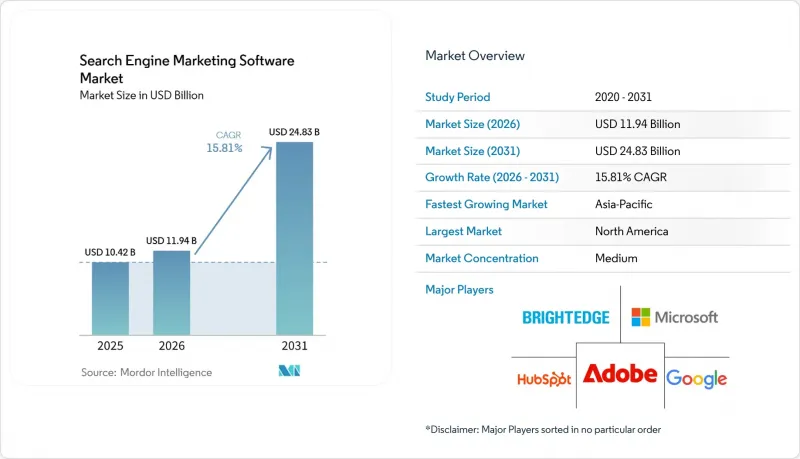
本報告按部署類型(雲端部署和本地部署)、組織規模(大型企業和中小企業)、應用領域(例如搜尋廣告宣傳管理、電子商務流量獲取)、最終用戶(例如品牌和廣告商、數位行銷機構)以及地區進行細分。市場預測以美元計價。
全球搜尋引擎行銷軟體市場趨勢及洞察
付費搜尋廣告支出在各個數位管道都在成長。
隨著人工智慧問答引擎、零售媒體網路和社交搜尋爭奪商業性支出,傳統付費搜尋預計將持續成長。通路配置的多樣化增加了跨 Google AI Mode、Microsoft Copilot Search 和 Amazon 等平台管理覆蓋範圍、預算和效果衡量的工作量。這是因為團隊需要調整不同的宣傳活動結構、報告項目、競標行為和投放時間,才能做出一致的預算決策。當廣告主需要一個統一的操作層來管理不同的競標規則和報告系統時,搜尋引擎行銷軟體市場將從中受益,尤其是那些需要維護足夠詳細資訊以有效管理各個平台並應用通用核准標準的代理商和知名品牌。如果一個通用系統能夠減少人工匹配,不僅增加平台特定訊息,還能幫助管理人員識別需要解決的問題,那麼其帶來的商業效益將更加顯著。電通預測,到 2028 年,演算法驅動的廣告活動將佔廣告總支出的 75%,這將增加對結構化宣傳活動數據、競標規則和監控工具的需求。
引進人工智慧驅動的競標和預算最佳化
原生AI競標並未取代搜尋引擎行銷軟體,而是改變了其角色。廣告主仍然需要獨立的報告、異常處理、策略管理以及一種能夠方便地比較不同自動化系統結果的方法。 2025年5月,Google推出了搜尋宣傳活動的“AI Max”,新增了基於AI的定向和創新功能。谷歌報告稱,在CPA和ROAS目標不變的情況下,AI Max平均提升了14%的轉換率;而從精確匹配或詞組匹配轉向廣泛匹配的宣傳活動,轉換率提升了27%。動態搜尋廣告計畫於2026年9月前遷移至“AI Max”,從而縮短廣告主和軟體供應商的調整週期。 2026年5月,微軟廣告為所有廣告主推出了「AI Max for Search」試驗計畫,將宣傳活動覆蓋範圍擴展至Copilot Search和Copilot Answers。在搜尋引擎行銷軟體市場,能夠提供跨引擎診斷、控制以及超越原生控制面板的多帳戶分析功能的供應商,其價值正日益凸顯。
由於 cookie 功能和平台隱私控制下降導致訊號遺失。
2026年,訊號劣化仍是搜尋引擎行銷軟體使用者面臨的核心衡量挑戰。儘管Google在2025年4月於Chrome瀏覽器中採用了用戶選擇第三方Cookie的模式,但宣傳活動衡量仍受到瀏覽器限制和隱私控制的影響。 Safari和Firefox瀏覽器繼續阻止第三方Cookie,而iOS的「應用程式追蹤透明度」功能則降低了行動廣告識別碼的可用性。結合Google「同意模式」指南檢驗的數據顯示,德國的同意拒絕率在40%到54%之間,這限制了可觀察的宣傳活動數據。 IAB技術實驗室警告稱,隱私沙盒的局限性可能會降低行業投放相關有效廣告的能力。如果同意模式v2未能正確實施,歐洲的Google廣告宣傳活動可能會基於不完整的行為數據進行最佳化,從而增加預算決策不準確的風險。
細分市場分析
到 2025 年,基於雲端的部署將佔據搜尋引擎行銷軟體市場佔有率的 72.14%,預計到 2031 年將以 18.05% 的複合年成長率成長。這一組合表明,雲端產品不僅擁有最大的部署基礎,而且在所有部署選項中成長最為強勁。這是因為買家無需像部署本地管理系統那樣投入大量資金和進行冗長的技術設置,即可增加容量、用戶訪問權限和整合功能。在現代搜尋引擎行銷 (SEM) 營運中,雲端 API 對於獲取競標數據、搜尋查詢報告和 AI 產生的競標洞察至關重要。谷歌和微軟透過適合持續更新軟體環境的雲端點提供大量此類資訊。雲端供應商可以向客戶提供平台整合、模型更新和報告變更,而無需客戶單獨更新本地軟體。這使得廣告主能夠在廣告平台更改宣傳活動要求或衡量方法時快速回應。多租戶 SaaS 交付模式也支援在供應商的所有基本客群中共用產品改進。這些營運優勢使得雲端系統成為管理頻繁宣傳活動變更的團隊更實用的選擇。此外,隨著買家對更快部署和定期產品更新的需求增加,雲端系統正在推動搜尋引擎行銷軟體市場的發展。另一方面,當嚴格的內部資料管理是採購決策的關鍵因素時,本地部署工具仍然具有可行性。
在金融服務和政府機構等監管嚴格的商業環境中,本地部署仍然是可行的選擇。這些使用者可能需要特定的資料居住規則、內部安全審查或受控的整合流程。即便如此,宣傳活動數據和廣告平台功能也越來越依賴外部雲端介面。這使得完全本地部署的用戶難以跟上雲端產品的功能更新。由於買家優先考慮及時存取平台功能,這種限制正在推動搜尋引擎行銷軟體市場的成長。中小企業 (SME) 正在採用雲端服務,因為基於訂閱的收費系統降低了手動部署或本地管理工具的前期成本。小規模的團隊可以從特定功能入手,並隨著宣傳活動規模的增加而添加自動化功能。對於大型企業而言,基礎設施維護、升級和整合工作可能會使本地系統比類似的訂閱服務更昂貴。當宣傳活動平台引入新的基於人工智慧的格式和報告要求時,這種差異尤其重要。雲端交付提供了一種更簡單的方法,可以跨多個廣告帳戶維護當前功能。這表明,從本地部署遷移到雲端的趨勢將在整個預測期內持續下去。
預計到2025年,大型企業(SEM)將佔據搜尋引擎行銷軟體市場70.23%的佔有率,而中小企業預計到2031年將實現18.37%的複合年成長率。大型企業之所以能夠維持高獲利能力,是因為他們的合約通常包含客戶匯入、客戶支援、自訂API存取權和安全措施。此外,他們龐大的廣告組合使得標準化的營運流程比單一帳戶層級的工具更有價值。大規模廣告主也管理著跨眾多宣傳活動、品牌和區域市場的巨額預算。這些因素增加了轉換成本,並促進了與供應商的長期合作關係。企業採購負責人通常需要集中核准管理、詳細的報告以及對宣傳活動邏輯的控制。他們還要求與內部分析工具、客戶資料和財務系統整合。即使原生廣告工具不斷改進,這些需求也確保了對功能強大的軟體的持續需求。搜尋引擎行銷(SEM)軟體市場目前的收入仍然嚴重依賴企業合約。然而,企業領域的成長速度並未跟上小規模企業的快速擴張步伐。因此,供應商需要降低小規模採購負責人的採購複雜性,同時維持應對力。
中小企業對人工智慧驅動的宣傳活動管理工具的日益普及,反映了這類工具無需大規模的專業團隊即可滿足日益成長的需求。自動化減少了管理關鍵字、預算、創新素材和宣傳活動協調所需的技術工作。谷歌2026年針對中小微型企業的調查顯示,人工智慧驅動的工具可以透過提高目標定位的精準度和自動化程度,將中小企業的盈利提升30%至35%。小規模企業通常會根據與電商平台整合、易於設定和最低使用要求等標準來選擇產品。他們不太重視「多營業單位管理」功能,而這些功能對於全球性企業至關重要。這使得搜尋引擎行銷軟體產業需要獨特的產品和定價策略,從而將市場拓展到傳統上以企業客戶為主的領域之外。能夠為中小企業提供合適服務的供應商可以與未來可能需要更廣泛功能的企業建立早期合作關係。他們面臨的挑戰是如何在不增加企業級軟體實施負擔的情況下,提供實用的自動化功能。此外,隨著中小企業數量的成長,能夠利用專用搜尋引擎行銷工具的組織數量也不斷增加。因此,到 2031 年,該細分市場將在平台收入成長中發揮關鍵作用。
區域分析
到2025年,北美將佔據搜尋引擎行銷軟體市場37.12%的佔有率。這反映了該地區成熟的廣告主基礎、成熟的SaaS採購慣例以及平台和軟體供應商的集中度。該地區擁有大量軟體供應商、經驗豐富的廣告主和完善的SaaS採購流程,以及正在試點新型人工智慧驅動的宣傳活動類型並將成功方法推廣到更廣泛業務組合中的大規模廣告主。在美國,Google、微軟和亞馬遜構成了重要的廣告格局,催生了對能夠跨多個平台整合廣告組合分配和報告功能的產品的需求。同時,加拿大正在推行雙語廣告要求,而墨西哥則憑藉其蓬勃發展的電子商務產業,不斷拓展市場深度。
預計到2031年,亞太地區將以17.04%的複合年成長率(CAGR)成為所有地區中成長最快的地區。這主要歸功於行動優先的消費習慣、電子商務活動的蓬勃發展、微企業(SME)的數位轉型以及搜尋習慣的改變,這些因素共同推動了目標基本客群在多個國內市場的擴張。在中小微型企業數位化和電子商務蓬勃發展的推動下,預計到2025年,印度中小微型企業數位廣告相關的經濟效益將達到59.6億美元。根據《日經新聞》報道,矢野經濟研究所的一項調查顯示,到2025年,日本的數位行銷活動將年增14.1%。同時,博報堂DY控股公司指出,從關鍵字搜尋轉向人工智慧平台是重塑日本商業搜尋行為的關鍵因素。在中國,百度報告稱其ERNIE模型每天處理15億次API調用,而《個人資訊保護法》下的資料居住要求正在重塑當地的採購環境。在韓國、澳洲、印尼、泰國和越南,成熟或行動優先的數位廣告活動正在推動需求成長。
歐洲在搜尋引擎行銷軟體市場仍佔據重要佔有率,合規性要求影響產品的選擇。除了標準的宣傳活動管理要求外,買家還必須考慮資料收集、使用者許可溝通、受眾管理和報告設計。根據電通的區域調查,預計到2026年,德國的線上廣告支出將達到356億歐元(383億美元)。德國電信和資訊技術協會(Bitkom)的一項調查顯示,德國企業的資料保護成本仍然很高,這促使他們對具備「同意模式v2」和伺服器端追蹤功能的工具產生興趣。同時,在英國和法國,成熟的電子商務活動支撐著市場需求。在南美洲,隨著巴西和阿根廷不斷擴大其電子商務和本地搜尋資源,市場正在興起,但基礎設施的限制和外匯波動正在影響企業的採購活動。中東和非洲仍處於應用初期,成長主要集中在主要城市和政府主導的數位商務項目。
其他好處:
- Excel格式的市場預測(ME)表
- 3個月的分析師支持
目錄
第1章:引言
- 研究假設和市場定義
- 調查範圍
第2章:調查方法
第3章執行摘要
第4章 市場狀況
- 市場概覽
- 市場促進因素
- 數位管道付費搜尋廣告支出增加
- 引進人工智慧驅動的競標和預算最佳化。
- 電子商務擴張和效果行銷預算增加
- 越來越需要與第一方受眾互動。
- 向注重隱私的需求產生工作流程過渡
- 對跨通路歸因和報告的需求日益成長。
- 市場限制因素
- 由於 Cookie劣化和平台隱私控制導致的訊號遺失
- 由於供應商之間的激烈競爭,產品功能趨於飽和和同質化。
- 對搜尋引擎政策和競標規則變化的依賴
- 企業整合與日益成長的變革管理成本
- 產業價值鏈分析
- 監理情勢
- 技術展望
- 宏觀經濟因素對市場的影響
- 波特五力分析
第5章 市場規模與成長預測
- 部署模式
- 基於雲端的
- 現場
- 按組織規模
- 大公司
- 中小企業
- 透過使用
- 管理搜尋廣告宣傳
- 成效行銷和轉換率最佳化
- 取得電子商務流量
- 品牌知名度與聲量管理
- 本地搜尋和基於位置的行銷
- 最終用戶
- 品牌和廣告商
- 數位行銷機構
- 電子商務業務
- 公司及內部行銷團隊
- 按地區
- 北美洲
- 美國
- 加拿大
- 墨西哥
- 南美洲
- 巴西
- 阿根廷
- 其他南美國家
- 歐洲
- 德國
- 英國
- 法國
- 義大利
- 西班牙
- 俄羅斯
- 其他歐洲國家
- 亞太地區
- 中國
- 日本
- 印度
- 韓國
- 澳洲和紐西蘭
- 其他亞太國家
- 中東
- 沙烏地阿拉伯
- 阿拉伯聯合大公國
- 土耳其
- 其他中東國家
- 非洲
- 南非
- 奈及利亞
- 其他非洲國家
- 北美洲
第6章 競爭情勢
- 市場集中度
- 策略趨勢
- 市佔率分析
- 公司簡介
- Google LLC
- Microsoft Corporation
- Adobe Inc.
- Semrush Holdings, Inc.
- Ahrefs Pte. Ltd.
- BrightEdge Technologies, Inc.
- Conductor, Inc.
- Moz, Inc.
- WordStream, Inc.
- Marin Software Incorporated
- Optmyzr, Inc.
- Adthena Limited
- SpyFu, Inc.
- SE Ranking Limited
- SISTRIX GmbH
- Botify SAS
- Similarweb Ltd.
- HubSpot, Inc.
- Yoast BV
- WebFX, Inc.
第7章 市場機會與未來展望
According to Mordor Intelligence, the search engine marketing software market size was valued at USD 10.42 billion in 2025 and estimated to grow from USD 11.94 billion in 2026 to reach USD 24.83 billion by 2031, at a CAGR of 15.81% during the forecast period (2026-2031).
This report is Segmented by Deployment Mode (Cloud-Based and On-Premises), Organization Size (Large Enterprises and Small and Medium Enterprises [SMEs]), Application (Search Advertising Campaign Management, E-Commerce Traffic Acquisition, and More), End User (Brands and Advertisers, Digital Marketing Agencies, and More), and Geography. The Market Forecasts are Provided in Terms of Value (USD).
Global Search Engine Marketing Software Market Trends and Insights
Rising Paid Search Spend Across Digital Channels
Traditional paid search is projected to grow as AI answer engines, retail media networks, and social search compete for commercial-intent spending. This broader channel mix increases the work involved in managing reach, budgets, and measurement across Google AI Mode, Microsoft Copilot Search, and Amazon, because teams must reconcile different campaign structures, reporting fields, auction behavior, and timing before they can make a consistent budget decision. The search engine marketing software market benefits when advertisers need a single operating layer across different auction rules and reporting systems, especially for agencies and large brands that need to apply common approval standards while retaining enough detail to manage individual platforms effectively. The business case is stronger where a common system reduces manual reconciliations and helps managers identify which changes require action rather than simply generating more platform-specific information. Dentsu projects that algorithm-driven activity will account for 75% of total advertising spending by 2028, increasing the need for structured campaign data, bidding rules, and oversight tools.
Adoption of AI-Driven Bid and Budget Optimization
Native AI bidding has changed the work expected from search engine marketing software rather than removing the need for it, as advertisers still need independent reporting, exception handling, policy controls, and a practical way to compare results from different automated systems. Google introduced AI Max for Search campaigns in May 2025, adding AI-based targeting and creative capabilities. Google reported an average 14% increase in conversions at similar CPA and ROAS targets for AI Max, with a 27% uplift for campaigns moving from exact and phrase match to broad match. Dynamic Search Ads are scheduled to move to AI Max by September 2026, which shortens the adjustment cycle for advertisers and software providers. Microsoft Advertising opened an AI Max for Search pilot to all advertisers in May 2026, extending campaign reach into Copilot Search and Copilot Answers. The search engine marketing software market increasingly rewards providers that offer cross-engine diagnostics, controls, and multi-account intelligence beyond native dashboards.
Signal Loss From Cookie Degradation and Platform Privacy Controls
Signal degradation is a central measurement issue for search engine marketing software users in 2026. Google adopted a user-choice model for Chrome third-party cookies in April 2025, but campaign measurement remains affected by continuing browser restrictions and privacy controls. Safari and Firefox continue to block third-party cookies, while iOS App Tracking Transparency has reduced the availability of mobile advertising identifiers. Consent rejection rates in Germany ranged from 40% to 54% in the data reviewed alongside Google's Consent Mode guidance, limiting observable campaign behavior. The IAB Tech Lab warned that Privacy Sandbox restrictions could reduce the industry's ability to deliver relevant and effective advertising. Without a correct Consent Mode v2 implementation, European Google Ads campaigns may optimize based on incomplete behavioral data, increasing the risk of inaccurate budget decisions.
Other drivers and restraints analyzed in the detailed report include:
- Expansion of E-Commerce and Performance Marketing Budgets
- Growing Need for First-Party Audience Activation
- High Competitive Saturation and Feature Parity Across Vendors
For complete list of drivers and restraints, kindly check the Table Of Contents.
Segment Analysis
Cloud-based deployment held 72.14% of the search engine marketing software market share in 2025 and is projected to grow at an 18.05% CAGR through 2031. This combination shows that cloud delivery has both the largest installed base and the strongest growth within deployment choices, because buyers can add capacity, user access, and integrated functions without the capital outlay and prolonged technical setup associated with locally managed systems. Modern SEM operations depend on cloud APIs for bidding data, search query reports, and AI-generated auction insights. Google and Microsoft provide much of this information through cloud endpoints that are better suited to continuously updated software environments. Cloud providers can distribute platform integrations, model updates, and reporting changes to customers without a separate local software update. This helps advertisers respond when advertising platforms change campaign requirements or measurement methods. Multi-tenant SaaS delivery also supports shared product improvements across a vendor's customer base. These operating advantages make cloud systems more practical for teams that manage frequent campaign changes. They also support the search engine marketing software market as buyers seek faster implementation and routine product updates. On-premises tools remain relevant where strict internal data controls shape procurement decisions.
On-premises deployment remains a viable option in regulated enterprise settings, including financial services and government-adjacent organizations. These users may require specific data residency rules, internal security reviews, or controlled integration processes. Even in these cases, campaign data and advertising-platform functionality increasingly depend on external cloud interfaces. This limits the ability of a fully local deployment to keep pace with feature updates available to cloud products, a constraint that supports the search engine marketing software market, as buyers prioritize timely access to platform functions. SMEs are adopting the cloud because subscription pricing reduces the upfront implementation burden of manual or locally managed tools. Smaller teams can begin with focused functions and add automation as campaign volume increases. For large organizations, infrastructure maintenance, upgrades, and integration work can make local systems more expensive than comparable subscriptions. The difference is particularly important when campaign platforms introduce new AI-based formats or reporting requirements. Cloud delivery offers a simpler route to maintain current capabilities across multiple advertising accounts. This supports continued movement away from on-premises deployment during the forecast period.
Large enterprises held 70.23% of the search engine marketing software market share in 2025, while SMEs are projected to register an 18.37% CAGR through 2031. Enterprise revenue remains high because contracts often include onboarding, customer support, custom API access, and security controls, while the size of advertising portfolios makes a standardized operating process more valuable than separate account-level tools. Large advertisers also manage substantial budgets across many campaigns, brands, and geographic markets. These conditions create switching costs and support longer vendor relationships. Enterprise buyers often need centralized approval controls, detailed reporting, and ownership of campaign logic. They also require integrations with internal analytics, customer data, and financial systems. These needs sustain demand for robust software even as native advertising tools improve. The search engine marketing software market continues to rely on enterprise contracts for a large share of its current revenue. However, enterprise growth trails the faster expansion recorded among smaller organizations. Vendors must therefore maintain enterprise depth while reducing complexity for smaller buyers.
SME adoption reflects the growing availability of AI-supported campaign management without the need for large specialist teams. Automation can reduce the technical work needed to manage keywords, budgets, creative assets, and campaign adjustments. Google's 2026 MSME survey found that AI-driven tools could improve SME profitability by 30%-35% through improved targeting and automation. Smaller businesses often select products based on e-commerce storefront integration, a simple setup, and low minimum spend requirements. They place less value on the multi-entity management features that are important to global enterprises. This creates a distinct product and pricing need within the search engine marketing software industry and broadens the market beyond the historically dominant enterprise customer base. Vendors that serve SMEs well can build early relationships with firms that may later require broader capabilities. Their challenge is to provide useful automation without creating the implementation burden of enterprise software. The expanding SME base also broadens the number of organizations that can use dedicated SEM tools. This makes the segment important to platform revenue growth through 2031.
Complete Report Scope:
- By Deployment Mode
- Cloud-Based
- On-Premises
- By Organization Size
- Large Enterprises
- Small and Medium Enterprises (SMEs)
- By Application
- Search Advertising Campaign Management
- Performance Marketing and Conversion Optimization
- E-Commerce Traffic Acquisition
- Brand Awareness and Share of Voice Management
- Local Search and Location-Based Marketing
- By End User
- Brands and Advertisers
- Digital Marketing Agencies
- E-Commerce Businesses
- Enterprises and In-House Marketing Teams
- By Geography
- North America
- United States
- Canada
- Mexico
- South America
- Brazil
- Argentina
- Rest of South America
- Europe
- Germany
- United Kingdom
- France
- Italy
- Spain
- Russia
- Rest of Europe
- Asia-Pacific
- China
- Japan
- India
- South Korea
- Australia and New Zealand
- Rest of Asia-Pacific
- Middle East
- Saudi Arabia
- United Arab Emirates
- Turkey
- Rest of Middle East
- Africa
- South Africa
- Nigeria
- Rest of Africa
- North America
Geography Analysis
North America held 37.12% of the search engine marketing software market share in 2025, reflecting the region's established advertiser base, mature SaaS procurement practices, and concentration of platform and software-provider capabilities. The region has a deep concentration of software vendors, experienced advertisers, and established SaaS buying processes, alongside large advertisers that can test new AI-enabled campaign types and then apply successful practices across broader portfolios. Google, Microsoft, and Amazon each provide important advertising environments in the United States. This creates a need for products that combine portfolio allocation and reporting across multiple platforms, while Canada adds bilingual advertising requirements and Mexico adds depth through an expanding e-commerce sector.
Asia-Pacific is projected to record the fastest regional CAGR of 17.04% through 2031, as a mix of mobile-first behavior, expanding e-commerce activity, small-business digitalization, and changing search habits expands the addressable customer base across several distinct national markets. India is supported by MSME digitalization and e-commerce expansion, including USD 5.96 billion in 2025 economic output linked to digital advertising for Indian MSMEs. Japan's digital marketing activity grew 14.1% year over year in 2025, according to Yano Research Institute data reported by Nikkei, while Hakuhodo DY Holdings identified movement from keyword search to AI platforms as an important factor reshaping Japanese commercial search behavior. In China, Baidu reported that its ERNIE model processed 1.5 billion API calls per day, while data-residency requirements under the Personal Information Protection Law shape the local procurement environment. South Korea, Australia, Indonesia, Thailand, and Vietnam add demand through mature or mobile-first digital advertising activity.
Europe remains a significant part of the search engine marketing software market, with compliance requirements shaping product selection, as buyers must consider data collection, consent transmission, audience management, and reporting design alongside standard campaign management requirements. Germany's online advertising spending reached EUR 35.6 billion (USD 38.3 billion) in 2026, based on Dentsu regional tracking. Bitkom found that data-protection costs remained high among German companies, supporting interest in tools with Consent Mode v2 and server-side tracking capabilities, while the United Kingdom and France support demand through mature e-commerce activity. South America is emerging as Brazil and Argentina expand e-commerce and local search inventory, although infrastructure limits and currency volatility affect enterprise procurement. The Middle East and Africa remain earlier-stage adoption areas, with growth concentrated in large cities and government-backed digital commerce programs.
- Google LLC
- Microsoft Corporation
- Adobe Inc.
- Semrush Holdings, Inc.
- Ahrefs Pte. Ltd.
- BrightEdge Technologies, Inc.
- Conductor, Inc.
- Moz, Inc.
- WordStream, Inc.
- Marin Software Incorporated
- Optmyzr, Inc.
- Adthena Limited
- SpyFu, Inc.
- SE Ranking Limited
- SISTRIX GmbH
- Botify SAS
- Similarweb Ltd.
- HubSpot, Inc.
- Yoast B.V.
- WebFX, Inc.
Additional Benefits:
- The market estimate (ME) sheet in Excel format
- 3 months of analyst support
TABLE OF CONTENTS
1 INTRODUCTION
- 1.1 Study Assumptions and Market Definition
- 1.2 Scope of the Study
2 RESEARCH METHODOLOGY
3 EXECUTIVE SUMMARY
4 MARKET LANDSCAPE
- 4.1 Market Overview
- 4.2 Market Drivers
- 4.2.1 Rising Paid Search Spend Across Digital Channels
- 4.2.2 Adoption of AI-Driven Bid and Budget Optimization
- 4.2.3 Expansion of E-Commerce and Performance Marketing Budgets
- 4.2.4 Growing Need for First-Party Audience Activation
- 4.2.5 Shift Toward Privacy-Resilient Demand Generation Workflows
- 4.2.6 Increased Demand for Cross-Channel Attribution and Reporting
- 4.3 Market Restraints
- 4.3.1 Signal Loss From Cookie Degradation and Platform Privacy Controls
- 4.3.2 High Competitive Saturation and Feature Parity Across Vendors
- 4.3.3 Dependence on Search Engine Policy and Auction Rule Changes
- 4.3.4 Rising Enterprise Integration and Change-Management Costs
- 4.4 Industry Value Chain Analysis
- 4.5 Regulatory Landscape
- 4.6 Technological Outlook
- 4.7 Impact of Macroeconomic Factors on the Market
- 4.8 Porter's Five Forces Analysis
- 4.8.1 Threat of New Entrants
- 4.8.2 Bargaining Power of Suppliers
- 4.8.3 Bargaining Power of Buyers
- 4.8.4 Threat of Substitutes
- 4.8.5 Intensity of Competitive Rivalry
5 MARKET SIZE AND GROWTH FORECASTS (VALUE)
- 5.1 By Deployment Mode
- 5.1.1 Cloud-Based
- 5.1.2 On-Premises
- 5.2 By Organization Size
- 5.2.1 Large Enterprises
- 5.2.2 Small and Medium Enterprises (SMEs)
- 5.3 By Application
- 5.3.1 Search Advertising Campaign Management
- 5.3.2 Performance Marketing and Conversion Optimization
- 5.3.3 E-Commerce Traffic Acquisition
- 5.3.4 Brand Awareness and Share of Voice Management
- 5.3.5 Local Search and Location-Based Marketing
- 5.4 By End User
- 5.4.1 Brands and Advertisers
- 5.4.2 Digital Marketing Agencies
- 5.4.3 E-Commerce Businesses
- 5.4.4 Enterprises and In-House Marketing Teams
- 5.5 By Geography
- 5.5.1 North America
- 5.5.1.1 United States
- 5.5.1.2 Canada
- 5.5.1.3 Mexico
- 5.5.2 South America
- 5.5.2.1 Brazil
- 5.5.2.2 Argentina
- 5.5.2.3 Rest of South America
- 5.5.3 Europe
- 5.5.3.1 Germany
- 5.5.3.2 United Kingdom
- 5.5.3.3 France
- 5.5.3.4 Italy
- 5.5.3.5 Spain
- 5.5.3.6 Russia
- 5.5.3.7 Rest of Europe
- 5.5.4 Asia-Pacific
- 5.5.4.1 China
- 5.5.4.2 Japan
- 5.5.4.3 India
- 5.5.4.4 South Korea
- 5.5.4.5 Australia and New Zealand
- 5.5.4.6 Rest of Asia-Pacific
- 5.5.5 Middle East
- 5.5.5.1 Saudi Arabia
- 5.5.5.2 United Arab Emirates
- 5.5.5.3 Turkey
- 5.5.5.4 Rest of Middle East
- 5.5.6 Africa
- 5.5.6.1 South Africa
- 5.5.6.2 Nigeria
- 5.5.6.3 Rest of Africa
- 5.5.1 North America
6 COMPETITIVE LANDSCAPE
- 6.1 Market Concentration
- 6.2 Strategic Moves
- 6.3 Market Share Analysis
- 6.4 Company Profiles (includes Global Level Overview, Market Level Overview, Core Segments, Financials as available, Strategic Information, Market Rank/Share, Products and Services, Recent Developments)
- 6.4.1 Google LLC
- 6.4.2 Microsoft Corporation
- 6.4.3 Adobe Inc.
- 6.4.4 Semrush Holdings, Inc.
- 6.4.5 Ahrefs Pte. Ltd.
- 6.4.6 BrightEdge Technologies, Inc.
- 6.4.7 Conductor, Inc.
- 6.4.8 Moz, Inc.
- 6.4.9 WordStream, Inc.
- 6.4.10 Marin Software Incorporated
- 6.4.11 Optmyzr, Inc.
- 6.4.12 Adthena Limited
- 6.4.13 SpyFu, Inc.
- 6.4.14 SE Ranking Limited
- 6.4.15 SISTRIX GmbH
- 6.4.16 Botify SAS
- 6.4.17 Similarweb Ltd.
- 6.4.18 HubSpot, Inc.
- 6.4.19 Yoast B.V.
- 6.4.20 WebFX, Inc.
7 MARKET OPPORTUNITIES AND FUTURE OUTLOOK
- 7.1 White-Space and Unmet-Need Assessment

 人工智慧知識圖譜平台市場預測至2034年-全球分析:基於圖架構、知識處理能力、人工智慧整合、資料來源、應用、最終使用者和區域
 付費搜尋管理軟體:市場佔有率分析、產業趨勢與統計資料、成長預測(2026-2031 年)基於語義層和知識圖譜的代理人工智慧:市場佔有率分析、行業趨勢和統計數據以及成長預測(2026-2031 年)語意資料層技術市場預測-全球分析(按組件、架構類型、技術類型、整合層、應用、最終用戶和地區分類)——2034年
 語意知識圖譜市場規模、佔有率和成長分析:按圖類型、應用、最終用戶產業和地區分類-2026-2033年產業預測
 語意知識抓取市場:按技術、組件、應用和地區分類
 下一代搜尋引擎市場:按平台類型、最終用戶、分銷管道和地區分類,2026-2034 年
 企業知識圖譜市場規模、佔有率和趨勢分析報告:按產品/服務、類型、應用、部署模式、組織規模、最終用途、地區和細分市場預測,2026-2033年
 2026年全球企業知識圖譜市場報告2026年全球多模態產品搜尋市場報告