


 |
市場調查報告書
商品編碼
2061965
基於語義層和知識圖譜的代理人工智慧:市場佔有率分析、行業趨勢和統計數據以及成長預測(2026-2031 年)Agentic AI In Semantic Layer And Knowledge Graph - Market Share Analysis, Industry Trends & Statistics, Growth Forecasts (2026 - 2031) |
||||||

※ 本網頁內容可能與最新版本有所差異。詳細情況請與我們聯繫。
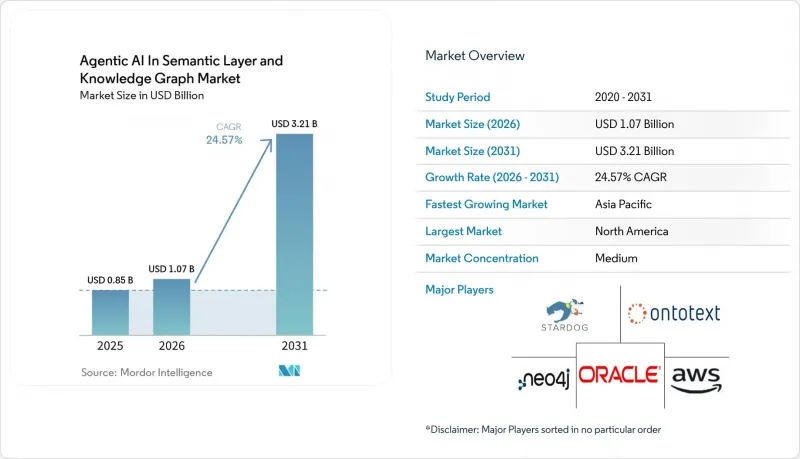
預計語義層和知識圖譜中基於代理的人工智慧市場規模將從 2025 年的 8.5 億美元成長到 2026 年的 10.7 億美元,然後從 2026 年到 2031 年以 24.57% 的複合年成長率成長,到 2031 年達到 32.1 億美元。
本報告按組件(軟體和服務)、知識圖譜類型(例如,企業知識圖譜)、應用(例如,客戶和360度視圖分析)、部署模式(雲端和本地部署)、最終用戶行業(例如,銀行、金融服務和保險 (BFSI)、醫療保健和生命科學、零售和電子商務)以及地區進行細分。市場預測以價值(美元)表示。
語意層和知識圖譜中基於代理的人工智慧的市場趨勢和洞察
擴大企業對基於代理的人工智慧在自主工作流程中的應用
企業對自主代理的採用已超越實驗階段,這一轉變正推動著對可託管語義結構日益成長的需求,這些結構能夠作為企業系統中可信的記憶。對於基於代理商的人工智慧市場而言,語義層和知識圖譜的這一轉變意義重大,因為代理商需要持久的上下文、清晰的關係和可追溯的邏輯才能在財務、營運和客戶工作流程的各個領域中運作。 Neo4j 於 2026 年 2 月正式推出了 AuraDB 客戶 Aura Agent,將這一趨勢推向了生產環境。 Aura Agent 具備本體驅動的自動化代理建置功能和託管的 MCP配置。微軟也於 2026 年 5 月發布了 Dataverse Business Skills 的公開預覽版,進一步擴展了企業代理程式工作流程。 Dataverse Business Skills 允許組織將流程和操作邏輯編碼為指令,供 AI 代理透過 Dataverse MCP 伺服器發現。這些版本表明,語義層和知識圖譜中的基於代理的人工智慧正在被生產需求而非試點活動所塑造。當企業需要代理能夠跨多個系統進行審計時,這一趨勢尤其明顯。
加速從資料湖到語意資料架構的過渡。
企業正在摒棄被動的資料湖,因為原始資料和碎片化的資料結構無法提供代理系統進行可靠推理所需的策略感知上下文。基於語意層和知識圖譜的代理人工智慧正受益於此轉變。語意層能夠以管治可解釋的格式呈現企業數據,而不是讓代理人暴露於複雜的模式中。微軟研究院報告稱,GraphRAG的多點跳躍企業查詢準確率達到了 86%,遠高於基準VectorRAG 的 32%,這有助於解釋為什麼更豐富的語義上下文在企業人工智慧架構中佔據了越來越重要的地位。在歐洲,這一趨勢得到了進一步強化,當地的人工智慧管治法規提高了對資料處理歷程、技術文件以及在高風險部署環境中可解釋的系統行為的需求。相關的科學研究強調了基於開放知識圖譜映射人工智慧法案要求和標準的重要性,這進一步支持了語義結構在管治企業人工智慧環境中的作用。
大型知識圖譜專案總體擁有成本高昂
大規模知識圖譜專案仍面臨沉重的所有權負擔,因為基礎設施、模式設計、實體解析、維護和持續管治的成本遠遠超過軟體購買決策本身。在語義層和知識圖譜的基於代理的人工智慧市場中,這種成本壓力對需要基於圖的代理但又無法承擔大規模專家團隊或多階段部署計劃的中型企業來說尤其具有挑戰性。供應商的產品設計表明,市場正在努力減輕這種負擔。例如,Neo4j 於 2025 年 12 月發布了“Fleet Manager”,作為統一管理雲端、混合和本地圖部署的控制平台。超大規模資料中心業者服務供應商提供的託管服務也在降低營運成本。例如,AWS 不斷擴展 Neptune Analytics,增加了一些原本需要客戶直接進行工程開發的功能。儘管有這些改進,基於代理的人工智慧在語義層和知識圖譜中的應用仍然緩慢,因為買家將本體工程和圖譜更新維護視為長期成本中心,而不是一次性專案任務。
細分市場分析
預計到2025年,軟體收入將佔總收入的62.87%,並繼續保持主導地位。這一比例反映了平台許可、查詢引擎、本體管理工具以及嵌入式向量搜尋功能等成本,這些都必須在企業圖譜投入實際應用之前到位。在語意層和知識圖譜的智慧體人工智慧市場,軟體也受益於高度客製化的需求,因為許多應用仍然始於客製化的模式設計和整合工作。因此,在更廣泛的服務生態系統成熟之前,能夠提供核心圖譜基礎設施的平台供應商在初期收入結構中佔據優勢。
預計2026年至2031年,服務業的複合年成長率將達到24.97%,這表明買家在購買平台後越來越願意為實施支援付費。在語意層和知識圖譜產業的基於代理的人工智慧領域,這種轉變與以下現實密切相關:模式設計、實體解析、管治配置和維運監控所需的時間遠超過資料庫安裝本身。 Neo4j於2025年12月發布的「Fleet Manager」體現了對跨雲端、混合和本地環境進行更便利的生命週期管理的需求。 Databricks也於2026年4月透過正式發布Unity Catalog Business Semantics並加入開放語意交換(OSI)舉措,擴大了其服務範圍。然而,這仍然需要在客戶環境中進行整合工作。因此,隨著企業尋求外部幫助以將其圖平台轉型為治理管治的生產系統,語義層和知識圖譜市場的基於代理的人工智慧服務可能會繼續快速成長。
到2025年,企業知識圖譜將佔46.21%的市場佔有率,成為最大的知識圖譜類型。這一地位的形成主要得益於大型企業對專有資料(例如ERP資料、客戶檔案、產品目錄和交易歷史)的整合需求,這些資料需要整合到一個能夠識別單一關係的結構中。在基於代理的人工智慧領域,企業知識圖譜在語義層和知識圖譜市場中備受重視,因為它們支援對僅靠開放網路資料無法處理的內部資產進行推理。這種主導地位也反映出,大型企業更有獎勵在廣泛部署自主代理之前連接分散的系統。
預計到2031年,Web規模的知識圖譜將以25.17%的複合年成長率成長,成為成長最快的類型。這種成長趨勢與面向網際網路的應用情境密切相關,在這些情境中,實體解析、去重和關係推理必須在大規模的公共和半公共資訊池中運作。 Neo4j於2025年9月發布的Infinigraph展示了供應商如何透過在圖原生環境中支援超過100TB的資料配置和數十億個嵌入式向量來應對這種規模的需求。雲端平台的支援也是一個關鍵因素,因為AWS和微軟將在2025年至2026年間持續擴展其託管圖功能,從而減輕大規模圖工作負載的基礎設施負擔。這些因素共同作用意味著,儘管企業級圖譜仍保持主導地位,但隨著面向客戶的搜尋、建議和推理工作負載的擴展,Web規模的圖譜正在迅速發展。
區域分析
2025年,北美在基於代理的人工智慧(AI)語義層和知識圖譜領域佔據41.63%的市場佔有率,憑藉集中的企業AI投資、成熟的供應商基礎以及在銀行、金融和保險(BFSI)及技術應用領域的早期採用,保持了其主導地位。美國在基於圖的AI工具和託管圖平台方面的投資佔據主導地位,而加拿大則透過金融服務和醫療保健領域的應用做出了貢獻。墨西哥仍處於應用的早期階段。 2025年和2026年的關鍵產品發布,例如微軟的「Graph in Fabric」、Databricks的語義層擴展以及Neo4j平台的發布,進一步推動了市場發展。
在歐洲這個第二大市場,汽車、金融服務和公共部門對人工智慧管治計畫的需求不斷成長。德國、英國和法國引領市場,這主要得益於它們在受法規環境下對營運數據整合和可解釋性的強烈獎勵。歐盟的人工智慧法案提升了語意層和知識圖譜在資料管治和合規中的重要性。義大利和西班牙也透過金融服務自動化和公共部門數位轉型做出了貢獻,但與西歐主要市場相比,規模小規模。
亞太地區預計將在2026年至2031年間以25.52%的複合年成長率成長,這主要得益於中國、印度、韓國和日本的數位化轉型計劃,以及企業和公共人工智慧系統中語義推理技術的日益普及。 AWS已擴大在該地區的業務範圍,於2025年將Neptune Analytics擴展至孟買,並於2026年擴展至更多地點,從而彌合了託管圖部署方面的基礎設施缺口。中東地區在人工智慧領域的影響力日益增強,阿拉伯聯合大公國和沙烏地阿拉伯正致力於將公民資料和人工智慧舉措融入公共服務。南美洲和非洲的市場規模仍然小規模,但儘管面臨人才和成本的限制,巴西、南非和埃及的金融服務和電信業依然活躍。服務主導的部署模式在這些地區將繼續發揮重要作用。
其他好處:
- Excel格式的市場預測(ME)表
- 3個月的分析師支持
目錄
第1章:引言
- 研究假設和市場定義
- 調查範圍
第2章:調查方法
第3章執行摘要
第4章 市場狀況
- 市場概覽
- 市場促進因素
- 從資料湖到語意資料架構的轉變正在加速。
- 擴大企業對基於代理的人工智慧在自主工作流程中的應用
- 關鍵產業可解釋人工智慧的監管進展
- 向量化圖資料資料庫的主流化
- 銀行、金融服務和保險 (BFSI) 行業對即時 360 度客戶分析的需求正在激增。
- 開發者工具鏈中人工智慧原生知識代理的出現
- 市場限制因素
- 大型知識圖譜專案總體擁有成本高昂
- 缺乏合格的知識圖譜工程師和本體論專家
- 跨境知識整合中對資料主權的擔憂
- 不同圖形標準之間的互通性差距
- 宏觀經濟因素對市場的影響
- 產業價值鏈分析
- 監理情勢
- 技術展望
- 波特五力分析
第5章 市場規模與成長預測
- 按組件
- 軟體
- 服務
- 依知識圖譜類型
- 企業知識圖譜
- 領域特定知識圖譜
- 網路規模的知識圖譜
- 透過使用
- 客戶和360度視圖分析
- 詐欺偵測和風險管理
- 建議和個人化引擎
- 互動式/基於代理的人工智慧助手
- 知識發現與研究
- 部署模式
- 雲
- 現場
- 按最終用戶行業分類
- BFSI
- 醫療保健和生命科學
- 零售與電子商務
- 製造和供應鏈
- 政府/公共部門
- 按地區
- 北美洲
- 美國
- 加拿大
- 墨西哥
- 南美洲
- 巴西
- 阿根廷
- 其他南美國家
- 歐洲
- 英國
- 德國
- 法國
- 義大利
- 西班牙
- 其他歐洲國家
- 亞太地區
- 中國
- 日本
- 印度
- 韓國
- 其他亞太國家
- 中東和非洲
- 中東
- 阿拉伯聯合大公國
- 沙烏地阿拉伯
- 其他中東國家
- 非洲
- 南非
- 埃及
- 其他非洲國家
- 中東
- 北美洲
第6章 競爭情勢
- 市場集中度
- 策略趨勢
- 市佔率分析
- 公司簡介
- Amazon.com, Inc.(AWS)
- Neo4j, Inc.
- Oracle Corporation
- Stardog Union, Inc.
- Ontotext AD
- TigerGraph, Inc.
- IBM Corporation
- Google LLC
- Microsoft Corporation
- SAP SE
- Databricks, Inc.
- DataStax, Inc.
- GraphAware Limited
- TerminusDB
- ArangoDB GmbH
- Franz Inc.
- PoolParty(Semantic Web Company GmbH)
- Expert.ai SpA
- RelationalAI, Inc.
- Cambridge Semantics Inc.
第7章 市場機會與未來展望
According to Mordor Intelligence, the agentic AI market in the semantic layer and knowledge graph market size is expected to grow from USD 0.85 billion in 2025 to USD 1.07 billion in 2026, and is forecast to reach USD 3.21 billion by 2031 at a 24.57% CAGR over 2026-2031.
This report is Segmented by Component (Software, and Services), Knowledge-Graph Type (Enterprise Knowledge Graph, and More), Application (Customer and 360-View Analytics, and More ), Deployment Mode (Cloud, and On-Premises), End-User Industry (BFSI, Healthcare and Life Sciences, Retail and E-Commerce, and More), and Geography. The Market Forecasts are Provided in Terms of Value (USD).
Global Agentic AI In Semantic Layer And Knowledge Graph Market Trends and Insights
Rising Enterprise Adoption of Agentic AI for Autonomous Workflows
Enterprise adoption of autonomous agents has moved beyond experimentation, and that shift is increasing demand for governed semantic structures that can serve as reliable memory across enterprise systems. In the agentic AI market for the semantic layer and knowledge graph, this change matters because agents need persistent context, clear relationships, and traceable logic before they can operate across finance, operations, and customer workflows. Neo4j moved this trend closer to production in February 2026 when it launched Aura Agent in general availability with automated ontology-driven agent construction and hosted MCP deployment for AuraDB customers. Microsoft also extended enterprise agent workflows in May 2026 by introducing Dataverse Business Skills into public preview, enabling organizations to encode processes and operational logic as instructions discoverable by AI agents via the Dataverse MCP server. These launches show why the agentic AI in the semantic layer and knowledge graph market is being shaped by production needs rather than pilot activity, especially where enterprises want auditable agent actions across many systems.
Accelerating Shift from Data Lakes to Semantic Data Fabrics
Enterprises are moving away from passive data lakes because raw and disconnected data structures do not provide the policy-aware context that agent systems need for dependable reasoning. The agentic AI in the semantic layer and knowledge graph market is benefiting from that shift because semantic layers can present enterprise data in a governed, interpretable form, rather than exposing agents to schema complexity. Microsoft Research reported that GraphRAG achieved 86% multi-hop enterprise query accuracy, compared with 32% for the baseline vector RAG, which helps explain why richer semantic context is gaining priority in enterprise AI architecture. Europe is also reinforcing this direction because AI governance rules are increasing the need for data lineage, technical documentation, and explainable system behavior in high-risk deployments. A related scientific study argued for open knowledge graph-based mapping between AI Act requirements and standards, which further supports the role of semantic structures in governed enterprise AI environments.
High Total Cost of Ownership for Large-Scale Knowledge Graph Projects
Large-scale knowledge graph programs still carry a high ownership burden because infrastructure, schema design, entity resolution, curation, and ongoing governance costs extend far beyond software purchase decisions. In the agentic AI market for the semantic layer and knowledge graph, this cost pressure is especially relevant for mid-sized organizations that may want graph-grounded agents but cannot justify large specialist teams or multi-stage implementation programs. Vendor product design shows that the market is trying to reduce this burden, with Neo4j launching Fleet Manager in December 2025 as a unified control plane for cloud, hybrid, and on-premises graph deployments. Hyperscaler-managed services are also reducing some operational overhead, as AWS continues to expand Neptune Analytics and add features that would otherwise require more direct engineering effort from customers. Even with these improvements, the agentic AI in the semantic layer and knowledge graph market still faces slower adoption, where buyers see ontology engineering and graph freshness as long-running cost centers rather than one-time project tasks.
Other drivers and restraints analyzed in the detailed report include:
- Mainstream Availability of Vector-Enabled Graph Databases
- Surging Demand for Real-Time 360-View Customer Analytics In BFSI
- Shortage of Qualified Knowledge Graph Engineers and Ontologists
For complete list of drivers and restraints, kindly check the Table Of Contents.
Segment Analysis
Software accounted for 62.87% of revenue in 2025, maintaining its leading position across the component mix. That weighting reflected the cost of platform licensing, query engines, ontology management tools, and embedded vector search capabilities that must be in place before an enterprise graph becomes operationally useful. In the agentic AI market for the semantic layer and knowledge graph, software also benefited from heavy customization requirements, as many deployments still begin with tailored schema design and integration work. The early revenue mix, therefore, favored platform vendors that could supply core graph infrastructure before broader service ecosystems matured.
Services are projected to grow at a 24.97% CAGR from 2026 to 2031, indicating that buyers are increasingly paying for implementation support after platform purchase. In the agentic AI in the semantic layer and knowledge graph industry, this shift is tied to the practical reality that schema design, entity resolution, governance setup, and operational monitoring take longer than database installation alone. Neo4j's December 2025 launch of Fleet Manager reflected this need for easier lifecycle management across cloud, hybrid, and on-premises estates. Databricks also widened the service opportunity in April 2026 when it pushed Unity Catalog Business Semantics into general availability and joined the Open Semantic Interchange initiative, which will still require integration work inside customer environments. As a result, the agentic AI in the continue to seethe semantic layer and knowledge graph market is likely to continue to see services grow quickly as enterprises seek outside help to turn graph platforms into governed production systems.
Enterprise knowledge graphs accounted for 46.21% of the market value in 2025, making them the largest knowledge graph type. This position came from large organizations that needed to unify proprietary records, such as ERP data, customer profiles, product catalogs, and transaction histories, into a single, relationship-aware structure. In the agentic AI space, in the semantic layer and knowledge graph market, enterprise knowledge graphs are valuable because they support reasoning over internal assets that cannot be handled with open web data alone. Their lead also reflects the fact that large enterprises have stronger incentives to connect fragmented systems before they deploy autonomous agents widely.
Web-scale knowledge graphs are projected to grow at a 25.17% CAGR through 2031, which makes them the fastest-growing type. The growth path is tied to internet-facing use cases where entity resolution, deduplication, and relationship inference must operate across very large pools of public and semi-public information. Neo4j's Infinigraph launch in September 2025 showed how vendors are preparing for this scale by supporting 100TB+ deployments and billions of embedded vectors in a graph-native environment. Cloud platform support also matters here, because AWS and Microsoft continued to expand managed graph capabilities through 2025 and 2026, which lowers some of the infrastructure burden for very large graph workloads. That combination keeps enterprise graphs in the lead today, while web-scale graphs gain momentum as customer-facing search, recommendation, and reasoning workloads expand.
Geography Analysis
North America held 41.63% of the agentic AI market share in the semantic layer and knowledge graph market in 2025, maintaining its lead due to concentrated enterprise AI investment, a mature vendor base, and early adoption across BFSI and technology use cases. The United States led with investments in graph-grounded AI tools and managed graph platforms, while Canada contributed through financial services and healthcare adoption. Mexico remained in an earlier deployment phase. Key product launches, including Microsoft's Graph in Fabric, Databricks' expansion of its semantic layer, and Neo4j's platform releases in 2025 and 2026, further supported the market.
Europe, the second-largest region, saw demand growth in automotive, financial services, and public-sector AI governance programs. Germany, the United Kingdom, and France led due to stronger incentives for operational data linkage and explainability in regulated environments. The European Union AI Act heightened the importance of semantic layers and knowledge graphs for data governance and compliance.Italy and Spain contributed through financial services automation and public digital transformation, though on a smaller scale than leading Western European markets.
Asia-Pacific is projected to grow at a 25.52% CAGR from 2026 to 2031, driven by digital transformation programs and increased use of semantic reasoning in enterprise and public AI systems in China, India, South Korea, and Japan. AWS expanded regional access by extending Neptune Analytics to Mumbai in 2025 and additional locations in 2026, addressing infrastructure gaps for managed graph deployment. The Middle East is gaining prominence in AI, with the UAE and Saudi Arabia focusing on citizen data integration and public service AI initiatives. South America and Africa remain smaller markets, but Brazil, South Africa, and Egypt are building activity in financial services and telecommunications, despite talent and cost constraints. Service-led implementation models are likely to remain critical in these regions.
- Amazon.com, Inc. (AWS)
- Neo4j, Inc.
- Oracle Corporation
- Stardog Union, Inc.
- Ontotext AD
- TigerGraph, Inc.
- IBM Corporation
- Google LLC
- Microsoft Corporation
- SAP SE
- Databricks, Inc.
- DataStax, Inc.
- GraphAware Limited
- TerminusDB
- ArangoDB GmbH
- Franz Inc.
- PoolParty (Semantic Web Company GmbH)
- Expert.ai S.p.A.
- RelationalAI, Inc.
- Cambridge Semantics Inc.
Additional Benefits:
- The market estimate (ME) sheet in Excel format
- 3 months of analyst support
TABLE OF CONTENTS
1 INTRODUCTION
- 1.1 Study Assumptions and Market Definition
- 1.2 Scope of the Study
2 RESEARCH METHODOLOGY
3 EXECUTIVE SUMMARY
4 MARKET LANDSCAPE
- 4.1 Market Overview
- 4.2 Market Drivers
- 4.2.1 Accelerating Shift from Data Lakes to Semantic Data Fabrics
- 4.2.2 Rising Enterprise Adoption of Agentic AI For Autonomous Workflows
- 4.2.3 Regulatory Push for Explainable AI In Critical Industries
- 4.2.4 Mainstream Availability of Vector-Enabled Graph Databases
- 4.2.5 Surging Demand for Real-Time 360-View Customer Analytics In BFSI
- 4.2.6 Emergence of AI-Native Knowledge Agents in Developer Toolchains
- 4.3 Market Restraints
- 4.3.1 High Total Cost of Ownership for Large-Scale Knowledge Graph Projects
- 4.3.2 Shortage of Qualified Knowledge Graph Engineers and Ontologists
- 4.3.3 Data Sovereignty Concerns in Cross-Border Knowledge Integration
- 4.3.4 Interoperability Gaps Among Heterogeneous Graph Standards
- 4.4 Impact of Macroeconomic Factors on the Market
- 4.5 Industry Value Chain Analysis
- 4.6 Regulatory Landscape
- 4.7 Technological Outlook
- 4.8 Porter's Five Forces Analysis
- 4.8.1 Bargaining Power of Suppliers
- 4.8.2 Bargaining Power of Buyers
- 4.8.3 Threat of New Entrants
- 4.8.4 Threat of Substitutes
- 4.8.5 Intensity of Competitive Rivalry
5 MARKET SIZE AND GROWTH FORECASTS (VALUE)
- 5.1 By Component
- 5.1.1 Software
- 5.1.2 Services
- 5.2 By Knowledge-Graph Type
- 5.2.1 Enterprise Knowledge Graph
- 5.2.2 Domain-Specific Knowledge Graph
- 5.2.3 Web-Scale Knowledge Graph
- 5.3 By Application
- 5.3.1 Customer and 360-View Analytics
- 5.3.2 Fraud Detection and Risk Management
- 5.3.3 Recommendation and Personalization Engines
- 5.3.4 Conversational / Agentic AI Assistants
- 5.3.5 Knowledge Discovery and Research
- 5.4 By Deployment Mode
- 5.4.1 Cloud
- 5.4.2 On-Premises
- 5.5 By End-User Industry
- 5.5.1 BFSI
- 5.5.2 Healthcare and Life Sciences
- 5.5.3 Retail and E-Commerce
- 5.5.4 Manufacturing and Supply-Chain
- 5.5.5 Government and Public Sector
- 5.6 By Geography
- 5.6.1 North America
- 5.6.1.1 United States
- 5.6.1.2 Canada
- 5.6.1.3 Mexico
- 5.6.2 South America
- 5.6.2.1 Brazil
- 5.6.2.2 Argentina
- 5.6.2.3 Rest of South America
- 5.6.3 Europe
- 5.6.3.1 United Kingdom
- 5.6.3.2 Germany
- 5.6.3.3 France
- 5.6.3.4 Italy
- 5.6.3.5 Spain
- 5.6.3.6 Rest of Europe
- 5.6.4 Asia-Pacific
- 5.6.4.1 China
- 5.6.4.2 Japan
- 5.6.4.3 India
- 5.6.4.4 South Korea
- 5.6.4.5 Rest of Asia-Pacific
- 5.6.5 Middle East and Africa
- 5.6.5.1 Middle East
- 5.6.5.1.1 United Arab Emirates
- 5.6.5.1.2 Saudi Arabia
- 5.6.5.1.3 Rest of Middle East
- 5.6.5.2 Africa
- 5.6.5.2.1 South Africa
- 5.6.5.2.2 Egypt
- 5.6.5.2.3 Rest of Africa
- 5.6.5.1 Middle East
- 5.6.1 North America
6 COMPETITIVE LANDSCAPE
- 6.1 Market Concentration
- 6.2 Strategic Moves
- 6.3 Market Share Analysis
- 6.4 Company Profiles (includes Global Level Overview, Market Level Overview, Core Segments, Financials as available, Strategic Information, Market Rank/Share, Products and Services, Recent Developments)
- 6.4.1 Amazon.com, Inc. (AWS)
- 6.4.2 Neo4j, Inc.
- 6.4.3 Oracle Corporation
- 6.4.4 Stardog Union, Inc.
- 6.4.5 Ontotext AD
- 6.4.6 TigerGraph, Inc.
- 6.4.7 IBM Corporation
- 6.4.8 Google LLC
- 6.4.9 Microsoft Corporation
- 6.4.10 SAP SE
- 6.4.11 Databricks, Inc.
- 6.4.12 DataStax, Inc.
- 6.4.13 GraphAware Limited
- 6.4.14 TerminusDB
- 6.4.15 ArangoDB GmbH
- 6.4.16 Franz Inc.
- 6.4.17 PoolParty (Semantic Web Company GmbH)
- 6.4.18 Expert.ai S.p.A.
- 6.4.19 RelationalAI, Inc.
- 6.4.20 Cambridge Semantics Inc.
7 MARKET OPPORTUNITIES AND FUTURE OUTLOOK
- 7.1 White-Space and Unmet-Need Assessment

 人工智慧知識圖譜平台市場預測至2034年-全球分析:基於圖架構、知識處理能力、人工智慧整合、資料來源、應用、最終使用者和區域
 付費搜尋管理軟體:市場佔有率分析、產業趨勢與統計資料、成長預測(2026-2031 年)搜尋引擎行銷軟體:市場佔有率分析、產業趨勢與統計、成長預測(2026-2031)語意資料層技術市場預測-全球分析(按組件、架構類型、技術類型、整合層、應用、最終用戶和地區分類)——2034年
 語意知識圖譜市場規模、佔有率和成長分析:按圖類型、應用、最終用戶產業和地區分類-2026-2033年產業預測
 語意知識抓取市場:按技術、組件、應用和地區分類
 下一代搜尋引擎市場:按平台類型、最終用戶、分銷管道和地區分類,2026-2034 年
 企業知識圖譜市場規模、佔有率和趨勢分析報告:按產品/服務、類型、應用、部署模式、組織規模、最終用途、地區和細分市場預測,2026-2033年
 2026年全球企業知識圖譜市場報告2026年全球多模態產品搜尋市場報告