


 |
市場調查報告書
商品編碼
2118871
3D列印用塑膠:市場佔有率分析、產業趨勢與統計及成長預測(2026-2031年)3D Printing Plastics - Market Share Analysis, Industry Trends & Statistics, Growth Forecasts (2026 - 2031) |
||||||

※ 本網頁內容可能與最新版本有所差異。詳細情況請與我們聯繫。
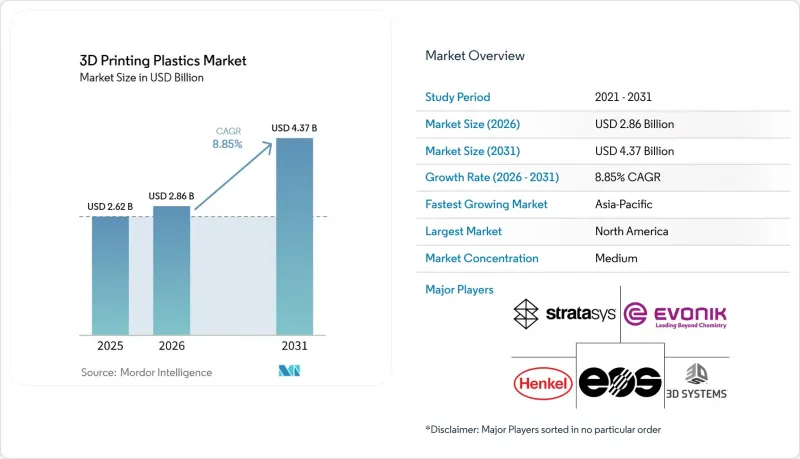
根據 Mordor Intelligence 預測,3D 列印塑膠市場規模預計在 2025 年達到 26.2 億美元,在 2026 年達到 28.6 億美元,在 2031 年達到 43.7 億美元。
預測期(2026-2031 年)的複合年成長率預計為 8.85%。
本報告按形態(絲狀、粉末、液體)、材料類型(光敏聚合物、丙烯腈-丁二烯-苯乙烯共聚物(ABS)等)、終端應用產業(醫療、航太與國防、汽車、電氣與電子等)以及地區(亞太、北美、歐洲、南美、中東和非洲)進行細分。市場預測以美元(USD)為單位。
全球3D列印塑膠市場趨勢與洞察
從快速原型製作到功能部件生產的過渡正在逐步推進。
3D列印塑膠市場的發展動力源自於積層製造技術在設計檢驗、橋樑製造、零件管理以及最終產品生產等領域的日益普及。 2026年7月,3D Systems公司指出,快速原型製作如今已涵蓋產品的整個生命週期,而不僅限於初始設計階段。這項轉變要求聚合物供應商不僅要確保單次列印的合格性能,還要提供可重複的結果和完善的材料控制文件。因為3D列印塑膠市場的生產用戶必須能夠在重複訂單和既定的生產計畫中,確保材料性能的一致性。此外,在生產過程中採用3D列印技術的製造商也需要支援可追溯性和滿足特定產業要求的品管系統。過去以小批量供應給原型製作實驗室的材料,如今可以根據更大規模、更可預測的生產計劃進行採購。這種轉變有利於那些能夠在長期生產過程中提供可靠輸出的供應商,因此,工藝文件和材料一致性已成為3D列印塑膠市場中至關重要的競爭優勢。
對高性能工程熱塑性塑膠的需求不斷成長
由於在醫療和航太領域高要求應用中的重要作用,PEEK預計到2031年將以10.21%的複合年成長率成長。符合ASTM F2026標準的PEEK植入可支援遵循ISO 13485品質系統的醫療設備製造商生產病患客製化的植入和手術器械。聚醚醯亞胺和PEEK通常以ULTEM品牌銷售,具有耐熱、耐化學腐蝕和輕質等特性,適用於飛機內裝零件和其他認證零件。聚苯碸(PPSU)和聚碳酸酯也用於必須承受高壓釜處理的模具,即使在小批量生產中也能保持較高的單件附加價值。因此,3D列印塑膠市場越來越依賴除了測試、文件和認證支援外,還具備混配能力的材料供應商。這些要求使特種化學品製造商比僅處理通用聚合物的供應商更具優勢。這一趨勢在 3D 列印塑膠市場尤為明顯,客戶需要材料記錄,以便在受監管的產品核可過程中進行審查。
與傳統聚合物材料相比,3D列印塑膠的高成本。
工程級列印材料,特別是PEEK、PPSU和生物相容性光敏樹脂,比射出成型中使用的同等通用級材料價格更高。這種成本可能成為其普及應用的限制因素,尤其是在消費品和一般工業製造領域,因為這些產業的單件成本與生產規模密切相關。列印級聚合物也需要受控的儲存環境,而且某些光敏樹脂的保存期限較短。對濕度敏感的尼龍粉末可能需要特殊處理,這會增加傳統聚合物供應鏈中不存在的物流成本。在南美洲和東南亞等新興市場,這些成本尤其高昂,因為這些地區成熟的射出成型成型供應鏈仍具有競爭力。因此,3D列印塑膠市場需要展現其價值,例如減少模具需求、縮短前置作業時間或提高零件客製化的靈活性,即使材料成本較高,也應如此,從而使採購決策不完全取決於材料成本。
細分市場分析
預計到2025年,3D列印塑膠絲材將佔3D列印塑膠市場佔有率的45.31%。這主要得益於熔融沈積成型(FDM)和熔融沈積成型(FFF)系統在原型實驗室、牙醫診所、教育機構和製造廠的廣泛應用。這些環境中的耗材激增使其成為設計、培訓、模具製造和生產支援等環節中常見的材料。耗材種類繁多,從聚乳酸(PLA)到聚醚醚酮(PEEK)和超高強度金屬乙烯(ULTEM)應有盡有。配備密封加熱腔的工業級FDM系統正在拓展其應用範圍,以滿足生產對強度更高、穩定性更強、耐熱性更佳的部件的需求。此外,對具有特定應用特性的耗材(例如阻燃性、增強性和在特定工況下的性能)的需求也支撐了3D列印塑膠絲材市場規模的成長。 2026 年 6 月,Stratasys 為鐵路和運輸用戶推出了 FDM PA6/66-GF30-FR,以滿足他們對阻燃終端用途組件和備件的需求。
預計到2031年,粉末製造將以9.06%的複合年成長率成長,成為3D列印塑膠市場中成長最快的細分領域,因為工業用戶正在尋求小批量生產的實用替代方案。多射流熔融(MJF)和選擇性雷射燒結(SLS)無需傳統模具即可實現批量生產,使製造商即使在通常需要模具投資的情況下也能考慮積層製造。這種能力對於難以證明模具成本合理的小批量生產尤其重要。粉末系統還使製造商能夠生產複雜零件,同時減少對傳統機械加工製作流程的依賴,並幫助生產團隊處理使用傳統方法難以製造的形狀。對粉末需求的成長反映了積層製造工作流程向生產導向型方向的轉變。此外,在3D列印塑膠市場中,生產用戶需要在迭代製造過程中控制品質和成本,這就產生了對即使在加工和重複使用後仍能保持性能穩定的材料的需求。液態樹脂在立體光刻技術和數位光處理技術中繼續發揮至關重要的作用,尤其是在牙科修復體、助聽器和高解析度工業零件領域。光敏聚合物配方的研發越來越注重生物相容性和阻燃性。
區域分析
到2025年,北美將佔據3D列印塑膠市場34.11%的佔有率。該地區航太和國防領域的採購要求材料必須符合嚴格的認證流程。此外,該地區還擁有完善的醫療製造基礎設施,使用經FDA批准的生物相容性樹脂和絲材。這些因素都支撐了對認證聚合物和有據可查的製造流程的需求。 2026年,Stratasys將在明尼蘇達州明尼通卡市開設一個佔地20萬平方英尺的區域總部,凸顯了該地區在工業積層製造應用方面的重要作用。加拿大和墨西哥作為航太供應鏈的近岸樞紐,其重要性也日益凸顯。
亞太地區預計到2031年將以9.25%的複合年成長率成長,這主要得益於多個已開發國家和新興經濟體製造業活動的增加,該地區3D列印塑膠市場成長率位居各區域之首。中國正在戰略性產業領域拓展積層製造,本土印表機和特種化學品製造商正不斷提高PA12和光敏聚合物的產能,以滿足日益成長的工業系統部署需求。在日本的汽車和航太領域,積層製造工作流程的應用正在不斷擴展,從而推動了對適用於認證生產應用的聚合物的需求。韓國的電子製造地正在推動對高精度光固化聚合物組件和抗靜電放電(ESD)聚合物外殼的需求。印度目前仍處於積層製造的早期階段,但與「印度製造」計畫相關的製造業投資正在促進航太和醫療設備產業的成長。在這些市場,隨著印表機部署數量的增加,對可大規模生產的聚合物系統的需求正在湧現。
在歐洲,德國和法國扮演主導角色,兩國在工業印表機領域擁有專業技術、強大的研發能力,航太業的需求也支持先進聚合物的應用。在德國,工業印表機方面的專業技術與聚合物製造方法的研究活動相結合。在法國,包括空中巴士和賽峰集團在內的航太工業基礎支撐著對高價值聚合物材料的需求。空中巴士每年生產超過25,000個飛機聚合物零件,充分體現了該地區經認證產品的巨大需求。歐盟《化學品註冊、評估、授權和限制法規》(REACH) 和歐盟《醫療設備法規》要求材料可追溯性和物質合規性,增加了新供應商的認證成本,同時也進一步凸顯了現有認證能力的重要性。南美洲、中東和非洲的市場規模仍然小規模,但巴西和沙烏地阿拉伯正在開發用於石油天然氣和工業維修領域的積層製造能力。
其他好處:
- Excel格式的市場預測(ME)表
- 3個月的分析師支持
目錄
第1章:引言
- 研究假設和市場定義
- 調查範圍
第2章:調查方法
第3章執行摘要
第4章 市場狀況
- 市場概覽
- 市場促進因素
- 從快速原型製作到功能部件生產的轉變正在加速。
- 對高性能工程熱塑性塑膠的需求不斷成長
- 3D列印機製造商正日益開發針對特定應用的聚合物配方。
- 航太和汽車產業對輕質聚合物零件的應用日益廣泛
- 擴大按需製造的應用,以降低模具成本和前置作業時間。
- 市場限制因素
- 與傳統聚合物材料相比,3D列印塑膠高成本
- 不同3D列印技術之間材料相容性的局限性
- 關鍵應用領域嚴格的材料認證和核准要求
- 價值鏈分析
- 波特五力分析
第5章 市場規模與成長預測
- 按形式
- 燈絲
- 粉末
- 液體
- 材料類型
- 光聚合物
- 丙烯腈丁二烯苯乙烯(ABS)
- 聚乳酸(PLA)
- 聚醯胺(尼龍)
- 聚碳酸酯(PC)
- 聚醚醚酮(PEEK)
- 聚對苯二甲酸乙二醇酯(PETG)
- 聚苯碸(PPSU)
- 熱塑性聚氨酯(TPU)
- 其他材料類型
- 按最終用途行業分類
- 衛生保健
- 航太/國防
- 車
- 電氣和電子設備
- 消費品
- 工業製造
- 其他終端用戶產業
- 按地區
- 亞太地區
- 中國
- 印度
- 日本
- 韓國
- 其他亞太國家
- 北美洲
- 美國
- 加拿大
- 墨西哥
- 歐洲
- 德國
- 英國
- 法國
- 義大利
- 俄羅斯
- 其他歐洲國家
- 南美洲
- 巴西
- 阿根廷
- 其他南美國家
- 中東和非洲
- 沙烏地阿拉伯
- 南非
- 其他中東和非洲國家
- 亞太地區
第6章 競爭情勢
- 市場集中度
- 策略趨勢
- 市佔率和排名分析
- 公司簡介
- 3D Systems, Inc.
- Arkema
- CRP Technology Srl
- dsm-firmenich
- EOS GmbH
- Evonik Industries AG
- Henkel AG & Co. KGaA
- Lubrizol
- Materialise NV
- SABIC
- Solvay
- Stratasys Ltd.
- Victrex plc
第7章 市場機會與未來展望
According to Mordor Intelligence, the 3D printing plastics market was valued at USD 2.62 billion in 2025 and is estimated to grow from USD 2.86 billion in 2026 to reach USD 4.37 billion by 2031, at a CAGR of 8.85% during the forecast period (2026-2031).
This report is Segmented by Form (Filament, Powder, and Liquid), Material Type (Photopolymer, Acrylonitrile Butadiene Styrene (ABS), and More), End-Use Industry (Healthcare, Aerospace & Defense, Automotive, Electrical & Electronics, and More), and Geography (Asia-Pacific, North America, Europe, South America, and Middle-East and Africa). The Market Forecasts are Provided in Terms of Value (USD).
Global 3D Printing Plastics Market Trends and Insights
Growing Shift from Rapid Prototyping to Functional Parts Production
The 3D printing plastics market is supported by wider use of additive manufacturing across design validation, bridge production, spare-parts management, and end-use component production. 3D Systems stated in July 2026 that rapid prototyping now supports the full product lifecycle rather than only early design work. This change requires polymer suppliers to provide repeatable results and documented material control, not only acceptable performance in a single print, because production users must be able to rely on the same material behavior across recurring orders and defined manufacturing schedules in the 3D printing plastics market. Manufacturers using printing in production also need quality systems that support traceability and sector-specific requirements. Materials that once moved in small volumes to prototyping laboratories can therefore be purchased under production schedules with larger and more predictable requirements. The shift favors suppliers that can support reliable output across extended production runs, which makes process documentation and material consistency central competitive requirements in the 3D printing plastics market.
Rising Demand for High-Performance Engineering Thermoplastics
PEEK is projected to grow at a 10.21% CAGR through 2031, reflecting its role in demanding medical and aerospace uses. Implant-grade PEEK that conforms to ASTM F2026 can support medical device producers working within ISO 13485 quality systems for patient-specific implants and surgical instruments. Polyetherimide, often sold under the ULTEM brand, and PEEK provide heat resistance, chemical resistance, and low weight for aircraft interior parts and other qualified components. Polyphenylsulfone (PPSU) and polycarbonate are also being used for tooling that must withstand autoclaving, where small production runs can still have high value per part. The 3D printing plastics market, therefore, depends increasingly on material suppliers that combine compounding capability with testing, documentation, and certification support. These requirements strengthen the position of specialty chemical producers relative to suppliers focused only on general-purpose polymers, especially when customers need material records that can be reviewed during a regulated product approval process within the 3D printing plastics market.
High Cost of 3D Printing Plastics Compared with Conventional Polymer Materials
Engineering-grade printing materials, especially PEEK, PPSU, and biocompatible photopolymer resins, cost more than comparable commodity grades used in injection molding. This cost can limit adoption when per-part economics are strongly tied to production volume, including consumer goods and general industrial manufacturing. Print-grade polymers also need controlled storage, while some photopolymers have shorter shelf lives. Moisture-sensitive nylon powders can require specialized handling, which adds logistics costs that conventional polymer supply chains may not carry. These costs are particularly high in emerging markets across South America and parts of Southeast Asia, where established injection molding supply chains remain competitive. The 3D printing plastics market must therefore demonstrate value through lower tooling needs, shorter lead times, or greater part customization when material prices are high, rather than relying on material cost alone to support the purchasing decision.
Other drivers and restraints analyzed in the detailed report include:
- Increasing Development of Application-Specific Polymer Formulations by 3D Printer Manufacturers
- Expanding Use of Lightweight Polymer Components in Aerospace and Automotive Industries
- Limited Material Compatibility Across Different 3D Printing Technologies
For complete list of drivers and restraints, kindly check the Table Of Contents.
Segment Analysis
Filament held 45.31% of the 3D printing plastics market share in 2025, supported by the wide installed base of fused deposition modeling and fused filament fabrication systems in prototyping laboratories, dental clinics, educational settings, and manufacturing locations. Their presence across these settings has made filament a familiar input for design, training, tooling, and production-support work. Filament supports a broad range of materials, from polylactic acid (PLA) to PEEK and ULTEM. Industrial FDM systems with enclosed heated chambers are extending their use into production-oriented applications that need stronger, more stable, and more heat-resistant components. The 3D printing plastics market size for filament is also supported by demand for grades with application-specific properties, including flame resistance, reinforcement, and performance under defined operating conditions. Stratasys introduced FDM PA6/66-GF30-FR in June 2026 for rail and transportation users who need flame-retardant end-use parts and spare parts.
Powder is projected to expand at a 9.06% CAGR through 2031, making it the fastest-growing form in the 3D printing plastics market as industrial users seek practical alternatives for smaller production batches. Multi Jet Fusion and selective laser sintering can support batch production without conventional tooling, allowing manufacturers to consider additive methods where mold investment would otherwise be required. This capability is valuable for short production runs, where the cost of tooling can be difficult to justify. Powder systems also help manufacturers produce complex parts with less dependence on traditional machining steps and allow production teams to address geometries that can be difficult to make through conventional methods. Growth in powder demand reflects the move toward production-oriented additive workflows. It also creates demand for materials that retain stable properties after processing and reuse, because production users need to control quality and cost across repeat builds in the 3D printing plastics market. Liquid resins remain important for stereolithography and digital light processing, particularly for dental prosthetics, hearing aids, and high-resolution industrial parts. Photopolymer formulation work is increasingly focused on biocompatibility and flame resistance.
Complete Report Scope:
- By Form
- Filament
- Powder
- Liquid
- By Material Type
- Photopolymer
- Acrylonitrile Butadiene Styrene (ABS)
- Polylactic Acid (PLA)
- Polyamide (Nylon)
- Polycarbonate (PC)
- Polyether Ether Ketone (PEEK)
- Polyethylene Terephthalate Glycol (PETG)
- Polyphenylsulfone (PPSU)
- Thermoplastic Polyurethane (TPU)
- Other Material Types
- By End-Use Industry
- Healthcare
- Aerospace & Defense
- Automotive
- Electrical & Electronics
- Consumer Goods
- Industrial Manufacturing
- Other End-use Industries
- By Geography
- Asia-Pacific
- China
- India
- Japan
- South Korea
- Rest of Asia-Pacific
- North America
- United States
- Canada
- Mexico
- Europe
- Germany
- United Kingdom
- France
- Italy
- Russia
- Rest of Europe
- South America
- Brazil
- Argentina
- Rest of South America
- Middle-East and Africa
- Saudi Arabia
- South Africa
- Rest of Middle-East and Africa
- Asia-Pacific
Geography Analysis
North America held 34.11% of the 3D printing plastics market share in 2025. Aerospace and defense procurement in the region requires materials that meet rigorous qualification processes. The region also has a developed healthcare manufacturing base that uses FDA-cleared biocompatible resins and filaments. These conditions support demand for certified polymers and documented production processes. Stratasys opened a 200,000-square-foot Americas Regional Corporate Headquarters in Minnetonka, Minnesota, in 2026, underscoring the region's role in industrial additive manufacturing deployment. Canada and Mexico are also becoming more relevant as nearshore locations for aerospace supply chains.
Asia-Pacific is forecast to grow at a 9.25% CAGR through 2031, the fastest regional rate in the 3D printing plastics market, as manufacturing activity increases across several established and emerging economies. China is expanding additive manufacturing in strategic industrial sectors, while local printer and specialty chemical companies are adding PA12 and photopolymer capacity for a growing installed base of industrial systems. Japan's automotive and aerospace sectors are increasing their use of additive manufacturing workflows, which can support demand for polymers suited to qualified production applications. South Korea's electronics manufacturing base supports demand for precision photopolymer parts and ESD-safe polymer housings. India is at an earlier stage of adoption, but manufacturing investment linked to the Make in India program is supporting aerospace and medical device activity. These markets create demand for production-capable polymer systems as installed printer fleets expand.
Europe is led by Germany and France, where industrial printer expertise, research capability, and aerospace demand support advanced polymer applications. Germany combines industrial printer expertise with research activity on polymer production methods. France's aerospace base, including Airbus and Safran, supports demand for high-value polymer materials. Airbus's annual output of more than 25,000 flight-ready polymer parts shows the depth of qualified demand within the region. Registration, Evaluation, Authorisation and Restriction of Chemicals (REACH) and the EU Medical Device Regulation require material traceability and substance compliance, which increases qualification costs for new suppliers and makes established certification capabilities more important. South America, and Middle-East and Africa remain smaller markets, although Brazil and Saudi Arabia are building additive manufacturing capability for oil and gas and industrial maintenance applications.
- 3D Systems, Inc.
- Arkema
- CRP Technology S.r.l.
- dsm-firmenich
- EOS GmbH
- Evonik Industries AG
- Henkel AG & Co. KGaA
- Lubrizol
- Materialise NV
- SABIC
- Solvay
- Stratasys Ltd.
- Victrex plc
Additional Benefits:
- The market estimate (ME) sheet in Excel format
- 3 months of analyst support
TABLE OF CONTENTS
1 Introduction
- 1.1 Study Assumptions and Market Definition
- 1.2 Scope of the Study
2 Research Methodology
3 Executive Summary
4 Market Landscape
- 4.1 Market Overview
- 4.2 Market Drivers
- 4.2.1 Growing Shift from Rapid Prototyping to Functional Parts Production
- 4.2.2 Rising Demand for High-Performance Engineering Thermoplastics
- 4.2.3 Increasing Development of Application-Specific Polymer Formulations by 3D Printer Manufacturers
- 4.2.4 Expanding Use of Lightweight Polymer Components in Aerospace and Automotive Industries
- 4.2.5 Growing Adoption of On-Demand Manufacturing to Reduce Tooling Costs and Lead Times
- 4.3 Market Restraints
- 4.3.1 High Cost of 3D Printing Plastics Compared with Conventional Polymer Materials
- 4.3.2 Limited Material Compatibility Across Different 3D Printing Technologies
- 4.3.3 Stringent Material Qualification and Certification Requirements for Critical Applications
- 4.4 Value Chain Analysis
- 4.5 Porter's Five Forces Analysis
- 4.5.1 Threat of New Entrants
- 4.5.2 Bargaining Power of Suppliers
- 4.5.3 Bargaining Power of Buyers
- 4.5.4 Threat of Substitutes
- 4.5.5 Competitive Rivalry
5 Market Size and Growth Forecasts (Value)
- 5.1 By Form
- 5.1.1 Filament
- 5.1.2 Powder
- 5.1.3 Liquid
- 5.2 By Material Type
- 5.2.1 Photopolymer
- 5.2.2 Acrylonitrile Butadiene Styrene (ABS)
- 5.2.3 Polylactic Acid (PLA)
- 5.2.4 Polyamide (Nylon)
- 5.2.5 Polycarbonate (PC)
- 5.2.6 Polyether Ether Ketone (PEEK)
- 5.2.7 Polyethylene Terephthalate Glycol (PETG)
- 5.2.8 Polyphenylsulfone (PPSU)
- 5.2.9 Thermoplastic Polyurethane (TPU)
- 5.2.10 Other Material Types
- 5.3 By End-Use Industry
- 5.3.1 Healthcare
- 5.3.2 Aerospace & Defense
- 5.3.3 Automotive
- 5.3.4 Electrical & Electronics
- 5.3.5 Consumer Goods
- 5.3.6 Industrial Manufacturing
- 5.3.7 Other End-use Industries
- 5.4 By Geography
- 5.4.1 Asia-Pacific
- 5.4.1.1 China
- 5.4.1.2 India
- 5.4.1.3 Japan
- 5.4.1.4 South Korea
- 5.4.1.5 Rest of Asia-Pacific
- 5.4.2 North America
- 5.4.2.1 United States
- 5.4.2.2 Canada
- 5.4.2.3 Mexico
- 5.4.3 Europe
- 5.4.3.1 Germany
- 5.4.3.2 United Kingdom
- 5.4.3.3 France
- 5.4.3.4 Italy
- 5.4.3.5 Russia
- 5.4.3.6 Rest of Europe
- 5.4.4 South America
- 5.4.4.1 Brazil
- 5.4.4.2 Argentina
- 5.4.4.3 Rest of South America
- 5.4.5 Middle-East and Africa
- 5.4.5.1 Saudi Arabia
- 5.4.5.2 South Africa
- 5.4.5.3 Rest of Middle-East and Africa
- 5.4.1 Asia-Pacific
6 Competitive Landscape
- 6.1 Market Concentration
- 6.2 Strategic Moves
- 6.3 Market Share (%)/Ranking Analysis
- 6.4 Company Profiles (includes Global Overview, Market Overview, Core Segments, Financials as available, Strategic Information, Products and Services, and Recent Developments)
- 6.4.1 3D Systems, Inc.
- 6.4.2 Arkema
- 6.4.3 CRP Technology S.r.l.
- 6.4.4 dsm-firmenich
- 6.4.5 EOS GmbH
- 6.4.6 Evonik Industries AG
- 6.4.7 Henkel AG & Co. KGaA
- 6.4.8 Lubrizol
- 6.4.9 Materialise NV
- 6.4.10 SABIC
- 6.4.11 Solvay
- 6.4.12 Stratasys Ltd.
- 6.4.13 Victrex plc
7 Market Opportunities and Future Outlook
- 7.1 White-Space and Unmet-Need Assessment

 全球高性能3D列印塑膠市場規模、佔有率、趨勢和成長分析報告(2026-2034年)
 3D列印塑膠市場:2026-2032年全球市場預測(依塑膠類型、形狀、列印技術、應用、終端用戶產業和分銷管道分類)
 3D列印塑膠市場報告:按類型、形式、應用、最終用戶和地區分類(2026-2034年)
 高性能3D列印塑膠市場規模、佔有率和成長分析:按材料類型、形狀、列印技術、應用、終端用戶產業、特性類型和地區分類-2026-2033年產業預測
 3D列印塑膠市場規模、佔有率和趨勢分析報告:按類型、形式、最終用途、地區和細分市場分類(2026-2033年)
 2026 年至 2035 年 3D 列印塑膠的市場機會、成長要素、產業趨勢分析與預測。高性能塑膠3D列印市場:按材料類型、形狀、列印技術、應用和最終用途產業分類,全球預測(2026-2032)
 高性能3D列印塑膠市場分析及預測(至2035年):依類型、產品、服務、技術、應用、材料類型、製程、最終用戶及組件分類
 高性能聚合物3D列印材料市場:依類型、形態、技術和終端應用產業劃分-全球預測至2036年
 2026年全球3D列印塑膠市場報告