


 |
市場調查報告書
商品編碼
2118226
OTT建議引擎:市佔率分析、產業趨勢與統計、成長預測(2026-2031年)OTT Recommendation Engine - Market Share Analysis, Industry Trends & Statistics, Growth Forecasts (2026 - 2031) |
||||||

※ 本網頁內容可能與最新版本有所差異。詳細情況請與我們聯繫。
根據 Mordor Intelligence 預測,OTT建議引擎市場規模將從 2025 年的 9 億美元和 2026 年的 11.7 億美元成長到 2031 年的 24.8 億美元,2026 年至 2031 年的年複合成長率(CAGR)為 16.21%。
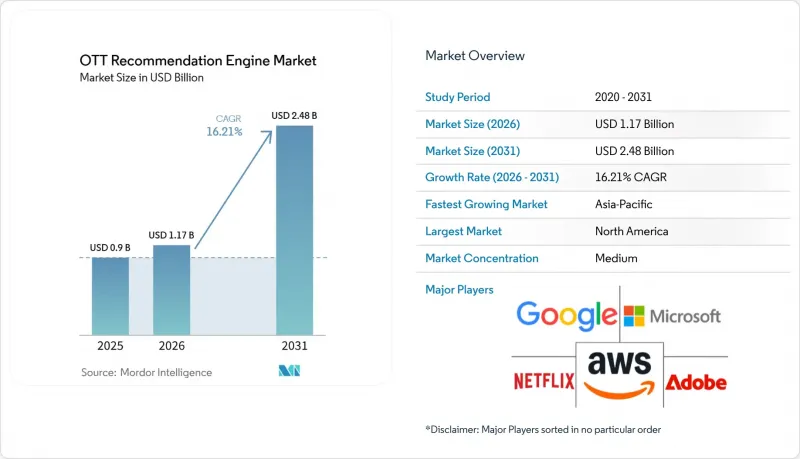
本報告按部署模式(雲端部署、本地部署等)、最終用戶(廣播公司和付費電視運營商、數位媒體和出版平台等)、經營模式(收費定期訂閱(建議、廣告和促銷建議等)以及地區進行細分。市場預測以美元計價。
全球OTT建議引擎市場趨勢與洞察
高度個人化觀看體驗的需求
建議品質是一項至關重要的營運指標,因為它同時影響解約率、觀看時間長度和廣告收入。 Netflix 在 2026 年發布的一項研究表明,其建議系統不僅影響用戶選擇觀看的影片,還影響用戶是否會觀看內容,而且個性化不僅與介面品質相關,還與每位用戶的收入相關。因此,OTT建議引擎市場正朝著整合主頁佈局、封面選擇和編輯呈現方式的系統發展。 Netflix 報告稱,與先前多階段的推薦系統相比,其「GenPage」系統提高了關鍵用戶參與度指標,並將端到端交付延遲降低了 20%。 JioHotstar 報告稱,當同時提供文字和音訊內容發現功能時,超過 60% 的用戶選擇了音頻,這表明發現介面可以影響底層模型所傳遞的價值。
串流內容量不斷增加
OTT建議引擎市場的發展動力源自於不斷擴大的內容庫,這使得手動發現內容變得越來越困難。 Amagi預計到2026年中期,其THUNDERSTORM平台上將提供超過6500個快速頻道,這凸顯了對準確的節目元資料和搜尋結果日益成長的需求。 Hub Entertainment Research在2026年的一項研究發現,不完整的類型、評級和劇集數據會降低節目在搜尋結果中的可見度,並削弱上下文廣告配對的準確性。豐富的元資料變得與排名品質同等重要,因為元資料不足會導致一些有價值的節目被忽略。 ThinkAnalytics在IBC2025上發布了ThinkMetadataAI,它可以自動為數十種語言的內容添加標籤,並將這些資訊與其發現工具整合。將豐富的元資料與排名系統結合的供應商,將更有能力服務於那些需要更強大的內容發現功能來管理龐大且多樣化內容庫的平台。
資料隱私和同意管理要求
隱私和透明度義務使得跨境個人化專案的運作更加困難。歐盟委員會已聲明,歐盟人工智慧法案下的透明度條例第50條將於2026年8月2日生效,該條例將對與使用者互動的相關系統施加資訊揭露和文件記錄義務。數位服務法案也對利用演算法進行內容管理的服務產生影響,要求提供基於使用者畫像的建議之外的有意義的替代方案。因此,OTT建議引擎市場需要支援更清晰的同意管理、文件記錄和使用者說明。為受歐洲隱私法規約束的資料建立單獨的訓練環境可能會增加基礎設施成本並減慢模型更新。擁有完善的同意和管治體系的大規模供應商可能比小規模的專業供應商更能滿足這些要求。
細分市場分析
到2025年,基於雲端的系統將佔據OTT建議引擎市場65.70%的佔有率,預計到2031年將以16.71%的複合年成長率成長。基於雲端的交付方式降低了維護特徵庫、重新訓練模型以及在廣播公司級內容庫中提供推理服務所需的工作量。它還允許團隊在無需建造和運營整個底層基礎設施的情況下擴展容量。位元組跳動的Volcengine為IPTV和OTT運營商提供託管式大螢幕建議服務,覆蓋主頁、頻道和內容詳情頁。這項服務表明,即使對於沒有自有模型開發團隊的營運商,OTT建議引擎市場也能提供打包式的個人化服務。
對於受嚴格資料本地化法規約束的國有廣播公司和營運商而言,本地部署系統仍然是一個可行的選擇。當跨境傳輸用戶資料受到限制時,這些要求尤其重要。混合方案正受到大規模付費電視業者的青睞,這些業者在自身系統中維護著高度敏感的用戶畫像。他們可以繼續利用雲端處理能力來處理敏感度較低的推理任務和非個人化訊號。這種方法使OTT建議引擎市場的供應商能夠在保持本地控制的同時,提供靈活的處理能力,而無需建立完全隔離的建議環境。
到2025年,廣播公司和付費電視業者將佔據OTT建議引擎市場40.45%的營收佔有率。這些業者擁有龐大的內容庫,需要高效的搜尋工具來輕鬆發現優質節目。隨著傳統廣播公司採用串流媒體主導的分發模式,建議系統正從簡單的應用選項演變為客戶維繫工具。數位媒體和出版平台也正在利用建議系統來管理大量內容,包括新聞、播客和用戶生成內容(UGC)。這些應用程式場景正在推動對用戶重新參與和及時內容推送的需求。
預計到2031年,聯網電視和設備生態系統將以16.94%的複合年成長率成長。智慧型電視製造商正在將建議功能整合到作業系統層,使用戶甚至在啟動單一串流媒體應用之前即可開始發現內容。 2026年2月,三星與Gracenote合作,利用大規模語言模式(LLM)為其全球智慧電視平台提供互動式搜尋和內容髮現功能。此類整合將內容發現流程前移至裝置介面。這使得設備製造商能夠影響用戶的注意力、家庭層面的內容發現以及與主螢幕相關的廣告投放,從而提升了整個OTT建議引擎市場互通性的重要性。
區域分析
2025年,北美地區貢獻了全球整體40.45%的收入,成為全球最大的收入來源地區。該地區擁有高度集中的訂閱制和廣告支援的串流媒體平台、成熟的程式化廣告工具以及廣泛的聯網電視普及率。亞馬遜於2026年7月對Prime Video進行了以人工智慧為核心的重新設計,顯示對建議的投入已超越產品團隊的範疇,成為經營團隊的優先事項。根據Amagi預測,到2026年中期,美國和加拿大將佔全球54%的快速觀看時間和74%的快速廣告曝光量。 Roku的研究發現,64%的Roku使用者家庭會觀看快速內容,這凸顯了作業系統層級內容發現的重要性。在南美,SKY+和DGO將於2025年4月將Mediagenix和Spideo的建議引擎分別整合到其包含170個和260個直播頻道的1萬個節目目錄中。
預計到2031年,亞太地區將以16.78%的複合年成長率(CAGR)成為所有地區中成長最快的地區。印度、中國、韓國、日本和東南亞市場的成長主要得益於行動優先的使用模式以及本地語言內容庫的擴展。擁有超過2億用戶的JioHotstar報告稱,當音訊和文字選項同時可用時,超過60%的用戶會選擇基於音訊的發現方式。 DMM TV開發了一種測量方法,用於建議版塊觀看的內容和透過其他平台管道觀看的內容。在中國,YD/T 4886-2024標準適用於基於人工智慧的行動影片建議服務。該標準於2024年10月生效,定義了相關服務的技術和功能要求。
在歐洲,歐盟人工智慧法案、GDPR 和數位服務法案提高了對用戶同意管理和可解釋建議實踐的需求,使得實施要求更加嚴格。雖然這些要求可能會推高工程成本,但也增加了對提供高度透明個人化工具的供應商的需求。在中東,沙迦廣播廣播公司) 於 2025 年 5 月報告稱,其已在其 Maraya 平台上部署了 Mediagenix 和 Spideo 的技術,用戶參與度提高了 20% 至 60%,轉換率提高了 35%。在非洲,儘管串流媒體的普及仍處於早期階段,但 Mangomolo 在 2025 年至 2026 年間擴展了其面向客戶(包括南非廣播公司 (SABC))的人工智慧個人化和本地化能力。這些地區的 OTT建議引擎市場受到本地語言支援、區域內容版權以及遵守不同監管要求等因素的影響。
其他好處:
- Excel格式的市場預測(ME)表
- 3個月的分析師支持
目錄
第1章:引言
- 研究假設和市場定義
- 調查範圍
第2章:調查方法
第3章執行摘要
第4章 市場狀況
- 市場概覽
- 宏觀經濟因素對市場的影響
- 市場促進因素
- 串流內容數量增加
- 高度個人化觀看體驗的需求
- 無 Cookie 廣告環境下的第一方資料策略
- 用於上下文建議推薦的即時和邊緣人工智慧推理
- 新興市場多語言內容的擴展
- 根據建議最佳化客戶維繫和廣告收入
- 市場限制因素
- 資料隱私和同意管理的要求
- 冷啟動和稀疏互動帶來的限制
- 演算法偏見、資訊繭房和可解釋性差距
- 計算成本、特徵儲存成本和模型服務成本不斷上升。
- 產業價值鏈分析
- 監理情勢
- 技術展望
- 波特五力模型
第5章 市場規模與成長預測
- 部署模式
- 基於雲端的
- 現場
- 混合實現
- 最終用戶
- 廣播公司及付費電視業者
- 數位媒體與出版平台
- 聯網電視和設備生態系統
- 按經營模式
- 收費式計費(SVOD)
- 交易收費(TVOD/PPV)
- 廣告支援收費(AVOD/FAST)
- 混合貨幣化和收費
- 透過使用
- 推薦內容
- 廣告和促銷建議
- 商業和訂閱方面的建議
- 其他用途
- 按地區
- 北美洲
- 美國
- 加拿大
- 墨西哥
- 南美洲
- 巴西
- 阿根廷
- 其他南美國家
- 歐洲
- 英國
- 德國
- 法國
- 義大利
- 西班牙
- 俄羅斯
- 其他歐洲國家
- 亞太地區
- 中國
- 印度
- 日本
- 韓國
- 新加坡
- 澳洲
- 其他亞太國家
- 中東
- 阿拉伯聯合大公國
- 沙烏地阿拉伯
- 土耳其
- 其他中東國家
- 非洲
- 南非
- 奈及利亞
- 埃及
- 其他非洲國家
- 北美洲
第6章 競爭情勢
- 市場集中度
- 策略趨勢
- 市佔率分析
- 公司簡介
- Amazon Web Services, Inc.
- Google LLC
- Microsoft Corporation
- Netflix, Inc.
- Adobe Inc.
- ThinkAnalytics Ltd.
- Gracenote, Inc.
- ContentWise Srl
- Recombee sro
- Dynamic Yield Ltd.
- Coveo Solutions Inc.
- Salesforce, Inc.
- Oracle Corporation
- SAP SE
- Algolia SAS
- Optimizely, Inc.
- Bloomreach Inc.
- Taboola, Inc.
- Outbrain Inc.
- Muvi LLC
- 24i Media Group BV
- Mediagenix NV
- Spideo SAS
- Argoid Analytics India Private Limited
- Kaltura, Inc.
第7章 市場機會與未來展望
According to Mordor Intelligence, the OTT recommendation engine market size is projected to expand from USD 0.90 billion in 2025 and USD 1.17 billion in 2026 to USD 2.48 billion by 2031, registering a CAGR of 16.21% between 2026 to 2031.
This report is Segmented by Deployment Mode (Cloud-Based, On-Premises, and More), End User (Broadcasters and Pay-TV Operators, Digital Media and Publishing Platforms, and More), Business Model (Recurring Subscription Billing (SVOD), and More), Application (Content Recommendation, Advertising and Promotional Recommendation, and More), and Geography. The Market Forecasts are Provided in Terms of Value (USD).
Global OTT Recommendation Engine Market Trends and Insights
Demand for Hyper-Personalized Viewer Experiences
Recommendation quality has become a central operating measure because it affects churn, viewing time, and advertising yield at the same time. Netflix research presented in 2026 found that its recommendation system affects both title choice and whether viewers watch at all, linking personalization to revenue per user rather than only interface quality. The OTT recommendation engine market is therefore moving toward systems that coordinate home-page layout, artwork selection, and editorial presentation together. Netflix reported that its GenPage system improved core engagement measures and reduced end-to-end serving latency by 20% compared with its earlier multi-stage recommender. JioHotstar reported that more than 60% of users selected voice when text and voice discovery were both offered, showing that discovery interfaces can shape the value delivered by the underlying model.
Rising Streaming Content Volumes
The OTT recommendation engine market is supported by catalog growth that makes manual discovery increasingly difficult. Amagi tracked more than 6,500 FAST channel deliveries on its THUNDERSTORM platform by mid-2026, increasing the need for accurate program metadata and search results. A 2026 Hub Entertainment Research report found that incomplete genre, rating, or episode data can reduce a program's visibility in search and weaken contextual advertising matches. Metadata enrichment is becoming as important as ranking quality because poor metadata can leave useful catalog titles unseen. ThinkAnalytics introduced ThinkMetadataAI at IBC2025 to automate content tagging across dozens of languages and connect that information to its discovery tools. Providers that combine enriched metadata with ranking systems are better placed to serve platforms seeking stronger discovery across large and varied libraries.
Data Privacy and Consent Management Requirements
Privacy and transparency obligations are making cross-border personalization programs more difficult to operate. The European Commission states that Article 50 transparency rules under the EU AI Act will apply from August 2, 2026, with disclosure and documentation obligations for relevant systems that interact with people. The Digital Services Act also affects services that use algorithmic curation by requiring meaningful options beyond profiling-based recommendations. The OTT recommendation engine market must therefore support clearer consent controls, documentation, and user-facing explanations. Separate training environments for data subject to European privacy rules can increase infrastructure costs and slow model updates. Larger providers with established consent and governance systems may find it easier to meet these requirements than smaller specialist vendors.
Other drivers and restraints analyzed in the detailed report include:
- First-Party Data Strategies in a Cookieless Advertising Environment
- Real-Time and Edge-AI Inference for Contextual Recommendations
- Cold-Start and Sparse-Interaction Limitations
For complete list of drivers and restraints, kindly check the Table Of Contents.
Segment Analysis
Cloud-based systems held 65.70% of the OTT recommendation engine market share in 2025 and are projected to grow at a 16.71% CAGR through 2031. Cloud delivery reduces the effort required to maintain feature stores, model retraining, and inference services for broadcaster-scale content libraries. It also allows teams to add capacity without building and operating the full underlying infrastructure. ByteDance's Volcengine offers a managed large-screen recommendation service for IPTV and OTT operators across home pages, channels, and content-detail pages. The service illustrates how the OTT recommendation engine market can offer packaged personalization to operators that do not maintain proprietary model teams.
On-premises systems remain relevant for state-owned broadcasters and operators subject to strict data-localization rules. These requirements are particularly important where cross-border transfer of viewer data is restricted. Hybrid arrangements are gaining attention among larger pay-TV operators that retain sensitive subscriber profiles within their own systems. Those operators can still use cloud capacity for less sensitive inference tasks and nonpersonal signals. This approach gives providers in the OTT recommendation engine market a way to preserve local control while providing flexible capacity without a fully isolated recommendation environment.
Broadcasters and pay-TV operators held 40.45% of revenue in 2025 within the OTT recommendation engine market. Their large content catalogs require effective discovery tools to make premium programs easier to find. As traditional broadcasters adopt streaming-led distribution, recommendation systems are becoming a retention tool rather than an optional app feature. Digital media and publishing platforms also use recommendation systems to manage high content volumes across news, podcasts, and user-generated material. Their use cases add demand for re-engagement and timely content presentation.
Connected-TV and device ecosystems are projected to grow at a 16.94% CAGR through 2031. Smart-TV manufacturers are placing recommendation features in the operating-system layer, allowing discovery to begin before a viewer enters an individual streaming app. In February 2026, Samsung partnered with Gracenote on LLM-enabled conversational search and discovery for its global smart-TV platform. Such integrations move discovery upstream toward the device interface. Device manufacturers can then influence audience attention, household-level discovery, and the advertising inventory associated with the home screen, which increases the importance of interoperability across the OTT recommendation engine market.
Complete Report Scope:
- By Deployment Mode
- Cloud-Based
- On-Premises
- Hybrid Deployment
- By End User
- Broadcasters and Pay-TV Operators
- Digital Media and Publishing Platforms
- Connected-TV and Device Ecosystems
- By Business Model
- Recurring Subscription Billing (SVOD)
- Transactional Billing (TVOD/PPV)
- Advertising-Supported Billing (AVOD/FAST)
- Hybrid Monetization Billing
- By Application
- Content Recommendation
- Advertising and Promotional Recommendation
- Commerce and Subscription Recommendation
- Other Applications
- By Geography
- North America
- United States
- Canada
- Mexico
- South America
- Brazil
- Argentina
- Rest of South America
- Europe
- United Kingdom
- Germany
- France
- Italy
- Spain
- Russia
- Rest of Europe
- Asia-Pacific
- China
- India
- Japan
- South Korea
- Singapore
- Australia
- Rest of Asia-Pacific
- Middle East
- United Arab Emirates
- Saudi Arabia
- Turkey
- Rest of Middle East
- Africa
- South Africa
- Nigeria
- Egypt
- Rest of Africa
- North America
Geography Analysis
North America held 40.45% of global revenue in 2025, giving the region the largest global revenue position. The region has a dense base of subscription and ad-supported streaming platforms, established programmatic advertising tools, and significant connected-TV usage. Amazon's July 2026 AI-focused redesign work on Prime Video showed that recommendation investment has moved beyond product teams to senior leadership priorities. Amagi reported that the United States and Canada generated 54% of global FAST viewing hours and 74% of global FAST advertising impressions in mid-2026. Roku found that 64% of Roku households stream FAST content, supporting the importance of operating-system-level discovery. In South America, SKY+ and DGO deployed Mediagenix and Spideo's recommendation engine across a 10,000-title catalog in April 2025, covering 170 and 260 live channels, respectively.
Asia-Pacific is projected to record the highest regional CAGR of 16.78% through 2031. India, China, South Korea, Japan, and Southeast Asian markets combine mobile-first usage with expanding vernacular-language catalogs. JioHotstar serves more than 200 million users and reported that over 60% of users chose voice-based discovery when voice and text options were available. DMM TV has developed measurement methods that distinguish views driven by recommendation rows from views arriving through other platform paths. China applies the YD/T 4886-2024 standard for AI-based mobile video recommendation services, which took effect in October 2024 and defines technical and functional requirements for relevant services.
Europe faces higher deployment requirements because the EU AI Act, GDPR, and Digital Services Act increase the need for consent controls and explainable recommendation practices. Those requirements can raise engineering costs, but they also increase demand for providers with transparent personalization tools. In the Middle East, Sharjah Broadcasting Authority deployed Mediagenix and Spideo technology for the Maraya platform in May 2025, reporting engagement gains of 20% to 60% and a 35% improvement in conversion. Africa remains earlier in streaming adoption, though Mangomolo expanded its AI personalization and localization capabilities through 2025 and 2026 for clients that include the South African Broadcasting Corporation. The OTT recommendation engine market in these regions is shaped by the need to support local languages, regional content rights, and differing regulatory expectations.
- Amazon Web Services, Inc.
- Google LLC
- Microsoft Corporation
- Netflix, Inc.
- Adobe Inc.
- ThinkAnalytics Ltd.
- Gracenote, Inc.
- ContentWise S.r.l.
- Recombee s.r.o.
- Dynamic Yield Ltd.
- Coveo Solutions Inc.
- Salesforce, Inc.
- Oracle Corporation
- SAP SE
- Algolia SAS
- Optimizely, Inc.
- Bloomreach Inc.
- Taboola, Inc.
- Outbrain Inc.
- Muvi LLC
- 24i Media Group B.V.
- Mediagenix NV
- Spideo SAS
- Argoid Analytics India Private Limited
- Kaltura, Inc.
Additional Benefits:
- The market estimate (ME) sheet in Excel format
- 3 months of analyst support
TABLE OF CONTENTS
1 INTRODUCTION
- 1.1 Study Assumptions and Market Definition
- 1.2 Scope of the Study
2 RESEARCH METHODOLOGY
3 EXECUTIVE SUMMARY
4 MARKET LANDSCAPE
- 4.1 Market Overview
- 4.2 Impact of Macroeconomic Factors on the Market
- 4.3 Market Drivers
- 4.3.1 Rising Streaming-Content Volumes
- 4.3.2 Demand for Hyper-Personalized Viewer Experiences
- 4.3.3 First-Party Data Strategies in a Cookieless Advertising Environment
- 4.3.4 Real-Time and Edge-AI Inference for Contextual Recommendations
- 4.3.5 Multilingual Content Expansion in Emerging Markets
- 4.3.6 Recommendation-Led Optimization of Retention and Advertising Yield
- 4.4 Market Restraints
- 4.4.1 Data Privacy and Consent Management Requirements
- 4.4.2 Cold-Start and Sparse-Interaction Limitations
- 4.4.3 Algorithmic Bias, Filter Bubbles, and Explainability Gaps
- 4.4.4 Escalating Compute, Feature-Store, and Model-Serving Costs
- 4.5 Industry Value-Chain Analysis
- 4.6 Regulatory Landscape
- 4.7 Technological Outlook
- 4.8 Porter's Five Forces
- 4.8.1 Threat of New Entrants Analysis
- 4.8.2 Bargaining Power of Suppliers Analysis
- 4.8.3 Bargaining Power of Buyers Analysis
- 4.8.4 Threat of Substitutes Analysis
- 4.8.5 Competitive Rivalry Analysis
5 MARKET SIZE AND GROWTH FORECASTS (VALUE)
- 5.1 By Deployment Mode
- 5.1.1 Cloud-Based
- 5.1.2 On-Premises
- 5.1.3 Hybrid Deployment
- 5.2 By End User
- 5.2.1 Broadcasters and Pay-TV Operators
- 5.2.2 Digital Media and Publishing Platforms
- 5.2.3 Connected-TV and Device Ecosystems
- 5.3 By Business Model
- 5.3.1 Recurring Subscription Billing (SVOD)
- 5.3.2 Transactional Billing (TVOD/PPV)
- 5.3.3 Advertising-Supported Billing (AVOD/FAST)
- 5.3.4 Hybrid Monetization Billing
- 5.4 By Application
- 5.4.1 Content Recommendation
- 5.4.2 Advertising and Promotional Recommendation
- 5.4.3 Commerce and Subscription Recommendation
- 5.4.4 Other Applications
- 5.5 By Geography
- 5.5.1 North America
- 5.5.1.1 United States
- 5.5.1.2 Canada
- 5.5.1.3 Mexico
- 5.5.2 South America
- 5.5.2.1 Brazil
- 5.5.2.2 Argentina
- 5.5.2.3 Rest of South America
- 5.5.3 Europe
- 5.5.3.1 United Kingdom
- 5.5.3.2 Germany
- 5.5.3.3 France
- 5.5.3.4 Italy
- 5.5.3.5 Spain
- 5.5.3.6 Russia
- 5.5.3.7 Rest of Europe
- 5.5.4 Asia-Pacific
- 5.5.4.1 China
- 5.5.4.2 India
- 5.5.4.3 Japan
- 5.5.4.4 South Korea
- 5.5.4.5 Singapore
- 5.5.4.6 Australia
- 5.5.4.7 Rest of Asia-Pacific
- 5.5.5 Middle East
- 5.5.5.1 United Arab Emirates
- 5.5.5.2 Saudi Arabia
- 5.5.5.3 Turkey
- 5.5.5.4 Rest of Middle East
- 5.5.6 Africa
- 5.5.6.1 South Africa
- 5.5.6.2 Nigeria
- 5.5.6.3 Egypt
- 5.5.6.4 Rest of Africa
- 5.5.1 North America
6 COMPETITIVE LANDSCAPE
- 6.1 Market Concentration
- 6.2 Strategic Moves
- 6.3 Market Share Analysis
- 6.4 Company Profiles (includes Global Level Overview, Market Level Overview, Core Segments, Financials as available, Strategic Information, Market Rank/Share, Products and Services, Recent Developments)
- 6.4.1 Amazon Web Services, Inc.
- 6.4.2 Google LLC
- 6.4.3 Microsoft Corporation
- 6.4.4 Netflix, Inc.
- 6.4.5 Adobe Inc.
- 6.4.6 ThinkAnalytics Ltd.
- 6.4.7 Gracenote, Inc.
- 6.4.8 ContentWise S.r.l.
- 6.4.9 Recombee s.r.o.
- 6.4.10 Dynamic Yield Ltd.
- 6.4.11 Coveo Solutions Inc.
- 6.4.12 Salesforce, Inc.
- 6.4.13 Oracle Corporation
- 6.4.14 SAP SE
- 6.4.15 Algolia SAS
- 6.4.16 Optimizely, Inc.
- 6.4.17 Bloomreach Inc.
- 6.4.18 Taboola, Inc.
- 6.4.19 Outbrain Inc.
- 6.4.20 Muvi LLC
- 6.4.21 24i Media Group B.V.
- 6.4.22 Mediagenix NV
- 6.4.23 Spideo SAS
- 6.4.24 Argoid Analytics India Private Limited
- 6.4.25 Kaltura, Inc.
7 MARKET OPPORTUNITIES AND FUTURE OUTLOOK
- 7.1 White-Space and Unmet-Need Assessment

 人工智慧驅動的學生評估市場預測至2034年:全球分析(按組成部分、評估類型、技術、部署模式、應用、最終用戶和地區分類)人工智慧驅動的學習分析市場預測至2034年:全球分析(按組件、分析類型、技術、部署模式、應用、最終用戶和地區分類)學習分析軟體市場預測至2034年-按軟體類型、分析類型、部署模式、組織規模、應用、最終用戶和地區分類的全球分析教育產業預測分析市場預測(至2034年)-按組成部分、資料來源、技術、部署模式、應用、最終用戶和地區分類的全球分析
 人工智慧驅動的內容個人化:市場佔有率分析、行業趨勢和統計數據以及成長預測(2026-2031 年)個人化行銷內容和宣傳活動自動化中的生成式人工智慧:市場佔有率分析、產業趨勢和統計數據以及成長預測(2026-2031 年)FocusIQ 2034 年市場預測:按解決方案類型、部署模式、技術、應用、最終用戶和地區分類的全球分析AI職業輔導平台市場預測至2034年:按組件、部署模式、技術、應用、最終用戶和地區分類的全球分析
 2026年全球人工智慧(AI)職業教練市場報告2026年全球訂閱體驗平台市場報告