


 |
市場調查報告書
商品編碼
2117594
個人化行銷內容和宣傳活動自動化中的生成式人工智慧:市場佔有率分析、產業趨勢和統計數據以及成長預測(2026-2031 年)Generative AI In Personalized Marketing Content and Campaign Automation - Market Share Analysis, Industry Trends & Statistics, Growth Forecasts (2026 - 2031) |
||||||

※ 本網頁內容可能與最新版本有所差異。詳細情況請與我們聯繫。
根據 Mordor Intelligence 預測,用於個人化行銷內容和宣傳活動自動化的生成式人工智慧市場預計將從 2025 年的 86.4 億美元成長到 2026 年的 109.3 億美元,到 2031 年達到 381.8 億美元,2026 年至 2031 年的複合年成長率為 28.2%。
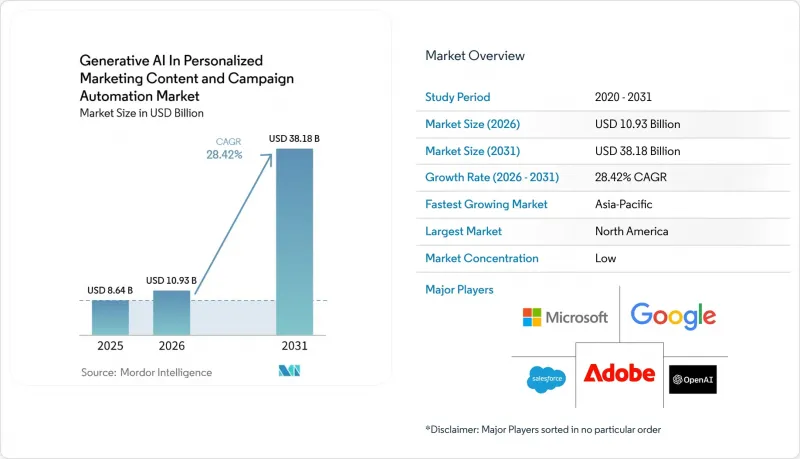
本報告按產品(軟體和服務)、部署模式(雲端、本地部署、混合部署)、應用領域(個人化內容和創新生成、宣傳活動策劃和製作等)、最終用戶(電子商務和零售、銀行、金融服務和保險、IT和電信等)以及地區進行細分。市場預測以美元計價。
全球趨勢與洞察:針對個人化行銷內容與宣傳活動自動化的生成式人工智慧
對人工智慧驅動、基於代理的個人化服務的需求日益成長。
在個人化行銷內容和宣傳活動自動化領域,生成式人工智慧市場正經歷著從孤立工具轉向基於代理的日常客戶營運執行模式的顯著轉變。 2026 年的產品發布表明,供應商不再僅僅將人工智慧視為文字寫作輔助工具,而是將其視為一個能夠規劃、推薦和執行整個客戶工作流程的系統。 Salesforce 於 2025 年 10 月擴大了與 OpenAI 的合作,將推理、語音和多模態功能整合到 Agentforce 360 中。這表明領先的平台供應商正在將基於代理的個人化功能整合到更廣泛的企業技術堆疊中。 Insider One 也在 2026 年 6 月宣布與 Google 建立合作夥伴關係,使品牌能夠在 AI 驅動的跨網路、行動、電子郵件、簡訊、RCS 和 WhatsApp 的旅程中利用即時 BigQuery 數據。這表明即時編配正在成為生產環境的核心組成部分。隨著越來越多的公司尋求最大限度地減少受眾洞察、內容創作和宣傳活動執行之間的交接環節,市場對能夠在單一營運層中整合這些功能的平台的需求日益成長。這推動了對整合套件的需求,並提高了能夠將編配、資料存取和管治整合到單一解決方案中的供應商的價值。
生成式人工智慧顯著降低了內容創作成本。
生成式人工智慧在個人化行銷內容和宣傳活動自動化的應用也不斷擴展。這是因為品牌現在可以創造出更細緻的內容,而無需像傳統工作流程那樣依賴大量的人工操作。這正在改變個人化的經濟模式,因為宣傳活動現在可以在相同的營運週期中適應更多不同的受眾群體、更多形式的內容以及更頻繁的更新。 2026年5月,Google雲端和OTB集團宣布推出由人工智慧驅動的、利用虛擬試穿功能打造的超個人化購物體驗。這表明,個人化創新輸出正從靜態文字擴展到更豐富的視覺商務體驗。 2026年7月,Visa推出了“AI金融助理”,這項服務結合了持卡人行為、交易智慧和機構數據,以銀行品牌提供個人化指導。這反映了在迭代式客戶觸點中不斷增強個人化的趨勢。隨著內容創作和決策支援更容易擴展,品牌更有可能擴大其受眾範圍,而不是局限於高階受眾。這將推動產生式人工智慧在個人化行銷內容和宣傳活動自動化中的應用,因為其價值既來自於降低單位投入,也來自於擴大宣傳活動覆蓋範圍。
品牌安全風險、人工智慧引起的「幻覺」以及對輸出品質的擔憂。
用於個人化行銷內容和宣傳活動自動化的生成式人工智慧市場仍然面臨著輸出不可靠的重大限制。當訊息不準確、帶有偏見或偏離品牌形象時,個人化的價值會迅速降低。這個問題並非紙上談兵;根據IAB的一份報告,70%的行銷人員在宣傳活動中至少遇到過一次與人工智慧產生的「幻覺」輸出、帶有偏見的創新或違規相關的事件。當內容、決策和交付在自動化工作流程中相互關聯時,這種風險會更加突出,因為一個有缺陷的產出可能在審核之前就傳播到多個管道。 2026年的一項學術研究指出,人工智慧生成的「幻覺」不僅是創新審核問題,更是企業管治問題,需要建立審計追蹤、課責和主動監控機制。這意味著,個人化行銷內容和宣傳活動自動化領域的生成式人工智慧供應商不僅需要展現內容產生速度,還需要展現對品牌安全和事實一致性的可衡量控制。無法在部署前檢驗其產品品質的公司往往反應遲緩,這可能導致採購和引進週期延長。
細分市場分析
到2025年,軟體將在用於個人化行銷內容和宣傳活動自動化的生成式人工智慧市場中佔據71.28%的佔有率。這反映了當前企業平台內建的豐富個人化功能。買家傾向於選擇軟體主導的部署方案,因為這些方案可以將受眾數據、內容生成、旅程編配和分析整合到單一環境中。這種廣泛的功能雖然能夠承受較高的轉換成本,但也使現有供應商在企業尋求從單一用途部署擴展到更廣泛的客戶參與專案時佔據優勢。 Salesforce在2025年10月擴大了與OpenAI的合作關係,這表明成熟的平台正在將推理、語音和多模態功能直接整合到面向客戶的工作流程中,而不是依賴單獨的工具。
預計到2031年,服務市場將以29.24%的複合年成長率成長,成為生成式人工智慧(AI)市場中成長最快的服務,該市場專注於個人化行銷內容和宣傳活動自動化。這一趨勢表明,AI的普及應用仍然高度依賴售後實施工作、整合支援、模型調優和營運指導。目前,許多公司正處於從應用階段向營運階段過渡的階段,因此對資料架構和宣傳活動流程設計的實施支援需求持續存在。這也表明,服務合作夥伴在將個人化工具與客戶關係管理(CRM)系統、管治流程和客戶體驗目標整合方面,將繼續發揮關鍵作用。
到2025年,雲端將佔據生成式人工智慧(AI)市場77.34%的佔有率,用於個人化行銷內容和宣傳活動自動化,這反映了託管基礎設施、快速更新以及與企業軟體輕鬆整合等優勢的吸引力。採用雲端技術還能讓客戶快速存取新的模型功能,而無需增加內部基礎設施的負擔。當個人化專案需要在多個管道和業務區域進行擴展時,這種模式尤其適用。供應商的發布趨勢,例如Google雲端、Salesforce以及Insider One近期將個人化功能與雲端連接資料和編配環境的整合,進一步印證了這一趨勢。
預計到2031年,混合部署將以29.88%的複合年成長率成長,成為生成式人工智慧市場中用於個人化行銷內容和宣傳活動自動化領域成長最快的部署模式。其主要驅動力是合規性,因為許多公司希望利用基於雲端的人工智慧功能,同時對敏感的客戶資料和審計記錄保持更嚴格的控制。這在銀行和醫療保健等高度監管的行業中尤其重要,因為資料儲存和監管會影響供應商的選擇和系統設計。歐洲的監管環境也正在推動這一趨勢,合規義務促使企業採用將推理的便利性與資料管理分開的部署模式。
區域分析
2025年,北美繼續保持其在生成式人工智慧(AI)市場(包括個人化行銷內容和宣傳活動自動化)的主導地位,佔40.18%的市場佔有率。該地區受益於成熟的雲端基礎設施、企業軟體的高滲透率以及平台供應商和大規模買家的高度集中。北美在個人化行銷內容和宣傳活動自動化領域生成式人工智慧市場的活躍,部分原因在於許多公司已經擁有能夠支援大規模部署的第一方資料系統和客戶參與技術堆疊。 2026年7月,Visa宣布向金融機構推出“AI金融助理”,並計劃於2026年8月在美國銀行進行試點部署。此舉反映了主流金融服務領域對生產級個人化技術的積極投資。雖然南美洲仍處於引進週期的早期階段,但巴西作為全部區域成長的關鍵短期切入點而脫穎而出。
預計到2031年,亞太地區將以30.94%的複合年成長率成長,成為生成式人工智慧(AI)市場中成長最快的地區,該市場專注於個人化行銷內容和宣傳活動自動化。這項成長主要得益於數位商務的擴張、主要消費經濟體企業積極採用AI技術,以及多個市場對AI發展的公共支持。新加坡的貢獻顯而易見,例如華僑銀行(OCBC)的「行動銀行體驗」(WoW)項目,該項目於2026年7月將基於AI虛擬形象的資產管理互動引入行動銀行,展現了客戶個性化如何滲透到日常金融活動中。日本也具有成長潛力,根據《2025年資訊與通訊白皮書》,55.2%的日本企業在其營運中使用生成式AI,這一比例低於中國、美國和德國。
歐洲在個人化行銷內容和宣傳活動自動化領域的生成式人工智慧市場仍然扮演著重要角色,但與其他一些地區相比,合規要求對其發展速度和架構的影響更大。歐盟人工智慧法案及更廣泛的歐洲法規環境迫使供應商和買家在擴大部署規模之前,更加重視文件編制、監督和資料處理。這種影響已在企業行為中顯現;SAP Emarsys 在 2025 年發布的報告顯示,歐盟人工智慧法案生效後,德國 48% 的行銷領導者從根本上改變了他們對人工智慧驅動的個人化策略。在中東,沙烏地阿拉伯和阿拉伯聯合大公國的數位轉型 (DX) 專案正在推動市場擴張,而非洲仍處於起步階段,南非和埃及是重要的早期採用者市場。
其他好處
- Excel格式的市場預測(ME)表
- 3個月的分析師支持
目錄
第1章:引言
- 研究假設和市場定義
- 調查範圍
第2章:調查方法
第3章執行摘要
第4章 市場狀況
- 市場概覽
- 市場促進因素
- 快速過渡到大規模即時個性化
- 利用生成式人工智慧縮短所有管道的內容創作週期。
- 對自動化跨通路宣傳活動編配和最佳化的需求日益成長。
- 生成式人工智慧與客戶關係管理 (CRM)、客戶資料平台 (CDP) 和行銷自動化平台整合的進展。
- 拓展多模態創新製作,應用於廣告、電子郵件和社群媒體。
- 提高行銷效率和內容投資報酬率的壓力日益增大
- 市場限制因素
- 品牌安全、虛假陳述和內容準確性風險
- 消費者資料隱私、同意與人工智慧管治挑戰
- 分段式 CRM、CDP 和行銷技術 (Martech) 生態系統整合的複雜性。
- 關於版權、智慧財產權和內容所有權的擔憂
- 價值鏈分析
- 市場生態系分析
- 監管環境、資料隱私和人工智慧管治現狀
- 技術展望
- 大規模語言模型與基礎模型
- 多模態生成人工智慧
- 搜尋增強型生成和品牌基礎
- 基於代理的人工智慧和自主行銷代理
- 合成介質的生成
- 波特五力分析
第5章 市場規模與成長預測
- 透過提供
- 軟體
- 服務
- 部署模式
- 雲
- 現場
- 混合
- 透過使用
- 生成個人化內容與創新
- 宣傳活動企劃與製作
- 宣傳活動自動化與使用者旅程編配
- 動態創新最佳化與個性化
- 行銷副駕駛和人工智慧代理
- 宣傳活動分析、洞察與最佳化
- 最終用戶
- 電子商務與零售
- BFSI
- 媒體與娛樂
- 旅遊與飯店
- 衛生保健
- 資訊科技/通訊
- 按地區
- 北美洲
- 美國
- 加拿大
- 墨西哥
- 南美洲
- 巴西
- 阿根廷
- 其他南美國家
- 歐洲
- 德國
- 英國
- 法國
- 義大利
- 西班牙
- 俄羅斯
- 其他歐洲國家
- 亞太地區
- 中國
- 日本
- 印度
- 韓國
- 澳洲
- 其他亞太國家
- 中東
- 沙烏地阿拉伯
- 阿拉伯聯合大公國
- 土耳其
- 其他中東國家
- 非洲
- 南非
- 埃及
- 其他非洲地區
- 北美洲
第6章 競爭情勢
- 市場集中度
- 策略趨勢
- 市佔率分析
- 公司簡介
- OpenAI
- Adobe Inc.
- Salesforce, Inc.
- Microsoft Corporation
- Google LLC
- Anthropic
- Klaviyo
- Oracle Corporation
- Braze
- HubSpot, Inc.
- Jasper AI, Inc.
- Writer, Inc.
- Copy.ai, Inc.
- Anyword Inc.
- Persado, Inc.
- Blueshift, Inc.
- Zeta Global Holdings Corp.
- Dynamic Yield(Mastercard)
- Optimove Inc.
第7章 市場機會與未來展望
According to Mordor Intelligence, the generative AI in Personalized Marketing Content and Campaign Automation Market size is expected to increase from USD 8.64 billion in 2025 to USD 10.93 billion in 2026 and reach USD 38.18 billion by 2031, growing at a CAGR of 28.42% over 2026-2031.
This report is Segmented by Offering (Software, and Services), Deployment Mode (Cloud, On-Premise, and Hybrid), Application (Personalized Content and Creative Generation, Campaign Planning and Creation, and More), End User (E-Commerce and Retail, BFSI, IT and Telecom, and More), and Geography. The Market Forecasts are Provided in Terms of Value (USD).
Global Generative AI In Personalized Marketing Content and Campaign Automation Market Trends and Insights
Growing Demand for AI-Driven, Agentic Personalization at Scale
The generative AI in personalized marketing content and campaign automation market is being pushed forward by a clear move from isolated tools toward agent-based execution inside daily customer operations. Product launches in 2026 show that vendors are no longer presenting AI solely as a writing aid, but are positioning it as a system that can plan, recommend, and act across customer workflows. Salesforce expanded its partnership with OpenAI in October 2025 and embedded reasoning, voice, and multimodal capabilities into Agentforce 360, which shows how major platform vendors are bringing agentic personalization into broader enterprise stacks. Insider One also announced a June 2026 partnership with Google that lets brands activate live BigQuery data within AI-orchestrated journeys across web, mobile, email, SMS, RCS, and WhatsApp, signaling that real-time orchestration is moving closer to core production environments. As more enterprises seek fewer handoffs between audience insight, content creation, and campaign action, the preference is shifting toward platforms that can coordinate those functions within a single operating layer. This is strengthening demand for integrated suites and raising the value of vendors that can combine orchestration, data access, and governance in a single solution.
GenAI Significantly Reduces Content Production Costs
The generative AI in personalized marketing content and campaign automation market is also expanding because brands can now create more tailored content without relying on the same level of manual effort that older workflows required. This changes the economics of personalization because a campaign can now support more audience variants, more formats, and more frequent updates inside the same operating cycle. Google Cloud and OTB Group launched an AI-powered, hyper-personalized shopping experience in May 2026 using virtual try-on, demonstrating that personalized creative output is scaling beyond static text into richer visual commerce experiences. Visa introduced an AI Financial Assistant in July 2026 as a service that combines cardholder behavior, transaction intelligence, and institutional data to deliver personalized guidance under bank branding, reflecting the same pattern of higher personalization across recurring customer interactions. When content creation and decision support are easier to scale, brands tend to expand coverage rather than limit it to premium audiences. This supports stronger adoption in the generative AI in personalized marketing content and campaign automation market, because value comes from broader campaign reach as much as from lower unit effort.
Brand Safety Risks, AI Hallucinations, and Output Quality Concerns
The generative AI in personalized marketing content and campaign automation market still faces a major restraint in the form of unreliable output, because personalization loses value quickly when the message is inaccurate, biased, or off-brand. The issue is not theoretical, as IAB reported that 70% of marketers had experienced at least 1 AI incident involving hallucinated outputs, biased creative, or compliance failures in campaigns. The risk becomes more serious when content, decisioning, and delivery are linked together in automated workflows, because one flawed output can spread across several channels before review. Academic work published in 2026 framed AI hallucinations as an enterprise governance problem that calls for audit trails, accountability, and active monitoring rather than simple creative review. This means vendors in the generative AI in personalized marketing content and campaign automation market need to show not only content speed, but also measurable control over brand safety and factual consistency. Enterprises that cannot validate output quality before deployment are likely to move more slowly, which lengthens procurement and implementation cycles.
Other drivers and restraints analyzed in the detailed report include:
- Rapid Shift Toward Real-Time Customer Personalization
- Expanding Multimodal AI Capabilities Broaden Application Range
- Consumer Data Privacy Concerns and Regulatory Compliance Complexity
For complete list of drivers and restraints, kindly check the Table Of Contents.
Segment Analysis
Software held a 71.28% share of the generative AI in personalized marketing content and campaign automation market in 2025, which reflects the depth of personalization functions now built into enterprise platforms. Buyers often prefer software-led deployments because they can combine audience data, content generation, journey orchestration, and analytics in one environment. That breadth supports higher switching costs and gives incumbent vendors an advantage when enterprises want to expand from single-use deployments into broader customer engagement programs. Salesforce's October 2025 partnership expansion with OpenAI showed how established platforms are embedding more reasoning, voice, and multimodal capability directly into customer-facing workflows instead of leaving those functions to separate tools.
Services are projected to expand at a 29.24% CAGR through 2031, which makes them the faster-growing offering in the generative AI in personalized marketing content and campaign automation market. This pattern shows that adoption still depends heavily on implementation work, integration support, model tuning, and operating guidance after the initial purchase. The generative AI in personalized marketing content and campaign automation market is still in a phase where many enterprises are moving from acquisition to production, and that creates a steady need for deployment support around data architecture and workflow design. It also suggests that service partners remain important in helping enterprises connect personalization tools to CRM systems, governance processes, and customer experience targets.
Cloud accounted for 77.34% of the generative AI in personalized marketing content and campaign automation market in 2025, which reflects the appeal of managed infrastructure, faster updates, and easier integration with enterprise software. Cloud deployment also gives customers quicker access to new model capabilities without the same internal infrastructure burden. This model fits especially well where personalization programs need to scale across multiple channels and operating regions. The direction of vendor launches supports this pattern, because Google Cloud, Salesforce, and Insider One each tied recent personalization capabilities to cloud-connected data and orchestration environments.
Hybrid deployment is projected to expand at a 29.88% CAGR through 2031, which makes it the fastest-growing deployment mode in the generative AI in personalized marketing content and campaign automation market. The main driver is compliance, because many enterprises want cloud-based AI capability while keeping sensitive customer data and audit records under tighter control. This is especially important in regulated sectors such as banking and healthcare, where data residency and oversight affect both vendor selection and system design. The European regulatory landscape reinforces this trend, as compliance obligations push enterprises toward deployment models that separate inference convenience from data control.
Complete Report Scope:
- By Offering
- Software
- Services
- By Deployment Mode
- Cloud
- On-Premise
- Hybrid
- By Application
- Personalized Content and Creative Generation
- Campaign Planning and Creation
- Campaign Automation and Journey Orchestration
- Dynamic Creative Optimization and Personalization
- Marketing Copilots and AI Agents
- Campaign Analytics, Insights, and Optimization
- By End User
- E-Commerce and Retail
- BFSI
- Media and Entertainment
- Travel and Hospitality
- Healthcare
- IT and Telecom
- By Geography
- North America
- United States
- Canada
- Mexico
- South America
- Brazil
- Argentina
- Rest of South America
- Europe
- Germany
- United Kingdom
- France
- Italy
- Spain
- Russia
- Rest of Europe
- Asia-Pacific
- China
- Japan
- India
- South Korea
- Australia
- Rest of Asia-Pacific
- Middle East
- Saudi Arabia
- United Arab Emirates
- Turkey
- Rest of Middle East
- Africa
- South Africa
- Egypt
- Rest of Africa
- North America
Geography Analysis
North America held a 40.18% share of the generative AI in personalized marketing content and campaign automation market in 2025, maintaining its leading regional position. The region benefits from mature cloud infrastructure, strong enterprise software penetration, and a high concentration of platform vendors and large buyers. The generative AI in personalized marketing content and campaign automation market is also stronger in North America because many enterprises already have first-party data systems and customer engagement stacks that can support deployment at scale. Visa introduced an AI Financial Assistant in July 2026 for financial institutions, with a pilot rollout to U.S. banks planned for August 2026, a move that reflects active investment in production-grade personalization within mainstream financial services. South America remains earlier in the adoption cycle, with Brazil standing out as the main near-term entry point for broader regional growth.
Asia-Pacific is projected to expand at a 30.94% CAGR through 2031, which makes it the fastest-growing geography in the generative AI in personalized marketing content and campaign automation market. Growth is being driven by expanding digital commerce, strong enterprise adoption in large consumer economies, and public support for AI development across several markets. Singapore's role is visible through OCBC WoW, which brought AI-avatar wealth engagement into mobile banking in July 2026 and showed how customer-facing personalization is moving into daily financial use. Japan also presents latent headroom, because the 2025 White Paper on Information and Communications reported that 55.2% of Japanese businesses used generative AI for work, a lower level than China, the United States, and Germany.
Europe remains a meaningful part of the generative AI in personalized marketing content and campaign automation market, although compliance demands are shaping its pace and architecture more heavily than in some other regions. The EU AI Act and the wider European regulatory setting are pushing vendors and buyers to focus more closely on documentation, oversight, and data handling before scaling deployments. This influence is already visible in enterprise behavior, because SAP Emarsys reported in 2025 that 48% of German marketing leaders had fundamentally changed their AI personalization approach after the EU AI Act's passage. The Middle East is expanding through digital transformation programs in Saudi Arabia and the UAE, while Africa remains at an early stage with South Africa and Egypt as the main initial deployment markets.
- OpenAI
- Adobe Inc.
- Salesforce, Inc.
- Microsoft Corporation
- Google LLC
- Anthropic
- Klaviyo
- Oracle Corporation
- Braze
- HubSpot, Inc.
- Jasper AI, Inc.
- Writer, Inc.
- Copy.ai, Inc.
- Anyword Inc.
- Persado, Inc.
- Blueshift, Inc.
- Zeta Global Holdings Corp.
- Dynamic Yield by Mastercard
- Optimove Inc.
Additional Benefits:
- The market estimate (ME) sheet in Excel format
- 3 months of analyst support
TABLE OF CONTENTS
1 INTRODUCTION
- 1.1 Study Assumptions and Market Definition
- 1.2 Scope of the Study
2 RESEARCH METHODOLOGY
3 EXECUTIVE SUMMARY
4 MARKET LANDSCAPE
- 4.1 Market Overview
- 4.2 Market Drivers
- 4.2.1 Rapid Shift Toward Real-Time Personalization at Scale
- 4.2.2 GenAI Reduces Content Production Cycles Across Channels
- 4.2.3 Growing Demand for Automated Cross-Channel Campaign Orchestration and Optimization
- 4.2.4 Increasing Integration of Generative AI with CRM, CDP, and Marketing Automation Platforms
- 4.2.5 Expansion of Multimodal Creative Generation for Ads, Email, and Social
- 4.2.6 Growing Pressure to Improve Marketing Productivity and Content ROI
- 4.3 Market Restraints
- 4.3.1 Brand Safety, Hallucination, and Content Accuracy Risks
- 4.3.2 Consumer Data Privacy, Consent, and AI Governance Challenges
- 4.3.3 Integration Complexity Across Fragmented CRM, CDP, and Martech Ecosystems
- 4.3.4 Copyright, IP, and Content Ownership Concerns
- 4.4 Value Chain Analysis
- 4.5 Market Ecosystem Analysis
- 4.6 Regulatory, Data Privacy, and AI Governance Landscape
- 4.7 Technological Outlook
- 4.7.1 Large Language Models and Foundation Models
- 4.7.2 Multimodal Generative AI
- 4.7.3 Retrieval-Augmented Generation and Brand Grounding
- 4.7.4 Agentic AI and Autonomous Marketing Agents
- 4.7.5 Synthetic Media Generation
- 4.8 Porter's Five Forces Analysis
- 4.8.1 Bargaining Power of Suppliers
- 4.8.2 Bargaining Power of Buyers
- 4.8.3 Threat of New Entrants
- 4.8.4 Threat of Substitutes
- 4.8.5 Competitive Rivalry
5 MARKET SIZE AND GROWTH FORECASTS (VALUE)
- 5.1 By Offering
- 5.1.1 Software
- 5.1.2 Services
- 5.2 By Deployment Mode
- 5.2.1 Cloud
- 5.2.2 On-Premise
- 5.2.3 Hybrid
- 5.3 By Application
- 5.3.1 Personalized Content and Creative Generation
- 5.3.2 Campaign Planning and Creation
- 5.3.3 Campaign Automation and Journey Orchestration
- 5.3.4 Dynamic Creative Optimization and Personalization
- 5.3.5 Marketing Copilots and AI Agents
- 5.3.6 Campaign Analytics, Insights, and Optimization
- 5.4 By End User
- 5.4.1 E-Commerce and Retail
- 5.4.2 BFSI
- 5.4.3 Media and Entertainment
- 5.4.4 Travel and Hospitality
- 5.4.5 Healthcare
- 5.4.6 IT and Telecom
- 5.5 By Geography
- 5.5.1 North America
- 5.5.1.1 United States
- 5.5.1.2 Canada
- 5.5.1.3 Mexico
- 5.5.2 South America
- 5.5.2.1 Brazil
- 5.5.2.2 Argentina
- 5.5.2.3 Rest of South America
- 5.5.3 Europe
- 5.5.3.1 Germany
- 5.5.3.2 United Kingdom
- 5.5.3.3 France
- 5.5.3.4 Italy
- 5.5.3.5 Spain
- 5.5.3.6 Russia
- 5.5.3.7 Rest of Europe
- 5.5.4 Asia-Pacific
- 5.5.4.1 China
- 5.5.4.2 Japan
- 5.5.4.3 India
- 5.5.4.4 South Korea
- 5.5.4.5 Australia
- 5.5.4.6 Rest of Asia-Pacific
- 5.5.5 Middle East
- 5.5.5.1 Saudi Arabia
- 5.5.5.2 United Arab Emirates
- 5.5.5.3 Turkey
- 5.5.5.4 Rest of Middle East
- 5.5.6 Africa
- 5.5.6.1 South Africa
- 5.5.6.2 Egypt
- 5.5.6.3 Rest of Africa
- 5.5.1 North America
6 COMPETITIVE LANDSCAPE
- 6.1 Market Concentration
- 6.2 Strategic Moves
- 6.3 Market Share Analysis
- 6.4 Company Profiles (includes Global Level Overview, Market Level Overview, Core Segments, Financials as available, Strategic Information, Market Rank/Share, Products and Services, Recent Developments)
- 6.4.1 OpenAI
- 6.4.2 Adobe Inc.
- 6.4.3 Salesforce, Inc.
- 6.4.4 Microsoft Corporation
- 6.4.5 Google LLC
- 6.4.6 Anthropic
- 6.4.7 Klaviyo
- 6.4.8 Oracle Corporation
- 6.4.9 Braze
- 6.4.10 HubSpot, Inc.
- 6.4.11 Jasper AI, Inc.
- 6.4.12 Writer, Inc.
- 6.4.13 Copy.ai, Inc.
- 6.4.14 Anyword Inc.
- 6.4.15 Persado, Inc.
- 6.4.16 Blueshift, Inc.
- 6.4.17 Zeta Global Holdings Corp.
- 6.4.18 Dynamic Yield by Mastercard
- 6.4.19 Optimove Inc.
7 MARKET OPPORTUNITIES AND FUTURE OUTLOOK
- 7.1 White-Space and Unmet-Need Assessment

 人工智慧驅動的學生評估市場預測至2034年:全球分析(按組成部分、評估類型、技術、部署模式、應用、最終用戶和地區分類)人工智慧驅動的學習分析市場預測至2034年:全球分析(按組件、分析類型、技術、部署模式、應用、最終用戶和地區分類)學習分析軟體市場預測至2034年-按軟體類型、分析類型、部署模式、組織規模、應用、最終用戶和地區分類的全球分析教育產業預測分析市場預測(至2034年)-按組成部分、資料來源、技術、部署模式、應用、最終用戶和地區分類的全球分析
 人工智慧驅動的內容個人化:市場佔有率分析、行業趨勢和統計數據以及成長預測(2026-2031 年)OTT建議引擎:市佔率分析、產業趨勢與統計、成長預測(2026-2031年)FocusIQ 2034 年市場預測:按解決方案類型、部署模式、技術、應用、最終用戶和地區分類的全球分析AI職業輔導平台市場預測至2034年:按組件、部署模式、技術、應用、最終用戶和地區分類的全球分析
 2026年全球人工智慧(AI)職業教練市場報告2026年全球訂閱體驗平台市場報告