


 |
市場調查報告書
商品編碼
2117561
人工智慧驅動的內容個人化:市場佔有率分析、行業趨勢和統計數據以及成長預測(2026-2031 年)AI Content Personalization - Market Share Analysis, Industry Trends & Statistics, Growth Forecasts (2026 - 2031) |
||||||

※ 本網頁內容可能與最新版本有所差異。詳細情況請與我們聯繫。
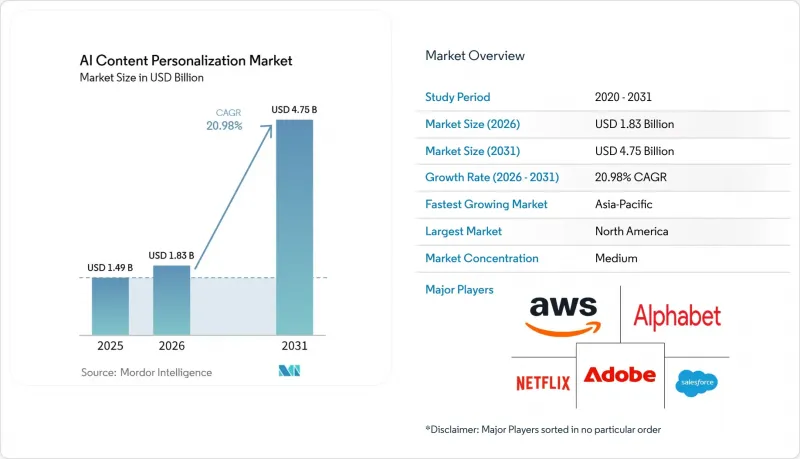
根據 Mordor Intelligence 預測,人工智慧驅動的內容個人化市場將從 2025 年的 14.9 億美元和 2026 年的 18.3 億美元成長到 2031 年的 47.5 億美元,2026 年至 2031 年的複合年成長率為 20.98%。
本報告按應用領域(內容建議、行銷和廣告個人化、客戶體驗個人化、受眾分析及其他應用)、最終用戶(串流平台、廣播公司和有線電視網路、電信業者、數位平台及其他最終用戶)和地區進行細分。市場預測以美元(USD)為單位。
全球人工智慧驅動的內容個人化市場趨勢與洞察
對高度個人化受眾體驗的需求日益成長
隨著內容庫的不斷擴充,通用內容輪播對許多觀眾的效用正在下降,尤其是在眾多服務爭奪用戶注意力的競爭環境中。德勤2026年的一項調查發現,如果串流影片服務能夠提供基於生成式人工智慧的建議,22%的粉絲會更頻繁地使用該服務。近30%的受訪者也希望獲得結合串流媒體、社群媒體和智慧財產權新聞的個人化摘要。當建議能夠幫助觀眾完整觀看他們開始觀看的內容時,其商業價值就最為顯著。此外,當語言、觀看習慣和內容庫偏好與西方訓練資料有差異時,針對特定區域的模型能夠為本地服務提供更強大的競爭基礎。因此,隨著內容庫的日益豐富和多樣化,對於那些希望保持用戶參與的服務而言,人工智慧驅動的內容個人化市場至關重要。
利用生成式人工智慧進行創新和線生成
生成式人工智慧正從實驗性功能轉向建立串流媒體主頁的實用方法。 Netflix 的「GenPage」利用觀看歷史記錄和請求上下文生成行、實體和頁面佈局,並將它們整合到一個結構化的輸出中。 Netflix 報告稱,線上 A/B 測試使端到端交付延遲降低了 20%,核心用戶參與度指標也得到了顯著提升。離線檢驗還發現,增強的提示資訊使加權二元分類損失降低了 6.9%,優於簡單地擴展模型處理能力的方法。這些方法使服務提供者能夠最佳化行名稱、封面圖和頁面結構,而無需為每個變體單獨進行手動編輯。因此,隨著服務提供者在不降低頁面載入速度的前提下追求更精細的個人化,人工智慧 (AI) 內容個人化市場正在從中受益。
資料居住要求和同意的複雜性
資料居住要求和使用者同意要求可能會限制個人化系統可取得的行為資訊。歐洲資料保護委員會於2025年發布的《數位服務法案》和《一般資料保護規則》(GDPR)指南規定,基於追蹤的使用者畫像分析需要明確同意,建議系統必須提供退出使用者畫像分析的選項。與基於更廣泛行為圖譜建構的系統相比,僅依賴第一方訊號並獲得使用者同意的企業可能缺乏足夠的訓練資料。針對符合GDPR的建議系統的研究發現,平均需要超過30次使用者互動才能產生令人信服的預測。人工智慧驅動的內容個人化市場可能會經歷更長的新用戶冷啟動期,這可能會給進入新司法管轄區的企業帶來更大的負擔。因此,人工智慧驅動的內容個人化市場必須在提供有價值的使用者體驗的同時,為客戶提供有意義的隱私選擇。
細分市場分析
截至2025年,內容建議在人工智慧驅動的內容個人化市場規模中佔34.04%。這個市場地位反映了累積互動資料的價值,因為每一次額外的會話都會增強協同過濾訊號。這種數據優勢可能會使參與企業更難趕上現有建議的品質。客戶體驗個人化預計將在2026年至2031年間以21.08%的複合年成長率成長。這一轉變反映了從單一內容行到協調整個會話(包括首頁、導航和搜尋)的趨勢。 Netflix的「GenPage」是頁面層級產生的典範,而Adobe的「CX Enterprise」則代表了一種更廣泛的客戶經驗編配方法。人工智慧驅動的內容個人化市場正朝著更廣泛的個人化定義發展,不僅涵蓋觀眾選擇的標題,還包括周圍的體驗。
在行銷和廣告個人化領域,隨著第三方 Cookie 的重要性下降,基於使用者同意的第一方訊號正日益受到重視。 Taboola 的「Realize+」利用決策引擎進行跨宣傳活動系列預算管理,並提供元素產生工具來最佳化創新和目標受眾。受眾分析透過收集訊號並將其反饋到最佳化流程中來支援這些應用。因此,對於許多買家而言,這已成為一個基礎層,而非獨立體驗。其他應用場景包括語音助理個性化和互動式內容適配,儘管這些仍在商業化發展階段。連網電視設定有望提供超越傳統螢幕會話的更豐富的行為訊號。人工智慧驅動的內容個人化產業還可以為企業學習、醫療保健內容入口網站和金融服務做出貢獻,而源自串流媒體的技術有望支持更高價值的互動。這些相關應用拓展了核心個人化功能的商業性價值。
區域分析
到2025年,北美將佔據全部區域%的市場。該地區受益於集中的研發投入和來自訂閱影片服務的大規模收入。德勤的一份報告顯示,近90%的美國家庭平均訂閱了四項影片服務。在這個成熟的AI驅動型內容個人化市場中,互動品質和客戶維繫是核心競爭挑戰。程序化廣告系統也正在推動個人化內容發現與廣告收入的更緊密結合。
亞太地區預計將成為成長最快的地區,2026年至2031年的複合年成長率將達到21.73%。這一成長主要得益於印度、韓國、日本和澳洲OTT服務的擴張,以及全部區域人工智慧工程能力的不斷提升。 Media Partners Asia預測,到2030年,印度將超越中國,成為全球最大的訂閱影片市場,個人訂閱用戶將達到3.58億。在印度,由於OTT內容有很大一部分是以本地語言觀看,因此在地化需求十分迫切。人工智慧系統正被用於翻譯各種印度語言的字幕、電子節目指南(EPG)描述和字幕說明。中國本土影片平台也正在開發生成式建議和直播個人化系統,這些系統有望在南亞和東南亞市場佔有一席之地。
歐洲和南美分別是第三和第四大區域市場。儘管歐洲的普及受到隱私和透明度要求的限制,但德國和英國仍然是注重隱私的個人化服務的重要中心。德國網路使用者協會 (BVDW) 2025 年的一項調查顯示,41% 的德國網路用戶願意共用他們的使用資料以改善內容建議。在以巴西為首的南美,隨著 OTT 的擴張和本地語言節目的製作,個人化服務的基礎正在逐步奠定。中東和非洲仍處於起步階段,但沙烏地阿拉伯媒體的數位化以及南非 OTT 的廣泛應用正在支撐著長期需求。這些區域差異要求人工智慧驅動的內容個人化市場必須兼顧在地化、資料管治和操作便利性。
其他好處:
- Excel格式的市場預測(ME)表
- 3個月的分析師支持
目錄
第1章:引言
- 研究假設和市場定義
- 調查範圍
第2章:調查方法
第3章執行摘要
第4章 市場狀況
- 市場概覽
- 市場促進因素
- 對高度個人化受眾體驗的需求日益成長
- 擴展即時行動決策
- 混合建議架構的快速普及
- 長尾內容目錄貨幣化的需求日益成長
- 對優先考慮隱私的個人化架構的需求。
- 利用 GenAI 進行創新和行生成
- 市場限制因素
- 新用戶和新遊戲的冷啟動準確率有差異。
- 資料儲存位置和知情同意程序的複雜性
- 在內容管理系統 (CMS)、客戶關係管理系統 (CRM)、客戶資料平台 (CDP) 和整個廣告技術堆疊之間進行進階整合。
- 個人化疲勞與對營運風險的認知
- 產業價值鏈分析
- 監理情勢
- 技術展望
- 波特五力分析
第5章 市場規模與成長預測
- 透過使用
- 推薦內容
- 行銷和廣告個人化
- 個人化客戶經驗
- 受眾分析
- 其他用途
- 最終用戶
- 串流媒體平台
- 廣播公司及有線電視網路
- 電信營運商
- 數位平台
- 其他最終用戶
- 按地區
- 北美洲
- 美國
- 加拿大
- 墨西哥
- 南美洲
- 巴西
- 阿根廷
- 智利
- 其他南美國家
- 歐洲
- 德國
- 英國
- 法國
- 義大利
- 西班牙
- 其他歐洲國家
- 亞太地區
- 中國
- 日本
- 印度
- 韓國
- 澳洲
- 其他亞太國家
- 中東
- 沙烏地阿拉伯
- 阿拉伯聯合大公國
- 卡達
- 其他中東國家
- 非洲
- 南非
- 埃及
- 奈及利亞
- 其他非洲國家
- 北美洲
第6章 競爭情勢
- 市場集中度
- 策略趨勢
- Vendor Positioning Analysis
- 公司簡介
- Netflix, Inc.
- Amazon.com, Inc.
- Alphabet Inc.
- Adobe Inc.
- International Business Machines Corporation
- Salesforce, Inc.
- Oracle Corporation
- Sitecore A/S
- Bloomreach, Inc.
- Taboola.com Ltd.
- Outbrain Inc.
- Revcontent, Inc.
- ThinkAnalytics Ltd.
- Kaltura, Inc.
- Brightcove Inc.
- Viaccess-Orca
- Dynamic Yield(Mastercard)
- Wurl, LLC
- ContentWise Srl
- Personyze Ltd.
第7章 市場機會與未來展望
According to Mordor Intelligence, the AI content personalization market size is projected to expand from USD 1.49 billion in 2025 and USD 1.83 billion in 2026 to USD 4.75 billion by 2031, registering a CAGR of 20.98% between 2026 and 2031.
This report is Segmented by Application (Content Recommendation, Marketing and Advertising Personalization, Customer Experience Personalization, Audience Analytics, and Other Applications), End User (Streaming Platforms, Broadcaster and Cable Networks, Telecom Operators, Digital Platforms, and Other End Users), and Geography. The Market Forecasts Provided in Terms of Value (USD).
Global AI Content Personalization Market Trends and Insights
Rising Demand for Hyper-Personalized Viewer Journeys
Catalog growth is making generic content carousels less useful for many viewers, especially when several services compete for the same attention. Deloitte's 2026 survey found that 22% of fans would use streaming video services more if they offered generative AI-based recommendations. Nearly 30% of respondents also wanted a personalized digest that combined streaming, social, and intellectual-property news. The underlying business case is strongest when recommendations help viewers complete more of the content they begin. Localized models can also give regional services a stronger basis for competing when language, viewing habits, and catalog preferences differ from those in Western training data. This makes the AI content personalization market important to services seeking to protect engagement as their libraries become broader and more varied.
GenAI-Assisted Creative and Row Generation
Generative AI is moving from an experimental feature toward a practical way to build streaming homepages. Netflix's GenPage uses viewing history and request context to generate rows, entities, and page layouts into a single, structured output. Netflix reported a 20% reduction in end-to-end serving latency and a statistically significant improvement in its core engagement metric during online A/B testing. Its offline work also found that prompt enrichment reduced the weighted binary classification loss by 6.9%, outperforming simply scaling model capacity. These approaches allow services to tailor row names, artwork, and page structure without depending on a separate human editorial process for every variation. The artificial intelligence (AI) content personalization market therefore benefits as operators seek more detailed personalization without slower page load times.
Data Residency and Consent Complexity
Data residency and consent requirements can limit the behavioral information available to personalization systems. The European Data Protection Board's 2025 guidance on the Digital Services Act and GDPR states that tracking-based profiling requires explicit consent and that recommender systems must provide non-profiling options. Operators that rely only on consented first-party signals can have less data for training than systems built on broader behavioral graphs. A study of GDPR-compliant recommender systems found that, on average, more than 30 user interactions were needed before compelling predictions could be generated. The AI content personalization market can face a longer cold-start period for new users and create a greater burden for operators entering additional jurisdictions. The AI content personalization market must therefore support useful experiences while allowing customers to make meaningful privacy choices.
Other drivers and restraints analyzed in the detailed report include:
- Expansion of Real-Time Behavioral Decisioning
- Rapid Adoption of Hybrid Recommendation Architectures
- High Integration Effort Across CMS, CRM, CDP, and Ad Tech Stacks
For complete list of drivers and restraints, kindly check the Table Of Contents.
Segment Analysis
Content recommendation accounted for 34.04% of the AI content personalization market size in 2025. Its position reflects the value of accumulated interaction data, because each additional session can strengthen collaborative filtering signals. That data advantage can make it more difficult for later entrants to match established recommendation quality. Customer experience personalization is projected to grow at a CAGR of 21.08% from 2026 to 2031. This shift reflects a move from standalone content rows to session-wide adjustments across homepages, navigation, and search. Netflix's GenPage illustrates page-level generation, while Adobe's CX Enterprise represents a broader approach to customer experience orchestration. The AI content personalization market is moving toward a broader definition of personalization that encompasses the surrounding experience rather than just the title selected for a viewer.
Marketing and advertising personalization also benefits from the growing use of consent-based first-party signals as third-party cookie pools become less central. Taboola's Realize+ uses a decision engine for cross-campaign budget decisions and an element generator for creative and targeting optimization. Audience analytics supports these applications by gathering signals and feeding them back into the optimization process. It is consequently an enabling layer rather than a separate experience for many buyers. Other applications include voice assistant personalization and interactive content adaptation, which remain less developed at a commercial scale. Connected television settings may provide rich behavioral signals beyond traditional screen sessions. The AI content personalization industry can also serve enterprise learning, healthcare content portals, and financial services, where streaming-derived methods may support higher-value engagements. These adjacent uses broaden the commercial role of core personalization capabilities.
Complete Report Scope:
- By Application
- Content Recommendation
- Marketing and Advertising Personalization
- Customer Experience Personalization
- Audience Analytics
- Other Applications
- By End User
- Streaming Platforms
- Broadcaster and Cable Networks
- Telecom Operators
- Digital Platforms
- Other End Users
- By Geography
- North America
- United States
- Canada
- Mexico
- South America
- Brazil
- Argentina
- Chile
- Rest of South America
- Europe
- Germany
- United Kingdom
- France
- Italy
- Spain
- Rest of Europe
- Asia-Pacific
- China
- Japan
- India
- South Korea
- Australia
- Rest of Asia-Pacific
- Middle East
- Saudi Arabia
- United Arab Emirates
- Qatar
- Rest of Middle East
- Africa
- South Africa
- Egypt
- Nigeria
- Rest of Africa
- North America
Geography Analysis
North America held 42.76% share of the regional total in 2025. The region benefits from concentrated technology research and development spending and large subscription video revenue pools. Deloitte reported that nearly 90% of US households subscribed to an average of 4 subscription video services. In this mature AI content personalization market, engagement quality and retention are central competitive issues. Programmatic advertising systems also support closer links between personalized discovery and advertising yield.
Asia-Pacific is projected to be the fastest-growing region, with a CAGR of 21.73% from 2026 to 2031. Growth is supported by expanding OTT services in India, South Korea, Japan, and Australia, as well as by stronger AI engineering capabilities across the region. Media Partners Asia projected that India will surpass China as the largest subscription video market by 2030, with 358 million individual subscriptions. India presents a demanding localization setting because regional-language viewing accounts for a major share of OTT consumption. AI systems are being used for subtitles, electronic program guide descriptions, and caption translation across Indian languages. China's domestic video platforms are also developing generative recommendation and live-streaming personalization systems that could compete in South and Southeast Asia.
Europe and South America were the third- and fourth-largest regional markets, respectively. European adoption is moderated by privacy and transparency requirements, although Germany and the United Kingdom remain important centers for privacy-compliant personalization. A 2025 BVDW study found that 41% of German internet users were willing to share their usage data to improve content recommendations. South America, led by Brazil, is building personalization capacity alongside OTT expansion and local-language programming. The Middle East and Africa remain early-stage markets, though media digitalization in Saudi Arabia and broader OTT adoption in South Africa support longer-term demand. These regional differences require the artificial intelligence (AI) content personalization market to combine localization, data governance, and operational simplicity.
- Netflix, Inc.
- Amazon.com, Inc.
- Alphabet Inc.
- Adobe Inc.
- International Business Machines Corporation
- Salesforce, Inc.
- Oracle Corporation
- Sitecore A/S
- Bloomreach, Inc.
- Taboola.com Ltd.
- Outbrain Inc.
- Revcontent, Inc.
- ThinkAnalytics Ltd.
- Kaltura, Inc.
- Brightcove Inc.
- Viaccess-Orca
- Dynamic Yield (Mastercard)
- Wurl, LLC
- ContentWise S.r.l.
- Personyze Ltd.
Additional Benefits:
- The market estimate (ME) sheet in Excel format
- 3 months of analyst support
TABLE OF CONTENTS
1 INTRODUCTION
- 1.1 Study Assumptions and Market Definition
- 1.2 Scope of the Study
2 RESEARCH METHODOLOGY
3 EXECUTIVE SUMMARY
4 MARKET LANDSCAPE
- 4.1 Market Overview
- 4.2 Market Drivers
- 4.2.1 Rising Demand for Hyper-Personalized Viewer Journeys
- 4.2.2 Expansion of Real-Time Behavioral Decisioning
- 4.2.3 Rapid Adoption of Hybrid Recommendation Architectures
- 4.2.4 Growing Need to Monetize Long-Tail Content Catalogs
- 4.2.5 Demand for Privacy-First Personalization Architectures
- 4.2.6 GenAI-Assisted Creative and Row Generation
- 4.3 Market Restraints
- 4.3.1 Cold-Start Accuracy Gaps for New Users and New Titles
- 4.3.2 Data Residency and Consent Complexity
- 4.3.3 High Integration Effort Across CMS, CRM, CDP and Ad Tech Stacks
- 4.3.4 Personalization Fatigue and Perceived Manipulation Risk
- 4.4 Industry Value Chain Analysis
- 4.5 Regulatory Landscape
- 4.6 Technological Outlook
- 4.7 Porter's Five Forces Analysis
- 4.7.1 Bargaining Power of Buyers
- 4.7.2 Bargaining Power of Suppliers
- 4.7.3 Threat of New Entrants
- 4.7.4 Threat of Substitutes
- 4.7.5 Intensity of Competitive Rivalry
5 MARKET SIZE AND GROWTH FORECASTS (VALUE)
- 5.1 By Application
- 5.1.1 Content Recommendation
- 5.1.2 Marketing and Advertising Personalization
- 5.1.3 Customer Experience Personalization
- 5.1.4 Audience Analytics
- 5.1.5 Other Applications
- 5.2 By End User
- 5.2.1 Streaming Platforms
- 5.2.2 Broadcaster and Cable Networks
- 5.2.3 Telecom Operators
- 5.2.4 Digital Platforms
- 5.2.5 Other End Users
- 5.3 By Geography
- 5.3.1 North America
- 5.3.1.1 United States
- 5.3.1.2 Canada
- 5.3.1.3 Mexico
- 5.3.2 South America
- 5.3.2.1 Brazil
- 5.3.2.2 Argentina
- 5.3.2.3 Chile
- 5.3.2.4 Rest of South America
- 5.3.3 Europe
- 5.3.3.1 Germany
- 5.3.3.2 United Kingdom
- 5.3.3.3 France
- 5.3.3.4 Italy
- 5.3.3.5 Spain
- 5.3.3.6 Rest of Europe
- 5.3.4 Asia-Pacific
- 5.3.4.1 China
- 5.3.4.2 Japan
- 5.3.4.3 India
- 5.3.4.4 South Korea
- 5.3.4.5 Australia
- 5.3.4.6 Rest of Asia-Pacific
- 5.3.5 Middle East
- 5.3.5.1 Saudi Arabia
- 5.3.5.2 United Arab Emirates
- 5.3.5.3 Qatar
- 5.3.5.4 Rest of Middle East
- 5.3.6 Africa
- 5.3.6.1 South Africa
- 5.3.6.2 Egypt
- 5.3.6.3 Nigeria
- 5.3.6.4 Rest of Africa
- 5.3.1 North America
6 COMPETITIVE LANDSCAPE
- 6.1 Market Concentration
- 6.2 Strategic Moves
- 6.3 Vendor Positioning Analysis
- 6.4 Company Profiles (includes Global Level Overview, Market Level Overview, Core Segments, Financials as available, Strategic Information, Products and Services, Recent Developments)
- 6.4.1 Netflix, Inc.
- 6.4.2 Amazon.com, Inc.
- 6.4.3 Alphabet Inc.
- 6.4.4 Adobe Inc.
- 6.4.5 International Business Machines Corporation
- 6.4.6 Salesforce, Inc.
- 6.4.7 Oracle Corporation
- 6.4.8 Sitecore A/S
- 6.4.9 Bloomreach, Inc.
- 6.4.10 Taboola.com Ltd.
- 6.4.11 Outbrain Inc.
- 6.4.12 Revcontent, Inc.
- 6.4.13 ThinkAnalytics Ltd.
- 6.4.14 Kaltura, Inc.
- 6.4.15 Brightcove Inc.
- 6.4.16 Viaccess-Orca
- 6.4.17 Dynamic Yield (Mastercard)
- 6.4.18 Wurl, LLC
- 6.4.19 ContentWise S.r.l.
- 6.4.20 Personyze Ltd.
7 MARKET OPPORTUNITIES AND FUTURE OUTLOOK
- 7.1 White-Space and Unmet-Need Assessment

 人工智慧驅動的學生評估市場預測至2034年:全球分析(按組成部分、評估類型、技術、部署模式、應用、最終用戶和地區分類)人工智慧驅動的學習分析市場預測至2034年:全球分析(按組件、分析類型、技術、部署模式、應用、最終用戶和地區分類)學習分析軟體市場預測至2034年-按軟體類型、分析類型、部署模式、組織規模、應用、最終用戶和地區分類的全球分析教育產業預測分析市場預測(至2034年)-按組成部分、資料來源、技術、部署模式、應用、最終用戶和地區分類的全球分析
 OTT建議引擎:市佔率分析、產業趨勢與統計、成長預測(2026-2031年)個人化行銷內容和宣傳活動自動化中的生成式人工智慧:市場佔有率分析、產業趨勢和統計數據以及成長預測(2026-2031 年)FocusIQ 2034 年市場預測:按解決方案類型、部署模式、技術、應用、最終用戶和地區分類的全球分析AI職業輔導平台市場預測至2034年:按組件、部署模式、技術、應用、最終用戶和地區分類的全球分析
 2026年全球人工智慧(AI)職業教練市場報告2026年全球訂閱體驗平台市場報告