


 |
市場調查報告書
商品編碼
2118199
法律知識管理軟體:市場佔有率分析、產業趨勢與統計及成長預測(2026-2031)Legal Knowledge Management Software - Market Share Analysis, Industry Trends & Statistics, Growth Forecasts (2026 - 2031) |
||||||

※ 本網頁內容可能與最新版本有所差異。詳細情況請與我們聯繫。
根據 Mordor Intelligence 預測,到 2031 年,法律知識管理軟體市場規模預計將達到 38.7 億美元,複合年成長率為 16.41%,從 2025 年的 15.6 億美元成長到 2026 年的 18.1 億美元。
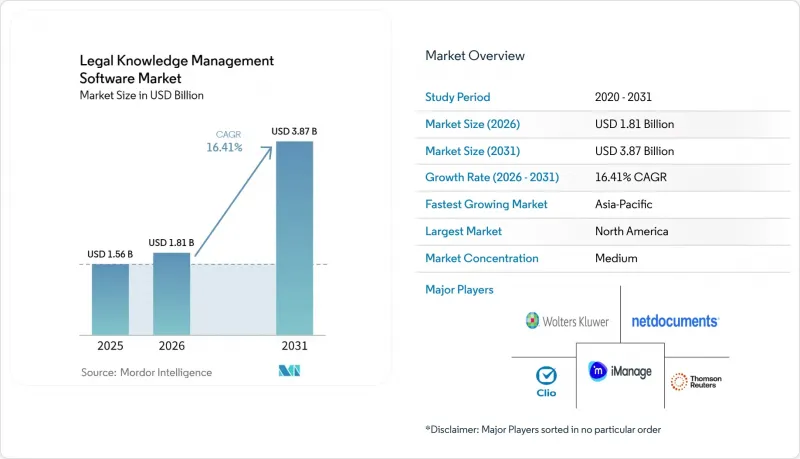
本報告按部署方式(雲端、本地部署、混合部署)、應用領域(法律研究和案例管理、文件和知識庫管理等)、功能(智慧搜尋和檢索、工作流程自動化等)、最終用戶產業(律師事務所等)以及地區進行細分。市場預測以美元計價。
全球法律知識管理軟體市場趨勢與洞察
對人工智慧驅動的法律搜尋和收購的需求日益成長。
法律知識管理軟體市場正在經歷轉型,其搜尋功能正從關鍵字搜尋轉向能夠識別案件背景、律師經驗和相關工作成果的搜尋。法律團隊已經開始朝著這個方向發展,92%的法律專業人士表示,到2026年,他們每天至少會使用一種人工智慧工具,52%的專業人士表示,人工智慧驅動的營運已直接提升了6%至20%的收入。這一趨勢正在改變軟體需求,因為買家現在期望知識管理系統不僅能夠定位資料夾和文件,還能從內部記錄中提供可操作的答案。這種優勢並非完全歸功於人工智慧;iManage的報告顯示,擁有強大知識庫的組織實現年收入成長的可能性幾乎是其他組織的兩倍。因此,法律知識管理軟體市場更接近核心人工智慧基礎設施,而不僅僅是後勤部門支援工具。能夠提高跨儲存庫搜尋準確性的供應商更有可能獲得更高的預算。這是因為更高的搜尋準確性(召回率)和排名準確性將對效率、回應速度以及以往法律工作成果在計費服務中的再利用產生積極影響。
專案和團隊之間對知識重用的需求日益成長。
此外,由於律師事務所和法務部門希望重複利用以往的成果,而不是反覆花費資金進行相同的分析,法律知識管理軟體市場正在不斷擴張。在法律案件中,條款、爭議點、談判歷史和內部指導文件往往是通用的,但這些資料通常分散在文件管理系統、電子郵件和小型資料庫中,缺乏完善的元資料管理系統。 iManage 的一項調查顯示,72% 的組織計劃在未來兩年內投資新的文件或知識管理平台,這表明系統更新周期十分普遍。當法務部門需要更快地解答反覆出現的供應商、合約和監管問題時,重複利用的價值尤其明顯。因此,法律知識管理軟體市場正從簡單的儲存功能轉向能夠將先例、案例歷史和專業知識以搜尋的結構連結起來的系統。此外,採購標準日益嚴格,買家越來越要求將管治和可審計性內建於知識層,而不是稍後使用單獨的工具添加。
對資料安全和客戶保密性的擔憂
法律知識管理軟體市場目前面臨的最大障礙是如何處理特權和機密客戶資訊。由於管理缺陷可能同時導致道德、合約和監管風險,法律採購負責人對這些系統的評估比許多其他企業應用更為嚴格。 Wolters Kluwer 的一項調查顯示,到 2026 年,39% 的法律人工智慧 (AI) 實施公司面臨的最大挑戰將是道德問題和資料隱私。當公司需要匯入大量案例歷史時,這些問題會阻礙實施,因為他們必須先決定哪些內容可以搜尋、誰可以存取以及如何監控 AI 的輸出。因此,認證和控制措施的證明在企業採購流程中變得越來越重要,尤其對於那些旨在向大型律師事務所和受監管企業銷售產品的供應商而言更是如此。由於買家仍不確定搜尋能否與嚴格的保密性和特權保護相結合,法律知識管理軟體市場的普及率可能仍將不平衡。
細分市場分析
到2025年,基於雲端的解決方案將佔據法律知識管理軟體市場48.93%的佔有率,成為該類別的主導部署模式。這一地位歸功於其基礎設施負擔低、易於更新以及對分散式法律運營的廣泛支持。法律知識管理軟體市場已發展到雲端不再被許多買家視為實驗性交付模式的階段。目前,雲端已成為許多新部署的預設選擇,而本地部署環境的使用範圍日益受限於高度監管的用例。供應商能夠快速地向大規模的基本客群部署人工智慧功能、安全性修補程式和介面變更,這也是買家傾向於採用雲端的另一個原因。
預計到2031年,混合部署將以每年18.13%的速度成長,這一成長速度顯示許多公司尋求的不僅僅是雲端遷移。當部分知識庫需要保留在受司法管轄的環境中,而其他工作流程則受益於共用搜尋和協作時,混合架構尤其有效。對於服務居住和保密要求各不相同的跨境客戶的公司而言,這種平衡尤為重要。因此,在法律知識管理軟體市場,能夠將通用的搜尋體驗與強大的基於位置的控制相結合的供應商備受青睞。對於希望完全掌控自身基礎設施的政府機構和保守型企業客戶而言,本地部署仍然十分重要,但其角色正從主流選擇轉變為專業選擇。
至2025年,文件和知識庫管理將佔法律知識管理軟體市場規模的39.71%,並持續成為整體應用支出中的核心部分。這個領域仍然至關重要,因為律師事務所擁有長期累積的工作成果、範本、操作手冊和客戶記錄,這些都需要系統化整理,才能在日常法律工作中創造價值。該領域的成功很大程度上仍然依賴這些知識庫中標籤、索引和授權的品質。如果沒有這項基礎,人工智慧工具可能只能產生表面結果,或遺漏事務所內部已有的相關資料。法律知識管理軟體市場將繼續受益於有助於搜尋、分類和大規模重複利用儲存內容的投資。
預計到2031年,案件和訴訟知識管理將以19.28%的年均成長率成長,成為市場上成長最快的應用領域。買家越來越重視交易歷史、訴訟策略、談判模式和內部決策,因為此類知識通常比僅僅訪問一般文件更具商業性價值。法律知識管理軟體產業正朝著將儲存庫內容與正在進行的案件的事實和工作流程連結起來的系統方向發展。這種轉變也提高了供應商的客戶維繫價值,因為與案件相關的洞察可以隨著時間的推移深深融入律師事務所的實踐和學習方法中。法律研究、案件管理和內部法律協作繼續發揮至關重要的支持作用,將內部知識與外部權威資訊和團隊協作聯繫起來。
區域分析
2025年,北美仍是最大的區域貢獻者,佔據法律知識管理軟體市場39.57%的佔有率。該地區受益於大型律師事務所的高度集中、法律技術方面的巨額預算以及成熟的工作流程和知識工具採購文化。美國仍然是需求中心,因為許多大型律師事務所和企業法務部門都設在美國。隨著供應商基於當地案例法和可靠的國家資料集建立人工智慧能力,加拿大的重要性也日益凸顯。 2026年6月,Clio透過收購Jurisage進一步鞏固了在該地區的地位,此次收購將利用加拿大的法律資料基礎設施,支援人工智慧驅動的法律營運。
歐洲在法律知識管理軟體市場仍佔據著舉足輕重的地位,因為與其他許多地區相比,合規性要求對產品設計的影響更為直接。該地區的買家更加重視特定司法管轄區的託管、可審計性以及對託管人工智慧的存取。這為那些不僅能展現豐富功能,還能展現成熟管治的供應商創造了有利的市場環境。沃特斯·克魯維爾於2026年3月將其Libra部署擴展至東歐,這顯示地域擴張和以合規性為中心的部署如何能夠成為歐洲法律科技領域的競爭優勢。英國、德國和法國仍然是極為重要的市場,這得益於其龐大的法律服務生態系統以及監管要求帶來的更嚴格的軟體選擇標準。
預計到2031年,亞太地區將以18.43%的複合年成長率成長,成為法律知識管理軟體市場成長最快的區域板塊。這一成長主要得益於雲端運算的普及、法律職能的復興以及對人工智慧驅動的法律工作流程日益成長的興趣。印度受惠於中小律師事務所更容易取得SaaS工具,而中國則正在開發本土化的法律技術,以滿足當地的訴訟程序和語言需求。澳洲、日本和韓國的需求市場更為成熟,買家正在利用更強大的搜尋和管治功能來增強其現有的法律技術體系。南美洲仍處於應用初期,成長動能主要集中在大型企業的法律部門和領先的本土律師事務所。中東和非洲地區仍在發展中,但預計數位化法律業務的擴展將支撐未來對在地化法律知識基礎設施的需求。
其他好處:
- Excel格式的市場預測(ME)表
- 3個月的分析師支持
目錄
第1章:引言
- 研究假設和市場定義
- 調查範圍
第2章:調查方法
第3章執行摘要
第4章 市場狀況
- 市場概覽
- 市場促進因素
- 對人工智慧驅動的法律資訊搜尋和檢索的需求日益成長。
- 專案和團隊之間對知識重用的需求日益成長。
- 擴展「雲端優先」法律工作流程
- 對合規性和可審計性的要求日益提高
- 擴大遠端和混合模式下的法律服務提供範圍
- 文件管理及與業務平台整合的進展
- 市場限制因素
- 對資料安全和客戶資訊保密性的擔憂。
- 與現有法律體系融合過程中的摩擦
- 大型律師事務所和公司的轉換成本很高。
- 使用者對工作流程變更的抵觸情緒以及確保知識保留的努力。
- 產業價值鏈分析
- 科技趨勢
- 監理情勢
- 宏觀經濟因素對市場的影響
- 波特五力分析
第5章 市場規模與成長預測
- 不同的發展
- 基於雲端的
- 現場
- 混合
- 透過使用
- 法律研究和案例法管理
- 文件和知識庫管理
- 專案和案例研究的知識管理
- 企業法律合作
- 功能性別
- 智慧搜尋和搜尋結果顯示
- 工作流程自動化
- 分析和報告能力
- 內容管治和版本控制
- 按最終用戶行業分類
- 律師事務所
- 公司法務部
- 政府機構
- 學術和研究機構
- 其他終端用戶產業
- 按地區
- 北美洲
- 美國
- 加拿大
- 墨西哥
- 南美洲
- 巴西
- 阿根廷
- 其他南美國家
- 歐洲
- 英國
- 德國
- 法國
- 其他歐洲國家
- 亞太地區
- 中國
- 日本
- 印度
- 韓國
- 澳洲
- 其他亞太國家
- 中東和非洲
- 中東
- 阿拉伯聯合大公國
- 沙烏地阿拉伯
- 其他中東國家
- 非洲
- 南非
- 肯亞
- 其他非洲國家
- 中東
- 北美洲
第6章 競爭情勢
- 市場集中度
- 策略趨勢
- 市佔率分析
- 公司簡介
- Thomson Reuters Corporation
- iManage LLC
- NetDocuments Software Inc.
- Clio Manage
- Wolters Kluwer NV
- LexisNexis Legal and Professional
- Litera Microsystems, LLC
- OpenText Corporation
- Knovos LLC
- Anaqua, Inc.
- Worldox(World Software Corporation)
- DocuWare Corporation
- The Access Group
- Everlaw, Inc.
- Mitratech Holdings, Inc.
- LegalSifter, Inc.
- PracticePanther Legal Software LLC
- Gavel and Gown Software Inc.
- World Software Corporation
- LEAP Legal Software Pty Ltd
- ContractPodAi
- SirionLabs
第7章 市場機會與未來展望
According to Mordor Intelligence, the legal knowledge management software market size stood at USD 1.56 billion in 2025 and USD 1.81 billion in 2026 and is forecast to reach USD 3.87 billion by 2031 at a CAGR of 16.41%.
This report is Segmented by Deployment (Cloud-Based, On-Premises, and Hybrid), Application (Legal Research and Precedent Management, Document and Knowledge Repository Management, and More), Functionality (Intelligent Search and Retrieval, Workflow Automation, and More), End User Industry (Law Firms, and More), and Geography. The Market Forecasts are Provided in Terms of Value (USD).
Global Legal Knowledge Management Software Market Trends and Insights
Growing Demand for AI-Assisted Legal Search and Retrieval
The legal knowledge management software market is being reshaped by the move from keyword search toward retrieval that can recognize matter context, attorney experience, and related work product. Legal teams are already working in that direction because 92% of legal professionals reported daily use of at least 1 AI tool in 2026, and 52% said AI-assisted work directly lifted revenue by 6%-20%. That pattern is changing software demand because buyers now expect knowledge systems to return usable answers from internal records instead of only locating folders and files. The gain is not coming from AI alone, because iManage reported that organizations with stronger knowledge foundations were nearly twice as likely to report year-over-year revenue growth. The legal knowledge management software market, therefore, sits closer to core AI infrastructure than to a supporting back-office tool. Vendors that improve retrieval precision across repositories are likely to capture more budget because better recall and ranking affect billable efficiency, response speed, and reuse of prior legal work.
Rising Need for Knowledge Reuse Across Matters and Teams
The legal knowledge management software market is also advancing because firms and in-house teams are under pressure to reuse prior work instead of paying for the same analysis many times. Legal matters often share clauses, issues, negotiation history, and internal guidance, but that material is usually spread across document systems, emails, and local storage with weak metadata discipline. iManage found that 72% of organizations planned to invest in a new document or knowledge management platform within the next 2 years, which shows how broad the replacement cycle has become. The value of reuse is especially clear where legal departments want faster answers on recurring supplier, contract, and regulatory questions. That is why the legal knowledge management software market is moving beyond simple storage toward systems that connect precedent, matter history, and know-how in a searchable structure. Procurement standards are also becoming stricter, which means buyers increasingly want governance and auditability built into the knowledge layer rather than added later through separate tools.
Data Security and Client Confidentiality Concerns
The legal knowledge management software market still faces its strongest barrier in the handling of privileged and confidential client information. Legal buyers evaluate these systems more strictly than many other enterprise applications because a control failure can create ethical, contractual, and regulatory exposure at the same time. Wolters Kluwer found that ethical concerns and data privacy were the top challenges for 39% of legal AI implementers in 2026. That concern slows deployment when firms need to ingest large volumes of matter history, since they must first decide what content can be queried, who can access it, and how AI outputs should be supervised. Certification and proof of controls have therefore moved closer to the center of enterprise buying processes, especially for vendors trying to sell into large firms and regulated corporate environments. The legal knowledge management software market will keep seeing uneven adoption where buyers remain unconvinced that search convenience can coexist with strict confidentiality and privilege protection.
Other drivers and restraints analyzed in the detailed report include:
- Expansion of Cloud-First Legal Workflows
- Increasing Compliance and Auditability Requirements
- Integration Friction With Legacy Legal Systems
For complete list of drivers and restraints, kindly check the Table Of Contents.
Segment Analysis
Cloud-based solutions held 48.93% of the legal knowledge management software market in 2025, which made this the leading deployment model across the category. That position reflected the lower infrastructure burden, easier updates, and wider support for distributed legal work. The legal knowledge management software market has reached a point where cloud is no longer treated as an experimental delivery model for most buyers. It is now the default path for many new deployments, while on-premises setups are increasingly reserved for highly regulated use cases. Buyers also favor cloud deployments because they help vendors roll out AI features, security patches, and interface changes faster across large customer bases.
Hybrid deployment is projected to grow at 18.13% through 2031, and that pace shows that many firms want more than a simple cloud migration story. Hybrid architecture works well where part of the knowledge base must stay in a jurisdictionally controlled environment, while other workflows benefit from shared search and collaboration. This balance is especially important for firms serving cross-border clients with varied residency and confidentiality expectations. The legal knowledge management software market is, therefore, rewarding vendors that can combine common search experiences with strong location-based controls. On-premises deployments are still relevant for government agencies and conservative enterprise buyers that want full infrastructure control, but their role is shifting from mainstream choice to specialized option.
Document and knowledge repository management accounted for 39.71% of the legal knowledge management software market size in 2025, which kept it at the center of spending across applications. This segment remains the foundation because firms have years of work product, templates, playbooks, and client records that need structure before they can deliver value in daily legal work. Much of the category still depends on the quality of tagging, indexing, and permissioning within these repositories. Without that base, AI tools may produce shallow results or miss relevant material that already exists inside the firm. The legal knowledge management software market continues to benefit from investments that make stored content easier to search, classify, and reuse at scale.
Matter and case knowledge management is forecast to grow at 19.28% through 2031, which makes it the fastest-moving application area in the market. Buyers are placing more value on deal history, case strategy, negotiation patterns, and internal decisions because that knowledge is often more commercially useful than generic document access alone. The legal knowledge management software industry is moving toward systems that can connect repository content with the facts and workflow of a live matter. That shift also raises retention value for vendors, because matter-linked intelligence can become deeply embedded in how firms work and learn over time. Legal research and precedent management, along with enterprise legal collaboration, still play important supporting roles because they help connect internal knowledge with external authority and shared team execution.
Complete Report Scope:
- By Deployment
- Cloud-Based
- On-Premises
- Hybrid
- By Application
- Legal Research and Precedent Management
- Document and Knowledge Repository Management
- Matter and Case Knowledge Management
- Enterprise Legal Collaboration
- By Functionality
- Intelligent Search and Retrieval
- Workflow Automation
- Analytics and Reporting
- Content Governance and Version Control
- By End User Industry
- Law Firms
- Corporate Legal Departments
- Government Agencies
- Academic and Research Institutions
- Other End User Industries
- By Geography
- North America
- United States
- Canada
- Mexico
- South America
- Brazil
- Argentina
- Rest of South America
- Europe
- United Kingdom
- Germany
- France
- Rest of Europe
- Asia-Pacific
- China
- Japan
- India
- South Korea
- Australia
- Rest of Asia-Pacific
- Middle East and Africa
- Middle East
- United Arab Emirates
- Saudi Arabia
- Rest of Middle East
- Africa
- South Africa
- Kenya
- Rest of Africa
- Middle East
- North America
Geography Analysis
North America held 39.57% of the legal knowledge management software market share in 2025, which kept it as the largest regional contributor. The region benefits from a high concentration of large law firms, larger legal technology budgets, and a mature buying culture for workflow and knowledge tools. The United States remains the center of demand because many of the biggest law firms and enterprise legal departments are based there. Canada is gaining importance as vendors shape AI capabilities around local precedent and trusted domestic datasets. Clio strengthened that regional position in June 2026 when it acquired Jurisage to support AI-powered legal work in Canada with a Canadian legal data foundation.
Europe remains a strong region in the legal knowledge management software market because compliance expectations are shaping product design more directly than in many other regions. Buyers across the region place a heavier weight on jurisdiction-specific hosting, auditability, and controlled AI access. That creates a favorable environment for vendors that can prove governance maturity rather than only feature breadth. Wolters Kluwer expanded Libra across Eastern Europe in March 2026, which showed how regional scale and compliance-focused rollout can become a competitive advantage in European legal technology. The United Kingdom, Germany, and France remain especially important because their legal services ecosystems are large and their regulatory expectations make software selection more rigorous.
Asia-Pacific is projected to grow at an 18.43% CAGR through 2031, which makes it the fastest-growing regional block in the legal knowledge management software market. Growth in the region is supported by expanding cloud adoption, more active legal operations functions, and a rising interest in AI-supported legal workflows. India is benefiting from easier access to SaaS tools for smaller and mid-sized firms, while China is developing domestic legal technology suited to local procedural and language needs. Australia, Japan, and South Korea represent more mature demand pockets where buyers are extending existing legal technology stacks with stronger retrieval and governance features. South America remains earlier in adoption, with momentum concentrated in large corporate legal departments and leading domestic law firms. The Middle East and Africa is still nascent, but directionally it supports future demand for localized legal knowledge infrastructure as digital legal work expands.
- Thomson Reuters Corporation
- iManage LLC
- NetDocuments Software Inc.
- Clio Manage
- Wolters Kluwer N.V.
- LexisNexis Legal and Professional
- Litera Microsystems, LLC
- OpenText Corporation
- Knovos LLC
- Anaqua, Inc.
- Worldox (World Software Corporation)
- DocuWare Corporation
- The Access Group
- Everlaw, Inc.
- Mitratech Holdings, Inc.
- LegalSifter, Inc.
- PracticePanther Legal Software LLC
- Gavel and Gown Software Inc.
- World Software Corporation
- LEAP Legal Software Pty Ltd
- ContractPodAi
- SirionLabs
Additional Benefits:
- The market estimate (ME) sheet in Excel format
- 3 months of analyst support
TABLE OF CONTENTS
1 INTRODUCTION
- 1.1 Study Assumptions and Market Definition
- 1.2 Scope of the Study
2 RESEARCH METHODOLOGY
3 EXECUTIVE SUMMARY
4 MARKET LANDSCAPE
- 4.1 Market Overview
- 4.2 Market Drivers
- 4.2.1 Growing Demand for AI-Assisted Legal Search and Retrieval
- 4.2.2 Rising Need for Knowledge Reuse Across Matters and Teams
- 4.2.3 Expansion of Cloud-First Legal Workflows
- 4.2.4 Increasing Compliance and Auditability Requirements
- 4.2.5 Growth in Remote and Hybrid Legal Service Delivery
- 4.2.6 Rising Integration With Document Management and Practice Platforms
- 4.3 Market Restraints
- 4.3.1 Data Security and Client Confidentiality Concerns
- 4.3.2 Integration Friction With Legacy Legal Systems
- 4.3.3 High Switching Costs for Large Law Firms and Enterprises
- 4.3.4 User Resistance to Workflow Change and Knowledge Capture Discipline
- 4.4 Industry Value-Chain Analysis
- 4.5 Technology Outlook
- 4.6 Regulatory Landscape
- 4.7 Impact of Macroeconomic Factors on the Market
- 4.8 Porter's Five Forces Analysis
- 4.8.1 Threat of New Entrants
- 4.8.2 Bargaining Power of Buyers
- 4.8.3 Bargaining Power of Suppliers
- 4.8.4 Threat of Substitutes
- 4.8.5 Intensity of Competitive Rivalry
5 MARKET SIZE AND GROWTH FORECASTS (VALUE)
- 5.1 By Deployment
- 5.1.1 Cloud-Based
- 5.1.2 On-Premises
- 5.1.3 Hybrid
- 5.2 By Application
- 5.2.1 Legal Research and Precedent Management
- 5.2.2 Document and Knowledge Repository Management
- 5.2.3 Matter and Case Knowledge Management
- 5.2.4 Enterprise Legal Collaboration
- 5.3 By Functionality
- 5.3.1 Intelligent Search and Retrieval
- 5.3.2 Workflow Automation
- 5.3.3 Analytics and Reporting
- 5.3.4 Content Governance and Version Control
- 5.4 By End User Industry
- 5.4.1 Law Firms
- 5.4.2 Corporate Legal Departments
- 5.4.3 Government Agencies
- 5.4.4 Academic and Research Institutions
- 5.4.5 Other End User Industries
- 5.5 By Geography
- 5.5.1 North America
- 5.5.1.1 United States
- 5.5.1.2 Canada
- 5.5.1.3 Mexico
- 5.5.2 South America
- 5.5.2.1 Brazil
- 5.5.2.2 Argentina
- 5.5.2.3 Rest of South America
- 5.5.3 Europe
- 5.5.3.1 United Kingdom
- 5.5.3.2 Germany
- 5.5.3.3 France
- 5.5.3.4 Rest of Europe
- 5.5.4 Asia-Pacific
- 5.5.4.1 China
- 5.5.4.2 Japan
- 5.5.4.3 India
- 5.5.4.4 South Korea
- 5.5.4.5 Australia
- 5.5.4.6 Rest of Asia-Pacific
- 5.5.5 Middle East and Africa
- 5.5.5.1 Middle East
- 5.5.5.1.1 United Arab Emirates
- 5.5.5.1.2 Saudi Arabia
- 5.5.5.1.3 Rest of Middle East
- 5.5.5.2 Africa
- 5.5.5.2.1 South Africa
- 5.5.5.2.2 Kenya
- 5.5.5.2.3 Rest of Africa
- 5.5.5.1 Middle East
- 5.5.1 North America
6 COMPETITIVE LANDSCAPE
- 6.1 Market Concentration
- 6.2 Strategic Moves
- 6.3 Market Share Analysis
- 6.4 Company Profiles (includes Global Level Overview, Market Level Overview, Core Segments, Financials as available, Strategic Information, Market Rank/Share, Products and Services, Recent Developments)
- 6.4.1 Thomson Reuters Corporation
- 6.4.2 iManage LLC
- 6.4.3 NetDocuments Software Inc.
- 6.4.4 Clio Manage
- 6.4.5 Wolters Kluwer N.V.
- 6.4.6 LexisNexis Legal and Professional
- 6.4.7 Litera Microsystems, LLC
- 6.4.8 OpenText Corporation
- 6.4.9 Knovos LLC
- 6.4.10 Anaqua, Inc.
- 6.4.11 Worldox (World Software Corporation)
- 6.4.12 DocuWare Corporation
- 6.4.13 The Access Group
- 6.4.14 Everlaw, Inc.
- 6.4.15 Mitratech Holdings, Inc.
- 6.4.16 LegalSifter, Inc.
- 6.4.17 PracticePanther Legal Software LLC
- 6.4.18 Gavel and Gown Software Inc.
- 6.4.19 World Software Corporation
- 6.4.20 LEAP Legal Software Pty Ltd
- 6.4.21 ContractPodAi
- 6.4.22 SirionLabs
7 MARKET OPPORTUNITIES AND FUTURE OUTLOOK
- 7.1 White-Space and Unmet-Need Assessment

 知識管理軟體市場預測至2034年-按組件、部署類型、組織規模、功能、最終用戶和地區分類的全球分析
 2026年全球協作與知識管理市場報告
 全球知識管理軟體市場規模、佔有率、趨勢和成長分析報告(2026-2034年)2026年全球知識管理軟體市場報告人工智慧市場預測(至2034年):知識管理領域全球分析(按工具類型、組件、價格範圍、應用、最終用戶和地區分類)2026年全球知識管理市場報告2026年全球人工智慧知識管理系統市場報告
 2026-2030年全球知識管理軟體市場
 人工智慧知識管理工具市場:2026-2032年全球預測(按組件、部署類型、組織規模、人工智慧類型、應用程式和最終用戶分類)
 知識管理軟體市場規模、佔有率和成長分析(按部署類型、功能、最終用戶和地區分類)—產業預測(2026-2033 年)