


 |
市場調查報告書
商品編碼
2118047
多智慧體系統:市場佔有率分析、產業趨勢與統計、成長預測(2026-2031 年)Multi-Agent Systems - Market Share Analysis, Industry Trends & Statistics, Growth Forecasts (2026 - 2031) |
||||||

※ 本網頁內容可能與最新版本有所差異。詳細情況請與我們聯繫。
根據 Mordor Intelligence 預測,多智慧體系統的市場規模預計將從 2025 年的 47.2 億美元成長到 2026 年的 58.4 億美元,到 2031 年將達到 209.8 億美元,2026 年至 2031 年的複合年成長率為 29.15%。
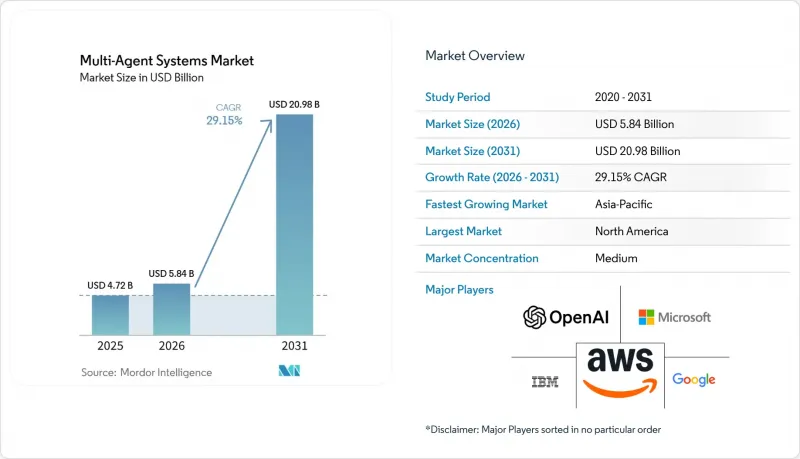
本報告按元件(軟體和服務)、部署模式(雲端和本地部署)、企業規模(大型企業和中小企業)、應用(工作流程和流程協作、軟體工程自動化等)、最終用戶產業(銀行、金融服務和保險、IT和電信等)以及地區進行細分。市場預測以價值(美元)表示。
全球多智慧體系統市場趨勢與洞察
企業對自主工作流程編配的需求
自主工作流程編配正超越前導測試階段,成為多智慧體系統市場中企業的正式優先事項。在高價值工作流程中,多個專家代理通常需要在同一流程中共用狀態、工具和升級規則,因此買家不再需要獨立的代理功能。這一點在採購核准、監管報告、財務營運和IT變更管理等領域尤為明顯,在這些領域,單一工作流程在完成之前往往需要經過多個內部團隊。因此,多智慧體系統市場對能夠將工作流程控制、管治、路由和整合整合到單一操作環境中的編配平台的需求日益成長。這種轉變也擴大了合約範圍,因為企業越來越傾向於將編配軟體、中介軟體和策略管理作為一個統一的軟體包進行部署,而不是單獨購買。能夠儘早獲得此編配層的供應商將在企業內部各個職能部門部署擴展的過程中,在客戶留存方面擁有顯著優勢。
大規模語言模型與多智慧體框架的融合
大規模語言模型與結構化編配框架的融合正在拓展多智慧體系統市場所能解決的問題範圍。 2026年4月,微軟在Copilot Studio中正式發表了多智慧體編配功能。這使得基於Microsoft Fabric、Microsoft 365 Agents SDK和開放的A2A協定所建構的智慧體能夠協作,共用實現企業目標。這導致供應商市場分化為兩類平台:一類是為嚴格控制的執行而建構的平台,另一類是為更具探索性或調查主導任務而設計的系統。 NVIDIA也在2026年3月發布了Agent Toolkit,該工具包結合了開放模型、執行時間元件和企業整合功能,旨在降低智慧體部署的營運門檻。降低這些門檻至關重要,因為成本敏感度仍然是中小企業面臨的一大挑戰。隨著基於LLM的推理整合到編配邏輯中變得越來越容易,預計多智慧體系統市場將更廣泛地採用那些以前僅靠基於規則的自動化難以處理的複雜功能。
代理框架之間缺乏互通性標準
缺乏互通性仍是多智慧體系統市場廣泛應用的最大障礙之一。基於不同框架構建的智慧體仍然無法以原生且一致的方式交換任務狀態、內存和管治元資料,迫使企業圍繞它們構建自定義整合層。這導致交付週期延長、實施成本增加,並且在同一配置環境中使用多個框架時,難以監控系統行為。雖然 A2A 協議改善了供應商委託能力,但企業仍需要額外的控制措施來管理更廣泛的生產環境中的管治和工作流程一致性。這個問題在大型企業中尤其突出,因為智慧體數量的無序成長超過了標準化流程。在多智慧體系統市場,這導致平台採購週期延長,並且在實現規模化之前更加依賴系統整合工作。
細分市場分析
2025年,軟體仍將是整個多智慧體系統市場最大的收入來源,佔67.23%的市佔率。這個細分市場包括編配平台、智慧體開發框架和協調中間件,這也解釋了為什麼企業支出主要集中在平台授權和訂閱主導交付模式上。買家通常會從軟體開始部署,因為在添加更廣泛的服務層之前,路由邏輯、管治控制和工具整合等功能都已在軟體中定義。在多智慧體系統市場,軟體銷售也受惠於更新帶來的經濟效益,因為一旦企業標準化了其編配邏輯,切換到其他供應商可能會造成業務中斷。 IBM在「Think 2026」中將watsonx Orchestrate擴展到更廣泛的智慧體控制平面,這表明供應商正在深化平台層,以保持其在企業部署領域的策略主導。
預計到2031年,服務板塊的複合年成長率將達到29.01%,成為多智慧體系統市場中成長最快的細分板塊。這主要是因為許多實施方案在從試點階段過渡到全面生產之前,仍然需要諮詢、整合、測試、客製化和託管支援。當智慧體系統需要與ERP、CRM、HRMS、資料管治和安全工具整合時,整合尤為重要,因為這些工具在設計之初並未考慮共用智慧體編配。正因如此,即使企業尋求減少對人工實施支援的長期依賴,服務板塊仍保持強勁成長。因此,多智慧體系統產業的軟體供應商正在投資開發視覺化建構器、可重複使用模板和低程式碼開發層,以減少未來對專業服務的依賴。因此,儘管軟體仍然是多智慧體系統市場的主要收入驅動力,但由於實施方案日益複雜,服務業務也不斷擴張。
預計到2025年,雲端運算將佔據多智慧體系統市場73.56%的佔有率,並在2031年之前以28.32%的複合年成長率成長。雲端運算的主導地位源自於超大規模資料中心業者管理的終端節點減輕了企業在基礎設施擴展、運行時修補程式和編配維護方面的負擔,從而助力企業實現快速部署。這使得採購企業能夠縮短生產過渡期,尤其是在內部智慧體開發能力有限的早期採用階段。此外,雲端運算在多智慧體系統市場的橫向企業用例中也更受歡迎,因為託管環境提供了一個基本的管治介面,無需事先建立自訂基礎設施。這項優勢使得雲端運算成為跨多個業務職能進行廣泛工作流程編配的預設部署模式。
另一方面,在多智慧體系統市場,本地部署在嚴格監管且需要考慮主權問題的環境中仍然佔據著穩固的地位。國防、醫療保健、公共部門和金融服務機構通常需要比標準公共雲端模型更嚴格的資料儲存、安全邊界和營運課責控制。 UiPath 於 2026 年 5 月透過擴展其面向公共部門的自動化套件中的基於代理的 AI 功能來滿足這一需求。這使得政府機構能夠在自身環境中部署這些解決方案並應用管治。此舉意義重大,因為本地部署通常由於捆綁的基礎設施、支援和管治層而價格更高。因此,在多智慧體系統市場,本地部署並非被視為一種衰退的模式,而是為需要更嚴格控制的買家提供的優質架構。
區域分析
預計到2025年,北美將佔據41.89%的市場佔有率,繼續保持其在多智慧體系統市場的最大區域中心地位。該地區受益於超大規模資料中心業者投資、現有平台提供者以及能夠整合編配、管治和運算支出的大型企業人工智慧預算。美國憑藉其在軟體平台領域的領先地位以及金融服務、醫療保健、國防和數位業務職能部門的強勁企業需求,仍然是核心部署中心。加拿大正透過金融服務現代化和公共部門數位化發展成為第二大中心。雲端安全聯盟 (CSA) 關於 NIST CAISI 的說明也強調了對合規性標準和管治的期望如何影響整個北美企業環境的採購行為。
預計到2031年,亞太地區將以29.81%的複合年成長率(CAGR)實現最高成長,成為多智慧體系統市場中最具活力的成長區域。中國正透過政府主導的人工智慧項目,投資於製造業監控和物流協調。印度是擴充性的需求來源,因為IT服務公司正在對工程師進行智慧體工程的再培訓,並將編配能力納入交貨合約。日本正因製造業對勞動力替代的需求而推動多智慧體系統的應用,而新加坡則透過符合資料主權標準的雲端節點,支援本地化應用。韓國、澳洲和紐西蘭則透過專注於電子、半導體和企業自動化,進一步創造了需求,為多智慧體系統市場提供了廣泛的區域成長基礎,使其不再局限於單一國家。
在歐洲,德國、英國和法國的需求尤其強勁。工業自動化、企業軟體應用和金融服務業正在推動這些國家多智慧體系統的普及。該地區的一個關鍵特徵是對原管治編配工具日益成長的興趣,而這種興趣的驅動力與一些生產部署因合規性壓力而放緩的趨勢相同。這導致了更選擇性的採購模式,透明度、課責和部署模式的選擇以及速度都受到了更高的重視。在中東和非洲,多智慧體系統的應用仍處於起步階段,但沙烏地阿拉伯和阿拉伯聯合大公國(阿拉伯聯合大公國)正透過國家層面的數位轉型和人工智慧基礎設施優先事項進行投資,而土耳其和南非則在銀行自動化和電信領域湧現出更強大的企業叢集。總而言之,這些趨勢揭示了不同地區之間存在的差異,這取決於管治要求、產業結構和國家數位化能力。
其他好處:
- Excel格式的市場預測(ME)表
- 3個月的分析師支持
目錄
第1章:引言
- 研究假設和市場定義
- 調查範圍
第2章:調查方法
第3章執行摘要
第4章 市場狀況
- 市場概覽
- 市場促進因素
- 企業對自主工作流程編配的需求
- 大規模語言模型與多智慧體框架的融合
- 對即時、分散式決策的需求日益成長。
- 擴大機器人技術與工業自動化的合作
- 雲端原生代理開發棧的成長
- 增加開放原始碼代理框架和工具的重用
- 市場限制因素
- 代理框架之間缺乏互通性標準
- 管治、可審計性和合規性的複雜性。
- 計算、推理和 API編配。
- 能夠處理多智慧體系統的工程師短缺
- 產業價值鏈分析
- 監理情勢
- 技術展望
- 波特五力分析
- 宏觀經濟因素對市場的影響
第5章 市場規模與成長預測
- 按組件
- 軟體(包括代理編配平台、代理開發框架、代理通訊中間件、代理監控和可觀測性解決方案、代理管治和策略引擎)
- 服務(包括諮詢服務、系統整合服務、實施和營運管理服務以及培訓和支援服務)
- 部署模式
- 雲
- 現場
- 按公司規模
- 大公司
- 小型企業
- 透過使用
- 工作流程和流程編配
- 軟體工程中的自動化
- 自主研究與分析
- 網路安全自動化
- 供應鍊和物流最佳化
- 其他應用包括客戶服務自動化、決策支援和規劃、模擬以及數位孿生建模。
- 按最終用戶行業分類
- BFSI
- 資訊科技/通訊
- 製造業
- 醫療保健和生命科學
- 零售與電子商務
- 運輸/物流
- 其他終端用戶產業(政府和國防、能源和公共產業、媒體和娛樂等)
- 按地區
- 北美洲
- 美國
- 加拿大
- 南美洲
- 巴西
- 阿根廷
- 其他南美國家
- 歐洲
- 德國
- 英國
- 法國
- 義大利
- 西班牙
- 其他歐洲國家
- 亞太地區
- 中國
- 印度
- 日本
- 韓國
- 澳洲和紐西蘭
- 新加坡
- 其他亞太國家
- 中東和非洲
- 海灣合作理事會國家
- 土耳其
- 南非
- 其他中東和非洲國家
- 北美洲
第6章 競爭情勢
- 市場集中度
- 策略趨勢
- 市佔率分析
- 公司簡介
- Microsoft Corporation
- Google LLC
- Amazon Web Services, Inc.
- OpenAI, LLC
- IBM Corporation
- Salesforce, Inc.
- ServiceNow, Inc.
- UiPath, Inc.
- Anthropic PBC
- LangChain, Inc.
- CrewAI Inc.
- LlamaIndex, Inc.
- Automation Anywhere, Inc.
- SAP SE
- Oracle Corporation
- NVIDIA Corporation
- Writer, Inc.
- Cohere Inc.
- Glean Technologies, Inc.
- Moveworks, Inc.
第7章 市場機會與未來展望
According to Mordor Intelligence, the multi-Agent systems market size is expected to grow from USD 4.72 billion in 2025 to USD 5.84 billion in 2026 and is forecast to reach USD 20.98 billion by 2031 at 29.15% CAGR over 2026-2031.
This report is Segmented by Component (Software and Services), Deployment Mode (Cloud and On-Premises), Enterprise Size (Large Enterprises, and Small and Medium Enterprises), Application (Workflow and Process Orchestration, Software Engineering Automation, and More), End-User Industry (BFSI, IT and Telecommunications, and More), and Geography. The Market Forecasts are Provided in Terms of Value (USD).
Global Multi-Agent Systems Market Trends and Insights
Enterprise Demand for Autonomous Workflow Orchestration
Autonomous workflow orchestration has moved beyond pilot testing and is becoming a formal enterprise priority in the multi-agent systems market. Buyers are no longer looking for isolated agent functions, because higher-value workflows usually require several specialized agents to share state, tools, and escalation rules across the same process. This is especially relevant in procurement approvals, regulatory reporting, finance operations, and IT change management, where a single workflow often crosses several internal teams before completion. As a result, the multi-agent systems market is seeing stronger demand for orchestration platforms that bundle workflow control, governance, routing, and integration into a single operating environment. That shift is also lifting contract scope, because enterprises increasingly want orchestration software, middleware, and policy management together rather than as separate purchases. Vendors that secure this orchestration layer early are in a stronger position to retain customers as deployments widen across enterprise functions.
Convergence of Large Language Models and Multi-Agent Frameworks
The convergence of large language models and structured orchestration frameworks is widening the range of problems that the multi-agent systems market can address. Microsoft made multi-agent orchestration generally available in Copilot Studio in April 2026, allowing agents built across Microsoft Fabric, the Microsoft 365 Agents SDK, and the open A2A protocol to work toward shared enterprise goals. This is separating the vendor field into platforms built for tightly governed execution and systems aimed at more exploratory or research-led tasks. NVIDIA also introduced its Agent Toolkit in March 2026, combining open models, runtime components, and enterprise integrations to reduce the operational barrier to agent deployment. Lower deployment friction matters because the multi-agent systems market still faces cost sensitivity in small and medium business environments. As LLM reasoning becomes easier to integrate with orchestration logic, the multi-agent systems market is likely to see broader adoption for functions that were previously too complex for rule-based automation alone.
Lack of Interoperability Standards Across Agent Frameworks
Interoperability remains one of the clearest limits on wider adoption in the multi-agent systems market. Agents built on different frameworks still do not exchange task state, memory, or governance metadata in a native, consistent way, forcing enterprises to build custom integration layers around them. That increases delivery time, raises implementation cost, and makes system behavior harder to monitor when several frameworks are used in the same deployment. Even though the A2A protocol has improved cross-vendor delegation, enterprises still need additional controls to manage governance and workflow consistency across broader production environments. This problem is especially visible in large organizations where agent sprawl is increasing faster than standardization. In the multi-agent systems market, the result is a slower platform-buying cycle and greater reliance on systems integration effort before scale can be achieved.
Other drivers and restraints analyzed in the detailed report include:
- Rising Need for Real-Time Distributed Decision Making
- Expansion of Robotics and Industrial Automation Coordination
- Governance, Auditability, and Compliance Complexity
For complete list of drivers and restraints, kindly check the Table Of Contents.
Segment Analysis
Software held 67.23% share in 2025 and remained the largest revenue base across the multi-agent systems market. This segment includes orchestration platforms, agent development frameworks, and coordination middleware, which explains why enterprise spending is concentrated in platform licensing and subscription-led delivery models. Buyers typically begin with software because that is where routing logic, governance controls, and tool integration are defined before any broader services layer is added. In the multi-agent systems market, software revenue also benefits from renewal economics because once an enterprise standardizes its orchestration logic, switching becomes more disruptive. IBM expanded watsonx Orchestrate at Think 2026 into a broader agentic control plane, which shows how software vendors are deepening the platform layer to keep strategic control of enterprise deployments.
Services are projected to grow at a 29.01% CAGR through 2031, making them the faster-growing subsegment in the multi-agent systems market. The main reason is that many deployments still require consulting, integration, testing, customization, and managed support before they can move from the pilot stage to broad production use. Integration work is especially important when agent systems must connect with ERP, CRM, HRMS, data governance, and security tools that were not built for shared agent orchestration. This has created a situation in which service growth is strong even as enterprises aim to reduce long-term dependence on manual deployment support. The multi-agent systems industry is therefore seeing software vendors invest in visual builders, reusable templates, and low-code development layers to reduce the intensity of professional services over time. As a result, the multi-agent systems market keeps software as its revenue anchor, while services expand alongside increasing implementation complexity.
Cloud accounted for 73.56% of the multi-agent systems market size in 2025 and advanced at a 28.32% CAGR through 2031. Cloud led because hyperscaler-managed endpoints reduce the burden of infrastructure scaling, runtime patching, and orchestration maintenance for enterprises that want faster deployment. This gives buyers a shorter path to production, especially in early-adopter phases when internal agent engineering capacity is limited. The multi-agent systems market also favors cloud for horizontal enterprise use cases because managed environments can provide baseline governance interfaces without requiring custom infrastructure work upfront. That early advantage has helped Cloud become the default deployment mode for broad workflow orchestration across several business functions.
On-premises has still gained a stronger footing in regulated and sovereignty-sensitive environments within the multi-agent systems market. Defense, healthcare, public sector, and financial services buyers often need tighter control over data residency, security boundaries, and operational accountability than standard public cloud models can easily support. UiPath addressed this requirement in May 2026 by extending agentic AI capabilities on Automation Suite for the public sector, enabling government organizations to run and govern these deployments within their own environments. That kind of move matters because on-premises deployments often carry higher contract values due to bundled infrastructure, support, and governance layers. The multi-agent systems market is therefore not treating on-premises as a declining model, but as a premium architecture for buyers with stricter control needs.
Complete Report Scope:
- By Component
- Software (Including Agent Orchestration Platforms, Agent Development Frameworks, Agent Communication Middleware, Agent Monitoring and Observability Solutions, and Agent Governance and Policy Engines)
- Services (Including Consulting Services, System Integration Services, Deployment and Managed Services, and Training and Support Services)
- By Deployment Mode
- Cloud
- On-Premises
- By Enterprise Size
- Large Enterprises
- Small and Medium Enterprises
- By Application
- Workflow and Process Orchestration
- Software Engineering Automation
- Autonomous Research and Analysis
- Cybersecurity Automation
- Supply Chain and Logistics Optimization
- Other Applications (Customer Service Automation, Decision Support and Planning, Simulation and Digital Twin Modeling, etc.)
- By End-User Industry
- BFSI
- IT and Telecommunications
- Manufacturing
- Healthcare and Life Sciences
- Retail and E-Commerce
- Transportation and Logistics
- Other End-User Industries (Government and Defense, Energy and Utilities, Media and Entertainment, etc.)
- By Geography
- North America
- United States
- Canada
- South America
- Brazil
- Argentina
- Rest of South America
- Europe
- Germany
- United Kingdom
- France
- Italy
- Spain
- Rest of Europe
- Asia-Pacific
- China
- India
- Japan
- South Korea
- Australia and New Zealand
- Singapore
- Rest of Asia-Pacific
- Middle East and Africa
- GCC Countries
- Turkey
- South Africa
- Rest of Middle East and Africa
- North America
Geography Analysis
North America accounted for 41.89% share in 2025 and remained the largest regional base in the multi-agent systems market. The region benefits from the concentration of hyperscaler investment, platform incumbents, and large enterprise AI budgets that can support orchestration, governance, and compute spending together. The United States remains the core adoption center because it combines software platform leadership with strong enterprise demand across financial services, healthcare, defense, and digital business functions. Canada is developing as a secondary node through financial services modernization and public-sector digitization. Cloud Security Alliance commentary tied to NIST CAISI also highlights how compliance-aware standards and governance expectations are shaping procurement behavior across North American enterprise environments.
Asia-Pacific is projected to record the fastest regional CAGR at 29.81% through 2031, making it the most dynamic growth zone in the multi-agent systems market. China is directing capital toward manufacturing supervision and logistics coordination through sovereign AI programs. India provides a scalable demand engine because IT services firms are re-skilling engineers for agent engineering and embedding orchestration capabilities into delivery contracts. Japan is pushing adoption through labor-substitution needs in manufacturing, while Singapore supports localized deployment through data-sovereignty compliant cloud nodes. South Korea, Australia, and New Zealand add further demand through electronics, semiconductors, and enterprise automation priorities, giving the multi-agent systems market a broad regional growth base rather than a single-country story.
Europe is seeing demand centered in Germany, the United Kingdom, and France, where industrial automation, enterprise software use, and financial services support deployment in the multi-agent systems market. The region is distinctive because the same compliance pressure that slows some production rollouts is also increasing interest in governance-native orchestration tools. That creates a more selective buying pattern in which transparency, accountability, and the choice of deployment model carry more weight than speed alone. In the Middle East and Africa, adoption is still early, but Saudi Arabia and the UAE are investing through national digital transformation and AI infrastructure priorities, while Turkey and South Africa represent stronger enterprise clusters in banking automation and telecom operations. Taken together, these patterns show that the multi-agent systems market is regionalizing around governance requirements, industrial structure, and national digital capacity.
- Microsoft Corporation
- Google LLC
- Amazon Web Services, Inc.
- OpenAI, LLC
- IBM Corporation
- Salesforce, Inc.
- ServiceNow, Inc.
- UiPath, Inc.
- Anthropic PBC
- LangChain, Inc.
- CrewAI Inc.
- LlamaIndex, Inc.
- Automation Anywhere, Inc.
- SAP SE
- Oracle Corporation
- NVIDIA Corporation
- Writer, Inc.
- Cohere Inc.
- Glean Technologies, Inc.
- Moveworks, Inc.
Additional Benefits:
- The market estimate (ME) sheet in Excel format
- 3 months of analyst support
TABLE OF CONTENTS
1 INTRODUCTION
- 1.1 Study Assumptions and Market Definition
- 1.2 Scope of the Study
2 RESEARCH METHODOLOGY
3 EXECUTIVE SUMMARY
4 MARKET LANDSCAPE
- 4.1 Market Overview
- 4.2 Market Drivers
- 4.2.1 Enterprise Demand for Autonomous Workflow Orchestration
- 4.2.2 Convergence of Large Language Models and Multi-Agent Frameworks
- 4.2.3 Rising Need for Real-Time Distributed Decision Making
- 4.2.4 Expansion of Robotics and Industrial Automation Coordination
- 4.2.5 Growth of Cloud-Native Agent Development Stacks
- 4.2.6 Increasing Reuse of Open-Source Agent Frameworks and Tooling
- 4.3 Market Restraints
- 4.3.1 Lack of Interoperability Standards Across Agent Frameworks
- 4.3.2 Governance, Auditability, and Compliance Complexity
- 4.3.3 Escalating Compute, Inference, and API Orchestration Costs
- 4.3.4 Scarcity of Multi-Agent System-Ready Engineering Talent
- 4.4 Industry Value Chain Analysis
- 4.5 Regulatory Landscape
- 4.6 Technological Outlook
- 4.7 Porter's Five Forces Analysis
- 4.7.1 Bargaining Power of Suppliers
- 4.7.2 Bargaining Power of Buyers
- 4.7.3 Threat of New Entrants
- 4.7.4 Threat of Substitutes
- 4.7.5 Competitive Rivalry
- 4.8 Impact of Macroeconomic Factors on the Market
5 MARKET SIZE AND GROWTH FORECASTS (VALUE)
- 5.1 By Component
- 5.1.1 Software (Including Agent Orchestration Platforms, Agent Development Frameworks, Agent Communication Middleware, Agent Monitoring and Observability Solutions, and Agent Governance and Policy Engines)
- 5.1.2 Services (Including Consulting Services, System Integration Services, Deployment and Managed Services, and Training and Support Services)
- 5.2 By Deployment Mode
- 5.2.1 Cloud
- 5.2.2 On-Premises
- 5.3 By Enterprise Size
- 5.3.1 Large Enterprises
- 5.3.2 Small and Medium Enterprises
- 5.4 By Application
- 5.4.1 Workflow and Process Orchestration
- 5.4.2 Software Engineering Automation
- 5.4.3 Autonomous Research and Analysis
- 5.4.4 Cybersecurity Automation
- 5.4.5 Supply Chain and Logistics Optimization
- 5.4.6 Other Applications (Customer Service Automation, Decision Support and Planning, Simulation and Digital Twin Modeling, etc.)
- 5.5 By End-User Industry
- 5.5.1 BFSI
- 5.5.2 IT and Telecommunications
- 5.5.3 Manufacturing
- 5.5.4 Healthcare and Life Sciences
- 5.5.5 Retail and E-Commerce
- 5.5.6 Transportation and Logistics
- 5.5.7 Other End-User Industries (Government and Defense, Energy and Utilities, Media and Entertainment, etc.)
- 5.6 By Geography
- 5.6.1 North America
- 5.6.1.1 United States
- 5.6.1.2 Canada
- 5.6.2 South America
- 5.6.2.1 Brazil
- 5.6.2.2 Argentina
- 5.6.2.3 Rest of South America
- 5.6.3 Europe
- 5.6.3.1 Germany
- 5.6.3.2 United Kingdom
- 5.6.3.3 France
- 5.6.3.4 Italy
- 5.6.3.5 Spain
- 5.6.3.6 Rest of Europe
- 5.6.4 Asia-Pacific
- 5.6.4.1 China
- 5.6.4.2 India
- 5.6.4.3 Japan
- 5.6.4.4 South Korea
- 5.6.4.5 Australia and New Zealand
- 5.6.4.6 Singapore
- 5.6.4.7 Rest of Asia-Pacific
- 5.6.5 Middle East and Africa
- 5.6.5.1 GCC Countries
- 5.6.5.2 Turkey
- 5.6.5.3 South Africa
- 5.6.5.4 Rest of Middle East and Africa
- 5.6.1 North America
6 COMPETITIVE LANDSCAPE
- 6.1 Market Concentration
- 6.2 Strategic Moves
- 6.3 Market Share Analysis
- 6.4 Company Profiles (includes Global Level Overview, Market Level Overview, Core Segments, Financials as available, Strategic Information, Market Rank/Share, Products and Services, Recent Developments)
- 6.4.1 Microsoft Corporation
- 6.4.2 Google LLC
- 6.4.3 Amazon Web Services, Inc.
- 6.4.4 OpenAI, LLC
- 6.4.5 IBM Corporation
- 6.4.6 Salesforce, Inc.
- 6.4.7 ServiceNow, Inc.
- 6.4.8 UiPath, Inc.
- 6.4.9 Anthropic PBC
- 6.4.10 LangChain, Inc.
- 6.4.11 CrewAI Inc.
- 6.4.12 LlamaIndex, Inc.
- 6.4.13 Automation Anywhere, Inc.
- 6.4.14 SAP SE
- 6.4.15 Oracle Corporation
- 6.4.16 NVIDIA Corporation
- 6.4.17 Writer, Inc.
- 6.4.18 Cohere Inc.
- 6.4.19 Glean Technologies, Inc.
- 6.4.20 Moveworks, Inc.
7 MARKET OPPORTUNITIES AND FUTURE OUTLOOK
- 7.1 White-Space and Unmet-Need Assessment

 碰撞感測器:市場佔有率分析、產業趨勢與統計、成長預測(2026-2031)
 防撞感測器市場規模、佔有率和成長分析:按感測器機制、運作頻率、應用模式、最終用戶產業和地區分類-2026-2033年產業預測
 防撞感測器市場:按車輛類型、感測器類型和應用分類-2026-2032年全球市場預測
 2026-2030年全球多智慧體系統(MAS)平台市場
 全球多智慧體編配平台市場:依產品、容量、部署、編配模式、組織規模及最終用戶產業分類-市場規模、產業動態、機會分析及2026-2035年預測多智慧體系統(MAS)平台:市場佔有率分析、產業趨勢與統計及成長預測(2026-2031)
 碰撞避免感測器市場預測至2034年—按技術、應用、最終用戶和地區分類的全球分析
 2026年全球多智慧體系統市場報告2026年全球防碰撞感測器市場報告
 防撞感測器市場規模、佔有率、成長及全球產業分析:按類型、應用和地區分類的洞察,2026-2034 年預測