


 |
市場調查報告書
商品編碼
2114516
碰撞感測器:市場佔有率分析、產業趨勢與統計、成長預測(2026-2031)Collision Sensors - Market Share Analysis, Industry Trends & Statistics, Growth Forecasts (2026 - 2031) |
||||||

※ 本網頁內容可能與最新版本有所差異。詳細情況請與我們聯繫。
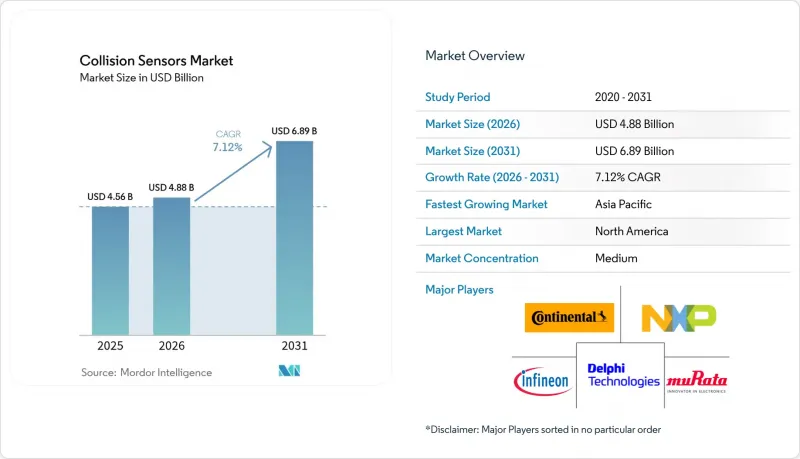
根據 Mordor Intelligence 預測,碰撞感測器市場規模將從 2025 年的 45.6 億美元成長到 2026 年的 48.8 億美元,然後在 2031 年達到 68.9 億美元,2026 年至 2031 年的複合年成長率為 7.12%。
本報告按應用領域(主動式車距維持定速系統、前向碰撞預警等)、技術(超音波、雷達等)、最終用戶(汽車、航太與國防、海事、鐵路、工業機器人及其他最終用戶)、車輛自動化級別(0-1級、2-3級、4-5級)和地區進行細分。市場預測以美元(USD)計價。
全球碰撞感測器市場趨勢及洞察
加強汽車安全法規
2024年,美國監管機構最終確定了相關法規,強制要求到2029年,所有新乘用車都必須配備行人自動緊急煞車系統(AEB)。這意味著汽車製造商(OEM)需要將熱成像攝影機和近紅外線攝影機與毫米波雷達整合,這將使物料清單(BOM)增加120至180美元。保險公司將以8%至12%的保費折扣作為這項投資的獎勵。歐洲新車安全評鑑協會(Euro NCAP)2024年的評測標準規定,在都市區路口缺乏自行車保護功能的車款將無法獲得五星評級,這將加速彎道雷達的普及應用。中國新車安全評鑑協會(C-NCAP)在2024年新增了「弱勢道路使用者」評估標準,促使國內供應商將低成本的超音波感測器與雷達結合,以控制轎車的價格上限。印度已製定一項計劃,強制要求到 2028 年為 120 萬輛重型卡車加裝前向碰撞警報系統,而日本則為車車齡10 年的車輛提供售後改裝套件補貼。
ADAS和自動駕駛技術的快速普及
Waymo在2024年底將業務擴展到洛杉磯和奧斯汀後,其付費自動駕駛計程車服務的累計乘車次數突破了200萬次。這表明,透過將遠端雷射雷達和成像雷達整合到感測器陣列中,其自動駕駛系統具備了L4等級的擴充性。特斯拉已交付180萬輛搭載FSD v12.5的汽車,該系統完全依賴鏡頭,但因在複雜極端情況下存在冗餘而受到批評。梅賽德斯-奔馳結合立體攝影機和雷射雷達,在加州和內華達州獲得了L3級別的認證,最高時速可達40英里/小時,從而將責任從駕駛員轉移到了汽車製造商(OEM)。隨著中國在2026年強制實施L2級的ADAS(高級駕駛輔助系統),預計每年將有約2800萬輛汽車安裝該系統,感測器市場將成為華為和德賽等公司的主導市場。通用汽車計劃在2025年整合Mobileye EyeQ6 Lite,目標是打造一套成本低於200美元的攝影機-雷達融合系統,以對抗特斯拉「僅視覺」的方案。
由於整合多個感測器,組件成本較高。
全套雷達、攝影機和雷射雷達系統會使車輛成本增加 600 至 1200 美元,限制了其在價格敏感型市場的普及。一級電子控制單元 (ECU) 需要高性能系統單晶片 (SoC),其成本佔高階駕駛輔助系統 (ADAS) 硬體成本的 45% 之多。為了避免超出關鍵的價格門檻,Martti Suzuki 已將 2024 年在其緊湊型轎車中引入二級 ADAS 的計劃推遲。車隊採購商通常優先考慮負載容量和燃油經濟性,傾向於選擇免手動駕駛選項。據 Stellantis 稱,南歐和南美的 ADAS 普及率低於 15%。
細分市場分析
到2025年,主動式車距維持定速系統將佔據碰撞感知器市場38.35%的主導佔有率,而自動緊急煞車(AEB)預計到2031年將以7.71%的複合年成長率成長。相當於保費8-12%的保險獎勵和美國聯邦法規正在推動其普及,而前向碰撞預警在大多數地區仍與AEB捆綁銷售。盲點監測在北美和歐洲的搭載率已超過60%,但隨著該功能成為標配,其成長速度正在放緩。超音波泊車感測器正面臨環景顯示影像系統的競爭壓力,供應商正透過添加自動泊車軟體來維持其附加價值。
其他先進功能,例如行人及騎乘者偵測,正在人口密集的都市區市場迅速普及。歐洲新車安全評鑑協會(Euro NCAP)針對摩托車交叉路口保護的評估標準,正迫使汽車製造商(OEM)採用彎道雷達和廣角攝影機。沃爾沃的「城市安全」系統已將保險索賠減少了28%,這充分證明了保護弱勢道路使用者解決方案的投資回報率(ROI)。電裝的緊湊型雷達模組正瞄準印度龐大的摩托車市場,並開拓新的相關市場。
由於雷達具有全年可靠性和成熟的供應鏈,預計到2025年,雷達將佔銷售額的62.15%。但隨著售價低於500美元的固態LiDAR單元在量產車級產品中普及,LiDAR的市場佔有率預計將以8.45%的複合年成長率逐漸下降。相機受益於高解析度CMOS感測器,但其低光性能仍然是一個挑戰,限制了其在L2以上等級的獨立應用。超音波感測器由於成本低廉,在低速應用中仍佔據主導地位。用於夜間行人偵測的紅外線模組和彌合被動安全與主動安全差距的MEMS壓力感測器正在推動細分市場的成長。
博世預計到2024年雷達出貨量將超過1億台,這得益於其採用的SiGe收發器和整合天線封裝(AIP)設計。大陸集團的第五代短程雷達預計到2026年將達到4度方位角解析度,價格低於40美元。 OmniVision推出了一款動態範圍達140 dB的500萬像素感應器,提升了隧道出口的性能。村田製作所將超音波輸出功率提高了40%,以滿足中國電動車市場的需求。
區域分析
預計到2025年,北美將佔全球銷售量的45.20%。這主要得益於全球最大的碰撞感知器市場的形成,而這又受到自動緊急煞車系統(AEB)強制實施和豪華車普及的推動。消費者願意為L2+等級的安全配置包支付1500至2500美元,保險公司也為配備前碰撞預警警報系統的車輛提供保費折扣。加拿大正在調整其標準,使其與美國國家公路交通安全管理局(NHTSA)的標準接軌,以迎接2028年的實施期限。同時,由於安全意識的提高,墨西哥的國內銷量也在成長。在半導體持續短缺的情況下,該地區的高階汽車製造商仍能優先獲得供應,從而增強了供應的穩定性。
亞太地區預計將成為成長最快的地區,複合年成長率(CAGR)達8.16%。中國將於2026年強制實施L2級自動駕駛系統,屆時每年將有2,800萬輛汽車受到影響,將為國內雷達和攝影機供應商帶來大規模穩定的基本客群。印度計畫在2028年為120萬輛重型卡車加裝前向碰撞警報系統,而要求配備六個安全氣囊的法規也正在增加每輛車的感測器數量。日本、韓國和台灣地區正利用其在光學和封裝技術方面的專長來擴大雷射雷達模組的出口。同時,東南亞國協預計將首先部署超音波泊車感測器,然後逐步升級到更先進的技術。
預計到2025年,歐洲將佔據約27%的市場佔有率,這主要得益於歐洲新車安全評鑑協會(Euro NCAP)極具影響力的五星評級體系,以及歐盟自2024年起強制所有新車配備自動緊急煞車(AEB)和車道維持輔助系統的通用安全法規。博世、大陸集團和採埃孚這三大德國供應商正透過垂直整合,在該地區保持高附加價值。在荷蘭,車聯網(V2X)協同感知技術正在2000公里的高速公路上進行試點,而法國和義大利則正在擴大電動車的獎勵計劃,強制要求電動車配備先進的安全功能。
除了南美洲,中東和非洲也是新興市場,但其銷售量佔不到10%。在巴西,電子穩定控制系統(ESC)和倒車影像的安裝是強制性的,這為未來碰撞感測器的普及奠定了基礎。在海灣國家,高階感測器套件正在智慧城市試點計畫中部署;而在南非,感測器主要安裝在出口到歐洲的車型上。
其他好處:
- Excel格式的市場預測(ME)表
- 3個月的分析師支持
目錄
第1章:引言
- 研究假設和市場定義
- 調查範圍
第2章:調查方法
第3章執行摘要
第4章 市場狀況
- 市場概覽
- 市場促進因素
- 加強汽車安全法規
- ADAS和自動駕駛技術的快速普及
- 固體雷射雷達的成本曲線正在下降。
- 利用V2X技術的預測性碰撞警報
- 電動車產量快速成長
- 老舊軍艦的軍事維修計劃
- 市場限制因素
- 多感測器融合中較高的物料清單成本
- 雪、霧和飛濺碎片造成的可靠性限制
- 半導體供應鏈的波動性
- 感測器網路中的網路安全漏洞
- 價值鏈分析
- 監理情勢
- 技術展望
- 波特五力分析
- 投資分析
第5章 市場規模與成長預測
- 透過使用
- 主動式車距維持定速系統
- 前方碰撞預警
- 盲點監測
- 車道偏離警示
- 停車感應器
- 後方交叉路口警示
- 自動緊急制動
- 其他用途
- 透過技術
- 超音波
- 雷達
- 攝影機/視覺
- LiDAR
- 紅外線的
- 壓力/MEMS
- 最終用戶
- 車
- 搭乘用車
- 輕型商用車
- 大型商用車輛
- 航太/國防
- 海上
- 鐵路
- 工業機器人
- 其他最終用戶
- 車
- 車輛自動駕駛水平
- 0-1級
- 2-3級
- 4-5級
- 按地區
- 北美洲
- 美國
- 加拿大
- 墨西哥
- 南美洲
- 巴西
- 阿根廷
- 其他南美國家
- 歐洲
- 德國
- 英國
- 法國
- 荷蘭
- 其他歐洲國家
- 亞太地區
- 中國
- 印度
- 日本
- 韓國
- 其他亞太國家
- 中東和非洲
- 中東
- 沙烏地阿拉伯
- 阿拉伯聯合大公國
- 其他中東國家
- 非洲
- 南非
- 奈及利亞
- 其他非洲國家
- 中東
- 北美洲
第6章 競爭情勢
- 市場集中度
- 策略趨勢
- 市佔率分析
- 公司簡介
- Continental AG
- Bosch GmbH
- Denso Corp.
- ZF Friedrichshafen AG
- Aptiv plc
- NXP Semiconductors NV
- Infineon Technologies AG
- Texas Instruments Inc.
- Murata Manufacturing Co.
- Aisin Corporation
- Delphi Automotive LLP
- Analog Devices Inc.
- Mobileye Global Inc.
- Velodyne LiDAR Inc.
- Hesai Technology
- Magna International Inc.
- Valeo SA
- Renesas Electronics
- Panasonic Corp.
- Omnivision Technologies
第7章 市場機會與未來展望
According to Mordor Intelligence, the collision sensors market size is expected to grow from USD 4.56 billion in 2025 to USD 4.88 billion in 2026 and is forecast to reach USD 6.89 billion by 2031 at 7.12% CAGR over 2026-2031.
This report is Segmented by Application (Adaptive Cruise Control, Forward Collision Warning, and More), Technology (Ultrasonic, Radar, and More), End-User (Automotive, Aerospace and Defense, Maritime, Rail, Industrial Robotics, and Other End-Users), Vehicle Autonomy Level (Level 0-1, Level 2-3, and Level 4-5), and Geography. The Market Forecasts are Provided in Terms of Value (USD).
Global Collision Sensors Market Trends and Insights
Enhanced Automotive Safety Regulations
Regulators in the United States finalized a rule in 2024 that requires pedestrian AEB on new passenger vehicles by 2029, prompting OEMs to integrate thermal or near-infrared cameras with millimeter-wave radar, incurring an additional USD 120-180 in bill-of-materials costs. Insurers reward this investment through 8-12% premium discounts. Euro NCAP's 2024 protocol withholds five-star ratings from models lacking cyclist protection at urban intersections, accelerating the rollout of corner radar. China's C-NCAP added vulnerable-road-user scoring in 2024, prompting domestic suppliers to combine low-cost ultrasonic sensors with radar to keep sedans under strict price ceilings. India drafted mandates that retrofit 1.2 million heavy trucks with forward-collision warning by 2028, while Japan subsidizes aftermarket kits for vehicles older than 10 years.
Rapid ADAS and Autonomous-Driving Rollout
Waymo surpassed 2 million paid robotaxi rides after expanding to Los Angeles and Austin in late 2024, proving Level 4 scalability once sensor suites marry long-range LiDAR with imaging radar. Tesla shipped FSD v12.5 to 1.8 million cars, relying on cameras only, but critics question redundancy during complex edge cases. Mercedes-Benz secured Level 3 approval in California and Nevada using stereo cameras plus LiDAR at speeds up to 40 mph, shifting liability from driver to OEM. China's 2026 Level 2 ADAS mandate equips roughly 28 million vehicles annually, solidifying a captive sensor market for Huawei and Desay. GM's 2025 integration of Mobileye EyeQ6 Lite targets sub-USD 200 camera-radar fusion to counter Tesla's vision-only path
High BOM Cost for Multi-Sensor Fusion
Full radar-camera-LiDAR stacks add USD 600-1,200 to vehicles, limiting penetration in price-sensitive markets. Tier-one ECUs account for up to 45% of ADAS hardware cost because they need high-performance SoCs. Maruti Suzuki postponed Level 2 ADAS on compact sedans in 2024 to avoid breaching key price thresholds. Fleet buyers often forgo hands-free options in favor of payload and fuel economy, and Stellantis reported sub-15% ADAS take-up across Southern Europe and South America.
Other drivers and restraints analyzed in the detailed report include:
- Falling Solid-State LiDAR Cost Curve
- V2X-Enabled Predictive Collision Alert
- Reliability Limits in Snow, Fog and Debris
For complete list of drivers and restraints, kindly check the Table Of Contents.
Segment Analysis
In 2025, adaptive cruise control commanded a dominant 38.35% share of the collision sensors market, while automatic emergency braking is projected to grow at an 7.71% CAGR, continuing through 2031. Insurance incentives worth 8-12% of premiums and U.S. federal mandates catalyze uptake, while forward-collision warning remains bundled with AEB in most regions. Blind-spot monitoring already exceeds a 60% fitment rate in North America and Europe, but growth is slowing now that the feature is standard. Ultrasonic parking sensors face pressure from surround-view cameras, suppliers react by adding automated-parking software to preserve value.
Other advanced functions, including pedestrian and cyclist detection, are rapidly gaining popularity in dense urban markets. Euro NCAP credits for motorcycle intersection protection force OEMs to integrate corner radar and wide-angle cameras. Volvo's City Safety system cut insurance claims by 28%, validating ROI for vulnerable-road-user solutions. Denso's compact radar module targets India's vast two-wheeler market, opening up a new adjacency.
Radar retained 62.15% revenue in 2025 thanks to year-round reliability and supply maturity, but LiDAR's 8.45% forecast CAGR will chip away as sub-USD 500 solid-state units become attainable for mass-market trims. Cameras gain from high-resolution CMOS sensors yet remain sensitive to low light, limiting solo use beyond Level 2. Ultrasonic sensors continue to dominate low-speed maneuvers due to their low cost. Infrared modules for night pedestrian detection and MEMS pressure sensors, which bridge the gap between passive and active safety, drive niche growth.
Bosch shipped more than 100 million radar units in 2024, leveraging SiGe transceivers and antenna-in-package designs. Continental's fifth-generation short-range radar is expected to deliver 4-degree azimuth resolution at a sub-USD 40 price point by 2026. Omnivision launched a 5MP sensor with 140 dB dynamic range, improving tunnel-exit performance. Murata raised the ultrasonic output 40% to serve Chinese EVs
Complete Report Scope:
- By Application
- Adaptive Cruise Control
- Forward Collision Warning
- Blind Spot Monitoring
- Lane Departure Warning
- Parking Sensors
- Rear Cross-Traffic Alert
- Automatic Emergency Braking
- Other Applications
- By Technology
- Ultrasonic
- Radar
- Camera / Vision
- LiDAR
- Infra-red
- Pressure / MEMS
- By End-User
- Automotive
- Passenger Vehicles
- Light Commercial Vehicles
- Heavy Commercial Vehicles
- Aerospace and Defense
- Maritime
- Rail
- Industrial Robotics
- Other End-Users
- Automotive
- By Vehicle Autonomy Level
- Level 0-1
- Level 2-3
- Level 4-5
- By Geography
- North America
- United States
- Canada
- Mexico
- South America
- Brazil
- Argentina
- Rest of South America
- Europe
- Germany
- United Kingdom
- France
- Netherlands
- Rest of Europe
- Asia-Pacific
- China
- India
- Japan
- South Korea
- Rest of Asia-Pacific
- Middle East and Africa
- Middle East
- Saudi Arabia
- United Arab Emirates
- Rest of Middle East
- Africa
- South Africa
- Nigeria
- Rest of Africa
- Middle East
- North America
Geography Analysis
North America contributed 45.20% of the 2025 revenue, as AEB mandates and premium-vehicle penetration created the world's largest collision sensor market. Consumers are willing to pay USD 1,500-2,500 for Level 2-plus bundles, and insurers reward forward-collision warning systems with lower premiums. Canada aligns its standards with those of the NHTSA for a 2028 deadline, while Mexico's domestic sales grow as safety awareness increases. Semiconductor allocations continue to favor the region's premium OEMs during shortages, thereby reinforcing supply resilience.
The Asia-Pacific region is set for an 8.16% CAGR, the highest regional growth rate. China's 2026 Level 2 mandate affects 28 million annual vehicles, ensuring a large captive base for domestic radar and camera suppliers. India plans to retrofit 1.2 million heavy trucks with forward-collision warning systems by 2028, and the six-airbag rules have already lifted the sensor content per vehicle. Japan, South Korea and Taiwan exploit optics and packaging expertise to export LiDAR modules, while ASEAN nations start with ultrasonic parking sensors before ascending the technology ladder.
Europe captured roughly 27% share in 2025 on the back of Euro NCAP's influential five-star criteria and the EU General Safety Regulation that requires AEB and lane-keeping assist on all new models from 2024 onward. Germany's supplier triad, Bosch, Continental and ZF, keeps value in-region through vertical integration. The Netherlands pilots V2X cooperative perception across 2,000 km of highways, while France and Italy expand electric-vehicle incentives that also mandate advanced safety functions.
South America plus the Middle East and Africa form a nascent market below 10% revenue. Brazil enforces electronic stability control and rear cameras, positioning for future collision-sensor uptake. Gulf states deploy premium sensor suites in smart-city pilots, and South Africa installs sensors mainly for export models bound for Europe.
- Continental AG
- Bosch GmbH
- Denso Corp.
- ZF Friedrichshafen AG
- Aptiv plc
- NXP Semiconductors N.V.
- Infineon Technologies AG
- Texas Instruments Inc.
- Murata Manufacturing Co.
- Aisin Corporation
- Delphi Automotive LLP
- Analog Devices Inc.
- Mobileye Global Inc.
- Velodyne LiDAR Inc.
- Hesai Technology
- Magna International Inc.
- Valeo SA
- Renesas Electronics
- Panasonic Corp.
- Omnivision Technologies
Additional Benefits:
- The market estimate (ME) sheet in Excel format
- 3 months of analyst support
TABLE OF CONTENTS
1 INTRODUCTION
- 1.1 Study Assumptions and Market Definition
- 1.2 Scope of the Study
2 RESEARCH METHODOLOGY
3 EXECUTIVE SUMMARY
4 MARKET LANDSCAPE
- 4.1 Market Overview
- 4.2 Market Drivers
- 4.2.1 Enhanced Automotive Safety Regulations
- 4.2.2 Rapid ADAS And Autonomous-Driving Rollout
- 4.2.3 Falling Solid-State Lidar Cost Curve
- 4.2.4 V2X-Enabled Predictive Collision Alert
- 4.2.5 Electrified-Vehicle Production Surge
- 4.2.6 Military Retro-Fit Programs For Legacy Fleets
- 4.3 Market Restraints
- 4.3.1 High BOM Cost For Multi-Sensor Fusion
- 4.3.2 Reliability Limits In Snow, Fog and Debris
- 4.3.3 Semiconductor Supply-Chain Volatility
- 4.3.4 Cyber-Security Exposure Of Sensor Networks
- 4.4 Value Chain Analysis
- 4.5 Regulatory Landscape
- 4.6 Technological Outlook
- 4.7 Porter's Five Forces Analysis
- 4.7.1 Threat of New Entrants
- 4.7.2 Bargaining Power of Buyers
- 4.7.3 Bargaining Power of Suppliers
- 4.7.4 Threat of Substitutes
- 4.7.5 Intensity of Competitive Rivalry
- 4.8 Investment Analysis
5 MARKET SIZE AND GROWTH FORECASTS (VALUE)
- 5.1 By Application
- 5.1.1 Adaptive Cruise Control
- 5.1.2 Forward Collision Warning
- 5.1.3 Blind Spot Monitoring
- 5.1.4 Lane Departure Warning
- 5.1.5 Parking Sensors
- 5.1.6 Rear Cross-Traffic Alert
- 5.1.7 Automatic Emergency Braking
- 5.1.8 Other Applications
- 5.2 By Technology
- 5.2.1 Ultrasonic
- 5.2.2 Radar
- 5.2.3 Camera / Vision
- 5.2.4 LiDAR
- 5.2.5 Infra-red
- 5.2.6 Pressure / MEMS
- 5.3 By End-User
- 5.3.1 Automotive
- 5.3.1.1 Passenger Vehicles
- 5.3.1.2 Light Commercial Vehicles
- 5.3.1.3 Heavy Commercial Vehicles
- 5.3.2 Aerospace and Defense
- 5.3.3 Maritime
- 5.3.4 Rail
- 5.3.5 Industrial Robotics
- 5.3.6 Other End-Users
- 5.3.1 Automotive
- 5.4 By Vehicle Autonomy Level
- 5.4.1 Level 0-1
- 5.4.2 Level 2-3
- 5.4.3 Level 4-5
- 5.5 By Geography
- 5.5.1 North America
- 5.5.1.1 United States
- 5.5.1.2 Canada
- 5.5.1.3 Mexico
- 5.5.2 South America
- 5.5.2.1 Brazil
- 5.5.2.2 Argentina
- 5.5.2.3 Rest of South America
- 5.5.3 Europe
- 5.5.3.1 Germany
- 5.5.3.2 United Kingdom
- 5.5.3.3 France
- 5.5.3.4 Netherlands
- 5.5.3.5 Rest of Europe
- 5.5.4 Asia-Pacific
- 5.5.4.1 China
- 5.5.4.2 India
- 5.5.4.3 Japan
- 5.5.4.4 South Korea
- 5.5.4.5 Rest of Asia-Pacific
- 5.5.5 Middle East and Africa
- 5.5.5.1 Middle East
- 5.5.5.1.1 Saudi Arabia
- 5.5.5.1.2 United Arab Emirates
- 5.5.5.1.3 Rest of Middle East
- 5.5.5.2 Africa
- 5.5.5.2.1 South Africa
- 5.5.5.2.2 Nigeria
- 5.5.5.2.3 Rest of Africa
- 5.5.5.1 Middle East
- 5.5.1 North America
6 COMPETITIVE LANDSCAPE
- 6.1 Market Concentration
- 6.2 Strategic Moves
- 6.3 Market Share Analysis
- 6.4 Company Profiles (includes Global level Overview, Market level overview, Core Segments, Financials as available, Strategic Information, Market Rank/Share, Products and Services, Recent Developments)
- 6.4.1 Continental AG
- 6.4.2 Bosch GmbH
- 6.4.3 Denso Corp.
- 6.4.4 ZF Friedrichshafen AG
- 6.4.5 Aptiv plc
- 6.4.6 NXP Semiconductors N.V.
- 6.4.7 Infineon Technologies AG
- 6.4.8 Texas Instruments Inc.
- 6.4.9 Murata Manufacturing Co.
- 6.4.10 Aisin Corporation
- 6.4.11 Delphi Automotive LLP
- 6.4.12 Analog Devices Inc.
- 6.4.13 Mobileye Global Inc.
- 6.4.14 Velodyne LiDAR Inc.
- 6.4.15 Hesai Technology
- 6.4.16 Magna International Inc.
- 6.4.17 Valeo SA
- 6.4.18 Renesas Electronics
- 6.4.19 Panasonic Corp.
- 6.4.20 Omnivision Technologies
7 MARKET OPPORTUNITIES AND FUTURE OUTLOOK
- 7.1 White-space and Unmet-Need Assessment

 多智慧體系統:市場佔有率分析、產業趨勢與統計、成長預測(2026-2031 年)
 防撞感測器市場規模、佔有率和成長分析:按感測器機制、運作頻率、應用模式、最終用戶產業和地區分類-2026-2033年產業預測
 防撞感測器市場:按車輛類型、感測器類型和應用分類-2026-2032年全球市場預測
 2026-2030年全球多智慧體系統(MAS)平台市場
 全球多智慧體編配平台市場:依產品、容量、部署、編配模式、組織規模及最終用戶產業分類-市場規模、產業動態、機會分析及2026-2035年預測多智慧體系統(MAS)平台:市場佔有率分析、產業趨勢與統計及成長預測(2026-2031)
 碰撞避免感測器市場預測至2034年—按技術、應用、最終用戶和地區分類的全球分析
 2026年全球多智慧體系統市場報告2026年全球防碰撞感測器市場報告
 防撞感測器市場規模、佔有率、成長及全球產業分析:按類型、應用和地區分類的洞察,2026-2034 年預測