


 |
市場調查報告書
商品編碼
2117628
QaaS(量子即服務)軟體平台:市場佔有率分析、行業趨勢和統計數據以及成長預測(2026-2031 年)Quantum-as-a-Service (QaaS) Software Platform - Market Share Analysis, Industry Trends & Statistics, Growth Forecasts (2026 - 2031) |
||||||

※ 本網頁內容可能與最新版本有所差異。詳細情況請與我們聯繫。
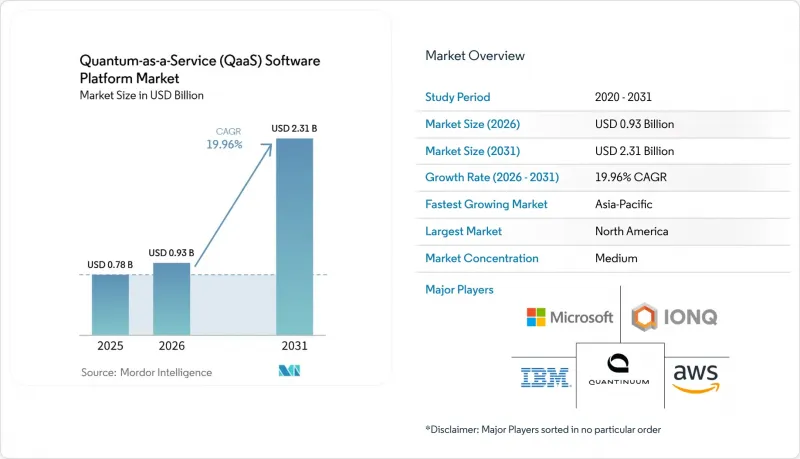
根據 Mordor Intelligence 預測,量子即服務 (QaaS) 軟體平台市場將從 2025 年的 7.8 億美元和 2026 年的 9.3 億美元成長到 2031 年的 23.1 億美元,2026 年至 2031 年的複合年成長率為 19.96%。
本報告按服務類型(量子運算雲端存取、量子模擬即服務及其他)、部署模式(公共雲端QaaS、私有專用量子存取、混合量子-經典工作流程)、最終用戶產業(銀行、金融服務和保險 (BFSI)、製藥和生命科學及其他)以及地區進行細分。市場預測以美元計價。
全球量子即服務 (QaaS) 軟體平台市場趨勢與洞察
越來越多的公司希望利用量子存取技術,但又不想擁有自己的硬體。
量子即服務 (QaaS) 軟體平台市場正受益於一個簡單的經濟轉變:很少有公司願意為早期工作負載擁有和維護昂貴的量子系統。購買者擴大利用 QaaS 軟體平台來最佳化其產品組合、驗證分子模擬以及檢驗安全用例,而無需承擔維護、校準或僱用低溫系統專業人員的人事費用。根據《2026 年全球量子產業狀況》調查,89% 的公司已經在積極使用量子技術,但只有 3% 的公司實現了大規模部署,這意味著從試驗環境過渡到生產環境還有很長的路要走。該調查還指出,企業對主權和本地控制的需求日益成長,這意味著企業尋求的不僅僅是存取權限,而是可控且可審計的存取模式。因此,QaaS 軟體平台市場正在以公共、私有和混合模式等多種形式擴展,而非單一的交付模式。
雲原生量子開發生態系的擴展
量子即服務 (QaaS) 軟體平台市場也不斷擴張。這是因為開發人員可以透過企業工作流程中已有的雲端環境存取量子資源。這降低了學習門檻,使團隊能夠將量子例程與傳統工具、資料管道和熟悉的存取控制並行測試。 2026 年 5 月,Scaleway 和 QbitSoft 推出了歐洲首個雲端原生量子部署計劃,使企業能夠透過單一的獨立雲端介面存取多種硬體模式。這種架構在 QaaS 軟體平台市場中至關重要,因為位於硬體層之上的軟體供應商可以成為企業工作流程設計中的長期控制點。隨著越來越多的後端可透過雲端訪問,QaaS 軟體平台市場可能會更青睞那些簡化開發人員部署的供應商,而不是那些僅僅宣傳硬體效能的供應商。
NISQ硬體的限制和較低的生產可靠性
量子即服務 (QaaS) 軟體平台市場仍面臨中型量子硬體雜訊過大等根本性限制。現有系統有許多問題,例如相干時間有限、連接性受限以及錯誤率高,這些問題會影響商業化電路的深度和一致性。 2026 年發表在《新物理學雜誌》(New Journal of Physics) 上的一項研究發現,NISQ 時代的量子機器學習系統仍然需要在表達能力、可學習性和抗噪性之間進行權衡,這阻礙了許多混合工作流程的平滑擴展。 《2026 年全球量子產業現況》報告指出,演算法設計而非硬體成熟度是生產部署的最大障礙,這顯示 QaaS 軟體平台市場正受到工程和應用兩方面的限制。隨著吞吐量不斷成長的企業轉向日常使用大規模的工作負載,QaaS 軟體平台市場仍需要一個更可靠的運作環境。
細分市場分析
到2025年,量子運算雲端存取將佔據量子即服務(QaaS)軟體平台市場佔有率的38.29%,成為企業進入該領域的主要商業性切入點。這個細分市場佔據主導地位的原因在於,買家通常會先從基於訂閱的硬體存取入手,然後再轉向更專業的模擬、最佳化或安全合約。這一趨勢確保了量子即服務(QaaS)軟體平台市場仍然以「訪問優先」的購買行為為基礎,尤其是在那些仍在探索用例和評估內部團隊適用性的公司中。此外,平台提供者在量子即服務(QaaS)軟體平台市場中佔據了穩固的地位,因為初始存取決策往往會對後續的工具鍊和工作流程選擇產生重大影響。
量子即服務 (QaaS) 軟體平台市場預計將以 21.63% 的複合年成長率成長至 2031 年,成為成長最快的服務類別。這一成長反映出人們對將機器學習工作流程應用於實際應用(而非僅用於學術實驗)的興趣日益濃厚。 QaaS 市場在材料、物流和金融建模等領域對模擬和最佳化服務的需求也在不斷成長,買家希望獲得比傳統標準更顯著的改進。量子密碼學和保全服務的重要性也日益凸顯,一些受監管的公司正在利用 QaaS 軟體平台市場在受控環境中檢驗容錯能力、風險敞口和未來的安全響應需求。
區域分析
到2025年,北美將佔全球整體收入的37.19%,成為量子即服務(QaaS)軟體平台市場最大的區域佔有率。美國正透過直接的政策調整來鞏固其主導地位,其中包括白宮於2026年6月簽署的第14413號行政命令,該命令旨在加速商業化進程並更新國家量子戰略。美國能源局也正透過「量子創世紀」(Quantum Genesis)舉措推動QaaS軟體平台市場的發展,該計畫將容錯系統開發與國家級運算基礎設施結合。 2026年5月,美國商務部宣布根據《晶片與資訊科技促進法案》(CHIPS Act)向九家量子相關企業提供20.13億美元的撥款,為該地區的商業化進程提供製造和工程支援。歐洲仍然是QaaS軟體平台市場的重要參與者。這是因為主權雲端的定位、國內供應商和受監管行業的需求(如乞力馬扎羅多模態QaaS 資料中心的推出以及 Scaleway 和 QbitSoft 的雲端原生部署計劃所表明的那樣)正在推動本地採用。
預計亞太地區在2026年至2031年間將以26.11%的複合年成長率成長,成為量子即服務(QaaS)軟體平台市場成長最快的地區。該地區受益於公共資金、研究機構和企業試點計畫之間的緊密合作,這正推動區域生態系統從以實驗室為中心的階段轉型為商業化模式。這種結構不僅透過引進雲端存取,也透過建構國內能力來支援量子即服務(QaaS)軟體平台市場的發展。中國、日本、印度和韓國正透過國家專案、區域夥伴關係以及與運算、電信和商業產品開發領域的早期買家合作,引領這項轉型。
儘管南美、中東和非洲的量子即服務 (QaaS) 軟體平台市場仍處於起步階段,但這些地區的買家具有重要的戰略意義,因為他們可以直接過渡到託管服務,而無需長期擁有硬體。 2025 年,沙烏地阿美和 Pascual 在沙烏地阿美位於達蘭的資料中心推出了沙烏地阿拉伯首個、也是中東首個商業化 QaaS 平台。此舉表明,中東的 QaaS 軟體平台市場正圍繞著能源、材料和工業最佳化等領域的機構應用情境而發展。在南美,儘管仍處於認知提升和試點階段,但巴西憑藉其強大的金融服務基礎設施和廣泛的數位轉型,在 QaaS 軟體平台市場擁有最大的潛力。
其他好處
- Excel格式的市場預測(ME)表
- 3個月的分析師支持
目錄
第1章:引言
- 研究假設和市場定義
- 調查範圍
第2章:調查方法
第3章執行摘要
第4章 市場狀況
- 市場概覽
- 市場促進因素
- 越來越多的公司希望利用量子存取技術,但又不想擁有自己的硬體。
- 雲原生量子開發生態系的擴展
- 加快政府資助的商業試點計畫(利用量子技術)的開發。
- 對混合量子-經典工作流程編配。
- 受監管產業對量子模擬和最佳化API的需求日益成長
- 為引入新興的PQC和量子風險測試案例做好準備
- 市場限制因素
- NISQ的硬體限制和較低的生產可靠性
- 量子軟體工程師和演算法專家短缺
- SDK 與雲端平台之間互通性的碎片化
- 資料主權、安全和出口管制限制
- 宏觀經濟因素對市場的影響
- 產業價值鏈分析
- 監理情勢
- 技術展望
- 波特五力分析
第5章 市場規模與成長預測
- 按服務類型
- 量子運算雲端存取
- Quantum-Simulation-as-a-Service
- 量子最佳化 API
- 量子機器學習服務
- 量子密碼學與保全服務
- 部署模式
- 公共雲端QaaS
- 私人量子訪問
- 混合量子-經典工作流程
- 按最終用戶行業分類
- 銀行、金融服務和保險(BFSI)
- 製藥和生命科學
- 航太/國防
- 材料/化學
- 物流和供應鏈
- 其他
- 按地區
- 北美洲
- 美國
- 加拿大
- 墨西哥
- 南美洲
- 巴西
- 阿根廷
- 其他南美國家
- 歐洲
- 德國
- 英國
- 法國
- 俄羅斯
- 其他歐洲國家
- 亞太地區
- 中國
- 日本
- 印度
- 韓國
- 澳洲
- 其他亞太國家
- 中東和非洲
- 中東
- 土耳其
- 以色列
- 沙烏地阿拉伯
- 阿拉伯聯合大公國
- 其他中東國家
- 非洲
- 南非
- 其他非洲地區
- 中東
- 北美洲
第6章 競爭情勢
- 市場集中度
- 策略趨勢
- 市佔率分析
- 公司簡介
- IBM Corporation
- Microsoft Corporation
- Amazon Web Services, Inc.
- IonQ, Inc.
- Quantinuum Ltd.
- QC Ware Corporation
- Zapata Computing Holdings Inc.
- Classiq Technologies Ltd.
- Riverlane Ltd.
- Q-CTRL Pty Ltd.
- Xanadu Quantum Technologies Inc.
- Pasqal SAS
- QuEra Computing Inc.
- Aliro Technologies, Inc.
- Horizon Quantum Computing Pte. Ltd.
- Terra Quantum AG
- Quantastica Ltd.
- QunaSys Inc.
- Strangeworks, Inc.
- D-Wave Systems Inc.
- Rigetti Computing, Inc.
- Fujitsu Limited
- Atos SE
- Alibaba Cloud Computing Ltd.
- Huawei Technologies Co., Ltd.
- Origin Quantum Computing Technology Co., Ltd.
第7章 市場機會與未來展望
According to Mordor Intelligence, the quantum-as-a-service (QaaS) software platform market size is projected to expand from USD 0.78 billion in 2025 and USD 0.93 billion in 2026 to USD 2.31 billion by 2031, registering a CAGR of 19.96% between 2026-2031.
This report is Segmented by Service Type (Quantum Computing Cloud Access, Quantum Simulation-As-A-Service, and More), Deployment Mode (Public Cloud QaaS, Private Dedicated Quantum Access, and Hybrid Quantum-Classical Workflow), End User Industry (BFSI, Pharmaceutical and Life Sciences, and More), and Geography. The Market Forecasts are Provided in Terms of Value (USD).
Global Quantum-as-a-Service (QaaS) Software Platform Market Trends and Insights
Rising Enterprise Demand for Quantum Access Without Hardware Ownership
The quantum-as-a-service (QaaS) software platform market is benefiting from a simple economic shift, as few enterprises want to own and maintain expensive quantum systems for early-stage workloads. Buyers are increasingly using the quantum-as-a-service (QaaS) software platform market to test portfolio optimization, molecular simulation, and security use cases without incurring cryogenic maintenance, calibration, or specialist staffing costs. The State of the Global Quantum Industry 2026 found that 89% of enterprises were already hands-on with quantum technologies, but only 3% had reached scaled deployment, leaving a significant conversion path from trial activity to production use. The same study also pointed to sovereignty requirements and local control expectations, meaning enterprises are not only asking for access; they are asking for controlled, auditable access models. That is why the quantum-as-a-service market is expanding across public, private, and hybrid formats rather than through a single delivery model.
Expansion of Cloud-Native Quantum Development Ecosystems
The quantum-as-a-service (QaaS) software platform market is also moving forward because developers can reach quantum resources through cloud environments that already sit inside enterprise workflows. This lowers the learning barrier and lets teams test quantum routines alongside classical tools, data pipelines, and familiar access controls. In May 2026, Scaleway and QbitSoft launched Europe's first cloud-native quantum adoption program, giving enterprises access to multiple hardware modalities through one sovereign cloud interface. That kind of structure matters in the quantum-as-a-service (QaaS) software platform market because software providers that sit above the hardware layer can become the long-term control point for enterprise workflow design. As more backends become available through cloud access, the quantum-as-a-service (QaaS) software platform market is likely to reward vendors that simplify developer adoption rather than vendors that only promote raw hardware characteristics.
NISQ Hardware Limitations and Low Production Reliability
The quantum-as-a-service (QaaS) software platform market still faces the basic limits of noisy intermediate-scale quantum hardware. Current systems have finite coherence times, limited connectivity, and error rates that reduce the depth and consistency of commercially useful circuits. Research published in the New Journal of Physics in 2026 showed that NISQ-era quantum machine learning systems still face a tradeoff among expressivity, trainability, and noise resilience, which keeps many hybrid workflows from scaling cleanly. The State of the Global Quantum Industry 2026 also reported that algorithm design has overtaken hardware maturity as the leading barrier to production deployment, which shows that the quantum-as-a-service (QaaS) software platform market is being held back by both engineering and application limits. Even as throughput improves, the quantum-as-a-service (QaaS) software platform market still needs more reliable production conditions before enterprises shift larger workloads into routine use.
Other drivers and restraints analyzed in the detailed report include:
- Government-Funded Quantum Programs Accelerating Commercial Pilot Activity
- Growing Need for Hybrid Quantum-Classical Workflow Orchestration
- Shortage of Quantum Software Engineers and Algorithm Specialists
For complete list of drivers and restraints, kindly check the Table Of Contents.
Segment Analysis
Quantum Computing Cloud Access held 38.29% of the quantum-as-a-service (QaaS) software platform market share in 2025, which made it the main commercial doorway for enterprises entering this space. The segment leads because buyers usually start with subscription-based access to hardware before moving toward more specialized simulation, optimization, or security contracts. This pattern keeps the quantum-as-a-service (QaaS) software platform market grounded in access-first purchasing behavior, especially among enterprises that are still qualifying use cases and internal teams. It also gives platform operators a strong position in the quantum-as-a-service (QaaS) software platform market because early access decisions often shape later toolchain and workflow choices.
The quantum-as-a-service (QaaS) software platform market size for Quantum Machine Learning Services is projected to expand at a 21.63% CAGR through 2031, which makes it the fastest-growing service category. That growth reflects rising interest in production-oriented machine learning workflows rather than only academic experiments. The quantum-as-a-service (QaaS) software platform market is also seeing a stronger pull for simulation and optimization services in materials, logistics, and financial modeling, where buyers want measurable improvements over classical baselines. Quantum cryptography and security services are gaining weight as well, because some regulated enterprises are using the quantum-as-a-service (QaaS) software platform market to test resilience, risk exposure, and future security-readiness requirements within controlled environments.
Complete Report Scope:
- By Service Type
- Quantum Computing Cloud Access
- Quantum Simulation as a Service
- Quantum Optimization APIs
- Quantum Machine Learning Services
- Quantum Cryptography and Security Services
- By Deployment Mode
- Public Cloud QaaS
- Private Dedicated Quantum Access
- Hybrid Quantum-Classical Workflow
- By End User Industry
- Banking, Financial Services, and Insurance (BFSI)
- Pharmaceutical and Life Sciences
- Aerospace and Defense
- Materials and Chemistry
- Logistics and Supply Chain
- Other End User Industries
- By Geography
- North America
- United States
- Canada
- Mexico
- South America
- Brazil
- Argentina
- Rest of South America
- Europe
- Germany
- United Kingdom
- France
- Russia
- Rest of Europe
- Asia-Pacific
- China
- Japan
- India
- South Korea
- Australia
- Rest of Asia-Pacific
- Middle East and Africa
- Middle East
- Turkey
- Israel
- Saudi Arabia
- United Arab Emirates
- Rest of Middle East
- Africa
- South Africa
- Rest of Africa
- Middle East
- North America
Geography Analysis
North America held 37.19% of global revenue in 2025, which gave it the largest regional position in the quantum-as-a-service (QaaS) software platform market share. The United States is strengthening that lead through direct policy coordination, because the White House issued Executive Order 14413 in June 2026 to accelerate commercialization and update the national quantum strategy. The US Department of Energy is also pushing the quantum-as-a-service (QaaS) software platform market through the Quantum Genesis initiative, which is tied to fault-tolerant system development and national-scale computing infrastructure. In May 2026, the US Department of Commerce announced USD 2.013 billion in CHIPS Act incentives for 9 quantum companies, which adds fabrication and engineering support to the region's commercial pipeline. Europe remains a meaningful part of the quantum-as-a-service (QaaS) software platform market because sovereign cloud positioning, domestic providers, and regulated-sector demand are supporting local adoption, as shown by Qilimanjaro's multimodal QaaS data center launch and the Scaleway and QbitSoft cloud-native adoption program.
Asia-Pacific is projected to grow at a 26.11% CAGR from 2026 to 2031, which makes it the fastest-growing regional part of the quantum-as-a-service (QaaS) software platform market size. The region is benefiting from strong alignment among public funding, research institutions, and enterprise pilot activity, which is helping local ecosystems move from laboratory focus to commercial access models. This structure is supporting the quantum-as-a-service (QaaS) software platform market through domestic capability building rather than only through imported cloud access. China, Japan, India, and South Korea are shaping that shift through national programs, local partnerships, and early buyer engagement across computing, communications, and commercial product development.
South America, the Middle East, and Africa remain earlier-stage parts of the quantum-as-a-service (QaaS) software platform market, but they are strategically important because buyers there can move directly into managed-service formats without a long hardware ownership phase. In 2025, Aramco and Pasqal launched Saudi Arabia's first quantum computer and the Middle East's first commercial quantum computing as a service platform at Aramco's Dhahran data center. That move shows that the quantum-as-a-service (QaaS) software platform market in the Middle East is forming around institutional use cases in energy, materials, and industrial optimization. South America remains closer to awareness and pilot activity, with Brazil showing the strongest potential in the quantum-as-a-service (QaaS) software platform market because of its financial services depth and broader digital transformation push.
- IBM Corporation
- Microsoft Corporation
- Amazon Web Services, Inc.
- IonQ, Inc.
- Quantinuum Ltd.
- QC Ware Corporation
- Zapata Computing Holdings Inc.
- Classiq Technologies Ltd.
- Riverlane Ltd.
- Q-CTRL Pty Ltd.
- Xanadu Quantum Technologies Inc.
- Pasqal SAS
- QuEra Computing Inc.
- Aliro Technologies, Inc.
- Horizon Quantum Computing Pte. Ltd.
- Terra Quantum AG
- Quantastica Ltd.
- QunaSys Inc.
- Strangeworks, Inc.
- D-Wave Systems Inc.
- Rigetti Computing, Inc.
- Fujitsu Limited
- Atos SE
- Alibaba Cloud Computing Ltd.
- Huawei Technologies Co., Ltd.
- Origin Quantum Computing Technology Co., Ltd.
Additional Benefits:
- The market estimate (ME) sheet in Excel format
- 3 months of analyst support
TABLE OF CONTENTS
1 INTRODUCTION
- 1.1 Study Assumptions and Market Definition
- 1.2 Scope of the Study
2 RESEARCH METHODOLOGY
3 EXECUTIVE SUMMARY
4 MARKET LANDSCAPE
- 4.1 Market Overview
- 4.2 Market Drivers
- 4.2.1 Rising Enterprise Demand for Quantum Access Without Hardware Ownership
- 4.2.2 Expansion of Cloud-Native Quantum Development Ecosystems
- 4.2.3 Government-Funded Quantum Programs Accelerating Commercial Pilot Activity
- 4.2.4 Growing Need for Hybrid Quantum-Classical Workflow Orchestration
- 4.2.5 Increased Demand for Quantum Simulation and Optimization APIs in Regulated Industries
- 4.2.6 Emerging PQC Readiness and Quantum Risk Testing Use Cases
- 4.3 Market Restraints
- 4.3.1 NISQ Hardware Limitations and Low Production Reliability
- 4.3.2 Shortage of Quantum Software Engineers and Algorithm Specialists
- 4.3.3 Interoperability Fragmentation Across SDKs and Cloud Platforms
- 4.3.4 Data Sovereignty, Security, and Export Control Constraints
- 4.4 Impact of Macroeconomic Factors on the Market
- 4.5 Industry Value-Chain Analysis
- 4.6 Regulatory Landscape
- 4.7 Technological Outlook
- 4.8 Porter's Five Forces Analysis
- 4.8.1 Threat of New Entrants
- 4.8.2 Bargaining Power of Suppliers
- 4.8.3 Bargaining Power of Buyers
- 4.8.4 Threat of Substitutes
- 4.8.5 Intensity of Competitive Rivalry
5 MARKET SIZE AND GROWTH FORECASTS (VALUE)
- 5.1 By Service Type
- 5.1.1 Quantum Computing Cloud Access
- 5.1.2 Quantum Simulation as a Service
- 5.1.3 Quantum Optimization APIs
- 5.1.4 Quantum Machine Learning Services
- 5.1.5 Quantum Cryptography and Security Services
- 5.2 By Deployment Mode
- 5.2.1 Public Cloud QaaS
- 5.2.2 Private Dedicated Quantum Access
- 5.2.3 Hybrid Quantum-Classical Workflow
- 5.3 By End User Industry
- 5.3.1 Banking, Financial Services, and Insurance (BFSI)
- 5.3.2 Pharmaceutical and Life Sciences
- 5.3.3 Aerospace and Defense
- 5.3.4 Materials and Chemistry
- 5.3.5 Logistics and Supply Chain
- 5.3.6 Other End User Industries
- 5.4 By Geography
- 5.4.1 North America
- 5.4.1.1 United States
- 5.4.1.2 Canada
- 5.4.1.3 Mexico
- 5.4.2 South America
- 5.4.2.1 Brazil
- 5.4.2.2 Argentina
- 5.4.2.3 Rest of South America
- 5.4.3 Europe
- 5.4.3.1 Germany
- 5.4.3.2 United Kingdom
- 5.4.3.3 France
- 5.4.3.4 Russia
- 5.4.3.5 Rest of Europe
- 5.4.4 Asia-Pacific
- 5.4.4.1 China
- 5.4.4.2 Japan
- 5.4.4.3 India
- 5.4.4.4 South Korea
- 5.4.4.5 Australia
- 5.4.4.6 Rest of Asia-Pacific
- 5.4.5 Middle East and Africa
- 5.4.5.1 Middle East
- 5.4.5.1.1 Turkey
- 5.4.5.1.2 Israel
- 5.4.5.1.3 Saudi Arabia
- 5.4.5.1.4 United Arab Emirates
- 5.4.5.1.5 Rest of Middle East
- 5.4.5.2 Africa
- 5.4.5.2.1 South Africa
- 5.4.5.2.2 Rest of Africa
- 5.4.5.1 Middle East
- 5.4.1 North America
6 COMPETITIVE LANDSCAPE
- 6.1 Market Concentration
- 6.2 Strategic Moves
- 6.3 Market Share Analysis
- 6.4 Company Profiles (includes Global Level Overview, Market Level Overview, Core Segments, Financials as available, Strategic Information, Market Rank/Share, Products and Services, Recent Developments)
- 6.4.1 IBM Corporation
- 6.4.2 Microsoft Corporation
- 6.4.3 Amazon Web Services, Inc.
- 6.4.4 IonQ, Inc.
- 6.4.5 Quantinuum Ltd.
- 6.4.6 QC Ware Corporation
- 6.4.7 Zapata Computing Holdings Inc.
- 6.4.8 Classiq Technologies Ltd.
- 6.4.9 Riverlane Ltd.
- 6.4.10 Q-CTRL Pty Ltd.
- 6.4.11 Xanadu Quantum Technologies Inc.
- 6.4.12 Pasqal SAS
- 6.4.13 QuEra Computing Inc.
- 6.4.14 Aliro Technologies, Inc.
- 6.4.15 Horizon Quantum Computing Pte. Ltd.
- 6.4.16 Terra Quantum AG
- 6.4.17 Quantastica Ltd.
- 6.4.18 QunaSys Inc.
- 6.4.19 Strangeworks, Inc.
- 6.4.20 D-Wave Systems Inc.
- 6.4.21 Rigetti Computing, Inc.
- 6.4.22 Fujitsu Limited
- 6.4.23 Atos SE
- 6.4.24 Alibaba Cloud Computing Ltd.
- 6.4.25 Huawei Technologies Co., Ltd.
- 6.4.26 Origin Quantum Computing Technology Co., Ltd.
7 MARKET OPPORTUNITIES AND FUTURE OUTLOOK
- 7.1 White Space and Unmet-Need Assessment

 雲端運算:市場佔有率分析、產業趨勢與統計、成長預測(2026-2031)
 2026-2030年全球政府部門人工智慧市場
 2026-2030年全球雲端運算市場
 雲端運算市場報告:趨勢、預測和競爭分析(至2035年)
 基於雲端的臨床試驗市場規模、佔有率和成長分析:按組件、部署類型、應用、最終用戶和地區分類-2026-2033年產業預測
 2026年全球國防雲端運算市場報告2026年全球軍用雲端運算市場報告行動雲端運算:市場佔有率分析、產業趨勢與統計及成長預測(2026-2031 年)
 雲端運算市場:按服務模式、部署模式、組織規模、應用程式和產業分類-2026-2032年全球市場預測
 2034年航太航太雲端運算市場預測-按服務模式、部署模式、功能、應用、最終用戶和區域分類的全球分析