


 |
市場調查報告書
商品編碼
2120828
行動雲端運算:市場佔有率分析、產業趨勢與統計及成長預測(2026-2031 年)Mobile Cloud Computing - Market Share Analysis, Industry Trends & Statistics, Growth Forecasts (2026 - 2031) |
||||||

※ 本網頁內容可能與最新版本有所差異。詳細情況請與我們聯繫。
據 Mordor Intelligence 稱,2025 年行動雲端運算市場價值為 681.5 億美元,預計到 2031 年將達到 1,676.2 億美元,而 2026 年為 791.7 億美元,預測期(2026-2031 年)的複合年成長率為 16.18%。
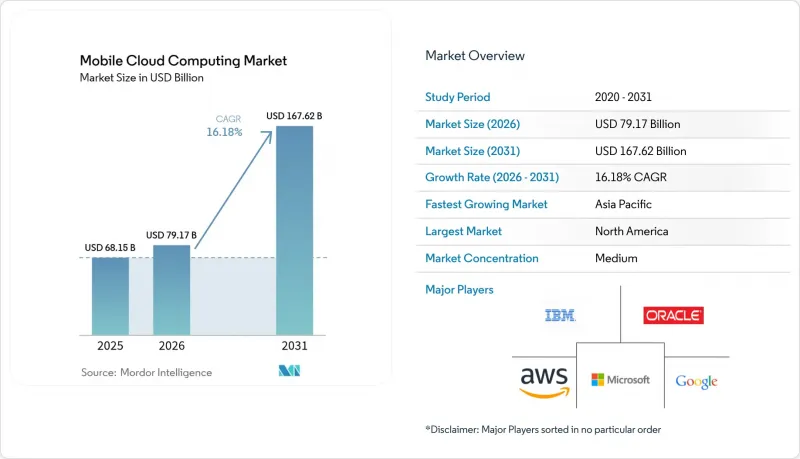
本報告按應用領域(遊戲、金融/商業、娛樂、教育、醫療保健、旅遊等)、使用者(企業、消費者)、服務模式(SaaS(軟體即服務)、PaaS(平台即服務)等)、部署類型(公共雲端等)、行動作業系統(Android、iOS等)和地區進行細分。市場預測以美元計價。
全球行動雲端運算市場趨勢與洞察
新興國家IT基礎設施的發展
印度、印尼、巴西和奈及利亞的大規模光纖骨幹網,以及強制性的國內資料中心部署,正在降低延遲並擴大覆蓋範圍,使雲端應用即使在二、三線城市也能運作。印度的「數位印度」計畫在2024年撥款12億美元,用於創建一個國有雲區,供本地新創企業在不依賴外國資源的情況下使用。在印尼,強制在國內區域部署公共行動應用的法規已經促使雅加達和泗水新建了超大規模資料中心。巴西也正在進行類似的基礎建設,預計到2024年,4G網路將覆蓋94%的城市,加速農村地區農產品採用雲端運算。隨著邊緣節點的日益普及,應用程式供應商正在將其功能向用戶更近的地方遷移,這推動了行動雲端運算市場兩位數的成長。
網路連線技術的進步
2024年,全球行動數據流量達到每月131Exabyte,較去年同期成長25%。這主要得益於高清影片串流媒體和需要持續同步的辦公室應用。諸如2Africa之類的海底光纜系統將批發頻寬價格降低了30%,使得塞內加爾、肯亞和坦尚尼亞的電信業者能夠提供無限資料通訊和雲端儲存套餐,從而將偶爾使用數據的用戶轉變為每日數據上傳用戶。 Starlink和OneWeb的低地球衛星星系填補了阿拉斯加和亞馬遜盆地的連接空白,擴展了基於雲端的行動服務的基礎設施。資料通訊成本下降和使用量增加的良性循環正在加速服務的普及,並推動行動雲端運算市場的發展。
資料安全問題
多租戶架構會增加傳輸中資料被攔截和靜態資料未授權存取的風險。一項針對1200家公司的2024年調查發現,62%的公司由於密鑰管理和審計缺陷方面的不確定性而推遲轉型,尤其是在醫療保健和銀行業。歐洲監管機構加強了對將交易資料快取在海外雲端的行動銀行應用程式的審查,迫使多家銀行重新採用私有雲。端對端加密層會引入10-15毫秒的延遲,影響即時使用者體驗並減緩服務普及速度。
細分市場分析
隨著遠端醫療、遠端患者監護和雲端診斷的擴展,行動雲端運算市場中的醫療保健領域預計到2031年將以17.12%的複合年成長率成長。美國食品藥物管理局(FDA)在2024年批准了87款用於雲端資料處理的行動醫療保健應用程式,高於2023年的52款。飛利浦推出了一款行動超音波診斷設備將影像傳輸給放射科醫生,從而將農村地區的診斷週期從48小時縮短至4小時。雖然遊戲領域仍佔27.78%的收入,但這個飽和市場的成長正步入成熟階段。金融、娛樂和教育類應用程式的需求穩定,但醫療保健領域的法規核准和報銷模式的建立正使其成為一個垂直市場,並將推動下一波行動雲端運算市場的成長。
雲端遊戲的主導地位表明市場對低延遲渲染、微交易和社交遊戲功能有著強勁的需求。然而,第一人稱觀點(FPS) 遊戲需要往返傳輸時間低於 30 毫秒,這迫使服務提供者在距離用戶 50 公里範圍內部署邊緣運算,對除規模最大的超大規模資料中心業者服務商之外的所有營運商來說,這都是一項資本密集的挑戰。相較之下,醫療保健產業對延遲的接受度更高,延遲範圍從毫秒到秒,這使得工作負載可以部署在更深處的雲端,並有助於在邊緣基礎設施有限的新興市場進行部署。到 2031 年,醫療保健領域用戶群的不斷擴大和監管政策的逐步明確將縮小其與遊戲產業的市場佔有率差距,從而鞏固行動雲端運算市場的跨產業韌性。
隨著行動工作者對客戶記錄、協作套件和現場服務應用程式的持續存取需求,企業級市場將在2025年佔據70.55%的收入佔有率。 Salesforce、Microsoft 365和SAP的行動用戶端是這項支出的主要來源。一項針對800位IT領導者的2024年調查顯示,73%的受訪者認為行動和雲端整合是採用新軟體時最重要的三大購買標準之一(JMIR.ORG)。同時,隨著訂閱式雲端儲存、串流媒體和遊戲服務的日益普及,消費者市場正以17.95%的複合年成長率快速成長。 Dropbox報告稱,其2024年的行動上傳量年增了35%,而蘋果的付費iCloud帳戶數量也在同年突破了10億。
這些消費趨勢迫使服務供應商最佳化間歇性連線、簡化使用者介面流程並降低入門級價格,從而將設計重點從專注於企業合規性和服務等級協定 (SLA) 轉向其他方面。雖然企業仍將擁有預算影響力,但不斷擴大的消費群帶來了規模效應和品牌知名度,拓寬了行動雲端運算市場的客戶獲取機會。
區域分析
北美地區預計到2025年將佔全球收入的36.25%,這得益於其高密度可用區和2.8億5G獨立用戶。這些優勢能夠為行動工作負載提供低於20毫秒的延遲。亞馬遜雲端服務(AWS)、微軟Azure和Google雲端在該地區營運超過40個可用區,為自動駕駛汽車、工業IoT和高頻交易金融應用提供遙測支援。加拿大於2024年強制要求公共行動服務採用主權雲,刺激了Telus和Bell等公司的投資,但目前大部分商業流量仍依賴美國的超大規模資料中心業者服務供應商。
預計到2031年,亞太地區的複合年成長率將達到16.65%。在中國,5G基地台數量將在2024年超過350萬個,覆蓋95%的都市區,這將使阿里雲和騰訊雲能夠為8億行動用戶部署延遲低於10毫秒的邊緣節點。印度的統一支付介面(UPI)將在2024年透過其雲端付款閘道每月處理120億筆行動交易,充分展現了其行動優先的規模優勢。日本電信業者正透過網路切片技術確保企業用戶的低延遲體驗,而韓國已將其超大規模網路容量加倍,以滿足直播和遊戲的需求。
歐洲、中東、非洲和南美洲的情況各不相同。歐洲的「Gaia-X」計畫正在加強資料主權,強制要求公共行動應用程式在本地進行雲端處理。杜拜的智慧城市正在利用行動雲端提供行政服務,這啟發了鄰近的海灣國家。非洲受益於新的海底網路容量以及數據和雲端服務的整合,但由於電力供應不穩定,本地備份至關重要。南美洲面臨宏觀經濟波動,但騰訊雲在聖保羅和拉各斯的新區域正在降低金融科技和遊戲產業的延遲。嚴格的監管、基礎設施的成熟度以及消費者購買力的差異,共同構成了行動雲端運算市場成長的複雜圖像。
其他好處:
- Excel格式的市場預測(ME)表
- 3個月的分析師支持
目錄
第1章:引言
- 研究假設和市場定義
- 調查範圍
第2章:調查方法
第3章執行摘要
第4章 市場狀況
- 市場概覽
- 市場促進因素
- 新興國家IT基礎設施的進步
- 網路連線技術的進步
- 行動應用邊緣人工智慧的廣泛應用
- 雲端遊戲平台使用量的擴展
- 5G獨立組網的擴展
- 低程式碼行動後端服務的普及
- 市場限制因素
- 資料安全問題
- 行動裝置電池續航時間短
- 雲端服務費用飆升
- 關於資料居住要求和數位主權的法規
- 價值鏈分析
- 監理情勢
- 技術展望
- 宏觀經濟因素對市場的影響
- 波特五力分析
第5章 市場規模與成長預測
- 透過使用
- 遊戲
- 金融與商業
- 娛樂
- 教育
- 衛生保健
- 旅行
- 其他用途
- 使用者
- 公司
- 一般消費者
- 按服務模式
- Software-as-a-Service(SaaS)
- Platform-as-a-Service(PaaS)
- Infrastructure-as-a-Service(IaaS)
- 不同的發展
- 公共雲端
- 私有雲端
- 混合雲端
- 行動作業系統
- Android
- iOS
- 其他
- 地區
- 北美洲
- 美國
- 加拿大
- 墨西哥
- 歐洲
- 英國
- 德國
- 法國
- 義大利
- 其他歐洲國家
- 亞太地區
- 中國
- 日本
- 印度
- 韓國
- 其他亞洲國家
- 中東
- 以色列
- 沙烏地阿拉伯
- 阿拉伯聯合大公國
- 土耳其
- 其他中東國家
- 非洲
- 南非
- 埃及
- 其他非洲國家
- 南美洲
- 巴西
- 阿根廷
- 其他南美國家
- 北美洲
第6章 競爭情勢
- 市場集中度
- 策略趨勢
- 市佔率分析
- 公司簡介
- International Business Machines Corporation
- Amazon Web Services Inc.
- Google LLC
- Oracle Corporation
- Microsoft Corporation
- SAP SE
- Akamai Technologies, Inc.
- Salesforce, Inc.
- Cloudways Ltd.
- Kony, Inc.
- Alibaba Cloud(Alibaba Group Holding Limited)
- Tencent Cloud Computing Beijing Co., Ltd.
- Huawei Technologies Co., Ltd.
- VMware, Inc.
- Rackspace Technology, Inc.
- Fujitsu Limited
- Citrix Systems, Inc.
- Red Hat, Inc.
- Box, Inc.
- Dropbox, Inc.
第7章 市場機會與未來展望
According to Mordor Intelligence, the mobile cloud computing market size was valued at USD 68.15 billion in 2025 and estimated to grow from USD 79.17 billion in 2026 to reach USD 167.62 billion by 2031, at a CAGR of 16.18% during the forecast period (2026-2031).
This report is Segmented by Application (Gaming, Finance and Business, Entertainment, Education, Healthcare, Travel, and More), User (Enterprise, and Consumer), Service Model (Software-As-A-Service, Platform-As-A-Service, and More), Deployment (Public Cloud, and More), Mobile Operating System (Android, IOS, and More), and Geography. The Market Forecasts are Provided in Terms of Value (USD).
Global Mobile Cloud Computing Market Trends and Insights
Development in IT Infrastructure in Emerging Countries
Massive fiber backbones and sovereign data-center mandates in India, Indonesia, Brazil, and Nigeria are shrinking latency and widening coverage, making cloud-backed apps viable in tier-2 and tier-3 cities. India's Digital India program allocated USD 1.2 billion in 2024 to build state-owned cloud zones that local start-ups can tap without foreign dependency. Indonesia's requirement that public mobile apps reside in domestic zones has already triggered new hyperscale facilities in Jakarta and Surabaya. Similar upgrades in Brazil lifted 4G availability to 94% of municipalities in 2024, catalyzing rural agribusiness adoption. As edge nodes propagate, application publishers migrate functions closer to users, sustaining double-digit expansion in the mobile cloud computing market.
Advancing Internet Connectivity
Global mobile data traffic reached 131 exabytes per month in 2024, a 25% jump year-on-year, underpinned by high-definition video streaming and always-synced productivity apps. Submarine systems such as 2Africa lowered wholesale bandwidth prices 30%, letting carriers in Senegal, Kenya, and Tanzania bundle unlimited data with cloud storage, flipping intermittent users into daily uploaders. LEO satellite constellations from Starlink and OneWeb filled connectivity gaps in Alaska and the Amazon basin, widening the accessible base for cloud-powered mobile services. The reinforcing cycle of cheaper gigabytes and higher usage accelerates service uptake, boosting the mobile cloud computing market.
Concerns Associated with Data Security
Multi-tenant architectures elevate exposure to interception during transit and unauthorized access at rest. A 2024 study of 1,200 enterprises found 62% delayed migrations over key-management uncertainty and audit gaps, notably in healthcare and banking sectors. European regulators tightened scrutiny around mobile banking apps caching transaction data in foreign clouds, pushing several banks back to private zones. End-to-end encryption layers add 10-15 milliseconds of latency, impairing real-time experience and tempering uptake.
Other drivers and restraints analyzed in the detailed report include:
- Growing Adoption of Edge AI for Mobile Applications
- Rising Usage of Cloud Gaming Platforms
- Limited Battery Life of Mobile Devices
For complete list of drivers and restraints, kindly check the Table Of Contents.
Segment Analysis
The healthcare slice of the mobile cloud computing market size is on track to expand at a 17.12% CAGR through 2031 as telemedicine, remote patient monitoring, and cloud-sourced diagnostics scale. The U.S. FDA cleared 87 mobile medical apps for cloud data processing in 2024, up from 52 in 2023. Philips rolled out a mobile ultrasound that streams images to radiologists, shortening rural diagnostic cycles from 48 hours to 4 hours. Gaming still holds 27.78% revenue share, but growth is maturing in saturated markets. Finance, entertainment, and education apps ride steady demand, yet healthcare's regulatory green lights and reimbursement models position it as the catalytic vertical shaping the next wave of the mobile cloud computing market.
Cloud gaming's share leadership signals entrenched demand for low-latency rendering, micro-transactions, and social play features. Yet first-person shooters require sub-30 millisecond round-trip time, compelling providers to deploy edge compute within 50 kilometers of users, capital-intensive for all but the largest hyperscalers. In contrast, healthcare gains from longer tolerance for latency seconds rather than milliseconds allowing workloads to reside deeper in the cloud and easing rollout across emerging markets with limited edge presence. By 2031, the healthcare segment's expanding user base and regulatory clarity will narrow the share gap with gaming and solidify multi-vertical resilience in the mobile cloud computing market.
Enterprises contributed 70.55% of 2025 revenue as mobile workforces demanded continuous access to customer records, collaboration suites, and field service apps. Salesforce, Microsoft 365, and SAP mobile clients anchor this spend. A survey of 800 IT leaders in 2024 showed 73% view mobile-cloud integration as top-three purchase criteria for new software deployments JMIR.ORG. Meanwhile, consumers are expanding at an 17.95% CAGR as subscription cloud storage, streaming, and gaming services gain traction. Dropbox reported 35% year-on-year growth in mobile uploads in 2024, and Apple recorded more than 1 billion paid iCloud accounts the same year.
The consumer trajectory forces providers to optimize for intermittent connectivity, lighter UI flows, and lower entry-level price points, shifting design priorities previously centered on enterprise compliance and service-level agreements. Enterprises will continue to wield budget influence, but the swelling consumer base adds volume scale and brand visibility, widening the funnel for the mobile cloud computing market.
Complete Report Scope:
- By Application
- Gaming
- Finance and Business
- Entertainment
- Education
- Healthcare
- Travel
- Other Applications
- By User
- Enterprise
- Consumer
- By Service Model
- Software-as-a-Service (SaaS)
- Platform-as-a-Service (PaaS)
- Infrastructure-as-a-Service (IaaS)
- By Deployment
- Public Cloud
- Private Cloud
- Hybrid Cloud
- By Mobile Operating System
- Android
- iOS
- Others
- Geography
- North America
- United States
- Canada
- Mexico
- Europe
- United Kingdom
- Germany
- France
- Italy
- Rest of Europe
- Asia-Pacific
- China
- Japan
- India
- South Korea
- Rest of Asia
- Middle East
- Israel
- Saudi Arabia
- United Arab Emirates
- Turkey
- Rest of Middle East
- Africa
- South Africa
- Egypt
- Rest of Africa
- South America
- Brazil
- Argentina
- Rest of South America
- North America
Geography Analysis
North America generated 36.25% of 2025 revenue, benefiting from dense availability zones and 280 million 5G standalone subscribers, which deliver sub-20 millisecond latency for mobile workloads. Amazon Web Services, Microsoft Azure, and Google Cloud operate more than 40 zones in the region, powering autonomous vehicle telemetry, industrial IoT, and high-frequency finance apps. Canada mandated sovereign cloud for public mobile services in 2024, prompting Telus and Bell investments but leaving most commercial traffic on U.S. hyperscalers.
Asia Pacific is projected to lead growth at a 16.65% CAGR to 2031. China surpassed 3.5 million 5G base stations in 2024, covering 95% of urban zones, allowing Alibaba Cloud and Tencent Cloud to place edge nodes within 10 milliseconds of 800 million mobile users. India's Unified Payments Interface processed 12 billion mobile transactions monthly in 2024 over cloud payment gateways, illustrating mobile-first scale. Japan's carrier network slicing guarantees enterprise latency, while South Korea doubled hyperscale capacity to feed live streaming and gaming hunger.
Europe, the Middle East and Africa, and South America present mixed scenarios. Europe's Gaia-X hardens data sovereignty, requiring local cloud processing for public mobile apps. Dubai's Smart City uses mobile cloud for civic services, inspiring neighboring Gulf states. Africa benefits from new subsea capacity and bundled data-plus-cloud offerings, yet power instability compels on-premises backups. South America contends with macro volatility, though new Tencent Cloud regions in Sao Paulo and Lagos cut latency for fintech and gaming. The imbalance of regulatory stringency, infrastructure maturity, and consumer purchasing power sets a mosaic growth profile for the mobile cloud computing market.
- International Business Machines Corporation
- Amazon Web Services Inc.
- Google LLC
- Oracle Corporation
- Microsoft Corporation
- SAP SE
- Akamai Technologies, Inc.
- Salesforce, Inc.
- Cloudways Ltd.
- Kony, Inc.
- Alibaba Cloud (Alibaba Group Holding Limited)
- Tencent Cloud Computing Beijing Co., Ltd.
- Huawei Technologies Co., Ltd.
- VMware, Inc.
- Rackspace Technology, Inc.
- Fujitsu Limited
- Citrix Systems, Inc.
- Red Hat, Inc.
- Box, Inc.
- Dropbox, Inc.
Additional Benefits:
- The market estimate (ME) sheet in Excel format
- 3 months of analyst support
TABLE OF CONTENTS
1 INTRODUCTION
- 1.1 Study Assumptions and Market Definition
- 1.2 Scope of the Study
2 RESEARCH METHODOLOGY
3 EXECUTIVE SUMMARY
4 MARKET LANDSCAPE
- 4.1 Market Overview
- 4.2 Market Drivers
- 4.2.1 Development in IT Infrastructure in Emerging Countries
- 4.2.2 Advancing Internet Connectivity
- 4.2.3 Growing Adoption of Edge AI for Mobile Applications (UNDER-THE-RADAR)
- 4.2.4 Rising Usage of Cloud Gaming Platforms
- 4.2.5 Expansion of 5G Stand-Alone Networks
- 4.2.6 Proliferation of Low-Code Mobile Backend Services (UNDER-THE-RADAR)
- 4.3 Market Restraints
- 4.3.1 Concerns Associated with Data Security
- 4.3.2 Limited Battery Life of Mobile Devices
- 4.3.3 Escalating Cloud-Service Egress Fees (UNDER-THE-RADAR)
- 4.3.4 Data-Residency and Digital-Sovereignty Regulations
- 4.4 Value-Chain Analysis
- 4.5 Regulatory Landscape
- 4.6 Technological Outlook
- 4.7 Impact of Macroeconomic Factors on the Market
- 4.8 Porter's Five Forces Analysis
- 4.8.1 Threat of New Entrants
- 4.8.2 Bargaining Power of Buyers or Consumers
- 4.8.3 Bargaining Power of Suppliers
- 4.8.4 Threat of Substitute Products
- 4.8.5 Intensity of Competitive Rivalry
5 MARKET SIZE AND GROWTH FORECASTS (VALUE)
- 5.1 By Application
- 5.1.1 Gaming
- 5.1.2 Finance and Business
- 5.1.3 Entertainment
- 5.1.4 Education
- 5.1.5 Healthcare
- 5.1.6 Travel
- 5.1.7 Other Applications
- 5.2 By User
- 5.2.1 Enterprise
- 5.2.2 Consumer
- 5.3 By Service Model
- 5.3.1 Software-as-a-Service (SaaS)
- 5.3.2 Platform-as-a-Service (PaaS)
- 5.3.3 Infrastructure-as-a-Service (IaaS)
- 5.4 By Deployment
- 5.4.1 Public Cloud
- 5.4.2 Private Cloud
- 5.4.3 Hybrid Cloud
- 5.5 By Mobile Operating System
- 5.5.1 Android
- 5.5.2 iOS
- 5.5.3 Others
- 5.6 Geography
- 5.6.1 North America
- 5.6.1.1 United States
- 5.6.1.2 Canada
- 5.6.1.3 Mexico
- 5.6.2 Europe
- 5.6.2.1 United Kingdom
- 5.6.2.2 Germany
- 5.6.2.3 France
- 5.6.2.4 Italy
- 5.6.2.5 Rest of Europe
- 5.6.3 Asia-Pacific
- 5.6.3.1 China
- 5.6.3.2 Japan
- 5.6.3.3 India
- 5.6.3.4 South Korea
- 5.6.3.5 Rest of Asia
- 5.6.4 Middle East
- 5.6.4.1 Israel
- 5.6.4.2 Saudi Arabia
- 5.6.4.3 United Arab Emirates
- 5.6.4.4 Turkey
- 5.6.4.5 Rest of Middle East
- 5.6.5 Africa
- 5.6.5.1 South Africa
- 5.6.5.2 Egypt
- 5.6.5.3 Rest of Africa
- 5.6.6 South America
- 5.6.6.1 Brazil
- 5.6.6.2 Argentina
- 5.6.6.3 Rest of South America
- 5.6.1 North America
6 COMPETITIVE LANDSCAPE
- 6.1 Market Concentration
- 6.2 Strategic Moves
- 6.3 Market Share Analysis
- 6.4 Company Profiles (includes Global level Overview, Market level overview, Core Segments, Financials as available, Strategic Information, Market Rank or Share for key companies, Products and Services, and Recent Developments)
- 6.4.1 International Business Machines Corporation
- 6.4.2 Amazon Web Services Inc.
- 6.4.3 Google LLC
- 6.4.4 Oracle Corporation
- 6.4.5 Microsoft Corporation
- 6.4.6 SAP SE
- 6.4.7 Akamai Technologies, Inc.
- 6.4.8 Salesforce, Inc.
- 6.4.9 Cloudways Ltd.
- 6.4.10 Kony, Inc.
- 6.4.11 Alibaba Cloud (Alibaba Group Holding Limited)
- 6.4.12 Tencent Cloud Computing Beijing Co., Ltd.
- 6.4.13 Huawei Technologies Co., Ltd.
- 6.4.14 VMware, Inc.
- 6.4.15 Rackspace Technology, Inc.
- 6.4.16 Fujitsu Limited
- 6.4.17 Citrix Systems, Inc.
- 6.4.18 Red Hat, Inc.
- 6.4.19 Box, Inc.
- 6.4.20 Dropbox, Inc.
7 MARKET OPPORTUNITIES AND FUTURE OUTLOOK
- 7.1 White-Space and Unmet-Need Assessment

 雲端運算:市場佔有率分析、產業趨勢與統計、成長預測(2026-2031)
 2026-2030年全球政府部門人工智慧市場
 2026-2030年全球雲端運算市場
 雲端運算市場報告:趨勢、預測和競爭分析(至2035年)
 基於雲端的臨床試驗市場規模、佔有率和成長分析:按組件、部署類型、應用、最終用戶和地區分類-2026-2033年產業預測
 2026年全球國防雲端運算市場報告2026年全球軍用雲端運算市場報告QaaS(量子即服務)軟體平台:市場佔有率分析、行業趨勢和統計數據以及成長預測(2026-2031 年)
 雲端運算市場:按服務模式、部署模式、組織規模、應用程式和產業分類-2026-2032年全球市場預測
 2034年航太航太雲端運算市場預測-按服務模式、部署模式、功能、應用、最終用戶和區域分類的全球分析