


 |
市場調查報告書
商品編碼
2117587
預測性銷售智慧軟體:市場佔有率分析、產業趨勢與統計、成長預測(2026-2031)Predictive Sales Intelligence Software - Market Share Analysis, Industry Trends & Statistics, Growth Forecasts (2026 - 2031) |
||||||

※ 本網頁內容可能與最新版本有所差異。詳細情況請與我們聯繫。
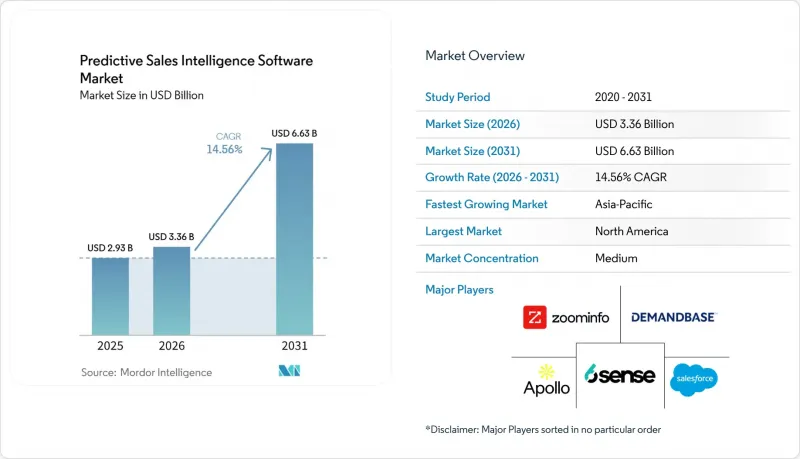
根據 Mordor Intelligence 預測,預測性銷售情報軟體的市場規模預計將從 2025 年的 29.3 億美元和 2026 年的 33.6 億美元成長到 2031 年的 66.3 億美元,2026 年至 2031 年的年複合成長率(CAGR)為 14.56%。
本報告按元件(軟體和服務)、部署模式(雲端和本地部署)、組織規模(中小企業和大型企業)、應用程式(線索產生和潛在客戶開發、預測性案源計分等)、最終用戶產業(IT和電信等)以及地區進行細分。市場預測以價值(美元)表示。
全球預測性銷售情報軟體市場趨勢及洞察
AI原生買家訊號評分正在徹底改變轉化經濟學。
到2026年,如果人工智慧能夠以90%的準確率預測潛在客戶的購買可能性,77%的B2B銷售負責人將會依賴人工智慧,這一比例高於2025年的37%。這一轉變表明,採購團隊正迅速從單純的好奇轉向對模型驅動主導的實際依賴。 6sense報告稱,從2025年第二季到2026年第一季,經6QA優先排序的客戶,其機會價值比未優先排序的客戶高出29%,交易規模高出33%。最佳效果體現在模型是基於封閉式和封閉式失敗的成交結果進行學習,而非簡單的活動訊號。由於系統更反映過去的成交模式而非當前需求,CRM歷史記錄有限或偏差的負責人的得分往往較低。為此,供應商正在加快學習週期,這有助於縮小預測性銷售智慧軟體市場中最新購買訊號與銷售行動之間的差距。
RevOps標準化帶來的新資料管治要求
隨著收入營運(RevOps)的整合,預測性銷售智慧軟體的角色正從線索合格評估擴展到預測、區域規劃和合約續約監控。 Salesforce 在 2026 年對 22 個國家的 4050 名銷售負責人進行的一項調查顯示,44% 的德國銷售主管認為孤立的系統是人工智慧應用的一大障礙。調查還發現,72% 的受訪者在廣泛部署人工智慧之前,優先考慮資料清洗和標準化。這一趨勢意味著,當企業基於統一的營運模式管理客戶資料時,預測性銷售智慧軟體市場將更具盈利。因此,市場中 RevOps 架構越成熟,供應商就越有機會超越有限的線索產生應用,實現平台級部署。
資料隱私法規給聯絡人資料供應鏈帶來了壓力。
2026年7月,歐洲資料保護委員會 (EDPB) 發布指導意見,收緊了在生成式人工智慧 (AI) 背景下大規模網路抓取個人資料的法律依據要求。這些規則將直接影響預測性銷售智慧軟體市場,因為專家聯絡資訊和使用者畫像訊號是資料豐富和評分的核心輸入要素。合規負擔不僅限於歐洲,跨國買家正在全部區域實施類似的控制措施。小規模供應商由於無法將合規投資分攤到大規模的基本客群,因此在應對法律問題和重新設計工作流程方面面臨更高的成本。這會延緩企業發展藍圖,並增加大型成熟公司在預測性銷售智慧軟體市場獲得更大優勢的可能性。在推廣透明度、同意處理和審計準備正逐漸成為購買必備條件而非僅僅是可選功能的領域,這種壓力尤其顯著。
細分市場分析
到2025年,軟體將佔據62.43%的市場佔有率,鞏固預測性銷售智慧軟體市場從服務主導執行模式轉向平台主導交付模式的發展。這一主導地位反映出買家優先考慮在單一營運層內整合意圖儀錶板、預測評分引擎、工作流程自動化和CRM整合警報功能。軟體供應商也受惠於SaaS的經濟效益,隨著使用者數量的成長,其額外交付成本更低,功能更新速度也比傳統企業發布週期更快。然而,預測性銷售智慧軟體產業不會降低其在人工支援方面的作用,因為在複雜的部署過程中,模型調優和資料管治仍然需要專家參與。
預計到2031年,服務市場將以16.82%的複合年成長率成長,成為成長最快的組成部分,儘管軟體市場在規模上仍然領先於它。這反映出企業環境中對工作流程設計、CRM資料準備、模型調優和部署監管的需求日益成長。由於企業希望將智慧技術同時融入預測、區域規劃和客戶優先排序,因此對服務的需求往往格外強勁。 Apollo.io於2026年3月收購Pocus也預示著市場的發展方向,即企業訊號智慧將更加緊密地整合到統一的平台體驗中。隨著這種轉變的推進,在預測性銷售智慧軟體市場中,軟體包功能與曾經包含在獨立專業服務項目中的要素之間的界線可能會變得模糊。
預計到2025年,雲端將佔據預測性銷售智慧軟體市場63.81%的佔有率,並將在2031年之前以15.39%的複合年成長率保持最快成長速度。 API主導的整合減少了對客製化部署工作的需求,進一步鞏固了雲端的市場地位。這種模式與銷售團隊目前的軟體採購方式相符,因為在大多數商業環境中,部署速度比基礎設施所有權更為重要。在金融服務、國防相關客戶和承包商生態系統等高度監管的環境中,本地部署仍然發揮著重要作用,因為這些環境對居住要求和內部安全法規仍然十分嚴格。然而,預測性銷售智慧軟體市場正日益受到以下事實的影響:共用訊號層和協調的資料流在雲端環境中比在隔離環境中更有效。
如今,雲端原生平台與僅僅遷移到雲端的傳統系統之間存在著更大的差距。雲端原生供應商能夠整合更多訊號類型,快速重新訓練模型,並擴展運算資源以實現即時評分,同時最大限度地減少操作摩擦。 Apollo.io 計劃於 2026 年透過 Claude 和 ChatGPT 部署基於 MCP 的訪問,這表明雲端優先設計如何讓最終用戶更輕鬆地直接啟動工作流程。此外,就合規性要求而言,在管理管治的雲端環境中,本地部署的合理性越來越難以證明,因為雲端環境更容易維護文件、日誌和稽核管理。正因如此,雲端仍然是預測性銷售智慧軟體市場中規模最大、成長最快的交付層。
區域分析
2025年,北美繼續保持其最大區域貢獻者的地位,佔據預測性銷售智慧軟體市場佔有率的34.56%。美國仍然是需求中心,這主要得益於其對企業軟體的大量投資、成熟的客戶關係管理(CRM)系統以及市場推廣(GTM)工具的高採用率。根據美國人口普查局統計,2026年5月,企業人工智慧(AI)採用率達19.8%,為整體數位應用領域樹立了標竿。在加拿大,來自SaaS和金融服務買家的需求正在成長;而在墨西哥,隨著跨國公司將標準化的收入管理系統擴展到當地產業,市場也不斷擴張。在整個預測性銷售智慧軟體市場,區域主導地位仍然更依賴基礎設施的成熟度,而非價格競爭。
儘管合規負擔日益加重,但憑藉其成熟的採購流程,歐洲仍然是至關重要的需求中心。德國和英國繼續保持商業需求的基礎,尤其是在企業團隊尋求更強大的預測系統和更完善的資料管治的領域。歐洲資料保護委員會 (EDPB) 關於網路抓取及相關隱私義務的指導意見正在重塑服務於該地區的供應商的產品架構選擇。簡而言之,歐洲預測性銷售智慧軟體市場將重視那些支援可審計性、使用者授權管理和透明的 AI 驅動型推廣的平台。
預計到2031年,亞太地區將以19.42%的複合年成長率成長,成為預測性銷售智慧軟體市場成長最快的地區。中國受惠於企業快速數位轉型,而印度則受惠於SaaS的日益普及以及大規模的外包基礎,這些企業將提高線索管理效率視為理所當然。日本和韓國則透過先進的企業IT環境和大型企業全面採用人工智慧來推動成長。儘管南美和中東及非洲的市場佔有率仍然較小,但隨著基於雲端的入門級產品降低了准入門檻,巴西、阿根廷、沙烏地阿拉伯、阿拉伯聯合大公國、以色列和南非的採用率正在穩步提升。
其他好處:
- Excel格式的市場預測(ME)表
- 3個月的分析師支持
目錄
第1章:引言
- 研究假設和市場定義
- 調查範圍
第2章:調查方法
第3章執行摘要
第4章 市場狀況
- 市場概覽
- 宏觀經濟因素對市場的影響
- 市場促進因素
- 基於人工智慧的買家訊號評分可提高轉換優先排序。
- RevOps標準化有助於跨部門實現預測可見性。
- 基於雲端的自助式廣告的引入,正在擴大其在中型企業市場的滲透率。
- 將意向數據與 CRM 和行銷自動化系統整合,可提高訊號品質。
- 工作流程自動化減少了 SDR 和 AE 調查所需的時間。
- 帳戶式銷售的擴張正在推動對預測性目標定位的需求不斷成長。
- 市場限制因素
- 由於資料隱私限制,聯絡方式資料和購買意願資料的收集受到限制。
- 訊號衰減和數據過時會降低模型的準確性。
- CRM、MAP 和 CDP 堆疊整合的複雜性導致部署延遲。
- 預算審查減緩了公司在核心創收團隊之外的全面部署速度。
- 產業價值鏈分析
- 價格分析
- 技術展望
- 監理情勢
- 波特五力分析
第5章 市場規模與成長預測
- 按組件
- 軟體
- 服務
- 部署模式
- 雲
- 現場
- 按組織規模
- 小型企業
- 大公司
- 透過使用
- 潛在客戶開發與線索挖掘
- 預測案源計分
- 銷售預測
- 資料管理和資料增強
- 銷售業績分析及報告編制
- 其他用途
- 按最終用戶行業分類
- 銀行、金融服務和保險(BFSI)
- IT/通訊
- 醫療保健和生命科學
- 零售與電子商務
- 製造業
- 媒體與娛樂
- 政府/公共部門
- 其他終端用戶產業
- 按地區
- 北美洲
- 美國
- 加拿大
- 墨西哥
- 南美洲
- 巴西
- 阿根廷
- 其他南美國家
- 歐洲
- 德國
- 英國
- 法國
- 俄羅斯
- 其他歐洲國家
- 亞太地區
- 中國
- 日本
- 印度
- 韓國
- 澳洲
- 其他亞太國家
- 中東和非洲
- 中東
- 土耳其
- 以色列
- 沙烏地阿拉伯
- 阿拉伯聯合大公國
- 其他中東國家
- 非洲
- 南非
- 其他非洲國家
- 中東
- 北美洲
第6章 競爭情勢
- 市場集中度
- 策略趨勢
- 市佔率分析
- 公司簡介
- ZoomInfo Technologies Inc.
- Salesforce, Inc.
- Apollo.io, Inc.
- 6sense Insights, Inc.
- Demandbase, Inc.
- LinkedIn Corporation
- Dun and Bradstreet Holdings, Inc.
- HubSpot, Inc.
- Oracle Corporation
- Cognism Ltd.
- Lusha Systems Ltd.
- SalesIntel LLC
- HG Insights LLC
- LeadGenius Inc.
- Outreach, Inc.
- SalesLoft, Inc.
- Clearbit, Inc.
- UpLead LLC
- Zoho Corporation Pvt. Ltd.
- Clari Inc.
第7章 市場機會與未來展望
According to Mordor Intelligence, the predictive sales intelligence software market size is projected to expand from USD 2.93 billion in 2025 and USD 3.36 billion in 2026 to USD 6.63 billion by 2031, registering a CAGR of 14.56% between 2026 to 2031.
This report is Segmented by Component (Software, and Services), Deployment Mode (Cloud, and On-Premises), Organization Size (Small and Medium Enterprises, and Large Enterprises), Application (Lead Generation and Prospecting, Predictive Lead Scoring, and More), End-User Industry (IT and Telecommunication, and More), and Geography. The Market Forecasts are Provided in Terms of Value (USD).
Global Predictive Sales Intelligence Software Market Trends and Insights
AI-Native Buyer Signal Scoring Reshapes Conversion Economics
In 2026, 77% of B2B sales professionals said they would rely on AI if it could predict a prospect's likelihood to buy with 90% accuracy, up from 37% in 2025. That shift shows how quickly buying teams are moving from curiosity to practical dependence on model-led prioritization. 6sense reported that opportunities on prioritized 6QA accounts posted 29% higher opportunity values and 33% larger deal sizes than non-prioritized accounts between Q2 2025 and Q1 2026. The strongest results are appearing where models are trained on closed-won and closed-lost outcomes instead of simple activity signals. Buyers with sparse or biased CRM histories still face weaker scoring because the system reflects old win patterns more than present demand conditions. Vendors are responding by moving toward faster learning cycles so the predictive sales intelligence software market can shorten the gap between fresh buying signals and sales action.
RevOps Standardization Creates a New Data Governance Imperative
Revenue operations consolidation is broadening the role of predictive sales intelligence software from lead qualification into forecasting, territory planning, and renewal monitoring. Salesforce's 2026 study of 4,050 sales professionals across 22 countries found that 44% of German sales leaders said siloed systems hinder AI initiatives. The same study found that 72% prioritize data cleansing and standardization before wider AI use. That pattern means the return from the predictive sales intelligence software market rises when firms already manage customer data under a unified operating model. Markets with stronger RevOps discipline, therefore, give vendors a wider opening for full platform adoption instead of limited prospecting use.
Data Privacy Regulation Compresses the Contact Data Supply Chain
The EDPB published guidance in July 2026 that tightened expectations around lawful grounds for large-scale web scraping of personal data in generative AI contexts. Those rules affect the predictive sales intelligence software market directly because professional contact details and profiling signals are core inputs for enrichment and scoring. The compliance burden is not staying inside Europe because multinational buyers are applying similar controls across broader operating footprints. Smaller vendors face higher legal engineering and workflow redesign costs when they cannot spread compliance investment across a large customer base. This slows product roadmaps and raises the likelihood that scaled incumbents gain further ground in the predictive sales intelligence software market. The pressure is most visible where outreach transparency, consent handling, and audit readiness are becoming purchase requirements rather than optional features.
Other drivers and restraints analyzed in the detailed report include:
- Cloud Self-Serve Models Unlock the Mid-Market Growth Layer
- Intent Data Fusion Widens the Signal Quality Gap Between Vendors
- Signal Decay Erodes Predictive Model Accuracy Over Time
For complete list of drivers and restraints, kindly check the Table Of Contents.
Segment Analysis
Software held 62.43% share in 2025, which kept the predictive sales intelligence software market anchored in platform-led delivery rather than service-led execution. That lead reflects how buyers are prioritizing intent dashboards, predictive scoring engines, workflow automation, and CRM-embedded alerting within one operating layer. The software side also benefits from SaaS economics, where additional users carry lower incremental delivery costs and feature updates move faster than traditional enterprise release cycles. At the same time, the predictive sales intelligence software industry is not reducing the role of human support because model calibration and data governance still require specialist input during complex rollouts.
Services are projected to advance at a 16.82% CAGR through 2031, which makes them the fastest-growing component even though software remains larger. This reflects a growing need for workflow design, CRM cleanup, model tuning, and deployment oversight in enterprise environments. The service requirement tends to be strongest where organizations want to embed intelligence across forecasting, territory planning, and account prioritization at the same time. Apollo.io's acquisition of Pocus in March 2026 also pointed to a market direction where enterprise signal intelligence is being folded more tightly into a unified platform experience. As that shift continues, the predictive sales intelligence software market is likely to see a blur between packaged software capability and what once sat inside separate professional services projects.
Cloud held 63.81% predictive sales intelligence software market share in 2025 and is also projected to record the fastest growth at a 15.39% CAGR through 2031. That position continues to strengthen as API-led integrations reduce the need for custom deployment work. The model aligns with how revenue teams now buy software, as activation speed matters more than infrastructure ownership in most commercial settings. On-premises remains relevant in regulated environments such as financial services, defense-linked accounts, and contractor ecosystems where residency or internal security rules remain strict. Even so, the predictive sales intelligence software market is increasingly shaped by environments where shared signal layers and linked data flows work better in cloud settings than in isolated installations.
The deeper divide now sits between cloud-native platforms and older systems that were merely moved into the cloud. Cloud-native vendors can ingest more signal types, retrain models faster, and scale compute for live scoring with less operational friction. Apollo.io's 2026 rollout of MCP-based access through Claude and ChatGPT showed how a cloud-first design makes direct workflow activation easier for end users. Compliance requirements are also making on-premises deployments harder to defend because documentation, logging, and audit controls are easier to maintain in governed cloud environments. For that reason, cloud remains both the largest and the fastest-moving delivery layer in the predictive sales intelligence software market.
Complete Report Scope:
- By Component
- Software
- Services
- By Deployment Mode
- Cloud
- On-Premises
- By Organization Size
- Small and Medium Enterprises
- Large Enterprises
- By Application
- Lead Generation and Prospecting
- Predictive Lead Scoring
- Sales Forecasting
- Data Management and Enrichment
- Sales Performance Analytics and Reporting
- Other Applications
- By End-User Industry
- Banking, Financial Services, and Insurance (BFSI)
- IT and Telecommunication
- Healthcare and Life Sciences
- Retail and E-commerce
- Manufacturing
- Media and Entertainment
- Government and Public Sector
- Other End-User Industries
- By Geography
- North America
- United States
- Canada
- Mexico
- South America
- Brazil
- Argentina
- Rest of South America
- Europe
- Germany
- United Kingdom
- France
- Russia
- Rest of Europe
- Asia-Pacific
- China
- Japan
- India
- South Korea
- Australia
- Rest of Asia-Pacific
- Middle East and Africa
- Middle East
- Turkey
- Israel
- Saudi Arabia
- United Arab Emirates
- Rest of Middle East
- Africa
- South Africa
- Rest of Africa
- Middle East
- North America
Geography Analysis
North America held 34.56% of the predictive sales intelligence software market share in 2025, which kept it as the largest regional contributor. The United States remains the center of demand because it combines dense enterprise software spending with mature CRM adoption and high GTM tool usage. The U.S. Census Bureau reported that business AI use reached 19.8% in May 2026, which provided a broad baseline for the wider digital adoption environment. Canada is adding demand from SaaS and financial services buyers, while Mexico is advancing as multinational firms extend standardized revenue stacks into local operations. Across the predictive sales intelligence software market, this regional lead still rests on infrastructure maturity more than on price competition.
Europe remains an important demand center because buying sophistication is high even as compliance burdens rise. Germany and the United Kingdom continue to anchor commercial demand, particularly where enterprise teams want stronger forecasting discipline and better data governance. EDPB guidance on web scraping and related privacy obligations is reshaping product architecture choices for vendors serving the region. That means the predictive sales intelligence software market in Europe rewards platforms that can support auditability, consent discipline, and transparent AI-enabled outreach.
Asia-Pacific is projected to expand at a 19.42% CAGR through 2031, which makes it the fastest-growing region in the predictive sales intelligence software market. China is benefiting from fast enterprise digitalization, while India is supported by stronger SaaS adoption and a large outsourcing base that naturally values lead management efficiency. Japan and South Korea add growth through advanced enterprise IT environments and formal AI adoption efforts inside larger corporations. South America, the Middle East, and Africa still account for smaller shares, but adoption is building in Brazil, Argentina, Saudi Arabia, the United Arab Emirates, Israel, and South Africa as cloud-based entry tiers reduce commitment thresholds.
- ZoomInfo Technologies Inc.
- Salesforce, Inc.
- Apollo.io, Inc.
- 6sense Insights, Inc.
- Demandbase, Inc.
- LinkedIn Corporation
- Dun and Bradstreet Holdings, Inc.
- HubSpot, Inc.
- Oracle Corporation
- Cognism Ltd.
- Lusha Systems Ltd.
- SalesIntel LLC
- HG Insights LLC
- LeadGenius Inc.
- Outreach, Inc.
- SalesLoft, Inc.
- Clearbit, Inc.
- UpLead LLC
- Zoho Corporation Pvt. Ltd.
- Clari Inc.
Additional Benefits:
- The market estimate (ME) sheet in Excel format
- 3 months of analyst support
TABLE OF CONTENTS
1 INTRODUCTION
- 1.1 Study Assumptions and Market Definition
- 1.2 Scope of the Study
2 RESEARCH METHODOLOGY
3 EXECUTIVE SUMMARY
4 MARKET LANDSCAPE
- 4.1 Market Overview
- 4.2 Impact of Macroeconomic Factors on the Market
- 4.3 Market Drivers
- 4.3.1 AI-Native Buyer Signal Scoring Improves Conversion Prioritization
- 4.3.2 RevOps Standardization Drives Cross-Functional Forecast Visibility
- 4.3.3 Cloud-Based Self-Serve Adoption Expands Mid-Market Penetration
- 4.3.4 Intent Data Fusion With CRM and Marketing Automation Improves Signal Quality
- 4.3.5 Workflow Automation Reduces SDR and AE Research Time
- 4.3.6 Account-Based Selling Expansion Raises Demand for Predictive Targeting
- 4.4 Market Restraints
- 4.4.1 Data Privacy Constraints Limit Contact and Intent Data Collection
- 4.4.2 Signal Decay and Data Staleness Reduce Model Accuracy
- 4.4.3 Integration Complexity Across CRM, MAP, and CDP Stacks Delays Deployment
- 4.4.4 Budget Scrutiny Slows Enterprise-Wide Rollouts Outside Core Revenue Teams
- 4.5 Industry Value-Chain Analysis
- 4.6 Pricing Analysis
- 4.7 Technological Outlook
- 4.8 Regulatory Landscape
- 4.9 Porter's Five Forces Analysis
- 4.9.1 Bargaining Power of Buyers
- 4.9.2 Bargaining Power of Suppliers
- 4.9.3 Threat of New Entrants
- 4.9.4 Threat of Substitutes
- 4.9.5 Intensity of Competitive Rivalry
5 MARKET SIZE AND GROWTH FORECASTS (VALUE)
- 5.1 By Component
- 5.1.1 Software
- 5.1.2 Services
- 5.2 By Deployment Mode
- 5.2.1 Cloud
- 5.2.2 On-Premises
- 5.3 By Organization Size
- 5.3.1 Small and Medium Enterprises
- 5.3.2 Large Enterprises
- 5.4 By Application
- 5.4.1 Lead Generation and Prospecting
- 5.4.2 Predictive Lead Scoring
- 5.4.3 Sales Forecasting
- 5.4.4 Data Management and Enrichment
- 5.4.5 Sales Performance Analytics and Reporting
- 5.4.6 Other Applications
- 5.5 By End-User Industry
- 5.5.1 Banking, Financial Services, and Insurance (BFSI)
- 5.5.2 IT and Telecommunication
- 5.5.3 Healthcare and Life Sciences
- 5.5.4 Retail and E-commerce
- 5.5.5 Manufacturing
- 5.5.6 Media and Entertainment
- 5.5.7 Government and Public Sector
- 5.5.8 Other End-User Industries
- 5.6 By Geography
- 5.6.1 North America
- 5.6.1.1 United States
- 5.6.1.2 Canada
- 5.6.1.3 Mexico
- 5.6.2 South America
- 5.6.2.1 Brazil
- 5.6.2.2 Argentina
- 5.6.2.3 Rest of South America
- 5.6.3 Europe
- 5.6.3.1 Germany
- 5.6.3.2 United Kingdom
- 5.6.3.3 France
- 5.6.3.4 Russia
- 5.6.3.5 Rest of Europe
- 5.6.4 Asia-Pacific
- 5.6.4.1 China
- 5.6.4.2 Japan
- 5.6.4.3 India
- 5.6.4.4 South Korea
- 5.6.4.5 Australia
- 5.6.4.6 Rest of Asia-Pacific
- 5.6.5 Middle East and Africa
- 5.6.5.1 Middle East
- 5.6.5.1.1 Turkey
- 5.6.5.1.2 Israel
- 5.6.5.1.3 Saudi Arabia
- 5.6.5.1.4 United Arab Emirates
- 5.6.5.1.5 Rest of Middle East
- 5.6.5.2 Africa
- 5.6.5.2.1 South Africa
- 5.6.5.2.2 Rest of Africa
- 5.6.5.1 Middle East
- 5.6.1 North America
6 COMPETITIVE LANDSCAPE
- 6.1 Market Concentration
- 6.2 Strategic Moves
- 6.3 Market Share Analysis
- 6.4 Company Profiles (includes Global Level Overview, Market Level Overview, Core Segments, Financials as available, Strategic Information, Market Rank/Share, Products and Services, Recent Developments)
- 6.4.1 ZoomInfo Technologies Inc.
- 6.4.2 Salesforce, Inc.
- 6.4.3 Apollo.io, Inc.
- 6.4.4 6sense Insights, Inc.
- 6.4.5 Demandbase, Inc.
- 6.4.6 LinkedIn Corporation
- 6.4.7 Dun and Bradstreet Holdings, Inc.
- 6.4.8 HubSpot, Inc.
- 6.4.9 Oracle Corporation
- 6.4.10 Cognism Ltd.
- 6.4.11 Lusha Systems Ltd.
- 6.4.12 SalesIntel LLC
- 6.4.13 HG Insights LLC
- 6.4.14 LeadGenius Inc.
- 6.4.15 Outreach, Inc.
- 6.4.16 SalesLoft, Inc.
- 6.4.17 Clearbit, Inc.
- 6.4.18 UpLead LLC
- 6.4.19 Zoho Corporation Pvt. Ltd.
- 6.4.20 Clari Inc.
7 MARKET OPPORTUNITIES AND FUTURE OUTLOOK
- 7.1 White-space and Unmet-Need Assessment

 銷售情報市場-2026-2032年全球市場預測
 2026-2030年全球銷售情報市場
 銷售情報市場-全球產業規模、佔有率、趨勢、機會、預測:按產品/服務、應用、部署模式、組織規模、產業垂直領域、地區和競爭格局分類,2021-2031年
 2026年全球銷售情報市場報告
 銷售智慧軟體市場分析及預測(至 2035 年):按類型、產品類型、服務、技術、組件、應用、部署類型、最終用戶、功能和解決方案分類
 全球銷售情報市場:市場規模、佔有率、成長率、產業分析、依類型、應用和地區劃分的分析及預測(2026-2034 年)
 銷售情報市場規模、佔有率和成長分析(按產品、應用、部署方式、組織規模、產業和地區分類):產業預測(2026-2033 年)2026 年至 2032 年銷售情報市場(按軟體類型、部署模式、應用程式和地區分類)