


 |
市場調查報告書
商品編碼
2117581
生成式人工智慧在自動駕駛汽車訓練資料產生中的應用:市場佔有率分析、行業趨勢和統計數據以及成長預測(2026-2031 年)Generative AI In Autonomous Vehicle Training Data Generation - Market Share Analysis, Industry Trends & Statistics, Growth Forecasts (2026 - 2031) |
||||||

※ 本網頁內容可能與最新版本有所差異。詳細情況請與我們聯繫。
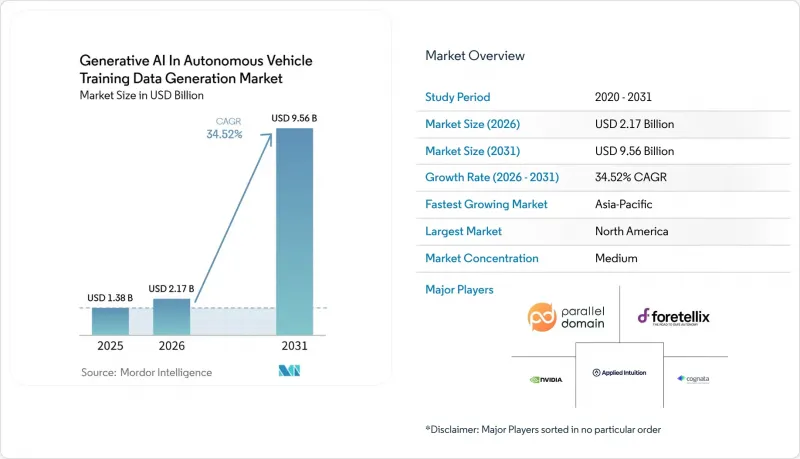
據 Mordor Intelligence 稱,用於產生自動駕駛汽車訓練數據的生成式人工智慧市場預計將從 2025 年的 13.8 億美元成長到 2026 年的 21.7 億美元,到 2031 年達到 95.6 億美元,預計 2026 年至 2031 年的複合年成長率為 331 年的複合年成長率為 331 年。
本報告按產品(軟體平台和工具、服務)、資料模態(圖像、影片等)、應用(ADAS 測試等)、最終用戶(汽車原始設備製造商、一級供應商等)、部署模式(本地部署等)和地區(北美、歐洲等)進行細分。市場預測以美元計價。
全球趨勢與洞察:用於產生自動駕駛汽車訓練資料的生成式人工智慧
安全合成訓練場景的需求日益成長
驅動生成式人工智慧市場為自動駕駛汽車產生訓練資料的首要因素,是真實車輛資料中罕見駕駛事件出現頻率不足以支援全面且安全的模型訓練。與緊急車輛的互動、行人突然移動、惡劣天氣以及異常道路碰撞等事件對於部署準備至關重要,但這些事件在自然駕駛場景中發生頻率過低,僅靠道路資料收集難以建立均衡的訓練庫。 NVIDIA 於 2025 年發布了 Cosmos World Foundation 模型及相關實體人工智慧資料集,直接解決了這一長尾覆蓋問題,使開發者能夠利用地圖、深度和天氣資料作為輸入,產生多樣化的駕駛片段。 CARLA 也在 2025 年將 Cosmos Transfer 整合到其開放原始碼模擬平台中,從而為更多開發者提供了生成式合成工作流程。安全檢驗的壓力使得解決這項挑戰變得更加緊迫。這是因為 ISO/TS 5083:2025 對部署高級自動駕駛系統之前進行場景範圍和可追溯性測試提出了更明確的要求。
現實世界資料收整合本不斷上升和可擴展性受限
用於產生自動駕駛車輛訓練資料的生成式人工智慧市場也受惠於大規模生產中真實世界感測器資料流的收集、清洗、標註和檢驗成本的飆升。儘管現代車隊每輛車每天可產生高達 4 TB 的原始感測器數據,但獲取關於罕見極端情況和感測器間上下文的有用真實數據仍然比獲取原始數據本身更具挑戰性。合成資料產生透過實現預標註輸出並減少新場景庫所需的人工標註工作,改變了成本結構。據 Applied Intuition 稱,他們計劃在 2025 年處理數百Petabyte的訓練資料並支援 5,000 萬次模擬。這充分說明了在自動駕駛專案中,大規模資料基礎設施的高成本和營運負擔有多沉重。因此,對於那些無法建立自身車隊規模資料營運的一級供應商和中型開發公司而言,託管式合成資料管道正變得越來越有吸引力。
合成數據與真實感測器數據之間的檢驗差距
生成式人工智慧市場在為自動駕駛車輛產生訓練資料方面的主要限制因素仍然是合成輸出與真實運作環境中實際感測器行為之間的差距。即使是基於生成場景訓練的模型,在遇到細微的噪音模式、反射率效應以及無法在模擬中完全重現的大氣條件時,表現也會下降。一項針對自動駕駛資料集安全性的2025年研究也強調,需要在新的安全保障架構下保持資料沿襲和模型影響的可追溯性,這增加了合成資料管道的文件負擔。 NVIDIA的NuRec API透過從真實車輛資料重建高保真3D環境,有助於彌合部分差距,但檢驗仍需要專門的工程工作流程。在跨感測器模式的標準化遷移基準變得更加普遍之前,它們的普及速度將無法達到潛在需求所預期的水平。
細分市場分析
到2025年,軟體平台和工具將佔據74.32%的市場佔有率,這表明用於產生自動駕駛汽車訓練資料的生成式人工智慧市場仍然側重於平台所有權,而非外包執行。早期買家主要專注於場景產生、標註管理和資料整理系統。這些工具與內部工程工作流程緊密相關,使團隊能夠更精細地控制操作設計域、感測器配置和邊界情況邏輯。這一趨勢有利於能夠提供可擴展API、可配置環境以及與下游模型訓練管道整合的供應商。這也反映了原始設備製造商(OEM)和一級供應商希望將場景設計和檢驗的核心邏輯保留在自身組織內部的願望。
預計到2031年,服務市場將以34.67%的複合年成長率成長,並有望成為該領域成長最快的板塊,因為越來越多的客戶缺乏營運大規模合成數據專案所需的內部團隊。因此,用於產生自動駕駛汽車訓練資料的生成式人工智慧市場正從純粹的軟體採購模式轉向整合平台存取和託管執行的混合模式。 Applied Intuition的「資料引擎」從原始資料(車隊日誌)中整理Petabyte級資料集,用於基礎模型訓練,這表示平台供應商已經在建立以軟體授權為中心的常規服務層。隨著訓練後調優和評估工作日益專業化,對服務的需求預計將會增加,因為許多客戶優先考慮的是更快的周轉時間和品質保證,而不是在內部擁有所有工作流程組件。
到2025年,多模態感測器資料將佔據45.67%的市場佔有率,證實了在用於產生自動駕駛車輛訓練資料的生成式人工智慧市場中,買家更重視跨感測器的一致性,而非單一模態的輸出。由於自動駕駛車輛感知系統並非孤立地運行攝影機、雷達或LiDAR,因此,當幾何關係、時間以及物體行為在所有資料流中保持一致時,合成資料的效用就會顯著提升。這正是多模態堆疊對於平台定位和場景設計至關重要的原因。這也解釋了為什麼圖像和影片雖然仍然重要,但它們本身已不再是工作流程中最有價值的部分。
由於理解動態場景高度依賴精確的空間表示,LiDAR點雲生成市場預計到2031年將以34.53%的複合年成長率成長。在2025年ICRA大會上發表的一項關於LidarDM的研究表明,產生的虛擬世界能夠支援更逼真的雷射雷達模擬工作流程。 NVIDIA的「Cosmos Predict-2」將多模態世界建模擴展到2025年,透過產生具有更強運動和物體控制的未來世界狀態影片,實現了合成感測器輸出之間更豐富的同步。 ISO/TS 21934-2:2024也支援這一方向,因為在碰撞前技術模擬的虛擬環境中進行測試和證據產生需要更廣泛的模態覆蓋。
區域分析
到2025年,北美將佔據生成式人工智慧(AI)市場32.12%的佔有率,用於產生自動駕駛汽車的訓練數據,成為最大的貢獻地區。該地區受益於自動駕駛汽車(AV)開發商、模擬平台供應商和GPU基礎設施供應商的高度集中,其中美國是主要的商業化中心。 Applied Intuition、NVIDIA、Parallel Domain和Foretellix等公司都為此生態系統的深度發展提供了支援。 Applied Intuition預計到2025年將完成5,000萬次仿真,並計畫在全球新增六個辦公室地點。美國仍然是正在進行的自動駕駛專案的最大中心,這些專案需要在多個應用場景下產生大量的合成檢驗資料。墨西哥雖然規模較小,但也發揮重要作用,跨國商業自動駕駛專案正在測試和物流應用場景中拓展其營運範圍。
預計到2031年,亞太地區將以36.32%的複合年成長率成長,並有望成為所有地區中生成式人工智慧(AI)市場成長最快的地區,該市場用於產生自動駕駛汽車的訓練資料。該地區的成長主要得益於中國對自動駕駛產業的大力投入、日本對商用車領域的關注以及韓國高級駕駛輔助系統(ADAS)供應鏈的擴張。韓國公司SUM於2025年推出了其「Abyss」數據營運平台,該平台可將真實世界的駕駛數據轉化為符合國家自動駕駛數據標準的AI資產,這表明韓國本土能力建設已超越試點階段。在日本和印度,路線規劃和物流領域的自動駕駛發展也推動了市場成長,因為這為合成測試和訓練內容創造了更結構化的需求。
歐洲憑藉其強大的原始設備製造商 (OEM) 和一級供應商基礎以及更嚴格的法規環境,仍然是全球第二大區域市場(按以金額為準)。英國正透過 Wayve 加強其區域影響力。 Wayve 於 2026 年 2 月完成了 12 億美元的 D資金籌措,並正利用「GAIA」世界模型作為基礎,在倫敦進行商業機器人計程車試驗。德國繼續透過其 OEM 生態系統和 dSPACE 等供應商支持該地區的大部分工業活動。同時,法國正透過 AVSimulation 加強其模擬能力。由於當地自動駕駛汽車 (AV) 車隊規模和基礎設施有限,南美、中東和非洲在用於生成自動駕駛汽車訓練數據的生成式人工智慧市場中所佔佔有率仍然小規模,儘管基於雲端的工作流程正在降低研究和物流項目的准入門檻。
其他好處:
- Excel格式的市場預測(ME)表
- 3個月的分析師支持
目錄
第1章:引言
- 研究假設和市場定義
- 調查範圍
第2章:調查方法
第3章執行摘要
第4章 市場狀況
- 市場概覽
- 市場促進因素
- 對關鍵邊緣案例和罕見事件的訓練資料的需求日益成長。
- 現實世界的資料收集和標註面臨成本上升和可擴展性挑戰。
- 擴大高階駕駛輔助系統(ADAS)和自動駕駛的人工智慧開發計劃
- 現實世界中罕見事件的數據匱乏
- 利用基礎模型生成場景
- 對多樣化、持續更新和多模態人工智慧訓練資料集的需求日益成長。
- 市場限制因素
- 檢驗差距與實際駕駛條件對比
- 建構物理上精確的仿真堆疊成本高昂。
- 碎片化的場景標準和互通性
- 對GPU和雲端運算的依賴
- 價值鏈分析
- 法規和標準的發展趨勢
- 技術展望
- 波特五力分析
第5章 市場規模與成長預測
- 報價
- 軟體平台和工具
- 服務
- 按數據模態
- 影像
- 影片
- LiDAR點雲
- 雷達
- 多模態感測器數據
- 透過使用
- ADAS測試
- 自動駕駛汽車的研發
- 人工智慧和機器學習模型的訓練
- 安全合規性檢驗
- 設計檢驗
- 按最終用途
- 汽車原廠設備製造商
- 一級供應商
- 科技公司
- 研究機構
- 按實現類型
- 現場
- 基於雲端的
- 混合
- 按地區
- 北美洲
- 美國
- 加拿大
- 墨西哥
- 南美洲
- 巴西
- 阿根廷
- 其他南美國家
- 歐洲
- 德國
- 英國
- 法國
- 義大利
- 西班牙
- 俄羅斯
- 其他歐洲國家
- 亞太地區
- 中國
- 日本
- 印度
- 韓國
- 澳洲
- 其他亞太國家
- 中東
- 沙烏地阿拉伯
- 阿拉伯聯合大公國
- 土耳其
- 其他中東國家
- 非洲
- 南非
- 埃及
- 其他非洲國家
- 北美洲
第6章 競爭情勢
- 市場集中度
- 策略趨勢
- 市佔率分析
- 公司簡介
- NVIDIA Corporation
- Applied Intuition Inc.
- Cognata Ltd.
- Parallel Domain Inc.
- Foretellix Ltd.
- Ansys Inc.
- The MathWorks, Inc.
- dSPACE GmbH
- Siemens Digital Industries Software
- Dassault Systemes SE
- Altair Engineering Inc.
- Autodesk, Inc.
- Unity Software Inc.
- IPG Automotive GmbH
- AVSimulation SAS
- rFpro Limited
- aiMotive
- Elektrobit Automotive GmbH
- Scale AI, Inc.
第7章 市場機會與未來展望
According to Mordor Intelligence, the generative AI in autonomous vehicle training data generation market size is expected to increase from USD 1.38 billion in 2025 to USD 2.17 billion in 2026 and reach USD 9.56 billion by 2031, growing at a CAGR of 34.52% over 2026-2031.
This report is Segmented by Offering (Software Platforms and Tools, and Services), Data Modality (Image, Video, and More), Application (ADAS Testing, and More), End Use (Automotive OEMs, Tier 1 Suppliers, and More), Deployment Mode (On-Premises, and More), and Geography (North America, Europe, and More). The Market Forecasts are Provided in Terms of Value (USD).
Global Generative AI In Autonomous Vehicle Training Data Generation Market Trends and Insights
Growing Need for Safe Synthetic Training Scenarios
The generative AI in autonomous vehicle training data generation market is being pushed first by the simple fact that rare driving events do not appear often enough in physical fleet data to support broad and safe model training. Emergency vehicle interactions, sudden pedestrian movement, heavy weather, and unusual road conflicts all matter for deployment readiness, but they appear too infrequently in natural driving to build balanced training libraries from road collection alone. NVIDIA released Cosmos world foundation models and a related physical AI dataset in 2025 to let developers generate varied driving clips from map, depth, and weather inputs, directly addressing this long-tail coverage problem. CARLA also integrated Cosmos Transfer into its open-source simulation platform in 2025, which widened access to generative synthetic workflows across a large developer base. Safety validation pressure adds more urgency because ISO/TS 5083:2025 sets clearer expectations for scenario coverage and traceable testing before deployment of higher-level autonomous systems.
Rising Cost and Scalability Constraints of Real-World Data Collection
The generative AI in autonomous vehicle training data generation market is also benefiting from the rising cost of collecting, cleaning, labeling, and validating real-world sensor streams at a production scale. Modern fleets can generate up to 4 TB of raw sensor data per vehicle per day, yet usable ground truth for rare edge cases and cross-sensor context remains much harder to secure than raw volume. Synthetic generation changes the cost structure by enabling pre-annotated outputs and reducing the manual labeling needed for new scenario libraries. Applied Intuition said it processed hundreds of petabytes of training data and supported 50 million simulations in 2025, which shows how expensive and operationally demanding large-scale data infrastructure has become for autonomy programs. That makes managed synthetic data pipelines more attractive for Tier 1 suppliers and mid-sized developers that cannot build fleet-scale data operations on their own.
Verification Gap Between Synthetic and Real-World Sensor Data
The main restraint on the generative AI in autonomous vehicle training data generation market remains the gap between synthetic outputs and real sensor behavior in deployment conditions. Models trained on generated scenarios can still underperform when they meet subtle noise patterns, reflectance effects, and atmospheric conditions that the simulation does not fully reproduce. Research on dataset safety in autonomous driving published in 2025 also stressed that data lineage and model impact must remain traceable under emerging safety assurance frameworks, which raises the documentation burden for synthetic pipelines. NVIDIA's NuRec APIs help close part of that gap by reconstructing high-fidelity 3D environments from real fleet data, but validation still depends on specialized engineering workflows. Until standardized transfer benchmarks become more common across sensor modalities, adoption will continue to move more slowly than the underlying demand suggests.
Other drivers and restraints analyzed in the detailed report include:
- Expansion of ADAS and Autonomous Driving Programs
- Shortage of Real-World Edge Case Training Data
- High Cost of Physics-Based Simulation Infrastructure
For complete list of drivers and restraints, kindly check the Table Of Contents.
Segment Analysis
Software platforms and tools held 74.32% share in 2025, which shows that the generative AI in autonomous vehicle training data generation market still rests first on platform ownership rather than outsourced execution. Early buyers have focused on scenario generation, annotation control, and data curation systems because these tools sit closest to internal engineering workflows and give teams greater control over operational design domains, sensor configurations, and corner-case logic. This pattern favors vendors that can provide extensible APIs, configurable environments, and integration with downstream model training pipelines. It also reflects a preference among OEMs and Tier 1 suppliers to keep the core logic of scenario design and validation inside their own organizations.
Services are projected to expand at a 34.67% CAGR through 2031, making it the fastest-growing part of this segment as more customers lack the internal teams needed to run synthetic data programs at scale. The generative AI in autonomous vehicle training data generation market is therefore shifting from pure software procurement toward blended models where platform access and managed execution move together. Applied Intuition's Data Engine, which curates petabyte-scale datasets from raw fleet logs for foundation model training, shows how platform vendors are already building recurring service layers around software licenses. As post-training, calibration, and evaluation work grows more specialized, service demand is likely to rise because many customers need delivery speed and quality assurance more than they need ownership of every workflow component.
Multimodal sensor data commanded 45.67% share in 2025, which confirms that buyers in the generative AI in autonomous vehicle training data generation market value cross-sensor consistency more than single-modality output. Autonomous perception systems do not operate on camera, radar, or LiDAR in isolation, so synthetic data is more useful when geometry, timing, and object behavior remain aligned across all streams. This explains why multimodal stacks have become central to platform positioning and scenario design. It also explains why images and videos remain important but no longer define the highest-value part of the workflow on their own.
LiDAR point cloud generation is projected to grow at a 34.53% CAGR through 2031, as dynamic scene understanding relies heavily on precise spatial representation. Research presented at ICRA 2025 on LidarDM showed how generated worlds can support more realistic LiDAR simulation workflows. NVIDIA's Cosmos Predict-2 extended multimodal world modeling in 2025 by generating future-world-state videos with stronger motion and object control, enabling richer synchronization across synthetic sensor outputs. ISO/TS 21934-2:2024 also supports this direction because virtual environments for pre-crash technology simulation require broader modality coverage for testing and evidence generation.
Complete Report Scope:
- By Offering
- Software Platforms and Tools
- Services
- By Data Modality
- Image
- Video
- LiDAR Point Cloud
- Radar
- Multimodal Sensor Data
- By Application
- ADAS Testing
- Autonomous Vehicle Development
- AI and ML Model Training
- Safety and Compliance Validation
- Design Validation
- By End Use
- Automotive OEMs
- Tier 1 Suppliers
- Technology Companies
- Research Institutions
- By Deployment Mode
- On-Premises
- Cloud-Based
- Hybrid
- By Geography
- North America
- United States
- Canada
- Mexico
- South America
- Brazil
- Argentina
- Rest of South America
- Europe
- Germany
- United Kingdom
- France
- Italy
- Spain
- Russia
- Rest of Europe
- Asia-Pacific
- China
- Japan
- India
- South Korea
- Australia
- Rest of Asia-Pacific
- Middle East
- Saudi Arabia
- United Arab Emirates
- Turkey
- Rest of Middle East
- Africa
- South Africa
- Egypt
- Rest of Africa
- North America
Geography Analysis
North America held 32.12% of the generative AI in autonomous vehicle training data generation market share in 2025, which made it the largest regional contributor. The region benefits from a dense mix of AV developers, simulation platform vendors, and GPU infrastructure suppliers, with the United States serving as the main center for commercialization. Applied Intuition, NVIDIA, Parallel Domain, and Foretellix all support that ecosystem depth, and Applied Intuition reported 50 million simulations in 2025 while expanding to six new global offices. The United States also remains the largest base for active autonomous-driving programs that require high volumes of synthetic validation data across multiple use cases. Mexico adds a smaller but relevant role as cross-border commercial autonomy programs widen the operating corridor for testing and logistics use cases.
Asia-Pacific is projected to expand at 36.32% CAGR through 2031, giving it the fastest regional pace in the generative AI in autonomous vehicle training data generation market. Growth in the region is being supported by China's industrial push into autonomous driving, Japan's efforts in commercial vehicles, and South Korea's expanding ADAS supply base. South Korea's SUM launched the Abyss data operating platform in 2025 to convert real-world driving data into AI-ready assets aligned with national autonomous-driving data standards, indicating that local capability-building is moving beyond pilot work. Japan and India also add momentum as corridor programs and logistics autonomy efforts create more structured demand for synthetic testing and training content.
Europe remains the second-largest regional market in value terms because it combines a deep OEM and Tier 1 supplier base with a stricter regulatory setting. The United Kingdom strengthens regional depth through Wayve, which secured a USD 1.2 billion Series D round in February 2026 and is using its GAIA world model as the base for commercial robotaxi trials in London. Germany continues to anchor much of the region's industrial activity through its OEM ecosystem and vendors such as dSPACE, while France adds simulation capability through AVSimulation. South America, the Middle East, and Africa still represent smaller positions in the generative AI in autonomous vehicle training data generation market because local AV fleet scale and infrastructure remain limited, though cloud-based workflows are lowering entry barriers for research and logistics programs.
- NVIDIA Corporation
- Applied Intuition Inc.
- Cognata Ltd.
- Parallel Domain Inc.
- Foretellix Ltd.
- Ansys Inc.
- The MathWorks, Inc.
- dSPACE GmbH
- Siemens Digital Industries Software
- Dassault Systemes SE
- Altair Engineering Inc.
- Autodesk, Inc.
- Unity Software Inc.
- IPG Automotive GmbH
- AVSimulation SAS
- rFpro Limited
- aiMotive
- Elektrobit Automotive GmbH
- Scale AI, Inc.
Additional Benefits:
- The market estimate (ME) sheet in Excel format
- 3 months of analyst support
TABLE OF CONTENTS
1 INTRODUCTION
- 1.1 Study Assumptions and Market Definition
- 1.2 Scope of the Study
2 RESEARCH METHODOLOGY
3 EXECUTIVE SUMMARY
4 MARKET LANDSCAPE
- 4.1 Market Overview
- 4.2 Market Drivers
- 4.2.1 Growing Need for Safety-Critical Edge-Case and Rare-Event Training Data
- 4.2.2 Rising Cost and Scalability Challenges of Real-World Data Collection and Annotation
- 4.2.3 Expansion of ADAS and Autonomous Driving AI Development Programs
- 4.2.4 Shortage of Real-World Rare Event Data
- 4.2.5 Foundation Model Enabled Scenario Generation
- 4.2.6 Growing Demand for Diverse, Continuously Updated, and Multimodal AI Training Datasets
- 4.3 Market Restraints
- 4.3.1 Verification Gap Versus Real-World Driving Conditions
- 4.3.2 High Cost of Physics-Accurate Simulation Stacks
- 4.3.3 Fragmented Scenario Standards and Interoperability
- 4.3.4 GPU and Cloud Compute Dependency
- 4.4 Value Chain Analysis
- 4.5 Regulatory and Standards Landscape
- 4.6 Technological Outlook
- 4.7 Porter's Five Forces Analysis
- 4.7.1 Bargaining Power of Suppliers
- 4.7.2 Bargaining Power of Buyers
- 4.7.3 Threat of New Entrants
- 4.7.4 Threat of Substitutes
- 4.7.5 Competitive Rivalry
5 MARKET SIZE AND GROWTH FORECASTS (VALUE)
- 5.1 By Offering
- 5.1.1 Software Platforms and Tools
- 5.1.2 Services
- 5.2 By Data Modality
- 5.2.1 Image
- 5.2.2 Video
- 5.2.3 LiDAR Point Cloud
- 5.2.4 Radar
- 5.2.5 Multimodal Sensor Data
- 5.3 By Application
- 5.3.1 ADAS Testing
- 5.3.2 Autonomous Vehicle Development
- 5.3.3 AI and ML Model Training
- 5.3.4 Safety and Compliance Validation
- 5.3.5 Design Validation
- 5.4 By End Use
- 5.4.1 Automotive OEMs
- 5.4.2 Tier 1 Suppliers
- 5.4.3 Technology Companies
- 5.4.4 Research Institutions
- 5.5 By Deployment Mode
- 5.5.1 On-Premises
- 5.5.2 Cloud-Based
- 5.5.3 Hybrid
- 5.6 By Geography
- 5.6.1 North America
- 5.6.1.1 United States
- 5.6.1.2 Canada
- 5.6.1.3 Mexico
- 5.6.2 South America
- 5.6.2.1 Brazil
- 5.6.2.2 Argentina
- 5.6.2.3 Rest of South America
- 5.6.3 Europe
- 5.6.3.1 Germany
- 5.6.3.2 United Kingdom
- 5.6.3.3 France
- 5.6.3.4 Italy
- 5.6.3.5 Spain
- 5.6.3.6 Russia
- 5.6.3.7 Rest of Europe
- 5.6.4 Asia-Pacific
- 5.6.4.1 China
- 5.6.4.2 Japan
- 5.6.4.3 India
- 5.6.4.4 South Korea
- 5.6.4.5 Australia
- 5.6.4.6 Rest of Asia-Pacific
- 5.6.5 Middle East
- 5.6.5.1 Saudi Arabia
- 5.6.5.2 United Arab Emirates
- 5.6.5.3 Turkey
- 5.6.5.4 Rest of Middle East
- 5.6.6 Africa
- 5.6.6.1 South Africa
- 5.6.6.2 Egypt
- 5.6.6.3 Rest of Africa
- 5.6.1 North America
6 COMPETITIVE LANDSCAPE
- 6.1 Market Concentration
- 6.2 Strategic Moves
- 6.3 Market Share Analysis
- 6.4 Company Profiles (includes Global Level Overview, Market Level Overview, Core Segments, Financials as available, Strategic Information, Market Rank/Share, Products and Services, Recent Developments)
- 6.4.1 NVIDIA Corporation
- 6.4.2 Applied Intuition Inc.
- 6.4.3 Cognata Ltd.
- 6.4.4 Parallel Domain Inc.
- 6.4.5 Foretellix Ltd.
- 6.4.6 Ansys Inc.
- 6.4.7 The MathWorks, Inc.
- 6.4.8 dSPACE GmbH
- 6.4.9 Siemens Digital Industries Software
- 6.4.10 Dassault Systemes SE
- 6.4.11 Altair Engineering Inc.
- 6.4.12 Autodesk, Inc.
- 6.4.13 Unity Software Inc.
- 6.4.14 IPG Automotive GmbH
- 6.4.15 AVSimulation SAS
- 6.4.16 rFpro Limited
- 6.4.17 aiMotive
- 6.4.18 Elektrobit Automotive GmbH
- 6.4.19 Scale AI, Inc.
7 MARKET OPPORTUNITIES AND FUTURE OUTLOOK
- 7.1 White-Space and Unmet-Need Assessment

 全球車載數據貨幣化平台市場規模、佔有率、趨勢和成長分析報告(2026-2034)
 汽車數據貨幣化:全球市場
 2026年全球汽車數據貨幣化平台市場報告
 汽車資料貨幣化:市場佔有率分析、產業趨勢與統計、成長預測(2026-2031)汽車數據貨幣化平台市場規模、佔有率、成長、全球產業分析、區域趨勢及2026年至2034年預測
 汽車資料市場預測至2034年-全球資料分析(按資料類型、資料來源、車輛類型、驅動系統、部署模式、資料所有權、應用程式、最終使用者和地區分類)
 汽車資料管理市場:商業機會、成長要素、產業趨勢分析及2026-2035年預測汽車資料貨幣化市場預測至2034年:按資料類型、貨幣化模式、部署模式、收入來源、應用、最終用戶和地區分類的全球分析全球汽車數據分析市場規模、佔有率、趨勢和成長分析報告(2026-2034)汽車數據貨幣化平台市場機會、成長要素、產業趨勢分析及2026-2035年預測