


 |
市場調查報告書
商品編碼
2117555
NVDIMM 和持久性記憶體模組:市場佔有率分析、行業趨勢和統計數據、成長預測(2026-2031 年)NVDIMM and Persistent Memory Module - Market Share Analysis, Industry Trends & Statistics, Growth Forecasts (2026 - 2031) |
||||||

※ 本網頁內容可能與最新版本有所差異。詳細情況請與我們聯繫。
根據 Mordor Intelligence 預測,NVDIMM 和持久記憶體模組市場將從 2025 年的 8.3 億美元和 2026 年的 8.9 億美元成長到 2031 年的 13 億美元,2026 年至 2031 年的年複合成長率(CAGR)為 7.92%。
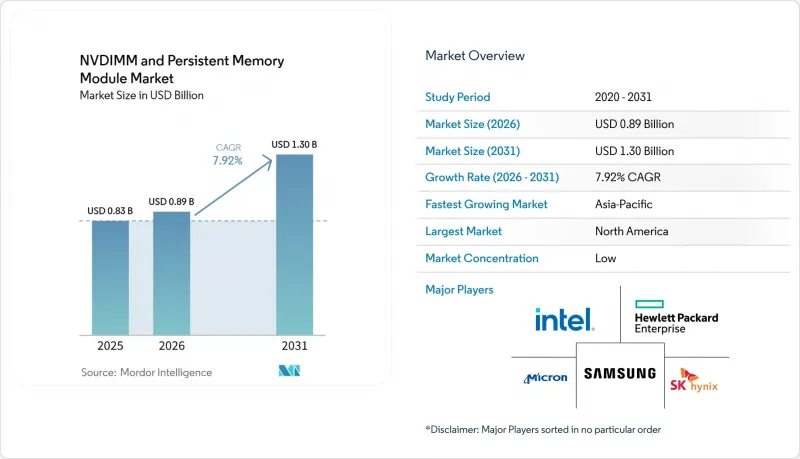
本報告按產品類型(NVDIMM-N、NVDIMM-F、NVDIMM-P 等)、最終用戶(企業 IT、通訊和邊緣基礎設施等)、應用程式(資料庫加速、即時分析等)、技術(DRAM+NAND 混合、基於NAND快閃記憶體等)和地區(北美、亞太等)進行細分。市場預測以美元 (USD) 為單位。
全球NVDIMM與持久性記憶體模組市場趨勢及洞察
需要持久記憶體的人工智慧和高效能運算工作負載
大規模語言模型推理叢集需要特徵儲存、鍵值快取和嵌入式向量來應對上下文重置,而無需重複載入儲存。這進一步凸顯了在活動記憶體空間內保持資料持久性的重要性。由於易失性DRAM無法在斷電或計畫內中斷期間維持運作狀態,因此這項需求提升了NVDIMM和持久記憶體模組市場的戰略價值。微軟在2026年第三季10-Q報告中指出,其2026年250億美元的資本支出與DRAM和HBM價格上漲相關,顯示記憶體經濟性正從單純的基礎設施營運問題演變為電路板層面的問題。隨著通訊和金融服務環境中的AI推理叢集對斷電後會話連續性和低延遲重新啟動的需求日益成長,NVDIMM和持久記憶體模組市場也從中受益。這使得NVDIMM和持久記憶體模組市場的潛在應用範圍從傳統的高效能運算設施擴展到更廣泛的企業環境。此外,Rhambus 已將 2026 年 7 月推出的 DDR5 伺服器晶片組定位為面向基於代理的 AI 和高效能運算 (HPC) 伺服器基礎架構。這印證了主流 AI 伺服器的設計週期中正在考慮支援持久記憶體的觀點。
延長超大規模和企業資料中心的更新週期
隨著許多買家在2026年向DDR5平台遷移,伺服器現代化進程推動了NVDIMM和持久記憶體模組市場的發展。這一時機意義重大,因為在僅支援DDR4的環境中難以證明其合理性的升級,隨著企業更換核心伺服器主機板和記憶體控制器,變得更加現實。美光科技在提交給美國證券交易委員會(SEC)的2026年第三季公佈財報中表示,其2026年的資本支出將從2025年的138億美元增至270億美元,支出重點將放在先進DRAM和HBM的產能上。在這種環境下,NVDIMM和持久記憶體模組市場脫穎而出。這是因為專用的持久層可以在不將所有容錯要求強加於通用DRAM的情況下,保護高價值工作負載。 2025年12月,SK海力士的256GB DDR5 RDIMM獲得了英特爾資料中心認證。這進一步擴展了檢驗的DDR5生態系統,為供應商尋求OEM設計採納提供了基礎。 NVDIMM 和持久記憶體模組市場正從中受益,因為每個新認證的 DDR5 平台都為在伺服器升級週期中部署持久記憶體模組創造了更可靠的途徑。
整合模組和平台的成本很高
NVDIMM 和持久記憶體模組市場仍然面臨著巨大的價格障礙。這是因為這些模組的材料清單(BOM) 比標準 DRAM 更為複雜。它們的架構需要 DRAM、NAND 快閃記憶體、儲能元件以及用於備份和復原作業的控制器邏輯,這甚至在認證完成之前就已經推高了成本。因此,在中階市場環境中,NVDIMM 和持久記憶體模組市場的規模化發展十分困難,因為中端市場每個插槽的預算有限,投資回報必須符合正常的 IT 支出週期。此外,認證過程也是一大障礙,因為它需要在設計達到量產獲利水準之前,對韌體、BIOS、作業系統支援和伺服器主機板相容性進行長達 12 至 24 個月的單獨檢驗。另外,SNIA NVM 程式設計模型增加了軟體適配工作量,因為應用團隊必須使用直接存取路徑,而不是傳統的緩衝儲存方法。在組件成本效益進一步提高且平台堆疊認證變得更加容易之前,NVDIMM 和持久記憶體模組市場在增值部署環境中的吸引力將高於成本驅動型部署環境。
細分市場分析
2025年,NVDIMM-N在NVDIMM和持久記憶體模組市場佔據58.71%的市場佔有率,憑藉其在各大伺服器產品線中獲得的廣泛OEM檢驗,保持了領先產品類型的地位。 NVDIMM和持久記憶體模組市場仍然高度依賴這種格式,因為它在運作中兼具DRAM般的性能,而NAND快閃記憶體僅在斷電時才會持久保存。這種設計減少了高負載運行時NAND快閃記憶體的直接損耗,從而確保了現有部署在重視穩定認證記錄的企業環境中能夠繼續使用。對於那些優先考慮已知韌體運行和已驗證的互通性而非過早採用新格式的客戶而言,NVDIMM-N也是NVDIMM和持久記憶體模組市場的首選。 Unigen和Kingston仍然是該領域的主要供應商,兩家公司均在既定的合規性和檢驗框架內運營,相關框架已在來源文件中概述。
NVDIMM-P 是成長最快的產品類型,預計到 2031 年的複合年成長率將達到 9.11%。由於它與新的 DDR5 平台和位元組尋址持久性技術更加契合,因此其市場定位意義重大。隨著買家對持久性的需求不斷成長,NVDIMM 和持久性記憶體模組市場對 NVDIMM-P 的需求仍有成長空間,因為使用者需要比外部記憶體擴展設備通常提供的更低延遲。 CXL 聯盟在 2025 年表示,從 NVDIMM-N 概念到 CXL 持久性記憶體的過渡將是一個共存階段,而不是即時替換,因為將高速易失性媒體與非揮發性備份相結合的邏輯將得以保留。 JEDEC 也為持久性記憶體協定的標準化指明了方向,這仍然是下一代伺服器 OEM 認證的核心要素。因此,NVDIMM 和持久記憶體模組市場可能會利用 NVDIMM-P 作為產品策略,在下一個平台週期中獲得更大的市場佔有率,同時繼續依靠 NVDIMM-N 來維持其目前的規模。
到 2025 年,企業 IT 將佔終端用戶銷售額的 43.88%,這反映了持久記憶體長期以來在保護資料庫狀態、交易日誌和查核點檔案方面發揮的重要作用。 NVDIMM 和持久記憶體模組市場深深紮根於這個買家群體,因為部署通常發生在嚴格控制的伺服器堆疊中,這些堆疊包含供應商特定的韌體、電池和控制器邏輯。因此,一旦現有供應商的設計通過了生產伺服器平台的認證,他們就能確立強大的市場地位。 NVDIMM 和持久記憶體模組市場對於超大規模資料中心業者和雲端服務供應商也持續佔據著重要的策略地位。然而,與企業相比,這些買家往往會更積極地評估基於 CXL 的替代方案以及傳統模組。政府和研究機構在專門的高效能運算 (HPC) 環境中持續支持著市場需求,在這些環境中,資料完整性和重新啟動行為與正式的運作要求直接相關。
通訊和邊緣基礎設施是終端用戶領域成長最快的細分市場,預計到2031年將以9.25%的複合年成長率成長,使其成為NVDIMM和持久記憶體模組市場最顯著的新興成長點。 NVDIMM和持久記憶體模組市場受益於5G獨立網路、開放式無線存取網(Open RAN)和多接取邊緣運算(MAEC),這些技術在將對延遲敏感的處理從中央設施轉移出去方面發揮著重要作用。 SK海力士於2026年開始量產其面向人工智慧伺服器環境的SOCAMM2 192GB模組,這顯示先進的記憶體技術創新正朝著分散式和邊緣部署模式的方向發展。在這些環境中,買家優先考慮的是防止斷電,因為遠端節點無法容忍長時間的重新啟動延遲或重複的模型狀態重建。因此,NVDIMM和持久記憶體模組市場不僅受益於邊緣資料量的不斷成長,也受益於分散式通訊基礎架構中記憶體狀態遺失所帶來的日益嚴重的營運損失。
區域分析
2025年,北美地區佔據了NVDIMM和持久記憶體模組45.43%的市場。這反映了該地區超大規模容量的集中、大型企業記憶體內工作負載的需求以及活躍的伺服器OEM認證專案。北美地區NVDIMM和持久記憶體模組市場表現尤為強勁,這得益於該地區買家傾向於儘早採用新的伺服器架構和記憶體密集型AI基礎設施。根據微軟2026年第三季10-Q報告,2026年高達250億美元的資本支出將歸因於DRAM和HBM價格的飆升,這表明北美電信巨頭正在積極應對記憶體成本壓力,以確保AI容量。美光科技在2026年第三季報告中也指出,2026年的資本支出將達到270億美元,進一步鞏固了北美在擴大先進記憶體供應和平台檢驗的重要地位。 NVDIMM 和持久記憶體模組市場正受益於這種環境,因為平台檢驗、組件存取以及對容錯記憶體的需求都高度集中在該地區。
歐洲在區域市場規模中排名第二,其需求模式與北美截然不同。歐洲的NVDIMM和持久記憶體模組市場更受到金融服務、醫療保健和製造業等受監管企業產業的影響,在這些產業中,容錯性和重新啟動完整性與人工智慧效能同等重要。 HPE將於2026年5月推出針對SAP HANA工作負載的Compute Scale-up Server 3250,這與此區域趨勢相符,因為許多大型記憶體內資料庫環境仍與企業業務永續營運要求相關,而非超大規模實驗。 NVDIMM和持久記憶體模組市場也符合歐洲的部署模式,在歐洲,軟體部署路徑通常由標準主導的基礎設施規劃和漫長的認證週期決定,而不是快速的試點部署擴充。
亞太地區是NVDIMM和持久性記憶體模組市場規模成長最快的地區,預計到2031年將以8.96%的複合年成長率成長。這一成長主要得益於韓國、日本和台灣強大的半導體製造能力,以及中國、印度和東南亞地區5G的廣泛部署和工業自動化需求的協同效應。 SK海力士宣布將於2026年開始量產SOCAMM2 192GB產品,這進一步鞏固了亞太地區作為下一代人工智慧基礎設施相關記憶體模組的供應中心和試驗場的地位。此外,由於分散式通訊和工業節點需要更靠近運行站點的記憶體容錯能力,NVDIMM和持久性記憶體模組市場也受益於區域成長的優勢。雖然世界其他地區的普及速度相對較慢,但海灣國家主導的人工智慧資料中心的部署以及巴西和南非等國雲端基礎設施的逐步擴展預計將在預測期內創造更多機會。
其他好處:
- Excel格式的市場預測(ME)表
- 3個月的分析師支持
目錄
第1章:引言
- 研究假設和市場定義
- 調查範圍
第2章:調查方法
第3章執行摘要
第4章 市場狀況
- 市場概覽
- 市場促進因素
- 人工智慧和高效能運算工作負載需要持久、低延遲的記憶體。
- 延長超大規模和企業資料中心的更新週期
- 向記憶體內和即時分析架構的遷移
- 過渡到DDR5平台以支援新的持久記憶體設計
- 邊緣運算和工業彈性要求
- 優先考慮避免伺服器停機和採取斷電應對措施。
- 市場限制因素
- 整合模組和平台的成本很高
- 最佳化軟體生態系統並延緩認證週期。
- 由於基於 CXL 的記憶體擴展架構而產生的競爭
- 這種設計方案的應用僅限於高價值的企業用例。
- 產業價值鏈分析
- 監理情勢
- 技術展望
- 宏觀經濟因素對市場的影響
- 波特五力分析
第5章 市場規模與成長預測
- 依產品類型
- NVDIMM-N
- NVDIMM-F
- NVDIMM-P
- 持久性記憶體 DIMM (PMem)
- 最終用戶
- 企業IT
- 雲端服務供應商/超大規模資料中心業者雲端服務供應商
- 通訊和邊緣基礎設施
- 政府和研究機構
- 透過使用
- 資料庫加速
- 即時分析
- 災害復原和資料持久性
- 邊緣運算系統
- 透過技術
- DRAM + NAND 混合
- NAND快閃記憶體體基座
- 位元組尋址持久記憶體(3D XPoint)
- 新興 SCM 技術(MRAM、ReRAM、PCM)
- 按地區
- 北美洲
- 歐洲
- 亞太地區
- 中國
- 日本
- 韓國
- 台灣
- 其他亞太國家
- 世界其他地區
第6章 競爭情勢
- 市場集中度
- 策略趨勢
- 市佔率分析
- 公司簡介
- Micron Technology, Inc.
- SK hynix Inc.
- Intel Corporation
- Samsung Electronics Co., Ltd.
- SMART Global Holdings, Inc.
- Netlist, Inc.
- Viking Technology, Inc.
- AgigA Tech, Inc.
- Kingston Technology Company, Inc.
- Hewlett Packard Enterprise Company
- Dell Technologies Inc.
- Fujitsu Limited
- Huawei Technologies Co., Ltd.
- Super Micro Computer, Inc.
- Everspin Technologies, Inc.
- Rambus Inc.
- Unigen Corporation
第7章 市場機會與未來展望
According to Mordor Intelligence, the NVDIMM and persistent memory module market size is projected to expand from USD 0.83 billion in 2025 and USD 0.89 billion in 2026 to USD 1.3 billion by 2031, registering a CAGR of 7.92% between 2026 to 2031.
This report is Segmented by Product Type (NVDIMM-N, NVDIMM-F, NVDIMM-P, and More), End User (Enterprise IT, Telecom and Edge Infrastructure, and More), Application (Database Acceleration, Real-Time Analytics, and More), Technology (DRAM+NAND Hybrid, NAND Flash-Based, and More), and Geography (North America, Asia Pacific, and More). The Market Forecasts are Provided in Terms of Value (USD).
Global NVDIMM and Persistent Memory Module Market Trends and Insights
AI and High-Performance Computing Workloads Requiring Persistent Memory
Large language model inference clusters need feature stores, KV caches, and embedding vectors to survive context resets without repeated storage reloads, which makes persistence more relevant inside active memory footprints. That requirement is lifting the strategic value of the NVDIMM and persistent memory module market because volatile DRAM alone cannot preserve the working state across outages or planned interruptions. Microsoft stated in its Q3 FY2026 10-Q that USD 25 billion of its 2026 capital expenditure was linked to DRAM and HBM price inflation, showing that memory economics had become a board-level issue rather than only an infrastructure operations concern. The NVDIMM and persistent memory module market also benefits, as AI inference clusters in telecom and financial services environments increasingly require session continuity and low-latency restart behavior after power events. That expands the addressable market for the NVDIMM and persistent memory module markets beyond traditional high-performance computing facilities into broader enterprise deployments. Rambus also framed its July 2026 DDR5 server chipset launch around agentic AI and HPC server infrastructure, which supports the view that persistent memory readiness is now being considered within mainstream AI server design cycles.
Growth in Hyperscale and Enterprise Data Center Refresh Cycles
The NVDIMM and persistent memory module market is gaining support from server refresh activity, as many buyers are moving to DDR5-capable platforms in 2026. That timing matters because upgrades that were harder to justify on DDR4-only environments become more practical when enterprises are already changing core server boards and memory controllers. Micron said in its fiscal Q3 2026 earnings release filed with the SEC that fiscal 2026 capital expenditures would reach USD 27 billion, up from USD 13.8 billion in fiscal 2025, with spending centered on advanced DRAM and HBM capacity. In that environment, the NVDIMM and persistent memory module market stands out because specialized persistence layers can protect high-value workloads without imposing every resilience requirement on commodity DRAM. SK hynix completed Intel Data Center Certification for its 256GB DDR5 RDIMM in December 2025, which broadened the validated DDR5 ecosystem that module vendors depend on when pursuing OEM design wins. The NVDIMM and persistent memory module market benefits from this, as each new qualified DDR5 platform creates a more credible insertion path for persistent memory modules during active server refresh cycles.
High Module and Platform Integration Cost
The NVDIMM and persistent memory module market still faces a meaningful pricing barrier because these modules carry more bill-of-materials complexity than standard DRAM. The architecture requires DRAM, NAND, an energy storage component, and controller logic for backup and restore behavior, which lifts the cost base before qualification work is even complete. That makes the NVDIMM and persistent memory module market harder to scale in mid-market environments where per-socket budgets stay tight and payback periods must fit normal IT spending cycles. Qualification adds another layer because firmware, BIOS, operating system support, and server board compatibility often need separate validation over 12-24 months before a design reaches production revenue. The SNIA NVM programming model also increases software adaptation work because application teams need to use direct access pathways rather than conventional buffered storage methods. Until component economics improve further and platform stacks become easier to certify, the NVDIMM and persistent memory module market will remain more attractive in higher-value deployments than in cost-sensitive rollouts.
Other drivers and restraints analyzed in the detailed report include:
- Shift Toward In-Memory Databases and Real-Time Analytics Architecture
- DDR5 Platform Transitions Supporting New Persistent Memory Designs
- Slow Software Ecosystem Optimization and Qualification Cycles
For complete list of drivers and restraints, kindly check the Table Of Contents.
Segment Analysis
NVDIMM-N held 58.71% of the NVDIMM and persistent memory module market share in 2025, which kept it as the leading product type because it already had broad OEM validation across major server lines. The NVDIMM and persistent memory module market still leans heavily on this format because it combines DRAM-like performance during operation with NAND-backed persistence only at power loss. That design reduces direct NAND wear during active workloads and keeps the installed base relevant in enterprise environments that prioritize stable qualification history. The NVDIMM and persistent memory module market also favors NVDIMM-N in accounts where buyers value known firmware behavior and proven interoperability over early adoption of newer formats. Unigen and Kingston remained important suppliers in this area because both companies operate inside the established compliance and validation framework described in the source material.
NVDIMM-P is the fastest-growing product type with a 9.11% CAGR through 2031, and that positioning matters because it aligns more directly with newer DDR5 platforms and byte-addressable persistence. The NVDIMM and persistent memory module market is opening more space for NVDIMM-P because buyers want persistence at lower latency than external memory expansion devices can usually provide. The CXL Consortium stated in 2025 that the move from NVDIMM-N concepts into CXL persistent memory preserves the logic of fast volatile media paired with non-volatile backup, which supports a coexistence phase instead of an immediate replacement cycle. JEDEC also set the standards direction for persistent memory protocol work, which remains central to OEM qualification on new server generations. The NVDIMM and persistent memory module market should therefore continue to rely on NVDIMM-N for current scale while using NVDIMM-P as the product path that captures more of the next platform cycle.
Enterprise IT accounted for 43.88% of end-user revenue in 2025, which reflected the long-standing role of persistent memory in protecting database state, transaction logs, and checkpoint files. The NVDIMM and persistent memory module market has deep roots in this buyer group because deployments often sit inside tightly managed server stacks with vendor-specific firmware and battery or controller logic. That creates durable positions for incumbent suppliers once a design is qualified on a production server platform. The NVDIMM and persistent memory module market also remains strategically important for hyperscalers and cloud providers, even though these buyers are more willing than enterprises to evaluate CXL-based alternatives alongside traditional modules. Government and research organizations continue to support demand in specialized HPC environments where data integrity and restart behavior are tied to formal operating requirements.
Telecom and edge infrastructure is the fastest-growing end-user segment, with a 9.25% CAGR through 2031, making it the clearest new expansion lane for the NVDIMM and persistent memory module market. The NVDIMM and persistent memory module market is benefiting from 5G standalone networks, Open RAN, and multi-access edge computing, which push more latency-sensitive processing away from central facilities. SK hynix began mass production of its SOCAMM2 192GB module in 2026 for AI server environments, showing that advanced memory innovation is moving closer to distributed and edge-oriented deployment models. In these environments, buyers value power-fail protection because remote nodes cannot absorb long restart delays or repeated model-state reconstruction. The NVDIMM and persistent memory module market therefore gains not only from higher data volumes at the edge, but also from the higher operational penalty attached to lost memory state in distributed telecom infrastructure.
Complete Report Scope:
- By Product Type
- NVDIMM-N
- NVDIMM-F
- NVDIMM-P
- Persistent Memory DIMMs (PMem)
- By End User
- Enterprise IT
- Cloud Service Providers / Hyperscalers
- Telecom and Edge Infrastructure
- Government and Research Organizations
- By Application
- Database Acceleration
- Real-Time Analytics
- Disaster Recovery and Data Persistence
- Edge Computing Systems
- By Technology
- DRAM + NAND Hybrid
- NAND Flash-Based
- Byte-Addressable Persistent Memory (3D XPoint)
- Emerging SCM Technologies (MRAM, ReRAM, PCM)
- By Geography
- North America
- Europe
- Asia Pacific
- China
- Japan
- South Korea
- Taiwan
- Rest of Asia Pacific
- Rest of the World
Geography Analysis
North America held 45.43% of the NVDIMM and persistent memory module market share in 2025, which reflected the region's heavy concentration of hyperscale capacity, large enterprise in-memory workloads, and active server OEM qualification programs. The NVDIMM and persistent memory module market is particularly strong in the region because buyers there tend to adopt new server architectures and memory-intensive AI infrastructure earlier. Microsoft's Q3 FY2026 10-Q showed that USD 25 billion of its 2026 capital expenditure was attributed to DRAM and HBM price inflation, which shows how strongly large North American operators are absorbing memory cost pressure to secure AI capacity. Micron also said in its fiscal Q3 2026 filing that capital expenditures would reach USD 27 billion in fiscal 2026, reinforcing the role of North America in advanced memory supply expansion and platform validation. The NVDIMM and persistent memory module market benefits from that environment because platform validation, component access, and demand for resilient memory all remain unusually concentrated in the region.
Europe ranked as the second-largest regional market and showed a different demand pattern from North America. The NVDIMM and persistent memory module market in Europe is shaped more by regulated enterprise sectors such as financial services, healthcare, and manufacturing, where resilience and restart integrity matter as much as AI performance. HPE's May 2026 launch of the Compute Scale-up Server 3250 for SAP HANA workloads fits this regional pattern because many of the largest in-memory database environments remain tied to enterprise continuity requirements rather than hyperscale experimentation. The NVDIMM and persistent memory module market also aligns with European deployment patterns because the software path is often governed by standards-led infrastructure planning and long qualification cycles rather than rapid pilot scaling.
Asia Pacific is the fastest-growing region at an 8.96% CAGR through 2031, and this makes it the clearest geographic growth engine in the NVDIMM and persistent memory module market size. The NVDIMM and persistent memory module market is expanding in the region because semiconductor manufacturing strength in South Korea, Japan, and Taiwan is being matched by broader 5G rollout and industrial automation demand across China, India, and Southeast Asia. SK hynix said it had begun mass production of SOCAMM2 192GB in 2026, which supports the region's role as both a supply center and a proving ground for next-generation memory modules tied to AI infrastructure. The NVDIMM and persistent memory module market is also gaining from the edge side of regional growth because distributed telecom and industrial nodes need memory resilience closer to operations. The Rest of the World remained earlier in adoption, but sovereign AI data center activity in Gulf markets and gradual cloud infrastructure expansion in countries such as Brazil and South Africa are expected to create incremental opportunities over the forecast period.
- Micron Technology, Inc.
- SK hynix Inc.
- Intel Corporation
- Samsung Electronics Co., Ltd.
- SMART Global Holdings, Inc.
- Netlist, Inc.
- Viking Technology, Inc.
- AgigA Tech, Inc.
- Kingston Technology Company, Inc.
- Hewlett Packard Enterprise Company
- Dell Technologies Inc.
- Fujitsu Limited
- Huawei Technologies Co., Ltd.
- Super Micro Computer, Inc.
- Everspin Technologies, Inc.
- Rambus Inc.
- Unigen Corporation
Additional Benefits:
- The market estimate (ME) sheet in Excel format
- 3 months of analyst support
TABLE OF CONTENTS
1 INTRODUCTION
- 1.1 Study Assumptions and Market Definition
- 1.2 Scope of the Study
2 RESEARCH METHODOLOGY
3 EXECUTIVE SUMMARY
4 MARKET LANDSCAPE
- 4.1 Market Overview
- 4.2 Market Drivers
- 4.2.1 AI and High-Performance Computing Workloads Requiring Persistent Low-Latency Memory
- 4.2.2 Growth in Hyperscale and Enterprise Data Center Refresh Cycles
- 4.2.3 Shift Toward In-Memory Databases and Real-Time Analytics Architectures
- 4.2.4 DDR5 Platform Transitions Supporting New Persistent Memory Designs
- 4.2.5 Edge Computing and Industrial Resilience Requirements
- 4.2.6 Server Downtime Avoidance and Power-Loss Protection Priorities
- 4.3 Market Restraints
- 4.3.1 High Module and Platform Integration Cost
- 4.3.2 Slow Software Ecosystem Optimization and Qualification Cycles
- 4.3.3 Competition From CXL-Based Memory Expansion Architectures
- 4.3.4 Limited Design Wins Outside High-Value Enterprise Use Cases
- 4.4 Industry Value Chain Analysis
- 4.5 Regulatory Landscape
- 4.6 Technological Outlook
- 4.7 Impact of Macroeconomic Factors on the Market
- 4.8 Porter's Five Forces Analysis
- 4.8.1 Bargaining Power of Suppliers
- 4.8.2 Bargaining Power of Buyers
- 4.8.3 Threat of New Entrants
- 4.8.4 Threat of Substitutes
- 4.8.5 Intensity of Competitive Rivalry
5 MARKET SIZE AND GROWTH FORECASTS (VALUE)
- 5.1 By Product Type
- 5.1.1 NVDIMM-N
- 5.1.2 NVDIMM-F
- 5.1.3 NVDIMM-P
- 5.1.4 Persistent Memory DIMMs (PMem)
- 5.2 By End User
- 5.2.1 Enterprise IT
- 5.2.2 Cloud Service Providers / Hyperscalers
- 5.2.3 Telecom and Edge Infrastructure
- 5.2.4 Government and Research Organizations
- 5.3 By Application
- 5.3.1 Database Acceleration
- 5.3.2 Real-Time Analytics
- 5.3.3 Disaster Recovery and Data Persistence
- 5.3.4 Edge Computing Systems
- 5.4 By Technology
- 5.4.1 DRAM + NAND Hybrid
- 5.4.2 NAND Flash-Based
- 5.4.3 Byte-Addressable Persistent Memory (3D XPoint)
- 5.4.4 Emerging SCM Technologies (MRAM, ReRAM, PCM)
- 5.5 By Geography
- 5.5.1 North America
- 5.5.2 Europe
- 5.5.3 Asia Pacific
- 5.5.3.1 China
- 5.5.3.2 Japan
- 5.5.3.3 South Korea
- 5.5.3.4 Taiwan
- 5.5.3.5 Rest of Asia Pacific
- 5.5.4 Rest of the World
6 COMPETITIVE LANDSCAPE
- 6.1 Market Concentration
- 6.2 Strategic Moves
- 6.3 Market Share Analysis
- 6.4 Company Profiles (includes Global Level Overview, Market Level Overview, Core Segments, Financials as available, Strategic Information, Market Rank/Share, Products and Services, Recent Developments)
- 6.4.1 Micron Technology, Inc.
- 6.4.2 SK hynix Inc.
- 6.4.3 Intel Corporation
- 6.4.4 Samsung Electronics Co., Ltd.
- 6.4.5 SMART Global Holdings, Inc.
- 6.4.6 Netlist, Inc.
- 6.4.7 Viking Technology, Inc.
- 6.4.8 AgigA Tech, Inc.
- 6.4.9 Kingston Technology Company, Inc.
- 6.4.10 Hewlett Packard Enterprise Company
- 6.4.11 Dell Technologies Inc.
- 6.4.12 Fujitsu Limited
- 6.4.13 Huawei Technologies Co., Ltd.
- 6.4.14 Super Micro Computer, Inc.
- 6.4.15 Everspin Technologies, Inc.
- 6.4.16 Rambus Inc.
- 6.4.17 Unigen Corporation
7 MARKET OPPORTUNITIES AND FUTURE OUTLOOK
- 7.1 White-space and Unmet-Need Assessment

 NVMe 交換適配器市場:全球市場預測,2026-2032 年
 2026年新興記憶體和儲存技術全球市場報告
 非揮發性記憶體高速介面(NVMe)全球市場規模、佔有率、趨勢和成長分析報告(2026-2034年)非揮發性記憶體(NVM)全球市場規模、佔有率、趨勢和成長分析報告(2026-2034)
 新興非揮發性記憶體:市場佔有率分析、產業趨勢與統計及成長預測(2026-2031 年)NanoRAM 市場 - 2026-2032 年全球市場預測非揮發性記憶體市場-2026-2032年全球市場預測全球記憶體和儲存技術市場(2027-2037 年)非揮發性記憶體:市場佔有率分析、產業趨勢與統計資料、成長預測(2026-2031 年)
 光纖通道NVMe市場分析及預測(至2035年):按類型、產品、服務、技術、組件、應用、部署、最終用戶、解決方案和安裝類型分類