


 |
市場調查報告書
商品編碼
2117492
鍍膜玻璃:市場佔有率分析、產業趨勢與統計、成長預測(2026-2031)Coated Glass - Market Share Analysis, Industry Trends & Statistics, Growth Forecasts (2026 - 2031) |
||||||

※ 本網頁內容可能與最新版本有所差異。詳細情況請與我們聯繫。
據 Mordor Intelligence 稱,2025 年鍍膜玻璃市值為 443.7 億美元,預計到 2031 年將達到 681.2 億美元,而 2026 年為 470.6 億美元,預測期內(2026-2031 年)的複合年成長率預計為 7.68%。
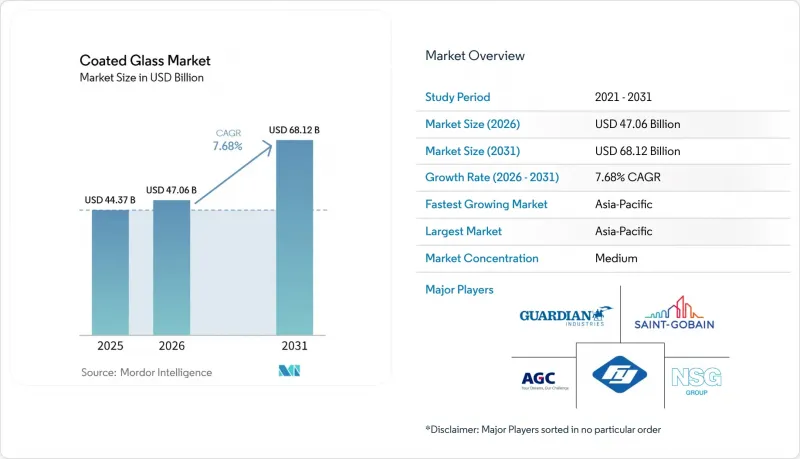
本報告按類型(建築玻璃等)、鍍膜類型(反射塗層、低輻射鍍膜等)、基材(浮法玻璃、鋼化玻璃等)、終端應用產業(建築、汽車等)和地區(亞太、北美、歐洲、南美、中東和非洲)進行細分。市場預測以美元計價。
全球鍍膜玻璃市場趨勢及洞察
由於建築圍護結構的能耗降低,低輻射(Low-E)規範的採用率正在提高。
目前,玻璃屋頂在商業和住宅建築的節能法規遵從中發揮核心作用,使得建築圍護結構的性能成為鍍膜玻璃市場的直接採購因素。修訂後的《建築能效指令》於2024年5月生效,並要求成員國在2026年5月前將其納入本國法律。該指令使得維修目標和零排放建築標準成為專案開發商和製造商的短期需求指標。此外,中國即將於2026年4月頒布、2026年11月生效的GB/T 47553-2026標準,也將透過更緊密地將建築玻璃的選擇與可測量的能量平衡計算聯繫起來,從而推動鍍膜玻璃市場的發展。隨著能源效率法規的日益嚴格,大規模商業競標中標準透明玻璃的應用範圍正在縮小,即使在新供應全面到位之前,經認證的低輻射鍍膜玻璃產品在鍍膜玻璃市場的實際價值也在不斷提升。 NSG 集團決定在波蘭投資 1.6 億波幣(4,000 萬美元)新建一條濺鍍塗層生產線,這表明供應商正在將生產能力部署在附近,以應對下一波由監管驅動的維修需求。
對太陽輻射控制日益成長的需求,使得電動車的續航里程與鍍膜玻璃的規格密切相關。
此外,由於汽車設計的進步和太陽能發電的普及,鍍膜玻璃市場受益於單一產品中光學和熱控性能價值的不斷提升。在電動車(EV)領域,太陽能控制玻璃和可加熱玻璃能夠改善車內溫度控制,隨著製造商致力於保持續航里程並提升各平台的功能性,它們的重要性日益凸顯。根據福耀玻璃預測,到2025年,公司高附加價值產品的市佔率預計將成長5.4個百分點,淨利將成長24.2%。這表明,鍍膜和高功能性玻璃產品的成長速度超過了標準汽車玻璃產品。在太陽能領域,由於專案開發商仍然優先考慮提高組件性能和專案的長期經濟可行性,因此抗反射膜玻璃仍然佔據著重要地位,這使得鍍膜玻璃市場在建築業之外擁有廣泛的應用基礎。 Guardian Glass 在埃及投資購買新的高性能鍍膜設備,也顯示該供應商預計當地建築市場和附近出口路線對太陽能控制玻璃和Low-E低輻射鍍膜玻璃的需求將會增加。
大量資本投資的需求是市場進入者所面臨的結構性障礙。
鍍膜玻璃市場進入門檻很高。這是因為先進的濺鍍生產線需要大量的資本投資、較長的試運行週期,以及投產後嚴格的良率控制。 NSG集團在波蘭的計畫就充分說明了這一點。即使是一條先進的鍍膜生產線也需要1.6億波幣(約4000萬美元)的投資。 Sisekam公司對鍍膜玻璃生產線的持續投資也表明,該市場產能的大幅擴張仍然主要局限於那些擁有雄厚財力和穩定下游市場管道的公司。在鍍膜玻璃市場,新興經濟體的區域需求可能超過當地的供應。這是因為許多潛在參與企業缺乏快速建立具有競爭力的生產線所需的時間、製程技術或資本結構。因此,尤其是在設備前置作業時間較長的旺季,大型成熟企業進入新地區的速度遠超中小企業在國內建立實際生產能力的速度。
細分市場分析
到2025年,建築玻璃將佔鍍膜玻璃市場銷售額的56.44%,成為該市場最大的類別。這一地位的形成得益於大規模的商業和住宅活動,以及節能法規的推動,這些因素使得鍍膜建築玻璃成為許多大型項目的常用配置。鍍膜玻璃市場將繼續依賴此類產品作為其銷售量,因為辦公大樓、商業區、公共工程和高性能住宅開發項目都需要各種組合產品,包括低輻射鍍膜住宅和太陽輻射控制產品。儘管各個終端市場的具體情況有所不同,但這一基礎的重要性仍然不變,因為建築相關的需求多種多樣,涵蓋了維修、新建和符合建築規範的維修,而非單一產品週期。這種廣泛的需求基礎也有助於主要製造商提高工廠運轉率,並支持對新型鍍膜生產線和下游製程的投資。
建築玻璃憑藉其龐大的市場規模以及與鍍膜玻璃行業關鍵需求促進因素(例如法規、能源效率和以規格為導向的採購)的契合度,佔據著主導地位。另一方面,汽車玻璃是成長最快的領域,預計到2031年將維持7.80%的複合年成長率。這表明,高價值功能的發展速度超過了傳統的建築主導型類別。在汽車應用中,玻璃現在支援溫度控管、光學性能、顯示整合和感測器相容性,因此,隨著每個新汽車平臺的推出,將採用更多種類的鍍膜產品。福耀玻璃2025年的表現(包括高價值產品市場佔有率的成長)印證了這一轉變,顯示成長的驅動力不僅來自汽車產量的增加,也來自對功能豐富的鍍膜產品日益成長的需求。這一趨勢表明,鍍膜玻璃市場將繼續調整其產品組合,在建築領域龐大的銷售量基礎和汽車領域快速成長的價值流之間取得平衡。
到2025年,低輻射(Low-E)鍍膜將主導鍍膜玻璃市場,佔42.70%的市場佔有率。這反映了Low-E鍍膜在節能窗戶、帷幕牆和中空玻璃單元中的核心作用。其地位源自於Low-E鍍膜能夠滿足鍍膜玻璃市場的關鍵監管要求,即在不影響採光性能的前提下,降低建築圍護結構的熱傳遞。因此,Low-E產品已成為在歐洲、中國、北美以及其他建築性能法規更為嚴格的地區運營的鍍膜製造商的主要收入來源。反射鍍膜和太陽輻射控制鍍膜也與Low-E產品並駕齊驅,佔據重要地位。這些鍍膜能夠滿足高溫氣候下的建築需求,減少眩光,並在太陽輻射增益是主要設計考量的市場中提升帷幕牆美觀。這些鍍膜共同將鍍膜玻璃市場與法規合規性和特定氣候條件下的性能要求連結起來,有助於維持各類建築的廣泛需求。
預計到2031年,抗反射膜將以8.12%的複合年成長率成長,顯示鍍膜玻璃市場正在超越傳統的窗戶應用領域。光學清晰度直接影響性能的應用,例如汽車感測器、抬頭顯示器系統、攝影機蓋和太陽能玻璃,是推動這一成長的最主要因素。隨著玻璃表面越來越承擔電子和視覺功能,防反射性能正成為產品的基本要求。康寧公司於2025年1月推出的Gorilla Armor 2被譽為首款用於行動裝置的耐刮高穿透玻璃陶瓷,進一步推動了塗層向兼具清晰度、耐用性和高階定位的單層層級構造轉變。因此,隨著光學性能在快速成長的細分產品領域的重要性日益凸顯,鍍膜玻璃市場不再僅以熱效率來定義。
區域分析
預計到2025年,亞太地區將佔全球鍍膜玻璃市場佔有率的47.52%,並有望成為所有地區中成長最快的地區,到2031年複合年成長率將達到8.41%。這確立了亞太地區作為鍍膜玻璃市場主要需求區域的地位,其成長動力主要來自大規模的建設活動、完善的製造網路以及建築和汽車領域日益成長的性能要求。中國仍然是該地區最大的生產市場,這得益於其龐大的建築環境以及平板玻璃和下游加工生態系統。儘管與過去幾年相比,新建住宅的成長速度可能會放緩,但出於合規要求而進行的翻新和維修需求將繼續支撐對鍍膜產品的需求。中國最新的綠色產品評價標準《GB/T 35604-2025》計畫於2025年11月生效,該標準將為中國最大的建築應用領域-建築玻璃的選擇增加更多正式標準。
印度正崛起為鍍膜玻璃市場的重要成長點。這主要得益於隨著商業區的開發和高性能建築需求的成長,Low-E低輻射鍍膜玻璃和太陽能控制玻璃的普及率不斷提高。此外,強調鍍膜產品本地供應的生產模式在該地區也取得了成功,尤其是在運輸、破損風險和交貨時間至關重要的情況下。在汽車和電子相關應用領域,亞太地區保持著主導地位。這是因為製造商、零件供應商和終端用戶都集中在同一個龐大的工業區。這種規模和接近性持續支撐著亞太地區的鍍膜玻璃市場,其他地區短期內難以趕上。
北美和歐洲是鍍膜玻璃市場的監管和技術標竿。在歐洲,修訂後的建築能源性能指令 (EPBD) 將於 2026 年 5 月納入各國法律,這一截止日期將推動全部區域對高性能建築產品的穩定採購。 NSG 集團在波蘭新建的鍍膜生產線以及 Sisecam 在歐洲對鍍膜玻璃的投資表明,在政策支持和穩定的維修需求推動下,供應商正在擴大產能。在北美,高性能建築產品需求的成長以及對產品文件(包括商業項目環境產品聲明 (EPD) 下的材料)日益成長的關注,都支撐著鍍膜玻璃市場的發展。
南美洲、中東和非洲以及歐洲其他地區在鍍膜玻璃市場中所佔佔有率仍然相對較小,但前景仍然樂觀。在南美,建設活動的活性化帶來了一定的推動作用,但外匯波動和能源成本可能會抑制鍍膜玻璃需求的成長。在中東和非洲,Guardian Glass在埃及投資高性能鍍膜設備表明,該地區正逐步從高度依賴進口轉向更依賴本地或區域供應。這種轉變可望減少供應延遲,並提高鄰近建築市場高性能鍍膜產品的供應量。
其他好處:
- Excel格式的市場預測(ME)表
- 3個月的分析師支持
目錄
第1章:引言
- 研究假設和市場定義
- 調查範圍
第2章:調查方法
第3章執行摘要
第4章 市場狀況
- 市場概覽
- 市場促進因素
- 減少商業設施維修過程中建築圍護結構的能量損失。
- 汽車玻璃對太陽輻射控制的需求日益成長。
- 增強了與電致變色玻璃和智慧玻璃的兼容性。
- 綠建築專案中隱含碳的採購標準應更加嚴格。
- 對具有耐刮擦性和耐化學腐蝕性的工業表面材料的需求。
- 資料中心和專用建築中多功能玻璃的應用日益廣泛。
- 市場限制因素
- 真空鍍膜生產線資本投入高、收益率低。
- 銀及特殊氧化物投入成本的波動性
- OEM和帷幕牆規範中重新認證的負擔。
- 價值鏈分析
- 波特五力分析
第5章 市場規模與成長預測
- 按類型
- 建築玻璃
- 汽車玻璃
- 工業玻璃
- 消費用玻璃
- 按塗層類型
- 反射塗層
- 低輻射鍍膜
- 太陽輻射控制塗層
- 抗反射膜
- 按基礎材料
- 浮法玻璃
- 強化玻璃
- 夾層玻璃
- 按最終用途行業分類
- 建築/施工
- 車
- 家用電子產品
- 產業
- 按地區
- 亞太地區
- 中國
- 印度
- 日本
- 韓國
- 其他亞太國家
- 北美洲
- 美國
- 加拿大
- 墨西哥
- 歐洲
- 德國
- 英國
- 法國
- 義大利
- 俄羅斯
- 其他歐洲國家
- 南美洲
- 巴西
- 阿根廷
- 其他南美國家
- 中東和非洲
- 沙烏地阿拉伯
- 南非
- 其他中東和非洲國家
- 亞太地區
第6章 競爭情勢
- 市場集中度
- 策略趨勢
- 市佔率和排名分析
- 公司簡介
- AGC Inc.
- Asahi India Glass Limited
- Cardinal Glass Industries, Inc.
- Central Glass Co., Ltd.
- China Glass Holding, Ltd.
- Euroglas GmbH
- Fuyao Glass Industry Group Co., Ltd.
- Guardian Industries
- Nippon Sheet Glass Co., Ltd.
- Saint-Gobain
- SCHOTT AG
- Sisecam Group
- Taiwan Glass Ind. Corp.
- Vitro, SAB de CV
- Xinyi Glass Holdings Limited
第7章 市場機會與未來展望
According to Mordor Intelligence, the coated glass market size was valued at USD 44.37 billion in 2025 and is estimated to grow from USD 47.06 billion in 2026 to reach USD 68.12 billion by 2031, at a CAGR of 7.68% during the forecast period (2026-2031).
This report is Segmented by Type (Architectural Glass, and More), Coating Type (Reflective Coatings, Low-E Coatings, and More), Substrate (Float Glass, Tempered Glass, and More), End-Use Industry (Building and Construction, Automotive, and More), and Geography (Asia-Pacific, North America, Europe, South America, and Middle-East and Africa). The Market Forecasts are Provided in Terms of Value (USD).
Global Coated Glass Market Trends and Insights
Lower Building Envelope Energy Consumption Lifts Low-Emissivity (Low-E) Specification Rates
Building envelope performance is becoming a direct purchasing factor in the coated glass market, as glazing now plays a central role in energy compliance for commercial and residential buildings. The revised Energy Performance of Buildings Directive entered into force in May 2024 and requires member states to incorporate it into national law by May 2026, turning renovation targets and zero-emission building standards into near-term demand indicators for project developers and fabricators. China's GB/T 47553-2026 standard, released in April 2026 and effective from November 2026, is also expected to support the coated glass market by linking building glass selection more closely to measurable energy balance calculations. As efficiency rules become stricter, standard clear glass is losing scope in large commercial tenders, increasing the practical value of certified Low-E products in the coated glass market even before the new supply fully comes online. NSG Group's decision to invest PLN 160 million (USD 40 million) in a new sputtering coating line in Poland shows how suppliers are placing capacity close to the next wave of regulated renovation demand.
Rising Solar-Control Demand Links EV Range Economics to Coated Glass Specification
The coated glass market is also benefiting as vehicle design and solar generation increase the value of optical and thermal control performance within a single product. In electric vehicles, solar-control and heatable glass can improve cabin temperature management, which is becoming more important as manufacturers aim to protect driving range and increase the feature content of each platform. Fuyao Glass reported that the share of its high-value-added products increased by 5.4 percentage points in 2025, while net profit rose by 24.2%, indicating that coated and function-rich glazing is growing faster than standard vehicle glass lines. On the solar side, anti-reflective coated glass remains important because project developers continue to value improvements that enhance module performance and long-term project economics, helping the coated glass market maintain a broader application base beyond construction. Guardian Glass's investment in a new high-performance coater in Egypt also shows that suppliers are positioning for solar-control and Low-E demand from both regional construction and nearby export corridors.
High Capex Requirements Create a Structural Barrier for Market Entrants
The coated glass market has a high entry barrier, as advanced sputtering lines require large capital outlays, long commissioning periods, and strict yield control once production begins. NSG Group's Poland project illustrates this factor: a single advanced coating line requires an investment of PLN 160 million (USD 40 million). Sisecam's continued investments in coated glass lines further indicate that meaningful capacity expansion in this market remains largely limited to companies with strong balance sheets and stable downstream access. In the coated glass market, regional demand can outpace local coated glass supply in emerging economies because many potential entrants lack the time, process expertise, or capital structure needed to build competitive lines quickly. As a result, large incumbents can expand into new regions faster than smaller firms can establish viable domestic capacity, particularly during periods of strong demand when equipment lead times increase.
Other drivers and restraints analyzed in the detailed report include:
- Growth in Electrochromic Glass Converts Glazing from Passive to Active Infrastructure
- Stricter Embodied-Carbon Regulations Redefine Procurement Criteria for Coated Glass
- Silver And Specialty Oxide Price Volatility Undermines Cost Predictability
For complete list of drivers and restraints, kindly check the Table Of Contents.
Segment Analysis
Architectural glass accounted for 56.44% of revenue in 2025, making it the largest type in the coated glass market. Large-scale commercial and residential building activity supported this position, while energy-efficiency regulations also contributed, as coated architectural glazing has become a common specification in many large projects. The coated glass market continues to rely on this type for its volume base, as office buildings, commercial corridors, public projects, and higher-performance residential developments require a broad mix of Low-E and solar-control products. This base remains important when individual end markets become uneven, as building-related demand spans renovations, new construction, and code-driven upgrades rather than depending on a single product cycle. The same broad demand base also helps leading producers improve plant utilization, supporting investment in newer coating stacks and downstream processing.
Architectural glass leads because of its scale and its alignment with the coated glass industry's key demand drivers: regulation, energy savings, and specification-led procurement. Automotive glass, however, is the fastest-growing type, with a 7.80% CAGR through 2031, indicating that higher-value functionality is expanding faster than traditional construction-led categories. In automotive applications, glass now supports heat management, optical performance, display integration, and sensor compatibility, allowing each new vehicle platform to carry more coating content than before. Fuyao Glass's 2025 results, including the increase in the share of high-value-added products, support this shift, as they indicate stronger demand for coated and function-rich products rather than growth driven only by higher vehicle output. This dynamic keeps the coated glass market balanced between a large architectural volume base and a faster-moving automotive value stream that is expected to continue reshaping the product mix.
Low-emissivity (Low-E) coatings led the coated glass market with a 42.70% share in 2025, reflecting their central role in energy-efficient windows, facades, and insulated glazing units. Their position comes from their ability to address the coated glass market's primary regulatory requirement: reducing heat transfer through building envelopes without compromising daylight performance. This makes Low-E products the main revenue anchor for coating producers serving Europe, China, North America, and other regions tightening building performance rules. Reflective and solar-control coatings remain important alongside Low-E products, as they address hot-climate building requirements, glare control, and facade aesthetics in markets where solar gain is a major design concern. Together, these coatings keep the coated glass market linked to compliance and climate-specific performance needs, helping maintain broad demand across different building types.
Anti-reflective coatings are projected to grow at an 8.12% CAGR through 2031, showing how the coated glass market is expanding beyond traditional window applications. Applications where optical clarity directly affects performance, such as automotive sensors, heads-up display systems, camera covers, and photovoltaic glass, provide the strongest support for this growth. As glass surfaces take on more electronic and visual functions, anti-reflective performance becomes more embedded in product requirements. Corning's January 2025 launch of Gorilla Armor 2, described as the first scratch-resistant anti-reflective glass ceramic for mobile devices, also supports the shift toward coatings that combine visibility, durability, and premium positioning in a single layer stack. As a result, the coated glass market is no longer defined only by thermal efficiency, as optical performance is becoming important in faster-growing product niches.
Complete Report Scope:
- By Type
- Architectural Glass
- Automotive Glass
- Industrial Glass
- Consumer Glass
- By Coating Type
- Reflective Coatings
- Low-E Coatings
- Solar Control Coatings
- Anti-Reflective Coatings
- By Substrate
- Float Glass
- Tempered Glass
- Laminated Glass
- By End-Use Industry
- Building and Construction
- Automotive
- Consumer Electronics
- Industrial
- By Geography
- Asia-Pacific
- China
- India
- Japan
- South Korea
- Rest of Asia-Pacific
- North America
- United States
- Canada
- Mexico
- Europe
- Germany
- United Kingdom
- France
- Italy
- Russia
- Rest of Europe
- South America
- Brazil
- Argentina
- Rest of South America
- Middle-East and Africa
- Saudi Arabia
- South Africa
- Rest of Middle-East and Africa
- Asia-Pacific
Geography Analysis
Asia-Pacific is expected to hold 47.52% of the global coated glass market share in 2025 and is forecast to record the fastest regional CAGR, at 8.41%, through 2031. This positions Asia-Pacific as a key demand region for the coated glass market, supported by large-scale construction activity, manufacturing networks, and rising performance requirements across buildings and vehicles. China remains the region's largest-volume base, driven by its vast built environment and flat-glass and downstream-processing ecosystem. Although new housing growth may moderate compared with previous years, renovation demand and compliance-led upgrades continue to support demand for coated products. China's updated green product assessment standard, GB/T 35604-2025, which is set to take effect in November 2025, will add another formal layer to building glass selection in the country's largest construction applications.
India is emerging as a key growth market within the coated glass market, as commercial corridors and demand for higher-performance buildings drive greater adoption of Low-E and solar-control glass. The region also benefits from a manufacturing model that favors local supply for coated products, especially where transportation, breakage risk, and delivery timelines are critical. In vehicle and electronics-linked applications, Asia-Pacific retains an advantage because producers, component suppliers, and end-use customers are concentrated across the same broader industrial zones. This combination of scale and adjacency continues to support the coated glass market in Asia-Pacific and remains difficult for other regions to match in the near term.
North America and Europe serve as regulatory and technology reference points for the coated glass market. In Europe, the May 2026 national transposition deadline under the revised Energy Performance of Buildings Directive (EPBD) supports steady procurement of high-performance architectural products across the region. NSG Group's new coating line in Poland and Sisecam's coated glass investments in Europe indicate that suppliers are adding capacity in markets where policy support and renovation demand remain stable. In North America, demand for higher-performing architectural products and increased focus on product documentation, including Environmental Product Declaration (EPD)-backed materials for commercial projects, are supporting the coated glass market.
South America, the Middle East and Africa, and the rest of Europe remain smaller parts of the coated glass market, but their outlook remains positive. South America benefits from improving construction activity, although currency volatility and energy costs can limit the pace of coated glass demand growth. In the Middle East and Africa, Guardian Glass's investment in a high-performance coater in Egypt indicates a gradual shift from higher import dependence toward more local or regional supply options. This shift can reduce supply delays and improve the availability of higher-performance coated products across nearby building markets.
- AGC Inc.
- Asahi India Glass Limited
- Cardinal Glass Industries, Inc.
- Central Glass Co., Ltd.
- China Glass Holding, Ltd.
- Euroglas GmbH
- Fuyao Glass Industry Group Co., Ltd.
- Guardian Industries
- Nippon Sheet Glass Co., Ltd.
- Saint-Gobain
- SCHOTT AG
- Sisecam Group
- Taiwan Glass Ind. Corp.
- Vitro, S.A.B. de C.V.
- Xinyi Glass Holdings Limited
Additional Benefits:
- The market estimate (ME) sheet in Excel format
- 3 months of analyst support
TABLE OF CONTENTS
1 Introduction
- 1.1 Study Assumptions and Market Definition
- 1.2 Scope of the Study
2 Research Methodology
3 Executive Summary
4 Market Landscape
- 4.1 Market Overview
- 4.2 Market Drivers
- 4.2.1 Lower Building Envelope Energy Loss in Commercial Retrofits
- 4.2.2 Rising Solar-Control Demand in Vehicle Glazing
- 4.2.3 Growth in Electrochromic and Smart Glazing Compatibility
- 4.2.4 Stricter Embodied-Carbon Procurement in Green Building Programs
- 4.2.5 Need for Scratch-Resistant and Chemical-Resistant Industrial Surfaces
- 4.2.6 Expansion of Multifunctional Glass in Data Centers and Specialty Buildings
- 4.3 Market Restraints
- 4.3.1 High Capex and Yield Loss in Vacuum Coating Lines
- 4.3.2 Silver and Specialty Oxide Input Cost Volatility
- 4.3.3 Requalification Burden for OEM and Facade Specifications
- 4.4 Value Chain Analysis
- 4.5 Porter's Five Forces Analysis
- 4.5.1 Threat of New Entrants
- 4.5.2 Bargaining Power of Suppliers
- 4.5.3 Bargaining Power of Buyers
- 4.5.4 Threat of Substitutes
- 4.5.5 Competitive Rivalry
5 Market Size and Growth Forecasts (Value)
- 5.1 By Type
- 5.1.1 Architectural Glass
- 5.1.2 Automotive Glass
- 5.1.3 Industrial Glass
- 5.1.4 Consumer Glass
- 5.2 By Coating Type
- 5.2.1 Reflective Coatings
- 5.2.2 Low-E Coatings
- 5.2.3 Solar Control Coatings
- 5.2.4 Anti-Reflective Coatings
- 5.3 By Substrate
- 5.3.1 Float Glass
- 5.3.2 Tempered Glass
- 5.3.3 Laminated Glass
- 5.4 By End-Use Industry
- 5.4.1 Building and Construction
- 5.4.2 Automotive
- 5.4.3 Consumer Electronics
- 5.4.4 Industrial
- 5.5 By Geography
- 5.5.1 Asia-Pacific
- 5.5.1.1 China
- 5.5.1.2 India
- 5.5.1.3 Japan
- 5.5.1.4 South Korea
- 5.5.1.5 Rest of Asia-Pacific
- 5.5.2 North America
- 5.5.2.1 United States
- 5.5.2.2 Canada
- 5.5.2.3 Mexico
- 5.5.3 Europe
- 5.5.3.1 Germany
- 5.5.3.2 United Kingdom
- 5.5.3.3 France
- 5.5.3.4 Italy
- 5.5.3.5 Russia
- 5.5.3.6 Rest of Europe
- 5.5.4 South America
- 5.5.4.1 Brazil
- 5.5.4.2 Argentina
- 5.5.4.3 Rest of South America
- 5.5.5 Middle-East and Africa
- 5.5.5.1 Saudi Arabia
- 5.5.5.2 South Africa
- 5.5.5.3 Rest of Middle-East and Africa
- 5.5.1 Asia-Pacific
6 Competitive Landscape
- 6.1 Market Concentration
- 6.2 Strategic Moves
- 6.3 Market Share (%)/Ranking Analysis
- 6.4 Company Profiles (includes Global Overview, Market Overview, Core Segments, Financials as available, Strategic Information, Products and Services, and Recent Developments)
- 6.4.1 AGC Inc.
- 6.4.2 Asahi India Glass Limited
- 6.4.3 Cardinal Glass Industries, Inc.
- 6.4.4 Central Glass Co., Ltd.
- 6.4.5 China Glass Holding, Ltd.
- 6.4.6 Euroglas GmbH
- 6.4.7 Fuyao Glass Industry Group Co., Ltd.
- 6.4.8 Guardian Industries
- 6.4.9 Nippon Sheet Glass Co., Ltd.
- 6.4.10 Saint-Gobain
- 6.4.11 SCHOTT AG
- 6.4.12 Sisecam Group
- 6.4.13 Taiwan Glass Ind. Corp.
- 6.4.14 Vitro, S.A.B. de C.V.
- 6.4.15 Xinyi Glass Holdings Limited
7 Market Opportunities and Future Outlook
- 7.1 White-Space and Unmet-Need Assessment

 玻璃鱗片塗料:市場佔有率分析、產業趨勢與統計、成長預測(2026-2031)
 平板玻璃塗層市場-2026-2032年全球市場預測
 高穿透玻璃市場規模、佔有率和成長分析:按產品類型、塗層技術、應用、終端用戶產業、玻璃類型、厚度和地區分類-2026-2033年產業預測
 全球防眩光玻璃市場規模、佔有率、趨勢和成長分析報告(2026-2034年)
 鍍膜玻璃市場-全球產業規模、佔有率、趨勢、機會和預測:按生產流程、應用、功能、產品、地區和競爭格局分類,2021-2031年
 玻璃鱗片塗料市場商機、成長要素、產業趨勢分析及2026-2035年預測。
 防眩光玻璃市場規模、佔有率和趨勢分析報告:按類型、應用、地區和細分市場分類(2026-2033 年)2026 年至 2035 年平板玻璃塗層的市場機會、成長要素、產業趨勢與預測。玻璃塗層市場:按類型、技術、功能、形式和應用分類-2026-2032年全球市場預測玻璃鱗片塗料市場:按類型、樹脂類型、應用和最終用途產業分類-2026-2032年全球市場預測