


 |
市場調查報告書
商品編碼
2045844
玻璃鱗片塗料市場商機、成長要素、產業趨勢分析及2026-2035年預測。Glass Flake Coatings Market Opportunity, Growth Drivers, Industry Trend Analysis, and Forecast 2026 - 2035 |
||||||

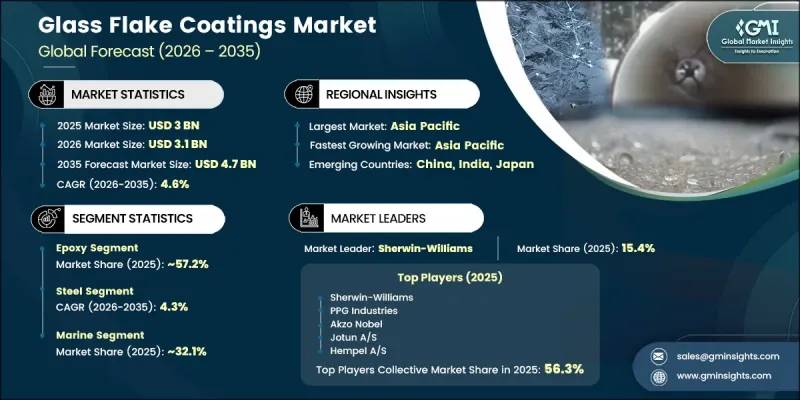
2025年全球玻璃鱗片塗料市場價值為30億美元,預計到2035年將以4.6%的複合年成長率成長至47億美元。
由於市場對高性能防護塗層系統的需求不斷成長,該行業正蓬勃發展。這些系統旨在提高關鍵基礎設施的耐久性並延長其使用壽命。玻璃鱗片塗層因其卓越的阻隔性能而廣受認可,能夠顯著提高耐腐蝕性、化學穩定性以及在惡劣運行環境下對基材的保護。這些塗層廣泛應用於設備和結構暴露於極端條件且需要長期表面保護和減少維護需求的行業。在海上結構、能源設施和重型工業資產中的應用有助於提高營運效率並延長資產壽命。此外,它們在整個生命週期中降低維護成本和停機時間的能力也推動了其在各個行業的廣泛應用。先進配方(尤其是水性體系)的環保特性符合全球永續性和環境合規標準。噴塗和刷塗等應用技術的不斷改進,進一步提升了其在各種工業環境中的易用性。隨著各行業日益重視耐久性、成本效益和環境責任,預計全球對玻璃鱗片塗層的需求將穩定成長。
| 市場範圍 | |
|---|---|
| 開始年份 | 2025 |
| 預測期 | 2026-2035 |
| 上市時的市場規模 | 30億美元 |
| 預測金額 | 47億美元 |
| 複合年成長率 | 4.6% |
隨著終端用戶產業對防腐蝕、運作安全和長期資產性能的日益重視,玻璃鱗片塗料產業正在不斷發展。工業化和基礎設施建設的擴張推動了對能夠承受嚴苛環境條件的高級防護塗料的需求。製造商正致力於產品創新,以提高塗料的性能、附著力和耐化學性。人們對永續塗料技術的日益關注也推動了符合環保標準的配方研發。此外,對減少維護和延長資產壽命策略的投入增加,也促進了先進塗料系統在工業應用上的普及。
預計到2025年,環氧樹脂市佔率將達到57.2%,並在2035年之前以4.4%的複合年成長率成長。環氧樹脂體系憑藉其強附著力、優異的耐化學性和卓越的機械耐久性,持續佔據市場主導地位。這些塗料廣泛應用於需要長期表面保護的嚴苛工業環境中。隨著工業領域日益重視遵守更嚴格的環保法規,環保水性環氧樹脂配方的廣泛應用進一步推動了該領域的成長。環氧樹脂技術的不斷進步提高了其性能效率,並擴展了其在多個終端應用領域的應用範圍。
預計到2025年,鋼鐵業將佔據62.5%的市場佔有率,並在2035年之前以4.3%的複合年成長率成長。由於鋼鐵廣泛應用於基礎設施、工業設施以及需要高結構強度的重型應用領域,因此它仍然是首選的基礎材料。為了防止在惡劣環境下發生腐蝕並延長運作,鋼鐵通常會塗覆保護塗層。塗層鋼在嚴苛工業環境中的日益普及,推動了對先進保護塗層解決方案的持續需求。持續進行的基礎設施建設和資產現代化改造項目,進一步促進了玻璃鱗片塗層在鋼鐵表面的應用。
預計到2025年,北美玻璃鱗片塗料市場佔有率將達到20.1%。該地區受益於工業、汽車和航太領域對先進防腐蝕系統的強勁需求。延長資產壽命和提高運作可靠性的日益重視推動了高性能塗料解決方案的應用。完善的工業基礎設施以及對維護和維修活動的持續投入,進一步促進了市場成長。此外,對安全標準和環境法規的日益重視也推動了北美整體產業對先進防護塗料的使用。
目錄
第1章:調查方法和範圍
第2章執行摘要
第3章 行業洞察
- 產業生態系分析
- 供應商情況
- 利潤率
- 每個階段增加的價值
- 影響價值鏈的因素
- 中斷
- 影響產業的因素
- 促進因素
- 產業潛在風險與挑戰
- 市場機遇
- 成長潛力分析
- 監理情勢
- 波特的分析
- PESTLE分析
- 價格趨勢
- 按地區
- 按類型
- 未來市場趨勢
- 技術與創新展望
- 最新科技趨勢
- 新興技術
- 專利趨勢
- 貿易統計
- 主要進口國
- 主要出口國
- 永續性和環境方面
- 永續計劃
- 減少廢棄物策略
- 生產中的能源效率
- 具有環保意識的舉措
- 考慮碳足跡
第4章 競爭情勢
- 介紹
- 企業市佔率分析
- 按地區
- 北美洲
- 歐洲
- 亞太地區
- LATAM
- 中東和非洲
- 按地區
- 企業矩陣分析
- 主要市場公司的競爭分析
- 競爭定位矩陣
- 主要進展
- 併購
- 夥伴關係和聯盟
- 新產品發布
- 業務拓展計劃
第5章 市場估算與預測:依樹脂類型分類,2022-2035年
- 環氧樹脂
- 溶劑型環氧樹脂
- 水性環氧樹脂
- 乙烯基酯
- 標準乙烯基酯
- 改性乙烯基酯
- 聚酯纖維
- 不飽和聚酯
- 飽和聚酯
- 其他樹脂
第6章 市場估算與預測:依基材分類,2022-2035年
- 鋼
- 碳鋼
- 不銹鋼
- 鍍鋅鋼
- 具體的
- 新水泥建築物
- 混凝土修復和翻新
- 玻璃纖維和複合材料
- 船體
- 化學品儲存槽
- 工業設備
- 樹
- 船舶甲板和結構
- 海上平台用木製部件
- 其他基質
第7章 市場估計與預測:依最終用途產業分類,2022-2035年
- 海上
- 商船和貨船
- 海軍/國防艦艇
- 海上平台及鑽井設備
- 遊艇和休閒船艇
- 石油和天然氣
- 上游領域(探勘和生產)
- 中游(管道和儲存)
- 下游產業(煉油/石化)
- 海洋和水下基礎設施
- 化學品
- 化學處理設備
- 儲存槽和圍護設備
- 化學品運輸
- 建造
- 橋樑和基礎設施
- 商業建築
- 工業設施
- 污水處理廠
- 產業
- 製造工廠
- 發電(火力發電、核能、可再生能源發電)
- 水和污水處理
- 採礦和礦物加工
- 其他終端用戶產業
第8章 市場估計與預測:依地區分類,2022-2035年
- 北美洲
- 美國
- 加拿大
- 歐洲
- 德國
- 英國
- 法國
- 西班牙
- 義大利
- 其他歐洲國家
- 亞太地區
- 中國
- 印度
- 日本
- 澳洲
- 韓國
- 其他亞太國家
- 拉丁美洲
- 巴西
- 墨西哥
- 阿根廷
- 其他拉丁美洲國家
- 中東和非洲
- 沙烏地阿拉伯
- 南非
- UAE
- 其他中東和非洲國家
第9章:公司簡介
- Akzo Nobel
- Asian Paints PPG
- Berger Paints India
- Carboline(RPM)
- Chemco International
- Chugoku Marine Paints
- Hempel A/S
- Induron Coatings
- Jotun A/S
- KCC Corporation
- Nippon Paint Holdings
- Polyglass(Corrocoat)
- PPG Industries
- Sherwin-Williams
- Teknos Group
- Tnemec
The Global Glass Flake Coatings Market was valued at USD 3 billion in 2025 and is estimated to grow at a CAGR of 4.6% to reach USD 4.7 billion by 2035.
The industry is gaining traction due to increasing demand for high-performance protective coating systems designed to enhance durability and extend the service life of critical infrastructure. Glass flake coatings are widely recognized for their superior barrier properties, which significantly improve corrosion resistance, chemical stability, and substrate protection under harsh operating environments. These coatings are extensively used in industries where equipment and structures are exposed to extreme conditions, requiring long-lasting surface protection and reduced maintenance requirements. Their application across marine structures, energy facilities, and heavy industrial assets is contributing to improved operational efficiency and asset longevity. In addition, their ability to reduce lifecycle maintenance costs and downtime is strengthening adoption across multiple sectors. The eco-friendly nature of advanced formulations, particularly water-based systems, is also aligning with global sustainability initiatives and environmental compliance standards. Continuous improvements in application techniques, including spray and brush methods, are further enhancing usability across diverse industrial settings. As industries increasingly prioritize durability, cost efficiency, and environmental responsibility, demand for glass flake coatings is expected to grow steadily worldwide.
| Market Scope | |
|---|---|
| Start Year | 2025 |
| Forecast Year | 2026-2035 |
| Start Value | $3 Billion |
| Forecast Value | $4.7 Billion |
| CAGR | 4.6% |
The glass flake coatings industry is evolving as end-use sectors increasingly focus on corrosion protection, operational safety, and long-term asset performance. Rising industrialization and infrastructure development are driving the need for advanced protective coatings capable of withstanding aggressive environmental conditions. Manufacturers are emphasizing product innovation to enhance coating performance, adhesion strength, and resistance to chemical exposure. Growing emphasis on sustainable coating technologies is also encouraging the development of environmentally compliant formulations. In addition, increasing investment in maintenance reduction strategies and asset life extension is supporting broader adoption of advanced coating systems across industrial applications.
The epoxy segment accounted for 57.2% share in 2025 and is projected to grow at a CAGR of 4.4% through 2035. Epoxy-based systems continue to dominate due to their strong adhesion properties, excellent chemical resistance, and superior mechanical durability. These coatings are widely used in demanding industrial environments where long-term surface protection is required. Increasing adoption of environmentally friendly water-based epoxy formulations is further supporting segment growth, as industries shift toward compliance with stricter environmental regulations. Continuous improvements in epoxy resin technology are enhancing performance efficiency and expanding application scope across multiple end-use sectors.
The steel segment held a 62.5% share in 2025 and is expected to grow at a CAGR of 4.3% through 2035. Steel remains the preferred substrate due to its widespread use in infrastructure, industrial facilities, and heavy-duty applications requiring high structural strength. The material is commonly treated with protective coatings to prevent corrosion and extend operational lifespan under challenging environmental conditions. Increasing use of coated steel in demanding industrial environments is driving sustained demand for advanced protective coating solutions. Ongoing infrastructure development and asset modernization projects are further reinforcing the use of glass flake coatings on steel surfaces.
North America Glass Flake Coatings Market accounted for 20.1% share in 2025. The region benefits from high demand for advanced corrosion protection systems across industrial, automotive, and aerospace applications. Increasing focus on extending asset life and improving operational reliability is driving the adoption of high-performance coating solutions. Strong industrial infrastructure, along with continuous investment in maintenance and refurbishment activities, is further supporting market expansion. The growing emphasis on safety standards and environmental compliance is also encouraging the use of advanced protective coatings across North American industries.
Key companies operating in the Global Glass Flake Coatings Market include Akzo Nobel, Asian Paints PPG, Berger Paints India, Carboline, Chemco International, Chugoku Marine Paints, Hempel A/S, Induron Coatings, Jotun A/S, KCC Corporation, Nippon Paint Holdings, Polyglass, PPG Industries, Sherwin-Williams, Teknos Group, and Tnemec. Companies operating in the glass flake coatings market are focusing on multiple strategic initiatives to strengthen their competitive position and expand global reach. Leading players are investing heavily in research and development to enhance coating durability, chemical resistance, and long-term corrosion protection performance. Many companies are developing advanced water-based and low-emission formulations to align with evolving environmental regulations and sustainability goals. Strategic collaborations with industrial end users, construction firms, and energy sector operators are helping companies expand application reach and secure long-term contracts. Manufacturers are also increasing production capacity and optimizing supply chain networks to meet growing demand from infrastructure and heavy industry projects.
Table of Contents
Chapter 1 Methodology & Scope
- 1.1 Market scope and definition
- 1.2 Research design
- 1.2.1 Research approach
- 1.2.2 Data collection methods
- 1.3 Data mining sources
- 1.3.1 Global
- 1.3.2 Regional/Country
- 1.4 Base estimates and calculations
- 1.4.1 Base year calculation
- 1.4.2 Key trends for market estimation
- 1.5 Primary research and validation
- 1.5.1 Primary sources
- 1.6 Forecast model
- 1.7 Research assumptions and limitations
Chapter 2 Executive Summary
- 2.1 Industry 360° synopsis
- 2.2 Key market trends
- 2.2.1 Regional
- 2.2.2 Resin
- 2.2.3 Substrate
- 2.2.4 End use industry
- 2.3 TAM Analysis, 2026-2035
- 2.4 CXO perspectives: Strategic imperatives
- 2.4.1 Executive decision points
Chapter 3 Industry Insights
- 3.1 Industry ecosystem analysis
- 3.1.1 Supplier landscape
- 3.1.2 Profit margin
- 3.1.3 Value addition at each stage
- 3.1.4 Factor affecting the value chain
- 3.1.5 Disruptions
- 3.2 Industry impact forces
- 3.2.1 Growth drivers
- 3.2.2 Industry pitfalls and challenges
- 3.2.3 Market opportunities
- 3.3 Growth potential analysis
- 3.4 Regulatory landscape
- 3.4.1 North America
- 3.4.2 Europe
- 3.4.3 Asia Pacific
- 3.4.4 Latin America
- 3.4.5 Middle East & Africa
- 3.5 Porter's analysis
- 3.6 PESTEL analysis
- 3.7 Price trends
- 3.7.1 By region
- 3.7.2 By type
- 3.8 Future market trends
- 3.9 Technology and Innovation landscape
- 3.9.1 Current technological trends
- 3.9.2 Emerging technologies
- 3.10 Patent Landscape
- 3.11 Trade statistics (HS code)
- 3.11.1 Major importing countries
- 3.11.2 Major exporting countries
- 3.12 Sustainability and environmental aspects
- 3.12.1 Sustainable practices
- 3.12.2 Waste reduction strategies
- 3.12.3 Energy efficiency in production
- 3.12.4 Eco-friendly initiatives
- 3.13 Carbon footprint consideration
Chapter 4 Competitive Landscape, 2025
- 4.1 Introduction
- 4.2 Company market share analysis
- 4.2.1 By region
- 4.2.1.1 North America
- 4.2.1.2 Europe
- 4.2.1.3 Asia Pacific
- 4.2.1.4 LATAM
- 4.2.1.5 MEA
- 4.2.1 By region
- 4.3 Company matrix analysis
- 4.4 Competitive analysis of major market players
- 4.5 Competitive positioning matrix
- 4.6 Key developments
- 4.6.1 Mergers & acquisitions
- 4.6.2 Partnerships & collaborations
- 4.6.3 New Product Launches
- 4.6.4 Expansion Plans
Chapter 5 Market Estimates and Forecast, By Resin, 2022-2035 (USD Billion) (Kilo Tons)
- 5.1 Key trends
- 5.2 Epoxy
- 5.2.1 Solvent-based epoxy
- 5.2.2 Water-based epoxy
- 5.3 Vinyl ester
- 5.3.1 Standard vinyl ester
- 5.3.2 Modified vinyl ester
- 5.4 Polyester
- 5.4.1 Unsaturated polyester
- 5.4.2 Saturated polyester
- 5.5 Other resins
Chapter 6 Market Estimates and Forecast, By Substrate, 2022-2035 (USD Billion) (Kilo Tons)
- 6.1 Key trends
- 6.2 Steel
- 6.2.1 Carbon steel
- 6.2.2 Stainless steel
- 6.2.3 Galvanized steel
- 6.3 Concrete
- 6.3.1 New concrete structures
- 6.3.2 Concrete rehabilitation & repair
- 6.4 Fiberglass & composites
- 6.4.1 Marine vessel hulls
- 6.4.2 Chemical storage tanks
- 6.4.3 Industrial equipment
- 6.5 Wood
- 6.5.1 Marine decking & structures
- 6.5.2 Offshore platform wood components
- 6.6 Other substrates
Chapter 7 Market Estimates and Forecast, By End Use Industry, 2022-2035 (USD Billion) (Kilo Tons)
- 7.1 Key trends
- 7.2 Marine
- 7.2.1 Commercial shipping & cargo vessels
- 7.2.2 Naval & defense vessels
- 7.2.3 Offshore platforms & rigs
- 7.2.4 Yacht & recreational boats
- 7.3 Oil & gas
- 7.3.1 Upstream (exploration & production)
- 7.3.2 Midstream (pipeline & storage)
- 7.3.3 Downstream (refining & petrochemical)
- 7.3.4 Offshore & subsea infrastructure
- 7.4 Chemical
- 7.4.1 Chemical processing equipment
- 7.4.2 Storage tanks & containment
- 7.4.3 Chemical transportation
- 7.5 Construction
- 7.5.1 Bridges & infrastructure
- 7.5.2 Commercial buildings
- 7.6 Industrial facilities
- 7.6.1 Wastewater treatment plants
- 7.6.2 Industrial
- 7.6.3 Manufacturing facilities
- 7.6.4 Power generation (thermal, nuclear, renewable)
- 7.6.5 Water & wastewater treatment
- 7.6.6 Mining & mineral processing
- 7.7 Other end-use industries
Chapter 8 Market Estimates and Forecast, By Region, 2022-2035 (USD Billion) (Kilo Tons)
- 8.1 Key trends
- 8.2 North America
- 8.2.1 U.S.
- 8.2.2 Canada
- 8.3 Europe
- 8.3.1 Germany
- 8.3.2 UK
- 8.3.3 France
- 8.3.4 Spain
- 8.3.5 Italy
- 8.3.6 Rest of Europe
- 8.4 Asia Pacific
- 8.4.1 China
- 8.4.2 India
- 8.4.3 Japan
- 8.4.4 Australia
- 8.4.5 South Korea
- 8.4.6 Rest of Asia Pacific
- 8.5 Latin America
- 8.5.1 Brazil
- 8.5.2 Mexico
- 8.5.3 Argentina
- 8.5.4 Rest of Latin America
- 8.6 Middle East and Africa
- 8.6.1 Saudi Arabia
- 8.6.2 South Africa
- 8.6.3 UAE
- 8.6.4 Rest of Middle East and Africa
Chapter 9 Company Profiles
- 9.1 Akzo Nobel
- 9.2 Asian Paints PPG
- 9.3 Berger Paints India
- 9.4 Carboline (RPM)
- 9.5 Chemco International
- 9.6 Chugoku Marine Paints
- 9.7 Hempel A/S
- 9.8 Induron Coatings
- 9.9 Jotun A/S
- 9.10 KCC Corporation
- 9.11 Nippon Paint Holdings
- 9.12 Polyglass (Corrocoat)
- 9.13 PPG Industries
- 9.14 Sherwin-Williams
- 9.15 Teknos Group
- 9.16 Tnemec

 玻璃鱗片塗料:市場佔有率分析、產業趨勢與統計、成長預測(2026-2031)
 平板玻璃塗層市場-2026-2032年全球市場預測鍍膜玻璃:市場佔有率分析、產業趨勢與統計、成長預測(2026-2031)
 高穿透玻璃市場規模、佔有率和成長分析:按產品類型、塗層技術、應用、終端用戶產業、玻璃類型、厚度和地區分類-2026-2033年產業預測
 全球防眩光玻璃市場規模、佔有率、趨勢和成長分析報告(2026-2034年)
 鍍膜玻璃市場-全球產業規模、佔有率、趨勢、機會和預測:按生產流程、應用、功能、產品、地區和競爭格局分類,2021-2031年
 防眩光玻璃市場規模、佔有率和趨勢分析報告:按類型、應用、地區和細分市場分類(2026-2033 年)
 2026 年至 2035 年平板玻璃塗層的市場機會、成長要素、產業趨勢與預測。玻璃塗層市場:按類型、技術、功能、形式和應用分類-2026-2032年全球市場預測玻璃鱗片塗料市場:按類型、樹脂類型、應用和最終用途產業分類-2026-2032年全球市場預測