


 |
市場調查報告書
商品編碼
2115075
玻璃鱗片塗料:市場佔有率分析、產業趨勢與統計、成長預測(2026-2031)Glass Flake Coating - Market Share Analysis, Industry Trends & Statistics, Growth Forecasts (2026 - 2031) |
||||||

※ 本網頁內容可能與最新版本有所差異。詳細情況請與我們聯繫。
根據 Mordor Intelligence 預測,玻璃鱗片塗料市場規模將從 2025 年的 17.4 億美元成長到 2026 年的 18.2 億美元,到 2031 年將達到 22.7 億美元,2026 年至 2031 年的複合年成長率為 4.52%。
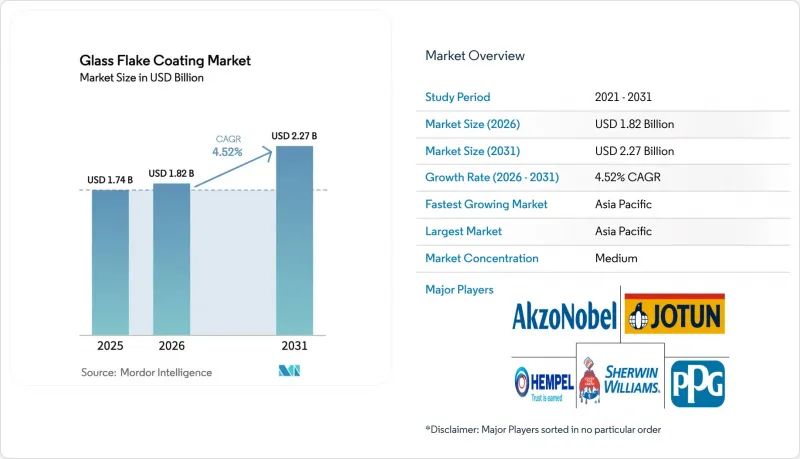
本報告按基材(鋼材和混凝土)、樹脂(乙烯基酯、聚酯、環氧樹脂)、塗層(中階、底漆、面漆)、終端用戶行業(石油天然氣、船舶、化學等)以及地區(亞太地區、北美地區、歐洲地區、南美地區、中東和非洲地區)進行細分。市場預測以美元計價。
全球玻璃鱗片塗層市場趨勢及洞察
擴大石油和天然氣管道的維護活動
管線營運商正在延長資產的使用壽命而非更換它們,這使得玻璃鱗片塗層系統從高階選項躍升為IOGP S-715標準的標準配備。本標準規定總乾膜厚度為1000微米,並需定期進行劣化檢驗。能源實驗室指南正在加強強制性狀態檢查和認證檢查員的監督,從而增強了服務需求對材料需求的協同效應。北美管道和危險材料安全管理局(PHMSA)的法規現在將開挖和塗層更新與完好性檢驗掛鉤。這一趨勢在環焊縫中尤其明顯,因為在這些區域使用熔融環氧樹脂並不實際。進入門檻不斷提高,承包商必須具備NACE或FROSIO III級資格以及ISO 9001系統認證,這導致經驗豐富的承包商佔據了更多業務。因此,玻璃鱗片塗層市場受益於基於規範的需求,而非可自由支配的支出。
海洋基礎設施面臨嚴峻的腐蝕挑戰
國際海事組織(IMO)的《船舶和船舶性能規範》(PSPC)規定,安定器艙塗層的使用壽命應為15年,不得起泡,且最小黏結強度為5兆帕,而多層玻璃鱗片環氧塗層始終符合這些標準。這種三層、1400微米的塗層系統在北極的周期性冷凍試驗中性能優於熱噴塗鋁,證明了其在低溫下的耐久性。佐敦公司的「Baltflake」聚酯塗層在噴塗區域已實現超過30年的免維護運行,DNV的研究估計,與傳統環氧塗層相比,它可以降低50%的生命週期成本。隨著離岸風力發電的擴張,成千上萬的單樁和過渡段需要符合ISO 24656 V型玻璃鱗片標準,這使得防腐蝕成為材料方案的關鍵組成部分。這些趨勢正促使玻璃鱗片解決方案在全球廣泛應用於船舶建造、升降式鑽機和基礎工程規範。
原料和樹脂價格波動
2024年初,中國不飽和聚酯樹脂價格下跌100-200元/噸,而美國雙酚A供不應求和港口堵塞導致環氧樹脂價格環比波動14%,擠壓了毛利率,也使競標有效期的設定更加複雜。大型供應商透過簽訂多年期供應合約來規避價格波動風險,但區域性中小企業卻將價格波動轉嫁給下游企業,削弱了它們在固定價格競標中的競爭力。高耗能的玻璃鱗片生產是另一個波動因素,其成本曲線與歐洲的液化天然氣和電力價格密切相關。
細分市場分析
2025年,受全球管道網路、海上平台、油輪船體和製程容器等產業需求的推動,鋼材將佔據玻璃鱗片塗料市場61.47%的佔有率。層狀鱗片平行於鋼基材排列,其擴散路徑比純樹脂長20倍,同時符合NORSOK M-501飛濺區性能標準。承包商和檢驗員幾乎無一例外都接受過專門針對鋼材相關規範的培訓,進一步鞏固了鋼材作為基材的優勢。加之合格人員和規範的充足供應,鋼材的優勢將在整個預測期內持續增強。
儘管混凝土的成長速度相對滯後,但其年複合成長率仍高達5.82%,這主要得益於亞太地區基礎設施業主採用玻璃鱗片環氧樹脂來防止橋樑和污水處理廠的氯化物滲入。 ACI PRC-515.2-13標準規定,在嚴格控制表面濕度和表面粗糙度的前提下,乙烯基酯和環氧塗料可用於高酸性環境。由於混凝土具有高孔隙率,因此必須使用透氣底漆或嵌入式網格布來降低起泡風險,這使得提供表面處理、底漆和麵漆全套服務並提供保固的供應商承包優勢。
乙烯基酯類塗料憑藉數十年來在IOGP和IMO法規下防濺區域的現場經驗,在2025年仍保持著玻璃鱗片塗料39.36%的市場佔有率。預先已通過核准的配方和已知的陰極剝離性能降低了海水浸泡的風險。然而,環氧樹脂正呈現強勁成長勢頭,預計到2031年將以5.94%的複合年成長率(CAGR)成長,其高交聯密度和室溫固化能力縮小了先前觀察到的性能差距。環氧樹脂對錶面處理不佳的鋼材也具有良好的黏合性,從而拓展了其在維修工程中的應用。聚酯類塗料目前仍主要應用於注重成本的建築領域,其10-15年的使用壽命已被視為足夠。
區域分析
預計到2025年,亞太地區將佔玻璃鱗片塗層市場46.31%的佔有率,複合年成長率達5.63%,主要成長動力來自中國的管道建設、印度煉油廠的維修以及東南亞沿海高氯化物地區LNG接收站。跨國供應商正利用其位於新加坡的培訓中心和獲得ISO 17025認證的測試實驗室,以應對東協地區法規的碎片化問題,並在當地競爭對手之前搶佔大訂單。北美市場的需求則得益於美國管道和危險材料安全管理局(PHMSA)主導的管道健康調查以及聯邦政府資助的、採用生命週期成本分析調查方法的橋樑維護項目。 PPG位於田納西州的新工廠計劃於2026年投產,建成後將作為該地區的緩衝庫存,縮短墨西哥灣沿岸地區的前置作業時間。
預計歐洲市場將迎來成長,光是ScotWind和INTOG的基礎工程一項,到2035年就可能新增超過2000根單樁的需求。 CoaST計畫推動水上施工技術的進步,旨在減少碳排放並簡化施工流程,這與歐盟綠色交易的目標相契合。在南美洲、中東和非洲,由於巴西鹽鹽層下FPSO計畫和沙烏地阿拉伯煉油廠維修,預計需求將有所成長,但技術純熟勞工短缺和標準執行不統一是阻礙因素。
其他好處:
- Excel格式的市場預測(ME)表
- 3個月的分析師支持
目錄
第1章:引言
- 研究假設和市場定義
- 調查範圍
第2章:調查方法
第3章執行摘要
第4章 市場狀況
- 市場概覽
- 市場促進因素
- 擴大石油和天然氣管道的維護和檢測服務
- 海洋基礎設施面臨嚴峻的腐蝕挑戰
- 化學加工領域對高性能塗料的需求日益成長
- 嚴格的環境法規正在推動長壽命防護系統的應用。
- 轉型
- 市場限制因素
- 原料和樹脂價格波動
- 原油價格波動正在減緩資本投資週期。
- 該應用程式的複雜性要求人員具備專業技能。
- 價值鏈分析
- 波特五力分析
第5章 市場規模與成長預測
- 按基礎材料
- 鋼
- 具體的
- 依樹脂類型
- 乙烯基酯
- 聚酯纖維
- 環氧樹脂
- 透過塗層
- 中階
- 底漆
- 面漆
- 按最終用戶行業分類
- 石油和天然氣
- 海上
- 化學處理
- 產業
- 建造
- 其他終端用戶產業
- 按地區
- 亞太地區
- 中國
- 印度
- 日本
- 韓國
- 東南亞國協
- 其他亞太國家
- 北美洲
- 美國
- 加拿大
- 墨西哥
- 歐洲
- 德國
- 英國
- 法國
- 義大利
- 北歐國家
- 其他歐洲國家
- 南美洲
- 巴西
- 阿根廷
- 其他南美國家
- 中東和非洲
- 沙烏地阿拉伯
- 南非
- 其他中東和非洲國家
- 亞太地區
第6章 競爭情勢
- 市場集中度
- 策略趨勢
- 市佔率和排名分析
- 公司簡介
- Akzo Nobel NV
- Asian Paints PPG Pvt. Ltd.
- BASF
- Berger Paints India
- Carboline(RPM International)
- Chemco International Ltd
- Chugoku Marine Paints Ltd.
- Hempel A/S
- Induron
- Jotun A/S
- KCC Corporation
- Nippon Paint Holdings
- Polyglass Coatings
- PPG Industries, Inc.
- Teknos Group
- The Sherwin-Williams Company
- Tnemec
第7章 市場機會與未來展望
According to Mordor Intelligence, the glass flake coating market size is expected to grow from USD 1.74 billion in 2025 to USD 1.82 billion in 2026 and is forecast to reach USD 2.27 billion by 2031 at 4.52% CAGR over 2026-2031.
This report is Segmented by Substrate (Steel and Concrete), Resin (Vinyl Ester, Polyester, and Epoxy), Coating Layer (Intermediate, Primer, and Topcoat), End-User Industry (Oil and Gas, Marine, Chemical Processing, and More), and Geography (Asia-Pacific, North America, Europe, South America, and Middle-East and Africa). The Market Forecasts are Provided in Terms of Value (USD).
Global Glass Flake Coating Market Trends and Insights
Expanding Oil and Gas Pipeline Maintenance Activities
Pipeline operators are extending service life rather than replacing assets, elevating glass flake systems from premium options to baseline specifications under IOGP S-715, which prescribes 1,000 µm total dry film thickness and cyclic aging validation. Energy Institute guidelines reinforce mandatory condition surveys and certified inspector oversight, adding a services multiplier to material demand. PHMSA enforcement in North America now links integrity digs to coating upgrades, particularly at girth welds where fusion-bonded epoxy is impractical. Qualification barriers rise as applicators must hold NACE or FROSIO Level III credentials and ISO 9001 systems, consolidating work among experienced contractors. As a result, the glass flake coating market benefits from specification-driven pull rather than discretionary spend.
Severe Corrosion Challenges in Marine Infrastructure
IMO PSPC mandates a 15-year ballast-tank coating life with zero blistering and a minimum 5 MPa adhesion threshold, benchmarks consistently met by multi-layer glass flake epoxy packages. A three-coat, 1,400 µm scheme surpassed thermal-sprayed aluminum under Arctic cyclic freeze testing, underscoring resilience in low temperatures. Jotun's Baltoflake polyester delivers 30-plus maintenance-free years in splash zones, and a DNV study pegged life-cycle cost savings at 50% relative to conventional epoxies. Offshore wind expansion adds thousands of monopiles and transition pieces that must meet ISO 24656 Type V glass-flake criteria, converting corrosion control into a material program line item. These dynamics lock glass flake solutions into vessel, jack-up, and foundation specifications worldwide.
Fluctuating Raw-Material and Resin Prices
Unsaturated polyester resin prices in China moved downward by 100-200 CNY per t in early 2024, but epoxy prices in the United States swung 14% month-over-month due to bisphenol-A outages and port congestion, compressing gross margins and complicating bid validity windows. Large vendors hedge through multi-year supply contracts, yet regional players pass volatility downstream, eroding competitiveness on fixed-price tenders. Energy-intensive glass flake production adds another variable, tying cost curves to LNG and electricity prices across Europe.
Other drivers and restraints analyzed in the detailed report include:
- Rising Demand for High-Performance Coatings in Chemical Processing
- Stringent Environmental Regulations Driving Long-Life Protective Systems
- Volatile Oil Prices Delaying CAPEX Cycles
For complete list of drivers and restraints, kindly check the Table Of Contents.
Segment Analysis
Steel contributed 61.47% of the glass flake coating market size in 2025 on the strength of global pipeline networks, offshore platforms, tanker hulls, and process vessels. Lamellar flakes orient parallel to steel substrates, delivering diffusion paths up to 20 times longer than neat resin and meeting NORSOK M-501 splash-zone performance levels. Contractors and inspectors are trained almost exclusively on steel protocols, reinforcing the substrate's hegemony. Coupling specifications with qualified workforce availability makes steel's dominance self-reinforcing over the forecast period.
Concrete trails but advances at a 5.82% CAGR as Asia-Pacific infrastructure owners adopt glass flake epoxies to arrest chloride ingress in bridges and wastewater assets. ACI PRC-515.2-13 lists vinyl ester and epoxy coatings for high-acid environments, provided surface moisture and profile are tightly controlled. The higher porosity of concrete necessitates vapor-permeable primers or embedded scrims to mitigate blister risk, favoring turnkey suppliers that bundle surface preparation, primer, and overcoat warranties.
Vinyl ester retained 39.36% of the glass flake coating market share in 2025, supported by decades of splash-zone field performance under IOGP and IMO rules. Pre-approved formulations and known cathodic-disbondment behavior reduce owner risk in seawater immersion. However, epoxy is outpacing at a 5.94% CAGR through 2031 thanks to high cross-link densities and ambient cures that narrow historical performance gaps. Epoxies also bond better to marginally prepared steel, expanding retrofit suitability. Polyester remains confined to cost-sensitive construction applications, where 10-15-year service life suffices.
Complete Report Scope:
- By Substrate
- Steel
- Concrete
- By Resin
- Vinyl Ester
- Polyester
- Epoxy
- By Coating Layer
- Intermediate
- Primer
- Topcoat
- By End-user Industry
- Oil and Gas
- Marine
- Chemical Processing
- Industrial
- Construction
- Other End-user Industries
- By Geography
- Asia-Pacific
- China
- India
- Japan
- South Korea
- ASEAN Countries
- Rest of Asia-Pacific
- North America
- United States
- Canada
- Mexico
- Europe
- Germany
- United Kingdom
- France
- Italy
- NORDIC Countries
- Rest of Europe
- South America
- Brazil
- Argentina
- Rest of South America
- Middle-East and Africa
- Saudi Arabia
- South Africa
- Rest of Middle East and Africa
- Asia-Pacific
Geography Analysis
Asia-Pacific commanded 46.31% of the glass flake coating market in 2025 and will expand at a 5.63% CAGR, led by Chinese pipeline buildouts, Indian refinery upgrades, and Southeast Asian LNG terminals that cluster in high-chloride coastal zones. Multinational suppliers leverage Singapore-based training centers and ISO 17025 labs to navigate fragmented ASEAN regulations, securing bulk orders ahead of local challengers. North America's demand is supported by PHMSA-driven pipeline integrity digs and federally funded bridge preservation that embed life-cycle cost methodology. The new PPG Tennessee facility, operational in 2026, provides regional buffer stock that reduces lead time for Gulf Coast turnarounds.
Europe is seeing growth, with ScotWind and INTOG foundations alone adding an addressable demand of more than 2,000 monopiles through 2035. The CoaST program's waterborne advances aim at lowering carbon footprints and application complexity, aligning with EU Green Deal objectives. South America and the Middle East and Africa show upside from Brazilian pre-salt FPSOs and Saudi refinery upgrades, constrained by skilled labor shortages and inconsistent standard enforcement.
- Akzo Nobel N.V.
- Asian Paints PPG Pvt. Ltd.
- BASF
- Berger Paints India
- Carboline (RPM International)
- Chemco International Ltd
- Chugoku Marine Paints Ltd.
- Hempel A/S
- Induron
- Jotun A/S
- KCC Corporation
- Nippon Paint Holdings
- Polyglass Coatings
- PPG Industries, Inc.
- Teknos Group
- The Sherwin-Williams Company
- Tnemec
Additional Benefits:
- The market estimate (ME) sheet in Excel format
- 3 months of analyst support
TABLE OF CONTENTS
1 Introduction
- 1.1 Study Assumptions and Market Definition
- 1.2 Scope of the Study
2 Research Methodology
3 Executive Summary
4 Market Landscape
- 4.1 Market Overview
- 4.2 Market Drivers
- 4.2.1 Expanding Oil and Gas Pipeline Maintenance Activities
- 4.2.2 Severe Corrosion Challenges in Marine Infrastructure
- 4.2.3 Rising Demand for High-Performance Coatings in Chemical Processing
- 4.2.4 Stringent Environmental Regulations Driving Long-Life Protective Systems
- 4.2.5 Shift Toward Life-Cycle Cost Modelling in Asset-Intensive Sectors
- 4.3 Market Restraints
- 4.3.1 Fluctuating Raw-Material and Resin Prices
- 4.3.2 Volatile Oil Prices Delaying CAPEX Cycles
- 4.3.3 Application Complexity Requiring Skilled Workforce
- 4.4 Value Chain Analysis
- 4.5 Porter's Five Forces Analysis
- 4.5.1 Threat of New Entrants
- 4.5.2 Bargaining Power of Buyers
- 4.5.3 Bargaining Power of Suppliers
- 4.5.4 Threat of Substitute Products
- 4.5.5 Degree of Competition
5 Market Size and Growth Forecasts (Value)
- 5.1 By Substrate
- 5.1.1 Steel
- 5.1.2 Concrete
- 5.2 By Resin
- 5.2.1 Vinyl Ester
- 5.2.2 Polyester
- 5.2.3 Epoxy
- 5.3 By Coating Layer
- 5.3.1 Intermediate
- 5.3.2 Primer
- 5.3.3 Topcoat
- 5.4 By End-user Industry
- 5.4.1 Oil and Gas
- 5.4.2 Marine
- 5.4.3 Chemical Processing
- 5.4.4 Industrial
- 5.4.5 Construction
- 5.4.6 Other End-user Industries
- 5.5 By Geography
- 5.5.1 Asia-Pacific
- 5.5.1.1 China
- 5.5.1.2 India
- 5.5.1.3 Japan
- 5.5.1.4 South Korea
- 5.5.1.5 ASEAN Countries
- 5.5.1.6 Rest of Asia-Pacific
- 5.5.2 North America
- 5.5.2.1 United States
- 5.5.2.2 Canada
- 5.5.2.3 Mexico
- 5.5.3 Europe
- 5.5.3.1 Germany
- 5.5.3.2 United Kingdom
- 5.5.3.3 France
- 5.5.3.4 Italy
- 5.5.3.5 NORDIC Countries
- 5.5.3.6 Rest of Europe
- 5.5.4 South America
- 5.5.4.1 Brazil
- 5.5.4.2 Argentina
- 5.5.4.3 Rest of South America
- 5.5.5 Middle-East and Africa
- 5.5.5.1 Saudi Arabia
- 5.5.5.2 South Africa
- 5.5.5.3 Rest of Middle East and Africa
- 5.5.1 Asia-Pacific
6 Competitive Landscape
- 6.1 Market Concentration
- 6.2 Strategic Moves
- 6.3 Market Share/Ranking Analysis
- 6.4 Company Profiles (includes Global level Overview, Market level overview, Core Segments, Financials as available, Strategic Information, Market Rank/Share for key companies, Products and Services, and Recent Developments)
- 6.4.1 Akzo Nobel N.V.
- 6.4.2 Asian Paints PPG Pvt. Ltd.
- 6.4.3 BASF
- 6.4.4 Berger Paints India
- 6.4.5 Carboline (RPM International)
- 6.4.6 Chemco International Ltd
- 6.4.7 Chugoku Marine Paints Ltd.
- 6.4.8 Hempel A/S
- 6.4.9 Induron
- 6.4.10 Jotun A/S
- 6.4.11 KCC Corporation
- 6.4.12 Nippon Paint Holdings
- 6.4.13 Polyglass Coatings
- 6.4.14 PPG Industries, Inc.
- 6.4.15 Teknos Group
- 6.4.16 The Sherwin-Williams Company
- 6.4.17 Tnemec
7 Market Opportunities and Future Outlook
- 7.1 White-space and Unmet-need Assessment

 平板玻璃塗層市場-2026-2032年全球市場預測
 鍍膜玻璃:市場佔有率分析、產業趨勢與統計、成長預測(2026-2031)
 高穿透玻璃市場規模、佔有率和成長分析:按產品類型、塗層技術、應用、終端用戶產業、玻璃類型、厚度和地區分類-2026-2033年產業預測
 全球防眩光玻璃市場規模、佔有率、趨勢和成長分析報告(2026-2034年)
 鍍膜玻璃市場-全球產業規模、佔有率、趨勢、機會和預測:按生產流程、應用、功能、產品、地區和競爭格局分類,2021-2031年
 玻璃鱗片塗料市場商機、成長要素、產業趨勢分析及2026-2035年預測。
 防眩光玻璃市場規模、佔有率和趨勢分析報告:按類型、應用、地區和細分市場分類(2026-2033 年)2026 年至 2035 年平板玻璃塗層的市場機會、成長要素、產業趨勢與預測。玻璃塗層市場:按類型、技術、功能、形式和應用分類-2026-2032年全球市場預測玻璃鱗片塗料市場:按類型、樹脂類型、應用和最終用途產業分類-2026-2032年全球市場預測