

 |
市場調查報告書
商品編碼
2117462
自動防眩後視鏡:市場佔有率分析、產業趨勢與統計、成長預測(2026-2031)Auto Dimming Mirror - Market Share Analysis, Industry Trends & Statistics, Growth Forecasts (2026 - 2031) |
||||||

※ 本網頁內容可能與最新版本有所差異。詳細情況請與我們聯繫。
據 Mordor Intelligence 稱,2025 年自動調光鏡市值為 20.9 億美元,預計到 2031 年將從 2026 年的 21.9 億美元成長至 27.8 億美元,2026 年至 2031 年的複合年成長率為 4.89%。
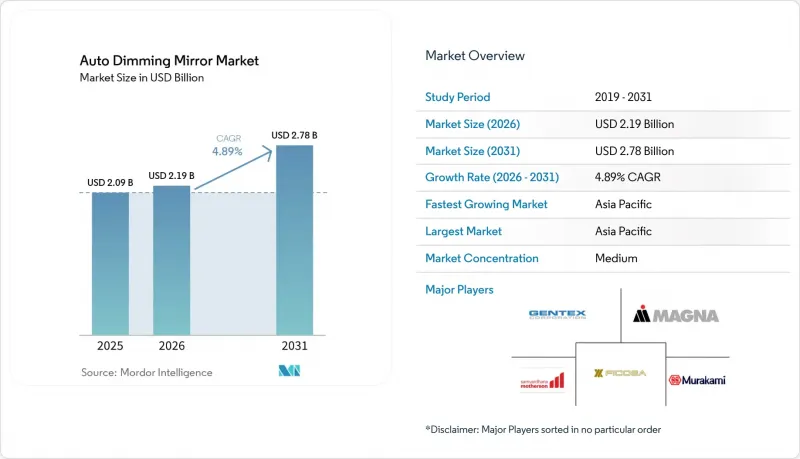
本報告按產品類型(電致變色後視鏡、自我調整後視鏡等)、功能(連網自動防眩後視鏡和非連網自動防眩後視鏡)、技術(自動防眩目和手動防眩目)、應用、車輛類型、驅動系統、分銷管道和地區進行細分。市場預測以價值(美元)和銷售(台)為單位呈現。
自動調光後視鏡市場的全球趨勢與洞察
中端市場原廠配套車輛的競爭。
自動防眩後視鏡正逐漸被引入到以往使用傳統後視鏡的車輛中,尤其是在中型乘用車領域。由於車輛產量和配置水準的不斷提高,中國、印度以及亞太地區其他地區的生產基地仍然至關重要。如果汽車製造商將自動防眩後視鏡作為出廠選配配置,市場將會受益,但供應商需要滿足當地的檢驗、成本、交付和品質要求。出廠安裝的系統正在改變供應商的選擇標準。汽車製造商要求後視鏡組件符合車輛的電氣架構、線路、軟體、安全要求和服務計畫。這有利於那些能夠支援整個生產週期並管理設計變更的供應商。然而,出於成本考慮,一些車型可能會保留手動後視鏡,而價格因素仍將是市場成長的關鍵驅動力。
亞太地區汽車產量增加和電動車蓬勃發展
電動車製造商正在仔細評估外部組件,因為空氣動力阻力會影響能耗、續航里程和車輛效率。側視鏡的形狀和位置促使人們對緊湊型設計和基於攝影機的替代方案產生興趣。這強化了重新思考長續航力電動車及其相關平台外後視鏡架構的技術合理性。後視鏡製造商可能需要整合新材料、感測器、熱源、軟體和鏡頭,但並非所有電動車都會採用純攝影機系統或完全取消傳統外後視鏡。在先進的後視鏡組件仍能保持自動防眩光功能的地區,自動防眩光後視鏡市場將受益,但隨著攝影機監控系統取代外部電致變色模組,該市場將面臨壓力。
與傳統後視鏡相比,零件成本更高
自動防眩後視鏡比傳統後視鏡更昂貴,因為它需要電致變色玻璃、感測器、電子元件以及車輛專用整合。汽車製造商發現,在零件預算仍然緊張的入門車型中,很難承擔這筆成本。因此,如果自動防眩後視鏡不符合目標車型的價格,他們可能會將其限制在高配車型上。此外,成本壓力也可能迫使供應商優先考慮成熟的設計而非先進的系統。這些因素可能會減緩這項技術的廣泛應用,尤其是在價格敏感的汽車市場。
細分市場分析
預計到2025年,電致變色後視鏡將佔據68.98%的市場佔有率,而自我調整後視鏡預計到2031年將以5.95%的複合年成長率成長。電致變色產品仍然是市場的核心,因為它們能夠有效減少夜間駕駛時的眩光。它們在原廠車輛安裝項目中的廣泛應用支撐了持續的需求,使其成為汽車製造商熟悉的零件選擇。製造商非常了解這些產品的檢驗要求,並能整合到現有的後視鏡設計和車輛控制系統中。這種高度的熟悉度鞏固了它們在乘用車、部分商用車以及各種價位車輛中的應用地位。
自我調整後視鏡正日益受到關注,因為除了具備防眩光功能外,它們還能將額外的感測、控制或互聯功能整合到單一組件中。與基礎設計相比,這些產品能更精確地適應不斷變化的光線條件,並支援更廣泛的車輛功能。它們也更符合車輛的整體規劃,例如日益普及的攝影機和軟體功能的整合。產品開發人員必須確保新增功能不會增加後視鏡的製造、診斷或維修難度。對於零件預算有限的中階車型而言,在配備自我調整系統時,成本仍然是一個重要的考慮因素。
預計到2025年,連網自動防眩後視鏡將佔該品類銷售量的64.48%,年複合成長率達5.12%。隨著汽車製造商將更多功能整合到電子控制車輛架構和集中控制系統中,連網後視鏡的角色日益凸顯。聯網功能可依設計要求,支援車載系統內的顯示功能、攝影機功能和資料交換。此外,它還能幫助製造商在不改變後視鏡基本位置的情況下,為不同配置的車型提供不同的後視鏡功能。隨著聯網汽車的普及,這些後視鏡在採用數位介面的新型乘用車專案中扮演著重要角色。其應用取決於各汽車平臺是否具備對應的電氣、軟體及網路安全架構。
非連網後視鏡仍然受到那些偏好更簡單、更少依賴電子設備的消費者的青睞。車隊營運商、商業營運商和替換用戶往往更重視產品的耐用性、可預測的運作狀態和易於維護性。這些後視鏡無需網路整合或軟體更新等額外功能即可減少眩光。因此,當聯網汽車基礎設施不完善、不可用或對使用者而言沒有必要時,它們是理想之選。供應商可以同時提供這兩種產品線,因為每位客戶的營運需求、服務模式和採購優先順序各不相同。
預計到2025年,自動防眩目功能將佔該類別銷售額的71.95%,並將在2031年之前以6.79%的複合年成長率成長。這項技術能夠根據後方光線的變化自動調節,無需駕駛在行駛過程中調整後視鏡設定。這項直接優勢使其適用於那些重視夜間舒適性、視野清晰度和減少駕駛分心的車輛。如果成本可接受且車輛架構相容,製造商可以在多個配置層級上採用該自動系統。此外,這項技術也能很好地與已配備感測器、控制設備、攝影機或顯示功能的電子後視鏡組件配合使用。
當車輛成本是主要購買因素且必須盡可能減少配置時,手動調光系統仍然有用。與自動系統相比,手動系統提供了一種熟悉的機械解決方案,所需的電子元件、感測器和整合步驟更少。因此,它們適用於入門級商用車和在價格敏感地區銷售的低價乘用車。然而,當駕駛條件頻繁變化或突然出現後方眩光時,手動操作的便利性就會降低。隨著自動系統的整合變得更加便捷和普及,汽車製造商可能會逐漸減少手動調光系統的應用。
區域分析
預計到2025年,亞太地區將佔該品類銷售額的40.51%,並在2031年之前以5.38%的複合年成長率成長。該地區擁有眾多主要的汽車生產基地,並且對能夠改善夜間駕駛體驗並為乘用車增添實際價值的功能的需求日益成長。中國和日本在汽車技術、供應商能力以及國內外電子後視鏡功能開發方面仍扮演著重要角色。隨著製造商擴大汽車生產規模,並在中階車型中引入更多功能,印度為該品類提供了新的成長機遇,這些車型的競爭力也日益增強。區域供應商必須滿足當地的認證要求,同時也要在成本、可靠性和工程支援方面與成熟的全球公司競爭。
北美自動防眩後視鏡市場是乘用車和高階配置包中高價值後視鏡的關鍵市場。該地區的汽車製造商對可整合到現有汽車平臺的顯示後視鏡、攝影機整合和互聯功能持續保持濃厚興趣。售後市場也為升級和特殊產品提供了途徑,滿足消費者對更舒適性、後方視野或更個性化內裝空間的需求。墨西哥作為全部區域車型的組裝基地以及更廣泛的供應商生產網路的一部分,發揮著至關重要的作用。加拿大透過與北美汽車生產、分銷、服務活動以及跨境供應關係的聯繫,促進了市場需求的成長。
在歐洲,由於供應商面臨監管變化和採用數位隱藏式系統的雙重壓力,市場發展較為緩慢。德國FLABEG Automotive公司於2025年關閉,改變了歐洲電致變色鏡產品的供應格局。歐洲製造商也考慮為高階車型和電動車(EV)專案引入攝影機和監控系統,這些專案需要更整合的電子設計。在南美、中東和非洲,市場規模仍然較小,但由於車隊安全需求和當地車輛生產的限制,預計需求有限。在這些地區,市場需要兼顧防眩光、價格合理、備件供應充足和售後服務完善的產品。
其他好處:
- Excel格式的市場預測(ME)表
- 3個月的分析師支持
目錄
第1章:引言
- 研究假設和市場定義
- 調查範圍
第2章:調查方法
第3章執行摘要
第4章 市場狀況
- 市場概覽
- 市場促進因素
- 中型車原廠配套設備的競爭
- 亞太地區汽車產量增加和電動車蓬勃發展
- 與ADAS/聯網汽車功能的整合
- 加強有關眩光的安全法規
- 數位/相機後視鏡系統的法規核准
- 降低長續航里程電動車空氣阻力的必要性
- 市場限制因素
- 與傳統後視鏡相比,零件成本更高
- 使用僅配備攝影機的後視鏡替代品正變得越來越流行。
- 入門車型的價格敏感性
- 歐盟玻璃供應鏈長期存在瓶頸
- 價值供應鏈分析
- 監理情勢
- 技術展望
- 波特五力模型
第5章 市場規模與成長預測
- 依產品類型
- 電致變色鏡
- 自我調整後視鏡
- 手動調光後視鏡
- 功能性別
- 連網自動防眩後視鏡
- 非連網自動防眩後視鏡
- 透過技術
- 自動調光
- 手動調光
- 透過使用
- 車載後視鏡
- 車門後視鏡
- 按車輛類型
- 搭乘用車
- 輕型商用車
- 中型和重型商用車輛
- 依推進類型
- 內燃機
- 電池式電動車(BEV)
- 混合動力電動車(HEV)
- 插電式混合動力車(PHEV)
- 燃料電池電動車(FCEV)
- 透過分銷管道
- OEM
- 售後市場
- 按地區
- 北美洲
- 美國
- 加拿大
- 其他北美國家
- 南美洲
- 巴西
- 阿根廷
- 其他南美國家
- 歐洲
- 英國
- 德國
- 西班牙
- 義大利
- 法國
- 俄羅斯
- 其他歐洲國家
- 亞太地區
- 印度
- 中國
- 日本
- 韓國
- 其他亞太國家
- 中東和非洲
- 阿拉伯聯合大公國
- 沙烏地阿拉伯
- 土耳其
- 埃及
- 南非
- 其他中東和非洲國家
- 北美洲
第6章 競爭情勢
- 市場集中度
- 策略趨勢
- 市佔率分析
- 公司簡介
- Gentex Corporation
- Magna International Inc.
- Samvardhana Motherson Reflectec
- Ficosa International SA
- Murakami Corporation
- Tokai Rika Co., Ltd.
- SL Corporation
- Global Media Industry Group Co., Ltd.(GERMID)
- Hyundai Mobis Co., Ltd.
- Metagal Industria E-commercio Ltd.
- Hella GmbH & Co. KGaA
- Fuyao Glass Industry Group Co., Ltd.
- Ambilight Inc.
- Continental AG
- Robert Bosch GmbH
第7章 市場機會與未來展望
According to Mordor Intelligence, the auto dimming mirror market size was valued at USD 2.09 billion in 2025 and is expected to grow from USD 2.19 billion in 2026 to reach USD 2.78 billion by 2031 at 4.89% CAGR over 2026-2031.
This report is Segmented by Product Type (Electrochromic Mirrors, Adaptive Mirrors, and More), Functionality (Connected Auto-Dimming Mirrors and Non-Connected Auto-Dimming Mirrors), Technology (Automatic Dimming and Manual Dimming), Application, Vehicle Type, Propulsion Type, Distribution Channel, and Geography. The Market Forecasts are Provided in Terms of Value (USD) and Volume (Units).
Global Auto Dimming Mirror Market Trends and Insights
OEM Fitment Race in Mid-Segment Cars
Auto-dimming mirrors are entering vehicle lines that previously used conventional mirrors, especially in mid-segment passenger vehicles. China, India, and other Asia-Pacific production centers remain important as vehicle output and feature content rise. The auto-dimming mirror market benefits when automakers offer the function as a factory option, though suppliers must meet local validation, cost, delivery, and quality requirements. Factory-installed systems are changing supplier selection. Automakers require mirror assemblies to align with vehicle electrical architecture, wiring, software, safety needs, and service plans. This favors suppliers that can support full production cycles and manage engineering changes. However, cost-sensitive programs may retain manual mirrors in some trims, keeping affordability central to market growth.
Rising Vehicle Production in APAC and EV Boom
Electric vehicle manufacturers closely evaluate exterior components because aerodynamic drag affects energy use, driving range, and vehicle efficiency. Side mirror shape and placement support interest in compact designs and camera-based alternatives. This strengthens the engineering case for rethinking exterior mirror architecture in long-range electric vehicles and related platforms. Mirror producers may need new materials, sensors, heating elements, software, and camera integration, though not every electric vehicle will adopt camera-only systems or remove conventional exterior mirrors. The auto dimming mirror market will benefit where advanced mirror assemblies retain auto-dimming capability, but it will face pressure when camera-monitor systems replace exterior electrochromic modules.
High BOM Cost vs. Traditional Mirrors
Auto-dimming mirrors cost more than traditional mirrors because they require electrochromic glass, sensors, electronics, and vehicle-specific integration. Automakers find this cost harder to absorb in entry-level vehicles, where component budgets remain tight. As a result, they may restrict the feature to higher trims when it does not fit the target vehicle price. Cost pressure can also push suppliers to favor proven designs over advanced systems. These factors can slow broader adoption, especially in price-sensitive vehicle markets.
Other drivers and restraints analyzed in the detailed report include:
- Integration with ADAS/Connected-Car Features
- Stricter Glare-Safety Regulations
- Growing Adoption of Camera-Only Mirror Replacements
For complete list of drivers and restraints, kindly check the Table Of Contents.
Segment Analysis
Electrochromic mirrors held 68.98% share in 2025, while adaptive mirrors are expected to grow at a 5.95% CAGR through 2031. Electrochromic products remain central because they provide a proven way to reduce reflected glare during routine nighttime driving. Their established use on factory-installed vehicle programs supports continued demand and gives automakers a familiar component choice. Manufacturers understand the validation requirements for these products and can integrate them with existing mirror designs and vehicle controls. This familiarity supports their position across passenger vehicles, selected commercial applications, and multiple vehicle price categories.
Adaptive mirrors are gaining attention because they can combine dimming with additional sensing, control, or connected functions in a single assembly. These products may adjust more precisely to changing light conditions than basic designs and support a wider set of vehicle features. They can also fit with broader vehicle plans for camera integration and software-based functions that are becoming more common. Product developers need to ensure that the added capability does not make the mirror difficult to manufacture, diagnose, or service. Cost remains an important consideration when adaptive systems are offered on mid-range vehicles with tighter component budgets.
Connected auto-dimming mirrors accounted for 64.48% of category revenue in 2025, and are forecasted to grow at a 5.12% CAGR. Their role has expanded as vehicle manufacturers bring more functions into electronically managed vehicle architectures and centralized control systems. Connectivity can support display features, camera functions, and data exchange within a vehicle system when the design requires it. It can also help a manufacturer offer different mirror functions across vehicle trims without changing the fundamental mirror location. The installed base of connected vehicles gives these mirrors a clear role in newer passenger vehicle programs that use digital interfaces. Their use remains tied to the availability of supporting electrical, software, and cybersecurity architecture within each vehicle platform.
Non-connected mirrors continue to serve customers who prefer a simpler product with fewer electronic dependencies. Fleets, commercial operators, and replacement buyers may place more value on durability, predictable operation, and straightforward maintenance. These mirrors can provide glare reduction without the additional requirements of network integration or software updates. This makes them suitable where connected-vehicle infrastructure is less developed, unavailable, or unnecessary for the buyer. Suppliers can maintain both product lines because their customers have different operating needs, service models, and purchasing priorities.
Automatic dimming accounted for 71.95% of category revenue in 2025 and is forecasted to grow at a 6.79% CAGR through 2031. The technology responds to changes in rearward light without requiring a driver to change the mirror setting during a journey. This direct benefit makes it suitable for vehicles that emphasize nighttime comfort, visibility, and reduced driver distraction. Manufacturers can use automatic systems across several trim levels when the cost is acceptable and the vehicle architecture supports them. The technology also has a clear fit with electronic mirror assemblies that already contain sensors, controls, cameras, or display functions.
Manual dimming systems remain relevant where vehicle cost is the main purchasing factor and feature content must be controlled. They offer a familiar mechanical solution and require fewer electronic components, sensors, and integration steps than automatic alternatives. This can make them useful on entry-level commercial vehicles and lower-priced passenger models sold in price-sensitive regions. However, manual operation provides less convenience when driving conditions change frequently, or rearward glare appears unexpectedly. Vehicle manufacturers may gradually reduce their use as automatic systems become easier to integrate and more widely accepted.
Complete Report Scope:
- By Product Type
- Electrochromic Mirrors
- Adaptive Mirrors
- Manual Dimming Mirrors
- By Functionality
- Connected Auto-Dimming Mirrors
- Non-Connected Auto-Dimming Mirrors
- By Technology
- Automatic Dimming
- Manual Dimming
- By Application
- Inside Rear-View Mirror
- Outside Rear-View Mirror
- By Vehicle Type
- Passenger Vehicles
- Light Commercial Vehicles
- Medium and Heavy Commercial Vehicles
- By Propulsion Type
- Internal Combustion Engine
- Battery Electric Vehicle (BEV)
- Hybrid Electric Vehicle (HEV)
- Plug-In Hybrid Electric Vehicle (PHEV)
- Fuel Cell Electric Vehicle (FCEV)
- By Distribution Channel
- OEM
- Aftermarket
- By Geography
- North America
- United States
- Canada
- Rest of North America
- South America
- Brazil
- Argentina
- Rest of South America
- Europe
- United Kingdom
- Germany
- Spain
- Italy
- France
- Russia
- Rest of Europe
- Asia-Pacific
- India
- China
- Japan
- South Korea
- Rest of Asia-Pacific
- Middle East and Africa
- United Arab Emirates
- Saudi Arabia
- Turkey
- Egypt
- South Africa
- Rest of Middle East and Africa
- North America
Geography Analysis
Asia-Pacific accounted for 40.51% of category revenue in 2025 and is forecasted to grow at a 5.38% CAGR through 2031. The region combines major vehicle production centers with growing demand for features that improve nighttime driving and add visible value to passenger vehicles. China and Japan remain important for vehicle technology, supplier capability, and the development of electronic mirror functions for domestic and export programs. India offers another route to growth as manufacturers expand vehicle production and introduce more features to mid-range models that are becoming more competitive. Regional suppliers must satisfy local qualification requirements and compete with established global companies on cost, reliability, and engineering support.
The auto dimming mirror market in North America is significant for higher-content mirrors used in passenger vehicles and premium feature packages. Vehicle manufacturers in the region continue to show interest in display mirrors, camera integration, and connected functions that can be incorporated into established vehicle platforms. The aftermarket also provides a route for upgrades and specialty products where buyers seek added comfort, rearward visibility, or a more distinctive vehicle interior. Mexico matters as a vehicle assembly location for models supplied across the region and as part of broader supplier production networks. Canada adds demand through its connection to North American vehicle production, distribution, service activity, and cross-border supply relationships.
Europe is developing at a slower pace because suppliers face both regulatory changes and pressure to adopt digital exterior viewing systems. The closure of FLABEG Automotive Germany in 2025 altered the European supply situation for electrochromic mirror products. European manufacturers are also considering camera-monitor systems for premium and electric vehicle programs that require a more integrated electronic design. South America and the Middle East and Africa remain smaller opportunities, but fleet safety needs and localized vehicle production can support selective demand. These regions require products that balance glare reduction with affordability, availability of replacement parts, and practical service support.
- Gentex Corporation
- Magna International Inc.
- Samvardhana Motherson Reflectec
- Ficosa International S.A.
- Murakami Corporation
- Tokai Rika Co., Ltd.
- SL Corporation
- Global Media Industry Group Co., Ltd. (GERMID)
- Hyundai Mobis Co., Ltd.
- Metagal Industria E-commercio Ltd.
- Hella GmbH & Co. KGaA
- Fuyao Glass Industry Group Co., Ltd.
- Ambilight Inc.
- Continental AG
- Robert Bosch GmbH
Additional Benefits:
- The market estimate (ME) sheet in Excel format
- 3 months of analyst support
TABLE OF CONTENTS
1 Introduction
- 1.1 Study Assumptions & Market Definition
- 1.2 Scope of the Study
2 Research Methodology
3 Executive Summary
4 Market Landscape
- 4.1 Market Overview
- 4.2 Market Drivers
- 4.2.1 OEM Fitment Race in Mid-Segment Cars
- 4.2.2 Rising Vehicle Production in APAC and EV Boom
- 4.2.3 Integration with ADAS/Connected-Car Features
- 4.2.4 Stricter Glare-Safety Regulations
- 4.2.5 Regulatory Green-Light for Digital/Camera Mirror Systems
- 4.2.6 Aerodynamic Drag-Reduction Need in Long-Range EVs
- 4.3 Market Restraints
- 4.3.1 High BOM Cost vs. Traditional Mirrors
- 4.3.2 Growing Adoption of Camera-Only Mirror Replacements
- 4.3.3 Price Sensitivity in Entry-Level Vehicles
- 4.3.4 Chronic EC-Glass Supply-Chain Bottlenecks
- 4.4 Value / Supply-Chain Analysis
- 4.5 Regulatory Landscape
- 4.6 Technological Outlook
- 4.7 Porter's Five Forces
- 4.7.1 Threat of New Entrants
- 4.7.2 Bargaining Power of Suppliers
- 4.7.3 Bargaining Power of Buyers
- 4.7.4 Threat of Substitutes
- 4.7.5 Intensity of Competitive Rivalry
5 Market Size & Growth Forecasts (Value (USD), Volume (Units))
- 5.1 By Product Type
- 5.1.1 Electrochromic Mirrors
- 5.1.2 Adaptive Mirrors
- 5.1.3 Manual Dimming Mirrors
- 5.2 By Functionality
- 5.2.1 Connected Auto-Dimming Mirrors
- 5.2.2 Non-Connected Auto-Dimming Mirrors
- 5.3 By Technology
- 5.3.1 Automatic Dimming
- 5.3.2 Manual Dimming
- 5.4 By Application
- 5.4.1 Inside Rear-View Mirror
- 5.4.2 Outside Rear-View Mirror
- 5.5 By Vehicle Type
- 5.5.1 Passenger Vehicles
- 5.5.2 Light Commercial Vehicles
- 5.5.3 Medium and Heavy Commercial Vehicles
- 5.6 By Propulsion Type
- 5.6.1 Internal Combustion Engine
- 5.6.2 Battery Electric Vehicle (BEV)
- 5.6.3 Hybrid Electric Vehicle (HEV)
- 5.6.4 Plug-In Hybrid Electric Vehicle (PHEV)
- 5.6.5 Fuel Cell Electric Vehicle (FCEV)
- 5.7 By Distribution Channel
- 5.7.1 OEM
- 5.7.2 Aftermarket
- 5.8 By Geography
- 5.8.1 North America
- 5.8.1.1 United States
- 5.8.1.2 Canada
- 5.8.1.3 Rest of North America
- 5.8.2 South America
- 5.8.2.1 Brazil
- 5.8.2.2 Argentina
- 5.8.2.3 Rest of South America
- 5.8.3 Europe
- 5.8.3.1 United Kingdom
- 5.8.3.2 Germany
- 5.8.3.3 Spain
- 5.8.3.4 Italy
- 5.8.3.5 France
- 5.8.3.6 Russia
- 5.8.3.7 Rest of Europe
- 5.8.4 Asia-Pacific
- 5.8.4.1 India
- 5.8.4.2 China
- 5.8.4.3 Japan
- 5.8.4.4 South Korea
- 5.8.4.5 Rest of Asia-Pacific
- 5.8.5 Middle East and Africa
- 5.8.5.1 United Arab Emirates
- 5.8.5.2 Saudi Arabia
- 5.8.5.3 Turkey
- 5.8.5.4 Egypt
- 5.8.5.5 South Africa
- 5.8.5.6 Rest of Middle East and Africa
- 5.8.1 North America
6 Competitive Landscape
- 6.1 Market Concentration
- 6.2 Strategic Moves
- 6.3 Market Share Analysis
- 6.4 Company Profiles (Includes Global Level Overview, Market Level Overview, Core Segments, Financials as Available, Strategic Information, Market Rank/Share for Key Companies, Products and Services, SWOT Analysis, and Recent Developments)
- 6.4.1 Gentex Corporation
- 6.4.2 Magna International Inc.
- 6.4.3 Samvardhana Motherson Reflectec
- 6.4.4 Ficosa International S.A.
- 6.4.5 Murakami Corporation
- 6.4.6 Tokai Rika Co., Ltd.
- 6.4.7 SL Corporation
- 6.4.8 Global Media Industry Group Co., Ltd. (GERMID)
- 6.4.9 Hyundai Mobis Co., Ltd.
- 6.4.10 Metagal Industria E-commercio Ltd.
- 6.4.11 Hella GmbH & Co. KGaA
- 6.4.12 Fuyao Glass Industry Group Co., Ltd.
- 6.4.13 Ambilight Inc.
- 6.4.14 Continental AG
- 6.4.15 Robert Bosch GmbH
7 Market Opportunities and Future Outlook
- 7.1 White-Space and Unmet-Need Assessment

 自動防眩後視鏡市場:2026-2032年全球市場按產品類型、車輛類型、應用和銷售管道分類的預測
 全球自動防眩後視鏡市場
 自動防眩後視鏡市場報告:按應用、車輛類型、燃料類型和地區分類(2026-2034 年)
 2026年全球自動防眩後視鏡市場報告汽車可調光玻璃市場:按類型、應用、車輛類型和最終用戶分類-2026-2032年全球市場預測
 自動防眩後視鏡市場 - 全球產業規模、佔有率、趨勢、機會、預測:按車輛類型、應用、功能類型、地區和競爭格局分類,2021-2031年SPD智慧調光玻璃市場按技術、通路、應用、最終用途和安裝類型分類-2026-2032年全球預測
 汽車玻璃用電致變色材料市場機會、成長促進因素、產業趨勢分析及預測(2025-2034年)
 依車輛類型、應用程式類型、銷售管道、地區、機會和預測對全球汽車自動防眩目鏡市場進行評估(2018 年至 2032 年)自動調光鏡市場機會、成長動力、產業趨勢分析與 2025 - 2034 年預測