


 |
市場調查報告書
商品編碼
2117425
印度SUV市場:市場佔有率分析、產業趨勢與統計、成長預測(2026-2031年)India SUV - Market Share Analysis, Industry Trends & Statistics, Growth Forecasts (2026 - 2031) |
||||||

※ 本網頁內容可能與最新版本有所差異。詳細情況請與我們聯繫。
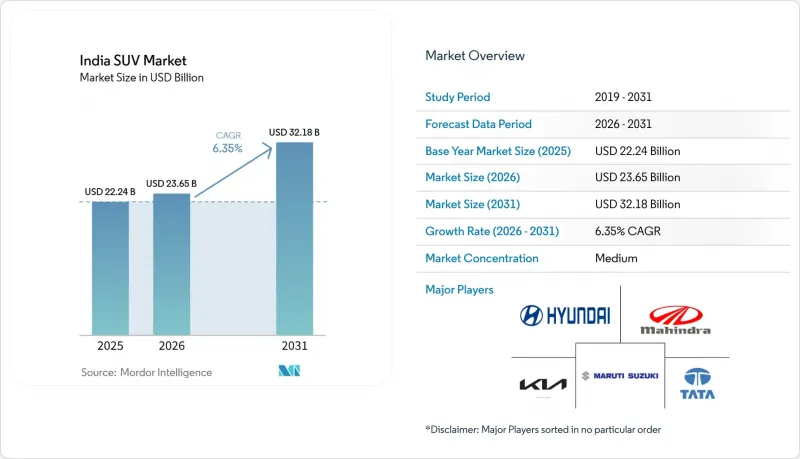
根據 Mordor Intelligence 預測,印度 SUV 市場預計將從 2025 年的 222.4 億美元成長到 2026 年的 236.5 億美元,到 2031 年達到 321.8 億美元,2026 年至 2031 年的複合年預計成長率為 6.35%。
本報告按車輛尺寸(緊湊型、中型、大型)、燃料類型(汽油、柴油、混合動力、電動)、驅動方式(兩驅、四輪驅動、全時四輪驅動)、最終用戶(個人用途、商業用途)和座位數(5人座、7人座及以上)進行分類。市場預測以貨幣價值(美元)和銷售(輛)兩種形式呈現。
印度SUV市場趨勢與洞察
中產階級可支配所得的快速成長與都市化
印度中產階級預計將增加自由裁量權支出,尤其是在購買SUV等「夢想之車」方面。總理經濟顧問委員會指出,城鄉都市區的汽車保有量均顯著成長。隨著都市化進程的推進,人們明顯傾向選擇能夠完美融合城市出行和休閒娛樂功能的車款。緊湊型SUV目前因其較高的離地間隙、更顯檔次以及更短的貸款期限而備受青睞。此外,受低利率的吸引,年輕的首次購車者往往完全忽略掀背車。
GST結構對總長度小於4公尺的「緊湊型」SUV有利。
商品及服務稅(GST)委員會降低了車長小於4公尺的SUV的補償附加稅,有效減輕了稅負,縮小了與掀背車的價格差距。據印度汽車經銷商協會聯合會(FADA)稱,緊湊型SUV的零售顯著成長。包括Martti、Tata、Hyundai和Mahindra在內的汽車製造商擴大了其車長小於4米的車型陣容,並將節省的成本轉嫁給了消費者,或用於增加車輛配置,從而推動了印度SUV市場向緊湊型車型的轉變。
燃油價格波動和柴油車補貼取消
燃油價格波動和柴油補貼逐步取消為SUV市場蒙上了一層不確定性的陰影,尤其是長期以來在該細分市場佔據主導地位的柴油車型。儘管近期柴油車銷售量有所成長,但能源轉型諮詢委員會推動在人口密集城市禁止柴油車銷售的措施已開始影響消費者的選擇。隨著柴油補貼即將取消,預計運行成本將上升,迫使車隊營運商重新考慮其動力傳動系統選擇。柴油車對於高里程用戶仍然具有優勢,但隨著更清潔的替代能源日益普及,其市場佔有率預計將會萎縮。
細分市場分析
到2025年,緊湊型SUV將佔印度SUV市場佔有率的49.33%,預計到2031年,該細分市場的年複合成長率將達到7.35%。近期特殊稅費的降低使緊湊型SUV獲得了價格優勢。這項優勢使得塔塔Nexon、瑪魯蒂Brezza和現代Venue等車款佔據市場主導地位,並在零售排行榜上名列前茅。隨著印度新車安全評鑑協會(Bharat NCAP)對部分關鍵車型授予五星評級,側面碰撞和柱撞保護等安全功能已成為購車者的必備之選。因此,六個安全氣囊和電子穩定控制系統(ESC)正逐漸成為中期拉皮款車型的標準配備。
即使製造商努力打造高階形象,中型SUV仍需繳納更高的課稅,減緩了其銷售成長。同時,全尺寸車型由於入門價格高昂,銷售也受到限制。在停車位稀缺的印度大都會圈,消費者對車長小於4公尺、可停放在標準停車位的車款需求顯著增加。因此,汽車製造商的工程策略著重於在4米車長限制內最佳化車內空間、提升資訊娛樂功能和安全性能,同時確保利潤率並避免繳納更高的商品及服務稅(GST)。
汽油車受惠於較低的入門價格和完善的服務網路,預計到2025年將佔61.11%的銷售佔有率。隨著柴油車和汽油車零售價格差距的縮小,柴油車的市佔率顯著下降。此外,選擇性催化還原(SCR)系統的引進也增加了單車成本。儘管目前印度電動車(EV)SUV市場規模仍然小規模,但在各邦政府補貼和電池成本大幅下降的推動下,預計到2031年將實現11.65%的複合年成長率。
混合動力SUV佔據的市佔率較小,價格也高於汽油動力車,但燃油效率顯著更高。未來,隨著電池成本的下降以及汽車製造商採用滑板式平台,混合動力SUV與汽油動力SUV的價格差距有望縮小。這一趨勢可能會使電動動力傳動系統的總擁有成本(TCO)計算更具優勢,尤其是在長途駕駛的情況下。
其他好處:
- Excel格式的市場預測(ME)表
- 3個月的分析師支持
目錄
第1章:引言
- 市場分析與定義的前提條件
- 分析範圍
第2章 分析方法
第3章執行摘要
第4章 市場狀況
- 市場概覽
- 市場促進因素
- 中產階級可支配所得的快速成長與都市化
- 商品及服務稅 (GST) 的結構對長度小於 4 公尺的「緊湊型」SUV 有利。
- 透過OEM產品在地化降低銷售價格和總擁有成本。
- 國家和高速公路網路的快速擴張
- 新時代的數位零售通路將業務拓展至區域地區。
- 人們對ADAS和聯網汽車功能作為差異化因素的興趣日益濃厚。
- 市場限制因素
- 柴油價格波動和補貼取消
- 嚴格的 CAFE II 和 RDE排放氣體法規推高了生產成本。
- 公共電動汽車高功率充電基礎設施不完善
- 半導體持續供不應求限制了裝飾配件的供應。
- 價值鍊和供應鏈分析
- 監理情勢
- 技術展望
- 波特五力分析
第5章:預測市場規模與成長率
- 按車輛尺寸
- 緊湊型(小於 4 公尺)
- 中型(4-4.6公尺)
- 全尺寸(4.6米或更大)
- 按燃料類型
- 汽油
- 柴油引擎
- 混合
- 電的
- 透過驅動系統
- 2WD
- 4WD
- AWD
- 最終用戶
- 個人使用
- 商業用途
- 按座位數
- 5座
- 7 個座位或以上
第6章 競爭情勢
- 市場集中度
- 策略趨勢
- 市佔率分析
- 公司簡介
- Maruti Suzuki India Ltd.
- Hyundai Motor India Ltd.
- Tata Motors Ltd.
- Mahindra & Mahindra Ltd.
- Kia India Pvt. Ltd.
- Toyota Kirloskar Motor Pvt. Ltd.
- JSW MG Motor India Pvt. Ltd.
- Renault India Pvt. Ltd.
- Honda Cars India Ltd.
- Jeep India(Stellantis)
- Skoda Auto Volkswagen India Pvt. Ltd.
- Nissan Motor India Pvt. Ltd.
- BYD India Pvt. Ltd.
- Citroen India(Stellantis)
- Volvo Car India Pvt. Ltd.
- Mercedes-Benz India Pvt. Ltd.
- BMW India Pvt. Ltd.
- Audi India Pvt. Ltd.
- Jaguar Land Rover India Ltd.
- Isuzu Motors India Pvt. Ltd.
第7章 市場機會與未來展望
According to Mordor Intelligence, the India SUV market size is expected to increase from USD 22.24 billion in 2025 to USD 23.65 billion in 2026 and reach USD 32.18 billion by 2031, growing at a CAGR of 6.35% over 2026-2031.
This report is Segmented by Vehicle Size (Compact, Mid-Size, and Full-Size), Fuel Type (Petrol, Diesel, Hybrid, and Electric), Drivetrain (2WD, 4WD, and AWD), End-User (Personal Use and Commercial Use), and Seating Capacity (5-Seater and 7-Seater and Above). The Market Forecasts are Provided in Terms of Value (USD) and Volume (Units).
India SUV Market Trends and Insights
Surging Middle-Class Disposable Income and Urbanization
India's middle class is set to boost discretionary spending, particularly on aspirational purchases like SUVs. The Prime Minister's Economic Advisory Council noted a significant uptick in vehicle ownership across both rural and urban landscapes. As urbanization progresses, there's a discernible shift towards vehicles that seamlessly blend city agility with recreational versatility. Compact SUVs are now favored for their elevated ground clearance, status enhancement, and shorter loan tenures. Moreover, younger first-time buyers, buoyed by attractive interest rates, are bypassing hatchbacks altogether.
Favorable GST Structure for Sub-4-Meter "Compact" SUVs
The GST Council reduced the compensation cess on sub-4-meter SUVs, lowering the effective tax burden and narrowing the price gap with hatchbacks. Compact SUV retail volumes grew significantly, according to the Federation of Automobile Dealers Associations . OEMs with strong sub-4-meter portfolios, such as Maruti, Tata, Hyundai, and Mahindra, passed savings to consumers or reinvested in additional features, reinforcing the India SUV market's shift toward compact models.
Volatile Fuel Prices and Subsidy Withdrawal on Diesel
Fuel price fluctuations and the slow phasing out of diesel subsidies are casting a shadow of uncertainty over SUV purchases, especially for diesel models that have long been the segment's frontrunners. While recent trends have shown a rise in diesel car sales, the Energy Transition Advisory Committee's push to ban diesel vehicles in cities with large populations is already swaying consumer choices. With the impending withdrawal of diesel subsidies, running costs are poised to climb, prompting fleet operators to reconsider their powertrain selections. Even though diesel continues to benefit high-mileage users, its market share is poised to dwindle as cleaner alternatives gain traction.
Other drivers and restraints analyzed in the detailed report include:
- OEM Localization Lowering Sticker Prices & TCO
- Growing Affinity For ADAS And Connected-Car Features
- Stringent CAFE II and RDE Emission Norms Escalating Production Cost
For complete list of drivers and restraints, kindly check the Table Of Contents.
Segment Analysis
Compact SUVs generated 49.33% of the Indian SUV market share in 2025, and the Indian SUV market size for this segment is projected to rise at a 7.35% CAGR through 2031. A recent cess cut gave COMPACT SUVs a price edge. This advantage allowed Tata's Nexon, Maruti's Brezza, and Hyundai's Venue to dominate, clinching a significant share of the top retail positions. With Bharat NCAP awarding 5-star ratings to leading models, safety features like side- and pole-impact protection have become essential for buyers. As a result, mid-cycle facelifts are now standardizing six airbags and electronic stability control.
Even with aspirations for a premium image, mid-size SUVs find themselves in a higher tax bracket, stunting their volume growth. Meanwhile, full-size models face limitations due to their high entry prices. In metro India, where parking is a premium, there's a noticeable shift in demand towards sub-4-meter models, which conveniently fit into standard parking spaces. Consequently, OEM engineering strategies focus on optimizing interior space, enhancing infotainment, and bolstering safety features within the 4-meter limit, while safeguarding profit margins and avoiding higher GST brackets.
Petrol units accounted for 61.11% of the 2025 revenue share, benefiting from lower entry prices and extensive service networks. As the retail price gap between diesel and petrol tightened, diesel's share dropped significantly. Additionally, the inclusion of selective catalytic reduction hardware increased the cost of each vehicle. The Indian SUV market for electric variants remains small in absolute terms, yet electric SUVs are projected to post an 11.65% CAGR through 2031, as state subsidies and battery costs decline significantly.
Hybrid SUVs hold a niche market share and are priced higher than their petrol counterparts, yet they offer significantly better fuel economy. Looking ahead, decreasing battery costs and OEMs' adoption of skateboard platforms are expected to reduce acquisition premiums. This development is likely to make total cost of ownership (TCO) calculations more favorable for electric powertrains, particularly in high-mileage scenarios.
Complete Report Scope:
- By Vehicle Size
- Compact (Up to 4 m)
- Mid-size (4 to 4.6 m)
- Full-size (Above 4.6 m)
- By Fuel Type
- Petrol
- Diesel
- Hybrid
- Electric
- By Drivetrain
- 2WD
- 4WD
- AWD
- By End-User
- Personal Use
- Commercial Use
- By Seating Capacity
- 5-Seater
- 7-Seater and above
List of Companies Covered in this Report:
- Maruti Suzuki India Ltd.
- Hyundai Motor India Ltd.
- Tata Motors Ltd.
- Mahindra & Mahindra Ltd.
- Kia India Pvt. Ltd.
- Toyota Kirloskar Motor Pvt. Ltd.
- JSW MG Motor India Pvt. Ltd.
- Renault India Pvt. Ltd.
- Honda Cars India Ltd.
- Jeep India (Stellantis)
- Skoda Auto Volkswagen India Pvt. Ltd.
- Nissan Motor India Pvt. Ltd.
- BYD India Pvt. Ltd.
- Citroen India (Stellantis)
- Volvo Car India Pvt. Ltd.
- Mercedes-Benz India Pvt. Ltd.
- BMW India Pvt. Ltd.
- Audi India Pvt. Ltd.
- Jaguar Land Rover India Ltd.
- Isuzu Motors India Pvt. Ltd.
Additional Benefits:
- The market estimate (ME) sheet in Excel format
- 3 months of analyst support
TABLE OF CONTENTS
1 Introduction
- 1.1 Study Assumptions and Market Definition
- 1.2 Scope of the Study
2 Research Methodology
3 Executive Summary
4 Market Landscape
- 4.1 Market Overview
- 4.2 Market Drivers
- 4.2.1 Surging Middle-Class Disposable Income And Urbanization
- 4.2.2 Favorable GST Structure for Sub-4-Meter "Compact" SUVs
- 4.2.3 OEM Localisation Lowering Sticker Prices and TCO
- 4.2.4 Rapid Expansion of National Highway and Expressway Network
- 4.2.5 New-Age Digital Retail Channels Widening Rural Reach
- 4.2.6 Growing Affinity for ADAS and Connected-Car Features As Differentiators
- 4.3 Market Restraints
- 4.3.1 Volatile Fuel Prices and Subsidy Withdrawal On Diesel
- 4.3.2 Stringent CAFE II and RDE Emission Norms Escalating Production Cost
- 4.3.3 Under-Developed High-Power Public EV Charging Backbone
- 4.3.4 Persistent Semiconductor Shortages Limiting Trim Availability
- 4.4 Value / Supply-Chain Analysis
- 4.5 Regulatory Landscape
- 4.6 Technological Outlook
- 4.7 Porter's Five Forces Analysis
- 4.7.1 Threat of New Entrants
- 4.7.2 Bargaining Power of Suppliers
- 4.7.3 Bargaining Power of Buyers
- 4.7.4 Threat of Substitutes
- 4.7.5 Intensity of Competitive Rivalry
5 Market Size and Growth Forecasts (Value (USD) and Volume (Units))
- 5.1 By Vehicle Size
- 5.1.1 Compact (Up to 4 m)
- 5.1.2 Mid-size (4 to 4.6 m)
- 5.1.3 Full-size (Above 4.6 m)
- 5.2 By Fuel Type
- 5.2.1 Petrol
- 5.2.2 Diesel
- 5.2.3 Hybrid
- 5.2.4 Electric
- 5.3 By Drivetrain
- 5.3.1 2WD
- 5.3.2 4WD
- 5.3.3 AWD
- 5.4 By End-User
- 5.4.1 Personal Use
- 5.4.2 Commercial Use
- 5.5 By Seating Capacity
- 5.5.1 5-Seater
- 5.5.2 7-Seater and above
6 Competitive Landscape
- 6.1 Market Concentration
- 6.2 Strategic Moves
- 6.3 Market Share Analysis
- 6.4 Company Profiles (Includes Global Level Overview, Market Level Overview, Core Segments, Financials as Available, Strategic Information, Market Rank/Share for Key Companies, Products and Services, and Recent Developments)
- 6.4.1 Maruti Suzuki India Ltd.
- 6.4.2 Hyundai Motor India Ltd.
- 6.4.3 Tata Motors Ltd.
- 6.4.4 Mahindra & Mahindra Ltd.
- 6.4.5 Kia India Pvt. Ltd.
- 6.4.6 Toyota Kirloskar Motor Pvt. Ltd.
- 6.4.7 JSW MG Motor India Pvt. Ltd.
- 6.4.8 Renault India Pvt. Ltd.
- 6.4.9 Honda Cars India Ltd.
- 6.4.10 Jeep India (Stellantis)
- 6.4.11 Skoda Auto Volkswagen India Pvt. Ltd.
- 6.4.12 Nissan Motor India Pvt. Ltd.
- 6.4.13 BYD India Pvt. Ltd.
- 6.4.14 Citroen India (Stellantis)
- 6.4.15 Volvo Car India Pvt. Ltd.
- 6.4.16 Mercedes-Benz India Pvt. Ltd.
- 6.4.17 BMW India Pvt. Ltd.
- 6.4.18 Audi India Pvt. Ltd.
- 6.4.19 Jaguar Land Rover India Ltd.
- 6.4.20 Isuzu Motors India Pvt. Ltd.
7 Market Opportunities and Future Outlook
- 7.1 White-space and Unmet-Need Assessment

 2026年全球掀背車市場報告
 電動SUV:市場佔有率分析、產業趨勢與統計、成長預測(2025-2030年)
 2026-2034年全球SUV市場規模、佔有率、趨勢和成長分析報告
 運動型多用途車(SUV)市場規模、佔有率和成長分析:按車輛類型、推進系統、驅動方式、燃料類型、座位數、最終用戶和地區分類-2026-2033年產業預測
 運動型多用途車(SUV)市場:全球市場預測,2026-2032年SUV:市佔率分析、產業趨勢與統計、成長預測(2025-2030 年)
 SUV市場分析及預測(至2035年):類型、產品、技術、組件、應用、最終用戶、安裝類型、設備、解決方案
 運動型多用途車(SUV)市場規模、佔有率和成長分析:按SUV尺寸、動力系統、驅動方式、銷售管道和地區分類-2026-2033年產業預測
 混合動力生活風格汽車市場:未來預測(至2034年)-按車輛類型、動力技術、生活方式導向、應用、最終用戶和地區分類的全球分析
 SUV市場-全球產業規模、佔有率、趨勢、機會、預測:按類型、燃料類型、尺寸、座位數、價格範圍、地區和競爭格局分類,2021-2031年