


 |
市場調查報告書
商品編碼
2097313
SUV:市佔率分析、產業趨勢與統計、成長預測(2025-2030 年)SUV - Market Share Analysis, Industry Trends & Statistics, Growth Forecasts (2025 - 2030) |
||||||

※ 本網頁內容可能與最新版本有所差異。詳細情況請與我們聯繫。
根據 Mordor Intelligence 預測,SUV 市場規模預計將在 2025 年達到 8,900 億美元,到 2030 年將擴大到 1.23 兆美元,複合年成長率為 6.66%。
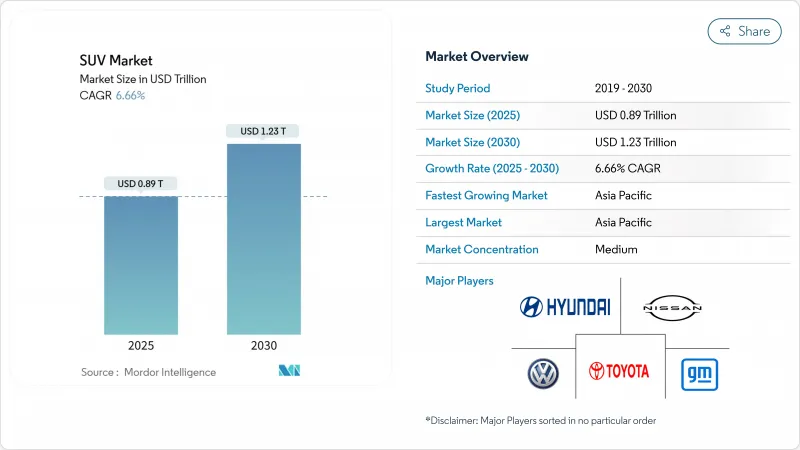
本報告按車輛尺寸(緊湊型、中型、大型)、燃料類型(汽油、柴油、混合動力、電動)、驅動方式(兩驅、四輪驅動、全時四輪驅動)、最終用戶(個人用途、商業用途)、乘客容量(5座、7人座)以及地區(北美、南美、歐洲、亞太、中東和非洲)進行細分。市場預測以貨幣價值(美元)和銷售(輛)兩種形式呈現。
全球SUV市場趨勢與洞察
為了資金籌措用於電氣化轉型,汽車製造商正專注於高利潤的SUV平台。
汽車製造商正將資金集中投入盈利豐厚的SUV產品線,因為SUV的利潤率始終高於轎車產品線,以確保獲得升級設備以實現電氣化所需的資金。例如,一家美國主要汽車品牌投資22億美元,將其位於科隆的工廠改造成專門生產新款Explorer衍生車型的純電動汽車工廠。這種良性循環使得現有組裝廠能夠保持運作,同時還能為電池採購、自主研發的電力驅動橋以及支援未來車型的空中下載(OTA)軟體基礎設施的投資提供資金。隨著電氣化成本的降低,SUV市場的策略重要性進一步提升,因為同一台平台可以轉型為純電動車,同時也能保留盈利的選配配置。
消費者對大型車輛的偏好發生了變化
印度、東南亞和拉丁美洲收入的成長推動了對能夠應對各種路況並象徵社會進步的高階車型的持續需求。從鄉村湧入都市區的人們更傾向於選擇SUV,因為SUV在擁擠的道路上視野開闊,週末出行靈活便捷,並且在碰撞事故中也更安全。各國製造商提供的獎勵促進了本地組裝,從而在降低購車成本的同時,也擴大了車型選擇範圍。不斷壯大的中產階級支撐著SUV市場的長期成長前景,確保在許多新興經濟體中,SUV市場的成長速度將超過整個微型車市場的成長速度。
加強對SUV的CAFE/CO2排放法規
目前,車隊平均燃油消耗目標要求輕型卡車(包括大多數SUV)到2031年達到每加侖50.4英里的燃油效率,較目前水準有顯著提高。要達到這一標準,需要採用更輕的車身、更小排氣量的渦輪增壓引擎或實現全面電氣化,所有這些都將耗費數十億美元的工程成本。對於大規模生產的汽車製造商而言,超過基準值的罰款每年可能超過10億美元,這可能會使其用於外觀重新設計和新生產線投資的預算捉襟見肘,並可能導致空氣動力學效率最低或車身最重的車型停產。
細分市場分析
2024年,緊湊型SUV佔了42.98%的市佔率。這反映出都市區消費者偏好操控性強、兼具SUV造型和高駕駛視野,且不犧牲都市區。大眾市場品牌正利用模組化底盤提供多種車身樣式,同時透過開發高階配置車型來確保獲利。容量較小的55-65kWh電池組的出現,滿足了居住者的日常續航需求,也推動了入門級電動車型進入市場。
儘管銷量有所下降,但全尺寸SUV仍是推動營收成長的主要動力。這是因為消費者願意為三排座椅、強大的牽引能力和旗艦級資訊娛樂系統支付豪華轎車等級的價格。得益於注重寬敞內部空間和企業VIP接送服務的富裕消費者,全尺寸SUV的複合年成長率高達11.39%,超過了SUV市場的整體表現。透過充分利用車內空間,全尺寸SUV可以在不犧牲載貨能力的情況下安裝超過100kWh的電池組,並且符合高所得地區的零排放法規。因此,預計到2030年,全尺寸SUV細分市場將在SUV市場的成長中佔據相當大的佔有率。
預計到2024年,汽油SUV仍將維持59.36%的市場佔有率,顯示在充電基礎設施仍然有限、消費者對續航里程持續擔憂的市場中,內燃機的重要性依然不容忽視。缸內直噴和氣缸關閉技術的效率提升,使得即使在充電基礎設施低度開發且對價格敏感的地區,也能滿足監管標準。製造商正在將輕度混合動力系統作為車輛的標準配置,以在不改變駕駛駕駛習慣的前提下降低二氧化碳排放。
預計電動SUV的複合年成長率將達到20.56%,是脫碳路線藍圖的基石。專用電動平台可容納滑板式電池和扁平底盤,從而帶來全新的設計靈活性。主要城市的補貼和零排放區的設立正在加速電動SUV的普及,而利用電池二次性利用的租賃方案則降低了二手車轉售的不確定性。不斷擴大的成本差距表明,電動SUV將成為SUV市場量化成長的主要驅動力。
區域分析
到2024年,亞太地區將佔據全球SUV市場佔有率的38.89%,並以8.19%的複合年成長率(CAGR)成為該地區在整個預測期內的主要成長引擎。當地汽車製造商正利用其龐大製造群的規模經濟優勢,在維持價格親民的同時,融入先進的主動安全功能。快速的都市化推動了緊湊型SUV的流行,而中國和韓國的富裕消費者則被具備L3級自動駕駛功能的智慧電動車旗艦車型所吸引,進一步擴大了該地區的SUV市場規模。
北美仍然是一個高價值市場,大型車輛在這裡享有文化地位,基礎設施也支撐著對全尺寸非承載式車身車輛的需求。隨著50.4英里/加侖(約4.7公升/百公里)的車隊燃油經濟性目標即將實現,各大品牌正轉向混合動力V6引擎和標誌性的純電動車型,同時又不犧牲牽引力,從而確保了注重生活方式的消費者的持續支持。加拿大和墨西哥零件供應鏈的整合降低了成本,並使得能夠以具有競爭力的價格提供提升冬季駕駛性能的新一代全輪驅動系統。從車頂帳篷到越野懸吊套件,該地區的配件生態系統正在擴大與SUV市場相關的售後市場收入。
在歐洲,由於都市區的交通堵塞,擁有較重車型的成本不斷上升。然而,由於製造商的創新,電動SUV已成為符合法規的典範車型,透過輕質鋁製車身面板和採用回收材料製成的內飾,在其整個生命週期內降低了排放。在關稅壁壘的限制下進行本地化生產,確保了供應的連續性;而斯堪地那維亞國家的電池更換試點項目,則正在檢驗其為鄰近市場帶來的潛在提案。這些適應性措施共同作用,既維護了歐洲在不斷發展的SUV市場中的重要地位,又兼顧了應對氣候變遷的努力。
其他好處:
- Excel格式的市場預測(ME)表
- 3個月的分析師支持
目錄
第1章:引言
- 研究假設和市場定義
- 調查範圍
第2章:調查方法
第3章執行摘要
第4章 市場狀況
- 市場概覽
- 市場促進因素
- 為了資金籌措用於電氣化轉型,汽車製造商正專注於高利潤的SUV平台。
- 消費者對大型車輛的偏好發生了變化
- 都市區緊湊型和小型SUV的受歡迎程度
- 生活方式車型對全輪驅動和越野性能的需求
- 訂閱式高階SUV的普及
- 用於長途行駛的氫燃料電池SUV的生產線
- 市場限制因素
- 針對SUV的更嚴格的CAFE和CO2排放法規
- 電動SUV電池材料和半導體供應受限
- 大型車輛的都市區通行費和擁擠限制
- 車輛重量增加導致保險費和總擁有成本 (TCO) 增加。
- 價值供應鏈分析
- 監理情勢
- 技術展望
- 波特五力分析
第5章 市場規模與成長預測
- 按車輛尺寸
- 袖珍的
- 中型
- 全尺寸
- 按燃料類型
- 汽油
- 柴油引擎
- 混合
- 電的
- 透過驅動系統
- 2WD
- 4WD
- AWD
- 最終用戶
- 個人使用
- 商業用途
- 按乘客容量
- 5座
- 7座
- 按地區
- 北美洲
- 美國
- 加拿大
- 其他北美國家
- 南美洲
- 巴西
- 阿根廷
- 其他南美國家
- 歐洲
- 英國
- 德國
- 西班牙
- 義大利
- 法國
- 俄羅斯
- 其他歐洲國家
- 亞太地區
- 印度
- 中國
- 日本
- 韓國
- 其他亞太國家
- 中東和非洲
- 阿拉伯聯合大公國
- 沙烏地阿拉伯
- 土耳其
- 埃及
- 南非
- 其他中東和非洲國家
- 北美洲
第6章 競爭情勢
- 市場集中度
- 策略趨勢
- 市佔率分析
- 公司簡介
- Toyota Motor Corporation
- Volkswagen AG
- Hyundai Motor Group
- Renault-Nissan-Mitsubishi Alliance
- General Motors Co.
- Tesla Inc.
- Stellantis NV
- Ford Motor Company
- BMW Group
- Mercedes-Benz Group AG
- Honda Motor Co., Ltd.
- SAIC Motor Corp.
- BYD Company Ltd.
- Geely Auto Holdings
- Tata Motors Ltd.
- Mahindra and Mahindra Ltd.
- Great Wall Motor Co.
- Changan Automobile
- Subaru Corp.
- Mazda Motor Corp.
- Mitsubishi Motors Corp.
- Suzuki Motor Corp.
- Jaguar Land Rover Plc
第7章 市場機會與未來展望
According to Mordor Intelligence, the SUV market reached USD 890 billion in 2025 and is forecast to climb to USD 1.23 trillion by 2030, advancing at a 6.66% CAGR.
This report is Segmented by Vehicle Size (Compact, Mid-Size, and Full-Size), Fuel Type (Petrol, Diesel, Hybrid, and Electric), Drivetrain (2WD, 4WD, and AWD), End-User (Personal Use and Commercial Use), Seating Capacity (5-Seater and 7-Seater), and Geography (North America, South America, Europe, Asia-Pacific and Middle East and Africa). The Market Forecasts are Provided in Terms of Value (USD) and Volume (Units).
Global SUV Market Trends and Insights
OEM Focus on High-Margin SUV Platforms to Fund Electrification
Automakers concentrate capital on lucrative SUV lines that routinely return margins higher than sedan portfolios, supplying the cash required to retool for electric output. For instance, a leading U.S. brand invested USD 2.2 billion to repurpose its Cologne complex into a dedicated battery-EV hub for a new Explorer derivative. This virtuous cycle keeps assembly plants humming today while underwriting battery sourcing, in-house e-axle design, and over-air software infrastructure that underpin tomorrow's models. As electrification costs slide, the same platforms migrate to pure-electric while retaining profitable option packs, reinforcing the strategic weight of the SUV market.
Consumer Preference Shift Toward Larger Vehicles
Rising incomes in India, Southeast Asia, and Latin America propel a sustained appetite for higher-riding body types that can navigate mixed road conditions and project upward mobility. Rural-to-urban migrants favor SUVs for visibility on congested streets, weekend versatility, and perceived crash security. National OEM incentives spur local assembly, containing acquisition cost and widening model choice. This expanding middle-class cohort anchors long-range growth prospects, ensuring the SUV market outpaces total light-vehicle expansion across many emerging economies.
Tightening CAFE / CO2 Rules Targeting SUVs
Fleet-average targets now compel light trucks, including most SUVs, to deliver 50.4 mpg by 2031, significantly above today's readings. Compliance mandates lighter bodies, downsized turbo engines, or full electrification, each demanding billions in engineering spend. Penalties for overshooting limits can surpass USD 1 billion yearly for volume producers, cutting capital available for styling updates or new production lines, and potentially shrinking variants with the poorest aerodynamics or heaviest curb weights.
Other drivers and restraints analyzed in the detailed report include:
- Proliferation of Compact and Sub-Compact SUVs in Urban Areas
- Demand for AWD/Off-Road Capability in Lifestyle Vehicles
- Battery-Material and Chip Supply Constraints for e-SUVs
For complete list of drivers and restraints, kindly check the Table Of Contents.
Segment Analysis
Compact SUVs commanded 42.98% market share in 2024, reflecting urban consumers' preference for maneuverable vehicles that retain SUV styling and elevated driving positions without compromising city practicality. Mass-market brands leverage modular chassis to spin multiple silhouettes while protecting margins through upscale trim ladders. Entry-level electrified variants are appearing, supported by more miniature 55-65 kWh packs that meet city dwellers' daily range needs.
Though contributing fewer units, full-size SUVs propel revenue as buyers pay luxury-car prices for three-row seating, robust towing, and flagship infotainment. Their 11.39% CAGR outpaces the overall SUV market thanks to affluent households and commercial VIP shuttle services that value cabin volume. Interior real estate enables battery packs surpassing 100 kWh without sacrificing cargo, aligning with zero-emission mandates in high-income regions. Consequently, the full-size slice will account for a notable portion of the incremental SUV market size through 2030.
Petrol-powered SUVs maintained 59.36% market share in 2024, demonstrating the continued relevance of internal combustion engines in markets where charging infrastructure remains limited and consumer range anxiety persists. Direct-injection upgrades and cylinder deactivation stretch efficiency, allowing compliance in price-sensitive regions where charging remains scarce. Manufacturers bundle mild hybrids to shave CO2 without altering driver behavior.
Electric SUVs, projected to post a 20.56% CAGR, are the linchpin of decarbonization roadmaps. E-platforms accommodate skateboard batteries and flat floors, opening new design freedom. Subsidies and zero-tailpipe zones in major cities accelerate take-rate, while secondary-life battery leasing schemes buffer resale uncertainty. The widening cost parity window signals electricity as the volume growth engine of the SUV market.
Complete Report Scope:
- By Vehicle Size
- Compact
- Mid-size
- Full-size
- By Fuel Type
- Petrol
- Diesel
- Hybrid
- Electric
- By Drivetrain
- 2WD
- 4WD
- AWD
- By End-User
- Personal Use
- Commercial Use
- By Seating Capacity
- 5-Seater
- 7-Seater
- By Region
- North America
- United States
- Canada
- Rest of North America
- South America
- Brazil
- Argentina
- Rest of South America
- Europe
- United Kingdom
- Germany
- Spain
- Italy
- France
- Russia
- Rest of Europe
- Asia-Pacific
- India
- China
- Japan
- South Korea
- Rest of Asia-Pacific
- Middle East and Africa
- United Arab Emirates
- Saudi Arabia
- Turkey
- Egypt
- South Africa
- Rest of Middle East and Africa
- North America
Geography Analysis
Asia-Pacific accounts for 38.89% of the global SUV market share in 2024, and its 8.19% CAGR positions the region as the prime growth engine over the forecast horizon. Local OEMs orchestrate economies of scale across sprawling manufacturing clusters, keeping transaction prices accessible even as active-safety content climbs. Rapid urbanization fuels compact-SUV penetration, whereas affluent cohorts in China and South Korea gravitate to smart-electric flagships with L3 autonomy, further boosting the regional SUV market size.
North America continues to represent a high-value arena where large vehicles enjoy cultural cachet and infrastructure supports full-size body-on-frame demand. Imminent 50.4 mpg fleet targets steer brands into hybridized V-6s and battery-powered icons without diluting towing credentials, ensuring sustained engagement by lifestyle buyers. Integration of Canadian and Mexican parts supply tempers cost escalation, allowing competitive pricing on next-gen AWD systems that enhance winter drivability. The region's accessory ecosystem, from rooftop tents to overland suspension kits, amplifies aftermarket revenues tied to the SUV market.
Europe grapples with dense-city congestion policies that raise ownership costs for heavier models. Nevertheless, manufacturer creativity positions electric SUVs as compliance champions, with lightweight aluminum closures and recycled interiors reducing life-cycle emissions. Production localization inside tariff walls safeguards supply continuity, and battery-swap trials in Scandinavia test convenience propositions that may spill into neighboring markets. Collectively, these adaptations preserve Europe's relevance within the evolving SUV market while honoring climate commitments.
- Toyota Motor Corporation
- Volkswagen AG
- Hyundai Motor Group
- Renault-Nissan-Mitsubishi Alliance
- General Motors Co.
- Tesla Inc.
- Stellantis N.V.
- Ford Motor Company
- BMW Group
- Mercedes-Benz Group AG
- Honda Motor Co., Ltd.
- SAIC Motor Corp.
- BYD Company Ltd.
- Geely Auto Holdings
- Tata Motors Ltd.
- Mahindra and Mahindra Ltd.
- Great Wall Motor Co.
- Changan Automobile
- Subaru Corp.
- Mazda Motor Corp.
- Mitsubishi Motors Corp.
- Suzuki Motor Corp.
- Jaguar Land Rover Plc
Additional Benefits:
- The market estimate (ME) sheet in Excel format
- 3 months of analyst support
TABLE OF CONTENTS
1 Introduction
- 1.1 Study Assumptions and Market Definition
- 1.2 Scope of the Study
2 Research Methodology
3 Executive Summary
4 Market Landscape
- 4.1 Market Overview
- 4.2 Market Drivers
- 4.2.1 OEM Focus on High-Margin SUV Platforms to Fund Electrification
- 4.2.2 Consumer Preference Shift Toward Larger Vehicles
- 4.2.3 Proliferation of Compact and Sub-Compact SUVs in Urban Areas
- 4.2.4 Demand for AWD/Off-Road Capability in Lifestyle Vehicles
- 4.2.5 Subscription-Based Premium SUV Uptake
- 4.2.6 Hydrogen Fuel-Cell SUV Pipeline for Long-Range Use Cases
- 4.3 Market Restraints
- 4.3.1 Tightening CAFE / CO2 Rules Targeting SUVs
- 4.3.2 Battery-Material and Chip Supply Constraints for e-SUVs
- 4.3.3 Urban Access Fees and Congestion Bans on Large Vehicles
- 4.3.4 Higher Insurance/TCO from Rising Curb-Weight
- 4.4 Value / Supply-Chain Analysis
- 4.5 Regulatory Landscape
- 4.6 Technological Outlook
- 4.7 Porter's Five Forces Analysis
- 4.7.1 Threat of New Entrants
- 4.7.2 Bargaining Power of Suppliers
- 4.7.3 Bargaining Power of Buyers
- 4.7.4 Threat of Substitutes
- 4.7.5 Intensity of Competitive Rivalry
5 Market Size and Growth Forecasts (Value (USD) and Volume (Units))
- 5.1 By Vehicle Size
- 5.1.1 Compact
- 5.1.2 Mid-size
- 5.1.3 Full-size
- 5.2 By Fuel Type
- 5.2.1 Petrol
- 5.2.2 Diesel
- 5.2.3 Hybrid
- 5.2.4 Electric
- 5.3 By Drivetrain
- 5.3.1 2WD
- 5.3.2 4WD
- 5.3.3 AWD
- 5.4 By End-User
- 5.4.1 Personal Use
- 5.4.2 Commercial Use
- 5.5 By Seating Capacity
- 5.5.1 5-Seater
- 5.5.2 7-Seater
- 5.6 By Region
- 5.6.1 North America
- 5.6.1.1 United States
- 5.6.1.2 Canada
- 5.6.1.3 Rest of North America
- 5.6.2 South America
- 5.6.2.1 Brazil
- 5.6.2.2 Argentina
- 5.6.2.3 Rest of South America
- 5.6.3 Europe
- 5.6.3.1 United Kingdom
- 5.6.3.2 Germany
- 5.6.3.3 Spain
- 5.6.3.4 Italy
- 5.6.3.5 France
- 5.6.3.6 Russia
- 5.6.3.7 Rest of Europe
- 5.6.4 Asia-Pacific
- 5.6.4.1 India
- 5.6.4.2 China
- 5.6.4.3 Japan
- 5.6.4.4 South Korea
- 5.6.4.5 Rest of Asia-Pacific
- 5.6.5 Middle East and Africa
- 5.6.5.1 United Arab Emirates
- 5.6.5.2 Saudi Arabia
- 5.6.5.3 Turkey
- 5.6.5.4 Egypt
- 5.6.5.5 South Africa
- 5.6.5.6 Rest of Middle East and Africa
- 5.6.1 North America
6 Competitive Landscape
- 6.1 Market Concentration
- 6.2 Strategic Moves
- 6.3 Market Share Analysis
- 6.4 Company Profiles (Includes Global level Overview, Market level overview, Core Segments, Financials as available, Strategic Information, Market Rank/Share for key companies, Products and Services, and Recent Developments)
- 6.4.1 Toyota Motor Corporation
- 6.4.2 Volkswagen AG
- 6.4.3 Hyundai Motor Group
- 6.4.4 Renault-Nissan-Mitsubishi Alliance
- 6.4.5 General Motors Co.
- 6.4.6 Tesla Inc.
- 6.4.7 Stellantis N.V.
- 6.4.8 Ford Motor Company
- 6.4.9 BMW Group
- 6.4.10 Mercedes-Benz Group AG
- 6.4.11 Honda Motor Co., Ltd.
- 6.4.12 SAIC Motor Corp.
- 6.4.13 BYD Company Ltd.
- 6.4.14 Geely Auto Holdings
- 6.4.15 Tata Motors Ltd.
- 6.4.16 Mahindra and Mahindra Ltd.
- 6.4.17 Great Wall Motor Co.
- 6.4.18 Changan Automobile
- 6.4.19 Subaru Corp.
- 6.4.20 Mazda Motor Corp.
- 6.4.21 Mitsubishi Motors Corp.
- 6.4.22 Suzuki Motor Corp.
- 6.4.23 Jaguar Land Rover Plc
7 Market Opportunities and Future Outlook
- 7.1 White-space and Unmet-Need Assessment

 2026年全球掀背車市場報告
 電動SUV:市場佔有率分析、產業趨勢與統計、成長預測(2025-2030年)
 2026-2034年全球SUV市場規模、佔有率、趨勢和成長分析報告印度SUV市場:市場佔有率分析、產業趨勢與統計、成長預測(2026-2031年)
 運動型多用途車(SUV)市場規模、佔有率和成長分析:按車輛類型、推進系統、驅動方式、燃料類型、座位數、最終用戶和地區分類-2026-2033年產業預測
 運動型多用途車(SUV)市場:全球市場預測,2026-2032年
 SUV市場分析及預測(至2035年):類型、產品、技術、組件、應用、最終用戶、安裝類型、設備、解決方案
 運動型多用途車(SUV)市場規模、佔有率和成長分析:按SUV尺寸、動力系統、驅動方式、銷售管道和地區分類-2026-2033年產業預測
 混合動力生活風格汽車市場:未來預測(至2034年)-按車輛類型、動力技術、生活方式導向、應用、最終用戶和地區分類的全球分析
 SUV市場-全球產業規模、佔有率、趨勢、機會、預測:按類型、燃料類型、尺寸、座位數、價格範圍、地區和競爭格局分類,2021-2031年