

 |
市場調查報告書
商品編碼
2117424
電動車充電線:市場佔有率分析、產業趨勢與統計、成長預測(2026-2031)EV Charging Cable - Market Share Analysis, Industry Trends & Statistics, Growth Forecasts (2026 - 2031) |
||||||

※ 本網頁內容可能與最新版本有所差異。詳細情況請與我們聯繫。
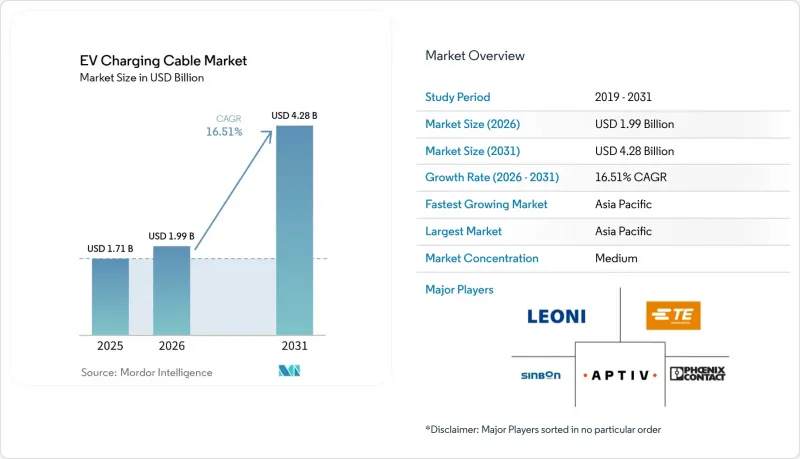
據 Mordor Intelligence 稱,2025 年電動車充電線市場價值 17.1 億美元,2026 年預計為 19.9 億美元,預計到 2031 年將達到 42.8 億美元。
預計從 2026 年到 2031 年,其複合年成長率將達到 16.51%。
本報告按電源類型(交流充電線和直流充電線)、線纜長度(小於5米、5-10米和大於10米)、充電等級(1級、2級和3級)、應用領域(個人充電和公共充電)、連接器類型(Type 1、Type 2、CCS、CHAdeMO和特斯拉NACS)以及地區進行細分。市場預測以美元(USD)計價。
全球電動車充電線纜市場趨勢及洞察
液冷式大電流電纜成本更低,使用壽命更長。
得益於菲尼克斯電氣 (Phoenix Contact) 和 Huber + Sooner 等公司的大規模生產,液冷組件的成本已大幅降低。菲尼克斯電氣的電纜使用壽命更長,也比風冷產品更實用。 Huber + Sooner 將 PT1000 感測器整合到 RADOX HPC500 插頭中,實現即時溫度控管,防止過熱。 ChargePoint 採用類似的液冷系統,以保持電池組的高功率輸出,從而顯著縮短充電時間。新的 IEC 測試標準要求電纜在長時間內承載高電流,而液冷產品無需增加導體直徑即可應對此挑戰。
加快公共直流快速充電走廊的部署
在美國,2025年新增了18,000個直流快速充電樁,增幅達30%,這得益於國家電動車基礎設施(NEVI)提供的50億美元資金支持。光是加州就新增了1,200多個充電站,德克薩斯州和佛羅裡達州分別新增了850個和720個,進一步擴展了東西向高速公路網路。歐洲替代燃料基礎設施(AFIF)撥款6億歐元,計畫在2027年前沿優先貨運走廊建造3,000個直流充電樁。特斯拉在2025年新增了6,786個超級充電樁,可使用CCS1轉接器為非特斯拉車輛充電,旨在實現閒置充電能力的商業化。 EVgo已獲得12.5億美元的聯邦貸款,將在1,100個以超市為中心的地點部署約7,500個快速充電樁,從而加強其在城市中心的部署基礎。該走廊項目將高速公路充電站的電纜長度標準化為 5 至 10 米,而路邊充電點則使用不到 5 米的較短電纜,以防止人為破壞。
銅和彈性體價格波動
由於智利和秘魯的採礦作業中斷,銅價飆升至歷史新高。隨著避險期的到期,這顯著增加了成本並降低了毛利率。同時,EPDM和TPE彈性體的價格也大幅上漲。這是由於煉油廠停產導致用於液冷套的低邵氏硬度等級材料的供應緊張。為了應對這些市場動態,歐洲小規模組裝製造商推遲了產能擴張計畫。大多數受訪公司選擇延後模具訂單,主要原因是成本大幅增加。雖然鋁銅包鋼線具有成本優勢,但其較大的直徑增加了都市區路邊安裝所需的彎曲半徑要求。
細分市場分析
直流產品年增16.98%,正逼近交流電產品預計在2025年達到的65.16%的領先優勢。這是因為車隊正在尋求功率350千瓦或以上的充電站解決方案,將充電時間縮短至20分鐘以內。隨著直流電動車充電電纜市場的擴張,菲尼克斯電氣已在500安培組件中實現了顯著的成本降低。同時,兆瓦級系統正在為卡車開闢一個高階細分市場。例如,ABB電纜性價比高,其投資可透過提高車輛運轉率來收回。利奧尼的「EcoSense Nxt」系列也不甘示弱,利用交流技術實現了輕量化結構,從而能夠在狹小空間內更快地安裝電纜。
液冷直流組件的毛利率高於交流組件,這些利潤將再投資於研發。隨著NACS和CCS2標準的整合,直流供應商已佔據戰略優勢,能夠充分利用其在電動車充電線纜領域不斷成長的市場佔有率,並力求與汽車製造商和充電設備OEM廠商建立設計夥伴關係。
2025年,長度小於5公尺的電纜產品佔總銷售量的45.73%。這主要得益於道路和車庫等場所的安裝需求,在這些場所,降低絆倒事故的風險至關重要。同時,長度超過10公尺的電纜正以16.85%的複合年成長率成長,因為高速公路服務區正在進行改造,增設貫通式車道以方便皮卡和拖車通行。
特斯拉的V4標準凸顯了中檔充電線市場日益成長的主導地位,該市場目前已佔據電動車充電線市場相當大的佔有率。為了彌補長距離佈線電阻造成的功率損耗,更粗的導線被用於充電,但這同時也增加了每條電纜的成本。在兆瓦級卡車充電站,由於採用了受電弓式架空安裝方式,更長的電纜正逐漸成為標準配置,從而減輕了駕駛員的手動操作負擔。
區域分析
預計到2025年,亞太地區將維持47.41%的市佔率。隨著中國強制要求GB/T和CCS2標準相容,像沃新能這樣的本土供應商蓬勃發展,該公司去年出貨了150萬個GB/T插頭,預計到2031年將維持16.94%的複合年成長率。根據國際能源總署(IEA)預測,東南亞每年都會新增充電樁。這一成長預計將顯著提升32安培充電線的季度需求。同時,日本正在分階段從CHAdeMO標準過渡到CCS2標準,這需要雙協定相容的充電介面。這項過渡不僅凸顯了日本的獨特地位,也顯示即使產業趨勢朝著更廣泛的標準化方向發展,對多標準充電線的需求仍然持續存在。
北美在電動車充電電纜標準化方面主導,北美充電標準 (NACS) 的採用已覆蓋相當大比例的新增充電埠。在舉措和特斯拉雄心勃勃的充電埠擴張計畫的推動下,主要交通走廊的充電基礎設施密度正在不斷提高,這主要得益於高容量線纜的部署。同時,EVgo 的充電設施預計將覆蓋都市區雜貨店聚集區,這將形成可預測的停留時間,適合使用高電流水冷線纜。
在歐洲,直流充電樁的數量預計將進一步增加,這得益於AFIR法規和AFIF的大量津貼。 ACCIONA Energia收購Cable Energia的網路,也凸顯了對黃金都市區位置的激烈競爭。儘管拉丁美洲、中東和非洲的銷售額佔比很小,但巴西無污染燃料基礎設施基金的投資以及阿拉伯聯合大公國雄心勃勃的充電樁部署計劃表明,市場需求正在成長。
其他好處:
- Excel格式的市場預測(ME)表
- 3個月的分析師支持
目錄
第1章:引言
- 研究假設和市場定義
- 調查範圍
第2章:調查方法
第3章執行摘要
第4章 市場狀況
- 市場概覽
- 市場促進因素
- 液冷式大電流電纜成本更低,使用壽命更長
- 加快公共直流快速充電走廊的部署
- 全球朝著統一CCS和NACS連接器標準的方向發展
- 大型卡車兆瓦級充電技術的興起
- 面向車隊的「有線電視即服務」訂閱模式。
- 利用回收的銅鋁合金來降低原料供應風險
- 市場限制因素
- 銅和彈性體的價格波動
- 都市區允許電纜電流的系統諧波上限
- 因過熱事件引發安全召回
- 原始設備製造商儘早過渡到無線感應式充電
- 價值供應鏈分析
- 監理情勢
- 技術展望
- 波特五力模型
第5章 市場規模與成長預測
- 按電源類型
- 交流充電線
- 直流充電線
- 按電纜長度
- 小於5米
- 5~10 m
- 超過10米
- 按充電等級
- 一級
- 二級
- 3級
- 按應用程式類型
- 家用充電
- 公共充電
- 依連接器類型
- 1型
- 類型 2
- CCS
- CHAdeMO
- 特斯拉 NACS
- 按地區
- 北美洲
- 美國
- 加拿大
- 其他北美國家
- 南美洲
- 巴西
- 阿根廷
- 其他南美國家
- 歐洲
- 英國
- 德國
- 西班牙
- 義大利
- 法國
- 俄羅斯
- 其他歐洲國家
- 亞太地區
- 印度
- 中國
- 日本
- 韓國
- 其他亞太國家
- 中東和非洲
- 阿拉伯聯合大公國
- 沙烏地阿拉伯
- 土耳其
- 埃及
- 南非
- 其他中東和非洲國家
- 北美洲
第6章 競爭情勢
- 市場集中度
- 策略趨勢
- 市佔率分析
- 公司簡介
- Leoni AG
- TE Connectivity Ltd.
- Aptiv PLC
- Sinbon Electronics
- Phoenix Contact
- Nexans SA
- Huber+Suhner AG
- Lapp Group
- Sumitomo Electric Ind.
- Amphenol Corp.
- Besen International Group Co., Ltd.
- Woer New Energy
- Chengdu Khons Technology Co., Ltd.
- Brugg eConnect
- Coroplast Group
- Philatron
- BizLink Group
第7章 市場機會與未來展望
According to Mordor Intelligence, the EV charging cable market size was valued at USD 1.71 billion in 2025, is estimated at USD 1.99 billion in 2026, and is projected to reach USD 4.28 billion by 2031, growing at a CAGR of 16.51% over 2026-2031.
This report is Segmented by Power Supply Type (AC Charging Cable and DC Charging Cable), Cable Length (Below 5 M, 5-10 M and Above 10 M), Charging Level (Level 1, Level 2, and Level 3), Application Type (Private Charging and Public Charging), Connector Type (Type 1, Type 2, CCS, Chademo, and Tesla NACS), and Geography. The Market Forecasts are Provided in Terms of Value (USD).
Global EV Charging Cable Market Trends and Insights
Falling Cost and Longer Life of Liquid-Cooled High-Amp Cables
Unit prices for liquid-cooled assemblies decreased significantly as Phoenix Contact, Huber+Suhner, and others achieved large-scale production. Phoenix Contact's cable now offers an extended lifespan, making it more usable than air-cooled counterparts . Huber+Suhner integrates PT1000 sensors into its RADOX HPC500 plug, enabling real-time thermal management to prevent overheating. ChargePoint employs a similar liquid-cooling system to maintain high-power delivery to battery packs, substantially reducing charging times. New IEC test cycles now subject cables to elevated current levels for prolonged periods, a challenge that liquid-cooled products meet without requiring oversized conductors.
Accelerated Rollout of Public DC Fast-Charging Corridors
The United States added 18,000 DC fast-charge ports in 2025, a 30% lift driven by USD 5 billion of National Electric Vehicle Infrastructure (NEVI) funding. California alone installed more than 1,200 stations, while Texas and Florida added 850 and 720, respectively, creating coast-to-coast highway coverage. Europe's Alternative Fuels Infrastructure Facility earmarked EUR 600 million to build 3,000 DC chargers along priority freight corridors by 2027 . Tesla opened 6,786 additional Supercharger ports in 2025 and began welcoming non-Tesla cars that use CCS1 adapters, monetizing idle capacity. EVgo secured a USD 1.25 billion federal loan to deploy about 7,500 fast chargers across 1,100 grocery-anchored sites, tightening its urban-core footprint. Corridor projects are standardizing on 5-10 meter cable lengths for highway bays, whereas curbside sites opt for sub-5 meter lines to curb vandalism.
Copper and Elastomer Price Volatility
Copper prices surged to record levels, driven by mine disruptions in Chile and Peru. This significantly increased costs and cut gross margins as hedge windows expired. Meanwhile, EPDM and TPE elastomers experienced notable price hikes, driven by refinery outages that tightened the supply of low-Shore-hardness grades, which are essential for liquid-cooled jackets. In response to these market dynamics, small European assemblers held back on capacity expansions. A majority of surveyed firms chose to defer tooling orders, citing significant cost spikes as the primary reason. While aluminum-copper-clad wire offers a cost advantage, it also increases cable diameter, complicating bend radius requirements for urban curbside installations.
Other drivers and restraints analyzed in the detailed report include:
- Global Convergence Toward CCS and NACS Connector Standards
- Emergence of Megawatt Charging for HD Trucks
- Safety Recalls Over Thermal-Runaway Incidents
For complete list of drivers and restraints, kindly check the Table Of Contents.
Segment Analysis
DC products grew 16.98% annually and are closing on AC's 65.16% 2025 lead as fleets pursue 350 kW-plus depot solutions that cut charge times to sub-20 minutes. As the market for DC electric vehicle charging cables grows, Phoenix Contact has achieved a significant cost reduction in its 500-amp assembly. Meanwhile, Megawatt systems are carving out a premium niche for trucks; for instance, ABB's cable, priced accordingly, offers a payback due to enhanced vehicle utilization. Not to be outdone, Leoni's EcoSense Nxt family, leveraging AC technology, has achieved reduced mass, facilitating quicker cable pulls through tight conduits.
Liquid-cooled DC assemblies boast higher gross margins than AC, and these profits are reinvested in R&D. With the convergence of NACS and CCS2, DC vendors are strategically positioned to capitalize on their growing market share in the electric vehicle charging cable sector, aiming to secure design partnerships with both automakers and charging-equipment OEMs.
Below-5-meter products led with 45.73% of 2025 revenue, due to curbside and garage installs that prioritize low trip-hazard risk. Yet lines over 10 meters are growing at a 16.85% CAGR as highway plazas reconfigure to add pull-through bays serving pickups and trailers.
Tesla's V4 standard highlights the growing dominance of the mid-range segment, which now holds a significant share of the electric vehicle charging cable market. To counteract resistive loss penalties on extended runs, larger conductors are used, which adds to the per-cable cost. In megawatt truck depots, the adoption of pantograph overhead mounts has made longer lengths the standard, alleviating drivers from manual handling.
Complete Report Scope:
- By Power Supply Type
- AC Charging Cable
- DC Charging Cable
- By Cable Length
- Below 5 m
- 5-10 m
- Above 10 m
- By Charging Level
- Level 1
- Level 2
- Level 3
- By Application Type
- Private Charging
- Public Charging
- By Connector Type
- Type 1
- Type 2
- CCS
- CHAdeMO
- Tesla NACS
- By Region
- North America
- United States
- Canada
- Rest of North America
- South America
- Brazil
- Argentina
- Rest of South America
- Europe
- United Kingdom
- Germany
- Spain
- Italy
- France
- Russia
- Rest of Europe
- Asia Pacific
- India
- China
- Japan
- South Korea
- Rest of Asia Pacific
- Middle East and Africa
- United Arab Emirates
- Saudi Arabia
- Turkey
- Egypt
- South Africa
- Rest of Middle East and Africa
- North America
Geography Analysis
Asia-Pacific maintained 47.41% revenue share in 2025. It will log a 16.94% CAGR through 2031 as China enforces GB/T compatibility with CCS2, stimulating local vendors like Woer New Energy, which shipped 1.5 million GB/T plugs last year. Southeast Asia is set to install new charging points annually, according to the International Energy Agency. This surge is expected to significantly increase demand for 32-amp cables each quarter. Meanwhile, Japan's gradual shift from the CHAdeMO standard to CCS2 necessitates the use of dual-protocol inlets. This transition not only underscores the country's unique position but also highlights the sustained demand for multi-standard cables, even as the industry trends towards broader standardization.
North America leads the charge in standardizing electric vehicle (EV) charging cables, with the adoption of the North American Charging Standard (NACS) now covering a significant share of new ports. Bolstered by the NEVI initiative and Tesla's ambitious expansion of ports, key corridors are becoming denser, predominantly featuring high-capacity cables. Meanwhile, EVgo's rollout of units is set to blanket urban grocery hubs, establishing predictable dwell times that favor high-amp, liquid-cooled lines.
Europe, supported by AFIR regulations, is set to gain additional DC chargers through significant AFIF grants. The competition for premium urban sites is evident in ACCIONA Energia's acquisition of Cable Energia's network. While Latin America and the Middle East & Africa together account for a small share of revenues, Brazil's investment in the Clean Fuels Infrastructure fund and the UAE's ambitious charger initiatives indicate growing demand.
- Leoni AG
- TE Connectivity Ltd.
- Aptiv PLC
- Sinbon Electronics
- Phoenix Contact
- Nexans SA
- Huber+Suhner AG
- Lapp Group
- Sumitomo Electric Ind.
- Amphenol Corp.
- Besen International Group Co., Ltd.
- Woer New Energy
- Chengdu Khons Technology Co., Ltd.
- Brugg eConnect
- Coroplast Group
- Philatron
- BizLink Group
Additional Benefits:
- The market estimate (ME) sheet in Excel format
- 3 months of analyst support
TABLE OF CONTENTS
1 Introduction
- 1.1 Study Assumptions and Market Definition
- 1.2 Scope of the Study
2 Research Methodology
3 Executive Summary
4 Market Landscape
- 4.1 Market Overview
- 4.2 Market Drivers
- 4.2.1 Falling Cost and Longer Life of Liquid-Cooled High-Amp Cables
- 4.2.2 Accelerated Rollout of Public DC Fast-Charging Corridors
- 4.2.3 Global Convergence Toward CCS and NACS Connector Standards
- 4.2.4 Emergence of Megawatt Charging for HD Trucks
- 4.2.5 Fleet "Cable-as-a-Service" Subscription Models
- 4.2.6 Use of Recycled Cu/Al Alloys To De-Risk Raw-Material Supply
- 4.3 Market Restraints
- 4.3.1 Copper and Elastomer Price Volatility
- 4.3.2 Grid-Harmonics Caps on Allowable Cable Current in Cities
- 4.3.3 Safety Recalls Over Thermal-Runaway Incidents
- 4.3.4 Early OEM Shift Toward Wireless Inductive Charging
- 4.4 Value / Supply-Chain Analysis
- 4.5 Regulatory Landscape
- 4.6 Technological Outlook
- 4.7 Porter's Five Forces
- 4.7.1 Threat of New Entrants
- 4.7.2 Bargaining Power of Suppliers
- 4.7.3 Bargaining Power of Buyers
- 4.7.4 Threat of Substitutes
- 4.7.5 Competitive Rivalry
5 Market Size and Growth Forecasts (Value (USD))
- 5.1 By Power Supply Type
- 5.1.1 AC Charging Cable
- 5.1.2 DC Charging Cable
- 5.2 By Cable Length
- 5.2.1 Below 5 m
- 5.2.2 5-10 m
- 5.2.3 Above 10 m
- 5.3 By Charging Level
- 5.3.1 Level 1
- 5.3.2 Level 2
- 5.3.3 Level 3
- 5.4 By Application Type
- 5.4.1 Private Charging
- 5.4.2 Public Charging
- 5.5 By Connector Type
- 5.5.1 Type 1
- 5.5.2 Type 2
- 5.5.3 CCS
- 5.5.4 CHAdeMO
- 5.5.5 Tesla NACS
- 5.6 By Region
- 5.6.1 North America
- 5.6.1.1 United States
- 5.6.1.2 Canada
- 5.6.1.3 Rest of North America
- 5.6.2 South America
- 5.6.2.1 Brazil
- 5.6.2.2 Argentina
- 5.6.2.3 Rest of South America
- 5.6.3 Europe
- 5.6.3.1 United Kingdom
- 5.6.3.2 Germany
- 5.6.3.3 Spain
- 5.6.3.4 Italy
- 5.6.3.5 France
- 5.6.3.6 Russia
- 5.6.3.7 Rest of Europe
- 5.6.4 Asia Pacific
- 5.6.4.1 India
- 5.6.4.2 China
- 5.6.4.3 Japan
- 5.6.4.4 South Korea
- 5.6.4.5 Rest of Asia Pacific
- 5.6.5 Middle East and Africa
- 5.6.5.1 United Arab Emirates
- 5.6.5.2 Saudi Arabia
- 5.6.5.3 Turkey
- 5.6.5.4 Egypt
- 5.6.5.5 South Africa
- 5.6.5.6 Rest of Middle East and Africa
- 5.6.1 North America
6 Competitive Landscape
- 6.1 Market Concentration
- 6.2 Strategic Moves
- 6.3 Market Share Analysis
- 6.4 Company Profiles (Includes Global Level Overview, Market Level Overview, Core Segments, Financials as Available, Strategic Information, Market Rank/Share for Key Companies, Products and Services, SWOT Analysis, and Recent Developments)
- 6.4.1 Leoni AG
- 6.4.2 TE Connectivity Ltd.
- 6.4.3 Aptiv PLC
- 6.4.4 Sinbon Electronics
- 6.4.5 Phoenix Contact
- 6.4.6 Nexans SA
- 6.4.7 Huber+Suhner AG
- 6.4.8 Lapp Group
- 6.4.9 Sumitomo Electric Ind.
- 6.4.10 Amphenol Corp.
- 6.4.11 Besen International Group Co., Ltd.
- 6.4.12 Woer New Energy
- 6.4.13 Chengdu Khons Technology Co., Ltd.
- 6.4.14 Brugg eConnect
- 6.4.15 Coroplast Group
- 6.4.16 Philatron
- 6.4.17 BizLink Group
7 Market Opportunities & Future Outlook
- 7.1 White-space & Unmet-Need Assessment

 電動車充電線纜市場-2026-2032年全球市場預測
 全球電動車充電線市場(至2033年):依電源(交流電/直流)、充電等級(1級、2級、3級)、應用(個人/公共)、充電模式(模式1、2、3、4)、連接器類型、線長、線纜類型、形狀、直徑與區域分類
 電動車充電線市場分析及預測(至2035年):按類型、產品、技術、組件、應用、材料類型、最終用戶、功能、安裝類型、設備分類
 電動車充電線市場預測至2034年-全球分析(按充電等級、充電模式、線材類型、線材形狀、護套材料、輸出功率、安裝配置、車輛類型、電源、銷售管道、應用和地區分類)
 電動車充電線市場規模、佔有率和成長分析:按電纜類型、充電線類型、連接器類型、直徑、材質、長度和地區分類-2026-2033年產業預測
 水冷式電動車充電電纜市場機會、成長要素、產業趨勢分析及2026-2035年預測。
 2026年全球電動車充電線市場報告電動車充電線市場機會、成長要素、產業趨勢分析及2026-2035年預測
 下一代電動車充電線市場:策略性洞察與預測(2026-2031)全球電動車充電線市場規模、佔有率、趨勢及成長分析報告(2026-2034年)