


 |
市場調查報告書
商品編碼
2117423
工業車輛:市場佔有率分析、產業趨勢及統計、成長預測(2026-2031)Industrial Vehicles - Market Share Analysis, Industry Trends & Statistics, Growth Forecasts (2026 - 2031) |
||||||

※ 本網頁內容可能與最新版本有所差異。詳細情況請與我們聯繫。
根據 Mordor Intelligence 預測,工業車輛市場預計將從 2025 年的 461.3 億美元成長到 2026 年的 483.6 億美元,到 2031 年達到 612.6 億美元,2026 年至 2031 年的複合年成長率為 4.84%。
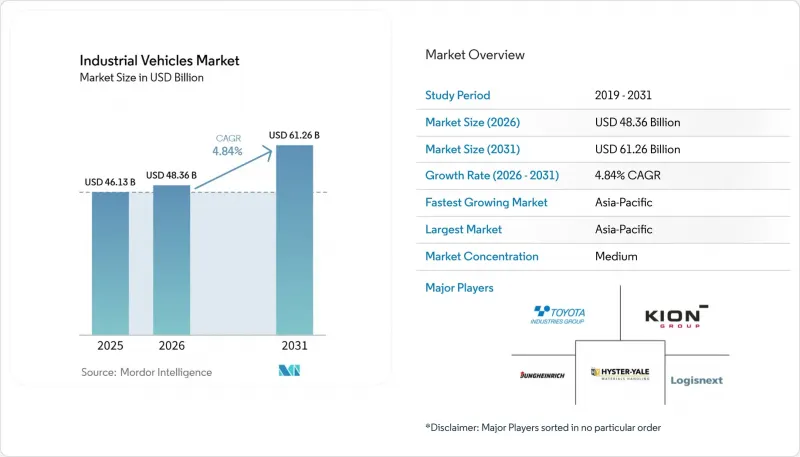
本報告按車輛類型(堆高機、牽引車等)、驅動系統(內燃機、電力等)、應用領域(製造、倉儲、其他)、重量等級(小型、中型、其他)、自動化程度(非自動化、半自動化、其他)和地區進行細分。市場預測以價值(美元)和銷售(台)為單位呈現。
全球工業車輛市場趨勢與洞察
倉儲業的繁榮是由電子商務推動的。
隨著線上訂單量屢創新高,企業對更高密度的倉儲、更快的揀貨速度和持續的履約週期提出了更高的要求,促使企業部署能夠在狹窄通道安全穿梭的電動前移式堆高機和自動化碼垛機。亞馬遜宣布,到2025年,將在其全球履約網路中部署超過一百萬台機器人,凸顯了其物料輸送業務的龐大規模。各大城市微型倉配中心的擴張進一步刺激了對緊湊型工業車輛解決方案的需求,這類解決方案將高吞吐量升降機與先進的視覺引導導航相結合。企業願意為能夠與倉庫管理軟體原生整合並確保即時庫存準確性的設備支付更高的價格。 「當日達」服務的標準化正在美國和亞太部分地區逐步確立,這推動了對下一代車輛車隊的投資,這些車輛能夠全天候運作且不排放廢氣,從而符合嚴格的室內空氣品質標準。
排放氣體法規正在加速電氣化進程。
加州的「零排放堆高機法規」禁止銷售新的內燃機關式堆高機,並強制逐步淘汰大型火花點火式堆高機,承諾在每台堆高機的整個生命週期內,為所有車輛帶來顯著的健康效益和成本降低。歐洲的「Fit for 55」計畫和中國的「Peak Out Carbon Neutrality」藍圖與加州的意圖相符,並正在推動鋰離子電池的普及。比亞迪的「Blade Battery」電池搭配FLASH充電器,可實現快速充電,使操作員能夠在輪班休息期間充電並淘汰備用電池。美國環保署(EPA)已恢復Tier 5排放標準的製定工作。同時,愛荷華州的「維修權」法案擴大了服務範圍,凸顯了在統一的電氣化過程中存在的監管差異。無法獲得從內燃機車輛轉型所需資金的企業將面臨資產過時和轉售價值下降的風險。
電動車和自動駕駛汽車的初始成本很高。
電動堆高機的價格遠高於內燃機堆高機,光是電池成本就可能大幅增加最終售價。價格上漲意味著,對於本就利潤微薄的業者而言,投資回收期將會延長。由於累計不確定性,客戶推遲了採購,Hister Yale公司報告銷售額下降並出現淨虧損。為了應對這些挑戰,該公司正在裁員,並力求長期降低年度成本。同時,那些難以為客戶提供融資或無法以低總擁有成本吸引客戶的製造商,則面臨著被價格極具競爭力的中國競爭對手搶佔市場佔有率的風險。
細分市場分析
到2025年,堆高機將佔工業車輛市場的40.15%,並繼續在通用物料搬運領域發揮核心作用。自動導引運輸車(AGV)雖然絕對值較小,但憑藉全天候運轉率和替代勞動力的經濟優勢,正以9.13%的複合年成長率成長。在全自動碼頭,貨櫃卡車的平均售價正在上漲。同時,牽引車正在開闢新的市場,主要用於機場地面支援作業。豐田、凱傲和永恆等老牌製造商正面臨堆高機銷售成長放緩的壓力,迫使它們進行創新,例如引入鋰離子電池和無線診斷功能。
中國AGV製造商,例如迅馳智行和VisionNav,正利用VNSLAM的精準性,提供極具競爭力的價格和更短的交付週期,對西方品牌構成挑戰。凱傲的IMOCO和QBIIK軟體凸顯了軟體層在提升整體設備效率(OEE)和創造硬體以外的未來價值方面日益成長的重要性。海斯特-耶魯的IDA自動駕駛卡車,透過將AI視覺、防碰撞和鋰離子電池等高階升級功能與編配軟體結合,可望將單車收益翻倍。
儘管預計到2025年內燃機仍將佔據工業車輛市場85.33%的佔有率,但電動車正以8.79%的速度成長,這得益於零排放法規和電池成本的下降。紐瓦克港訂購混合跨運機凸顯了港口混合動力系統日益普及的趨勢。同時,壓縮天然氣(CNG)堆高機在石化中心找到了市場需求,但基礎設施的限制阻礙了其廣泛應用。
比亞迪創新的“FLASH”充電器顯著縮短了待機時間。這種高效性使得即使是單電池車隊也能無縫應對多班次的需求。加州更嚴格的法規預計將進一步加速電動車的普及。這表明,即使經濟效益有限,法規也能對成長產生重大影響。缺乏完善的鋰離子電池產品組合的供應商將面臨市場落後的風險,錯失零售商和食品飲料製造商的競標,因為這些企業優先考慮室內零排放法規的合規性。
區域分析
預計到2025年,亞太地區將佔據工業車輛市場42.66%的佔有率,並在2031年之前以6.15%的年均成長率成長。中國AGV供應商憑藉其高精度的導航技術,正快速佔領食品雜貨、電子產品和跨境電商的履約中心市場。這一趨勢推動了杭叉的銷售,其電動堆高機在國內市場銷量顯著成長。在印度,與生產連結獎勵計畫吸引了大量外國直接投資,尤其是在智慧型手機和汽車零件領域。這些資金的湧入推動了倉庫的擴張。然而,不穩定的電力供應阻礙了鋰離子電池技術的應用,尤其是在一線城市以外的地區。同時,日本和韓國正在將物流整合到其「工業4.0」策略中。然而,豐田汽車公司正面臨挑戰,和解成本影響了其物料搬運業務的銷售,凸顯了該行業監管的脆弱性。
北美市場雖然規模較小,但卻佔據了高價位市場。這主要是由於加州嚴格的零排放法規以及即將實施的EPA Tier 5排放標準(提高了技術規格)。紐瓦克港正穩步推動電氣化,混合動力跨運機的交付已提上日程。大型零售商正面臨自動化程度有限的挑戰,沃爾瑪位於奧珀盧薩斯的工廠維修就是一個典型的例子。在歐洲,這一趨勢顯而易見。德國主導「工業4.0」計劃,凱傲(KION)的銷售額也表現強勁,儘管原物料價格飆升,訂單仍高達117.05億歐元。
儘管南美洲、中東和非洲在工業車輛市場佔有率中佔比較小,但它們蘊藏著豐富的新業務拓展機會。巴西蘇阿佩碼頭即將成為APM在拉丁美洲首個全面電氣化的港口,引進遠端操控起重機和電動堆場牽引車。蒙特利爾港在加拿大基礎設施銀行的支持下,正在擴大其康特雷庫爾碼頭設施,並大幅提升其標準箱(TEU)處理能力。同時,洛美貨櫃碼頭正在進行現代化改造,引進康尼起重機公司的「TruConnect」系統,用遠端監控的正面吊運機和空箱搬運設備替換原有設備。這表明,即使在銷售量相對較低的市場,數位化服務合約的採用率也在不斷提高。
其他好處:
- Excel格式的市場預測(ME)表
- 3個月的分析師支持
目錄
第1章:引言
- 市場分析與定義的前提條件
- 分析範圍
第2章 分析方法
第3章執行摘要
第4章 市場狀況
- 市場概覽
- 市場促進因素
- 受電子商務的推動,倉儲業蓬勃發展。
- 排放氣體法規正在加速電氣化進程。
- 面對人手不足,自動化和安全勢在必行
- 工業4.0物流整合
- 利用5G專用網路實現車輛編配。
- 「電池即服務」降低了資本投資門檻。
- 市場限制因素
- 電動車/自動駕駛汽車的初始成本較高
- 電池用金屬和半導體的供應瓶頸
- 互聯車隊的網路安全風險
- 地面品質對AGV/AMR導航的傳統限制
- 價值鍊和供應鏈分析
- 監理情勢
- 技術展望
- 波特五力分析
第5章:預測市場規模與成長率
- 按車輛類型
- 堆高機
- 牽引曳引機
- 貨櫃運輸卡車
- 工業曳引機
- 自動導引運輸車(AGV)
- 人員運輸車
- 剪式升降機
- 臂式升降機
- 其他
- 透過驅動系統
- 內燃機(ICE)
- 電的
- 混合
- CNG/LPG
- 透過使用
- 製造業
- 車
- 化學
- 食品/飲料
- 金屬和機械
- 倉庫
- 貨運/物流
- 建設業
- 農業
- 零售
- 其他
- 製造業
- 按體重類別
- 小型
- 中號
- 大的
- 按自動化級別
- 非自動
- 半自動
- 全自動
- 按地區
- 北美洲
- 美國
- 加拿大
- 其他北美國家
- 南美洲
- 巴西
- 阿根廷
- 其他南美國家
- 歐洲
- 英國
- 德國
- 西班牙
- 義大利
- 法國
- 俄羅斯
- 其他歐洲國家
- 亞太地區
- 印度
- 中國
- 日本
- 韓國
- 其他亞太國家
- 中東和非洲
- 阿拉伯聯合大公國
- 沙烏地阿拉伯
- 土耳其
- 埃及
- 南非
- 其他中東和非洲國家
- 北美洲
第6章 競爭情勢
- 市場集中度
- 策略趨勢
- 市佔率分析
- 公司簡介
- Toyota Industries Corporation
- KION Group AG
- Jungheinrich AG
- Mitsubishi Logisnext Co. Ltd.
- Hyster-Yale Materials Handling Inc.
- Crown Equipment Corporation
- BYD Company Ltd.
- Hangcha Group Co. Ltd.
- Komatsu Ltd.
- Doosan Industrial Vehicle Co. Ltd.
- Clark Material Handling Company
- Hyundai Construction Equipment Co.
- Caterpillar Inc.
- Raymond Corporation
- JCB Ltd.
第7章 市場機會與未來展望
According to Mordor Intelligence, the industrial vehicles market size is expected to increase from USD 46.13 billion in 2025 to USD 48.36 billion in 2026 and reach USD 61.26 billion by 2031, growing at a CAGR of 4.84% over 2026-2031.
This report is Segmented by Vehicle Type (Forklifts, Tow Tractors, and More), Propulsion Type (Internal Combustion Engine (ICE), Electric, and More), Application (Manufacturing, Warehousing, and More), Weight Category (Light Duty, Medium Duty, and More), Level of Autonomy (Non-Autonomous, Semi-Autonomous and More), and Geography. The Market Forecasts are Provided in Terms of Value (USD) and Volume (Units).
Global Industrial Vehicles Market Trends and Insights
E-commerce-Fueled Warehousing Boom
Record online-order volumes require denser storage, faster picking, and continuous fulfillment cycles, prompting operators to add electric reach trucks and autonomous pallet movers able to navigate narrow aisles safely. In 2025, Amazon announced the deployment of over 1 million robots in its worldwide fulfillment and logistics network, highlighting the vast scale of its material-handling operations. Micro-fulfillment nodes in major cities further stimulate demand for compact industrial vehicle solutions that combine high-throughput lifts with advanced vision-guided navigation. Operators pay premiums for equipment that integrates natively with warehouse-execution software, ensuring real-time inventory accuracy. Same-day delivery norms in the United States and parts of Asia-Pacific reinforce capital flows into next-generation fleets that can operate around the clock without emitting exhaust, thereby supporting stringent indoor-air-quality codes.
Emissions Regulations Accelerating Electrification
California's Zero-Emission Forklift Regulation bans new internal-combustion forklifts, phases out large-spark-ignition units, and projects significant health benefits alongside net fleet savings over each forklift's lifecycle. Europe's Fit for 55 package and China's dual-carbon roadmap echo California's intent, driving up lithium-ion adoption rates. BYD's Blade Battery, combined with FLASH chargers, enables quick pit stops, allowing operators to recharge during shift breaks and retire spare batteries. The Environmental Protection Agency reinitiated Tier 5 rulemaking. Concurrently, Iowa's right-to-repair statute broadens service access, highlighting regulatory divergence amidst a unified push for electrification . Operators unable to finance the shift from internal-combustion fleets face risks of stranded assets and declining resale values.
High Upfront Cost of Electric / Automated Vehicles
Electric forklifts command a significant premium over their internal-combustion counterparts, with batteries alone potentially adding substantial costs to the final bill. This price hike extends payback periods for operators already grappling with tight margins. Hyster-Yale reported a decline in sales, resulting in a net loss as customers postponed purchases amid macroeconomic uncertainties. In a bid to navigate these challenges, the company is reducing its workforce, targeting annual savings in the long term. Meanwhile, manufacturers that can't finance customers or showcase a lower total cost of ownership face the risk of losing market share to budget-friendly Chinese competitors.
Other drivers and restraints analyzed in the detailed report include:
- Automation and Safety Needs Amid Labor Shortages
- Battery-as-a-Service Lowering Capex Barriers
- Battery-Metal and Chip Supply Bottlenecks
For complete list of drivers and restraints, kindly check the Table Of Contents.
Segment Analysis
Forklifts generated 40.15% of the industrial vehicles market size in 2025, sustaining their central role in general material handling. Automated guided vehicles, though smaller in absolute dollars, are pacing at a 9.13% CAGR, benefiting from 24/7 uptime and labor substitution economics. At fully automated terminals, container-handling trucks have seen average selling prices rise. Meanwhile, tow tractors have carved out a niche, primarily serving airport ground support. Incumbents like Toyota Industries, KION, and Jungheinrich face pressure from stagnant forklift volumes, pushing them to innovate with lithium-ion integration and over-the-air diagnostics.
Chinese AGV manufacturers, such as Xunji Zhixing and VisionNav, utilize VNSLAM accuracy to offer competitive pricing and faster delivery cycles, challenging Western brands. KION's IMOCO and QBIIK software enhance overall equipment effectiveness, underscoring the growing importance of software layers in driving future value beyond hardware. Hyster-Yale's automated IDA truck combines AI vision, collision-avoidance, and lithium-ion batteries as premium upgrades, potentially doubling revenue per unit when bundled with orchestration software.
The industrial vehicles market share for internal-combustion engines stood at 85.33% in 2025, yet electrics are expanding at 8.79%, supported by zero-emission rules and falling battery costs. Port Newark has placed an order for hybrid straddle carriers, highlighting the growing trend of hybrid drivetrains in ports. While compressed natural gas forklifts find a niche in petrochemical hubs, infrastructure limitations hinder their broader adoption.
BYD's innovative FLASH charger significantly reduces idle time. This efficiency enables fleets with a single battery to seamlessly cater to multi-shift demands. California's regulatory push is set to further elevate electric vehicle adoption. This underscores the power of regulation in driving adoption, even when the economic benefits are marginal. Vendors lacking a robust lithium-ion lineup may find themselves sidelined, missing out on bids from retailers and food-and-beverage producers that prioritize indoor zero-emission compliance.
Complete Report Scope:
- By Vehicle Type
- Forklifts
- Tow Tractors
- Container Handling Trucks
- Industrial Tractors
- Automated Guided Vehicles (AGVs)
- Personnel Carriers
- Scissor Lifts
- Boom Lifts
- Others
- By Propulsion Type
- Internal Combustion Engine (ICE)
- Electric
- Hybrid
- CNG / LPG
- By Application
- Manufacturing
- Automotive
- Chemical
- Food and Beverages
- Metals and Machinery
- Warehousing
- Freight and Logistics
- Construction
- Agriculture
- Retail
- Others
- Manufacturing
- By Weight Category
- Light Duty
- Medium Duty
- Heavy Duty
- By Level of Autonomy
- Non-Autonomous
- Semi-Autonomous
- Fully Autonomous
- By Geography
- North America
- United States
- Canada
- Rest of North America
- South America
- Brazil
- Argentina
- Rest of South America
- Europe
- United Kingdom
- Germany
- Spain
- Italy
- France
- Russia
- Rest of Europe
- Asia-Pacific
- India
- China
- Japan
- South Korea
- Rest of Asia-Pacific
- Middle East and Africa
- United Arab Emirates
- Saudi Arabia
- Turkey
- Egypt
- South Africa
- Rest of Middle East and Africa
- North America
Geography Analysis
Asia-Pacific commanded 42.66% of the industrial vehicles market share in 2025 and is expected to grow at 6.15% through 2031. Chinese AGV vendors achieving high navigation accuracy are making significant inroads in grocery, electronics, and cross-border e-commerce fulfillment centers. This push has bolstered Hangcha's sales, moving a substantial number of electric forklifts domestically. In India, production-linked incentives are luring foreign direct investments, particularly in smartphones and auto parts. This influx is spurring warehouse expansions. However, the inconsistent grid power is hindering the adoption of lithium-ion technology, especially outside tier-1 cities. Meanwhile, Japan and South Korea are weaving intra-logistics into their Manufacturing 4.0 strategies. Yet, Toyota Industries faced a setback, with its materials-handling revenue dipping due to settlement costs, underscoring the industry's regulatory vulnerabilities.
North America may have a smaller market volume, but it commands premium pricing. This is largely due to California's stringent zero-emission rules and the anticipated EPA Tier 5 standards, which elevate technical specifications. Port Newark is taking strides towards electrification, with hybrid straddle carriers booked for delivery. Retail giants are pushing the envelope on automation, as evidenced by Walmart's retrofit in Opelousas. In Europe, the trend is unmistakable: Germany champions Industry 4.0 initiatives, and KION, even amidst raw-material inflation, sees its order intake surge to a notable EUR 11.705 billion, leading to strong revenue outcomes.
While South America, the Middle East, and Africa command a smaller share of the industrial vehicles market, they are ripe with green-field opportunities. Brazil's Suape terminal is set to become APM's inaugural fully electric port in Latin America, featuring remote-operated cranes and electric yard tractors. The Port of Montreal, with backing from the Canada Infrastructure Bank, is expanding its Contrecceur facility, adding significant TEU capacity. Meanwhile, Lome Container Terminal is modernizing with Konecranes' TruConnect, upgrading to remote-monitored reach stackers and empty-container handlers, highlighting the growing traction of digital service contracts, even in markets with modest unit sales volumes.
- Toyota Industries Corporation
- KION Group AG
- Jungheinrich AG
- Mitsubishi Logisnext Co. Ltd.
- Hyster-Yale Materials Handling Inc.
- Crown Equipment Corporation
- BYD Company Ltd.
- Hangcha Group Co. Ltd.
- Komatsu Ltd.
- Doosan Industrial Vehicle Co. Ltd.
- Clark Material Handling Company
- Hyundai Construction Equipment Co.
- Caterpillar Inc.
- Raymond Corporation
- JCB Ltd.
Additional Benefits:
- The market estimate (ME) sheet in Excel format
- 3 months of analyst support
TABLE OF CONTENTS
1 Introduction
- 1.1 Study Assumptions & Market Definition
- 1.2 Scope of the Study
2 Research Methodology
3 Executive Summary
4 Market Landscape
- 4.1 Market Overview
- 4.2 Market Drivers
- 4.2.1 E-commerce-Fueled Warehousing Boom
- 4.2.2 Emissions Regulations Accelerating Electrification
- 4.2.3 Automation and Safety Needs Amid Labor Shortages
- 4.2.4 Manufacturing 4.0 Integration of Intra-Logistics
- 4.2.5 5G Private Networks Enabling Fleet Orchestration
- 4.2.6 Battery-as-a-Service Lowering Capex Barriers
- 4.3 Market Restraints
- 4.3.1 High Upfront Cost of Electric / Automated Vehicles
- 4.3.2 Battery-Metal and Chip Supply Bottlenecks
- 4.3.3 Cyber-Security Risks in Connected Fleets
- 4.3.4 Legacy Floor Quality Limiting AGV/AMR Navigation
- 4.4 Value / Supply-Chain Analysis
- 4.5 Regulatory Landscape
- 4.6 Technological Outlook
- 4.7 Porter's Five Forces
- 4.7.1 Threat of New Entrants
- 4.7.2 Bargaining Power of Suppliers
- 4.7.3 Bargaining Power of Buyers
- 4.7.4 Threat of Substitutes
- 4.7.5 Competitive Rivalry
5 Market Size & Growth Forecasts (Value (USD) and Volume (Units))
- 5.1 By Vehicle Type
- 5.1.1 Forklifts
- 5.1.2 Tow Tractors
- 5.1.3 Container Handling Trucks
- 5.1.4 Industrial Tractors
- 5.1.5 Automated Guided Vehicles (AGVs)
- 5.1.6 Personnel Carriers
- 5.1.7 Scissor Lifts
- 5.1.8 Boom Lifts
- 5.1.9 Others
- 5.2 By Propulsion Type
- 5.2.1 Internal Combustion Engine (ICE)
- 5.2.2 Electric
- 5.2.3 Hybrid
- 5.2.4 CNG / LPG
- 5.3 By Application
- 5.3.1 Manufacturing
- 5.3.1.1 Automotive
- 5.3.1.2 Chemical
- 5.3.1.3 Food and Beverages
- 5.3.1.4 Metals and Machinery
- 5.3.2 Warehousing
- 5.3.3 Freight and Logistics
- 5.3.4 Construction
- 5.3.5 Agriculture
- 5.3.6 Retail
- 5.3.7 Others
- 5.3.1 Manufacturing
- 5.4 By Weight Category
- 5.4.1 Light Duty
- 5.4.2 Medium Duty
- 5.4.3 Heavy Duty
- 5.5 By Level of Autonomy
- 5.5.1 Non-Autonomous
- 5.5.2 Semi-Autonomous
- 5.5.3 Fully Autonomous
- 5.6 By Geography
- 5.6.1 North America
- 5.6.1.1 United States
- 5.6.1.2 Canada
- 5.6.1.3 Rest of North America
- 5.6.2 South America
- 5.6.2.1 Brazil
- 5.6.2.2 Argentina
- 5.6.2.3 Rest of South America
- 5.6.3 Europe
- 5.6.3.1 United Kingdom
- 5.6.3.2 Germany
- 5.6.3.3 Spain
- 5.6.3.4 Italy
- 5.6.3.5 France
- 5.6.3.6 Russia
- 5.6.3.7 Rest of Europe
- 5.6.4 Asia-Pacific
- 5.6.4.1 India
- 5.6.4.2 China
- 5.6.4.3 Japan
- 5.6.4.4 South Korea
- 5.6.4.5 Rest of Asia-Pacific
- 5.6.5 Middle East and Africa
- 5.6.5.1 United Arab Emirates
- 5.6.5.2 Saudi Arabia
- 5.6.5.3 Turkey
- 5.6.5.4 Egypt
- 5.6.5.5 South Africa
- 5.6.5.6 Rest of Middle East and Africa
- 5.6.1 North America
6 Competitive Landscape
- 6.1 Market Concentration
- 6.2 Strategic Moves
- 6.3 Market Share Analysis
- 6.4 Company Profiles (Includes Global Level Overview, Market Level Overview, Core Segments, Financials as Available, Strategic Information, Market Rank/Share for Key Companies, Products and Services, SWOT Analysis, and Recent Developments)
- 6.4.1 Toyota Industries Corporation
- 6.4.2 KION Group AG
- 6.4.3 Jungheinrich AG
- 6.4.4 Mitsubishi Logisnext Co. Ltd.
- 6.4.5 Hyster-Yale Materials Handling Inc.
- 6.4.6 Crown Equipment Corporation
- 6.4.7 BYD Company Ltd.
- 6.4.8 Hangcha Group Co. Ltd.
- 6.4.9 Komatsu Ltd.
- 6.4.10 Doosan Industrial Vehicle Co. Ltd.
- 6.4.11 Clark Material Handling Company
- 6.4.12 Hyundai Construction Equipment Co.
- 6.4.13 Caterpillar Inc.
- 6.4.14 Raymond Corporation
- 6.4.15 JCB Ltd.
7 Market Opportunities & Future Outlook
- 7.1 White-space & Unmet-Need Assessment

 全球氫動力重型機械市場規模、佔有率、趨勢和成長分析報告(2026-2034)
 2026-2030年全球氫燃料重型機械市場
 歐洲輕型商用車租賃:市場佔有率分析、產業趨勢與統計及成長預測(2026-2031 年)
 氫氣輔助重型機械市場分析及預測(至2035年):類型、產品、服務、技術、組件、應用、製程、最終用戶、安裝方式、設備氫動力重型機械市場規模、佔有率、成長、全球產業分析、區域趨勢及2026年至2034年預測。
 工業車輛市場-2026-2032年全球市場預測氫動力重型機械市場分析及預測(至2035年):依類型、產品、服務、技術、組件、應用、形式、材質、部署形式及最終用戶分類
 零排放重型設備市場:商業機會、成長要素、產業趨勢分析及2026-2035年預測工業用車輛市場分析與預測(至2035年):類型、產品、技術、組件、應用、最終用戶、功能、設備、解決方案
 全球商用車自排變速箱市場