


 |
市場調查報告書
商品編碼
2071347
零排放重型設備市場:商業機會、成長要素、產業趨勢分析及2026-2035年預測Zero-Emission Heavy Machinery Market Opportunity, Growth Drivers, Industry Trend Analysis, and Forecast 2026 - 2035 |
||||||

全球零排放重型設備市場預計到 2025 年將達到 150 億美元,年複合成長率為 17%,到 2035 年將達到 744 億美元。
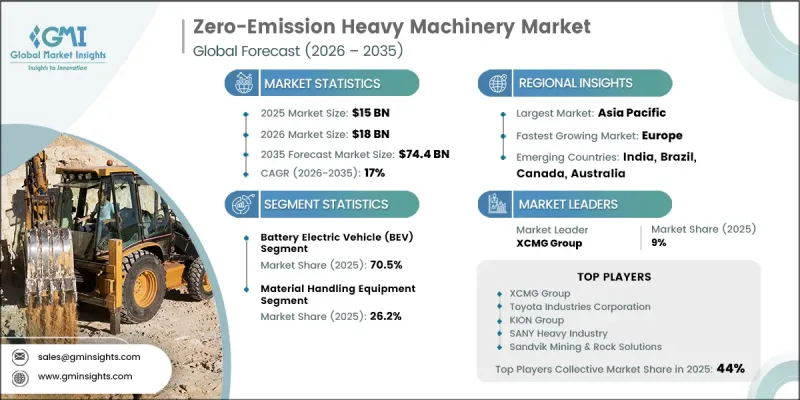
全球脫碳努力的協同推進、電池經濟性的提升以及電動重型機械在受監管工業應用中運營可行性的提高,共同推動了市場擴張。主要經濟體對非道路移動機械排放氣體的監管壓力日益加大,加速了從柴油車向零排放替代能源的轉型。歐盟針對非道路機械的第五階段排放標準十分嚴格,而一些歐洲國家已經對高排放環境下使用的建築和工業設備實施了更嚴格的採購要求。生命週期成本分析日益凸顯電動重型機械的優勢:更高的營運效率、更低的維護需求和更低的燃料依賴性,足以抵消其較高的初始投資成本,並在多年的服務週期中持續發揮作用。能源儲存系統、充電基礎設施和電動動力系統的不斷進步,進一步提升了零排放設備的商業性可行性,為全球各工業領域的市場長期持續成長奠定了基礎。
| 市場範圍 | |
|---|---|
| 開始年份 | 2025 |
| 預測期 | 2026-2035 |
| 上市時的市場規模 | 150億美元 |
| 預計金額 | 744億美元 |
| 複合年成長率 | 17% |
預計到2025年,電池式電動車(BEV)平台市佔率將達到70.5%,市場規模將達106億美元。 BEV系統的主導地位得益於鋰離子電池技術的成熟、成本效益的提升以及與中小型機械應用的兼容性。此外,BEV無需大規模充電基礎設施即可在標準輪班週期內高效運作,這進一步推動了其在各種工業應用場景中的普及。
物料輸送設備領域佔26.2%的市場佔有率,市場規模達39億美元。這一成長主要得益於電動堆高機、自動化倉庫搬運系統和港口物流機械等領域電氣化的快速普及。在這些應用中,運作模式與電池充電週期完美匹配。可預測的使用計畫、室內運作環境以及物流基礎設施自動化程度的提高,都使這些應用受益於電氣化。
到2025年,北美零排放重型設備市場將佔全球市場佔有率的20%,規模達30億美元。美國是推動區域需求成長的主要力量,這得益於非道路機械排放氣體法規的進步以及清潔建築和工業設備的日益普及。非道路排放法規的持續排放氣體持續推動車輛現代化,建築、採礦和物流行業的柴油動力機械正被電動機械所取代。
目錄
第1章:調查方法
第2章執行摘要
第3章 行業洞察
- 產業生態系分析
- 影響價值鏈的因素
- 利潤率分析
- 中斷
- 前景
- 製造商
- 中斷
- 供應商情況
- 主要新聞和舉措
- 技術與創新展望
- 監理情勢
- 影響因素
- 促進因素
- 產業潛在風險與挑戰
- 機會
- 2025年價格分析
- 2022-2025年歷史價格趨勢分析
- 依球員類型分類的定價策略(高級球員、超值球員、成本加成球員)
- 區域價格波動分析
- 成長潛力分析
- 波特的分析
- PESTLE分析
- 貿易數據分析
- 進出口量及進口額趨勢
- 主要貿易路線及關稅的影響
- 人工智慧和生成式人工智慧對市場的影響
- 利用人工智慧改造現有經營模式
- 按細分市場分類的生成式人工智慧用例和部署藍圖
- 風險、限制和監管考量
- 生產能力和生產情況
- 設備產能:按地區和主要生產商分類
- 運轉率和擴張計劃
第4章 競爭情勢
- 介紹
- 企業市佔率分析
- 競爭定位矩陣
- 戰略展望矩陣
- 主要市場公司的競爭分析
- 主要進展
- 併購
- 夥伴關係和聯盟
- 新產品發布
- 業務拓展計劃
第5章 市場估計與預測:依類型分類,2022-2035年
- 電池式電動車(BEV)
- 氫燃料電池(FCEV)
- 插電式混合動力車(PHEV)
- 其他(新興動力傳動系統)
第6章 市場估計與預測:依機械類型分類,2022-2035年
- 土方工程及挖掘設備
- 運輸及傾卸設備
- 物料輸送設備
- 升降平台設備
- 挖掘和地基工程設備
- 其他(攪拌機、攤舖機、壓路機、滾筒、清掃機)
第7章 市場估計與預測:依應用領域分類,2022-2035年
- 建造
- 礦業
- 港口和物流碼頭
- 農業
- 產業和地方政府
- 其他(林業、國防、特種越野)
第8章 市場估算與預測:依電池容量分類,2022-2035年
- 小於 50 千瓦時
- 50 kWh~200 kWh
- 200 kWh~500 kWh
- 超過 500 千瓦時
第9章 市場估價與預測:依通路分類,2022-2035年
- OEM直銷
- 經銷商和經銷商網路
- 租賃/出租
- 線上和電子商務平台
第10章 估價與預測:按地區分類,2022-2035年
- 北美洲
- 美國
- 加拿大
- 歐洲
- 德國
- 英國
- 法國
- 義大利
- 西班牙
- 亞太地區
- 中國
- 印度
- 日本
- 韓國
- 澳洲
- 拉丁美洲
- 巴西
- 墨西哥
- 阿根廷
- 中東和非洲
- UAE
- 沙烏地阿拉伯
- 南非
第11章:公司簡介
- 世界公司
- Caterpillar Inc.
- Komatsu Ltd.
- Volvo Construction Equipment
- Epiroc AB
- Sandvik AB
- Liebherr Group
- SANY Heavy Industry
- XCMG Group
- JCB Ltd.
- CATL
- Toyota Industries Corporation
- KION Group
- 當地公司
- Ballard Power Systems Inc.
- Terex Corporation
- Hyster-Yale Group, Inc.
- Wacker Neuson SE
- CNH Industrial
- Allison Transmission
- 新興企業
- Forsee Power
- Kreisel Electric GmbH & Co KG
- PowerCell Group AB
The Global Zero-Emission Heavy Machinery Market was valued at USD 15 billion in 2025 and is estimated to grow at a CAGR of 17% to reach USD 74.4 billion in 2035.
Market expansion is driven by the alignment of global decarbonization mandates, improving battery economics, and increasing operational viability of electrified heavy equipment in regulated industrial applications. Regulatory pressure on non-road mobile machinery emissions has intensified across major economies, accelerating the replacement of diesel-based fleets with zero-emission alternatives. The European Union's Stage V standards for non-road machinery have established a strict baseline, while several European countries have already implemented even more stringent procurement requirements for construction and industrial equipment used in high-emission environments. Lifecycle cost analysis increasingly favors electric heavy machinery as operating efficiency gains, reduced maintenance requirements, and lower fuel dependency offset higher upfront capital costs over multi-year usage cycles. The ongoing evolution of energy storage systems, charging infrastructure, and electrified drivetrains continues to strengthen the commercial feasibility of zero-emission equipment, positioning the market for sustained long-term expansion across global industrial sectors.
| Market Scope | |
|---|---|
| Start Year | 2025 |
| Forecast Year | 2026-2035 |
| Start Value | $15 Billion |
| Forecast Value | $74.4 Billion |
| CAGR | 17% |
The battery electric vehicle (BEV) platforms segment held a 70.5% share, representing USD 10.6 billion in 2025. The leadership of BEV systems is supported by the maturity of lithium-ion battery technology, cost efficiency improvements, and compatibility with compact and mid-sized machinery applications. Their ability to operate effectively within standard shift cycles without requiring extensive charging infrastructure has further strengthened adoption across industrial use cases.
The material handling equipment segment held a 26.2% share, generating USD 3.9 billion. Growth is driven by strong adoption of electric forklifts, automated warehouse transport systems, and port logistics machinery, where operational patterns align effectively with battery charging cycles. These applications benefit from electrification due to predictable usage schedules, indoor operation environments, and increasing automation in logistics infrastructure.
North America Zero-Emission Heavy Machinery Market accounted for 20% share in 2025, representing USD 3 billion. The United States leads regional demand, supported by evolving emissions regulations for off-road machinery and increasing adoption of clean construction and industrial equipment. Regulatory frameworks governing non-road emissions continue to drive fleet modernization, encouraging the replacement of diesel-powered machinery with electric alternatives across construction, mining, and logistics operations.
Major companies operating in the global zero-emission heavy machinery market include Volvo Construction Equipment, Komatsu Ltd., Caterpillar Inc., CNH Industrial, XCMG Group, SANY Heavy Industry, Liebherr Group, JCB Ltd., Sandvik AB, Terex Corporation, Epiroc AB, Wacker Neuson SE, Hyster-Yale Group, Inc., Toyota Industries Corporation, KION Group, CATL, Allison Transmission, Forsee Power, Ballard Power Systems Inc., PowerCell Group AB, and Kreisel Electric GmbH & Co KG. Companies operating in the zero-emission heavy machinery market are adopting multiple strategic approaches to strengthen their market position and accelerate adoption. A primary focus is the development of advanced battery-electric and hybrid powertrain systems designed to improve operational efficiency and reduce the total cost of ownership. Manufacturers are also investing heavily in battery technology partnerships and in-house energy storage development to enhance performance and extend equipment runtime. Expansion of charging infrastructure ecosystems and modular energy solutions is another key strategy aimed at improving deployment flexibility across construction and mining sites. Companies are increasingly prioritizing fleet integration capabilities, digital monitoring systems, and predictive maintenance tools to enhance equipment lifecycle management.
Table of Contents
Chapter 1 Research Methodology
- 1.1 Research approach
- 1.2 Quality Commitments
- 1.2.1 GMI AI policy & data integrity commitment
- 1.2.1.1 Source consistency protocol
- 1.2.1 GMI AI policy & data integrity commitment
- 1.3 Research Trail & Confidence Scoring
- 1.3.1 Research Trail Components
- 1.3.2 Scoring Components
- 1.4 Data Collection
- 1.4.1 Partial list of primary sources
- 1.5 Data mining sources
- 1.5.1 Paid sources
- 1.5.1.1 Sources, by region
- 1.5.1 Paid sources
- 1.6 Base estimates and calculations
- 1.6.1 Base year calculation for any one approach
- 1.7 Forecast model
- 1.7.1 Quantified market impact analysis
- 1.7.1.1 Mathematical impact of growth parameters on forecast
- 1.7.1 Quantified market impact analysis
- 1.8 Research transparency addendum
- 1.8.1 Source attribution framework
- 1.8.2 Quality assurance metrics
- 1.8.3 Our commitment to trust
Chapter 2 Executive Summary
- 2.1 Industry 360° synopsis, 2022 - 2035
- 2.2 Key market trends
- 2.2.1 Regional
- 2.2.2 Type
- 2.2.3 Machinery Type
- 2.2.4 Battery Capacity
- 2.2.5 Application
- 2.2.6 Distribution Channel
Chapter 3 Industry Insights
- 3.1 Industry ecosystem analysis
- 3.1.1 Factor affecting the value chain
- 3.1.2 Profit margin analysis
- 3.1.3 Disruptions
- 3.1.4 Future outlook
- 3.1.5 Manufacturers
- 3.1.6 Distributors
- 3.2 Supplier landscape
- 3.3 Key news & initiatives
- 3.4 Technology & Innovation Landscape
- 3.5 Regulatory landscape
- 3.6 Impact on forces
- 3.6.1 Growth drivers
- 3.6.2 Industry pitfalls & challenges
- 3.6.3 Opportunities
- 3.7 Pricing analysis, 2025 (driven by primary research)
- 3.7.1 Historical price trend analysis (2022-2025)
- 3.7.2 Pricing strategy by player type (premium/value/cost-plus)
- 3.7.3 Regional price variation analysis
- 3.8 Growth potential analysis
- 3.9 Porter's analysis
- 3.10 PESTEL analysis
- 3.11 Trade data analysis (driven by paid database)
- 3.11.1 Import/export volume & value trends (Driven by Primary Research)
- 3.11.2 Key trade corridors & tariff impact (Driven by Primary Research)
- 3.12 Impact of AI & generative AI on the market
- 3.12.1 AI-driven disruption of existing business models
- 3.12.2 GenAI use cases & adoption roadmap by segment
- 3.12.3 Risks, limitations & regulatory considerations
- 3.13 Capacity & Production Landscape (Driven by Primary Research)
- 3.13.1 Installed Capacity by Region & Key Producer (Driven by Primary Research)
- 3.13.2 Capacity Utilization Rates & Expansion Pipelines (Driven by Primary Research)
Chapter 4 Competitive Landscape, 2025
- 4.1 Introduction
- 4.2 Company market share analysis
- 4.3 Competitive positioning matrix
- 4.4 Strategic outlook matrix
- 4.5 Competitive analysis of major market players
- 4.6 Key developments
- 4.6.1 Mergers & acquisitions
- 4.6.2 Partnerships & collaborations
- 4.6.3 New product launches
- 4.6.4 Expansion plans
Chapter 5 Market Estimates & Forecast, By Type, 2022 - 2035, (USD Billion) (Thousand Units)
- 5.1 Key trends
- 5.2 Battery Electric Vehicle (BEV)
- 5.3 Hydrogen Fuel Cell (FCEV)
- 5.4 Plug-in Hybrid (PHEV)
- 5.5 Others (Emerging Powertrains)
Chapter 6 Market Estimates & Forecast, By Machinery Type, 2022 - 2035, (USD Billion) (Thousand Units)
- 6.1 Key trends
- 6.2 Earthmoving & Excavation Equipment
- 6.3 Haulage & Dumping Equipment
- 6.4 Material Handling Equipment
- 6.5 Lifting & Access Equipment
- 6.6 Drilling & Foundation Equipment
- 6.7 Others (Mixers, Pavers, Compactors, Rollers, Sweepers)
Chapter 7 Market Estimates & Forecast, By Application, 2022 - 2035, (USD Billion) (Thousand Units)
- 7.1 Key trends
- 7.2 Construction
- 7.3 Mining
- 7.4 Ports & Logistics Terminals
- 7.5 Agriculture
- 7.6 Industrial & Municipal
- 7.7 Others (Forestry, Defense, Specialized Off-Highway)
Chapter 8 Market Estimates & Forecast, By Battery Capacity, 2022 - 2035, (USD Billion) (Thousand Units)
- 8.1 Key trends
- 8.2 Less Than 50 kWh
- 8.3 50 kWh to 200 kWh
- 8.4 200 kWh to 500 kWh
- 8.5 More Than 500 kWh
Chapter 9 Market Estimates & Forecast, By Distribution Channel, 2022 - 2035, (USD Billion) (Thousand Units)
- 9.1 Key trends
- 9.2 OEM Direct Sales
- 9.3 Dealer & Distributor Network
- 9.4 Rental & Leasing
- 9.5 Online & E-Commerce Platforms
Chapter 10 Estimates & Forecast, By Region, 2022 - 2035, (USD Billion) (Million Units)
- 10.1 Key trends
- 10.2 North America
- 10.2.1 U.S.
- 10.2.2 Canada
- 10.3 Europe
- 10.3.1 Germany
- 10.3.2 U.K.
- 10.3.3 France
- 10.3.4 Italy
- 10.3.5 Spain
- 10.4 Asia Pacific
- 10.4.1 China
- 10.4.2 India
- 10.4.3 Japan
- 10.4.4 South Korea
- 10.4.5 Australia
- 10.5 Latin America
- 10.5.1 Brazil
- 10.5.2 Mexico
- 10.5.3 Argentina
- 10.6 MEA
- 10.6.1 UAE
- 10.6.2 Saudi Arabia
- 10.6.3 South Africa
Chapter 11 Company Profiles (Business Overview, Financial Data, Product Landscape, Strategic Outlook, SWOT Analysis)
- 11.1 Global players
- 11.1.1 Caterpillar Inc.
- 11.1.2 Komatsu Ltd.
- 11.1.3 Volvo Construction Equipment
- 11.1.4 Epiroc AB
- 11.1.5 Sandvik AB
- 11.1.6 Liebherr Group
- 11.1.7 SANY Heavy Industry
- 11.1.8 XCMG Group
- 11.1.9 JCB Ltd.
- 11.1.10 CATL
- 11.1.11 Toyota Industries Corporation
- 11.1.12 KION Group
- 11.2 Regional players
- 11.2.1 Ballard Power Systems Inc.
- 11.2.2 Terex Corporation
- 11.2.3 Hyster-Yale Group, Inc.
- 11.2.4 Wacker Neuson SE
- 11.2.5 CNH Industrial
- 11.2.6 Allison Transmission
- 11.3 Emerging players
- 11.3.1 Forsee Power
- 11.3.2 Kreisel Electric GmbH & Co KG
- 11.3.3 PowerCell Group AB

 工業車輛市場-2026-2032年全球市場預測
 氫動力重型機械市場分析及預測(至2035年):依類型、產品、服務、技術、組件、應用、形式、材質、部署形式及最終用戶分類工業用車輛市場分析與預測(至2035年):類型、產品、技術、組件、應用、最終用戶、功能、設備、解決方案
 全球商用車自排變速箱市場
 商用車半導體市場-全球產業規模、佔有率、趨勢、機會與預測:按組件類型、應用類型、地區和競爭對手分類,2021-2031年
 2026年全球深層土壤攪拌設備市場報告
 工業車輛市場機會、成長要素、產業趨勢分析及2026-2035年預測
 工業車輛市場規模、佔有率和成長分析:按產品類型、推進系統、應用和地區分類-2026-2033年產業預測全球二手車市場:機會與策略展望(至2035年)
 清潔車輛市場:按類型、最終用戶、地區分類