


 |
市場調查報告書
商品編碼
2117409
行動車輛維修服務:市場佔有率分析、產業趨勢與統計、成長預測(2026-2031)Mobile Vehicle Repair Service - Market Share Analysis, Industry Trends & Statistics, Growth Forecasts (2026 - 2031) |
||||||

※ 本網頁內容可能與最新版本有所差異。詳細情況請與我們聯繫。
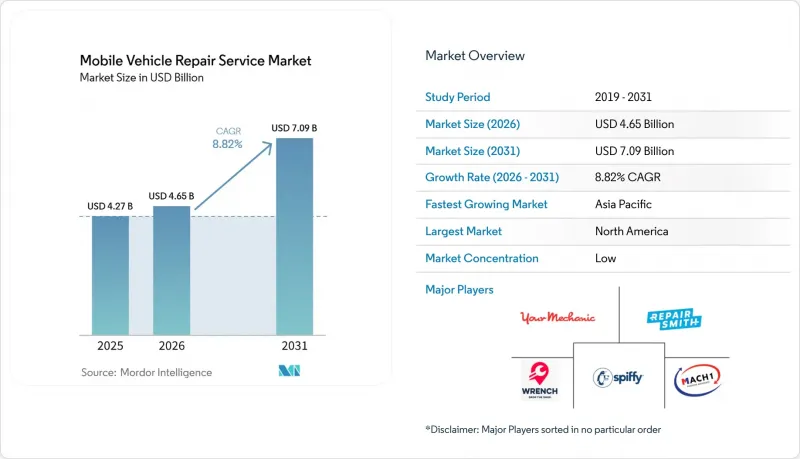
根據 Mordor Intelligence 預測,行動車輛維修服務市場預計將從 2025 年的 42.7 億美元成長到 2026 年的 46.5 億美元,到 2031 年達到 70.9 億美元,2026 年至 2031 年的複合年成長率預計為 8.82%。
本報告按車輛類型(摩托車等)、驅動系統(內燃機、電動)、服務類型(日常維護、診斷服務等)、零件類型(電池等)、服務供應商(原始設備製造商等)、最終用戶(個人等)和地區進行細分。市場預測以美元計價。
全球移動車輛維修服務市場趨勢與洞察
隨著車輛老化,維修保養需求也增加。
隨著車輛平均使用壽命的延長,維修頻率也隨之增加,這催生了對能夠現場解決問題的行動維修服務提供者日益成長的需求。維護老舊車輛的成本遠高於維護新車,因此車主傾向於選擇預防性維護訂閱服務來降低意外支出。在北美和歐洲等地區,由於供不應求和新車價格上漲的影響尤其顯著,對這類服務的需求正在急劇成長,從而延長了車輛的更換週期。移動服務車輛能夠有效率地處理電池和冷卻系統故障等常見問題,從而避免救援車費用,最大限度地減少營運損失,並提高客戶忠誠度。因此,那些以單一月費提供預防性維護和緊急應變的平台,能夠為每位用戶創造更高的終身價值。
消費者往往優先考慮便利性和現場服務。
在印度,相當一部分都市區車主正選擇數位化驅動的按需服務,這一趨勢在美國和德國也同樣存在,這些國家的主流應用程式能夠提供快速回應。忙碌的雙薪家庭和零工經濟從業者正從耗時的實體店購物轉向高效的街頭服務。這種轉變提高了用戶的複購率。透明的定價、即時GPS追蹤和即時電子收據等功能正在建立用戶信任。因此,服務供應商能夠有效消除出遊帶來的低效環節,同時也能設定比傳統實體店更高的價格。
移動維修服務合格技術人員短缺
許多維修店在吸引人才方面面臨挑戰,因為工傷賠償的成長速度跟不上薪資水準的上漲。日益成長的技術純熟勞工需求加劇了這個問題,使得維修店越來越難以吸引和留住人才。這種薪資差距阻礙了新人才進入該領域,並限制了行動維修服務業務的擴張潛力。隨著勞動力老化和預計退休人數的增加,各平台都在致力於學徒計劃和股權激勵計劃等舉措,以加強人才儲備。雖然這些舉措可能會減緩短期內的區域擴張速度,但其目標是建立永續的長期發展結構。
細分市場分析
預計到2025年,乘用車銷量將佔總銷量的53.47%,反映出龐大的車輛保有量,但由於新車型的維修保養需求下降,成長正在放緩。商用車預計將以8.87%的複合年成長率成長,這主要得益於電子商務和共享出行車隊將行動汽車維修服務納入營運預算,以應對緊張的交付週期。
Zenith與亞馬遜合作,旨在提高整個貨車車隊的運轉率,這凸顯了透過外包車輛管理來提高資產利用率的優勢。在人口稠密的亞洲都市區,摩托車正在開闢一個成長迅速的細分市場,而摩托車外送司機則依靠便利的路邊維修服務來維持收入。移動車輛維修服務市場正在不斷發展。個人車主偶爾會出於方便的目的使用這項服務,而車隊營運商則開始簽訂與運轉率指標掛鉤的長期合約。提供企業級控制面板、統一計費和現場夜班人員配備等服務的供應商正在擴大其在商業市場的佔有率。
由於內燃機汽車保有量龐大,預計到2025年,內燃機汽車仍將佔移動車輛維修服務收入的66.28%,繼續構成移動車輛維修服務市場佔有率的基礎。然而,在政府強制推行零排放銷售政策和電池成本下降的推動下,電動車的需求正以9.92%的複合年成長率成長。雖然由於換油頻率降低,車輛到店維修次數將會減少,但高壓診斷、因車輛總重增加而導致的輪胎磨損以及軟體更新等服務正在創造新的收入來源。通用汽車利用BrightDrop電動廂型車在全國推廣的「MobileService+」服務,展現了汽車製造商如何將電動車特有的挑戰(例如續航里程問題)轉化為獲利機會。
隨著電氣化進程的推進,那些對技術人員進行高壓安全再培訓、投資可攜式直流充電器並儲備電池健康度(SOH)分析儀的企業,將在行動車輛維修服務市場中佔據優勢。同時,那些仍專注於換油服務的企業將面臨收入下滑的風險。
區域分析
北美地區人事費用高昂(行動維修服務的平均時薪為 160 美元),且遠端資訊處理技術廣泛應用,支援預測性維護工作流程,預計到 2025 年,該地區將佔全球收入的 42.18%。雖然通用汽車的「MobileService+」等原始設備製造商 (OEM) 的舉措擴大了行動汽車維修服務訂閱套餐的潛在市場,但技術人員短缺正在減緩區域推廣的步伐。車輛老化和城市向郊區擴張推動了行動維修服務的便利性,但加州更嚴格的排放氣體測試增加了柴油服務車的合規成本。
亞太地區預計將以8.91%的複合年成長率成長,這主要得益於印度高度數位化的都市區、中國龐大的汽車保有量以及日本不斷成長的電動車維修需求。印度本土公司GoMechanic已在多個二線城市設立服務點。該公司將固定維修店與移動維修車結合,專門服務那些空間有限、難以容納傳統升降機的地區。與此同時,汽車製造商和全球供應商正在日本建立加盟網路,重點關注快速成長且潛力巨大的電動車維修市場。這些努力共同推動了全部區域移動汽車維修服務的普及。
歐洲為改善空氣品質所做的努力既帶來了機遇,也帶來了挑戰。倫敦的政策強制要求貨車電動化,但符合標準的業者將獲得許多優惠,例如無限次進入市中心。阿姆斯特丹的目標是實現服務車輛零排放。總部位於英國的ClickMechanic平台已展現出在成熟市場中擴充性的潛力,並透過將大量認證技師整合到統一的預約系統中,實現了顯著的收入成長。儘管拉丁美洲和海灣地區的市場仍未充分開發,但巴西、阿根廷、阿拉伯聯合大公國和沙烏地阿拉伯等國的汽車保有量和車輛數量正在顯著成長。能夠根據當地習俗調整定價和支付策略的業者將更有可能從中獲益。
其他好處:
- Excel格式的市場預測(ME)表
- 3個月的分析師支持
目錄
第1章:引言
- 市場分析與定義的前提條件
- 分析範圍
第2章 分析方法
第3章執行摘要
第4章 市場狀況
- 市場概覽
- 市場促進因素
- 由於車輛老化,維修需求不斷增加。
- 消費者偏好便利性與現場服務
- 聯網汽車遠端資訊處理技術的發展使得遠距離診斷。
- 電子商務和最後一公里配送企業將車輛管理外包。
- 城市地區強制設立低排放「維修區」。
- 面向電動車網約車車隊的訂閱式行動維護套餐
- 市場限制因素
- 移動維修服務合格技術人員短缺
- 電池式電動車的維護需求低
- 城市關於路邊作業區域的規定
- 遠距離診斷平台中的網路安全責任
- 價值鍊和供應鏈分析
- 監理情勢
- 技術展望
- 波特五力分析
第5章:預測市場規模與成長率
- 按車輛類型
- 摩托車
- 搭乘用車
- 商用車輛
- 透過驅動系統
- 內燃機(ICE)
- 電的
- 按服務類型
- 定期維護
- 診斷服務
- 緊急維修
- 其他服務(輪胎服務等)
- 按組件類型
- 電池
- 胎
- 煞車和煞車系統
- 其他部件(例如引擎)
- 透過服務供應商
- OEM(汽車製造商)
- 第三方服務供應商
- 最終用戶
- 個人
- 車隊車主
- 按地區
- 北美洲
- 美國
- 加拿大
- 其他北美國家
- 南美洲
- 巴西
- 阿根廷
- 其他南美國家
- 歐洲
- 德國
- 英國
- 西班牙
- 義大利
- 法國
- 荷蘭
- 其他歐洲國家
- 亞太地區
- 印度
- 中國
- 日本
- 韓國
- 印尼
- 其他亞太國家
- 中東和非洲
- 阿拉伯聯合大公國
- 沙烏地阿拉伯
- 土耳其
- 埃及
- 南非
- 其他中東和非洲國家
- 北美洲
第6章 競爭情勢
- 市場集中度
- 策略趨勢
- 市佔率分析
- 公司簡介
- YourMechanic
- Wrench Inc.
- RepairSmith
- Get Spiffy
- Mach1 Services
- Pep Boys
- AAA Roadside & Mobile
- Jiffy Lube Fleet Services
- Firestone Complete Auto Care Mobile
- GoMechanic
- Pitstop
- AutoNation Mobile Service
- Bosch Car Service
- Meineke Car Care Centers
- Mister Mobile
- Lube Mobile
- ClickMechanic
第7章 市場機會與未來展望
According to Mordor Intelligence, the mobile automotive repair services market size is expected to increase from USD 4.27 billion in 2025 to USD 4.65 billion in 2026 and reach USD 7.09 billion by 2031, growing at a CAGR of 8.82% over 2026-2031.
This report is Segmented by Vehicle Type (Two-Wheelers and More), Propulsion Type (Internal Combustion Engine and Electric), Service Type (Routine Maintenance, Diagnostic Services, and More), Component Type (Batteries and More), Service Provider (Original Equipment Manufacturer and More), End-User (Individual and More), and Geography. The Market Forecasts are Provided in Terms of Value (USD).
Global Mobile Vehicle Repair Service Market Trends and Insights
Aging Vehicle Parc Boosts Maintenance Demand
The average age of vehicles has increased, leading to more frequent repairs and driving demand for mobile operators who can address issues on-site. Maintaining older vehicles is significantly more expensive than maintaining newer ones, prompting owners to choose preventive maintenance subscriptions to manage unexpected expenses. Regions such as North America and Europe, affected by supply shortages and rising new-vehicle prices, have experienced a noticeable increase in demand for these services, extending vehicle replacement cycles. Common issues, such as battery or cooling system failures, are efficiently handled by mobile vans, eliminating towing costs and minimizing lost work hours, which enhances customer loyalty. As a result, platforms that offer both preventive and emergency coverage under a single monthly fee are capturing greater lifetime value from each user.
Consumer Preference For Convenience and On-Site Service
A significant portion of urban car owners in India are opting for digital doorstep services, a trend also observed in the U.S. and Germany, where leading apps provide quick response times. Busy dual-income households and gig-economy drivers are replacing lengthy shop visits with efficient curbside services. This shift has resulted in higher repeat purchase rates. Features such as transparent pricing, real-time GPS tracking, and instant digital receipts have strengthened user trust. Consequently, service providers can charge premiums over traditional brick-and-mortar shops while effectively addressing travel inefficiencies.
Shortage of Certified Mobile Technicians
Many repair shops are grappling with staffing challenges, as worker compensation struggles to keep pace with changing rates. This issue has been exacerbated by a growing demand for skilled labor, making it increasingly difficult for repair shops to attract and retain qualified workers . This wage gap discourages new talent from entering the field and limits the potential for mobile expansion. With an aging workforce and a wave of retirements expected, platforms are focusing on initiatives such as apprenticeships and equity incentives to strengthen their labor pipelines. These efforts may delay immediate geographic expansion but aim to build sustainable long-term capacity.
Other drivers and restraints analyzed in the detailed report include:
- Growth of Connected-Car Telematics Enabling Remote Diagnostics
- Fleet Outsourcing By E-Commerce and Last-Mile Operators
- Lower Maintenance Needs of Battery-Electric Vehicles
For complete list of drivers and restraints, kindly check the Table Of Contents.
Segment Analysis
Passenger cars held 53.47% of 2025 revenue, reflecting a vast installed base, though growth lags as newer models demand fewer services. Commercial vehicles are forecast to expand at an 8.87% CAGR, propelled by e-commerce and ride-hailing fleets that embed mobile automotive repair services into operating budgets amid tight delivery schedules.
Zenith's collaboration with Amazon to improve uptime across its fleet of vans highlights the asset utilization benefits of fleet outsourcing. In densely populated Asian cities, two-wheelers carve out a niche growth segment, with scooter couriers depending on quick roadside repairs to sustain their income. The mobile automotive repair services market is evolving: individual owners opt for occasional convenience visits, whereas fleets secure long-term contracts linked to uptime metrics. Providers offering enterprise dashboards, consolidated billing, and night-shift crews at depots are seizing a larger slice of the commercial pie.
Internal-combustion units accounted for 66.28% of 2025 revenue, still anchoring the mobile automotive repair services market share, due to the legacy parc size. Electric-vehicle demand, however, is rising at a 9.92% CAGR as governments mandate zero-emission sales and battery costs fall. Reduced fluid-change frequency lowers visit counts, yet high-voltage diagnostics, tire wear from heavier curb weights, and software updates create new revenue lanes. GM's nationwide MobileService+-delivered by BrightDrop electric vans-illustrates how OEMs are monetizing EV-specific pain points such as range-anxiety rescue.
Operators that retrain technicians in high-voltage safety, invest in portable DC chargers, and stock battery-state-of-health analyzers will hold the strongest position in the mobile automotive repair services market as electrification advances. Those that cling to an oil-change-centric offering risk revenue erosion.
Complete Report Scope:
- By Vehicle Type
- Two-Wheelers
- Passenger Cars
- Commercial Vehicles
- By Propulsion Type
- Internal Combustion Engine (ICE)
- Electric
- By Service Type
- Routine Maintenance
- Diagnostic Services
- Emergency Repairs
- Others (Tire Services, etc.)
- By Component Type
- Batteries
- Tires
- Brakes and Braking Systems
- Other Components (Engine, etc.)
- By Service Provider
- Original Equipment Manufacturer (OEM)
- Third-Party Service Providers
- By End-User
- Individual
- Fleet Owners
- By Geography
- North America
- United States
- Canada
- Rest of North America
- South America
- Brazil
- Argentina
- Rest of South America
- Europe
- Germany
- United Kingdom
- Spain
- Italy
- France
- Netherlands
- Rest of Europe
- Asia-Pacific
- India
- China
- Japan
- South Korea
- Indonesia
- Rest of Asia-Pacific
- Middle-East and Africa
- United Arab Emirates
- Saudi Arabia
- Turkey
- Egypt
- South Africa
- Rest of Middle-East and Africa
- North America
Geography Analysis
North America contributed 42.18% of 2025 revenue, buoyed by high labor rates-median USD 160 per mobile billable hour-and widespread telematics penetration, which feeds predictive maintenance workflows. OEM initiatives such as GM's MobileService+ have widened the addressable market for mobile automotive repair services subscription packages, while technician shortages temper the speed of geographic rollout. Aging vehicles and suburban sprawl favor mobile convenience, though stricter California emissions inspections raise compliance costs for diesel service vans.
Asia-Pacific will advance at an 8.91% CAGR, propelled by India's digitally savvy urban population, China's vast parc of vehicles, and Japan's growing demand for EV maintenance. GoMechanic, a local player, has established service hubs in multiple Tier-II cities across India. They have combined fixed workshops with mobile vans, targeting neighborhoods where traditional lift-bay real estate is limited. Meanwhile, OEMs and global suppliers are setting up franchise networks in Japan, focusing on the expanding EV maintenance market, which is expected to grow significantly. Collectively, these efforts are increasing the availability of mobile automotive repair services throughout the region.
Europe's clean-air initiatives bring both opportunities and challenges. London's policies mandate van electrification but provide benefits like unrestricted downtown access to compliant operators. Amsterdam is working toward achieving a zero-emission service fleet. ClickMechanic, a UK-based platform, has demonstrated the potential for scalability in mature markets by uniting a large number of approved mechanics on a single booking engine, achieving notable revenue growth. While Latin America and the Gulf markets remain largely untapped, there is a noticeable increase in vehicle ownership and fleet expansion in countries such as Brazil, Argentina, the UAE, and Saudi Arabia. Operators who adapt their pricing and payment strategies to align with local customs are well-positioned to benefit.
- YourMechanic
- Wrench Inc.
- RepairSmith
- Get Spiffy
- Mach1 Services
- Pep Boys
- AAA Roadside & Mobile
- Jiffy Lube Fleet Services
- Firestone Complete Auto Care Mobile
- GoMechanic
- Pitstop
- AutoNation Mobile Service
- Bosch Car Service
- Meineke Car Care Centers
- Mister Mobile
- Lube Mobile
- ClickMechanic
Additional Benefits:
- The market estimate (ME) sheet in Excel format
- 3 months of analyst support
TABLE OF CONTENTS
1 Introduction
- 1.1 Study Assumptions & Market Definition
- 1.2 Scope of the Study
2 Research Methodology
3 Executive Summary
4 Market Landscape
- 4.1 Market Overview
- 4.2 Market Drivers
- 4.2.1 Aging Vehicle Parc Boosts Maintenance Demand
- 4.2.2 Consumer Preference for Convenience and on-Site Service
- 4.2.3 Growth of Connected-Car Telematics Enabling Remote Diagnostics
- 4.2.4 Fleet Outsourcing by E-Commerce and Last-Mile Operators
- 4.2.5 Low-Emission Repair-Zone Mandates in Urban Cores
- 4.2.6 Subscription-Based Mobile Maintenance Bundles for EV Ride-Hailing Fleets
- 4.3 Market Restraints
- 4.3.1 Shortage of Certified Mobile Technicians
- 4.3.2 Lower Maintenance Needs of Battery-Electric Vehicles
- 4.3.3 City Restrictions on Roadside Work Zones
- 4.3.4 Cyber-Security Liability for Remote Diagnostics Platforms
- 4.4 Value / Supply-Chain Analysis
- 4.5 Regulatory Landscape
- 4.6 Technological Outlook
- 4.7 Porter's Five Forces
- 4.7.1 Threat of New Entrants
- 4.7.2 Bargaining Power of Suppliers
- 4.7.3 Bargaining Power of Buyers
- 4.7.4 Threat of Substitutes
- 4.7.5 Competitive Rivalry
5 Market Size & Growth Forecasts (Value (USD))
- 5.1 By Vehicle Type
- 5.1.1 Two-Wheelers
- 5.1.2 Passenger Cars
- 5.1.3 Commercial Vehicles
- 5.2 By Propulsion Type
- 5.2.1 Internal Combustion Engine (ICE)
- 5.2.2 Electric
- 5.3 By Service Type
- 5.3.1 Routine Maintenance
- 5.3.2 Diagnostic Services
- 5.3.3 Emergency Repairs
- 5.3.4 Others (Tire Services, etc.)
- 5.4 By Component Type
- 5.4.1 Batteries
- 5.4.2 Tires
- 5.4.3 Brakes and Braking Systems
- 5.4.4 Other Components (Engine, etc.)
- 5.5 By Service Provider
- 5.5.1 Original Equipment Manufacturer (OEM)
- 5.5.2 Third-Party Service Providers
- 5.6 By End-User
- 5.6.1 Individual
- 5.6.2 Fleet Owners
- 5.7 By Geography
- 5.7.1 North America
- 5.7.1.1 United States
- 5.7.1.2 Canada
- 5.7.1.3 Rest of North America
- 5.7.2 South America
- 5.7.2.1 Brazil
- 5.7.2.2 Argentina
- 5.7.2.3 Rest of South America
- 5.7.3 Europe
- 5.7.3.1 Germany
- 5.7.3.2 United Kingdom
- 5.7.3.3 Spain
- 5.7.3.4 Italy
- 5.7.3.5 France
- 5.7.3.6 Netherlands
- 5.7.3.7 Rest of Europe
- 5.7.4 Asia-Pacific
- 5.7.4.1 India
- 5.7.4.2 China
- 5.7.4.3 Japan
- 5.7.4.4 South Korea
- 5.7.4.5 Indonesia
- 5.7.4.6 Rest of Asia-Pacific
- 5.7.5 Middle-East and Africa
- 5.7.5.1 United Arab Emirates
- 5.7.5.2 Saudi Arabia
- 5.7.5.3 Turkey
- 5.7.5.4 Egypt
- 5.7.5.5 South Africa
- 5.7.5.6 Rest of Middle-East and Africa
- 5.7.1 North America
6 Competitive Landscape
- 6.1 Market Concentration
- 6.2 Strategic Moves
- 6.3 Market Share Analysis
- 6.4 Company Profiles (Includes Global Level Overview, Market Level Overview, Core Segments, Financials as Available, Strategic Information, Market Rank/Share for Key Companies, Products and Services, SWOT Analysis, and Recent Developments)
- 6.4.1 YourMechanic
- 6.4.2 Wrench Inc.
- 6.4.3 RepairSmith
- 6.4.4 Get Spiffy
- 6.4.5 Mach1 Services
- 6.4.6 Pep Boys
- 6.4.7 AAA Roadside & Mobile
- 6.4.8 Jiffy Lube Fleet Services
- 6.4.9 Firestone Complete Auto Care Mobile
- 6.4.10 GoMechanic
- 6.4.11 Pitstop
- 6.4.12 AutoNation Mobile Service
- 6.4.13 Bosch Car Service
- 6.4.14 Meineke Car Care Centers
- 6.4.15 Mister Mobile
- 6.4.16 Lube Mobile
- 6.4.17 ClickMechanic
7 Market Opportunities & Future Outlook
- 7.1 White-Space & Unmet-Need Assessment

 全球汽車維修保養服務市場規模、佔有率、趨勢及成長分析報告(2026-2034年)
 電動車維修服務:市場佔有率分析、產業趨勢與統計、成長預測(2026-2031)
 充氣式起重袋市場-2026-2032年全球市場預測汽車維修保養服務市場:2026-2032年全球市場預測(依服務類型、提供者類型、範圍、收入模式、車輛類型和客戶類型分類)全球車輛車隊維護和服務市場規模、佔有率、趨勢和成長分析報告(2026-2034年)
 汽車維修保養服務市場分析及預測(至2035年):依類型、產品類型、服務、技術、組件、應用、流程、最終使用者、設備及解決方案分類
 2026-2030年全球汽車維修保養服務市場
 搭乘用電動車維修服務市場:商機、成長要素、產業趨勢分析及2026-2035年預測汽車電池再生服務市場機會、成長促進因素、產業趨勢分析及2026-2035年預測2026 年至 2035 年商業按需車輛維修市場的商業機會、成長要素、產業趨勢分析與預測。