


 |
市場調查報告書
商品編碼
2116882
電動車維修服務:市場佔有率分析、產業趨勢與統計、成長預測(2026-2031)Electric Vehicle Repair Service - Market Share Analysis, Industry Trends & Statistics, Growth Forecasts (2026 - 2031) |
||||||

※ 本網頁內容可能與最新版本有所差異。詳細情況請與我們聯繫。
根據 Mordor Intelligence 預測,電動車維修服務市場規模將從 2025 年的 248 億美元成長到 2026 年的 298.2 億美元,然後在 2031 年達到 751.1 億美元,2026 年至 2031 年的複合年成長率為 20.3%。
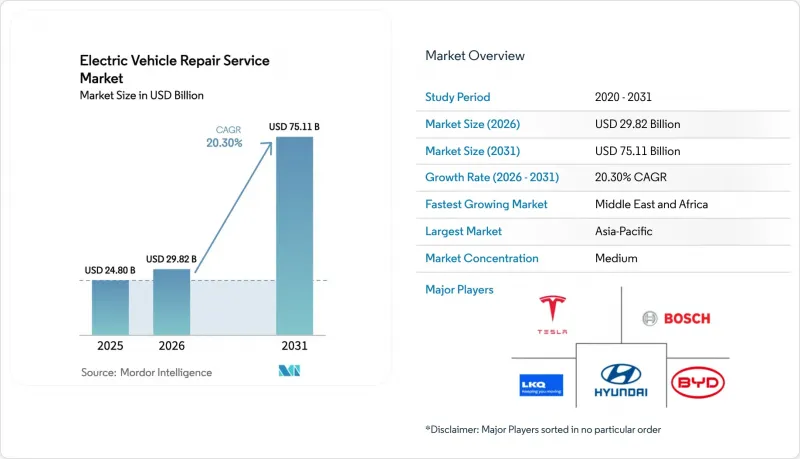
本報告按動力系統類型(電池式電動車、插電式混合動力汽車等)、服務類型(預防性維護、機械維修等)、零件類型(高壓電池/電池管理系統、馬達/逆變器等)、服務供應商、車輛類型和地區進行細分。市場預測以美元計價。
全球電動車維修服務市場趨勢與洞察
全球電動車數量的增加以及車輛在保固期過後老化。
2020年至2022年間售出的車輛正陸續接近保固期末,車主必須承擔全部維修費用,導致獨立維修店的維修需求激增。在中國,大型電動卡車的滲透率預計在2025年上半年達到22%,這一規模遠超過其他地區,且服務活動主要集中在物流走廊沿線。目前,計劃外運作每天對商用車隊造成500至1000美元的損失,促使企業採用預防性維護合約和電池再生技術。韓國Poen公司透過以新電池三分之一的價格再生電池組,在2020年至2023年間實現了顯著成長。因此,車輛保有量的成熟為擁有儲能技術的企業提供了長期獲利前景。
政府零排放車輛法規和購車獎勵
加州的「先進清潔卡車」法規等政策要求逐步提高零排放車輛在車隊中的比例,從而確保需要認證服務能力的運作中車輛數量可預測。在巴西,擴大基礎建設補貼促使電動車銷量成長90%,到2024年達到177,360輛,其中71%為插電式混合動力汽車。這表明獎勵如何能夠推動售後市場需求。國內生產補貼也鼓勵汽車製造商建立區域服務中心,以確保合規支持。然而,2025年後聯邦獎勵的不確定性可能會擾亂採購,尤其是在營運成本仍然微乎其微的商用車領域。
具備高壓電操作資格的工程師嚴重短缺。
目前的認證項目培養的專業人才不足以滿足車輛電氣化進程的需求。高壓培訓可能需要六到十二個月,而整合複雜電池管理系統(BMS)和遠端資訊處理功能的商用卡車平台的需求尤其緊張。高昂的人事費用推高了維修價格,並限制了區域服務網路的擴張。像博世這樣早期就投資提陞技術人員技能的公司已經獲得了永續的勞動力優勢,而小規模的維修店則在資金和人員方面舉步維艱。
細分市場分析
預計到2025年,電池式電動車(BEV)將佔據電動車維修服務市場63.48%的佔有率,凸顯其在該市場的強勢地位。由於其機械結構相對簡單,純電動車的維修需求主要集中在電池診斷、逆變器校準和熱迴路清洗等日常維護,而非動力總成大修。隨著電動車維修服務市場的擴張,純電動車的大規模普及確保了維修店穩定的業務量。燃料電池電動車(FCEV)目前市場佔有率較小,但隨著貨運路線周邊加氫網路的建設,其正以23.95%的複合年成長率實現顯著成長。氫燃料電池堆的維護需要無塵室操作和氣體洩漏檢測等額外要求,而具備這些條件的設施稀缺,這催生了一個高價值的細分市場。
目前仍在運作插電式混合動力汽車和傳統混合動力汽車的車隊,其混合動力汽車的雙動力傳動系統相關工作量巨大,這就要求服務中心除了維護高壓設備外,還要維護內燃機 (ICE) 的工具。專業服務中心正利用其廣泛的技術專長,向尋求簡化維護的業者交叉銷售純電池式電動車(BEV) 改裝服務。隨著純電動車 (BEV) 車型不斷擴大,燃料電池電動車 (FCEV) 在長途貨運領域的應用日益廣泛,那些針對每種能源架構都提供系統化培訓的服務供應商,將在多個細分市場中贏得一部分客戶。
至2025年,包括軟體更新、冷卻液更換和高壓絕緣測試在內的預防性維護計畫將佔電動車維修服務市場佔有率的32.10%。目前,無線診斷技術能夠在溫度控管組件故障發生前數週檢測到異常,從而實現零件的及時訂購,並提高首次維修成功率。特斯拉在2025年率先推出的AI輔助分流技術,透過分析服務請求中的情緒數據來確定優先級,從而減少溝通延遲。隨著老化電池組數量的增加,電池診斷和再製造業務也將隨之擴展,並有望成為未來的收入支柱,其複合年成長率將達到22.12%。
雖然機械維修的比例正在下降,但在發生碰撞或電池重量導致懸吊應力過大的情況下,機械維修仍然是必要的。車身修理廠現在都設有隔離區域和專用的電動車維修工位,以降低電弧閃光的風險。隨著車隊營運商優先考慮運作,以及都市區充電排隊現象逐漸成為技術人員的常規等待區域,行動和遠端維修服務(包括韌體更新、輪胎換位和12V電池更換)正在加速發展。
區域分析
到2025年,亞太地區將佔據電動車維修服務市場44.80%的佔有率。這主要得益於中國強大的電池製造能力和積極的車隊改造計劃。人口密集的城市地區維修店運轉率高,而寧德時代等成熟的垂直整合型企業同時供應電池組和服務工具包,進一步鞏固了該地區的市場主導地位。蔚來汽車的換電站網路將於2025年聖誕節前開始試運行第五代換電站,進一步完善其在地化服務體系。日本和韓國在氫能系統和電池再生領域展現領先優勢。 Poen在電池再生業務方面取得的顯著複合年成長率充分體現了其深厚的技術實力。印度市場潛力巨大,但目前面臨技術人員短缺和充電基礎設施發展不平衡的問題。
在北美,成熟的經銷商網路與資料存取的監管壓力並存。加州的零排放車輛 (ZEV) 強制令以及特斯拉龐大的超級充電網路導致維修業務高度集中,但由於熟練技師短缺,人事費用飆升。如果實施安全的 API,聯邦層級的維修權法案或可允許獨立維修店進入市場。加拿大也效法美國,推出了類似的獎勵。
歐洲正受益於嚴格的二氧化碳排放標準以及企業對車隊採用電動車的堅定承諾。德國和北歐國家在升級維修車間方面處於領先地位,歐盟電池指令正在加速回收能力的擴張,例如SK tes位於鹿特丹的工廠。然而,熟練勞動力短缺的挑戰與北美類似。南歐和新興的東歐地區正在採用改裝商業模式,將輕型都市區內燃機(ICE)貨車改裝為純電動車(BEV)動力系統,以符合城市低排放區的法規。
中東和非洲地區以21.58%的複合年成長率領先,這主要得益於海灣合作理事會(GCC)主權財富基金對充電走廊和組裝廠的投資。嚴酷的沙漠氣候對溫度控管提出了更高的要求,延長了冷卻板和冷卻水泵的檢查週期。土耳其透過與歐洲的關稅同盟,已發展成為區域零件和服務中心;南非則利用其採礦合作夥伴關係,建立穩定的電池材料供應鏈。巴西在南美洲扮演著核心角色,其2024年電動車銷量的顯著成長表明,基礎設施建設正在主導電動車的普及。到2025年2月,公共充電樁的數量將達到2430個直流充電樁,從而擴大售後市場的覆蓋範圍。
其他好處:
- Excel格式的市場預測(ME)表
- 3個月的分析師支持
目錄
第1章:引言
- 研究假設和市場定義
- 調查範圍
第2章:調查方法
第3章執行摘要
第4章 市場狀況
- 市場概覽
- 市場促進因素
- 全球電動車數量的增加以及車輛在保固期過後老化。
- 政府採取措施強制推行零排放車輛並鼓勵購買。
- 公共直流快速充電網路快速發展
- 面向獨立維修店的主要OEM認證項目
- 關於維修權和存取遠端資訊處理資料的法律法規取得了進展
- 電池二次利用服務生態系的興起
- 市場限制因素
- 具備高壓電操作執照的合格技術人員嚴重短缺。
- 更換鋰離子電池高成本且有物流風險
- 透過OEM軟體鎖定和OTA診斷功能限制第三方存取。
- 與內燃機汽車(ICE)相比,電動車(EV)的機械磨損零件銷售正在下降。
- 價值供應鏈分析
- 監理情勢
- 技術展望
- 波特五力模型
第5章 市場規模與成長預測
- 透過驅動系統
- 電池式電動車(BEV)
- 插電式混合動力車(PHEV)
- 混合動力電動車(HEV)
- 燃料電池汽車(FCEV)
- 按服務類型
- 預防性維護(軟體更新、高壓系統檢查)
- 機械維修
- 電池診斷與再生
- 車身和油漆(電動車專用材料)
- 行動和遠端維修服務
- 依組件類型
- 高壓電池/電池管理系統
- 馬達/逆變器
- 溫度控管/暖通空調
- ADAS感測器校準
- 底盤/懸吊
- 透過服務供應商
- OEM 直營服務中心
- OEM授權加盟店
- 獨立電動車專業維修店
- 行動維修網路
- 車輛類型
- 搭乘用車
- 輕型商用車
- 中型和大型商用車輛
- 按地區
- 北美洲
- 美國
- 加拿大
- 其他北美國家
- 南美洲
- 巴西
- 阿根廷
- 其他南美國家
- 歐洲
- 德國
- 英國
- 法國
- 義大利
- 西班牙
- 俄羅斯
- 其他歐洲國家
- 亞太地區
- 中國
- 日本
- 印度
- 韓國
- 澳洲和紐西蘭
- 其他亞太國家
- 中東和非洲
- 阿拉伯聯合大公國
- 沙烏地阿拉伯
- 土耳其
- 埃及
- 南非
- 其他中東和非洲國家
- 北美洲
第6章 競爭情勢
- 市場集中度
- 策略趨勢
- 市佔率分析
- 公司簡介
- Robert Bosch GmbH
- LKQ Corporation
- Tesla Inc.
- Hyundai Motor Co.
- BYD Auto Co. Ltd
- NIO Inc.
- Rivian Automotive LLC
- Lucid Group Inc.
- Cox Automotive Mobility(Spiffy)
- RepairSmith Inc.
- Whitley Automotive
- SK On Co. Ltd
- AutoNation Inc.
- ZF Aftermarket
第7章 市場機會與未來展望
According to Mordor Intelligence, the electric vehicle repair service market size is expected to grow from USD 24.80 billion in 2025 to USD 29.82 billion in 2026 and is forecast to reach USD 75.11 billion by 2031 at 20.3% CAGR over 2026-2031.
This report is Segmented by Propulsion Type (Battery Electric Vehicle, Plug-In Hybrid Electric Vehicle, and More), Service Type (Preventive Maintenance, Corrective Mechanical Repair, and More), Component Type (High-Voltage Battery and BMS, Electric Motor/Inverter, and More), Service Provider, Vehicle Type, and Geography. The Market Forecasts are Provided in Terms of Value (USD).
Global Electric Vehicle Repair Service Market Trends and Insights
Rising Global EV Parc and Post-Warranty Vehicle Aging
Vehicle cohorts sold between 2020-2022 have begun to exit warranty, exposing owners to full repair costs and creating a surge in independent shop volumes. China illustrates scale effects as heavy-duty electric trucks reached 22% penetration in the first half of 2025, far ahead of other regions, concentrating service activity along logistics corridors. Unscheduled downtime now costs commercial fleets USD 500-1,000 per day, pushing preventive maintenance contracts and battery refurbishment adoption. South Korea's Poen grew significantly from 2020-2023 by remanufacturing battery packs at one-third the new-unit price. The maturing parc therefore underpins long-run revenue visibility for operators with energy-storage competencies.
Government ZEV Mandates and Purchase Incentives
Policies such as California's Advanced Clean Trucks rule compel escalating zero-emission fleet percentages, guaranteeing a predictable volume of in-service vehicles that require certified maintenance capacity. Brazil's EV sales surged 90% to 177,360 units in 2024, 71% plug-ins after infrastructure subsidies widened, demonstrating how incentives translate into aftermarket demand. Domestic-production credits also push OEMs to seed regional service footprints to secure compliance support. However, uncertainty over post-2025 federal incentives could inject procurement volatility, especially in commercial adoption, where operating-cost parity remains marginal.
Acute Shortage of High-Voltage-Licensed Technicians
Certification pipelines currently produce too few specialists to meet fleet electrification timelines. High-voltage coursework can run 6-12 months, and demand is worst for commercial truck platforms that integrate complex BMS and telematics overlays. Premium wages inflate repair pricing and limit the expansion of regional service density. Firms investing early in technician up-skilling, like Bosch, gain durable labor advantages while smaller garages stall on capital and talent.
Other drivers and restraints analyzed in the detailed report include:
- Rapid Build-Out of Public DC-Fast Charging Networks
- Mainstream OEM Certification Programs for Independent Shops
- High Cost and Logistics Risk of Lithium-ion Battery Replacement
For complete list of drivers and restraints, kindly check the Table Of Contents.
Segment Analysis
Battery Electric Vehicles represented 63.48% of the electric vehicle repair service market share in 2025, underscoring their entrenched dominance within the electric vehicle repair service market. The segment's mechanical simplicity translates into recurring needs for battery diagnostics, inverter calibration, and thermal-loop flushing rather than drivetrain overhauls. As the electric vehicle repair service market expands, BEVs' high installed base guarantees steady workshop throughput. Though only a minimal share today, Fuel-Cell Electric Vehicles headline growth at 23.95% CAGR as refueling networks emerge around freight corridors. Hydrogen stack servicing demands additional cleanroom protocols and gas-leak detection, which few facilities possess, creating a premium niche.
Fleets still running Plug-in Hybrids and conventional Hybrids generate hybrid dual-powertrain work, obligating shops to maintain ICE tooling alongside high-voltage gear. Specialized garages use this cross-skill to cross-sell full BEV conversions to operators seeking maintenance simplification. With BEVs pushing into heavier classes and FCEVs scaling in long-haul trucking, providers that stratify training across energy architectures will capture multi-segment wallet share.
Preventive schedules delivered 32.10% of the electric vehicle repair service market share in 2025 through software updates, coolant replacement, and high-voltage insulation checks. Over-the-air diagnostics now flag thermal-pack deviations weeks before failure, enabling just-in-time part ordering that lifts first-time fix rates. AI-assisted triage, pioneered by Tesla in 2025, mines sentiment data from service requests to prioritize cases and reduce communication lags. Battery diagnostics and remanufacturing, growing at 22.12% CAGR, anchor the future revenue arc as aging packs swell refurbishment pipelines.
Corrective mechanical repairs retreat in share but remain necessary after collisions or suspension stress from battery weight. Bodywork centers now install insulated isolation zones and EV-only bays to mitigate arc flash risk. Mobile and remote repair visits-covering firmware flashes, tire rotations, and 12-V battery swaps-accelerate as fleets prize uptime and urban charging queues provide predictable technician staging points.
Complete Report Scope:
- By Propulsion Type
- Battery Electric Vehicle (BEV)
- Plug-in Hybrid Electric Vehicle (PHEV)
- Hybrid Electric Vehicle (HEV)
- Fuel-Cell Electric Vehicle (FCEV)
- By Service Type
- Preventive Maintenance (software updates, HV-system checks)
- Corrective Mechanical Repair
- Battery Diagnostics and Remanufacture
- Body and Paint (EV-specific materials)
- Mobile and Remote Repair Services
- By Component Type
- High-Voltage Battery and BMS
- Electric Motor / Inverter
- Thermal Management and HVAC
- ADAS Sensors and Calibration
- Chassis / Suspension
- By Service Provider
- OEM-Owned Service Centers
- OEM-Authorized Franchises
- Independent EV-Specialist Garages
- Mobile Repair Networks
- By Vehicle Type
- Passenger Car
- Light Commercial Vehicle
- Medium and Heavy Commercial Vehicle
- By Geography
- North America
- United States
- Canada
- Rest of North America
- South America
- Brazil
- Argentina
- Rest of South America
- Europe
- Germany
- United Kingdom
- France
- Italy
- Spain
- Russia
- Rest of Europe
- Asia-Pacific
- China
- Japan
- India
- South Korea
- Australia and New Zealand
- Rest of Asia-Pacific
- Middle East and Africa
- United Arab Emirates
- Saudi Arabia
- Turkey
- Egypt
- South Africa
- Rest of Middle East and Africa
- North America
Geography Analysis
Asia-Pacific held 44.80% of the electric vehicle repair service market share in 2025, anchored by China's battery manufacturing scale and aggressive fleet conversion quotas. Dense urban clusters yield high workshop utilization, while vertically integrated incumbents like CATL supply both packs and service toolkits, reinforcing regional dominance. NIO's swap network trialing fifth-generation stations by Christmas 2025 further deepens localized service sophistication. Japan and South Korea contribute niche leadership in hydrogen systems and battery refurbishment. Poen's notable CAGR battery remanufacture exemplifies capability depth. India's market shows promise yet wrestles with technician shortages and uneven charging rollouts.
North America combines established dealership networks with legislative pressure for data access. California's ZEV mandates and extensive Tesla Supercharger grids deliver the densest repair volumes, though technician scarcity inflates labor rates. Federal right-to-repair bills could unlock independent shop participation once secure APIs arrive. Canada follows closely with incentives mirrored in the United States structures.
Europe benefits from stringent CO2 standards and robust corporate fleet commitments. Germany and the Nordic nations lead workshop upgrades, while the EU battery directive accelerates recycling capacity buildouts like SK tes's Rotterdam plant. However, skilled-labor constraints echo North American challenges. Southern Europe and emerging Eastern European clusters adopt retrofit business models, converting light commercial ICE vans to BEV drivetrains to comply with urban low-emission zones.
Middle East & Africa shows the fastest 21.58% CAGR, catalyzed by GCC sovereign funds funneling capital into charging corridors and assembly plants. Harsh desert climates stress thermal management, raising service intervals on cooling plates and coolant pumps. Turkey's customs-union link to Europe positions it as a regional parts and service hub, while South Africa leverages mining ties to anchor battery material flows. Brazil anchors South America, its significant EV-sales surge in 2024 validating infrastructure-driven adoption; public chargers rose to 2,430 DC units by February 2025, expanding aftermarket footprints.
- Robert Bosch GmbH
- LKQ Corporation
- Tesla Inc.
- Hyundai Motor Co.
- BYD Auto Co. Ltd
- NIO Inc.
- Rivian Automotive LLC
- Lucid Group Inc.
- Cox Automotive Mobility (Spiffy)
- RepairSmith Inc.
- Whitley Automotive
- SK On Co. Ltd
- AutoNation Inc.
- ZF Aftermarket
Additional Benefits:
- The market estimate (ME) sheet in Excel format
- 3 months of analyst support
TABLE OF CONTENTS
1 Introduction
- 1.1 Study Assumptions & Market Definition
- 1.2 Scope of the Study
2 Research Methodology
3 Executive Summary
4 Market Landscape
- 4.1 Market Overview
- 4.2 Market Drivers
- 4.2.1 Rising Global EV Parc and Post-Warranty Vehicle Aging
- 4.2.2 Government ZEV Mandates and Purchase Incentives
- 4.2.3 Rapid Build-Out of Public DC-Fast Charging Networks
- 4.2.4 Mainstream OEM Certification Programs for Independent Shops
- 4.2.5 Right-to-Repair and Telematics-Data-Access Legislation Momentum
- 4.2.6 Emergence of Battery-Second-Life Service Ecosystems
- 4.3 Market Restraints
- 4.3.1 Acute Shortage of High-Voltage-Licensed Technicians
- 4.3.2 High Cost and Logistics Risk of Lithium-ion Battery Replacement
- 4.3.3 OEM Software Locks and OTA Diagnostics Limiting Third-Party Access
- 4.3.4 Declining Mechanical Wear Parts Revenue Per EV vs ICE
- 4.4 Value / Supply-Chain Analysis
- 4.5 Regulatory Landscape
- 4.6 Technological Outlook
- 4.7 Porter's Five Forces
- 4.7.1 Threat of New Entrants
- 4.7.2 Bargaining Power of Buyers
- 4.7.3 Bargaining Power of Suppliers
- 4.7.4 Threat of Substitutes
- 4.7.5 Intensity of Competitive Rivalry
5 Market Size & Growth Forecasts (Value (USD))
- 5.1 By Propulsion Type
- 5.1.1 Battery Electric Vehicle (BEV)
- 5.1.2 Plug-in Hybrid Electric Vehicle (PHEV)
- 5.1.3 Hybrid Electric Vehicle (HEV)
- 5.1.4 Fuel-Cell Electric Vehicle (FCEV)
- 5.2 By Service Type
- 5.2.1 Preventive Maintenance (software updates, HV-system checks)
- 5.2.2 Corrective Mechanical Repair
- 5.2.3 Battery Diagnostics and Remanufacture
- 5.2.4 Body and Paint (EV-specific materials)
- 5.2.5 Mobile and Remote Repair Services
- 5.3 By Component Type
- 5.3.1 High-Voltage Battery and BMS
- 5.3.2 Electric Motor / Inverter
- 5.3.3 Thermal Management and HVAC
- 5.3.4 ADAS Sensors and Calibration
- 5.3.5 Chassis / Suspension
- 5.4 By Service Provider
- 5.4.1 OEM-Owned Service Centers
- 5.4.2 OEM-Authorized Franchises
- 5.4.3 Independent EV-Specialist Garages
- 5.4.4 Mobile Repair Networks
- 5.5 By Vehicle Type
- 5.5.1 Passenger Car
- 5.5.2 Light Commercial Vehicle
- 5.5.3 Medium and Heavy Commercial Vehicle
- 5.6 By Geography
- 5.6.1 North America
- 5.6.1.1 United States
- 5.6.1.2 Canada
- 5.6.1.3 Rest of North America
- 5.6.2 South America
- 5.6.2.1 Brazil
- 5.6.2.2 Argentina
- 5.6.2.3 Rest of South America
- 5.6.3 Europe
- 5.6.3.1 Germany
- 5.6.3.2 United Kingdom
- 5.6.3.3 France
- 5.6.3.4 Italy
- 5.6.3.5 Spain
- 5.6.3.6 Russia
- 5.6.3.7 Rest of Europe
- 5.6.4 Asia-Pacific
- 5.6.4.1 China
- 5.6.4.2 Japan
- 5.6.4.3 India
- 5.6.4.4 South Korea
- 5.6.4.5 Australia and New Zealand
- 5.6.4.6 Rest of Asia-Pacific
- 5.6.5 Middle East and Africa
- 5.6.5.1 United Arab Emirates
- 5.6.5.2 Saudi Arabia
- 5.6.5.3 Turkey
- 5.6.5.4 Egypt
- 5.6.5.5 South Africa
- 5.6.5.6 Rest of Middle East and Africa
- 5.6.1 North America
6 Competitive Landscape
- 6.1 Market Concentration
- 6.2 Strategic Moves
- 6.3 Market Share Analysis
- 6.4 Company Profiles (Includes Global Level Overview, Market Level Overview, Core Segments, Financials as Available, Strategic Information, Market Rank/Share for Key Companies, Products and Services, SWOT Analysis, and Recent Developments)
- 6.4.1 Robert Bosch GmbH
- 6.4.2 LKQ Corporation
- 6.4.3 Tesla Inc.
- 6.4.4 Hyundai Motor Co.
- 6.4.5 BYD Auto Co. Ltd
- 6.4.6 NIO Inc.
- 6.4.7 Rivian Automotive LLC
- 6.4.8 Lucid Group Inc.
- 6.4.9 Cox Automotive Mobility (Spiffy)
- 6.4.10 RepairSmith Inc.
- 6.4.11 Whitley Automotive
- 6.4.12 SK On Co. Ltd
- 6.4.13 AutoNation Inc.
- 6.4.14 ZF Aftermarket
7 Market Opportunities & Future Outlook
- 7.1 White-space & Unmet-Need Assessment

 全球汽車維修保養服務市場規模、佔有率、趨勢及成長分析報告(2026-2034年)
 行動車輛維修服務:市場佔有率分析、產業趨勢與統計、成長預測(2026-2031)
 充氣式起重袋市場-2026-2032年全球市場預測汽車維修保養服務市場:2026-2032年全球市場預測(依服務類型、提供者類型、範圍、收入模式、車輛類型和客戶類型分類)全球車輛車隊維護和服務市場規模、佔有率、趨勢和成長分析報告(2026-2034年)
 汽車維修保養服務市場分析及預測(至2035年):依類型、產品類型、服務、技術、組件、應用、流程、最終使用者、設備及解決方案分類
 2026-2030年全球汽車維修保養服務市場
 搭乘用電動車維修服務市場:商機、成長要素、產業趨勢分析及2026-2035年預測汽車電池再生服務市場機會、成長促進因素、產業趨勢分析及2026-2035年預測2026 年至 2035 年商業按需車輛維修市場的商業機會、成長要素、產業趨勢分析與預測。