


 |
市場調查報告書
商品編碼
2071247
2026 年至 2035 年商業按需車輛維修市場的商業機會、成長要素、產業趨勢分析與預測。Commercial On-Demand Vehicle Repair Market Opportunity, Growth Drivers, Industry Trend Analysis, and Forecast 2026 - 2035 |
||||||

全球商業按需車輛維修市場預計到 2025 年將價值 41 億美元,預計到 2035 年將以 12.9% 的複合年成長率成長至 133 億美元。
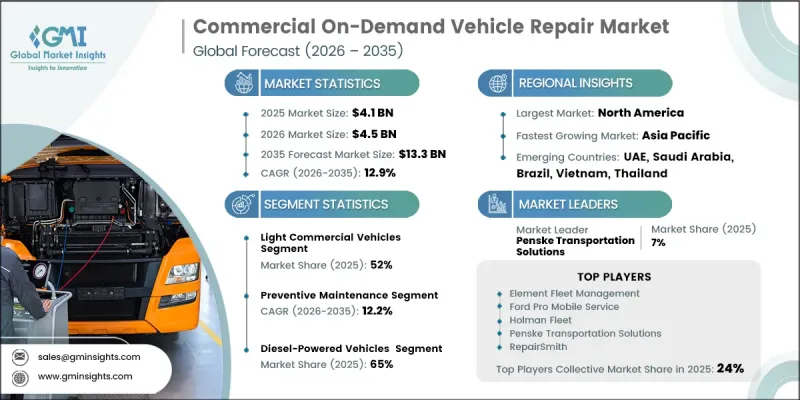
隨著被動式、事後支援模式向數位化管理、計畫性維修解決方案的轉變,車輛維護產業正經歷一場重大變革,這些解決方案可直接送達車輛所在地。這種變革在車輛維修站、物流中心、停車場和其他營運場所正加速推進,因為在這些場所,最大限度地減少停機時間至關重要。尤其是在那些將車輛運轉率放在首位、無法容忍長時間服務中斷的商用車營運商中,這種變革更為顯著。推動這項變革的主要動力是對車輛運轉率和營運效率的日益重視。每一次維修延誤的減少都意味著生產力的提高、營運成本的降低以及服務性能的提升。傳統的維修店維護通常需要車輛運輸、預約安排和長時間的等待,所有這些都會影響創收活動。行動維修服務透過將技術人員、診斷設備和更換零件直接送到車輛所在地,解決了這些挑戰,從而加快了維修速度並最大限度地減少了對營運的干擾。隨著商務傳輸網路中時間限制的日益嚴格,按需商用車維修市場正在崛起,成為最佳化車隊和簡化維護流程的策略解決方案。
| 市場範圍 | |
|---|---|
| 開始年份 | 2025 |
| 預測期 | 2026-2035 |
| 初始市場規模 | 41億美元 |
| 預測金額 | 133億美元 |
| 複合年成長率 | 12.9% |
電子商務活動的持續擴張和都市區物流網路的不斷成長,正顯著推動各大都會圈對行動維修服務的需求。商業配送服務的快速發展,也催生了對能夠應對日常高強度使用需求的可靠車輛維護解決方案的日益成長。車輛在惡劣條件下頻繁運行,導致維護要求更加複雜,因此需要方便用戶使用型服務模式,以最大限度地減少停機時間並提高車隊生產力。隨著物流業者尋求更大的營運柔軟性,按需維修服務作為傳統維護管道之外的極具吸引力的替代方案,正日益受到關注。
預計到2025年,輕型商用車市佔率將達到52%,並在2035年之前以13.1%的複合年成長率成長。該細分市場涵蓋了運輸、配送、服務營運和城市物流活動中常用的各種車輛。由於輕型商用車在商業旅遊和城市配送生態系統中發揮核心作用,因此其重要性依然不容忽視。獨特的營運模式、監管分類和運轉率要求,推動了對專為輕型商用車車隊量身定做的靈活維護解決方案的需求。
預計到2025年,預防性維護市場佔有率將達到38%,並在2035年之前以12.2%的複合年成長率成長。此細分市場包括旨在維持車輛性能、提高安全性並降低意外機械故障發生機率的定期維護活動。對於尋求最大限度提高資產運轉率和控制長期營運成本的車隊營運商而言,定期維護計畫的重要性日益凸顯。行動服務交付尤其適用於預防性維護,因為服務需求可預測,可以提前規劃,並且可以最大限度地減少對營運的干擾。隨著車隊管理策略日益數據驅動,預計在整個預測期內,對預防性維護服務的需求將保持強勁。
預計到2025年,歐洲商用車按需維修市場佔有率將達到27%,並在2035年之前以11.4%的複合年成長率成長。歐洲市場的成長主要得益於完善的交通基礎設施、活躍的商用車市場以及對車隊效率日益成長的重視。主要區域經濟體為提高車輛運轉率、最佳化營運績效並滿足不斷變化的運輸需求而做出的努力,也推動了行動維護解決方案的日益普及。
目錄
第1章:調查方法和範圍
第2章執行摘要
第3章 行業洞察
- 產業生態系分析
- 供應商情況
- 替換零件和耗材
- 診斷硬體和軟體供應商
- 售後市場零件製造商
- 按需行動維修服務供應商
- 分銷管道
- 最終用途
- 成本結構
- 利潤率
- 每個階段增加的價值
- 垂直整合趨勢
- 顛覆者
- 供應商情況
- 影響產業的因素
- 促進因素
- 車輛運轉率最佳化的需求日益成長
- 電子商務的成長和最後一公里配送車輛的增加
- 車載資訊系統和聯網汽車的廣泛應用
- 傳統修理店人手不足
- 產業潛在風險與挑戰
- 去中心化服務供應商生態系統
- 招募技術嫻熟的行動技術人員很困難。
- 市場機遇
- 人工智慧驅動的預測性維護計劃
- OEM認證行動服務網路的成長
- 使用應用程式預訂服務正變得越來越流行。
- 遠距離診斷和虛擬援助的整合
- 促進因素
- 成長潛力分析
- 價格分析
- 對過去價格趨勢的分析
- 依球員類型分類的定價策略(高級球員、超值球員、成本加成球員)
- 監理情勢
- 北美洲
- 美國:聯邦汽車運輸安全管理局 (FMCSA) 對行動技術人員的工作時間 (HOS) 實施限制。
- 加拿大:行動工作場所的 OSHA 安全標準
- 歐洲
- 德國:歐盟關於流動工人及工作時間的指令
- 英國:REACH法規及行動電話維修中危險物品的運輸
- 法國:NF C15-100(V2G 補充劑)
- 荷蘭:PTP-2025(智慧充電和V2G)
- 亞太地區
- 日本:關於移動服務的道路運輸車輛法
- 中國:《重型車輛法》中關於移動維修的規定
- 韓國:KEMCO的V2G認證
- 澳洲:AS/NZS 4777.2 (2020+)
- 拉丁美洲
- 巴西:移動車輛維修服務註冊
- 智利:PROFECO 的行動電話維修消費者保護
- 中東和非洲
- 阿拉伯聯合大公國:地方政府對出行服務車輛的授權
- 沙烏地阿拉伯:核准零售汽車業的行動維修店(RMI)
- 北美洲
- 技術與創新展望
- 最新技術
- 新興技術
- 波特的分析
- PESTLE分析
- 專利分析
- 人工智慧和生成式人工智慧對市場的影響
- 利用人工智慧改造現有經營模式
- 自動化設計最佳化
- 用於需求預測的供應鏈人工智慧
- 按細分市場分類的生成式人工智慧用例和部署藍圖
- 風險、限制和監管考量
- 預測假設和情境分析
- 基本案例:驅動複合年成長率的關鍵宏觀經濟與產業變量
- 樂觀情境:宏觀經濟與產業的順風
- 悲觀情景:宏觀經濟放緩或產業逆風
- 永續性和環境方面
- 永續計劃
- 減少廢棄物策略
- 生產中的能源效率
- 具有環保意識的舉措
- 考慮碳足跡
第4章 競爭情勢
- 介紹
- 企業市佔率分析
- 北美洲
- 歐洲
- 亞太地區
- 拉丁美洲
- 中東和非洲
- 競爭定位矩陣
- 主要進展
- 併購
- 夥伴關係和聯盟
- 新產品發布
- 業務拓展計劃及資金籌措
- 按公司規模進行基準測試
- 排名分類標準與遴選標準
- 按銷售額、地區和創新能力分類的層級定位矩陣。
第5章 市場估計與預測:依服務業分類,2022-2035年
- 預防性維護服務
- 更換機油和濾清器
- 更換液壓油
- 更換皮帶和軟管
- 更換濾芯
- 其他
- 糾正性維修服務
- 煞車系統維修
- 引擎和傳動系統維修
- 懸吊和轉向系統維修
- 電氣系統維修
- 其他
- 診斷服務
- 檢查引擎故障燈和 OBD-II 診斷
- 無啟動診斷
- 購車前車輛檢查
- 其他
- 緊急應變和道路救援系統
- 電瓶啟動服務
- 補胎和更換輪胎
- 緊急燃料配送
- 其他
第6章 市場估價與預測:依車輛類型分類,2022-2035年
- 輕型商用車(LCV)
- 中型商用車(MCV)
- 重型商用車(HCV)
第7章 市場估計與預測:依服務類型分類,2022-2035年
- 現場/移動服務
- 收貨和退貨服務
- 遠距離診斷和支援
第8章 市場估算與預測:依燃料類型分類,2022-2035年
- 汽油
- 柴油引擎
- 全電動
- PHEV
- HEV
- FCEV
第9章 市場估計與預測:依供應商分類,2022-2035年
- 平台聚合器
- 獨立手機維修服務供應商
- OEM認證行動服務網路
- 特許經營型行動服務供應商
第10章 市場估價與預測:依預訂管道分類,2022-2035年
- 行動應用
- 網站和入口網站
- 客服中心和電話預訂
- 透過 OBD-II 實現遠端資訊處理和自動預訂
- 基於OEM的車輛整合
第11章 市場估計與預測:依應用領域分類,2022-2035年
- 物流/運輸
- 電子商務和最後一公里配送
- 建築和基礎設施
- 現場服務
- 公司和政府車輛
- 其他
第12章 市場估計與預測:依最終用途分類,2022-2035年
- B2B
- B2C
第13章 市場估計與預測:依地區分類,2022-2035年
- 北美洲
- 美國
- 加拿大
- 歐洲
- 英國
- 德國
- 法國
- 義大利
- 西班牙
- 比利時
- 荷蘭
- 瑞典
- 俄羅斯
- 亞太地區
- 中國
- 印度
- 日本
- 澳洲
- 新加坡
- 韓國
- 越南
- 印尼
- 泰國
- 拉丁美洲
- 巴西
- 墨西哥
- 阿根廷
- 中東和非洲
- 南非
- 沙烏地阿拉伯
- UAE
- 土耳其
第14章:公司簡介
- 世界公司
- ClickMechanic
- Element Fleet Management
- Fixter
- Holman
- Penske Truck Leasing
- RepairSmith(AutoNation)
- Spiffy
- Road Rescue Network
- Wrench(YourMechanic)
- Yoshi
- 當地公司
- AutoFix
- Cafler
- CarPass
- Instant Car Fix
- FixMyCar
- GoMechanic
- Jrop
- 新興企業
- Cox Fleet
- FleetNation
- TRUCKUP
The Global Commercial On-Demand Vehicle Repair Market was valued at USD 4.1 billion in 2025 and is estimated to grow at a CAGR of 12.9% to reach USD 13.3 billion by 2035.
The industry is undergoing a significant transformation as maintenance services shift from reactive breakdown support toward digitally managed, scheduled repair solutions delivered directly to vehicle locations. This evolution is gaining momentum across fleet depots, distribution centers, parking facilities, and other operational sites where minimizing downtime is critical. Growth is particularly strong among commercial fleet operators that rely on high vehicle utilization and cannot afford extended service interruptions. The primary driver behind adoption is the increasing focus on fleet availability and operational efficiency. Every reduction in maintenance-related delays contributes to improved productivity, lower operating costs, and enhanced service performance. Traditional workshop-based maintenance often requires vehicle transportation, appointment scheduling, and prolonged idle periods, all of which impact revenue-generating activities. Mobile repair services address these challenges by bringing technicians, diagnostic equipment, and replacement parts directly to the vehicle, enabling faster service completion and reducing operational disruptions. As commercial transportation networks become increasingly time-sensitive, the commercial on-demand vehicle repair market is emerging as a strategic solution for fleet optimization and maintenance efficiency.
| Market Scope | |
|---|---|
| Start Year | 2025 |
| Forecast Year | 2026-2035 |
| Start Value | $4.1 Billion |
| Forecast Value | $13.3 Billion |
| CAGR | 12.9% |
The continued expansion of e-commerce activity and urban distribution networks is generating substantial demand for mobile repair services across metropolitan regions. Rapid growth in commercial delivery operations has increased the need for dependable vehicle maintenance solutions capable of supporting intensive daily usage patterns. Frequent vehicle operation under demanding conditions contributes to higher maintenance requirements, increasing demand for accessible service models that minimize downtime and improve fleet productivity. As logistics operators seek greater operational flexibility, on-demand repair services are becoming an increasingly attractive alternative to conventional maintenance channels.
The light commercial vehicles segment accounted for 52% share in 2025 and is projected to grow at a CAGR of 13.1% through 2035. This segment includes a broad range of vehicles commonly utilized for transportation, distribution, service operations, and urban logistics activities. The category remains highly significant due to its central role in commercial mobility and city-based delivery ecosystems. Distinct operating patterns, regulatory classifications, and utilization rates contribute to strong demand for flexible maintenance solutions specifically tailored to light commercial vehicle fleets.
The preventive maintenance segment held a 38% share in 2025 and is forecast to grow at a CAGR of 12.2% through 2035. The segment encompasses routine service activities designed to maintain vehicle performance, improve safety, and reduce the likelihood of unexpected mechanical failures. Scheduled maintenance programs continue to gain importance among fleet operators seeking to maximize asset utilization and control long-term operating expenses. Mobile service delivery is particularly well-suited for preventive maintenance because service requirements are predictable, scheduling can be planned in advance, and operational disruptions can be minimized. As fleet management strategies become increasingly data-driven, demand for preventive maintenance services is expected to remain strong throughout the forecast period.
Europe Commercial On-Demand Vehicle Repair Market held a 27% share in 2025 and is projected to grow at a CAGR of 11.4% through 2035. Market growth across Europe is supported by a strong transportation infrastructure, extensive commercial vehicle activity, and rising emphasis on fleet efficiency. Increasing adoption of mobile maintenance solutions is driven by efforts to improve vehicle availability, optimize operational performance, and meet evolving transportation requirements across major regional economies.
Key companies operating in the Global Commercial On-Demand Vehicle Repair Market include Geotab, Pitstop, Ford Pro Mobile Service, TRUCKUP, Cafler, Wrench, Penske Transportation Solutions, Element Fleet Management, RepairSmith, FixMyCar, Cox Fleet, Holman, GoMechanic, CarPass, FleetNation, Yoshi, AutoFix, ClickMechanic, Fixico, Spiffy, and Trimble Transportation. Companies operating within the commercial on-demand vehicle repair industry are pursuing multiple strategies to strengthen their market presence and enhance competitive positioning. Leading participants are investing in digital service platforms, predictive maintenance technologies, fleet analytics, and mobile workforce management solutions to improve operational efficiency and customer experience. Strategic partnerships with fleet operators, logistics providers, vehicle manufacturers, and technology companies are helping expand service networks and increase customer acquisition. Market players are also focusing on geographic expansion, technician network growth, and service diversification to address a wider range of commercial vehicle requirements. Investments in real-time diagnostics, connected vehicle technologies, and automated scheduling systems are improving service responsiveness and reducing repair turnaround times.
Table of Contents
Chapter 1 Methodology & Scope
- 1.1 Research approach
- 1.2 Quality Commitments
- 1.2.1 GMI AI policy & data integrity commitment
- 1.2.1.1 Source consistency protocol
- 1.2.1 GMI AI policy & data integrity commitment
- 1.3 Research Trail & Confidence Scoring
- 1.3.1 Research Trail Components
- 1.3.2 Scoring Components
- 1.4 Data Collection
- 1.4.1 Partial list of primary sources
- 1.5 Data mining sources
- 1.5.1 Paid sources
- 1.5.1.1 Sources, by region
- 1.5.1 Paid sources
- 1.6 Base estimates and calculations
- 1.6.1 Base year calculation
- 1.7 Forecast model
- 1.7.1 Quantified market impact analysis
- 1.7.1.1 Mathematical impact of growth parameters on forecast
- 1.7.1 Quantified market impact analysis
- 1.8 Research transparency addendum
- 1.8.1 Source attribution framework
- 1.8.2 Quality assurance metrics
- 1.8.3 Our commitment to trust
Chapter 2 Executive Summary
- 2.1 Industry 360° synopsis
- 2.2 Key market trends
- 2.2.1 Service
- 2.2.2 Vehicle
- 2.2.3 Service Mode
- 2.2.4 Fuel
- 2.2.5 Provider
- 2.2.6 Booking Channel
- 2.2.7 Application
- 2.2.8 End use
- 2.3 TAM Analysis, 2026-2035
- 2.4 CXO perspectives: Strategic imperatives
Chapter 3 Industry Insights
- 3.1 Industry ecosystem analysis
- 3.1.1 Supplier landscape
- 3.1.1.1 Replacement parts & consumables
- 3.1.1.2 Diagnostic hardware & software providers
- 3.1.1.3 Aftermarket component manufacturers
- 3.1.1.4 On-demand mobile repair operators
- 3.1.1.5 Distribution Channel
- 3.1.1.6 End Use
- 3.1.2 Cost structure
- 3.1.3 Profit margin
- 3.1.4 Value addition at each stage
- 3.1.5 Vertical integration trends
- 3.1.6 Disruptors
- 3.1.1 Supplier landscape
- 3.2 Industry impact forces
- 3.2.1 Growth drivers
- 3.2.1.1 Rising fleet uptime optimization requirements
- 3.2.1.2 Growth of e-commerce & last-mile delivery fleets
- 3.2.1.3 Increasing telematics & connected vehicle adoption
- 3.2.1.4 Labor shortages in conventional repair workshops
- 3.2.2 Industry pitfalls & challenges
- 3.2.2.1 Fragmented service provider ecosystem
- 3.2.2.2 Limited skilled mobile technician availability
- 3.2.3 Market opportunities
- 3.2.3.1 AI-enabled predictive maintenance scheduling
- 3.2.3.2 Growth of OEM-authorized mobile service networks
- 3.2.3.3 Increasing adoption of app-based service booking
- 3.2.3.4 Remote diagnostics and virtual assistance integration
- 3.2.1 Growth drivers
- 3.3 Growth potential analysis
- 3.4 Pricing Analysis (Driven by Primary Research)
- 3.4.1 Historical Price Trend Analysis
- 3.4.2 Pricing Strategy by Player Type (Premium / Value / Cost-plus)
- 3.5 Regulatory landscape
- 3.5.1 North America
- 3.5.1.1 US: FMCSA Hours of Service (HOS) for Mobile Technicians
- 3.5.1.2 Canada: OSHA Mobile Workplace Safety Standards
- 3.5.2 Europe
- 3.5.2.1 Germany: EU Mobile Workforce & Working Time Directive
- 3.5.2.2 UK: REACH & Hazardous Material Transport for Mobile Repairs
- 3.5.2.3 France: NF C15-100 (V2G Addendum)
- 3.5.2.4 Netherlands: PTP-2025 (Smart Charging & V2G)
- 3.5.3 Asia-Pacific
- 3.5.3.1 Japan: Road Transport Vehicle Act for Mobile Services
- 3.5.3.2 China: Heavy Vehicle National Law (HVNL) Mobile Repair Provisions
- 3.5.3.3 South Korea: KEMCO V2G Certification
- 3.5.3.4 Australia: AS/NZS 4777.2 (2020+)
- 3.5.4 Latin America
- 3.5.4.1 Brazil: Mobile Automotive Repair Service Registration
- 3.5.4.2 Chile: PROFECO Consumer Protection for Mobile Repairs
- 3.5.5 Middle East & Africa
- 3.5.5.1 UAE: Municipal Mobile Service Vehicle Permits
- 3.5.5.2 Saudi Arabia: Retail Motor Industry (RMI) Mobile Workshop Accreditation
- 3.5.1 North America
- 3.6 Technology and Innovation landscape
- 3.6.1 Current technologies
- 3.6.2 Emerging technologies
- 3.7 Porter's analysis
- 3.8 PESTEL analysis
- 3.9 Patent analysis (Driven by Primary Research)
- 3.10 Impact of AI & generative AI on the market
- 3.10.1 AI-Driven Disruption of Existing Business Models
- 3.10.2 Automated design optimization
- 3.10.3 Supply chain AI for demand forecasting
- 3.10.4 GenAI use cases & adoption roadmap by segment
- 3.10.5 Risks, Limitations & Regulatory Considerations
- 3.11 Forecast assumptions & scenario analysis (Driven by Primary Research)
- 3.11.1 Base Case - key macro & industry variables driving CAGR
- 3.11.2 Optimistic Scenarios - Favorable Macro and Industry Tailwinds
- 3.11.3 Pessimistic Scenario - Macroeconomic slowdown or industry headwinds
- 3.12 Sustainability and environmental aspects
- 3.12.1 Sustainable practices
- 3.12.2 Waste reduction strategies
- 3.12.3 Energy efficiency in production
- 3.12.4 Eco-friendly Initiatives
- 3.12.5 Carbon footprint considerations
Chapter 4 Competitive Landscape, 2025
- 4.1 Introduction
- 4.2 Company market share analysis
- 4.2.1 North America
- 4.2.2 Europe
- 4.2.3 Asia-Pacific
- 4.2.4 Latin America
- 4.2.5 Middle East & Africa
- 4.3 Competitive positioning matrix
- 4.4 Key developments
- 4.4.1 Mergers & acquisitions
- 4.4.2 Partnerships & collaborations
- 4.4.3 New product launches
- 4.4.4 Expansion plans and funding
- 4.5 Company tier benchmarking
- 4.5.1 Tier classification criteria & qualifying thresholds
- 4.5.2 Tier positioning matrix by revenue, geography & innovation
Chapter 5 Market Estimates & Forecast, By Service, 2022 - 2035 ($Mn)
- 5.1 Key trends
- 5.2 Preventive Maintenance Services
- 5.2.1 Oil & filter changes
- 5.2.2 Fluid replacements
- 5.2.3 Belt & hose replacements
- 5.2.4 Filter replacements
- 5.2.5 Others
- 5.3 Corrective repair services
- 5.3.1 Brake system repairs
- 5.3.2 Engine & drivetrain repairs
- 5.3.3 Suspension & steering repairs
- 5.3.4 Electrical system repair
- 5.3.5 Others
- 5.4 Diagnostic services
- 5.4.1 Check engine light & OBD-II diagnostics
- 5.4.2 No-start diagnostics
- 5.4.3 Pre-purchase vehicle inspections
- 5.4.4 Others
- 5.5 Emergency & roadside assistance
- 5.5.1 Battery jump-start services
- 5.5.2 Flat tire repair & replacement
- 5.5.3 Emergency fuel delivery
- 5.5.4 Others
Chapter 6 Market Estimates & Forecast, By Vehicle, 2022 - 2035 ($Mn)
- 6.1 Key trends
- 6.2 Light commercial vehicles (LCV)
- 6.3 Medium commercial vehicles (MCV)
- 6.4 Heavy commercial vehicles (HCV)
Chapter 7 Market Estimates & Forecast, By Service Mode, 2022 - 2035 ($Mn)
- 7.1 Key trends
- 7.2 On-site/mobile service
- 7.3 Pickup and return service
- 7.4 Remote diagnosis and assistance
Chapter 8 Market Estimates & Forecast, By Fuel, 2022 - 2035 ($Mn)
- 8.1 Key trends
- 8.2 Gasoline
- 8.3 Diesel
- 8.4 All-electric
- 8.4.1 PHEV
- 8.4.2 HEV
- 8.4.3 FCEV
Chapter 9 Market Estimates & Forecast, By Provider, 2022 - 2035 ($Mn)
- 9.1 Key trends
- 9.2 Platform-based aggregators
- 9.3 Independent mobile mechanics
- 9.4 OEM-authorized mobile service networks
- 9.5 Franchise-based mobile service providers
Chapter 10 Market Estimates & Forecast, By Booking Channel, 2022 - 2035 ($Mn)
- 10.1 Key trends
- 10.2 Mobile applications
- 10.3 Websites and web portals
- 10.4 Call centers and phone booking
- 10.5 Telematics and OBD-II auto-booking
- 10.6 OEM in-car integration
Chapter 11 Market Estimates & Forecast, By Application, 2022 - 2035 ($Mn)
- 11.1 Key trends
- 11.2 Logistics & Transportation
- 11.3 E-commerce & Last-Mile Delivery
- 11.4 Construction & Infrastructure
- 11.5 Field Services
- 11.6 Corporate & Government Fleets
- 11.7 Others
Chapter 12 Market Estimates & Forecast, By End use, 2022 - 2035 ($Mn)
- 12.1 Key trends
- 12.2 B2B
- 12.3 B2C
Chapter 13 Market Estimates & Forecast, By Region, 2022 - 2035 ($Mn)
- 13.1 North America
- 13.1.1 US
- 13.1.2 Canada
- 13.2 Europe
- 13.2.1 UK
- 13.2.2 Germany
- 13.2.3 France
- 13.2.4 Italy
- 13.2.5 Spain
- 13.2.6 Belgium
- 13.2.7 Netherlands
- 13.2.8 Sweden
- 13.2.9 Russia
- 13.3 Asia Pacific
- 13.3.1 China
- 13.3.2 India
- 13.3.3 Japan
- 13.3.4 Australia
- 13.3.5 Singapore
- 13.3.6 South Korea
- 13.3.7 Vietnam
- 13.3.8 Indonesia
- 13.3.9 Thailand
- 13.4 Latin America
- 13.4.1 Brazil
- 13.4.2 Mexico
- 13.4.3 Argentina
- 13.5 MEA
- 13.5.1 South Africa
- 13.5.2 Saudi Arabia
- 13.5.3 UAE
- 13.5.4 Turkey
Chapter 14 Company Profiles
- 14.1 Global players
- 14.1.1 ClickMechanic
- 14.1.2 Element Fleet Management
- 14.1.3 Fixter
- 14.1.4 Holman
- 14.1.5 Penske Truck Leasing
- 14.1.6 RepairSmith (AutoNation)
- 14.1.7 Spiffy
- 14.1.8 Road Rescue Network
- 14.1.9 Wrench (YourMechanic)
- 14.1.10 Yoshi
- 14.2 Regional players
- 14.2.1 AutoFix
- 14.2.2 Cafler
- 14.2.3 CarPass
- 14.2.4 Instant Car Fix
- 14.2.5 FixMyCar
- 14.2.6 GoMechanic
- 14.2.7 Jrop
- 14.3 Emerging players
- 14.3.1 Cox Fleet
- 14.3.2 FleetNation
- 14.3.3 TRUCKUP

 全球汽車維修保養服務市場規模、佔有率、趨勢及成長分析報告(2026-2034年)
 電動車維修服務:市場佔有率分析、產業趨勢與統計、成長預測(2026-2031)行動車輛維修服務:市場佔有率分析、產業趨勢與統計、成長預測(2026-2031)
 充氣式起重袋市場-2026-2032年全球市場預測汽車維修保養服務市場:2026-2032年全球市場預測(依服務類型、提供者類型、範圍、收入模式、車輛類型和客戶類型分類)全球車輛車隊維護和服務市場規模、佔有率、趨勢和成長分析報告(2026-2034年)
 汽車維修保養服務市場分析及預測(至2035年):依類型、產品類型、服務、技術、組件、應用、流程、最終使用者、設備及解決方案分類
 2026-2030年全球汽車維修保養服務市場
 搭乘用電動車維修服務市場:商機、成長要素、產業趨勢分析及2026-2035年預測汽車電池再生服務市場機會、成長促進因素、產業趨勢分析及2026-2035年預測