


 |
市場調查報告書
商品編碼
2117390
汽車OEM應用程式商店:市場佔有率分析、產業趨勢與統計、成長預測(2026-2031年)Automotive OEM App Store - Market Share Analysis, Industry Trends & Statistics, Growth Forecasts (2026 - 2031) |
||||||

※ 本網頁內容可能與最新版本有所差異。詳細情況請與我們聯繫。
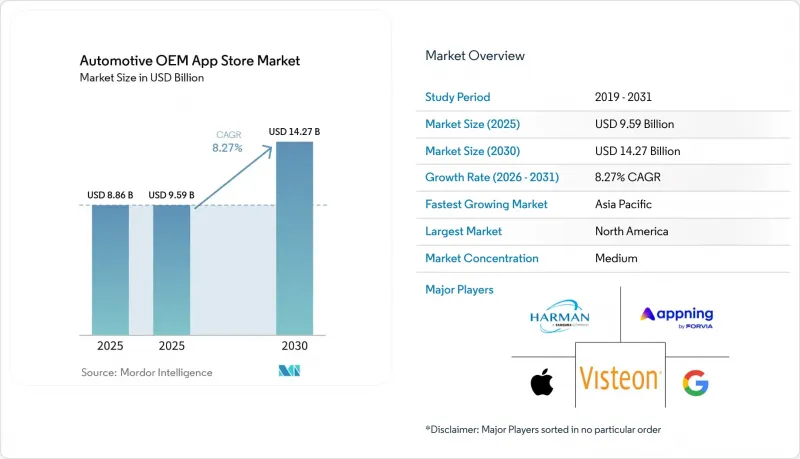
根據 Mordor Intelligence 預測,汽車 OEM 應用商店的市場規模預計將從 2025 年的 88.6 億美元成長到 2025 年的 95.9 億美元,到 2030 年達到 142.7 億美元,2025 年至 2030 年的年複合成長率(CAGR)。
本報告按服務類型(地圖、導航等)、開發方式(自主開發和第三方/外包開發)、車輛類型(乘用車等)、作業系統類型(Android 和 iOS)以及地區進行分類。市場預測以美元計價。
全球汽車OEM應用商店市場的趨勢與洞察。
原始設備製造商向軟體定義汽車轉型及持續收入
製造商正在重新定義其電氣架構,而軟體如今被視為重要的利潤來源。通用汽車(GM)的Ultifi平台支援空中下載(OTA)功能激活,是其近期設定的大規模遞延收入目標的核心,凸顯了經營團隊對應用程式主導利潤的重視。 BMW的iDrive 9和即將推出的新車型將僅使用其自主開發的AOSP代碼。另一方面,梅賽德斯-奔馳正在組建大規模的工程師團隊,自主開發大部分軟體,旨在未來幾年從數位服務中獲得可觀的收入。透過掌控自身平台,這些製造商的軟體毛利率遠高於傳統一級供應商微薄的利潤率。然而,這種轉變加劇了與供應商之間的緊張關係,供應商目前正尋求重新談判收入分成協議。
聯網汽車普及率的快速成長
目前,聯網汽車標配始終線上數據機,為不斷擴張的汽車OEM應用商店市場奠定了基礎。然而,這一戰略轉變是由歐盟數據法推動的,該法規定“任何授權開發者都應有權訪問即時感測器數據”,迫使各品牌在用戶體驗而非數據壟斷方面展開競爭。大眾汽車集團於2023年為多款奧迪車型推出了應用程式商店,並計劃在2030年實現4,000萬輛聯網汽車的目標,目前已在監管合規期限前選定了70多個全球應用。麥肯錫的研究表明,38%的高階車買家願意更換品牌以尋求更全面的數位化服務,這縮小了品牌差異化的空間。因此,隨著聯網功能從可選配置轉變為監管要求,第三方應用的部署速度將成為衡量其成功與否的關鍵指標。
網路安全/隱私核准瓶頸
ISO/SAE 21434 和 UNECE WP.29 R155/R156 於 2024 年成為強制性標準,要求所有新應用或更新應用都必須進行嚴格的威脅分析、漏洞評估和空中下載 (OTA)檢驗測試。 TISAX 評估增加了對供應商的安全認證要求,而美國採購合約擴大引用 NIST 網路安全框架,從而形成事實上的最低合規標準。雖然利用市場上預先篩選的目錄可以規避這些障礙,但獨立開發者往往缺乏進行跨司法管轄區審計所需的資源,導致知名品牌佔據主導地位,並延長了發布週期。
細分市場分析
到2025年,地圖和導航服務將佔據汽車OEM應用商店市場43.27%的佔有率,鞏固其作為大多數車載資訊娛樂系統必備功能的地位。 HERE Technologies過去十年為2.38億輛汽車提供數據,以及同期與AWS達成的10億美元合作,都充分證明了即時地圖更新如何助力其實現持續盈利。
支付和購物應用是成長最快的類別,預計到 2031 年將以 8.29% 的複合年成長率成長。隨著汽車製造商 (OEM) 整合結帳流程,汽車 OEM 應用商店市場將普遍轉向收取交易費。娛樂、新聞和效率類應用雖然是對產品組合的補充,但由於旨在防止駕駛員分心的限制,在完全自動駕駛普及之前,它們的成長預計將受到限制。
到2025年,第三方外包將佔汽車OEM應用商店市場規模的68.65%,反映了FORVIA Appning、Harman Ignite和Visteon等承包平台所帶來的效率提升。光是FORVIA Appning就支援超過23個品牌,並計畫在2025年底覆蓋20%的聯網汽車。這凸顯了中小型OEM廠商利用這些平台快速擴展其產品目錄的優勢。
隨著BMW的iDrive 9、賓士的MB.OS和豐田的Arene等系統追求30-50%的資料管理和軟體利潤率,汽車廠商自主研發正以8.31%的複合年成長率加速發展。因此,汽車OEM應用商店產業正沿著兩條路徑發展:「透過外包擴大涵蓋範圍以追求速度」和「透過自主研發深化應用以追求差異化」。
區域分析
預計到2025年,北美將佔據汽車OEM應用商店市場收入的38.54%,主要得益於通用汽車的OnStar、福特的SYNC以及特斯拉的垂直整合模式。然而,該地區嚴格的「兩秒凝視規則」限制了能夠吸引用戶的內容,與監管較少的地區相比,這限制了其成長。 Stellantis已將「AppMarket」整合到約200萬輛汽車中,這表明即使在成熟市場,成熟品牌也能拓展其軟體業務。
歐盟數據法案將於2026年9月生效,該法案正在重塑歐洲的格局。這項法律強制要求外部開發者即時存取資料。大眾汽車的應用商店目前已擁有超過70款應用,該公司計劃在2030年實現4,000萬輛聯網汽車。 BMWiDrive 9系統的擴展以及FORVIA Appning符合GDPR標準並通過安全檢驗的應用目錄,進一步鼓勵了開發者的參與,並支持汽車OEM應用商店市場的持續成長。
預計到2031年,亞太地區將以8.41%的複合年成長率實現最高增速,主要得益於中國汽車製造商出口以軟體為核心的汽車產品以及印度聯網汽車法規的推動。比亞迪的「DiLink」、吉利的跨境應用以及豐田的「Arene」體現了該地區的獨特創新,實現了5G、C-V2X和智慧家庭的融合。 2025年7月,上汽集團決定將「Appning」引進MG和IM的出口車型,這清楚展現了中國品牌如何利用白牌商店進軍歐洲、南美和中東及非洲市場,從而推動全球汽車OEM應用商店市場的擴張。
其他好處:
- Excel格式的市場預測(ME)表
- 3個月的分析師支持
目錄
第1章:引言
- 研究假設和市場定義
- 調查範圍
第2章:調查方法
第3章執行摘要
第4章 市場狀況
- 市場概覽
- 市場促進因素
- 原始設備製造商向軟體定義汽車轉型及持續收入
- 聯網汽車普及率的快速成長
- Android 生態系統正在加速第三方應用程式的普及。
- 歐盟資料法將開放車載資料的存取權限。
- Z世代對車上數位商務和支付的需求日益成長。
- 身臨其境型駕駛座應用的 5G/Edge API
- 市場限制因素
- Android 和 iOS 之間的作業系統碎片化
- 網路安全/隱私核准瓶頸
- 原始設備製造商 (OEM) 與一級供應商之間關於收入分成的衝突
- 關於駕駛分心行為的法規上限
- 價值供應鏈分析
- 監理情勢
- 技術展望
- 波特五力模型
第5章 市場規模與成長預測
- 按服務類型
- 地圖和導航
- 車上娛樂系統(Podcast、音樂、音訊)
- 新聞和雜誌
- 付款和購買
- 商業/生產力
- 其他服務類型(遊戲、經銷商搜尋等)
- 按開發類型
- 內部
- 第三方/外包
- 按車輛類型
- 搭乘用車
- 輕型商用車
- 中型和重型商用車輛
- 依作業系統類型
- Android
- iOS
- 按地區
- 北美洲
- 美國
- 加拿大
- 其他北美國家
- 南美洲
- 巴西
- 阿根廷
- 其他南美國家
- 歐洲
- 德國
- 英國
- 法國
- 西班牙
- 義大利
- 荷蘭
- 俄羅斯
- 其他歐洲國家
- 亞太地區
- 中國
- 印度
- 日本
- 韓國
- ASEAN
- 澳洲
- 紐西蘭
- 其他亞太國家
- 中東和非洲
- 阿拉伯聯合大公國
- 沙烏地阿拉伯
- 土耳其
- 南非
- 奈及利亞
- 其他中東和非洲國家
- 北美洲
第6章 競爭情勢
- 市場集中度
- 策略趨勢
- 市佔率分析
- 公司簡介
- Harman International
- Tesla Inc.
- General Motors
- Ford Motor Company
- CognitiveClouds(Mahalo Digital)
- Cariad SE
- BMW Group
- Toyota Connected Corp.
- Amazon Web Services
- Mercedes-Benz Group
- Google Automotive Services
- Apple Inc.
- Stellantis NV
- Faurecia Aptoide Automotive
- Visteon Corp.
- Continental AG
- Robert Bosch GmbH
- HERE Technologies
- TomTom International
- Mapbox Inc.
第7章 市場機會與未來展望
According to Mordor Intelligence, the automotive OEM app store market size is projected to expand from USD 8.86 billion in 2025 and USD 9.59 billion in 2025 to USD 14.27 billion by 2030, registering a CAGR of 8.27% between 2025 to 2030.
This report is Segmented by Service Type (Map & Navigation and More), Development Type (In-House and Third-party/Outsourced), Vehicle Type (Passenger Cars and More), Operating System Type (Android and IOS), and Geography. The Market Forecasts are Provided in Terms of Value (USD).
Global Automotive OEM App Store Market Trends and Insights
OEM Shift to Software-Defined Vehicles and Recurring Revenue
Electrical architectures are being redefined by manufacturers, with software now viewed as a key profit driver. General Motors' Ultifi platform, which enables over-the-air feature activations, is at the heart of a significant deferred-revenue target set for the near future, underscoring the C-suite's focus on app-driven profits. BMW's iDrive 9 and the upcoming Neue Klasse will exclusively utilize in-house AOSP code. Meanwhile, Mercedes-Benz has mobilized a substantial team of engineers to develop the majority of their software in-house, aiming for notable earnings from digital services in the coming years. By maintaining control over their platforms, these manufacturers are reaping considerably higher gross software margins compared to the minimal margins seen by traditional Tier-1 suppliers. However, this shift has intensified tensions with suppliers, who are now pushing for renegotiated revenue-sharing agreements.
Soaring Connected-Car Penetration
Connected vehicles now ship with always-on modems as standard, creating the baseline infrastructure for Automotive OEM App Store market expansion. The strategic pivot, however, stems from the EU Data Act's obligation to expose live sensor feeds to any authorized developer, compelling brands to compete on user experience instead of data hoarding . Volkswagen Group launched its Application Store across multiple Audi models in 2023 and targets 40 million connected cars by 2030, already curating more than 70 global apps to get ahead of the compliance cut-off. McKinsey research shows 38% of premium-segment buyers are willing to switch marques for richer digital services, compressing differentiation windows . Faster onboarding of third-party apps, therefore, becomes a make-or-break metric as connectivity shifts from an optional feature to a regulatory prerequisite.
Cyber-Security / Privacy Approval Bottlenecks
ISO/SAE 21434 and UNECE WP.29 R155/R156 turned mandatory in 2024, forcing every new or updated app through rigorous threat-analysis, vulnerability assessment, and over-the-air validation drills. TISAX assessments layer on supplier-security proof points, while U.S. procurement contracts increasingly cite the NIST Cybersecurity Framework, creating a de facto floor for compliance. Applying markets' pre-vetted catalogs to shortcut these hurdles, yet independent developers often lack the resources for multi-jurisdiction audits, entrenching big-brand dominance and lengthening launch cycles.
Other drivers and restraints analyzed in the detailed report include:
- Android Ecosystem Accelerating Third-Party App Availability
- EU Data Act Opening In-Vehicle Data Access
- Driver-Distraction Regulatory Ceilings
For complete list of drivers and restraints, kindly check the Table Of Contents.
Segment Analysis
Map and Navigation services controlled 43.27% of the Automotive OEM App Store market in 2025, confirming their role as baseline functionality bundled into most infotainment stacks. HERE Technologies' decade-long data supply to 238 million vehicles and its USD 1 billion, 10-year AWS alliance illustrate how live mapping upgrades help sustain recurring fees.
Payment and Purchase apps are the fastest risers, advancing at an 8.29% CAGR through 2031 as OEMs embed checkout flows, fueling a wider shift in the Automotive OEM App Store market toward transaction-fee capture. Entertainment, News, and Productivity categories round out portfolios but remain constrained by distraction limits until hands-free autonomy scales.
Third-party outsourcing captured 68.65% of the Automotive OEM App Store market size in 2025, reflecting efficiencies from turnkey platforms such as FORVIA Appning, Harman Ignite, and Visteon. FORVIA Appning alone powers more than 23 brands and intends to address 20% of connected vehicles by the end of 2025, evidencing platform leverage that smaller OEMs tap to scale catalogs quickly.
In-house coding is accelerating at an 8.31% CAGR as BMW's iDrive 9 and Mercedes-Benz's MB.OS and Toyota's Arene seek data control and 30-50% software margins. The Automotive OEM App Store industry, therefore, faces a dual-track evolution: outsourced breadth for speed, in-house depth for differentiation.
Complete Report Scope:
- By Service Type
- Map and Navigation
- In-vehicle Entertainment (podcast, music, audio)
- News and Magazines
- Payment and Purchase
- Business / Productivity
- Other Service Types (games, dealer locator, etc.)
- By Development Type
- In-house
- Third-party / Outsourced
- By Vehicle Type
- Passenger Cars
- Light Commercial Vehicles
- Medium and Heavy Commercial Vehicles
- By Operating System Type
- Android
- iOS
- By Geography
- North America
- United States
- Canada
- Rest of North America
- South America
- Brazil
- Argentina
- Rest of South America
- Europe
- Germany
- United Kingdom
- France
- Spain
- Italy
- Netherlands
- Russia
- Rest of Europe
- Asia-Pacific
- China
- India
- Japan
- South Korea
- ASEAN
- Australia
- New Zealand
- Rest of Asia-Pacific
- Middle East and Africa
- United Arab Emirates
- Saudi Arabia
- Turkey
- South Africa
- Nigeria
- Rest of Middle East and Africa
- North America
Geography Analysis
North America retained 38.54% of the Automotive OEM App Store market revenue in 2025, propelled by GM's OnStar, Ford SYNC, and Tesla's vertically integrated model. Yet the region's strict 2-second glance rule curtails high-engagement content, tempering upside relative to less-regulated arenas. Stellantis already embeds AppMarket across roughly 2 million vehicles, showing legacy brands can still scale software in a mature landscape.
Europe's outlook is shaped by the EU Data Act, effective September 2026, which forces real-time data access for external developers. Volkswagen's Application Store already hosts 70-plus apps and targets 40 million connected vehicles by 2030. BMW's iDrive 9 expansion and FORVIA Appning's GDPR-aligned, safety-verified catalog further catalyze developer onboarding, supporting sustained growth in the Automotive OEM App Store market.
Asia-Pacific is on track for the fastest 8.41% CAGR through 2031, driven by Chinese OEMs exporting software-centric cars and India's connected-car rules. BYD's DiLink, Geely's cross-border app, and Toyota's Arene showcase regional innovation that blends 5G, C-V2X, and smart-home convergence. SAIC's July 2025 decision to deploy Appning across MG and IM exports underscores how Chinese brands leverage white-label stores to penetrate Europe, South America, and MEA, expanding the Automotive OEM App Store market's global footprint.
- Harman International
- Tesla Inc.
- General Motors
- Ford Motor Company
- CognitiveClouds (Mahalo Digital)
- Cariad SE
- BMW Group
- Toyota Connected Corp.
- Amazon Web Services
- Mercedes-Benz Group
- Google Automotive Services
- Apple Inc.
- Stellantis N.V.
- Faurecia Aptoide Automotive
- Visteon Corp.
- Continental AG
- Robert Bosch GmbH
- HERE Technologies
- TomTom International
- Mapbox Inc.
Additional Benefits:
- The market estimate (ME) sheet in Excel format
- 3 months of analyst support
TABLE OF CONTENTS
1 Introduction
- 1.1 Study Assumptions & Market Definition
- 1.2 Scope of the Study
2 Research Methodology
3 Executive Summary
4 Market Landscape
- 4.1 Market Overview
- 4.2 Market Drivers
- 4.2.1 OEM Shift to Software-Defined Vehicles and Recurring Revenue
- 4.2.2 Soaring Connected-Car Penetration
- 4.2.3 Android Ecosystem Accelerating Third-Party App Availability
- 4.2.4 EU Data Act Opening In-Vehicle Data Access
- 4.2.5 Gen Z Demand for In-Car Digital Commerce and Payments
- 4.2.6 5G/Edge Apis Enabling Immersive Cockpit Apps
- 4.3 Market Restraints
- 4.3.1 OS Fragmentation Between Android and iOS
- 4.3.2 Cyber-Security / Privacy Approval Bottlenecks
- 4.3.3 OEM-Tier-1 Revenue-Share Conflicts
- 4.3.4 Driver-Distraction Regulatory Ceilings
- 4.4 Value / Supply-Chain Analysis
- 4.5 Regulatory Landscape
- 4.6 Technological Outlook
- 4.7 Porter's Five Forces
- 4.7.1 Threat of New Entrants
- 4.7.2 Bargaining Power of Suppliers
- 4.7.3 Bargaining Power of Buyers
- 4.7.4 Threat of Substitutes
- 4.7.5 Competitive Rivalry
5 Market Size & Growth Forecasts (Value (USD))
- 5.1 By Service Type
- 5.1.1 Map and Navigation
- 5.1.2 In-vehicle Entertainment (podcast, music, audio)
- 5.1.3 News and Magazines
- 5.1.4 Payment and Purchase
- 5.1.5 Business / Productivity
- 5.1.6 Other Service Types (games, dealer locator, etc.)
- 5.2 By Development Type
- 5.2.1 In-house
- 5.2.2 Third-party / Outsourced
- 5.3 By Vehicle Type
- 5.3.1 Passenger Cars
- 5.3.2 Light Commercial Vehicles
- 5.3.3 Medium and Heavy Commercial Vehicles
- 5.4 By Operating System Type
- 5.4.1 Android
- 5.4.2 iOS
- 5.5 By Geography
- 5.5.1 North America
- 5.5.1.1 United States
- 5.5.1.2 Canada
- 5.5.1.3 Rest of North America
- 5.5.2 South America
- 5.5.2.1 Brazil
- 5.5.2.2 Argentina
- 5.5.2.3 Rest of South America
- 5.5.3 Europe
- 5.5.3.1 Germany
- 5.5.3.2 United Kingdom
- 5.5.3.3 France
- 5.5.3.4 Spain
- 5.5.3.5 Italy
- 5.5.3.6 Netherlands
- 5.5.3.7 Russia
- 5.5.3.8 Rest of Europe
- 5.5.4 Asia-Pacific
- 5.5.4.1 China
- 5.5.4.2 India
- 5.5.4.3 Japan
- 5.5.4.4 South Korea
- 5.5.4.5 ASEAN
- 5.5.4.6 Australia
- 5.5.4.7 New Zealand
- 5.5.4.8 Rest of Asia-Pacific
- 5.5.5 Middle East and Africa
- 5.5.5.1 United Arab Emirates
- 5.5.5.2 Saudi Arabia
- 5.5.5.3 Turkey
- 5.5.5.4 South Africa
- 5.5.5.5 Nigeria
- 5.5.5.6 Rest of Middle East and Africa
- 5.5.1 North America
6 Competitive Landscape
- 6.1 Market Concentration
- 6.2 Strategic Moves
- 6.3 Market Share Analysis
- 6.4 Company Profiles (includes Global Level Overview, Market Level Overview, Core Segments, Financials as Available, Strategic Information, Market Rank/Share for Key Companies, Products and Services, SWOT Analysis, and Recent Developments)
- 6.4.1 Harman International
- 6.4.2 Tesla Inc.
- 6.4.3 General Motors
- 6.4.4 Ford Motor Company
- 6.4.5 CognitiveClouds (Mahalo Digital)
- 6.4.6 Cariad SE
- 6.4.7 BMW Group
- 6.4.8 Toyota Connected Corp.
- 6.4.9 Amazon Web Services
- 6.4.10 Mercedes-Benz Group
- 6.4.11 Google Automotive Services
- 6.4.12 Apple Inc.
- 6.4.13 Stellantis N.V.
- 6.4.14 Faurecia Aptoide Automotive
- 6.4.15 Visteon Corp.
- 6.4.16 Continental AG
- 6.4.17 Robert Bosch GmbH
- 6.4.18 HERE Technologies
- 6.4.19 TomTom International
- 6.4.20 Mapbox Inc.
7 Market Opportunities & Future Outlook
- 7.1 White-space & Unmet-Need Assessment


