


 |
市場調查報告書
商品編碼
2117271
雲端自動化:市場佔有率分析、產業趨勢與統計、成長預測(2026-2031)Cloud Automation - Market Share Analysis, Industry Trends & Statistics, Growth Forecasts (2026 - 2031) |
||||||

※ 本網頁內容可能與最新版本有所差異。詳細情況請與我們聯繫。
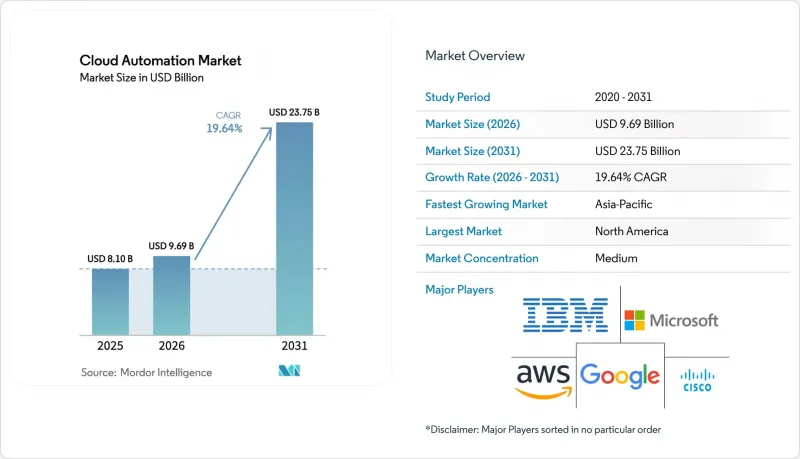
根據 Mordor Intelligence 估計,到 2026 年,雲端自動化市值將達到 96.9 億美元,高於 2025 年的 81 億美元,預計到 2031 年將達到 237.5 億美元。
預計從 2026 年到 2031 年,其複合年成長率將達到 19.64%。
本報告按部署模式(公共雲端、私有雲端、其他)、最終用戶產業(銀行、金融服務和保險、醫療保健、其他)、組織規模(中小企業、其他)、工作負載/流程類型(基礎設施配置、應用程式部署、其他)和地區(北美、南美、歐洲、其他)進行細分。市場預測以美元計價。
全球雲端自動化市場趨勢與洞察
多混合雲端架構的普及
多重雲端和混合雲端策略正從風險規避演變為競爭優勢,預計到2024年,許多公司將跨多個雲端供應商營運。這種架構轉變推動了對統一編配平台的需求,這些平台能夠在保持工作負載可移植性和柔軟性的同時,抽象化基礎架構的複雜性。隨著歐盟和亞太地區資料主權法規要求具備在地化處理能力,這一趨勢正在進一步加速,迫使企業採用能夠跨主權邊界無縫管理工作負載的地理分散式自動化框架。
DevOps 和 CI/CD 的採用正在推動「一切皆程式碼」的趨勢。
隨著大型企業擴大組建專門的平台團隊,平台工程正逐漸成為擴展 DevOps 實踐的關鍵策略。這種演變推動了對自助式自動化工具的需求,使開發人員能夠透過程式碼驅動的工作流程來配置基礎架構、部署應用程式和管理安全策略。此外,這一趨勢也為那些優先考慮提升開發人員體驗的中小型供應商開闢了新的道路。各組織正積極尋求這些敏捷的替代方案,以取代那些常常扼殺創新和敏捷性的傳統單體平台。
持續存在的隱私和安全漏洞
隨著分散式基礎設施環境中攻擊面的不斷擴大,雲端自動化平檯面臨日益嚴峻的安全挑戰。根據雲端安全聯盟 (CSA) 2024 年的報告,與自動化相關的安全事件增加了 47%,主要原因是存取策略配置錯誤和金鑰管理不善。這種漏洞令風險規避型企業,尤其是金融服務和醫療保健行業的企業,感到擔憂,因為監管合規要求對安全漏洞採取零容忍態度。
細分市場分析
儘管預計到2025年公共雲端仍將維持46.95%的最大市場佔有率,但混合雲端自動化正處於最快的成長軌道,預計到2031年將以19.98%的複合年成長率成長。這種差異反映出企業在策略上優先考慮工作負載的柔軟性,而非依賴單一供應商,尤其是在不同司法管轄區的資料居住要求日益嚴格的情況下。公共雲端自動化受益於超大規模資料中心業者雲端服務商對人工智慧驅動的最佳化能力的投資,而私有雲端領域則專注於滿足需要空氣間隙安全性和超低延遲效能的特殊用例。
從部署模式來看,明顯的區域趨勢顯現出來。北美企業出於成本效益的考慮,更傾向於公共雲端自動化,而歐洲企業則優先考慮混合部署方案,以滿足GDPR合規要求。私有雲端自動化雖然規模最小,但在資料主權高於成本的高度監管產業中,它仍然發揮著至關重要的作用。邊緣運算的整合正在模糊傳統的部署邊界,推動了對能夠跨不同基礎設施環境編配工作負載的統一自動化平台的需求。
在「工業4.0」計劃的推動下,製造業正成為成長最快的終端用戶領域,該計劃要求在整個生產環境中實現即時自動化,預計到2031年複合年成長率將達到20.52%。智慧工廠部署需要從邊緣到雲端的編配能力,以管理數千個物聯網設備,同時保持關鍵控制系統的毫秒響應時間。 IT和電信產業受惠於早期自動化應用以及持續的基礎設施現代化需求,預計到2025年將維持最大的市場佔有率,達到26.35%。
隨著法律規範的演進以適應基於雲端的患者資料處理,醫療保健產業的自動化應用正在加速推進,預計到2025年,符合HIPAA標準的自動化平台將實現18.12%的成長率。在銀行、金融和保險(BFSI)領域,自動化應用則較為謹慎,優先考慮安全性和合規性自動化,而非營運效率的提升。零售業的自動化著重於最佳化供應鏈和提升客戶體驗,而其他行業則在探索行業特定的應用案例,例如管理能源網路和協調運輸物流。
區域分析
預計到2025年,北美將佔據32.75%的市場佔有率,這主要得益於其成熟的雲端基礎設施以及企業對自動化框架的早期採用。該地區的成長軌跡反映了超大規模資料中心業者雲端服務商對人工智慧驅動的最佳化能力的投資,以及財富500強企業對平台工程方法的廣泛應用。特別是加拿大企業,正專注於混合雲端自動化,以滿足資料居住要求,同時維持跨境營運效率。墨西哥新興製造業企業正在推動對能夠與北美供應鏈整合的工業4.0自動化解決方案的需求,這為面向跨境營運的專業自動化平台創造了商機。
預計到2031年,亞太地區將以20.64%的複合年成長率成長,成為全球雲端自動化應用的主要成長引擎。中國對本土雲端平台的重視,推動了對能夠在其獨特法規環境下運作的自動化工具的需求。同時,日本勞動力老化加速了傳統工業領域的自動化技術普及。印度的IT服務業正發揮全球自動化中心的作用,本土供應商在為國際市場開發專業平台的同時,也滿足了對成本敏感的當地企業的需求。東南亞國家正受益於政府的數位化舉措,這些舉措要求公共部門營運採用「雲端優先」模式。
歐洲自動化技術的普及反映了該地區的兩大關鍵優先事項:合規性和技術自主權。 GDPR 和新的人工智慧法規正在影響平台的選擇標準。德國的「工業4.0」舉措正在推動製造業對自動化的需求,而英國脫歐後的監管環境則為能夠跨多個司法管轄區合規的自動化平台提供了機會。該地區對永續技術實踐的重視,也使得那些能夠透過最佳化資源利用和提高能源效率來展現可衡量的環境效益的自動化平台更受青睞。
其他好處
- Excel格式的市場預測(ME)表
- 3個月的分析師支持
目錄
第1章:引言
- 研究假設和市場定義
- 調查範圍
第2章:調查方法
第3章執行摘要
第4章 市場狀況
- 市場概覽
- 市場促進因素
- 對低成本儲存和高速資料存取的需求日益成長。
- 增加對雲端原生自動化工具集的研發投入
- 多混合雲端架構的普及
- DevOps 和 CI/CD 的採用正在推動「一切皆程式碼」的趨勢。
- 透過 FinOps 自動化實現即時雲端成本管治
- 面向工業4.0的微型資料中心邊緣到雲端自動化
- 市場限制因素
- 持續存在的隱私和安全漏洞
- 遺留基礎設施技術債
- 遵守跨境法規的障礙
- 嚴重缺乏編寫「策略即程式碼」腳本的技能
- 產業價值鏈分析
- 監理情勢
- 宏觀經濟因素對市場的影響
- 技術展望
- 五力分析
- 供應商的議價能力
- 買方的議價能力
- 新進入者的威脅
- 替代品的威脅
- 競爭公司之間的競爭
- 投資分析
第5章 市場規模與成長預測
- 按部署模式
- 公共雲端
- 私有雲端
- 混合雲端
- 按最終用戶行業分類
- BFSI
- 衛生保健
- 資訊科技/通訊
- 製造業
- 零售
- 其他終端用戶產業
- 按組織規模
- 中小企業
- 大公司
- 依工作負載流程類型
- 基礎架構配置
- 應用程式部署
- 安全合規性
- 監控和績效管理
- 按地區
- 北美洲
- 美國
- 加拿大
- 墨西哥
- 南美洲
- 巴西
- 阿根廷
- 其他南美國家
- 歐洲
- 德國
- 英國
- 法國
- 義大利
- 西班牙
- 俄羅斯
- 其他歐洲國家
- 亞太地區
- 中國
- 日本
- 印度
- 韓國
- 東南亞
- 其他亞太國家
- 中東和非洲
- 中東
- 沙烏地阿拉伯
- 阿拉伯聯合大公國
- 其他中東國家
- 非洲
- 南非
- 埃及
- 其他非洲國家
- 中東
- 北美洲
第6章 競爭情勢
- 市場集中度
- 策略趨勢
- 市佔率分析
- 公司簡介
- Amazon Web Services, Inc.
- Microsoft Corporation(Azure)
- Google LLC(Google Cloud Platform)
- IBM Corporation
- Oracle Corporation
- Cisco Systems, Inc.
- Hewlett Packard Enterprise Company
- Citrix Systems, Inc.
- Alibaba Cloud(Alibaba Group Holding Ltd.)
- Red Hat, Inc.
- ServiceNow, Inc.
- Puppet Labs, LLC
- Chef Software, Inc.
- HashiCorp, Inc.
- BMC Software, Inc.
- Micro Focus International plc
- Splunk Inc.
- Dynatrace LLC
- Turbonomic, Inc.
- CloudBolt Software, Inc.
- Morpheus Data, LLC
- Nutanix, Inc.
- Scalr, Inc.
- Opex Software, Inc.
第7章 市場機會與未來展望
According to Mordor Intelligence, the cloud automation market size in 2026 is estimated at USD 9.69 billion, growing from 2025 value of USD 8.10 billion with 2031 projections showing USD 23.75 billion, growing at 19.64% CAGR over 2026-2031.
This report is Segmented by Deployment Model (Public Cloud, Private Cloud, and More), End-User Industry (BFSI, Healthcare, and More), Organization Size (Small and Medium Enterprises, and More), Workload/Process Type (Infrastructure Provisioning, Application Deployment, and More), and Geography (North America, South America, Europe, and More). The Market Forecasts are Provided in Terms of Value (USD).
Global Cloud Automation Market Trends and Insights
Proliferation of Multi-/Hybrid-Cloud Architectures
Multi-cloud and hybrid-cloud strategies have evolved beyond risk mitigation to become competitive differentiators, with several enterprises expected to operate across multiple cloud providers by 2024. This architectural shift drives demand for unified orchestration platforms that can abstract infrastructure complexity while maintaining workload portability and flexibility. The trend accelerates as data sovereignty regulations in the EU and Asia-Pacific require localized processing capabilities, forcing enterprises to deploy geographically distributed automation frameworks that can seamlessly manage workloads across sovereign boundaries.
DevOps and CI/CD Adoption Driving "Everything-as-Code"
As large enterprises increasingly form dedicated platform teams, platform engineering emerges as the dominant strategy for scaling DevOps practices. This evolution has spurred a heightened demand for self-service automation tools, empowering developers to provision infrastructure, deploy applications, and oversee security policies via code-driven workflows. Furthermore, this trend is paving the way for smaller automation vendors, who prioritize enhancing the developer experience. Organizations are actively seeking these nimble alternatives, moving away from traditional monolithic platforms that often stifle innovation and agility.
Persistent Privacy and Security Vulnerabilities
Cloud automation platforms are facing escalating security challenges as the attack surface expands across distributed infrastructure environments. The 2024 Cloud Security Alliance report documented a 47% increase in automation-related security incidents, primarily attributed to misconfigured access policies and inadequate management of secrets. This vulnerability creates hesitation among risk-averse enterprises, particularly in financial services and healthcare sectors, where regulatory compliance requirements demand zero-tolerance approaches to security breaches.
Other drivers and restraints analyzed in the detailed report include:
- FinOps Automation for Real-Time Cloud Cost Governance
- Accelerated Research and Development Spending on Cloud-Native Automation Tool-Sets
- Acute Skills Gap in Policy-as-Code Scripting
For complete list of drivers and restraints, kindly check the Table Of Contents.
Segment Analysis
Hybrid cloud automation commands the fastest growth trajectory, with a 19.98% CAGR through 2031, despite the public cloud maintaining the largest market share at 46.95% in 2025. This divergence reflects enterprises' strategic preference for workload flexibility over single-vendor dependencies, particularly as data residency requirements intensify across jurisdictions. Public cloud automation benefits from hyperscaler investments in AI-driven optimization capabilities, while private cloud segments serve specialized use cases requiring air-gapped security or ultra-low latency performance.
The deployment model landscape reveals distinct regional preferences, with North American enterprises favoring public cloud automation for cost efficiency, while European organizations prioritize hybrid approaches to address GDPR compliance requirements. Private cloud automation, although representing the smallest segment, remains relevant in highly regulated industries where data sovereignty concerns outweigh cost considerations. Edge computing integration is increasingly blurring traditional deployment boundaries, creating a demand for unified automation platforms that can orchestrate workloads across diverse infrastructure environments.
Manufacturing emerges as the fastest-growing end-user segment, with a 20.52% CAGR through 2031, driven by Industry 4.0 initiatives that require real-time automation across production environments. Smart factory implementations demand edge-to-cloud orchestration capabilities that can manage thousands of IoT devices while maintaining millisecond response times for critical control systems. IT and telecom maintain the largest market share at 26.35% in 2025, benefiting from early automation adoption and continuous infrastructure modernization requirements.
Healthcare automation adoption is accelerating as regulatory frameworks evolve to accommodate cloud-based patient data processing, with HIPAA-compliant automation platforms experiencing an 18.12% growth rate in 2025. BFSI segments demonstrate measured adoption patterns, prioritizing security and compliance automation over operational efficiency gains. Retail automation focuses on supply chain optimization and enhancing the customer experience, while other industries explore vertical-specific use cases, ranging from energy grid management to transportation logistics coordination.
Complete Report Scope:
- By Deployment Model
- Public Cloud
- Private Cloud
- Hybrid Cloud
- By End-user Industry
- BFSI
- Healthcare
- IT and Telecom
- Manufacturing
- Retail
- Other End-user Industry
- By Organization Size
- Small and Medium Enterprises (SMEs)
- Large Enterprises
- By Workload / Process Type
- Infrastructure Provisioning
- Application Deployment
- Security and Compliance
- Monitoring and Performance Management
- By Geography
- North America
- United States
- Canada
- Mexico
- South America
- Brazil
- Argentina
- Rest of South America
- Europe
- Germany
- United Kingdom
- France
- Italy
- Spain
- Russia
- Rest of Europe
- Asia-Pacific
- China
- Japan
- India
- South Korea
- South-East Asia
- Rest of Asia-Pacific
- Middle East and Africa
- Middle East
- Saudi Arabia
- United Arab Emirates
- Rest of Middle East
- Africa
- South Africa
- Egypt
- Rest of Africa
- Middle East
- North America
Geography Analysis
North America is expected to command a 32.75% market share in 2025, leveraging its mature cloud infrastructure and early enterprise adoption of automation frameworks. The region's growth trajectory reflects hyperscaler investments in AI-driven optimization capabilities and the proliferation of platform engineering practices among Fortune 500 companies. Canadian enterprises, in particular, focus on hybrid cloud automation to address data residency requirements while maintaining cross-border operational efficiency. Mexico's emerging manufacturing sector drives demand for Industry 4.0 automation solutions that can integrate with North American supply chains, creating opportunities for specialized automation platforms targeting cross-border operations.
The Asia-Pacific region's 20.64% CAGR through 2031 positions it as the primary growth engine for global cloud automation adoption. China's emphasis on domestic cloud platforms drives demand for automation tools that can operate within the country's unique regulatory environment, while Japan's aging workforce accelerates the adoption of automation across traditional industries. India's IT services sector serves as a global automation hub, with domestic vendors developing specialized platforms for international markets while addressing the cost-sensitive requirements of local enterprises. Southeast Asian economies benefit from government digitalization initiatives that mandate cloud-first approaches for public sector operations.
Europe's automation adoption reflects the region's dual focus on regulatory compliance and technological sovereignty, with GDPR and emerging AI regulations shaping platform selection criteria. Germany's Industrie 4.0 initiative drives demand for manufacturing automation, while the UK's post-Brexit regulatory landscape creates opportunities for automation platforms that can manage compliance across multiple jurisdictions. The region's commitment to sustainable technology practices favors automation platforms that can demonstrate measurable environmental benefits through optimized resource utilization and energy efficiency improvements.
- Amazon Web Services, Inc.
- Microsoft Corporation (Azure)
- Google LLC (Google Cloud Platform)
- IBM Corporation
- Oracle Corporation
- Cisco Systems, Inc.
- Hewlett Packard Enterprise Company
- Citrix Systems, Inc.
- Alibaba Cloud (Alibaba Group Holding Ltd.)
- Red Hat, Inc.
- ServiceNow, Inc.
- Puppet Labs, LLC
- Chef Software, Inc.
- HashiCorp, Inc.
- BMC Software, Inc.
- Micro Focus International plc
- Splunk Inc.
- Dynatrace LLC
- Turbonomic, Inc.
- CloudBolt Software, Inc.
- Morpheus Data, LLC
- Nutanix, Inc.
- Scalr, Inc.
- Opex Software, Inc.
Additional Benefits:
- The market estimate (ME) sheet in Excel format
- 3 months of analyst support
TABLE OF CONTENTS
1 INTRODUCTION
- 1.1 Study Assumptions and Market Definition
- 1.2 Scope of the Study
2 RESEARCH METHODOLOGY
3 EXECUTIVE SUMMARY
4 MARKET LANDSCAPE
- 4.1 Market Overview
- 4.2 Market Drivers
- 4.2.1 Surging need for low-cost storage and faster data access
- 4.2.2 Accelerated research and development spending on cloud-native automation tool-sets
- 4.2.3 Proliferation of multi-/hybrid-cloud architectures
- 4.2.4 DevOps and CI/CD adoption driving -everything-as-code-
- 4.2.5 FinOps automation for real-time cloud cost governance
- 4.2.6 Edge-to-cloud automation for Industry 4.0 micro-DCs
- 4.3 Market Restraints
- 4.3.1 Persistent privacy and security vulnerabilities
- 4.3.2 Legacy infrastructure technical debt
- 4.3.3 Cross-border regulatory compliance hurdles
- 4.3.4 Acute skills gap in policy-as-code scripting
- 4.4 Industry Value Chain Analysis
- 4.5 Regulatory Landscape
- 4.6 Impact of Macroeconomic Factors on the Market
- 4.7 Technological Outlook
- 4.8 Porter-s Five Forces Analysis
- 4.8.1 Bargaining Power of Suppliers
- 4.8.2 Bargaining Power of Buyers
- 4.8.3 Threat of New Entrants
- 4.8.4 Threat of Substitutes
- 4.8.5 Intensity of Competitive Rivalry
- 4.9 Investment Analysis
5 MARKET SIZE AND GROWTH FORECASTS (VALUE)
- 5.1 By Deployment Model
- 5.1.1 Public Cloud
- 5.1.2 Private Cloud
- 5.1.3 Hybrid Cloud
- 5.2 By End-user Industry
- 5.2.1 BFSI
- 5.2.2 Healthcare
- 5.2.3 IT and Telecom
- 5.2.4 Manufacturing
- 5.2.5 Retail
- 5.2.6 Other End-user Industry
- 5.3 By Organization Size
- 5.3.1 Small and Medium Enterprises (SMEs)
- 5.3.2 Large Enterprises
- 5.4 By Workload / Process Type
- 5.4.1 Infrastructure Provisioning
- 5.4.2 Application Deployment
- 5.4.3 Security and Compliance
- 5.4.4 Monitoring and Performance Management
- 5.5 By Geography
- 5.5.1 North America
- 5.5.1.1 United States
- 5.5.1.2 Canada
- 5.5.1.3 Mexico
- 5.5.2 South America
- 5.5.2.1 Brazil
- 5.5.2.2 Argentina
- 5.5.2.3 Rest of South America
- 5.5.3 Europe
- 5.5.3.1 Germany
- 5.5.3.2 United Kingdom
- 5.5.3.3 France
- 5.5.3.4 Italy
- 5.5.3.5 Spain
- 5.5.3.6 Russia
- 5.5.3.7 Rest of Europe
- 5.5.4 Asia-Pacific
- 5.5.4.1 China
- 5.5.4.2 Japan
- 5.5.4.3 India
- 5.5.4.4 South Korea
- 5.5.4.5 South-East Asia
- 5.5.4.6 Rest of Asia-Pacific
- 5.5.5 Middle East and Africa
- 5.5.5.1 Middle East
- 5.5.5.1.1 Saudi Arabia
- 5.5.5.1.2 United Arab Emirates
- 5.5.5.1.3 Rest of Middle East
- 5.5.5.2 Africa
- 5.5.5.2.1 South Africa
- 5.5.5.2.2 Egypt
- 5.5.5.2.3 Rest of Africa
- 5.5.5.1 Middle East
- 5.5.1 North America
6 COMPETITIVE LANDSCAPE
- 6.1 Market Concentration
- 6.2 Strategic Moves
- 6.3 Market Share Analysis
- 6.4 Company Profiles (includes Global-level Overview, Market-level Overview, Core Segments, Financials as available, Strategic Information, Market Rank/Share, Products and Services, Recent Developments)
- 6.4.1 Amazon Web Services, Inc.
- 6.4.2 Microsoft Corporation (Azure)
- 6.4.3 Google LLC (Google Cloud Platform)
- 6.4.4 IBM Corporation
- 6.4.5 Oracle Corporation
- 6.4.6 Cisco Systems, Inc.
- 6.4.7 Hewlett Packard Enterprise Company
- 6.4.8 Citrix Systems, Inc.
- 6.4.9 Alibaba Cloud (Alibaba Group Holding Ltd.)
- 6.4.10 Red Hat, Inc.
- 6.4.11 ServiceNow, Inc.
- 6.4.12 Puppet Labs, LLC
- 6.4.13 Chef Software, Inc.
- 6.4.14 HashiCorp, Inc.
- 6.4.15 BMC Software, Inc.
- 6.4.16 Micro Focus International plc
- 6.4.17 Splunk Inc.
- 6.4.18 Dynatrace LLC
- 6.4.19 Turbonomic, Inc.
- 6.4.20 CloudBolt Software, Inc.
- 6.4.21 Morpheus Data, LLC
- 6.4.22 Nutanix, Inc.
- 6.4.23 Scalr, Inc.
- 6.4.24 Opex Software, Inc.
7 MARKET OPPORTUNITIES AND FUTURE OUTLOOK
- 7.1 White-space and Unmet-Need Assessment

 雲端整合軟體市場-2026-2032年全球市場預測
 社區關係管理市場預測至2034年—按解決方案類型、部署模式、技術、應用、最終用戶和地區分類的全球分析雲端自動化市場預測至 2034 年—按組件、部署模型、組織規模、功能、最終用戶和地區分類的全球分析
 協會管理軟體市場規模、佔有率和成長分析:按部署類型、組織類型、應用、企業規模、提供的服務、最終用戶和地區分類-2026-2033年產業預測
 零售和酒店業的薪資核算軟體:市場佔有率分析、行業趨勢和統計數據以及成長預測(2026-2031 年)雲端整合軟體:市場佔有率分析、產業趨勢與統計、成長預測(2026-2031)
 雲端整合軟體市場規模、佔有率和趨勢分析報告:按類型、企業規模、應用、地區和細分市場預測(2026-2033 年)社群管理應用市場預測至2034年-全球分析(按組件、部署模式、組織規模、技術、應用、最終用戶和地區分類)
 2026年全球雲端整合軟體市場報告2026年全球雲端目錄服務軟體市場報告