


 |
市場調查報告書
商品編碼
2073309
零售和酒店業的薪資核算軟體:市場佔有率分析、行業趨勢和統計數據以及成長預測(2026-2031 年)Payroll Software In Retail and Hospitality - Market Share Analysis, Industry Trends & Statistics, Growth Forecasts (2026 - 2031) |
||||||

※ 本網頁內容可能與最新版本有所差異。詳細情況請與我們聯繫。
根據 Mordor Intelligence 預測,2025 年零售和酒店業薪資核算軟體市場規模預計將達到 23.4 億美元,2026 年至 2031 年的複合年成長率將達到 9.94%,到 2031 年將分別達到 25.3 億美元和 40.6 億美元。
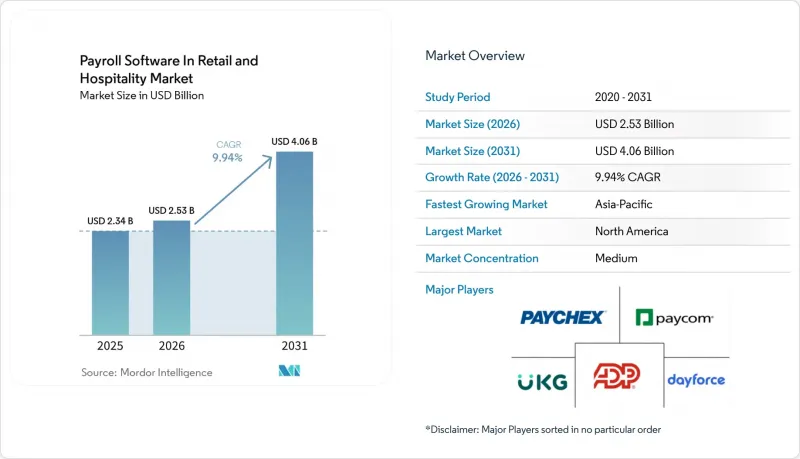
本報告按元件(軟體和服務)、組織規模(大型企業和中小企業)、部署模式(雲端和本地部署)、功能(核心薪資核算處理、考勤管理、薪資分析和報告、稅務和合規管理以及其他功能)和地區進行細分。市場預測以美元(USD)為單位。
全球零售與酒店業薪資核算軟體市場趨勢與洞察
雲端薪資核算解決方案的普及應用日益廣泛
薪資核算不僅僅是一種低成本的IT選擇,它正逐漸成為擁有多家門市的零售商和飯店企業的實用營運標準。零售和酒店業薪資核算軟體市場正受益於這一轉變,因為雲端系統支援跨地域的即時同步、便捷的更新以及現場員工和管理人員的行動存取。 UKG表示,其「One View」跨國薪資核算套件支援120種貨幣和150多個國家的薪資核算,這充分展現了雲端架構為擁有分散式員工隊伍的雇主帶來的規模經濟效益。這意味著零售和酒店業薪資核算軟體市場正因合規性和營運規範的雙重推動而蓬勃發展,這使得優先採用雲端技術的供應商在短期內擁有明顯的優勢。
零售和酒店業的合規性日益複雜。
零售和餐飲業的薪資核算必須應對小費、加班規則、最低工資要求以及各地區報告標準的不斷變化。分散或人工的薪資核算系統難以跟上頻繁的規則變更,因此,零售和餐飲業的薪資核算軟體正日益普及。 Strada Global 的一份報告指出,到 2025 年,薪資複雜度評分將平均上升 5%,凸顯了跨薪資核算管理薪資核算法規的難度日益增加。在美國,國稅局 (IRS) 2025-69 號通知確認,從 2026課稅年度開始,合格小費和合格加班費需要單獨申報 W-2 表格。這迫使供應商重新設計其小費追蹤、扣繳和報告邏輯。在法國,薪資核算,例如夜班工資、輪班工資、週日和節日工資,以及根據 CCN HCR 框架將餐費視為實物福利的處理方式。這提升了專業薪資核算引擎的價值。因此,在零售和酒店業,擁有深厚合規專業知識的供應商在薪資核算軟體方面具有優勢,而小規模的供應商則面臨越來越大的壓力,需要迎頭趕上。
小規模飯店企業對成本高度敏感,利潤率較低。
小規模餐飲企業對價格仍然高度敏感,即使營運效益顯而易見,也難以推廣使用薪資核算軟體。零售和餐飲業的薪資核算軟體尤其面臨這一障礙,因為餐廳、咖啡館和小規模飯店的利潤率低,難以負擔新的月度訂閱費用。 PayFit 指出,餐廳的稅前淨利約為 3-5%,但人事費用通常佔銷售額的 30-40%,幾乎沒有剩餘預算用於軟體投資。這種壓力導致小規模企業主傾向於選擇外包薪資核算、會計主導的工作流程或基礎的數位化工具,而不是功能豐富的薪資核算平台。對於零售和餐飲業的薪資核算軟體而言,這意味著供應商需要提供入門價格、模組化套餐配置以及清晰的投資回報前景,才能鼓勵員工人數少於 50 人的公司採用。
細分市場分析
到2025年,軟體將佔據77.48%的市場佔有率,繼續成為零售和酒店業薪資核算軟體最大的收入來源。這一地位反映了訂閱式薪資核算引擎的核心作用,這些引擎將處理、合規和員工資料整合在一個統一的環境中。買家仍然將軟體層視為“記錄系統”,尤其是在他們需要嚴格控制考勤記錄、稅務處理和報告的準確性時。這種買家行為也解釋了為什麼高度整合的平台仍然佔據零售和酒店行業薪資核算軟體市場的大部分支出。
預計到2031年,服務板塊將以10.68%的複合年成長率成長,成為零售和酒店業薪資核算軟體市場中成長最快的部分。這一成長主要由薪資核算管理外包、合規支援和供應商主導的營運驅動,而非一次性部署。據SD Worx公司稱,該公司每月為超過95,000家客戶處理超過600萬筆薪資核算,其中包括Hesperia和Ibis等西班牙和法國酒店品牌,這充分體現了其服務深度如何支持高容量的薪資核算環境。這種轉變正在改變零售和酒店業「購買」和「內部開發」薪資核算軟體之間的平衡,因為工作安排複雜且人力資源團隊規模有限的雇主越來越重視風險轉移和軟體所有權。隨著供應商直接掌控報告、計算和本地合規運營,客戶留存率不斷提高,轉換競爭對手的難度也隨之增加。因此,儘管軟體仍佔據大部分收入,但服務板塊的成長速度更快。因此,零售和酒店業的薪資核算軟體市場正朝著以軟體為核心平台,並透過服務不斷提升客戶價值的模式轉變。
到2025年,大型企業將佔據零售和酒店行業薪資核算軟體市場64.92%的佔有率,這反映了該行業薪資核算的複雜性和高合約金額。大型零售商和飯店集團需要具備跨國管理能力、整合員工資料以及與相關人力資源系統可靠整合的功能。此外,管理更大的員工隊伍、更多的門市以及更嚴格的合規要求,也使得對薪資核算架構的大量投資成為必要。這確保了大型企業客戶仍然是零售和酒店薪資核算軟體收入的核心來源。
同時,預計到2031年,中小企業(SME)的複合年成長率將達到10.12%,這意味著客戶群正在快速擴張。這一成長主要得益於結合了雲端原生定價、行動員工自助薪資核算和可操作的合規自動化功能的產品。 UKG於2025年12月收購Inova Payroll,顯示主要供應商將外包和中小企業薪資核算視為策略成長領域,而不僅僅是輔助業務。 Inova Payroll為超過4000家擁有龐大第一線員工隊伍的中小企業提供支援的經驗便印證了這一點。隨著企業級供應商進軍下游市場,以及新參與企業以更豐富的產品組合進入高階市場,零售和旅館業的薪資核算軟體也正在適應這一轉變。傳統上,中小企業買家最難獲得傳統平台的支持,但這種差距正在縮小。這一轉變表明,儘管企業合約仍然是主要的收入來源,但到2031年,零售和酒店業的薪資核算軟體市場仍將保持更廣泛的成長基礎。此外,除了功能豐富性之外,價格、實施速度和易用性等因素對中小企業來說也變得越來越重要,導致這些領域的競爭壓力增加。
區域分析
2025年,北美在零售和酒店業薪資核算軟體市場佔有35.74%的佔有率,是該地區最大的市場貢獻者。該地區受益於成熟的薪資核算軟體生態系統、密集的門市和設施網路,以及對小時工排班工具的廣泛應用。美國仍然是重要的收入來源,這得益於其複雜的工資和加班法規,以及雇主普遍採用小費和輪班制度。美國國稅局2025-69號通知引入了從2026課稅年度開始對「合格小費」和「合格加班費」的單獨申報要求,這立即增加了對薪資核算系統更新的需求。在加拿大,由於各省薪資核算的差異以及穩定的長期就業基礎,預計市場需求將保持穩定;而墨西哥的市場滲透率相對較低,因為基於雲端的薪資核算應用仍處於起步階段。
歐洲的獨特之處不在於其規模,而是其合規要求的密集程度,這使得專業薪資核算平台發揮了至關重要的作用。在法國,飯店、咖啡館和餐廳必須根據《法國雇主福利法》(CCN HCR)框架,將夜班工資、輪班工資、週日和節日工資以及餐補視為實物福利進行薪資核算。這迫使雇主實施專門設計或高度客製化的薪資核算系統。此外,法國強制提交數位薪資報告(DSN),並鼓勵準確及時地提交,進一步增強了採用現代薪資核算軟體的營運優勢。這些因素共同推動了零售和餐飲業對薪資核算軟體的整體需求,尤其是在產業協議直接規範薪資規則的領域,趨勢更為顯著。
亞太地區是成長最快的地區,預計到2031年,零售和旅館業薪資核算軟體市場將以11.06%的複合年成長率成長。這一成長主要得益於服務業勞動力市場的正常化、酒店營運中數位化解決方案的日益普及以及對行動優先薪資核算平台的日益成長的興趣。印度就是一個典型的例子,當地客製化的產品已經將薪資核算與公積金(PF)、員工社會保險(ESI)和預扣稅(TDS)處理功能整合在一起,滿足了飯店雇主對經濟實惠且實用的合規工具的需求。此外,全部區域較高的員工離職率也提升了快速入職和員工存取工具與薪資核算整合的價值。因此,儘管北美目前仍佔據銷售額榜首,但亞太地區的零售和酒店業薪資核算軟體市場成長速度超過了其他更成熟的地區。在這些主要地區之外,市場普及程度仍然不均衡,但旅遊業的活性化和長期就業機會的增加將繼續支撐中期需求。
其他好處:
- Excel格式的市場預測(ME)表
- 3個月的分析師支持
目錄
第1章:引言
- 研究假設和市場定義
- 調查範圍
第2章:調查方法
第3章執行摘要
第4章 市場狀況
- 市場概覽
- 市場促進因素
- 雲端薪資核算解決方案的普及應用日益廣泛
- 零售和酒店業的合規性日益複雜。
- 中小企業對整合式人力資源和薪資管理解決方案的需求日益成長。
- 新冠疫情後的復甦加速了勞動力的數位轉型。
- 跨國季節性就業模式的激增正在推動全球即時薪資核算。
- 擴大飯店連鎖企業的按需薪資和小費管理能力。
- 市場限制因素
- 小規模飯店企業對成本高度敏感,利潤率較低。
- 關於基於SaaS的薪資核算系統的資料安全和隱私問題
- POS 和考勤機的分散生態系統阻礙了與薪資核算的無縫整合。
- 區域旅遊目的地網路普及率低,阻礙了雲端服務的普及。
- 產業價值鏈分析
- 監理情勢
- 技術展望
- 宏觀經濟因素對市場的影響
- 波特五力分析
- 價格分析
第5章 市場規模與成長預測
- 按組件
- 軟體
- 服務
- 按組織規模
- 大公司
- 小型企業
- 部署模式
- 雲
- 現場
- 功能性別
- 核心薪資核算處理
- 考勤管理
- 薪資分析與報告編制
- 稅務和合規管理
- 其他功能
- 按地區
- 北美洲
- 美國
- 加拿大
- 墨西哥
- 南美洲
- 巴西
- 阿根廷
- 其他南美國家
- 歐洲
- 德國
- 英國
- 法國
- 西班牙
- 義大利
- 俄羅斯
- 其他歐洲國家
- 亞太地區
- 中國
- 印度
- 日本
- 韓國
- 澳洲和紐西蘭
- 其他亞太國家
- 中東
- 沙烏地阿拉伯
- 阿拉伯聯合大公國
- 土耳其
- 其他中東國家
- 非洲
- 南非
- 奈及利亞
- 埃及
- 其他非洲國家
- 北美洲
第6章 競爭情勢
- 市場集中度
- 策略趨勢
- 市佔率分析
- 公司簡介
- ADP LLC
- Paychex Inc.
- Paycor Inc.
- Ceridian HCM Holding Inc.
- UKG Inc.
- Paycom Software Inc.
- Gusto Inc.
- Square Inc.
- Intuit Inc.
- Oracle Corporation
- SAP SE
- Workday Inc.
- BambooHR LLC
- Zenefits Inc.
- Rippling People Center Inc.
- Namely Inc.
- Deel Inc.
- Papaya Global Ltd.
- HiBob Inc.
- CloudPay Inc.
- Justworks Inc.
- Patriot Software Company LLC
- Paylocity Holding Corporation
- Automatic Payroll Systems Inc.
- Sage Group plc
- Xero Limited
第7章 市場機會與未來展望
According to Mordor Intelligence, the payroll software in retail and hospitality market size was USD 2.34 billion in 2025 and is projected to reach USD 2.53 billion and USD 4.06 billion by 2031, at a CAGR of 9.94% from 2026 to 2031.
This report is Segmented by Component (Software, and Services), Organization Size (Large Enterprises, and SMEs), Deployment Mode (Cloud, and On-Premises), Functionality (Core Payroll Processing, Time and Attendance Management, Payroll Analytics and Reporting, Tax and Compliance Management, and Other Functionalities), and Geography. The Market Forecasts are Provided in Terms of Value (USD).
Global Payroll Software In Retail and Hospitality Market Trends and Insights
Growing Adoption Of Cloud-Based Payroll Solutions
Cloud payroll has become a practical operating standard for multi-location retailers and hospitality groups, not just a lower-cost IT option. The payroll software in retail and hospitality market is benefiting from this shift because cloud systems support real-time synchronization across outlets, easier updates, and mobile access for frontline workers and managers. UKG stated that its One View multi-country payroll suite supports payroll across 120 currencies and more than 150 countries, which shows the scale advantage that cloud architecture now offers to employers with distributed workforces. This means the payroll software in retail and hospitality market is being pushed by compliance and operating discipline at the same time, which gives cloud-first vendors a clear near-term advantage.
Increasing Compliance Complexity In Retail And Hospitality
Retail and hospitality payroll must absorb constant changes in tip treatment, overtime rules, minimum wage requirements, and location-specific filing standards. The payroll software in retail and hospitality market is gaining support from this pressure because fragmented or manual payroll setups are much less able to keep pace with frequent rule changes. Strada Global reported that per-country payroll complexity scores rose by an average of 5% in 2025, which confirms that payroll regulation is becoming more difficult to manage across markets. In the United States, IRS Notice 2025-69 confirmed separate W-2 reporting for qualified tips and qualified overtime compensation starting with the 2026 tax year, which forces vendors to redesign tip-tracking, withholding, and reporting logic. In France, hospitality payroll must also account for sector-specific calculations such as night work premiums, split-shift allowances, Sunday and holiday pay, and benefit-in-kind meal treatment under the CCN HCR framework, which raises the value of specialized payroll engines. The payroll software in retail and hospitality market is therefore favoring providers with dedicated compliance engineering depth, while smaller vendors face growing pressure to keep up.
High Cost Sensitivity And Narrow Margins In Small Hospitality Businesses
Small hospitality operators remain highly price sensitive, which limits payroll software penetration even when the operational case is clear. The payroll software in retail and hospitality market faces this friction most strongly, where restaurants, cafes, and small hotels operate with thin margins and limited room for new monthly subscriptions. PayFit noted that food and beverage establishments often run on pre-tax margins of 3-5%, while personnel costs can represent 30-40% of revenue, which leaves little discretionary budget for software spend. This pressure tends to push very small employers toward external payroll processing, accountant-led workflows, or basic digital tools instead of full-featured payroll platforms. For the payroll software in retail and hospitality market, that means vendors need entry-level pricing, modular packaging, and a clear payback story if they want stronger adoption below the 50-employee threshold.
Other drivers and restraints analyzed in the detailed report include:
- Rising Demand For Integrated HR And Payroll Suites Among SMEs
- Workforce Digitalization Accelerated By COVID-19 Recovery
- Data Security And Privacy Concerns Over SaaS Payroll
For complete list of drivers and restraints, kindly check the Table Of Contents.
Segment Analysis
Software held 77.48% of the market in 2025, which kept it as the leading revenue component across the payroll software in retail and hospitality market. That position reflects the central role of subscription-based payroll engines that combine processing, compliance support, and workforce data in one environment. Buyers continue to treat the software layer as the system of record, especially when they need strong control over time capture, tax treatment, and reporting accuracy. The same buyer behavior also explains why platforms with stronger integration depth still command the largest part of spending in the payroll software in retail and hospitality market.
The services segment is expanding at a 10.68% CAGR through 2031, which makes it the faster-growing component in the payroll software in retail and hospitality market size. Growth is being driven less by one-time implementation and more by managed payroll outsourcing, compliance support, and vendor-led operational execution. SD Worx stated that it processes more than 6 million payrolls each month across more than 95,000 clients, including hotel brands such as Hesperia and Ibis in Spain and France, which shows how service depth supports large-volume payroll environments. This shift changes the buy-versus-build balance in the payroll software in retail and hospitality industry because employers with complex schedules and limited HR teams increasingly value risk transfer as much as software ownership. Once a provider manages filings, calculations, and local compliance tasks directly, customer stickiness rises and replacement becomes harder. That is why services is growing faster even though software still anchors most revenue. The payroll software in retail and hospitality market is therefore moving toward a model where software creates the core platform and services deepen account value over time.
Large enterprises held 64.92% of the payroll software in retail and hospitality market share in 2025, which reflects their broader payroll complexity and higher contract values. Large retailers and hotel groups need multi-country support, consolidated workforce data, and dependable integration with adjacent HR systems. They also manage larger frontline headcounts, more locations, and heavier compliance exposure, which supports premium spending on payroll architecture. This keeps enterprise accounts central to revenue across the payroll software in retail and hospitality market.
At the same time, SMEs are projected to grow at a 10.12% CAGR through 2031, making them the faster-moving customer group. That growth is supported by cloud-native pricing, mobile employee self-service, and products that package payroll with practical compliance automation. UKG's December 2025 acquisition of Inova Payroll, which supported more than 4,000 SMBs with frontline-heavy workforces, showed that major vendors see outsourced and smaller business payroll as a strategic growth zone rather than a side segment. The payroll software in retail and hospitality industry is adjusting to this shift as enterprise vendors move downstream and newer entrants move upmarket with broader product bundles. SME buyers were historically the least well served by legacy platforms, but that gap is narrowing. This change should keep the payroll software in retail and hospitality market on a broader growth base through 2031, even as enterprise contracts remain the main revenue anchor. It also raises competitive pressure on pricing, onboarding speed, and ease of use, because these factors matter more to SMEs than feature depth alone.
Complete Report Scope:
- By Component
- Software
- Services
- By Organization Size
- Large Enterprises
- SMEs
- By Deployment Mode
- Cloud
- On-Premises
- By Functionality
- Core Payroll Processing
- Time and Attendance Management
- Payroll Analytics and Reporting
- Tax and Compliance Management
- Other Functionalities
- By Geography
- North America
- United States
- Canada
- Mexico
- South America
- Brazil
- Argentina
- Rest of South America
- Europe
- Germany
- United Kingdom
- France
- Spain
- Italy
- Russia
- Rest of Europe
- Asia-Pacific
- China
- India
- Japan
- South Korea
- Australia and New Zealand
- Rest of Asia-Pacific
- Middle East
- Saudi Arabia
- United Arab Emirates
- Turkey
- Rest of Middle East
- Africa
- South Africa
- Nigeria
- Egypt
- Rest of Africa
- North America
Geography Analysis
North America accounted for 35.74% of the payroll software in retail and hospitality market share in 2025, which made it the largest regional contributor. The region benefits from a mature payroll software ecosystem, dense store and property networks, and strong use of scheduling tools for hourly labor. The United States remains the main revenue center because it combines complex wage and overtime rules with a large base of tipped and shift-based employers. IRS Notice 2025-69 added another layer by confirming separate reporting requirements for qualified tips and qualified overtime compensation from the 2026 tax year, which immediately raised the need for payroll system updates. Canada adds steady demand through provincial payroll variation and a stable formal employment base, while Mexico presents a more underpenetrated opportunity where cloud payroll adoption is still building.
Europe stands out less for size than for compliance density, and that gives specialized payroll platforms a clear role. In France, payroll for hotels, cafes, and restaurants must account for night-shift premiums, split-shift allowances, Sunday and holiday pay, and benefit-in-kind meal calculations under the CCN HCR framework, which pushes employers toward purpose-built or heavily configured payroll systems. France also faces DSN filing demands that reward accurate and timely digital submission, reinforcing the operational case for modern payroll software. These conditions support software and service demand across the payroll software in retail and hospitality market, especially where sector agreements shape pay rules directly.
Asia-Pacific is the fastest-growing region, with the payroll software in retail and hospitality market size expected to expand at an 11.06% CAGR through 2031. Growth is supported by formalization in service labor, rising digital adoption in hospitality operations, and stronger interest in mobile-first payroll platforms. India is a key example because locally relevant products are already packaging payroll with PF, ESI, and TDS handling for hospitality employers that need practical compliance tools at accessible price points. The broader region also benefits from high frontline turnover, which increases the value of faster onboarding and payroll-linked worker access tools. The payroll software in retail and hospitality market is therefore moving faster in Asia-Pacific than in more mature regions, even though North America still leads in current revenue. Outside these core geographies, adoption remains more uneven, but growing tourism activity and formal employment expansion continue to support medium-term demand.
- ADP LLC
- Paychex Inc.
- Paycor Inc.
- Ceridian HCM Holding Inc.
- UKG Inc.
- Paycom Software Inc.
- Gusto Inc.
- Square Inc.
- Intuit Inc.
- Oracle Corporation
- SAP SE
- Workday Inc.
- BambooHR LLC
- Zenefits Inc.
- Rippling People Center Inc.
- Namely Inc.
- Deel Inc.
- Papaya Global Ltd.
- HiBob Inc.
- CloudPay Inc.
- Justworks Inc.
- Patriot Software Company LLC
- Paylocity Holding Corporation
- Automatic Payroll Systems Inc.
- Sage Group plc
- Xero Limited
Additional Benefits:
- The market estimate (ME) sheet in Excel format
- 3 months of analyst support
TABLE OF CONTENTS
1 INTRODUCTION
- 1.1 Study Assumptions and Market Definition
- 1.2 Scope of the Study
2 RESEARCH METHODOLOGY
3 EXECUTIVE SUMMARY
4 MARKET LANDSCAPE
- 4.1 Market Overview
- 4.2 Market Drivers
- 4.2.1 Growing Adoption of Cloud-Based Payroll Solutions
- 4.2.2 Increasing Compliance Complexity in Retail and Hospitality
- 4.2.3 Rising Demand for Integrated HR and Payroll Suites among SMEs
- 4.2.4 Workforce Digitalization Accelerated by COVID-19 Recovery
- 4.2.5 Surge in Multi-Country Seasonal Staffing Patterns Driving Real-Time Global Payroll
- 4.2.6 Expansion of On-Demand Pay and Tip Management Features in Hospitality Chains
- 4.3 Market Restraints
- 4.3.1 High Cost Sensitivity and Narrow Margins in Small Hospitality Businesses
- 4.3.2 Data Security and Privacy Concerns Over SaaS Payroll
- 4.3.3 Fragmented POS and Time-Clock Ecosystems Hindering Seamless Payroll Integration
- 4.3.4 Slow Internet Penetration in Rural Tourist Destinations Limits Cloud Adoption
- 4.4 Industry Value Chain Analysis
- 4.5 Regulatory Landscape
- 4.6 Technological Outlook
- 4.7 Impact of Macroeconomic Factors on the Market
- 4.8 Porter's Five Forces Analysis
- 4.8.1 Threat of New Entrants
- 4.8.2 Bargaining Power of Buyers
- 4.8.3 Bargaining Power of Suppliers
- 4.8.4 Threat of Substitute Products
- 4.8.5 Intensity of Competitive Rivalry
- 4.9 Pricing Analysis
5 MARKET SIZE AND GROWTH FORECASTS (VALUE)
- 5.1 By Component
- 5.1.1 Software
- 5.1.2 Services
- 5.2 By Organization Size
- 5.2.1 Large Enterprises
- 5.2.2 SMEs
- 5.3 By Deployment Mode
- 5.3.1 Cloud
- 5.3.2 On-Premises
- 5.4 By Functionality
- 5.4.1 Core Payroll Processing
- 5.4.2 Time and Attendance Management
- 5.4.3 Payroll Analytics and Reporting
- 5.4.4 Tax and Compliance Management
- 5.4.5 Other Functionalities
- 5.5 By Geography
- 5.5.1 North America
- 5.5.1.1 United States
- 5.5.1.2 Canada
- 5.5.1.3 Mexico
- 5.5.2 South America
- 5.5.2.1 Brazil
- 5.5.2.2 Argentina
- 5.5.2.3 Rest of South America
- 5.5.3 Europe
- 5.5.3.1 Germany
- 5.5.3.2 United Kingdom
- 5.5.3.3 France
- 5.5.3.4 Spain
- 5.5.3.5 Italy
- 5.5.3.6 Russia
- 5.5.3.7 Rest of Europe
- 5.5.4 Asia-Pacific
- 5.5.4.1 China
- 5.5.4.2 India
- 5.5.4.3 Japan
- 5.5.4.4 South Korea
- 5.5.4.5 Australia and New Zealand
- 5.5.4.6 Rest of Asia-Pacific
- 5.5.5 Middle East
- 5.5.5.1 Saudi Arabia
- 5.5.5.2 United Arab Emirates
- 5.5.5.3 Turkey
- 5.5.5.4 Rest of Middle East
- 5.5.6 Africa
- 5.5.6.1 South Africa
- 5.5.6.2 Nigeria
- 5.5.6.3 Egypt
- 5.5.6.4 Rest of Africa
- 5.5.1 North America
6 COMPETITIVE LANDSCAPE
- 6.1 Market Concentration
- 6.2 Strategic Moves
- 6.3 Market Share Analysis
- 6.4 Company Profiles (includes Global Level Overview, Market Level Overview, Core Segments, Financials as available, Strategic Information, Market Rank/Share, Products and Services, Recent Developments)
- 6.4.1 ADP LLC
- 6.4.2 Paychex Inc.
- 6.4.3 Paycor Inc.
- 6.4.4 Ceridian HCM Holding Inc.
- 6.4.5 UKG Inc.
- 6.4.6 Paycom Software Inc.
- 6.4.7 Gusto Inc.
- 6.4.8 Square Inc.
- 6.4.9 Intuit Inc.
- 6.4.10 Oracle Corporation
- 6.4.11 SAP SE
- 6.4.12 Workday Inc.
- 6.4.13 BambooHR LLC
- 6.4.14 Zenefits Inc.
- 6.4.15 Rippling People Center Inc.
- 6.4.16 Namely Inc.
- 6.4.17 Deel Inc.
- 6.4.18 Papaya Global Ltd.
- 6.4.19 HiBob Inc.
- 6.4.20 CloudPay Inc.
- 6.4.21 Justworks Inc.
- 6.4.22 Patriot Software Company LLC
- 6.4.23 Paylocity Holding Corporation
- 6.4.24 Automatic Payroll Systems Inc.
- 6.4.25 Sage Group plc
- 6.4.26 Xero Limited
7 MARKET OPPORTUNITIES AND FUTURE OUTLOOK
- 7.1 White-space and Unmet-need Assessment

 雲端自動化:市場佔有率分析、產業趨勢與統計、成長預測(2026-2031)
 雲端整合軟體市場-2026-2032年全球市場預測
 社區關係管理市場預測至2034年—按解決方案類型、部署模式、技術、應用、最終用戶和地區分類的全球分析雲端自動化市場預測至 2034 年—按組件、部署模型、組織規模、功能、最終用戶和地區分類的全球分析
 協會管理軟體市場規模、佔有率和成長分析:按部署類型、組織類型、應用、企業規模、提供的服務、最終用戶和地區分類-2026-2033年產業預測雲端整合軟體:市場佔有率分析、產業趨勢與統計、成長預測(2026-2031)
 雲端整合軟體市場規模、佔有率和趨勢分析報告:按類型、企業規模、應用、地區和細分市場預測(2026-2033 年)社群管理應用市場預測至2034年-全球分析(按組件、部署模式、組織規模、技術、應用、最終用戶和地區分類)
 2026年全球雲端整合軟體市場報告2026年全球雲端目錄服務軟體市場報告